How many oxalic acid vaporizations are needed to break the mite cycle
TL;DR
- During a broodless period, 3 oxalic acid vaporizations spaced 5 days apart kill exposed mites on adult bees and break the reproductive cycle.
- With capped brood present, you need at least 3 treatments spaced 5 to 7 days apart, repeated across several weeks, because oxalic acid cannot reach mites sealed in cells.
- Broodless timing does far more per treatment.
What does oxalic acid actually do to varroa mites?
Oxalic acid kills varroa mites on contact. Vaporized inside the hive, it settles as a fine crystalline residue that coats the bees and every interior surface. Mites riding on adult bees absorb the acid through their bodies and die. But the acid does nothing to mites sealed inside capped brood cells. A mite tucked in a cell with a developing pupa is completely protected.
That single fact decides how many treatments you need. If every mite were exposed on bees at once, one treatment would gut the population. In a colony with capped brood, roughly 70 to 80% of the mites are hidden in cells at any moment [1]. You can treat ten times in a row and never touch them until they emerge with their offspring.
Oxalic acid vaporization is EPA-registered in the U.S. as Api-Bioxal (active ingredient: oxalic acid dihydrate). The EPA label specifies 1 gram of oxalic acid per brood box, not to exceed 50 grams total per hive per application [2].
How many treatments do you need when the colony is broodless?
Three vaporizations, each about 5 days apart, is the standard broodless protocol. The Honey Bee Health Coalition's Varroa Management Guide backs this as the most efficient way to spend oxalic acid [1]. The math is simple.
A broodless colony has every mite riding exposed on adult bees. One treatment kills a high share of them but not all. A second treatment 5 days later catches survivors. A third treatment 5 days after that is a cleanup round. Three treatments handle the mite population about as thoroughly as the chemistry can.
The 5-day spacing is not arbitrary, but during a broodless window it isn't about mite reproduction either. There are no cells for mites to hide in and reproduce. You're giving the vapor time to dissipate and letting surviving mites spread back across the cluster before you hit them again.
Winter is the best timing you get. Most temperate colonies go naturally broodless from roughly late November through January, depending on climate. A mid-winter oxalic acid vaporization on a broodless cluster is the strongest single mite knockdown a hobbyist has access to. Nothing else touches it for efficiency.
How many treatments do you need when capped brood is present?
This is where it gets demanding. With capped brood present, you need a minimum of 3 treatments spaced 5 to 7 days apart, and plenty of beekeepers run 4 or 5. The idea is the same: chase mites as they emerge from cells.
Honey bee worker brood stays capped for roughly 12 days [3]. When the adult bee emerges, the mite emerges with her, exposed on a bee where the acid can reach her. But within hours she may slip into a new cell about to be capped and start another round. Your window between emergence and re-entry is short.
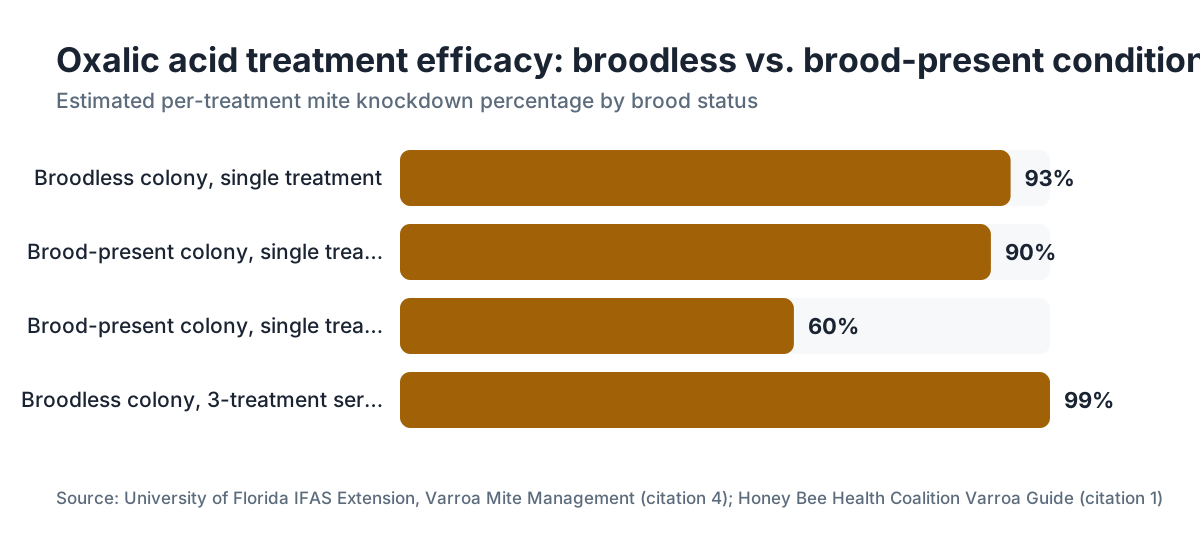
A 3-treatment series over 14 days with brood present will drop mite loads noticeably, but it won't match the knockdown of a broodless treatment. University of Florida IFAS Extension work shows oxalic acid during brood-present periods gives lower efficacy, with some studies reporting 60 to 90% per treatment versus 90 to 95% and up during broodless conditions [4]. The range is wide because colony size, brood area, and application technique all move the number.
With heavy brood, some beekeepers force a broodless window by caging the queen for 21 to 24 days before treating. More work, but it lets you run a clean broodless protocol. The technique is documented by the Honey Bee Health Coalition and several university extensions [1][5].
For the biology behind all this, the varroa mite article covers the mite life cycle in detail.
What spacing between treatments actually breaks the mite reproductive cycle?
Five days between treatments is the most-cited interval, and it has a biological basis. After emerging from a cell, a phoretic mite (one riding on an adult bee) usually finds a new cell to enter within 4 to 7 days when brood is available [3]. Treating every 5 days keeps pressure on mites before they can re-enter cells and start another generation.
During a broodless period, that 5-day spacing is really a cleaning schedule, not a hard biological rule. Treat every 3 days or every 7 days and you'll get similar results, because there are no cells for mites to hide in. Five days is a reasonable balance between repeat coverage and not battering the colony with constant vapor and disturbance.
With brood present, tighter spacing (5 days rather than 7) is slightly better because you catch more mites in the short phoretic window after emergence. The difference is small next to the much larger gain from treating during a genuinely broodless period.
Some commercial operations and research trials have run near-daily oxalic acid vapor with no obvious harm, but the EPA label allows up to 3 applications no more than 5 days apart, per colony, per year during active honey production [2]. Read your label. In the United States it is a legal requirement.
Why does the mite cycle matter so much for timing treatments?
Varroa destructor breeds in lockstep with honey bee brood. A mated female enters a larval cell just before it caps, hides under the larval food, and starts laying eggs once the cell seals. She produces one male and up to five female offspring inside the cell over roughly 12 days [3]. The daughters mate with the male in the cell. When the adult bee emerges, the mother and her mated daughters ride out with her.
So one mite that dodges a single treatment round can hand you multiple reproductive daughters. If your mite wash reads 2% today and you sit on your hands for three brood cycles (roughly 36 to 40 days), you can easily hit 4 to 6% or higher. The mite population's doubling time in a colony with active brood runs roughly 4 to 6 weeks under typical conditions [1].
Breaking the cycle with oxalic acid takes repeated pressure during the phoretic phase, which is exactly why the treatment count matters. One treatment is harm reduction. Three well-spaced treatments during a broodless period is real cycle disruption.
Does more than 3 treatments help, or is there a point of diminishing returns?
The Api-Bioxal label caps the user at 3 applications per year during the honey production season, but does not hold vaporization to that same limit during the winter or broodless period in the U.S. [2]. Some beekeepers run 5 or 6 treatments in winter, especially in warm climates where colonies never go fully broodless and mites keep cycling into cells.
Honestly, the data on whether treatments 4 through 6 add meaningful knockdown during a genuinely broodless period is thin. With no brood, three clean treatments over 10 days should cut the mite population by well over 90% according to the best field data available [1][4]. Treatments 4 and 5 are mostly chasing the statistical tail of survivors.
With brood present, extra treatments beyond 3 do earn their keep, since each round catches a fresh cohort emerging from cells. The real question is whether you're better off with more treatments at the same timing or with inducing a broodless window and running a tight 3-treatment series.
I wouldn't run more than 5 treatments in any single series, brood or no brood. There's no credible evidence of oxalic acid resistance in varroa yet, but rotating chemistries is good practice, and the Honey Bee Health Coalition recommends using multiple modes of action across the year [1].
What infestation level should trigger oxalic acid vaporization in the first place?
The Honey Bee Health Coalition recommends treating when your mite wash (alcohol wash or sugar roll) reads 2% or higher during the brood season, which is roughly 2 mites per 100 bees [1]. In late summer (August and September across most of the U.S.), some beekeepers treat at 1%, because the colony is raising the winter bees that have to survive 5 to 6 months.
If you're not monitoring, you're guessing. A colony can climb from 1% to 5% in 4 weeks during peak brood season. Wash at least 300 bees (half a cup) for a reliable count. The alcohol wash beats the sugar roll, which tends to undercount.
A threshold gives your treatments context. Three treatments in October at 1% is a solid preventive move. Three treatments in October at 5% is an emergency, and you should follow with another mite wash 48 to 72 hours after the final treatment to confirm the knockdown.
| Mite wash result | Recommended action |
|---|---|
| Under 1% (May-July) | Monitor monthly, no treatment yet |
| 1-2% (May-July) | Plan treatment, monitor closely |
| 2%+ (any brood season) | Treat promptly, 3-treatment series |
| 1%+ (August-September) | Treat to protect winter bees |
| Any level, broodless winter | Treat with 3 vaporizations, 5 days apart |
Is oxalic acid vaporization safe for bees and honey?
Oxalic acid occurs naturally in many plants and in honey itself at low levels. It's one of the few mite treatments allowed in hives with honey supers on in some contexts, though the Api-Bioxal label tells you to check current restrictions, because they have changed across several registration cycles [2].
At the correct dose (1 gram per box, up to 50 grams total), oxalic acid vaporization has not been shown to seriously harm adult bees or brood in well-replicated trials. University of California Cooperative Extension notes that oxalic acid at label rates does not measurably raise adult bee mortality when applied correctly [5]. Overdose by vaporizing too much acid in a small space and you will stress the bees, which is why the label dose matters.
The main safety worry is the beekeeper, not the bees. Oxalic acid vapor is a serious respiratory and mucous membrane irritant. A properly fitted NIOSH-approved respirator with an acid-gas cartridge is required. Eye protection and gloves are not optional. The EPA label says so plainly [2].
Honey stored in the hive during treatment picks up a small extra amount of oxalic acid, but multiple studies find levels stay well within the ranges that occur naturally in honey [6]. The FDA and EPA have both concluded residues are not a food safety concern at label rates.
How does a standard 3-treatment winter protocol actually work step by step?
Here's a practical walkthrough for the common case: a temperate-climate colony that's broodless or nearly broodless in winter.
First, confirm brood status. Open the hive on a day above 40°F (bees stay clustered and you don't need full access). Look for capped brood. See none, and you're in a genuine broodless window. Proceed with confidence.
Second, do your mite wash before treating. You want a baseline number so you can measure whether the treatments worked. A wash above 2% in winter means the colony went into cold weather carrying a heavy load and sits at elevated risk.
Third, run your first vaporization. Follow the Api-Bioxal label exactly: 1 gram per box, no more. Seal the entrance for at least 10 minutes after treatment to hold the vapor inside. Use a quality vaporizer, not a cheap pan-type rig that burns inconsistently.
Fourth, wait 5 days and treat again. Check for brood on this visit. If you spot a small patch that showed up since last time (queens sometimes fire back up during a warm spell), note it and keep your schedule. Those mites will emerge over the next 12 days and later treatments will catch them.
Fifth, wait another 5 days and run the third treatment. You've now covered the full phoretic mite population across roughly 10 days.
Sixth, follow up with a mite wash 3 to 5 days after the final treatment. Your target is under 1%, ideally under 0.5%. Still seeing 2% or more? There was active brood you missed, or your application wasn't consistent.
To plan and track these treatment dates, tools like the ones at VarroaVault help you map treatment windows against mite cycle timing, so nothing slips between visits.
What happens if you treat with brood present and some mites survive?
Some mites always survive. Accept that going in. A treatment series aims for reduction below the economic threshold (generally 2% during brood season), not zero, with enough runway before the fall period for the colony to raise clean, healthy winter bees.
If you treat three times with heavy brood present and your post-treatment wash still shows above 2%, you have options. Extend the series with one or two more treatments and recheck. Switch to a different chemistry, like formic acid or thymol-based products, which do penetrate capped brood to some degree [1][7]. Or, if your timing and management style allow, cage the queen to force an artificial broodless period, wait 21 to 24 days for the current brood to emerge, then run a fresh 3-treatment oxalic acid series.
Resistance to oxalic acid has not been documented in varroa field populations as of the most recent published assessments, so treatment failure is almost always a timing or application problem, not a chemistry problem [8]. Check your vaporizer, check your dose, and check your brood status before you blame the acid.
What other varroa treatments work alongside or instead of oxalic acid?
Oxalic acid is one tool. The Honey Bee Health Coalition's Varroa Management Guide lays out a full toolbox: formic acid (MAQS, Formic Pro), thymol (ApiGuard, Apilife Var), amitraz (Apivar strips), and hop beta acids (HopGuard) [1]. Each has a different mode of action, different brood penetration, and a different temperature window.
Formic acid is the main alternative that penetrates capped brood, which makes it useful when you can't get a broodless window. It needs temperatures between roughly 50 and 85°F to work and can stress colonies in hot weather [7]. Apivar (amitraz strips) works continuously over 6 to 8 weeks and hits hard, but resistance has been documented in some U.S. varroa populations [8].
Many experienced beekeepers run oxalic acid in winter (broodless period) and reach for amitraz strips in late summer if counts climb above threshold. A two-chemistry approach reduces selection pressure for resistance and covers the seasonal gaps where one treatment fits worse than the other.
Equipment matters too. A consistent vaporizer makes a real difference in how reliably you hit the label dose. See our beekeeping supplies section if you're setting up for the first time or replacing aging gear.
How do you know the treatments actually worked?
The only way to know is to count mites before and after. No shortcut exists. A visual inspection tells you almost nothing about mite load; a colony can carry 5% infestation and look perfectly normal to the eye.
Run an alcohol wash (300 bees minimum) 3 to 5 days after your final treatment. At that point, any mites that survived all three treatments while exposed on bees should show up. Mites sealed in brood during the treatment series still aren't counted yet, which is one more reason the 3-to-5-day wash is a minimum, not the whole story.
If your colony had brood during the series, run a second follow-up wash about 2 weeks after the final treatment. By then the brood capped during treatment has emerged, and the mites that rode out on those bees should have been exposed. A significant jump between the first and second follow-up wash tells you there was more brood than you thought, and those cells were sheltering a lot of mites.
The Honey Bee Health Coalition's guide lays out this monitoring workflow clearly, and University of Minnesota Extension provides detailed alcohol wash protocols [1][9].
Frequently asked questions
Can you do just one oxalic acid vaporization and get good results?
During a fully broodless period, one treatment kills a large share of exposed phoretic mites, possibly 90% or more in some studies. But three treatments over 10 days clean up survivors and are the standard recommendation. One treatment with brood present leaves most of the mite population untouched in capped cells. A single treatment is rarely enough.
How long does oxalic acid vapor stay active inside the hive?
The vapor itself disperses within minutes. The crystalline residue on bees and surfaces stays active for a while, but the killing happens during and shortly after the vaporization event. That's why the Api-Bioxal label requires sealing the entrance for at least 10 minutes after treatment. There is no meaningful residual protection between treatment sessions.
Can you treat too often with oxalic acid?
The Api-Bioxal EPA label limits applications to 3 per colony during the honey production season. During the broodless winter period the label is less restrictive for vaporization, but running more than 5 or 6 treatments in a single series has no good evidence of added benefit and risks stressing the colony with repeated disturbance and vapor exposure. Three well-spaced treatments hits the sweet spot.
Does oxalic acid vaporization work in cold weather?
Yes, and winter is often ideal because colonies go broodless. The vaporizer heats the acid mechanically, so ambient temperature doesn't block vaporization the way it limits some other treatments. Bees clustered tight in winter actually help spread the vapor as they move through the cluster. Treat on a calm day above 35 to 40°F so you can open the hive briefly without wrecking the heat.
What is the difference between oxalic acid vaporization and the dribble or spray method?
The dribble method drips an oxalic acid sugar syrup directly onto bees between frames. It works during broodless periods but can harm brood if any is present, and it generally gives lower efficacy than vaporization in colonies clustered across multiple boxes. Vaporization reaches the whole hive space and is the preferred method for winter treatment, when bees can't be easily separated from the cluster.
Does oxalic acid kill varroa eggs or larvae inside the cell?
No. Oxalic acid kills mites on contact with adult bees. It doesn't penetrate capped brood cells and has no effect on mites or their offspring sealed inside. This is the fundamental limit of the chemistry, and the whole reason broodless timing and multiple treatment rounds are needed for real mite cycle disruption.
How do you create a broodless period artificially for better oxalic acid results?
Cage the queen in a hair-roller cage or similar confinement device attached to a frame. With no queen laying, the colony raises no new brood. All existing capped brood emerges within about 21 to 24 days. At that point the colony is broodless and you can run a 3-treatment oxalic acid series with the full effect of a natural broodless period. Release the queen after the final treatment.
Is oxalic acid safe to use with honey supers on the hive?
The current Api-Bioxal EPA label for vaporization does not permit use when honey supers intended for human consumption are on the hive. Always read the most current label from the EPA or your product supplier before treating. Oxalic acid occurs naturally in honey at low levels, but the label restriction keeps residues within regulatory bounds, and you are legally required to follow it.
What mite count should I aim for after completing a 3-treatment series?
Your post-treatment alcohol wash should read under 2%, ideally under 1% during the brood season. In late summer or early fall, while winter bees are being raised, aim for under 1% or even under 0.5% if you can. The Honey Bee Health Coalition sets the treatment threshold at 2% during brood season and recommends treating any time in the broodless period if counts are elevated.
Can varroa mites become resistant to oxalic acid?
As of the most recent published literature and Honey Bee Health Coalition guidance, resistance to oxalic acid in varroa field populations has not been confirmed. Oxalic acid works as a direct contact poison rather than targeting a specific receptor, which may slow resistance compared with other acaricides. Treatment failures almost always trace back to timing, application error, or brood presence, not resistance.
How much oxalic acid do you actually use per treatment?
The Api-Bioxal label specifies 1 gram of oxalic acid dihydrate per brood box (hive body), with a maximum of 50 grams total per hive per application. For a standard two-box Langstroth hive you'd use 2 grams. Don't exceed the label dose. More is not more effective, and it can harm bees.
Do you need to remove honey supers before oxalic acid vaporization?
Yes. Under current U.S. Api-Bioxal labeling for vaporization, honey supers intended for human consumption must come off before treatment. Check the most current label, because these restrictions have been updated over successive EPA registration cycles. Treat only the brood boxes during active honey flow or when supers are on.
How does a 3-treatment oxalic acid series compare to Apivar strips for mite control?
Apivar (amitraz) strips work continuously over 6 to 8 weeks and reach mites emerging from brood during that time, an advantage when you can't get a broodless window. A broodless 3-treatment oxalic acid series can match or beat Apivar in percentage knockdown in less time and leaves no chemical residue in the hive. Many beekeepers use both over a year, rotating chemistries to reduce resistance risk.
Sources
- Honey Bee Health Coalition, Varroa Management Guide (2022 edition): Recommends 3 oxalic acid vaporizations 5 days apart during broodless period; treatment threshold of 2% mite wash during brood season; 70-80% of mite population in capped brood at any time; mite population doubling time of 4-6 weeks
- U.S. EPA, Api-Bioxal pesticide product label (registration no. 92869-1): Label specifies 1 gram oxalic acid per brood box, max 50 grams per hive per application; maximum 3 applications per colony during honey production season; respiratory and eye protection required; no use with honey supers for human consumption present
- Rosenkranz P. et al., Apidologie (2010), Varroa destructor biology and life cycle: Worker brood capped for approximately 12 days; phoretic mite seeks new cell within 4-7 days when brood available; mite produces one male and up to 5 female offspring per cell
- University of Florida IFAS Extension, Varroa Mite Management for Florida Beekeepers: Oxalic acid treatments with brood present produce 60-90% per-treatment efficacy; broodless treatments achieve 90-95%+ per treatment in field studies
- University of California Agriculture and Natural Resources Cooperative Extension, Honey Bee Pest and Disease Management: Oxalic acid at label rates does not measurably increase adult bee mortality when applied correctly
- Bogdanov S. et al., Apidologie (2002), Oxalic acid residues in honey and beeswax after treatment of honeybee colonies: Oxalic acid levels in honey after vaporization treatment remain within naturally occurring ranges; FDA and regulatory bodies have not flagged residues as a food safety concern at label rates
- Honey Bee Health Coalition, Varroa Management Guide, Formic Acid section: Formic acid products (MAQS, Formic Pro) penetrate capped brood cells; effective temperature range approximately 50-85°F; can stress colonies in hot weather
- Gregorc A. and Smodiš Škerl M.I., Acta Veterinaria (2007) and Honey Bee Health Coalition updated guidance: Amitraz resistance documented in varroa field populations in U.S.; oxalic acid resistance not confirmed in field populations as of most recent assessments; treatment failures attributed to timing and application error
- University of Minnesota Extension, Varroa Mite Monitoring and Management: Alcohol wash with minimum 300 bees provides reliable mite count; alcohol wash more accurate than sugar roll which tends to undercount; post-treatment wash recommended 3-5 days after final treatment
- USDA Agricultural Research Service, Beltsville Bee Lab, Varroa resources: Background on varroa destructor biology and treatment context in U.S. honey bee management
Last updated 2026-07-09