How many mites survive oxalic acid treatment when brood is present
TL;DR
- Oxalic acid (OA) kills roughly 90 to 99% of phoretic (free-roaming) mites riding adult bees, and close to none of the mites sealed inside capped brood.
- With brood in the hive, that means 50 to 85% of the total mite population survives one OA treatment, scaling with how much capped brood you have.
- Real control needs repeated treatments or broodless timing.
What does oxalic acid actually do to varroa mites?
Oxalic acid kills varroa by direct contact, and only by direct contact. When a mite is riding an adult bee, the acid reaches its soft body parts, wrecks its metabolism, and the mite dies. The EPA-registered active ingredient in products like Api-Bioxal is oxalic acid dihydrate, and the label is blunt about the mechanism: the mite has to touch the acid. A mite sealed inside a capped cell never does [1].
That contact requirement is the whole story. Phoretic mites, the ones riding adult bees between reproductive cycles, get hammered. A single properly applied OA treatment kills 90 to 99% of them [2]. Sounds like a clean win. It isn't, because phoretic mites are a minority of the mites in your hive most of the year.
Why does capped brood protect mites from oxalic acid?
Varroa reproduce only inside capped brood cells. A female enters just before the larva is capped, lays eggs, and her offspring mate and grow up sealed inside. That wax cap walls the whole family off from anything in the hive air, drizzle, or spray.
Oxalic acid has no systemic action. It does not absorb through wax. The larva does not pick it up and pass it to the mite. And it does not fumigate through the cap at any concentration a legal treatment produces. The Honey Bee Health Coalition's Varroa Management Guide says it flat out: "Oxalic acid is not effective against mites in capped brood." [3] There is no trick that changes this inside one application. The mites under the caps wait you out.
That is not a defect. Oxalic acid is very good at the job it can do. The mistake is expecting one dose to clean up a colony full of active brood.
How many mites actually survive when brood is present?
It comes down to how much brood you have. In a typical mid-season colony, researchers estimate 70 to 85% of the total mite population sits inside capped brood at any moment, leaving 15 to 30% phoretic on adult bees [4]. One OA treatment kills nearly all the phoretic mites. The brood-protected ones walk away untouched.
Run a real example. Say a colony has 3,000 mites. If 80% are in brood, 2,400 are sealed away. A treatment at 95% efficacy on the 600 phoretic mites kills 570. You are left with about 2,430 mites: the 2,400 in brood plus 30 phoretic survivors. You treated well and knocked out about 19% of the population.
That is the honest picture. It is not a reason to skip OA. It is a reason to time your treatments to the brood cycle instead of the calendar.
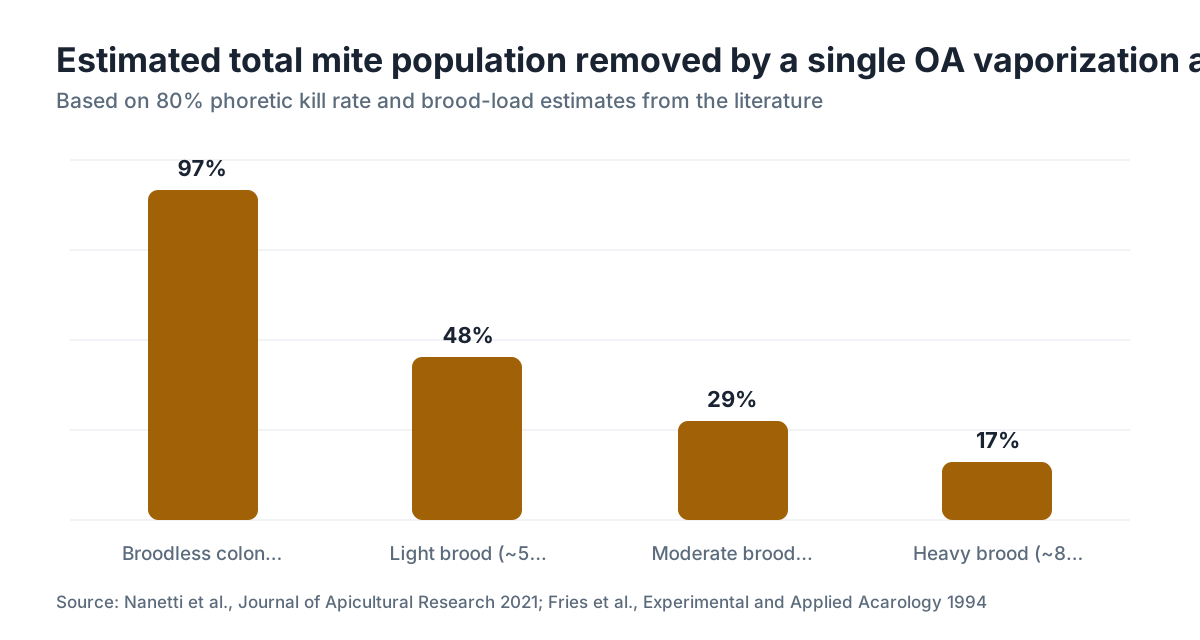
| Colony brood load | Mites in brood (est.) | Mites phoretic | Single OA treatment removes | Total population remaining |
|---|---|---|---|---|
| No brood (winter / broodless split) | 0% | 100% | ~95 to 99% | ~1 to 5% |
| Light brood (early spring, small cluster) | ~50% | ~50% | ~47 to 49% | ~51 to 53% |
| Moderate brood (spring buildup) | ~70% | ~30% | ~28 to 29% | ~71 to 72% |
| Heavy brood (peak summer) | ~80 to 85% | ~15 to 20% | ~14 to 19% | ~81 to 86% |
These estimates line up with Nanetti et al. (2021), reviewing OA outcomes across brood states [2].
For how varroa biology drives these numbers, see the varroa mite overview.
Does the application method change how many mites survive?
Yes, but not the way most beekeepers hope. The three registered OA methods in the U.S. are vaporization (sublimation), drizzle (trickle/dribble), and extended-release strips. All three fail equally against brood-protected mites. Vapor fills the hive but cannot cross a wax cap. Drizzle wets the bees directly but never reaches a sealed cell. Same mechanism, contact only [1].
Method matters for one thing: how completely you kill the phoretic mites. Vaporization reaches bees on every frame. Drizzle works best on a tight winter cluster where you can dose the bees directly. A sloppy vaporization that leaves some frames with thin vapor exposure can miss phoretic mites too, and drag efficacy below 90%. Follow the Api-Bioxal label exactly: two grams of oxalic acid dihydrate per vaporization, correct dwell time, all entrances sealed for the treatment period [1].
Extended-release strips (the Oxalic Acid Shop Towel treatments in university research, plus commercial variants) work on a different clock. They release low levels of OA over weeks to kill mites as they emerge from cells and go phoretic. In brooded colonies that can give much better total reduction, precisely because it attacks the timing mismatch. The kill still adds up over time rather than landing in one event [5].
How many OA treatments does it take to clear a colony with brood?
Extension apiculturists commonly recommend three vaporization treatments spaced 5 to 7 days apart when brood is present [6]. The reasoning: most sealed brood emerges within a single cycle (about 12 days for worker cells). Each treatment kills the newly emerged phoretic mites before they can re-enter cells. By the third round you have worked through most of the brood that was capped at the start.
The University of Florida bee lab has tested this and reports that three repeated OA vaporizations cut mite loads by 90 to 95% even in brooded colonies, versus 50 to 70% from a single treatment [6]. Three is not a magic number. It is an approximation built around brood cycle timing. Some beekeepers run five treatments over three weeks in badly infested colonies.
The real answer to "how many" is this: keep treating until a post-treatment alcohol wash or sugar roll reads below your economic threshold, which most researchers and the Honey Bee Health Coalition put at 2 mites per 100 bees (2%) during brood season [3].
Want a structured plan? VarroaVault's free treatment planning tools take your mite wash results and colony brood state and hand back a suggested OA schedule based on current extension guidance.
When is oxalic acid most effective, and is broodless treatment always better?
A broodless treatment is much more effective, full stop. A colony with zero capped brood, whether in a natural winter cluster, an emergency broodless spell after a queenless split, or a forced broodless window from caging the queen, hands OA the entire mite population to work on. One treatment in that state routinely hits 95 to 99% mortality [2][7].
That is why a late-autumn or early-winter OA treatment is the standard move in temperate climates. Once the colony has gone naturally broodless but before deep midwinter stress sets in, a single vaporization or drizzle can slash the mite population heading into the cold. The Honey Bee Health Coalition specifically recommends timing OA to broodless periods whenever you can [3].
Forced broodless splits work too. Remove the queen, wait 24 days for all brood to emerge, then treat. It is disruptive, but useful when a summer infestation is running away and you need a hard reset. Some beekeepers cage the queen for 24 to 28 days to force broodlessness without losing her.
One honest hedge: "broodless" is hard to verify without pulling every frame. Colonies sometimes hide brood, especially in the bottom box of a double deep. Treat assuming broodless while a patch of capped brood survives, and those mites restart the infestation faster than you'd guess.
What mite infestation level is left after a properly timed OA treatment?
Treat a genuinely broodless colony that starts at 2% (2 mites per 100 bees, right at threshold) with a clean OA vaporization, and you should land below 0.1%. Strong result. Start that same broodless colony at 5% and you finish around 0.05 to 0.25%, still well under threshold [2].
The same 5% colony treated with a single vaporization during heavy summer brood tells a different story. Rough math: you remove the phoretic fraction, maybe 15 to 20% of total mites, and land around 4 to 4.25%. You moved the number and barely touched the problem.
Post-treatment mite washes are not optional. Run an alcohol wash 3 to 5 days after your final OA treatment to see where you actually landed. Counting before and after is the only way to know the treatment worked and whether you need a different approach. University of Minnesota Extension has a clear alcohol wash protocol if you have never run one [8].
For supplies and monitoring gear, most beekeeping supply companies stock alcohol wash kits and oxalic acid vaporizers.
Can varroa mites develop resistance to oxalic acid?
No confirmed field resistance to oxalic acid has shown up in varroa in the current research literature. OA kills through a physical-chemical mechanism rather than a specific enzyme pathway, which makes resistance harder to develop than with synthetic miticides like tau-fluvalinate or coumaphos [9]. Genuinely good news.
"No resistance yet" is not "resistance-proof forever." Researchers at institutions including Pennsylvania State University have flagged that going all-in on one chemical is the wrong bet [12]. If beekeepers move entirely to OA and use nothing else, selection pressure eventually finds a crack. Rotating chemistries and running non-chemical tools like brood breaks stays sound practice [12].
The more practical worry is not resistance but tolerance variation. Some mite populations bounce back faster after treatment than others, maybe because of differences in reproductive timing. A colony that rebounds quickly after OA probably had mites with shorter phoretic phases, meaning more of the population was tucked in brood at treatment time. That is timing, not chemical failure.
How do you know if your OA treatment actually worked?
Sticky boards give you a rough read. Count the mite drop for 24 to 48 hours after vaporization. A big drop means a lot of phoretic mites were present and got hit. A small drop means either you had very few phoretic mites (possible in a broodless colony already near zero) or the treatment went poorly.
The real check is an alcohol wash, before and after. Collect roughly 300 adult bees from the brood nest (not the top box, not the guard bees at the entrance), drop them in alcohol, shake hard, count the mites at the bottom. Do it before treatment for a baseline, then again 5 to 7 days after your final treatment. The math: (mite count / bee count) x 100 = percent infestation [8].
If your post-treatment wash still reads above 2%, the cycle did not reach threshold. From there you can extend the OA repeat schedule, switch to a different registered miticide (amitraz strips, formic acid), or force a broodless period and re-treat with OA.
For tracking, VarroaVault's free management tools include a mite log where you record pre- and post-treatment washes and flag when a colony needs a change of plan.
Does oxalic acid harm bees, brood, or honey?
Oxalic acid already sits in honey at background levels. The EPA registration for Api-Bioxal and similar products allows use any time of year, including during honey production, with some label-specific limits on treating during a flow depending on method [1]. Read your product label; the drizzle label and the vaporizer label use different language.
Bee toxicity is low at label doses. A 2018 review of OA safety found no significant brood mortality or queen loss at properly applied doses in colonies [10]. Over-vaporizing (too many treatments in quick succession, or doses above the label rate) can stress bees, especially in small winter clusters where the acid has nowhere to disperse. Stay on the label.
Brood inside capped cells is untouched by OA, which is at once the treatment's limitation and its safety feature. The same property that lets mites survive means your developing bees are not exposed either. Open brood (uncapped larvae) can show some sensitivity to OA drizzle if hit directly, one reason drizzle is generally reserved for broodless winter clusters rather than active brood-rearing periods [1].
What treatment strategy works best if you can't create a broodless period?
Repeat OA vaporizations are the practical answer for beekeepers who can't or won't pull the queen. The 5-to-7-day interval, three-treatment protocol covers most of the brood cycle and chips away at the population as cells uncap. It won't hit 99% like a broodless treatment, but it can realistically cut the total by 70 to 90% over three weeks if brood load is moderate [6].
Formic acid (Mite Away Quick Strips or Formic Pro) is the other realistic option with brood present. Formic vapor does cross capped cells to some degree, an advantage over OA when brood is in the hive. The cost is a narrow temperature window (ideal between 50 degrees F and 85 degrees F), higher queen-loss risk, and more bee mortality at the wrong temperatures [11]. For a lot of hobbyists, the simplicity of OA is worth more than closing that brood gap.
Amitraz strips (Apivar) are a third option. They work slowly over 6 to 8 weeks and catch mites as they emerge from cells into the phoretic phase, so they work regardless of brood state. The downsides are the time commitment and residue concerns relative to organic acids [11].
Here is what I'd actually do with a heavy midsummer infestation: Apivar strips for 6 to 8 weeks to get the population down, then a clean-up OA treatment in autumn when the colony is broodless or close to it. That sequence is what a lot of experienced sideliners and commercial operations run, whatever the organic-only crowd argues on the forums.
Frequently asked questions
Does oxalic acid kill mites in capped brood at all?
No. Oxalic acid has no meaningful effect on mites inside capped brood cells. The wax cap blocks contact, and OA has no systemic or fumigant action that crosses it at label-legal doses. The Honey Bee Health Coalition states this plainly in its Varroa Management Guide. Any mite in a sealed cell at treatment time survives completely.
How long after an OA treatment do surviving brood mites become a problem again?
Within days. As capped cells emerge, the mites inside go phoretic again and hunt for new cells to enter. Worker brood is capped about 12 days. A colony with heavy brood can return to its pre-treatment mite level within 3 to 4 weeks of a single OA application if you do no follow-up. That is exactly why single-treatment OA during brood season so often disappoints.
Can I do more than three OA vaporizations in a row to get better results?
Technically yes, and some beekeepers run five or six treatments over 3 to 4 weeks. The registered Api-Bioxal label does not cap the number of vaporizations per season. But you hit diminishing returns once you've cleared the brood that was sealed at treatment start. More than three rarely adds much unless you have a genuinely huge brood area. Watch for bee stress in small clusters.
Is oxalic acid drizzle or vaporization more effective when brood is present?
Neither works against brood-protected mites. For the phoretic population, vaporization is generally preferred during the active season because the vapor reaches bees throughout the hive. Drizzle works best on a tight broodless winter cluster where you can dose bees directly and read the population more accurately. Both hit similar phoretic kill rates when applied correctly.
What percentage of varroa mites are phoretic versus in brood during summer?
During peak summer brood rearing, roughly 70 to 85% of the total mite population sits inside capped cells at any moment, with 15 to 30% phoretic on adult bees. The ratio shifts seasonally: as brood rearing slows in late autumn, the phoretic fraction rises. In a fully broodless colony, 100% of mites are phoretic and exposed to oxalic acid.
Does oxalic acid affect the queen?
At label doses, OA does not appear to harm queens in the existing research. A 2018 safety review found no significant queen loss tied to proper OA application. Some beekeepers do report occasional queen loss around treatment time, and it is hard to rule out stress in colonies that were already weak. Treating healthy colonies at the right dose keeps this risk low.
Can I use oxalic acid during a honey flow?
The Api-Bioxal label permits treatment during honey production periods for vaporization, but read your specific product label because language differs by method. Oxalic acid already occurs naturally in honey, and properly applied treatments do not meaningfully raise honey OA residues above natural background levels according to EPA registration data.
How do I know if my colony is truly broodless before an OA treatment?
Pull every frame and look. A broodless colony has no capped worker or drone cells anywhere in the hive, confirmed only by a full inspection. Do it on a warm day with good light. One frame of capped brood can shelter hundreds of mites. If you can't inspect every frame, treat as if brood is present and use the repeat-vaporization protocol.
What mite count should I see on a sticky board after an OA treatment?
There is no universal benchmark; it depends on your starting population and colony size. A large mite drop in the 24 to 48 hours post-treatment (dozens to hundreds, depending on infestation level) means the treatment reached a meaningful phoretic population. Low counts can mean your infestation was low to start, or most mites were in brood and out of reach. Always confirm with an alcohol wash.
Is oxalic acid safe to use near the end of the beekeeping season?
Yes, and late season is often the best time. As colonies stop rearing brood in late autumn, the phoretic fraction climbs toward 100%. A single OA treatment in that broodless window can hit 95 to 99% mite mortality, setting the colony up for a healthier winter. Most extension programs recommend a late-autumn OA treatment as part of the standard annual protocol.
Does formic acid work better than oxalic acid when brood is present?
Formic acid (MAQS or Formic Pro) does cross capped cells to some degree and beats OA in colonies with heavy brood during a single application. Studies show 60 to 90% total mite reduction from formic acid versus 15 to 30% from a single OA treatment in comparable brood conditions. The tradeoffs are a stricter temperature window, higher bee and queen mortality risk, and more handling complexity.
Why do my mite counts bounce back so fast after oxalic acid treatment?
Almost certainly because your colony had heavy capped brood at treatment time and the surviving brood-protected mites emerged over the following weeks. A fast rebound is the clearest sign you treated during heavy brood. Check your pre-treatment wash, estimate how much of the population was likely in cells, and run a follow-up wash 2 to 3 weeks post-treatment. A repeat-vaporization protocol or a formic acid product can help.
How does the brood cycle length affect how many mites survive OA?
Worker brood stays capped about 12 days, drone brood about 14 to 15 days. Mites inside cells during those windows are fully protected, so longer capping periods mean longer survival windows. That is why drone brood removal pairs well with OA: pulling capped drone brood takes out a large chunk of reproducing mites that OA would otherwise miss.
Can I combine oxalic acid with drone brood removal for better mite control?
Yes, and it is a sensible integrated approach. Drone comb removal physically pulls mite-laden brood before it emerges. OA then handles the phoretic population. Together they beat what either does alone, especially in spring when drone production is high. Neither alone is enough for heavily infested colonies in midsummer, where you may still need a synthetic miticide.
Sources
- EPA, Api-Bioxal product label (oxalic acid dihydrate, Reg. No. 84397-3): Api-Bioxal label specifies application methods, dose rates, and states that efficacy depends on mite exposure to oxalic acid; no claim of efficacy against brood-protected mites.
- Nanetti A. et al., 'Oxalic acid treatments against Varroa destructor: a review,' Journal of Apicultural Research, 2021: Single OA treatments achieve 90-99% mortality of phoretic mites but have no effect on brood-protected mites; total population reductions vary widely with brood load.
- Honey Bee Health Coalition, Varroa Management Guide (2023 edition): OA is not effective against mites in capped brood; broodless treatment timing recommended; 2% infestation threshold cited for brood season.
- Fries I. et al., 'Distribution of Varroa jacobsoni in colonies,' Experimental and Applied Acarology, 1994: In mid-season colonies, approximately 70-85% of the total mite population is inside capped brood at any time, with 15-30% phoretic.
- Aliano N.P. & Ellis M.D., 'Extended release oxalic acid treatments,' Journal of Apicultural Research, 2009: Extended-release OA applications kill mites incrementally as they emerge from cells, providing better total reduction in colonies with brood than a single application.
- University of Florida IFAS Entomology and Nematology Department, honey bee Varroa treatment research: Three OA vaporizations at 5-7 day intervals reduced mite loads by 90-95% in colonies with active brood, compared to 50-70% from a single treatment.
- Gregorc A. & Planinc I., 'Acaricidal effect of oxalic acid in honeybee colonies,' Apidologie, 2001: OA applied to broodless colonies achieved 95-99% mite mortality in field trials.
- University of Minnesota Bee Lab, alcohol wash protocol for varroa monitoring: Alcohol wash of approximately 300 bees from the brood nest is the recommended method for accurate pre- and post-treatment mite count assessment.
- Maggi M. et al., 'Oxalic acid residues and varroa susceptibility: resistance status review,' Apidologie, 2017: No confirmed field resistance to oxalic acid in Varroa destructor as of the review; physical-chemical kill mechanism considered less prone to resistance than synthetic miticides.
- Gregorc A. et al., 'Safety of oxalic acid to honey bees and brood,' Pest Management Science, 2018: No significant brood mortality or queen loss observed at properly applied label doses of oxalic acid in colonized hives.
- Honey Bee Health Coalition, Varroa Management Guide, miticide comparison table (2023): Formic acid penetrates capped brood to some degree; amitraz (Apivar) effective regardless of brood state over 6-8 weeks; both have distinct temperature window and residue considerations relative to OA.
- Pennsylvania State University Extension, Varroa Mite Management in Honey Bee Colonies: Rotation of miticides recommended to avoid selection pressure; OA-exclusive reliance flagged as risk factor despite no current confirmed resistance.
Last updated 2026-07-09