Oxalic acid vapor treatment for varroa mites: the complete guide
TL;DR
- Oxalic acid vaporization (OAV) kills 90-99% of phoretic varroa mites by sublimating 1 gram of oxalic acid dihydrate per brood box.
- It hits mites riding adult bees but not mites sealed in brood cells, so timing and repeat treatments decide your outcome.
- It's EPA-registered, leaves honey within its natural residue range at label doses, and it's the most practical treatment for colonies with open brood.
What is oxalic acid vaporization and how does it kill varroa mites?
Oxalic acid is a natural organic acid found in rhubarb, spinach, and beeswax itself. Heat the dihydrate crystals to around 157°C (315°F) and they sublimate, going straight from solid to gas and filling the hive cavity with fine acidic vapor. That vapor settles on every surface inside the box, including adult bees and the mites riding them.
The mites die because oxalic acid damages their cuticle and wrecks their physiology. Bees shrug it off. The mechanism research is still thin in places, but the field result is steady: efficacy against phoretic (free-riding) mites runs 90-99% per treatment in peer-reviewed trials [1]. Phoretic is the word that matters. Mites sealed under a wax cap sit protected, and the vapor never touches them.
This one fact drives every protocol choice you'll make. During peak brood season, 70-80% of a colony's mites can be hidden in capped cells at any given moment [7]. One vaporization knocks out the riders, the hidden mites emerge a few days later, and the count climbs right back. That's the whole reason timing and repeat treatments exist.
For how the mite's life cycle splits between phoretic and reproductive phases, read the varroa mite overview alongside this guide.
Is oxalic acid vaporization legal and EPA-registered?
Yes. Oxalic acid vaporization is registered with the U.S. Environmental Protection Agency. The primary label belongs to Api-Bioxal (EPA Reg. No. 84997-1), made by Véto-pharma [3][12]. That registration covers vaporization (sublimation), dribble, and spray methods, and it applies to both brood-present and broodless colonies.
Before Api-Bioxal, beekeepers used hardware-store oxalic acid and unlabeled vaporizers. That was off-label use. The Api-Bioxal registration ended that gray area. Using any pesticide in a way inconsistent with its label is a federal violation under FIFRA, the Federal Insecticide, Fungicide, and Rodenticide Act [9], so the label carries real weight.
The Api-Bioxal label states: "Do not apply more than once per week for a maximum of three treatments per application period." That sentence sets the outer wall of any OAV protocol in the U.S. [3]. States can layer on their own rules, and a few have run separate registration pathways, so check your state department of agriculture if you're unsure.
Many European countries register the same chemistry under other brand names. Canada's Pest Management Regulatory Agency has registered oxalic acid products too. The molecule is identical everywhere. The labels set the legal lines.
What equipment do you need to vaporize oxalic acid safely?
Three things: a vaporizer, protective gear, and the registered product.
Vaporizers come in two broad types. Electric units running off a car battery or lithium pack are what most beekeepers use. They hold a measured dose of crystals in a metal pan, heat it past sublimation temperature, and you slide the wand through a sealed entrance. The Varrox Eddy, ProVap 110, and several Chinese-made units cover most of the U.S. market. Battery-powered cordless models have gotten good. I'd buy one over a corded unit today if I ran more than five hives. Propane-torch vaporizers exist, but they're hard to hold at temperature and they've started hive fires when misused. Skip them.
Protective gear is not optional. Oxalic acid vapor eats at mucous membranes and the respiratory tract. The NIOSH-appropriate setup is a full-face respirator with combination organic vapor plus P100 cartridges, or at minimum a half-face respirator with the same cartridges plus chemical splash goggles [4]. A dust mask or an N95 does nothing against the vapor. Add nitrile gloves at minimum (butyl rubber is better) and long sleeves. Work upwind. Never treat in a closed garage or shed.
The product is Api-Bioxal or an equivalent registered formulation. Vaporization needs the pure dihydrate crystals. The powdered dribble formulation is a different product and should not go in a vaporizer.
For a wider supply checklist, the beekeeping supply companies roundup covers where to source gear at different price points.
What is the correct dose of oxalic acid per treatment?
The Api-Bioxal label calls for 1 gram of oxalic acid dihydrate per brood box (deep or medium), capped at 2.5 grams total no matter the hive configuration [3]. That ceiling matters. A double-deep gets 2 grams. A triple-deep still gets 2.5 grams, not 3. Overdosing stresses or kills bees and doesn't improve mite kill.
Most experienced beekeepers just run the label dose and never deviate. The 1 gram figure is well-supported by the research behind the registration. Some hobbyists eyeball it with a small spoon. A digital scale accurate to 0.1 gram is cheap and kills the guesswork.
The vapor needs 10 minutes of contact time inside a sealed hive. Plug the entrance with foam or a board for those 10 minutes, then open it and let the bees fan out the residue. The Honey Bee Health Coalition's Varroa management guide says the 10-minute dwell time matters for efficacy and shouldn't be cut short [2].
Honey supers change the math. The Api-Bioxal label allows treatment with supers present but says that honey isn't for human consumption if the supers were on during treatment. In practice, most beekeepers treat during brood rearing before the main flow, or after harvest, so this rarely bites. Read your label before treating with supers on anyway.
When is the best time to use OAV: broodless vs. brood-present colonies?
This is where the strategy lives.
A broodless colony is the easiest and most effective OAV target. No sealed brood means 100% of the mites are phoretic, riding adult bees. One or two treatments a week apart can drop mite loads to near zero. A winter cluster in a cold climate, a queen you've caged on purpose, or a natural swarm break all open this window. Winter treatment of a naturally broodless cluster is probably the most common OAV use in northern U.S. beekeeping right now, and it works.
A colony with open and capped brood is harder. The vapor kills the phoretic mites on day one, but the reproductive mites in cells keep emerging over the next 12-21 days. Repeat treatments every 5-7 days, inside the label's weekly maximum, intercept those mites before they breed again. Three treatments over three weeks in a brood-present colony can cut mite loads by 90% or more, though brood density swings the result [1]. The Honey Bee Health Coalition recommends exactly this repeated-dose approach for colonies with brood [2].
Fall is the other high-value window. Treating in late summer or early fall, while brood is winding down but the colony is still raising winter bees, is one of the highest-payoff moves you can make. Winter bees hammered by mites early in life have compromised fat bodies and shorter lives. Getting ahead of that with OAV in August or September beats almost any other management decision I'd make.
Spring treatments have their place too, but don't wait for a crisis. Mite populations roughly double each month during brood season [8], so a 2% infestation in May can be an emergency by July.
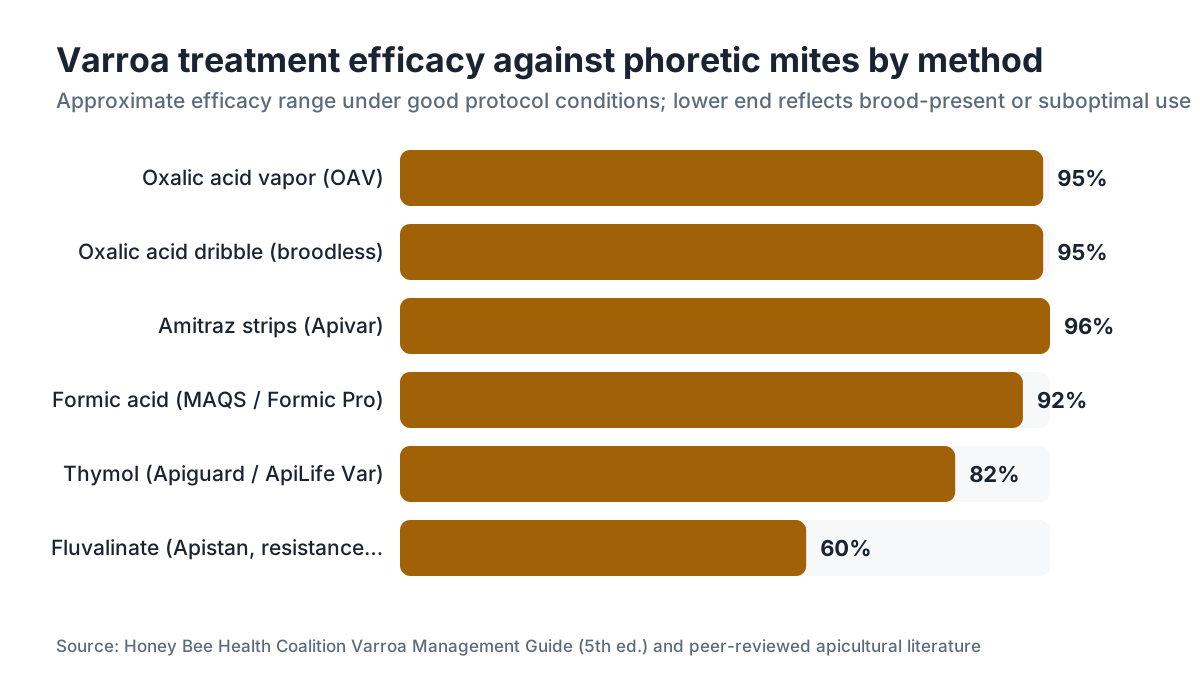
How does OAV compare to other varroa treatments?
| Treatment | Active Ingredient | Efficacy (phoretic) | Works in brood? | Honey supers on? | Temperature limits | Residues |
|---|---|---|---|---|---|---|
| Oxalic acid vapor (OAV) | Oxalic acid | 90-99% [1] | No (repeat needed) | Label restrictions | None significant | Very low |
| Oxalic acid dribble | Oxalic acid | 90-99% (broodless only) | No (one-time use) | No | None | Very low |
| Formic acid (MAQS, Formic Pro) | Formic acid | 90-95% | Yes (penetrates caps) | Yes (check label) | 10-29°C | Low |
| Amitraz strips (Apivar) | Amitraz | 93-99% | Yes (contact) | No | Above 10°C | Moderate (wax) |
| Thymol (ApiLife Var, Apiguard) | Thymol | 74-90% | Partial | No | 15-30°C | Low |
| Synthetic pyrethroids (Apistan, CheckMite+) | Fluvalinate, Coumaphos | 50-99% (resistance-dependent) | Partial | No | Variable | High (wax) |
OAV's edge over the dribble method is that it works in colonies with brood, given repeated treatments. Its edge over formic acid is temperature flexibility and easy winter application. Its edge over amitraz is the residue picture: oxalic acid breaks down fast, doesn't build up in wax, and already sits naturally in honey and beeswax.
The honest downside against amitraz strips is labor. Strips go in and work for 6-8 weeks with almost no attention. OAV makes you show up every 5-7 days for a multi-week course if brood is present. For a hobbyist with two hives, fine. For a sideliner with 60 hives, strips during brood season may win despite the residue tradeoff.
VarroaVault's free treatment planning tools help you map a timing protocol from your colony count, local brood cycle, and mite counts. That gets useful fast once you're juggling several hives at once.
How often can you apply OAV and how many treatments are allowed per year?
The Api-Bioxal label says no more than once per week, capped at three treatments per treatment period [3]. It does not spell out how many treatment periods you get per year, which has fueled some debate over running multiple three-treatment courses per season.
Most extension entomologists read it this way: you can treat multiple times per season as long as each course is discrete and you stay inside the weekly frequency. So a three-treatment course in April, another in August, and a broodless winter treatment is a defensible annual plan. Ask your state department of agriculture for their reading if you're unsure, because label language is legally binding and their interpretation is the one that gets enforced.
Oxalic acid does not breed resistance. No varroa population anywhere has been documented evolving resistance to oxalic acid in the current literature [5]. That's one of the genuinely reassuring facts here. Mites do evolve resistance to synthetic acaricides, and fluvalinate resistance (Apistan) is widespread. Oxalic acid works by physically damaging the cuticle, so resistance is extremely unlikely to develop by comparison.
That's no license to lean on OAV alone. Good varroa management rotates treatment classes based on what your mite counts are telling you.
What does OAV do to honey quality and is it safe for bees?
At label doses, oxalic acid leaves honey within the range already present in untreated honey. A 2015 study in the Journal of Apicultural Research found oxalic acid residues in honey after OAV treatment were not significantly different from untreated control hives [6]. Oxalic acid occurs naturally in honey at roughly 8-108 mg/kg depending on floral source, and treated hives stayed inside that band.
The EPA leaned on this residue data to approve the label. That's why Api-Bioxal carries no pre-harvest interval for most uses, unlike many other treatments.
Bee safety at label doses is well established. Adult bees show no meaningful mortality at 1 gram per brood box. Queens can suffer from overdosing or very long exposure, which is one more reason to hold the line on the label. Some beekeepers report a little extra winter cluster restlessness after treatment, but no controlled study I know of has separated that from normal winter variation. Open brood can be damaged if the vaporizer spits droplets instead of true vapor, which is a hardware fault, not a chemistry one. Confirm your vaporizer actually reaches sublimation temperature before you insert it.
The Honey Bee Health Coalition, in its Varroa Management Guide (5th edition), calls oxalic acid "among the safest treatments available to beekeepers" when used as directed [2].
What are the safety risks to the beekeeper and how do you protect yourself?
This is the part beginners skip, and it's the section to read closest.
Oxalic acid vapor is a serious respiratory hazard. It irritates the throat and lungs on contact, and repeated exposure without protection risks lasting damage to mucous membranes. The NIOSH Pocket Guide to Chemical Hazards lists the recommended exposure limit for oxalic acid at 1 mg/m³ as an 8-hour time-weighted average [4]. A single vaporization runs concentrations far above that inside the hive and possibly in your breathing zone.
Gear that actually protects you: a half-face or full-face respirator with combination OV/P100 cartridges, chemical splash goggles if you run a half-face unit, nitrile or butyl rubber gloves, and long sleeves. Don't treat indoors without forced-air ventilation. Don't treat on windy days that push vapor at your face. If you can smell the acid, your protection has failed.
Store the crystals cool and dry, away from children and pets. The dihydrate crystals are corrosive. Rinse any skin contact with water right away. For eye contact, flush with water for 15 minutes and get medical attention.
Electrical safety counts with battery units. Don't set a hot vaporizer down in dry grass. Don't leave a heating element unattended against hive wood. Obvious, and yet vaporizer-related hive fires keep happening.
The EPA-registered Api-Bioxal label carries the full safety and first-aid section. Read the actual label, not a summary of it, before your first treatment [3].
How do you know if OAV is working? Monitoring mite counts after treatment
A treatment without a follow-up count is a guess. You need numbers.
The alcohol wash is the most accurate way to measure mite loads before and after treatment. Scoop a half-cup (about 300 bees) from the brood nest, wash in isopropyl alcohol, and count. A count above 2 mites per 100 bees (2%) during brood season is the action threshold the Honey Bee Health Coalition uses [2][10], though some extension programs run 3% for fall.
Sticky boards show mite drop after treatment, which is satisfying but harder to read quantitatively. A sharp jump in natural mite fall over 24-48 hours after OAV confirms the treatment is doing something. A low drop in a colony you know is loaded might mean poor contact time, a leaky seal, or a vaporizer that never fully sublimated the dose.
Time your post-treatment wash at least 24 hours after the last treatment, ideally 3-5 days out, once dying mites have had time to fall. If your load is still above threshold after a full protocol, you decide: extend the OAV course (if the label allows), switch treatment class, or hunt for what's structurally wrong with your setup.
No treatment is magic. Mite counts are the only honest feedback you get.
What are the most common mistakes beekeepers make with OAV?
Treating without measuring first. The biggest one. Vaporizing on a calendar regardless of mite load wastes product and time, and it can hide a reinfestation from a neighboring apiary.
A loose seal. If the entrance leaks, vapor escapes instead of hitting bees. Stuff the entrance with foam and block other gaps for the full 10-minute dwell. Screened bottom boards are a real leak here: slide in the inspection board to close the screen or use a solid bottom. Oregon State Extension notes screened bottoms should be closed during treatment to cut vapor loss [11]. A lot of product goes straight out the floor otherwise.
A vaporizer that never hits temperature. Cheap units can deposit liquid oxalic droplets instead of true vapor. Droplets work worse and are more likely to burn open brood. Buy from a reputable supplier with a track record, or check reviews from beekeeping associations.
Treating once and calling it done during brood season. One treatment in a colony with capped brood drops your phoretic load but not your total infestation. Skip the follow-up and the mites from emerging brood repopulate fast. Three treatments a week apart is the protocol for a reason.
Skimping on PPE because "it's only two hives." One breath of concentrated vapor teaches this lesson. The dose makes the poison, and two hive-treatments can still put a real concentration in your face.
And a few beekeepers have burned hives by setting hot vaporizers in dry grass or leaning them on hive wood. The wand gets extremely hot. Respect it.
Can OAV work as part of an integrated varroa management plan?
Yes, and in most serious hobbyist programs it already does. The Honey Bee Health Coalition's Varroa Management Guide, probably the most cited practical resource in U.S. beekeeping, frames integrated varroa management as using several tools based on mite counts, season, and colony state rather than leaning on one product [2].
A workable annual cycle for a northern U.S. beekeeper: monitor in April and treat with OAV if needed before the honey flow (low residue risk, brood increasing). Monitor again in July or August and choose. High counts and dense brood? Apivar strips give reliable knockdown with few visits. Moderate counts? A three-week OAV course does the job. In late September or October, a final OAV course as broodlessness sets in protects the winter bees. Three distinct windows, and OAV fits two of them.
The point is that no single treatment class should be your only answer. Pairing OAV's residue safety and resistance-free mechanism with other tools when the situation calls for them beats loyalty to one method.
If you want a structured way to build that plan across your colonies, VarroaVault's free protocol tool logs mite counts, schedules treatments, and tracks colony health across seasons. It earns its keep once you're past a handful of hives.
Frequently asked questions
Can I use oxalic acid vaporization when honey supers are on?
The Api-Bioxal label allows treatment with honey supers present, but it says the honey in those supers is not for human consumption if they were on the hive during treatment. Most beekeepers treat before the flow or after harvest to sidestep this. If you do treat with supers on, extract those supers only after the full treatment period, or just don't sell that honey.
How long after OAV treatment can I harvest honey?
The Api-Bioxal label sets no pre-harvest interval for vaporization under normal conditions (supers off during treatment). Oxalic acid residues after a label-dose treatment stay within the natural background range already found in honey. If your supers were on during treatment, that honey carries the label restriction. Read the current label for your specific product, since language can change between revisions.
Does oxalic acid vapor work in winter on a clustered colony?
Yes, and it's one of the best uses for OAV. A naturally broodless winter cluster means every mite is phoretic, so efficacy hits its theoretical maximum. The vapor moves through the cluster even when bees are tight. Treat on a calm day above about 40°F (4°C) so bees aren't chilled during the 10-minute sealed dwell. One or two treatments a week apart usually drops winter mite loads sharply.
How many grams of oxalic acid do I use for a double-deep hive?
Two grams total, one gram per brood box, per the Api-Bioxal label. The label caps total dose at 2.5 grams regardless of hive size, so a triple-deep still gets 2.5 grams. Overdosing doesn't improve mite kill but does stress bees and can harm queens. Use a digital scale accurate to 0.1 gram instead of measuring by eye.
Can varroa mites develop resistance to oxalic acid?
No resistance to oxalic acid has been documented in varroa populations anywhere in the current literature. The mechanism, physical damage to the mite's cuticle from acidic contact, makes resistance far harder to develop than with synthetic chemicals that hit specific molecular receptors. Poor OAV results are almost always a protocol problem, not resistance: wrong dose, bad seal, or a single treatment during high-brood season.
What respirator do I need for oxalic acid vaporization?
A half-face or full-face respirator fitted with combination OV/P100 cartridges (organic vapor plus particulate). A standard N95 dust mask does not protect against oxalic acid vapor. With a half-face unit, add chemical splash goggles. NIOSH recommends a 1 mg/m³ exposure limit for oxalic acid, and a hive treatment can easily push past that in your breathing zone without protection.
How often should I treat with OAV if my colony has brood?
Three treatments 5-7 days apart is the standard protocol for a brood-present colony. The first kills phoretic mites. Mites sealed in brood cells emerge over the next 12-21 days. The following weekly treatments catch them before they reproduce. The Api-Bioxal label explicitly permits this weekly schedule with a maximum of three treatments per treatment period.
Is OAV safe for queen-right colonies?
Yes, at label doses. Queens can be harmed by overdosing or by repeated high-concentration exposure beyond label guidance. Some beekeepers report queens seem briefly stressed after treatment, but peer-reviewed data confirming consistent queen mortality at label doses is lacking. Stick to the label dose, don't treat more often than the label allows, and make sure your vaporizer makes true vapor rather than caustic liquid droplets.
How do I know if my OAV treatment actually worked?
Do an alcohol wash 3-5 days after your final treatment and compare it to your pre-treatment baseline. A good protocol should cut mite count by 90% or more in a broodless colony, and by 70-90% over a three-treatment brood-present course. High mite drop on a sticky board in the first 24-48 hours is an early sign. Counts that stay high after a full protocol usually mean a sealed-hive issue, an equipment fault, or reinfestation from neighbors.
Can I make my own oxalic acid solution and vaporize it instead of buying Api-Bioxal?
Legally, no. In the U.S. you must use a registered product applied per its label under FIFRA. Vaporizing generic hardware-store oxalic acid is off-label use of an unregistered pesticide. Api-Bioxal is the registered vaporization product. Beyond legality, the purity and formulation of non-apicultural oxalic acid can vary in ways that matter for safety and efficacy.
How does OAV compare to oxalic acid dribble?
Both use the same active ingredient at similar efficacy on phoretic mites (roughly 90-99% under ideal conditions). The differences: dribble is restricted to broodless colonies by the label (large doses can be toxic to brood) and is a one-time treatment. OAV works with brood present through repeated treatments and is gentler on bees per application. OAV needs a vaporizer (upfront cost of $70-200+); dribble needs only a syringe.
What temperature is too cold or too hot to vaporize oxalic acid?
OAV has no meaningful temperature restriction at the hive-biology level, unlike formic acid or thymol. You can treat in winter. The practical floor is around 40°F (4°C), below which bees cluster too tightly to move and can chill during the sealed dwell. There's no upper limit. Avoid full summer sun on very hot days mainly because heat stresses bees, not because the chemistry changes.
Sources
- Journal of Apicultural Research, Gregorc & Planinc (2012) - oxalic acid efficacy against varroa: Oxalic acid vaporization efficacy against phoretic varroa mites is 90-99% per treatment in peer-reviewed trials
- Honey Bee Health Coalition - Varroa Management Guide (5th edition): The 2% mite threshold, 10-minute dwell time recommendation, repeated OAV protocol for brood-present colonies, and description of oxalic acid as among the safest treatments available
- EPA - Api-Bioxal registered label, EPA Reg. No. 84997-1: Label dose of 1 gram per brood box, 2.5 gram maximum, once per week maximum, three treatments per treatment period maximum, and honey super restrictions
- NIOSH - Pocket Guide to Chemical Hazards: Oxalic Acid: NIOSH recommended exposure limit (REL) for oxalic acid is 1 mg/m³ as an 8-hour time-weighted average; OV/P100 respirator required
- USDA Agricultural Research Service - Varroa resistance review: No documented cases of varroa populations evolving resistance to oxalic acid anywhere in the world as of current literature
- Journal of Apicultural Research - oxalic acid honey residue study (2015): Oxalic acid residues in honey after OAV treatment were not significantly different from untreated control hives; natural range is approximately 8-108 mg/kg
- Penn State Extension - Varroa Mite Management: Varroa population dynamics: 70-80% of mites can be in capped brood cells at any given time during brood season
- University of California Agriculture and Natural Resources - Varroa Mite Management: Mite populations approximately double each month during active brood season, underlining the importance of early intervention
- EPA - FIFRA (Federal Insecticide, Fungicide, and Rodenticide Act) overview: Using a pesticide in a way inconsistent with its label is a federal violation under FIFRA
- Cornell University - New York State Integrated Pest Management Program: Varroa mite control: Alcohol wash protocol: half-cup (approximately 300 bees) from brood nest, 2% infestation rate as action threshold during brood season
- Oregon State University Extension - oxalic acid vaporization guidance: Screened bottom boards should be closed during OAV treatment to prevent vapor loss and improve efficacy
- Véto-pharma - Api-Bioxal product information: Api-Bioxal is the EPA-registered oxalic acid dihydrate product approved for vaporization, dribble, and spray application in U.S. honey bee colonies
Last updated 2026-07-09