How oxalic acid crystals kill varroa mites: the mechanism explained
TL;DR
- Oxalic acid kills varroa mites by direct contact with the mite's soft body tissues.
- The acid disrupts cell membranes and interferes with calcium and ion transport, causing rapid cell death.
- It does not penetrate capped brood cells, so efficacy against phoretic mites (those riding adult bees) runs 90-99% in broodless colonies but drops sharply when brood is present.
What is oxalic acid and where does it come from?
Oxalic acid is a simple dicarboxylic acid with the formula C2H2O4. It occurs naturally in rhubarb, spinach, wood sorrel, and in small quantities in honey itself. That natural origin is part of why regulators treat it differently from synthetic miticides. But do not let the word "natural" fool you into thinking it is gentle. At the concentrations used in beekeeping, oxalic acid is acutely corrosive to soft biological tissues.
The compound was first registered against Varroa destructor in the United States by the EPA in 2015, when Api-Bioxal (manufactured by Chemicals Laif S.p.A.) received approval as the only oxalic acid product licensed for use in honey bee colonies here [1]. The EPA product label spells out the permitted application methods and rates. Using oxalic acid in ways the label does not cover is a federal pesticide law violation under FIFRA.
Beekeepers in Europe had been using oxalic acid for roughly two decades before US approval, which is why so much early efficacy data comes from European field trials. The mechanism is the same regardless of geography. It is a contact poison.
What is the exact mechanism by which oxalic acid kills varroa mites?
Oxalic acid kills a varroa mite by contact with its soft tissues, dropping local pH and stripping the calcium the mite's cells need to function. Most articles answer this vaguely, so let's be specific about what the research actually shows.
Varroa mites feed by piercing the cuticle of honey bee pupae and adult bees and consuming hemolymph and fat body tissue [2]. The mite's ventral surface, especially around its mouthparts and leg bases, has thin, flexible cuticle that is far more permeable than the hardened dorsal plates. When oxalic acid contacts these soft regions, several things happen at the cellular level.
First, oxalic acid dissociates in water to release hydrogen ions (H+), lowering local pH. That acidic environment denatures proteins in the mite's cell membranes and shuts down enzyme function. Second, oxalate ions chelate calcium. Calcium keeps cell membranes intact and drives neuromuscular signaling. Strip the available calcium and you get membrane instability, disrupted nerve conduction, and loss of muscle control. The mite stops moving, cannot grip the bee, and dies.
A 2021 review in Experimental and Applied Acarology summarized the evidence this way: oxalic acid's acaricidal effect is "primarily attributable to direct contact toxicity affecting cuticle integrity and ion homeostasis" rather than any systemic or fumigant action [3]. That finding matters enormously for how you apply it. If the acid never touches the mite, the mite lives.
There is a secondary effect worth noting. When bees groom each other or move through spaces coated with oxalic acid crystals (as happens with the vaporization method), the acid rides along on contact. The bees' own grooming becomes a delivery system.
Does oxalic acid work as a vapor, a liquid, or a powder, and does the mechanism differ?
The cell contact toxicity is identical across all three application methods. What differs is how the acid reaches the mite.
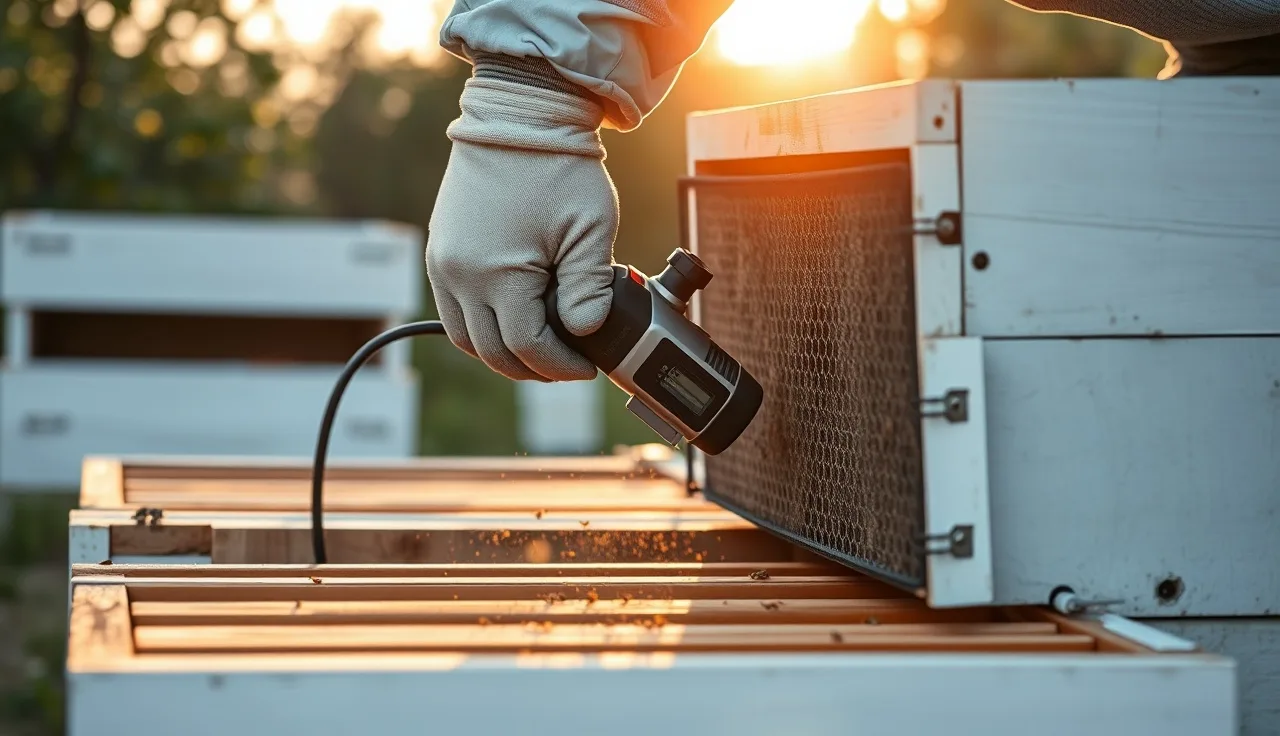
Vaporization (sublimation) heats solid oxalic acid dihydrate crystals above 157°C, turning them into a vapor that condenses as microscopic crystals on every interior hive surface and on the bees themselves [4]. The deposited crystals dissolve in the thin film of moisture on soft cuticle. This method spreads the acid broadly and is the most popular US approach for broodless or low-brood treatment.
Dribble (trickle) application delivers a 3.2% oxalic acid solution in sugar syrup directly onto bees between frames. Bees spread it through contact and grooming. The sugar syrup is mostly a carrier. The acid does the work. This method is approved in the US on package bees or broodless colonies.
Spray (not currently on the Api-Bioxal US label for in-hive use) and extended-release methods show up in research and in some European protocols.
Here is efficacy from controlled studies side by side:
| Method | Colony state | Reported mite kill rate | Source |
|---|---|---|---|
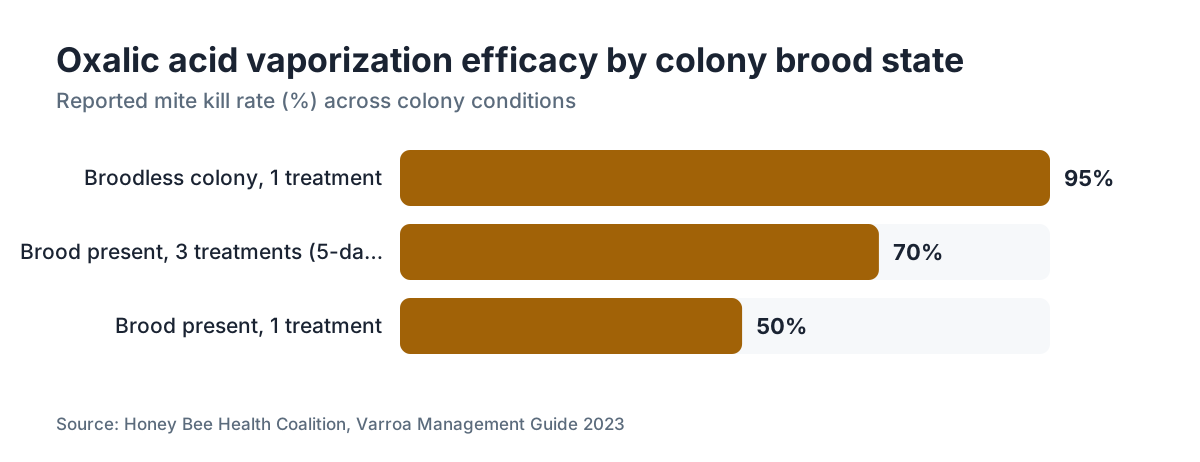
| Vaporization (1 treatment) | Broodless | 90-99% | Honey Bee Health Coalition, 2023 [5] |
| Vaporization (3 treatments, 5-day intervals) | Brood present | 60-80% | Honey Bee Health Coalition, 2023 [5] |
| Dribble (1 treatment) | Broodless | 90-97% | Gregorc & Planinc, 2012 [6] |
| Dribble (1 treatment) | Brood present | 30-60% | Gregorc & Planinc, 2012 [6] |
The pattern is obvious. Brood state is the dominant variable, not the application method.
Why doesn't oxalic acid kill mites inside capped brood cells?
Oxalic acid works by contact, and capped wax cells are a physical wall it cannot get through. This is the single biggest practical limit of the treatment, and the mechanism explains exactly why.
The acid, whether deposited as sublimated crystals or applied as dribble solution, cannot penetrate wax cappings. Any mite inside a capped cell is completely shielded from exposure [5].
Varroa's reproductive cycle turns this into a serious problem. A female mite enters a cell just before capping, lays eggs inside, and her offspring mature within the capped cell over roughly 10 days for worker brood to 14 days for drone brood. During that whole stretch, mites in cells are invisible to oxalic acid. When the bee emerges, the new mites and the foundress ride out on her body. If you haven't treated recently, they get another shot at entering fresh cells.
This is why a single treatment in a colony with an active brood nest might kill 40-70% of total mites and still leave a large surviving population. The mites you killed were all phoretic. The ones in brood survived and will rebuild the infestation within weeks.
For year-round management, most extension programs recommend one of two things: treat during a natural or induced broodless period (winter cluster, swarm, or caged-queen period), or run multiple vaporizations timed to catch emerging bees before mites can re-enter cells [5].
Is oxalic acid toxic to bees, and how do bees tolerate it while mites don't?
Yes, oxalic acid is toxic to bees at high doses. The selectivity is not absolute. It is a matter of degree and exposure route.
Bees tolerate oxalic acid for two main reasons. The hard chitinous exoskeleton covering most of a bee's body is far less permeable than the soft flexible cuticle on a varroa mite's ventral surface. The mite's body plan leaves much more soft tissue exposed. And bees can metabolize and excrete oxalate to a limited extent. Mites appear far less capable of doing so.
At label doses, Api-Bioxal causes measurable but temporary harm to adult bees. A study by Rademacher and Harz (2006) found that dribble treatment at recommended concentrations caused some adult bee mortality in small colonies with low bee populations, but no significant harm in full colonies [7]. Brood is genuinely sensitive. Dribble solution applied directly onto brood (rather than bees) causes significant larval mortality, which is one reason the dribble method is not recommended for colonies with open brood.
Vaporization at label rates poses less direct risk to brood than dribble, because the vapor condenses mostly on bees and surfaces rather than flooding open cells. Still, repeated vaporizations have been tied to some increase in bee mortality in a small number of trials, which is why the label limits treatment frequency [1].
The working rule: follow label rates and intervals exactly. More acid does not mean more mite death. It means more bee death.
How quickly does oxalic acid kill varroa mites after contact?
Faster than most beekeepers expect. Contact with a lethal dose immobilizes a mite within minutes in lab settings. Mites lose their grip on the bee's body, fall off, and die. Full mortality in lab bioassays typically hits within one to two hours of direct exposure at concentrations used in hive treatments [3].
In field conditions the timeline stretches out, because not every mite gets an immediate lethal dose. Mites riding in less accessible spots, particularly under the abdominal tergites, may pick up lower acid exposure and take longer to die or survive a single treatment entirely. That variability in exposure is part of why kill rates in real hives run slightly lower than in lab bioassays.
Mite drop (dead mites falling onto the bottom board) starts within hours of a vaporization treatment and continues for two to three days as delayed-mortality mites die off. If you use a sticky board, you'll see a sharp spike in mite drop the day after treatment and a tail trailing off by day three.
Can varroa mites develop resistance to oxalic acid?
This is where the mechanism actually offers some reassurance. Varroa mites have developed resistance to several synthetic miticides, most notably tau-fluvalinate (Apistan) and coumaphos (CheckMite+), through point mutations in their target proteins [8]. Those are specific biochemical targets a mutation can tweak with little fitness cost to the mite.
Oxalic acid's mechanism is different. It attacks fundamental properties of cell membranes and ion chemistry. There is no single protein target to mutate. To resist oxalic acid, a mite would theoretically need to remodel its cuticle permeability and its cellular calcium-handling systems at the same time. That is an enormous evolutionary ask.
As of the most recent monitoring data (2024), there are no confirmed field populations of oxalic acid-resistant varroa anywhere in the world [5]. No credible lab study has produced resistant populations through sustained selection pressure either. This does not mean resistance is impossible, but it looks far less likely than resistance to synthetic miticides with discrete receptor targets.
For that reason, most integrated pest management programs treat oxalic acid as the option least likely to be compromised by resistance over time, which is why the Honey Bee Health Coalition recommends it as a core tool in rotation protocols [5].
Does the sublimation temperature or crystal form affect how well oxalic acid works?
Yes, somewhat, but the label dose matters more than the exact vaporizer. This comes up a lot among beekeepers who own vaporizers and wonder whether equipment changes the outcome.
Api-Bioxal contains oxalic acid dihydrate, which sublimes at approximately 157°C [4]. Most commercial vaporizers heat the pan to 200-300°C to finish sublimation inside the treatment window (typically 2.5 minutes per application). If the pan runs too cold, you get incomplete vaporization and uneven distribution. If it runs too hot, you risk decomposing some of the oxalic acid into other compounds before it reaches the bees.
The deposited crystals on hive surfaces are hygroscopic. They pull moisture from the hive environment and dissolve into solution on contact with soft tissues. Drier hive conditions can slow dissolution but not eliminate the effect. Very high humidity can cause premature dissolution on hard surfaces before mites touch them, though this is modest in practical hive conditions.
The label dose is 2.17 grams of Api-Bioxal per hive body treated (roughly 1 gram of active oxalic acid) [1]. Dose matters more than vaporizer brand. A plain vaporizer that delivers the full dose evenly beats a fancy device used with a sloppy dose every time.
How does oxalic acid compare to other varroa treatments in terms of how it kills mites?
Every approved varroa treatment has a different mode of action, and knowing the differences helps you rotate them intelligently.
Amitraz (Apivar) is an alpha-2 adrenergic agonist and monoamine oxidase inhibitor. It disrupts mite nervous system signaling, causing mites to detach from bees and die. Resistance has emerged in some US populations [8].
Tau-fluvalinate (Apistan) and coumaphos (CheckMite+) are neurotoxins targeting sodium channels and acetylcholinesterase respectively. Widespread resistance makes them largely ineffective in many regions now.
Formic acid (Mite-Away Quick Strips, MAQS) vaporizes at ambient temperature and penetrates capped brood cells, killing mites on pupae inside. That penetration is formic acid's big advantage over oxalic acid. The downside is a narrow temperature window and greater risk to queen and brood if misapplied.
Thymol (Apiguard, ApiLife VAR) works partly by direct contact toxicity and partly by repelling mites from their feeding site. It also gets some penetration into capped cells at high temperatures.
Oxalic acid is contact-only, no brood penetration, but it has the strongest safety profile against resistance and leaves minimal residues in wax and honey at label rates [1][5].
Want help combining these modes of action across a season? VarroaVault's treatment planning tools let you map your hive's brood cycle against treatment windows.
For sourcing treatments, see beekeeping supply companies for a comparison of vendors who stock Api-Bioxal and other EPA-registered miticides.
What do you actually need to do to apply oxalic acid correctly and safely?
The mechanism only helps you if the application is right. Here is what the EPA label and extension guidance specify.
For vaporization, the label allows up to 50 grams of Api-Bioxal per treatment, administered with an approved vaporizer, up to three treatments per year. The bees must be confined (entrance closed) during and for at least 10 minutes after treatment [1]. You wear an N95 or better respirator, acid-resistant gloves, and eye protection. Oxalic acid vapor is corrosive to your respiratory tract. This is not optional safety theater.
For dribble, a 3.2% solution (35 grams Api-Bioxal per liter of 1:1 sugar syrup) goes on at 5 mL per seam of bees, up to 50 mL per colony [1]. Same PPE applies.
Timing: the Honey Bee Health Coalition's Varroa management guide recommends vaporization during the natural broodless period in late fall or early winter, when efficacy approaches 95-99% [5]. In warmer climates with year-round brood, multiple sequential vaporizations (every five days for three to four rounds) are the standard approach to catch mites as they emerge from cells [11].
Temperature: vaporization can happen at any temperature that lets you confine bees safely. Dribble works best above 10°C (50°F) but below 21°C (70°F). Colder, and the bees cluster too tightly. Warmer, and the solution spreads erratically.
For more on how this fits a full seasonal protocol, the University of Minnesota Bee Lab publishes timing calendars for different US climate zones [9].
Does oxalic acid leave residues in honey, and is it safe for human consumption?
This matters both for your conscience and for compliance.
Oxalic acid occurs naturally in honey at concentrations of roughly 8-9 mg/kg [10]. Honey from treated colonies can show slightly elevated levels right after treatment, but multiple studies find that levels return to the natural background range within weeks when treatments follow label rates and timing [10].
The European Food Safety Authority concluded in its assessment that oxalic acid treatment of honey bee colonies at authorized doses does not push honey oxalate residues above natural background levels [10]. The FDA and EPA, in authorizing Api-Bioxal, set no maximum residue limit for honey because residues at label rates do not present a food safety concern [1].
Wax is a different story, and a good one. Oxalic acid does not build up in wax the way lipophilic compounds like coumaphos do. This is one of its genuine advantages over older synthetic treatments.
Practically: do not treat supers with honey intended for harvest. The label prohibits it. Not because residues at label doses are dangerous, but because it is good practice and a legal requirement.
How do beekeepers know if an oxalic acid treatment actually worked?
The mechanism tells you what to measure: mite drop right after treatment, plus infestation rate before and after.
An alcohol wash or sugar roll before treatment gives you a baseline. The Honey Bee Health Coalition recommends treating when infestation reaches 2% or higher (2 mites per 100 bees) on adult bees, though many practitioners treat at 1% in summer when brood production is high [5]. Do another alcohol wash 24-48 hours after treatment to see how many phoretic mites are left. In a broodless colony treated once, a drop from 3% to 0.1% is realistic. In a colony with heavy brood, do not be surprised if post-treatment infestation looks barely moved. Most mites were in cells.
Sticky boards under the screened bottom board let you count mite drop over 24 hours. A spike of hundreds or thousands of dead mites the day after vaporization confirms the acid reached the bees and the bees were covered. A small drop (fewer than 20-30 mites) despite a high pre-treatment count points to poor distribution, maybe because bees were clustered too tightly or the vaporizer did not sublimate the full dose.
For the biology behind why timing works the way it does, our varroa mite reference article covers the parasite's life cycle, anatomy, and feeding behavior.
Frequently asked questions
Does oxalic acid kill varroa eggs or larvae inside capped cells?
No. Oxalic acid cannot penetrate wax cappings, so mites (and mite eggs and larvae) inside capped brood cells are completely protected from all forms of oxalic acid treatment. This is the compound's primary limitation. Only formic acid has meaningful penetration into capped cells among currently registered US treatments.
How many oxalic acid vaporizations does it take to clear a mite infestation in a colony with brood?
Most university extension programs recommend three to four vaporizations at five-day intervals to cover one full brood-capping cycle when brood is present. The five-day interval targets mites as they emerge from cells before they can re-enter new ones. Even with this protocol, expect 60-80% total mite reduction rather than the 90-99% achievable in broodless colonies. An alcohol wash after the series tells you whether you need another round.
Can you use oxalic acid in a hive with honey supers on?
No. The Api-Bioxal label explicitly prohibits applying oxalic acid when honey supers intended for human consumption are present. Remove supers before treatment and wait until after the honey harvest to treat. This is a legal requirement under FIFRA, more than a recommendation.
What is the difference between oxalic acid dihydrate and anhydrous oxalic acid for varroa treatment?
Api-Bioxal contains oxalic acid dihydrate (the hydrated crystal form). Anhydrous oxalic acid is not on the US label. The dihydrate sublimes at approximately 157°C and is the form studied in nearly all varroa efficacy trials. Using unlabeled forms of oxalic acid in a hive is a federal pesticide law violation, and efficacy data from the dihydrate does not automatically transfer to other forms.
How does temperature affect oxalic acid vaporization efficacy?
The vaporizer pan temperature needs to exceed 157°C for complete sublimation. Most commercial vaporizers handle this independently of ambient temperature. Very cold ambient conditions mean bees cluster tightly, which can reduce how well the deposited crystals reach mites tucked under abdominal tergites. Dribble application, by contrast, requires at least 10°C ambient to flow properly and should not be used above about 21°C.
Is oxalic acid the same thing as the oxalic acid in rhubarb?
Yes, it is the same compound. Rhubarb leaves are toxic partly because of high oxalic acid concentrations. Api-Bioxal is a pharmaceutical-grade version with defined purity. The natural occurrence in plants (and in honey itself, at 8-9 mg/kg) is why regulators consider it a lower-residue-risk option compared to synthetic miticides, though at treatment concentrations it is acutely toxic to soft tissues.
Why do some beekeepers cage the queen before oxalic acid treatment?
Caging the queen stops her from laying for roughly 21-25 days, which lets all worker brood emerge and creates a broodless window. You then treat once (or twice, a week apart) into a fully broodless colony, achieving 95-99% phoretic mite kill. It is probably the single most effective varroa management move you can make outside of natural winter broodlessness.
Can oxalic acid harm the queen or affect her laying after treatment?
At label rates, studies have not found significant long-term queen mortality or reduced laying capacity. Some early European studies on dribble application reported occasional queen loss, particularly in small colonies or when solution contacted the queen directly. Vaporization appears to have less impact on queens than dribble at equivalent doses. Following label rates minimizes queen risk.
Does the pH of the hive environment affect how well oxalic acid works?
Somewhat. Oxalic acid is most corrosive to mite tissues in its protonated (acidic) form. Inside the warm, slightly humid hive, dissolved crystal pH runs around 1-2 on surfaces before dilution. Hive conditions rarely alter this enough to meaningfully change efficacy, but extremely wet conditions can dilute deposited crystals on surfaces before mites contact them, slightly reducing exposure.
What PPE do you need when vaporizing oxalic acid in a hive?
The Api-Bioxal label requires a NIOSH-approved N95 (or better) respirator, acid-resistant gloves (nitrile is the minimum; butyl rubber is better for extended use), and chemical splash goggles. Oxalic acid vapor is corrosive to mucous membranes, eyes, and lung tissue. Treat in still air or with wind at your back. Never lean over the hive entrance during or immediately after vaporization.
How long after oxalic acid treatment can you add honey supers back?
The Api-Bioxal label does not specify a mandatory waiting period before returning supers, but the practical answer is: wait until the nectar flow starts and you have confirmed the treatment window is complete. Since oxalic acid residues in honey return to natural background levels within a few weeks at label doses, a two-to-four week interval before adding supers is a conservative but reasonable practice.
Has any research found varroa mites resistant to oxalic acid in the field?
As of 2024, no confirmed field-resistant varroa populations have been documented anywhere in the world. The mechanism (membrane disruption and calcium chelation rather than a single protein receptor target) makes resistance far harder to evolve than resistance to synthetic miticides. Researchers keep monitoring, but oxalic acid is currently the treatment least threatened by resistance among registered options.
Does oxalic acid work on Varroa jacobsoni as well as Varroa destructor?
The overwhelming majority of research, and the Api-Bioxal registration data, covers Varroa destructor, the species responsible for colony losses in Europe, the Americas, and most of Asia. Varroa jacobsoni, which parasitizes Apis cerana and has recently been found on Apis mellifera in Papua New Guinea, has not been as extensively studied. The contact toxicity mechanism would theoretically apply, but efficacy data specific to V. jacobsoni in Apis mellifera colonies is limited.
Sources
- EPA - Api-Bioxal product registration and label: Api-Bioxal registered in the US in 2015; label specifies dose of 2.17 g per hive body, up to 3 treatments per year, prohibited when honey supers are present
- USDA ARS - Varroa destructor biology overview: Varroa mites feed by piercing bee cuticle and consuming hemolymph and fat body tissue
- Experimental and Applied Acarology - oxalic acid acaricidal mechanism review: Oxalic acid's acaricidal effect is primarily attributable to direct contact toxicity affecting cuticle integrity and ion homeostasis rather than fumigant action
- University of California Agriculture and Natural Resources - oxalic acid sublimation properties: Oxalic acid dihydrate sublimes at approximately 157°C; commercial vaporizers heat to 200-300°C to ensure complete sublimation
- Honey Bee Health Coalition - Varroa Management Guide 2023: Vaporization in broodless colonies achieves 90-99% mite kill; efficacy drops to 60-80% with brood present; treatment threshold recommended at 2% infestation on adult bees; no confirmed oxalic acid resistance as of 2023
- Gregorc A. & Planinc I. (2012) - Acaricidal effect of oxalic acid in honeybee colonies: Dribble application in broodless colonies achieved 90-97% mite kill; efficacy dropped to 30-60% in colonies with brood present
- Rademacher E. & Harz M. (2006) - Oxalic acid for the control of varroosis in honey bee colonies: Dribble treatment at recommended concentrations caused some adult bee mortality in small colonies but no significant harm in full colonies
- USDA ARS Bee Research Laboratory - varroa resistance to synthetic miticides: Varroa mites have developed resistance to tau-fluvalinate and coumaphos through point mutations in target proteins; amitraz resistance has emerged in some US populations
- University of Minnesota Bee Lab - varroa management protocols: University of Minnesota Bee Lab publishes seasonal treatment timing calendars for different US climate zones
- European Food Safety Authority (EFSA) - assessment of oxalic acid residues in honey: Oxalic acid treatment at authorized doses does not result in honey oxalate residues above natural background levels of approximately 8-9 mg/kg; no maximum residue limit required
- Penn State Extension - Varroa mite management in honey bee colonies: Sequential vaporizations at 5-day intervals recommended when brood is present to cover one full brood-capping cycle
Last updated 2026-07-10