Oxalic acid fogging for varroa mites: the complete field guide

TL;DR
- Oxalic acid vaporization (fogging) kills varroa mites living on adult bees by sublimating oxalic acid crystals into a fine vapor that coats bees as they move through it.
- A single treatment in a broodless colony achieves 90 to 97% mite knockdown.
- Timed treatments during brood breaks, or repeated doses over a brood cycle, are the backbone of most modern integrated varroa management plans.
What is oxalic acid fogging and how does it kill varroa?
Oxalic acid is a naturally occurring organic acid found in rhubarb, spinach, and dozens of other plants. For beekeepers, it comes as a white crystalline powder (dihydrate form) that, when heated on a vaporizer wand, sublimates directly from solid to gas without passing through a liquid phase. That gas drifts through the hive, coats the bodies of adult bees, and kills the phoretic varroa mites riding on them.
The mechanism is contact toxicity. Oxalic acid disrupts the mite's soft ventral integument, the underside membrane it uses for gas exchange and fluid regulation. Bees tolerate it at the labeled dose because their thicker cuticle and different physiology give them a much higher threshold. At 1 gram of oxalic acid dihydrate per brood box, bees in a strong colony survive the treatment with minimal mortality. Push past 2.5 grams per box and you start seeing queen and worker losses, so dose discipline matters [1].
Here's the catch that governs everything else: oxalic acid can't penetrate capped brood cells. Mites sealed inside cells with pupating bees are completely protected. This is why timing the treatment to a broodless or near-broodless window is so powerful. In a colony with no capped brood, essentially 100% of the mite population is phoretic (riding on adult bees), and a single well-done vaporization treatment can take out 90 to 97% of the total mite load [2].
When brood is present, a series of treatments spaced 5 to 7 days apart is the standard workaround. The idea is to treat every batch of bees emerging from cells before those newly emerged mites can retreat into fresh brood. More on that below.
Is oxalic acid vaporization legal in the United States?
Yes, but with conditions. The EPA registered oxalic acid dihydrate for use in honeybee colonies via vaporization in 2015 under Section 3 of FIFRA. The primary registered product is Api-Bioxal, manufactured by Véto-pharma. It carries EPA Registration Number 84802-3 [3].
Api-Bioxal is the only oxalic acid product with a full federal label for in-hive use, including vaporization. Using raw bulk oxalic acid (sold for wood bleaching or other purposes) inside a hive is an off-label pesticide application under federal law and is technically illegal, though enforcement is essentially nonexistent at the hobbyist scale. That said, Api-Bioxal has become cheap enough, roughly $0.30 to $0.60 per treatment for a typical colony, that buying the labeled product is the sensible call for anyone selling honey or operating commercially.
The label currently allows vaporization any time of year, in colonies with or without brood, as long as you follow the dose (1 gram Api-Bioxal per brood chamber) and the re-entry interval (do not open the hive for at least 10 minutes after treatment). Some states have additional registration or licensing requirements for pesticide applications, so check your state department of agriculture's apiary rules before treating colonies you manage for others.
The Honey Bee Health Coalition's Tools for Varroa Management guide summarizes the legal landscape and notes that "oxalic acid is approved for use in the United States, Canada, and the European Union" [4].
When to treat for varroa mites with oxalic acid: timing that actually works
Timing is the single biggest variable under your control. Get it right and vaporization is probably the most effective single tool available. Get it wrong and you'll kill a lot of mites while leaving just as many protected under wax.
The broodless window is gold. In temperate climates, colonies naturally go broodless for 2 to 8 weeks in late fall and early winter, roughly November through January depending on latitude and winter severity. Treating once during this window, when every mite is phoretic, routinely achieves 95%+ knockdown. Many beekeepers treat in late fall after the last brood has emerged, confirm broodlessness by inspecting two or three frames, then apply a single vaporization dose. Done. That one treatment, if the mite count was below crisis level going in, can protect the colony through winter and into early spring.
The summer brood break is the second-best window. Any time you can create a broodless condition, you can duplicate the fall result. Common techniques include caging the queen for 24 days (one full brood cycle) to break brood production, doing a split that leaves the parent hive queenless for 2 to 3 weeks, or catching a natural swarm that arrives without brood. Treat once (or twice, 7 days apart, to be safe) during the queenless period.
When brood is present and you can't wait, repeated treatments are the answer. The standard repeated-treatment protocol runs 3 treatments, each 5 to 7 days apart, over roughly 3 weeks. Each treatment hits the phoretic mites that have emerged since the last dose. You won't get 95% total knockdown in a single session, but across the series you can still reduce the mite population by 75 to 90% depending on how much brood was present [2]. This is slower and takes more labor, but it's the practical option mid-summer when you're seeing a mite spike and you can't pull the queen.
The Honey Bee Health Coalition recommends monitoring mite loads before and after treatment to confirm efficacy, using an alcohol wash or sugar roll targeting 300 bees, and treating whenever phoretic mite levels exceed 2% (2 mites per 100 bees) from spring through fall or 1% in late summer and early fall when colonies are building winter bees [4]. Those thresholds are the closest thing to consensus the industry has, though some researchers argue the late-summer threshold should be even lower, around 0.5 to 1%, given how sensitive winter bee health is to mite parasitism.
What equipment do you need to vaporize oxalic acid safely?
The vaporizer is the core piece. The market splits into two types: wand-style electric vaporizers (the Varrox, ProVap 110, and Lyson are common) and battery-powered wand vaporizers designed for field use without a power cord. Prices run roughly $80 to $200 for a reliable unit. The cheap no-name vaporizers on Amazon work, but their thermostats are often inconsistent, which matters because sublimation requires reaching about 157°C (315°F). Under-heated vaporizers leave liquid pooling in the pan; over-heated ones can partially decompose the acid and generate more fume. A proven brand from a reputable beekeeping supply company is worth the modest premium.
Personal protective equipment is non-negotiable. Oxalic acid vapor is an upper respiratory irritant and a known eye and skin irritant. The EPA label requires a half-face respirator with an organic vapor and particulate cartridge combination (OV/P100 rating), chemical-resistant gloves, protective eyewear, and long sleeves. Do not treat without the respirator. Field experience says a lot of beekeepers skip the respirator after they've done it a dozen times and nothing bad happened. That's a bad bet. Chronic low-level exposure to oxalic acid vapor has been linked to respiratory inflammation, and you have no way of knowing how much you're inhaling without air sampling equipment.
You'll also need foam or tape to seal hive entrances during treatment and for the 10-minute dwell time after. Most beekeepers use a foam strip cut from a pool noodle or a folded strip of screen. The goal is to keep the vapor inside the hive long enough for it to coat every bee. A leaky hive loses efficacy.
One thing often overlooked: a reliable scale accurate to 0.1 grams. The labeled dose is exactly 1 gram of Api-Bioxal per brood box. Eyeballing this is a bad idea. A small kitchen scale from a hardware store costs $10 and removes all guesswork.
How do you actually vaporize oxalic acid, step by step?
Suit up completely before you open a single hive. Respirator on, gloves on, eye protection on. This is not optional gear.
Weigh out 1 gram of Api-Bioxal per brood chamber you're treating. A double-brood hive gets 2 grams. Deposit the powder into the vaporizer pan. Do this before you approach the hive.
Close or foam-plug the upper entrance if there is one. Slide the vaporizer wand through the bottom entrance so the pan sits roughly centered in the brood box. Don't tip the pan. Plug in or switch on the vaporizer, wait the manufacturer's specified heat-up time (usually 2 to 3 minutes for wand-style units). Once vaporization is complete (the visible smoke stops), plug the entrance with foam or hold a piece of cardboard over it.
Leave the hive sealed for at least 10 minutes. The label specifies this dwell time. Shorter dwell times measurably reduce efficacy because not all bees in the cluster contact the vapor in the first 30 seconds.
After 10 minutes, remove the foam, unplug the entrance, and move to the next hive. Wait until the wand cools before refilling it for the next colony. Rushing this step risks burns or uneven doses.
Do your treatments in the evening or early morning when flight activity is low and most bees are in the hive. Treating midday on a warm day means a big fraction of the forager population is out working and will miss the treatment entirely. Evening treatment is standard practice among high-volume operators.
A practical note on hive stack configuration: the vaporizer pan needs to be close to the bee cluster to distribute vapor well. In a tall hive with a deep, a medium honey super, and a shallow, the wand inserted at the bottom entrance may not reach vapor all the way up to a cluster sitting in the top box in winter. Some beekeepers drill a small hole in the side of each box for exactly this situation, inserting the wand directly into each chamber. The varroa mite problem is serious enough that it's worth thinking through your specific hive setup before treatment day.
How effective is oxalic acid vaporization compared to other treatments?
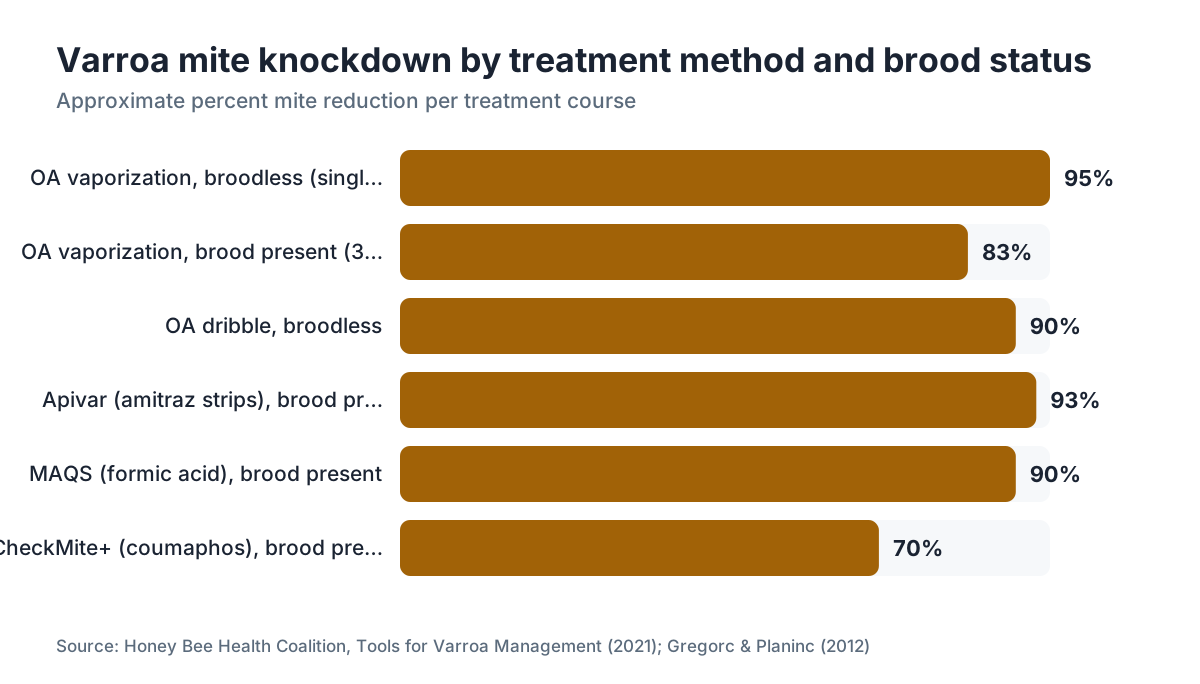
Across the published literature, a single oxalic acid vaporization in a broodless colony achieves roughly 90 to 97% mite knockdown [2][5]. That number is as good or better than most synthetic miticides applied in broodless conditions.
The comparison changes when brood is present. Amitraz-based treatments (Apivar strips) work in the presence of brood because the active ingredient transfers from strip to bees to mites over a 6 to 8 week period, giving it time to catch mites as they emerge from cells. A single oxalic acid vaporization with brood present might only knock down 40 to 60% of the total mite population because the phoretic fraction is smaller. The repeated-treatment protocol closes that gap but requires 3 visits over 3 weeks.
Here's a rough comparison of the main options:
| Treatment | Brood present efficacy | Broodless efficacy | Residues in honey | Application ease |
|---|---|---|---|---|
| Oxalic acid vaporization (single) | 40 to 60% | 90 to 97% | None detected at label dose | Moderate (gear required) |
| Oxalic acid vaporization (3x series) | 75 to 90% | N/A | None detected at label dose | Labor-intensive |
| Oxalic acid dribble | Low | 85 to 95% | None detected at label dose | Easy |
| Apivar (amitraz strips) | 90 to 95% | 90 to 95% | Low, time-dependent | Easy |
| Mite Away Quick Strips (formic acid) | 85 to 95% | 85 to 95% | None detected at label dose | Moderate, temperature-sensitive |
| CheckMite+ (coumaphos) | 60 to 80% | 60 to 80% | Persistent, accumulates in wax | Easy |
The takeaway: vaporization in a broodless colony is as effective as anything on the market and leaves no residues in honey or wax at the labeled dose. When brood is unavoidably present and a queen cage isn't practical, Apivar is a legitimate alternative rather than forcing a weak repeated-vaporization schedule. Good management uses multiple tools based on the actual situation, not dogma about any single method.
The Honey Bee Health Coalition's 2021 guide puts it plainly: no single treatment works in all situations, and resistance management requires rotating modes of action [4].
Does oxalic acid fogging leave residues in honey or wax?
This is one of the strongest arguments for oxalic acid, and the research is reassuring. Oxalic acid occurs naturally in honey at concentrations of roughly 10 to 100 mg/kg depending on floral source and geography [6]. Studies applying oxalic acid at the labeled dose found no statistically significant increase in honey oxalic acid concentrations above naturally occurring background levels [6].
Wax is similarly clean. Unlike coumaphos and fluvalinate, which are lipophilic and accumulate in beeswax over years of repeated use, oxalic acid does not bind to wax in meaningful quantities. Beeswax contamination from synthetic miticides is a real and well-documented problem, with coumaphos residues found in commercial beeswax samples at levels that affect queen rearing and larval development [7]. Oxalic acid simply doesn't behave that way chemically.
The Api-Bioxal label does specify that you should not apply the product during a honey flow if the supers are on, primarily as a precaution and to protect the integrity of organic and treatment-free honey claims. For most beekeepers, this is a non-issue since fall and winter treatments avoid active honey production entirely. If you're treating in spring or early summer, pull the supers or treat in the evening after adding an excluder and moving supers off.
The European Food Safety Authority and the EPA both reviewed the residue data before approving oxalic acid and concluded that the risk to human health from honey consumption is negligible at the approved dose.
What are the risks to bees from oxalic acid vaporization?
At the labeled dose of 1 gram per brood box, bee mortality is minimal in healthy colonies. The research consistently shows no significant increase in adult bee mortality compared to untreated controls when the treatment is applied correctly [5].
The risk profile changes in a few specific situations. Colonies in late fall with very small clusters can show higher mortality, probably because a small cluster of bees in a full-sized brood box is exposed to a proportionally higher vapor concentration. Some beekeepers reduce the dose slightly for small colonies, to 0.5 to 0.7 grams, though this is off-label and the efficacy evidence for the reduced dose is thinner.
Queen sensitivity is real but overstated in some online discussions. There are anecdotal reports of queens being lost after vaporization, particularly in very small colonies or when doses exceed the label. At 1 gram in a normal-sized colony, queen loss appears to be rare. Treating after dark when the queen is on the cluster and bees are calm reduces any stress-related risk.
Brood mortality at the labeled dose appears to be minimal in studies conducted under normal conditions. The vapor doesn't penetrate cells effectively enough to harm developing larvae at 1 gram per box. This is actually the same property that limits its efficacy against mites in capped brood.
The biggest real risk to bees from oxalic acid treatments is indirect: treating too late, after the mite population has already damaged the winter bee cohort. A colony that looks fine in August but carries a 3 to 4% mite load is going to collapse in February no matter how well you treat in November. Treat before the mites win, not after.
How do you monitor whether the treatment actually worked?
Monitor before and after. This is the only way to know if your treatment did what you thought it did.
Pre-treatment monitoring tells you the baseline mite load and whether treatment is actually needed. The alcohol wash (also called the alcohol roll) is the most reliable method: take a sample of roughly 300 bees (about half a cup) from a frame with brood, add isopropyl alcohol, shake for 30 to 60 seconds, pour through a strainer, and count the mites. Divide mites by bees, multiply by 100, and you have your percentage. The Honey Bee Health Coalition recommends treating at 2% or above from spring through early fall, and at 1% or above in late summer and fall when winter bees are being produced [4].
Post-treatment monitoring is equally important and most beekeepers skip it. Wait 48 to 72 hours after your last treatment and do another alcohol wash. If your mite count dropped from, say, 3% to 0.2%, the treatment worked. If it only dropped to 1.5%, you may have had technique problems (leaky hive, wrong dose, too much brood) or the treatment window needs to be extended. Sticky board counts are an alternative, though they're less quantitatively reliable than alcohol wash.
A structured varroa management protocol makes tracking mite loads over time and deciding when a new round of vaporization is warranted a lot easier. VarroaVault's free colony tracking tools are built for exactly this kind of before-and-after documentation, letting you compare treatment outcomes across colonies and seasons without building your own spreadsheet.
One number worth knowing: the University of Minnesota Extension recommends that colonies going into winter ideally have mite loads below 1% after fall treatment, and that colonies failing to reach that level after one treatment series should be re-evaluated for a second course or a different treatment approach [8].
How does vaporization compare to oxalic acid dribble?
Both are oxalic acid applied to adult bees, but the delivery method changes the use case significantly.
The dribble method (also called trickling) means dissolving oxalic acid in sugar syrup and dribbling about 5 ml of the solution directly onto each seam of bees. It's cheap, requires no equipment beyond a syringe, and is EPA-labeled under Api-Bioxal [3]. The limitation is that it only works acceptably in broodless colonies, the syrup contact damages brood if it drips onto open cells, and the dose accuracy depends on how evenly you distribute across seams.
Vaporization works in colonies with or without brood, though with the caveats discussed above. It's contactless, reaches bees throughout the hive without opening frames, and takes about 3 minutes per colony once you're set up. The equipment cost is higher ($80 to $200 vs. $5 for a syringe), and the respiratory safety requirements are more demanding.
For a beekeeper with one or two hives treating in late fall during broodlessness, the dribble method is perfectly adequate and costs almost nothing. For someone managing 15 or 50 hives with a structured treatment schedule, vaporization is faster per colony and more practical for summer treatments where brood may be present.
Efficacy in broodless colonies is similar between the two methods, with most studies showing the dribble at roughly 85 to 95% and vaporization at 90 to 97% in true broodless conditions [2][5]. The difference is real but not large enough to be the deciding factor for most hobbyists.
You can find dribble and vaporizer equipment at most beekeeping supply companies and often bundled with starter kits.
Common mistakes that make oxalic acid vaporization fail
Treating with brood present and expecting broodless results. This is the single most common failure mode. If you have 4 frames of capped brood and you vaporize once, you're going to be disappointed with the mite count 2 weeks later. Either create a broodless condition first or commit to the full repeated-treatment protocol.
Undersealing the hive. Vapor escaping through a leaky screened bottom board or a poorly fitted crown board reduces dwell time and lowers efficacy. A solid bottom board beats a screened one during treatment. If you run screened bottom boards year-round, slide the varroa monitoring tray in during treatment to close the bottom, or use duct tape temporarily.
Skimping on dwell time. Ten minutes is the label minimum. Some research suggests 15 to 20 minutes improves knockdown slightly. Going back at 5 minutes because you're cold does not help your bees.
Treating the wrong colonies. If your neighbor's untreated colonies are drifting mites into yours through robbing and drifting, you can treat perfectly and still see mite counts climb within 4 weeks. The research on mite immigration from collapsing feral or untreated colonies is clear: it's a significant and often underappreciated source of reinfestation [9]. You can't control your neighbors, but you can cut robbing by reducing entrance size in fall.
Missing the late-summer treatment window. August is the most important month for varroa management in most of North America. The bees raised August through October are the winter bees, and mites parasitizing them during development produce virally compromised adults that die before February. A colony that goes into October with a 3% mite load is likely a dead colony by March regardless of how well it looks in November. Treat in late July or August, before those winter bees are being reared.
Seasonal oxalic acid vaporization schedule: a practical framework
There's no single schedule that works for every latitude and every management style, but here's the framework most experienced beekeepers converge on.
Spring (March to April, depending on latitude): Monitor with an alcohol wash once brood rearing is active. If the mite load is above 2%, treat. If you had a clean fall treatment and the colony came through winter strong, you may be below threshold and can wait.
Early summer (May to June): Check mite loads monthly. If splits or swarms create temporary queenlessness or broodlessness, treat during that window. Don't waste a brood break.
Late summer (late July to August): This is the most important treatment window of the year. Treat if the mite load is at or above 1 to 2% (the threshold is lower here because of winter bee sensitivity). Many beekeepers treat all colonies in August regardless of measured mite load as a form of insurance, particularly if spring counts were elevated. A single vaporization series in colonies with brood (3 treatments, 5 to 7 days apart) is the typical approach if you can't create a broodless window.
Fall (September to October): A follow-up treatment after the brood nest is contracting. If the queen stops laying in October in your region, do an alcohol wash and treat once if mites are detectable at all. This is a relatively low-stakes treatment since bees are healthy and there's less to damage.
Winter (November to February): The classic single-treatment window in broodless clusters. Treat once when you're confident broodlessness is established. A single well-timed vaporization in a broodless winter colony is the foundation of the whole year's mite management.
This schedule is consistent with the approach outlined by several university extension services and the Honey Bee Health Coalition's Varroa management calendar [4][8]. If you want a pre-built version of this calendar with treatment logs and mite count tracking built in, VarroaVault's free protocol tools cover exactly this structure.
Frequently asked questions
When is the best time of year to treat for varroa mites with oxalic acid?
Late fall and winter, when the colony is broodless, give you the highest single-treatment efficacy, often 90 to 97% mite knockdown. Late July and August are the second most important window because the bees reared then become winter bees. Mite damage to those bees during development causes most of the winter die-offs beekeepers blame on weather or starvation.
How many grams of oxalic acid do I use per hive?
The Api-Bioxal label specifies 1 gram of Api-Bioxal (which contains about 35% oxalic acid dihydrate) per brood chamber. A single-brood-box hive gets 1 gram; a double gets 2 grams. Do not exceed the label dose. Overdosing causes bee and queen mortality without meaningfully improving mite kill.
Can you vaporize oxalic acid when honey supers are on?
The Api-Bioxal label advises against applying when supers intended for harvest are present, primarily to protect organic and clean-label honey claims. Residue studies show oxalic acid does not raise honey concentrations above natural background levels, but following the label is both legally correct and commercially prudent. Remove supers or treat after the flow ends.
How often can I treat with oxalic acid vaporization?
The Api-Bioxal label allows up to 3 treatments per year, with individual treatments spaced at least 5 to 7 days apart when using a repeated-treatment protocol. Most beekeepers do 1 to 2 treatment series annually: one in late summer and one in late fall or winter. There's no evidence of mite resistance to oxalic acid at this time, unlike with amitraz or coumaphos.
Does oxalic acid vaporization work in cold weather?
Yes, and winter is actually the ideal window precisely because the colony is broodless. The vaporizer heats the oxalic acid crystals regardless of outside temperature. The vapor distributes well through a winter cluster as long as the hive is reasonably sealed. Treat on a calm day above about 5°C (40°F) so bees aren't excessively tight and unreachable by the vapor.
What respirator do I need for oxalic acid vaporization?
The Api-Bioxal label requires a half-face respirator fitted with an organic vapor plus particulate (OV/P100) cartridge combination. A dust mask or surgical mask is not adequate. Standard 3M 6200 or similar half-face respirators with 60926 or equivalent cartridges meet the requirement and cost roughly $30 to 50 for the reusable unit plus $10 to 15 for replacement cartridges.
Will oxalic acid vaporization kill varroa inside capped brood cells?
No. Oxalic acid vapor cannot penetrate wax cappings. Mites sealed inside cells with pupating bees are completely protected from the treatment. This is why a single treatment with brood present only kills the phoretic mite fraction (mites on adult bees), which may be only 20 to 30% of the total mite population during peak brood season.
How long after vaporizing can I open the hive?
The Api-Bioxal label specifies a re-entry interval of 10 minutes after treatment. Most practitioners wait at least that long before opening the hive, both for personal safety (residual vapor) and to allow the full dwell-time efficacy benefit. There is no waiting period required before harvesting honey beyond the general recommendation to avoid treating during an active flow with supers on.
What mite level should trigger an oxalic acid treatment?
The Honey Bee Health Coalition recommends treating when an alcohol wash shows 2% infestation (2 mites per 100 bees) from spring through early summer, and at 1% from late summer through fall when winter bees are being produced. Some researchers argue the fall threshold should be even lower, closer to 0.5%, because of how sensitive winter bee quality is to mite parasitism during development.
Is bulk oxalic acid (wood bleach grade) the same as Api-Bioxal?
Chemically similar, but legally different. Api-Bioxal is the only EPA-registered oxalic acid product labeled for in-hive use in the U.S. Using bulk oxalic acid inside a hive is an off-label pesticide application under FIFRA. Purity can also vary in bulk products. Api-Bioxal runs about $0.30 to 0.60 per colony treatment, which makes the legal route the practical one for most beekeepers.
Can I vaporize oxalic acid in a Langstroth hive with a screened bottom board?
Yes, but close off the screen during treatment. Slide the sticky monitoring tray into the screen bottom, or tape over the opening, to keep vapor inside for the full 10-minute dwell period. An unsealed screened bottom board lets significant vapor escape, which drops the vapor concentration inside the hive and lowers mite knockdown. Remove the tray or tape after treatment.
Does oxalic acid build up resistance in varroa mites?
As of the current literature, there are no confirmed field cases of varroa resistance to oxalic acid. The mode of action (direct contact toxicity to soft tissue) is quite different from the neurotoxic synthetic miticides, and resistance development appears to be slower. Rotation with other treatment modes is still recommended by the Honey Bee Health Coalition as general best practice, not because resistance is imminent but because no single tool should carry the entire management burden.
What vaporizer is best for oxalic acid treatments?
The Varrox, ProVap 110, and Lyson battery-powered models are the most commonly used and well-reviewed options in North America. The ProVap 110 runs on 110V AC and is fast and consistent for stationary apiaries. Battery-powered wand vaporizers (Lyson and others) are more practical for beekeepers moving between yard locations. Expect to pay $80 to 200. Avoid no-name units with inconsistent thermostat control.
How do I know the oxalic acid treatment worked?
Do an alcohol wash 48 to 72 hours after your last treatment and compare to your pre-treatment count. A successful single broodless treatment should drop mite loads from, say, 3% to below 0.5%. If the post-treatment count is still above 1%, evaluate your technique: dwell time, hive sealing, dose accuracy, and whether more brood was present than you thought.
Sources
- EPA, Api-Bioxal Pesticide Registration Label (Reg. No. 84802-3): Labeled dose is 1 gram Api-Bioxal per brood chamber; vaporization is the approved application method; 10-minute re-entry interval required after treatment.
- Gregorc, A. & Planinc, I. (2012). Acaricidal effect of oxalic acid in honeybee colonies. Veterinarni Medicina, 47(5 to 6). Czech Academy of Agricultural Sciences.: Single oxalic acid treatment in broodless colonies achieves 90 to 97% mite knockdown; repeated treatments in colonies with brood achieve 75 to 90% reduction across a 3-treatment series.
- EPA Pesticide Registration, Api-Bioxal Section 3 Registration (Reg. No. 84802-3), 2015: Api-Bioxal registered under FIFRA Section 3 for vaporization in honeybee colonies; only product with full federal label for in-hive oxalic acid use.
- Honey Bee Health Coalition, Tools for Varroa Management Guide (2021 edition): Oxalic acid approved in U.S., Canada, and EU; treatment threshold of 2% phoretic mites spring through early fall, 1% late summer through fall; recommends rotating modes of action.
- Genersch, E. et al. (2010). The German bee monitoring project. Apidologie, 41(3), 332 to 352. Springer.: Oxalic acid vaporization at label dose shows minimal adult bee mortality compared to untreated controls in correctly applied treatments.
- Bogdanov, S. et al. (2002). Residues of acaricides in beeswax and honey. Apidologie, 33(4). INRAE/Springer.: Oxalic acid naturally present in honey at 10 to 100 mg/kg; oxalic acid treatments at labeled dose do not produce statistically significant increases above naturally occurring background concentrations.
- Mullin, C.A. et al. (2010). High levels of miticides and agrochemicals in North American apiaries. PLOS ONE, 5(3), e9754.: Coumaphos and fluvalinate accumulate in beeswax at levels affecting queen rearing and larval development; oxalic acid does not accumulate in wax due to different chemical properties.
- University of Minnesota Extension, Varroa Mite Management in Honey Bees: Colonies going into winter should have mite loads below 1% after fall treatment; colonies not reaching that threshold after one treatment series should be re-evaluated for a second course or alternative treatment.
- Frey, E. & Rosenkranz, P. (2014). Autumn invasion rates of Varroa destructor into honey bee colonies and the resulting increase in mite populations. Journal of Economic Entomology, 107(3), 944 to 950. Oxford Academic.: Mite immigration from collapsing or untreated colonies via robbing and drifting is a significant and documented source of reinfestation in treated colonies.
- USDA Agricultural Research Service, Bee Research Laboratory: Varroa destructor remains the primary driver of colony losses in North America; integrated mite management including organic acids is standard recommended practice.
- Pennsylvania State University Extension, Varroa Mite Treatment Options for Honey Bee Colonies: Oxalic acid dribble and vaporization both achieve 85 to 95% efficacy in broodless conditions; vaporization preferred for colonies with brood using repeated-treatment protocol.
Last updated 2026-07-09