Oxalic acid varroa treatment: the complete field guide
TL;DR
- Oxalic acid kills 90 to 99% of phoretic varroa mites, the ones riding on adult bees.
- It comes in two EPA-registered forms: dribble solution and vaporization.
- It does nothing to mites sealed inside capped brood.
- So timing to a broodless period, or running repeated vapor treatments, is what turns it into a colony-saver instead of a half measure.
What is oxalic acid and why do beekeepers use it for varroa?
Oxalic acid is a natural organic compound found in rhubarb, spinach, and plenty of other plants. In beekeeping it's the active ingredient in EPA-registered varroa treatments, chiefly Api-Bioxal, the only federally approved oxalic acid product for use in honey bee colonies in the United States as of 2024 [1]. Because it occurs naturally, it's cleared for certified organic operations when applied to the label.
Beekeepers reach for it for one reason. It works.
Against phoretic mites (the ones riding on adult bees outside capped cells), oxalic acid is about as good as anything on the market. The Honey Bee Health Coalition's Varroa Management Guide puts efficacy at 90 to 99% for phoretic mites under ideal conditions [2]. That number is hard to argue with.
The one hard limit: oxalic acid does essentially nothing to mites sealed inside brood cells. Varroa reproduce under cappings, so any mite hidden there when you treat walks away untouched. That's not a flaw special to oxalic acid. It's just how the chemistry works, and it drives every decision about when and how you apply it.
For hobbyist and sideliner beekeepers fighting varroa mite pressure, oxalic acid has become the default because it leaves no residue in wax or honey at legal rates, it's cheap, and it slides neatly into winter and extended broodless windows. If I could keep only one varroa product on the shelf, this is it.
What are the two methods for applying oxalic acid to bees?
Two application methods are legal in the United States: dribble (also called trickle) and vaporization (sublimation). A third approach, sponge or shop-towel extended release, has been tried experimentally but isn't on the Api-Bioxal label for general use. Stick to the label.
Dribble method
You mix Api-Bioxal into sugar syrup to make a 3.5% oxalic acid solution. The label spells it out: 35 g of Api-Bioxal per liter of 1:1 sugar syrup [1]. Then you dribble about 5 mL of that solution per occupied bee space, down between the frames, from a syringe or squeeze bottle. The label allows one dribble treatment per year when the colony has brood. During a genuine broodless period you're not bound by that single-treatment limit, as long as you follow the label.
Dribble needs no gear beyond a syringe and a mixing jar. It's the cheapest way in. The downside is you have to crack the hive open, and in winter that's a real disturbance. A tightly clustered colony may not spread the solution across the whole cluster either.
Vaporization (sublimation)
You load solid Api-Bioxal crystals (1 g per brood box, per the label) into a vaporizer wand that heats to roughly 200 degrees C. The crystals turn straight to gas, drift through the hive, and settle as fine oxalic acid crystals on bees and comb [1]. Mites pick up a lethal dose by contact.
Vaporization is what I'd point most people toward if they're treating more than a few hives. You seal the entrance for about 10 minutes after treating, then open it back up. No need to fully open the hive, which is a genuine win in cold weather. Multiple vapor treatments spaced 5 days apart, during a broodless period or during colony build-up when you're trying to stay ahead of mite reproduction, are both legal and far more effective than a single hit [2].
The catch is money and safety. A quality vaporizer runs $100 to $250 for a propane or electric model from reputable suppliers. And you must wear respiratory protection: a NIOSH-approved respirator rated for organic vapors and particulates, at minimum a P100 half-mask. Oxalic acid vapor is genuinely bad for lungs, eyes, and skin [1].
How effective is oxalic acid vapor treatment for varroa mites?
Against phoretic mites, oxalic acid vapor is among the most effective tools you have. A University of Florida IFAS Extension review found efficacy of 90 to 99% for phoretic mites [3]. In a broodless colony almost every mite is phoretic, which is why a winter or post-split treatment hits so hard. One well-timed broodless application can drop mite loads from dangerous to near zero.
With brood in the box, a single vapor treatment does much less, because mites under cappings are fully protected. Repeated treatments are the workaround. A study published in PLOS ONE found that three oxalic acid vapor treatments applied at 5-day intervals significantly reduced mite populations even in colonies with brood, by hitting mites over and over as they emerged from cells before they could crawl back into new brood [4].
The Honey Bee Health Coalition's Varroa Management Guide recommends a series of three treatments, 5 to 7 days apart, for colonies with brood [2]. That won't match the near-total knockdown of a broodless treatment, but it works in summer when a broodless window isn't on the table.
One honest caveat. Efficacy numbers from controlled research don't always translate cleanly to the field. If your hive is packed with brood and you treat once, expect partial results. Measure before and after with an alcohol wash or sugar roll. The numbers don't lie.
When is the best time to treat bees with oxalic acid?
Timing is everything with oxalic acid. The ideal window is a natural broodless period. Across most of North America that means late fall into early winter, usually once ambient temperatures have settled below about 50 degrees F and the queen has stopped or nearly stopped laying. By then, mites that were hiding in brood have emerged and almost all of them sit on adult bees. A single dribble or vapor treatment in that window hits 90 to 99% of the mite population [2].
Across much of the southern United States, and anywhere queens rarely quit laying, a reliable broodless period may never show up. In those spots beekeepers often manufacture a broodless window by caging the queen for 24 days (long enough for all brood to emerge), then treating. Extra work, but the math pays.
For summer, the three-treatment vapor series (5 to 7 days apart) gives you a tool without waiting for fall. Some beekeepers pair it with splits. When you make a split, the queenless half goes effectively broodless within about 9 days as the last open brood caps over and hatches. A vapor treatment around day 10 catches those mites at their most exposed.
Don't treat when daytime temperatures top about 95 degrees F, when a honey super meant for harvest is on the hive, or during a nectar flow with bees hauling volume through the boxes. The Api-Bioxal label covers all of these, and following it is both a legal requirement and plain good sense [1].
Is oxalic acid safe for bees, brood, and honey?
At label doses, adult honey bees handle oxalic acid well. Research hasn't found meaningful adult bee mortality at approved dribble or vapor rates [3]. Queens are the exception worth watching. There's evidence that direct contact with high concentrations of oxalic acid solution can harm queens. So don't drench the queen with dribble solution, and don't leave the entrance fully sealed for long stretches during vapor treatment on hot days. That's what I do.
Brood: oxalic acid can damage open larvae if you dribble heavily into frames with open brood. That's part of why the label caps dribble at once per year when brood is present, and why vaporization (which never pools liquid on comb) is generally kinder to colonies with open brood.
Honey: at legal doses, oxalic acid leaves no residue above natural background levels. It already occurs in honey, typically 8 to 40 mg/kg depending on the floral source [5]. Treated colonies produce honey that reads the same as untreated colonies in residue tests at EPA-compliant rates [5]. Still, don't treat with honey supers on. The label says so, and that honey could soak up more oxalic acid than it would ever gather naturally.
Wax residue is a non-issue at approved doses too. That's a big part of why oxalic acid beats synthetics like amitraz (Apivar) or fluvalinate (Apistan), both of which build up in wax and can drag down queen rearing or brood health as concentrations climb over the years.
What safety gear do you need when using oxalic acid vapor?
This part is not optional. Oxalic acid vapor is a real respiratory hazard, and the EPA label for Api-Bioxal spells out the personal protective equipment required for vaporization [1].
At minimum:
- A NIOSH-approved respirator with combined organic vapor cartridges and P100 particulate filters (a dust mask does nothing here)
- Chemical-resistant gloves (nitrile at a minimum, thicker rubber is better)
- Eye protection: sealed safety goggles, not glasses
- Long sleeves and pants to keep it off your skin
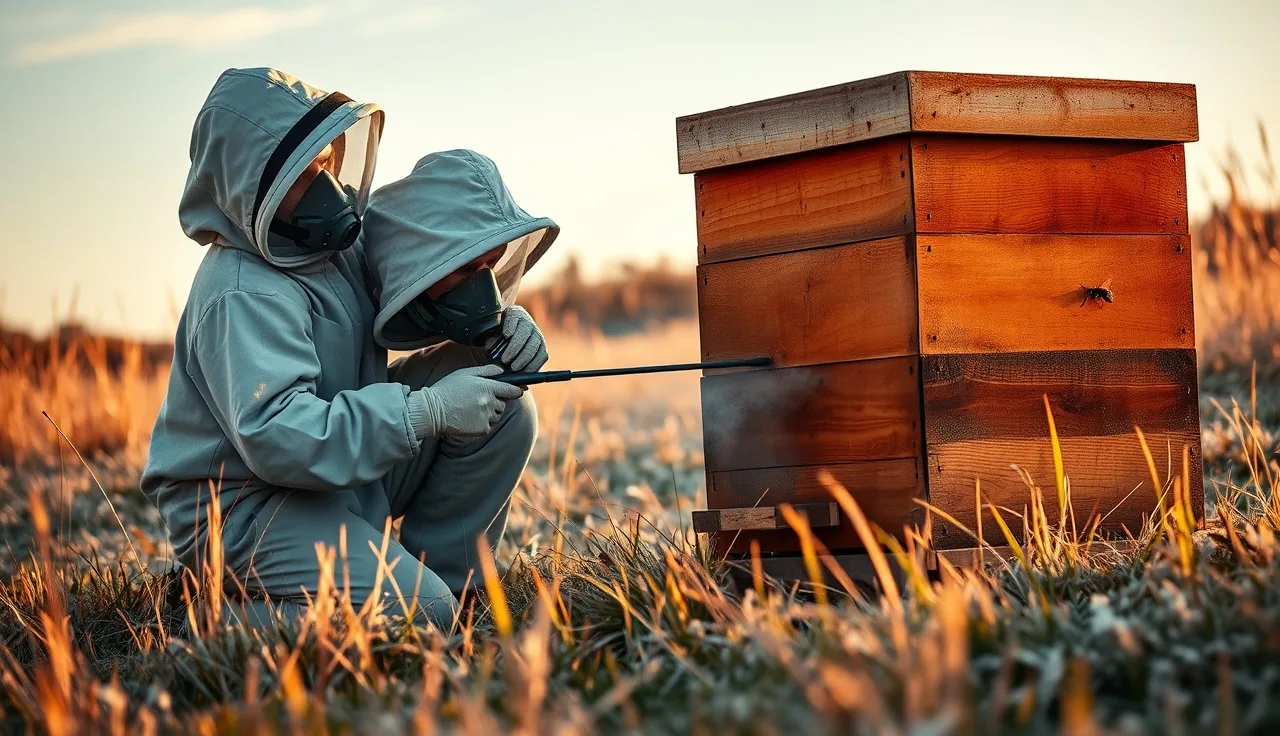
Treat in open outdoor air, never in a closed shed or garage. Stay upwind of the hive during the treatment period. Plenty of beekeepers skip the full suit since the hive stays closed during vaporization, but I'd still wear a veil for the moment you unseal the entrance.
For dribble, gloves and eye protection are still required by the label even though the vapor hazard is gone. The solution is concentrated enough to burn skin and eyes on contact.
Running more than a couple hives in one session? The respirator matters even more. Exposure stacks up across a session. Don't ditch it to save five minutes. The long-term lung effects of repeated oxalic acid vapor exposure are not something to field-test on yourself.
How does oxalic acid compare to other varroa treatments?
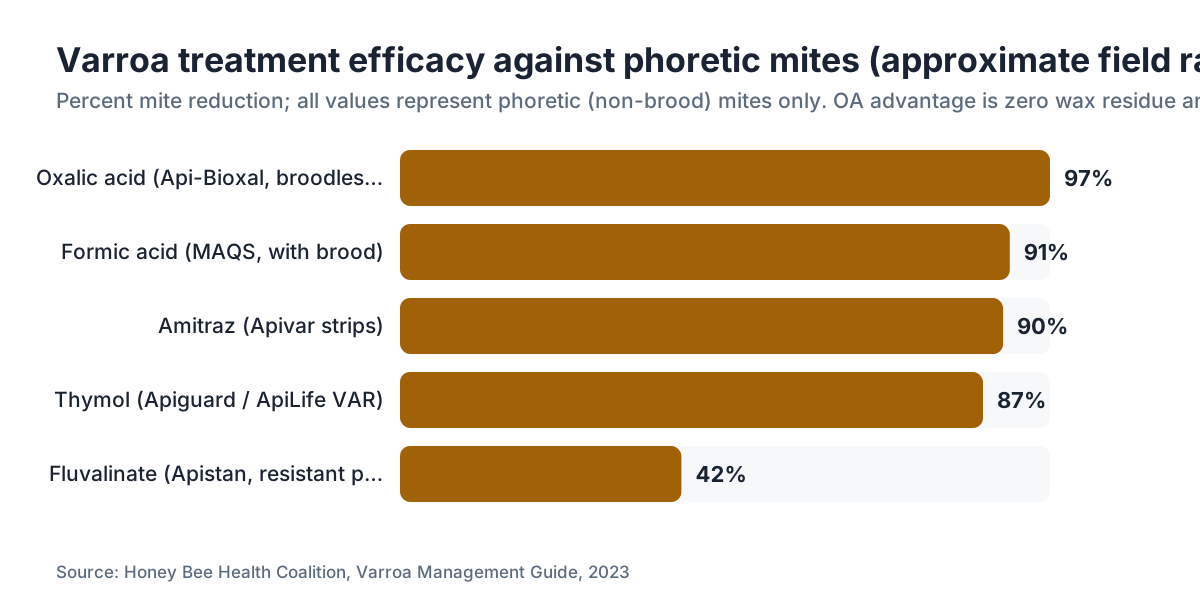
Here's a flat comparison of the main approved varroa treatments so you can see where oxalic acid lands.
| Treatment | Active Ingredient | Efficacy (phoretic) | Brood penetration | Honey super safe | Wax residue | Cost (per hive, approx.) |
|---|---|---|---|---|---|---|
| Api-Bioxal (OA dribble or vapor) | Oxalic acid | 90-99% [2] | None | Yes (no supers during treatment) | None at label dose [5] | $1-3 |
| Apivar strips | Amitraz | 85-95% [2] | Partial (slow release) | No | Yes, accumulates [2] | $5-10 |
| Apiguard / ApiLife VAR | Thymol | 80-93% [2] | Low | No | Minimal | $4-8 |
| Mite Away Quick Strips | Formic acid | 85-97% including brood [2] | Yes (penetrates cappings) | Limited | None | $8-15 |
| Apistan strips | Fluvalinate | Highly variable (widespread resistance) [2] | None | No | Yes, high accumulation [2] | $4-8 |
What oxalic acid has that nothing else has at this price: it's cheap, it leaves no wax residue, and it's cleared for organic operations. What it lacks: any reach into capped brood. Formic acid (Mite Away Quick Strips) is the only legal US treatment that penetrates cappings, so in summer with heavy pressure and a full brood nest, MAQS can be the smarter call despite the higher price and its touchiness about temperature.
My own approach: oxalic acid vapor in winter during the broodless period, then rotate to Apivar or MAQS in summer if counts say treat. Resistance to oxalic acid hasn't turned up in Varroa destructor populations so far [2], which is one more reason to use it with intent instead of hosing the hive down every few weeks.
What equipment do you need to vaporize oxalic acid?
A vaporizer, PPE (covered above), and Api-Bioxal. That's the whole list.
Vaporizers split into two types: propane-powered and electric (battery or plug-in). Propane wands are portable and go anywhere, but they want careful handling of the torch and consistent heating time. Electric vaporizers (like the Varrox or various battery models) heat to a set temperature on their own, which pulls the guesswork out of dosing. A reliable electric unit runs $100 to $250 depending on brand and features. Propane wands go for $60 to $100.
For the treatment itself, you dose 1 gram of Api-Bioxal crystals per brood box into the vaporizer tray. Most units ship with a scoop sized for that dose. You slide the wand through the entrance (or a small drilled hole in the bottom board), seal every entrance and vent with foam or tape, run the vaporizer for the manufacturer's time (usually 2 to 3 minutes for sublimation), then leave the hive shut for 10 minutes before you open it.
For dribble you need a mixing container, a scale good to 0.1 g, a squeeze bottle or syringe with a long tip, plus warm water and sugar. Equipment cost is basically nothing if you already own a kitchen scale.
If you want to keep your ordering simple, beekeeping supply companies that carry Api-Bioxal alongside vaporizers save you a second checkout. Some run free shipping honey bee supply companies deals past a certain order size, which adds up when a sideliner buys in bulk.
How do you know if your oxalic acid treatment worked?
You test before and after. Every single time. This one is non-negotiable if you care about the bees.
An alcohol wash is the most accurate way to read mite load. Collect about 300 adult bees (roughly a half-cup) off the brood nest frames, not the entrance, drop them into 70% isopropyl alcohol in a jar, shake hard, and count the mites that come loose. Divide by 300 for a percentage. The Honey Bee Health Coalition recommends treating at 2% or higher during brood season, and at 1% or higher in August and September as mite numbers climb toward winter [2].
A sticky board under the hive for 24 to 72 hours before and after gives you a relative drop count. Less precise than an alcohol wash for baseline load, but it plainly shows whether the treatment landed. After a good vapor treatment you'll see a pile of dead mites on the board.
After a broodless-period treatment, retest 7 to 10 days later. If your post-treatment wash shows under 1%, you're set for winter. If it's still high, figure out why: brood you missed, a wrong dose, or reinfestation from robbing and nearby colonies.
VarroaVault's free hive record tools help you track counts across seasons and treatments, so patterns in your own yard become obvious instead of you leaning on general benchmarks. Knowing your own apiary's baseline beats any published guideline.
Can you use oxalic acid treatment when honey supers are on?
No. The Api-Bioxal label is blunt about it: pull honey supers before treatment and don't put them back until the treatment is done [1]. That holds for both dribble and vapor.
The worry isn't that oxalic acid at label doses leaves unsafe residue (background oxalic acid in honey is natural). It's that supers on the hive during treatment could pick up more oxalic acid than they ever would naturally. Because super honey is what people eat, the EPA label plays it safe and requires you to get it out of the way.
In practice, your main oxalic acid window should land after you've pulled supers for the season, which lines up neatly with the late-summer and fall stretch when a pre-winter knockdown matters most. Got a late fall honey crop? Plan your last super pull, then treat right after. Don't sit on it.
People sometimes wonder whether brood-box honey (the winter stores) gets affected. At approved doses, residue data shows brood-box honey isn't meaningfully changed [5]. The label restriction is aimed at harvest honey in supers, not the stores the bees eat themselves.
What is Api-Bioxal and is it the only legal oxalic acid product for bees in the US?
Api-Bioxal, made by Chemicals Laif S.p.A. and sold through various US suppliers, is the only EPA-registered oxalic acid product currently approved for use in honey bee colonies in the United States [1]. Its EPA registration number is 92277-1. It contains 97.6% oxalic acid dihydrate as the active ingredient.
Before Api-Bioxal was approved in 2015, beekeepers used food-grade oxalic acid bought from wood-bleaching or cleaning-supply sources. Putting any oxalic acid product other than Api-Bioxal into a hive is an off-label, unregistered pesticide application in the US, which creates legal exposure for commercial operations and breaks federal law under FIFRA [7]. For hobbyists the enforcement risk is low, but the principle holds: Api-Bioxal went through EPA review for safety and efficacy. Home-sourced products never did.
Api-Bioxal comes in 35 g and 175 g packets. A 35 g packet runs roughly $10 to $15 from most suppliers and covers several treatments depending on method. The 175 g packet costs less per gram if you're running more than 10 to 15 hives.
In Canada, oxalic acid products are registered through the Pest Management Regulatory Agency (PMRA) and the rules differ somewhat. European beekeepers have had oxalic acid approved longer and can pick from several registered formulations. The chemistry is identical everywhere.
What do hobbyist beekeepers most often get wrong with oxalic acid treatment?
The biggest miss is treating once in fall and calling it done for the year. One oxalic acid treatment in October beats nothing, but it's the last step of a season-long plan, not a stand-in for one. Mite numbers build all summer. Hit 6% in August and coast until October, and you've already lost a chunk of your winter bees and maybe seeded deformed wing virus at colony-damaging levels.
Second miss: treating with brood still present and skipping the follow-up test. Many beekeepers treat in late October figuring the queen has quit, but in a warm year or a warm climate she may still have brood in the bottom box. One treatment there catches maybe 40 to 60% of mites. Check for brood before you treat. If brood's there, either wait for a true broodless window or plan three vapor treatments 5 to 7 days apart [2].
Third miss: ditching PPE because "I've done it a hundred times and I'm fine." Oxalic acid vapor damages respiratory tissue with repeated exposure. You feel fine right up until you don't.
Fourth: over-dribbling. More solution does not kill more mites. Soaking the bees raises the risk of queen harm and brood damage while doing nothing for efficacy. The label says 5 mL per bee space for a reason [1].
Fifth: never testing mite loads before and after, so you have no idea whether the treatment worked or whether reinfestation from the neighbors already erased your gains.
How does a winter oxalic acid treatment fit into a full-year varroa management plan?
Picture the varroa calendar as three decision points: early spring (April to May), midsummer (July to August), and pre-winter (September to October into November).
Early spring: count mites as soon as the colony has enough adult bees for an alcohol wash, usually when the first frames of brood show up. Already above 1 to 2%? You've got a mite problem carried over from winter, and you act now, before the colony builds and mites multiply with every new round of brood.
Midsummer: the window people blow past. Mite populations grow exponentially through July and August. Varroa doubling times run roughly one mite generation per worker bee generation, about 21 days at peak brood [6]. A small July problem is a colony-killer by September. If counts hit 2% at any point in summer, treat. Apivar, MAQS, or a repeated oxalic acid vapor series are your options with brood present.
Pre-winter: pull supers, run a final count, and if the broodless window has arrived or you can see it coming, hit them with oxalic acid. This treatment protects the winter bees, the ones that actually have to survive to February and beyond. Winter bees live 4 to 6 months. If they carry heavy mite and virus loads going into winter, the colony won't make it.
The Honey Bee Health Coalition's Varroa Management Guide lays out a fuller version of this seasonal framework and is free to download [2]. It's the best free resource on the subject, built by researchers and working beekeepers. Pair it with your own mite-count records, which is where a tool like VarroaVault's hive tracking earns its keep.
If you want to see how hive biology ties all this together, reading up on how varroa mite population dynamics work at the colony level will change how you read your own counts.
Frequently asked questions
How many times can you treat bees with oxalic acid per year?
For dribble, the Api-Bioxal label allows one treatment when brood is present. For vapor, multiple treatments are permitted. During a broodless period you can treat as needed. With brood present, three vapor treatments spaced 5 to 7 days apart is the protocol backed by both the label and Honey Bee Health Coalition guidance. Always read the current label, since EPA can update registration details.
Does oxalic acid kill varroa eggs or mites in capped cells?
No. Oxalic acid has no meaningful effect on mites sealed inside capped brood, no matter the application method. It only kills phoretic mites riding on adult bees at the moment you treat. This is the central limitation, and it's why timing to broodless periods, or running repeated vapor treatments to catch mites as they emerge from cells, matters so much for results.
What temperature is too cold (or too hot) to use oxalic acid?
For dribble, temperatures below about 40 degrees F (4 degrees C) make application awkward and a tight winter cluster may not spread the solution well. Vapor treatments work at lower temps and are common in winter. On the high end, avoid treating above 95 degrees F, where bee stress and vapor dispersion both get unpredictable. The Api-Bioxal label gives specific temperature guidance for each method.
Can you use oxalic acid on a colony that still has a honey super on it?
No. The Api-Bioxal label requires you to remove all honey supers before applying oxalic acid by either method and bars replacing them until treatment is complete. This is a legal requirement under the product's EPA registration, not a suggestion. Violating pesticide label requirements is a federal offense under FIFRA, whatever the low enforcement risk for hobbyists.
Is oxalic acid safe for a nucleus colony or a package of bees?
Yes, with care. Nucs and packages usually have little or no brood early on, which makes them prime candidates for a single treatment to knock down mites that arrived with the bees. Use the dribble method at a reduced volume matched to the actual bee space, or a single vapor treatment. Don't over-apply. A new package with a caged queen can be treated before the queen is released if the timing lines up.
How do you mix oxalic acid dribble solution correctly?
The Api-Bioxal label specifies 35 g of Api-Bioxal dissolved in 1 liter of 1:1 sugar syrup (equal parts sugar and water). That makes a 3.5% oxalic acid solution. Apply 5 mL per occupied bee space between frames. Wear gloves and eye protection while mixing and applying. Do not make it stronger thinking it will work better. Higher concentration doesn't improve efficacy and does raise the risk to your bees.
What is the difference between oxalic acid dribble and oxalic acid vapor for bees?
Dribble puts a liquid solution directly onto bees between frames, needs the hive opened, and is capped at one application per year when brood is present. Vapor sublimates solid crystals into a gas that spreads through the hive, can be done without fully opening the colony, and allows multiple treatments. Vapor is generally preferred for winter and for anyone running more than a few hives, though it needs a vaporizer and stricter PPE.
Can varroa mites develop resistance to oxalic acid?
As of the most recent Honey Bee Health Coalition Varroa Management Guide, resistance to oxalic acid hasn't been documented in Varroa destructor. Its mode of action (direct contact toxicity rather than a specific receptor or enzyme target) may make resistance less likely than with synthetics like fluvalinate or amitraz. That's no guarantee for the future, but it's one reason oxalic acid stays reliably effective where Apistan has lost most of its punch to resistance.
Will oxalic acid vapor harm the beekeeper if inhaled?
Yes. Oxalic acid vapor and aerosol particles harm respiratory tissue, eyes, and mucous membranes. Repeated or acute exposure can cause irritation, inflammation, and possibly longer-term lung damage. The Api-Bioxal label mandates a NIOSH-approved respirator with OV/P100 cartridges, chemical-resistant gloves, and eye protection for vaporization. Treat in open air and stay upwind. This is one place where cutting corners has real health consequences [11].
How long does it take for oxalic acid vapor to work?
The vapor spreads through the hive within minutes during the 10-minute sealed period after you pull the wand. Dead and dying mites drop over hours to days, which is why a sticky board set before and after shows a spike in mite drop across the 24 to 72 hours following treatment. You won't see final results in an alcohol wash count until about 5 to 7 days after the last treatment in a series.
Is oxalic acid approved for organic beekeeping?
Yes. Oxalic acid is on the National Organic Program's National List of Allowed and Prohibited Substances for organic livestock production, which covers honey bees, provided you use a registered product (Api-Bioxal in the US) and follow the label [8]. Check with your certifier, since specific treatment records may be required for certified organic operations. The organic clearance is one of oxalic acid's genuine advantages over synthetic treatments.
How much does oxalic acid treatment cost per hive?
Very little. A 35 g packet of Api-Bioxal costs roughly $10 to $15 and covers several treatments depending on method. Per-treatment cost for vapor lands around $1 to $3 per hive. The vaporizer is the main capital cost at $100 to $250 for a good electric unit, spread across many seasons. Dribble adds only a syringe and sugar. Against Apivar at $5 to $10 per hive or MAQS at $8 to $15, oxalic acid is far cheaper per treatment.
Can you treat a queenless hive with oxalic acid?
Yes, and a queenless split or swarm-cell colony is often a great time to treat. A queenless colony goes broodless within about 9 to 10 days after the queen is gone, as the last brood caps and hatches. Treat after all brood has emerged and nearly every mite is phoretic and exposed. Many beekeepers use splits on purpose to open a broodless treatment window as part of a summer varroa plan.
What mite count level should trigger an oxalic acid treatment?
The Honey Bee Health Coalition recommends treating at 2% or higher during brood season (roughly May through July), dropping to 1% in August and September to protect the winter bee cohort. A pre-winter treatment is broadly recommended regardless of count if you haven't treated since midsummer. Base the call on an actual alcohol wash count, not a visual guess.
Sources
- EPA, Api-Bioxal Product Label (Registration No. 92277-1): Api-Bioxal is the only EPA-registered oxalic acid product for use in honey bee colonies in the US; label specifies 35 g Api-Bioxal per liter of 1:1 syrup for dribble, 1 g per brood box for vapor, and requires removal of honey supers before treatment.
- Honey Bee Health Coalition, Varroa Management Guide (2023): Oxalic acid efficacy against phoretic mites is 90-99%; treatment threshold is 2% mite load during brood season and 1% in August-September; three OA vapor treatments 5-7 days apart recommended when brood is present; resistance to OA not documented in Varroa destructor.
- University of Florida IFAS Extension, Varroa Mite Management: Oxalic acid efficacy rates of 90-99% against phoretic mites; no significant adult bee mortality at label-compliant dosages documented.
- Gregorc A. et al., PLOS ONE, 2017: Oxalic acid treatments against Varroa destructor: Three oxalic acid vapor treatments at 5-day intervals significantly reduced mite populations even in colonies with capped brood by repeatedly exposing emerging mites before they could re-enter brood cells.
- Bogdanov S., Swiss Bee Research Centre: Beeswax residues and honey residues with oxalic acid: Oxalic acid occurs naturally in honey at 8-40 mg/kg; treated colonies at EPA-compliant rates produce honey with residue levels indistinguishable from untreated colonies; wax residues not a concern at approved dosages.
- USDA Agricultural Research Service, Bee Research Laboratory: Varroa destructor populations grow exponentially during summer brood-rearing season; mite doubling time roughly parallels worker bee generation intervals of approximately 21 days at peak brood production.
- EPA, Federal Insecticide Fungicide and Rodenticide Act (FIFRA) overview: Using any pesticide product in a manner inconsistent with its label, including unregistered OA products in hives, is a violation of FIFRA.
- USDA National Organic Program, National List of Allowed and Prohibited Substances: Oxalic acid is on the NOP National List as an allowed substance for organic livestock (including honey bee) production when used per registered label.
- Penn State Extension, Varroa Mite Management for Beekeepers: Alcohol wash is the most accurate method for determining varroa mite infestation levels; approximately 300 bees from the brood nest area recommended for sampling.
- North Carolina State University Apiculture, Varroa Mite Treatment Options: Amitraz (Apivar) and fluvalinate (Apistan) accumulate in beeswax at higher concentrations with repeated use; fluvalinate resistance is widespread in US Varroa populations.
- NIOSH, Respiratory Protection for Pesticide Applicators: NIOSH-approved half-mask respirator with OV/P100 combination cartridges required for protection against oxalic acid vapor and aerosol during sublimation treatments.
Last updated 2026-07-09