Why mites in capped brood survive oxalic acid vaporization

TL;DR
- Oxalic acid vapor kills varroa mites riding on adult bees (phoretic mites) but cannot pass through the wax cappings over bee brood.
- Mites inside capped cells are physically shielded from the gas.
- That is why one OA vaporization during active brood-rearing rarely drops infestation below threshold, and why brood breaks or treatments spaced 5 days apart are the standard fix.
What exactly does oxalic acid vapor do to varroa mites?
Oxalic acid vapor kills varroa by direct contact. It coats surfaces, frames, and the bodies of adult bees, and any mite it touches dies. That is the whole mechanism. There is no delayed, systemic, or long-residue action to speak of.
Oxalic acid is an organic acid that also occurs naturally in plants like rhubarb and spinach. When you vaporize it in a hive, it sublimates into a fine crystalline mist that settles on everything the gas can reach. Mites in the phoretic phase, riding on adult bees, take the hit. The molecular details aren't fully pinned down, but researchers believe the acid damages the mite's cuticle and disrupts its physiology on contact rather than through fumigation.[1]
The word that decides everything is contact. Oxalic acid isn't absorbed by bees and circulated to kill mites from the inside. It doesn't leave a residue that keeps working for weeks in any real sense. It works right now, on mites it can physically reach, and nowhere else.
Efficacy on phoretic mites is high. Multiple studies put contact kill above 90 percent when colonies are truly broodless.[2] That number isn't a sales pitch. It's what happens when the mites have nowhere to hide.
Why can't oxalic acid vapor get through wax cappings?
Wax is a very good barrier, and that is the entire problem. Brood cappings run roughly 0.1 to 0.2 mm thick, but they're layered, non-porous, and hydrophobic. Once OA vapor disperses through the hive air space, it deposits as crystals on exposed surfaces. It does not diffuse through solid wax the way a true fumigant moves through porous material.[3]
Think of it this way. Smoke fills a room and drifts into a cardboard box left open, but it won't get inside a sealed glass jar. A capped brood cell is the jar. The wax cap seals the cell atmosphere off from the hive atmosphere. Any gas concentration high enough to drive lethal amounts of oxalic acid through that cap would also kill the adult bees and almost certainly the brood.
This isn't a flaw unique to oxalic acid. Any treatment that works by contact or short vapor exposure runs into the same wall. It's why amitraz strips (Apivar) work on a different timeline: mites pick up the active ingredient as they walk across the strip or contact treated bees, and the exposure window stretches over weeks instead of minutes. Even amitraz, though, can't touch mites sealed inside cells during the first day or two before those cells emerge.[4]
The cappings problem is structural. It's built into bee biology, not into any product.
What percentage of varroa mites are in capped brood at any given time?
During spring and summer peak brood-rearing, roughly 80 to 90 percent of a colony's varroa live inside capped cells at any given moment.[5] Only 10 to 20 percent ride on adult bees where treatments can reach them. That single fact explains most failed OA treatments.
The Honey Bee Health Coalition's Varroa management guide lays it out plainly: the split between mites in brood and mites on adults shifts hard with colony population and time of year. In late fall and winter, when colonies are broodless or close to it, almost every mite is phoretic. That's the window where one OA vaporization genuinely wrecks the infestation.
Treat once with OA vapor in summer, with 10 frames of capped brood in the box, and you're reaching maybe 15 percent of the mites on the first pass. The other 85 percent wait under the wax, emerge with their host bees over the next 12 days, and pile straight into new cells being prepped for the next cycle. Your alcohol wash two weeks later looks nearly as bad as before you treated.
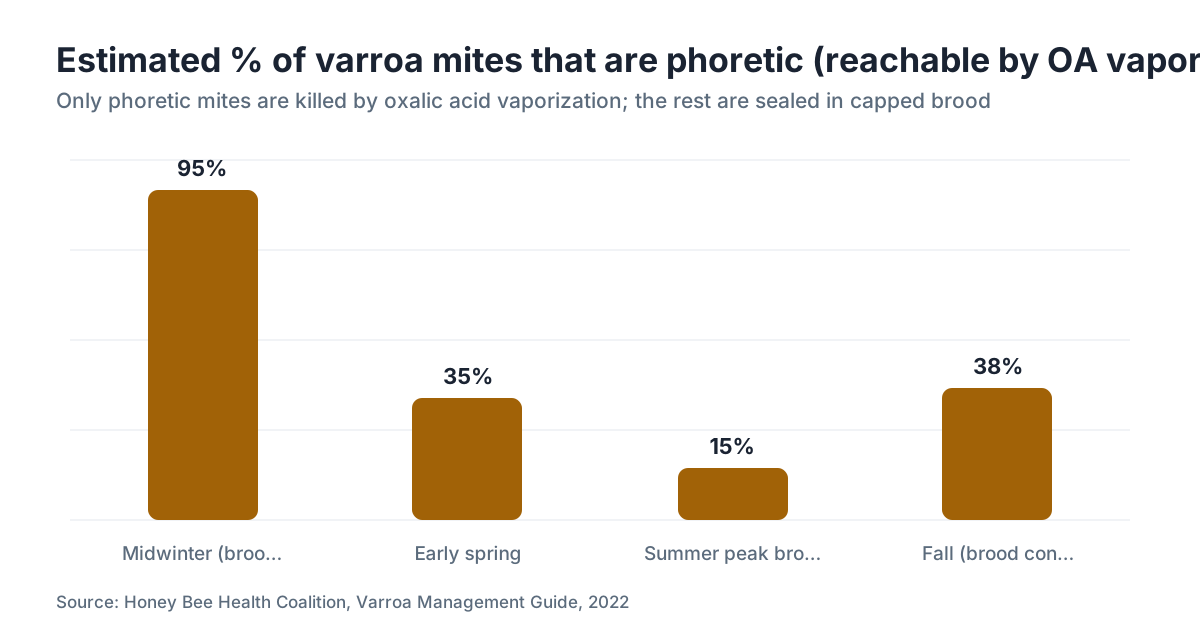
| Season | Approx. % mites phoretic | Approx. % mites in capped brood |
|---|---|---|
| Midwinter (broodless) | 90-100% | 0-10% |
| Early spring (light brood) | 30-40% | 60-70% |
| Summer peak brood | 10-20% | 80-90% |
| Fall (brood contracting) | 25-50% | 50-75% |
Source: Honey Bee Health Coalition, Varroa Management Guide, 2022 [5]
Does the type of brood (worker vs. drone) change anything?
Yes, more than most hobbyists expect. Varroa strongly prefer capped drone brood. Studies consistently find infestation rates in drone cells running 5 to 10 times higher than in worker cells.[6] Drone brood stays capped longer (about 14 to 15 days versus 12 for workers), which gives each mite more reproductive time, and mites appear to sense volatile cues from drone prepupae and pile into those cells before capping.
The preference doesn't change the physics. Those mites are still sealed away from oxalic acid vapor. But it has two practical effects. First, in spring, when colonies raise a lot of drone brood, your alcohol wash undercounts the real load because it misses the mites locked in drone comb. Second, drone brood removal (drone trapping) is a legitimate supplemental tool precisely because it physically pulls out a mite-heavy slice of the protected population.
Worker brood infestation shifts with colony strength and season, but during active brood-rearing you can generally expect somewhere between 1 and 3 mites per 100 worker cells in a colony sitting at threshold, with a much higher density in the drone cells alongside them.
How long does a varroa mite spend inside a capped cell?
Worker brood stays capped about 12 days before the adult bee emerges. Drone brood stays capped about 14 to 15 days. For that entire stretch, the mite inside is fully protected from OA vapor.
The mite doesn't wander in at random. A reproducing female (the foundress) enters a larval cell just before capping and starts laying. Her first egg is usually a male (haploid), the rest female. The daughters mate with the male inside the sealed cell, and the fertilized daughters ride out with the host bee ready to infest fresh cells. The foundress usually survives to do it again. The whole sequence plays out behind the wax.
That 12-day window is why the standard repeat protocol for OA vaporization in colonies with brood calls for applications every 5 days across three to four rounds.[7] The logic is simple. You treat, you kill the phoretics. Five days later, cells from your first round have emerged, releasing mites that are now phoretic, so you treat again. You keep going until you've cycled through the full capping period and caught every cohort as it surfaces. It isn't elegant. It works if you hold the timing.
Does oxalic acid have any effect at all on mites inside brood?
The honest answer is minimal to none under field conditions. A few lab studies looked at whether high OA concentrations could reach mites inside cells, and the results don't support in-cell efficacy. The concentrations needed to touch sealed cells are high enough to harm bees and brood first.[3]
Some beekeepers see a bigger mite drop than they expected after summer vaporization and decide the treatment is "getting into the brood." The likelier explanation is math. That drop reflects phoretic kill only, and it looks big because a summer colony can carry thousands of phoretic mites even at a low percentage. Fifteen percent of 5,000 total mites is 750 dead mites on the board. That looks like a win. But 4,250 are still under the wax.
The EPA-registered label for oxalic acid dihydrate (used in products like Api-Bioxal) says as much. The label describes the product "for treatment of honey bee colonies" and notes reduced efficacy in the presence of capped brood.[8] It's right there in the label language. Read the label.
What is a brood break and why does it make OA vaporization so much more effective?
A brood break is a deliberate pause in the colony's brood-rearing, long enough that all currently capped brood emerges and no new brood gets capped for at least 10 to 14 days. Pull that off and nearly 100 percent of the mite population is phoretic. One or two OA vaporizations during a brood break can drop infestation by 90 percent or more.[2]
There are a few ways to force the break. The most reliable is caging the queen for 12 to 14 days. Use a simple queen cage, a push-in cage over comb, or a queen castle. No queen, no eggs, no new capped brood once the current batch emerges. The colony will start emergency queen cells during the pause, so you'll need to manage those if you want the original queen back.
Natural brood breaks also happen in winter in northern climates. Many beekeepers time their late-fall or early-winter OA treatment to that window, after the last brood emerges but before cluster temperatures drop to where vaporization gets risky. A single vaporization in a truly broodless late-November colony in the northern U.S. is one of the strongest single moves available.
Re-queening during a break is another route. You pull the old queen (which itself buys a break), introduce a new one, and treat during the gap. Done with selected stock, this can also shift the colony toward hygienic traits.
For mapping this timing, monitoring tools help. VarroaVault has free mite management calculators that line up your brood cycle against treatment windows, so you're not guessing when the last capped cell should emerge.
How many oxalic acid vaporization treatments do you need if you can't do a brood break?
The accepted protocol for colonies with capped brood, based on label guidance and extension recommendations, is three to four applications spaced 5 days apart.[7] University of Minnesota Extension and others recommend the 5-day interval on purpose: it's shorter than the capping period, so you catch each cohort of mites as their cells open.
Why 5 days and not 7? Worker brood is capped for 12 days. Treat every 7 days and there's a stretch around day 5 to 7 of the capping period where mites from your last round have emerged and get 1 to 2 days to re-infest fresh cells before your next treatment. Tighter spacing shuts that gap.
Across three to four applications, real-world efficacy in colonies with brood usually lands in the 60 to 80 percent range, not the 90-plus you get broodless.[2] That's still worth doing. Start at a 5 percent alcohol wash (15 mites per 300 bees) and a 70 percent reduction gets you to about 1.5 percent, under most treatment thresholds. But it demands consistent timing. Skip one round or slide it a few days and the result slips noticeably.
One practical note: check your local rules. Some states and the EPA registration require OA vaporization be done by or under the supervision of a licensed applicator, depending on the product and method. Verify with your state department of agriculture before you buy equipment.
Are there other varroa treatments that get around the capped brood problem?
Yes, and knowing which tool fits which moment saves colonies.
Amitraz strips (Apivar) work over a 6 to 8 week contact period. As mites emerge from cells onto adult bees, they eventually contact the strip or treated bees and pick up the active ingredient. That long window covers the brood-protection gap, though you still need mites contacting the strip across the full capping cycle.[4] Apivar has a strong efficacy record and it's the treatment I'd reach for during peak brood season when a brood break isn't practical.
Formic acid (Mite Away Quick Strips, MAQS) is the one treatment with documented penetration into capped cells. The National Pesticide Information Center label material describes formic acid vapor diffusing through wax to some degree, so it can kill some mites inside brood. In-cell efficacy is real but variable, and formic acid carries real temperature limits (roughly 50 to 85 degrees F) and some brood loss risk, worse at the hot end.[9]
Hop beta acids (HopGuard 3) are another option, though in-cell data is thin and generally weaker than formic acid.
Thymol products (Apiguard, ApiLife Var) work by slow evaporation and reach into cells a little in warm conditions, but like formic acid they're temperature-dependent and in-cell efficacy is inconsistent.
The practical read: if you must treat during heavy brood season and can't break brood, Apivar is your most reliable pick. OA vaporization alone during peak brood is a partial treatment, so plan your monitoring around that. See our overview of varroa mite biology for more on how mite life stages line up with treatment timing.
How should you monitor after oxalic acid treatment to know if it worked?
Monitor, or you're guessing. A sticky board count in the 24 to 48 hours after treatment tells you how many phoretic mites you killed, and nothing more. A big drop number after a summer OA treatment does not mean the colony is below threshold. It means you killed the phoretics that were available at that moment.
The real test is an alcohol wash (or sugar roll, though the wash is more accurate) done at least 10 to 14 days after your last application, long enough for the post-treatment brood cohort to emerge and the mite population to settle. Take a 300-bee sample from the brood nest, not the outer frames. Count what washes out.
The Honey Bee Health Coalition recommends treating if an alcohol wash hits 2 percent (2 mites per 100 bees, or 6 mites per 300-bee sample) in spring and summer, and some extension services suggest acting at 1 percent in late summer and fall when colonies are raising winter bees.[5] Those thresholds exist because fall mite populations can crash a colony fast, well before obvious symptoms show.
Still above threshold after a full OA series? You have two moves: switch to a longer-contact treatment like Apivar, or force a brood break and re-treat with OA. Don't just run another OA series without figuring out why the first one fell short.
To log wash results and track treatment history over time, the free tools at VarroaVault help you see patterns across seasons instead of treating each hive check in isolation.
Can you combine oxalic acid vaporization with other treatments to improve efficacy?
Combinations are used, but the label restrictions matter and the research on running OA alongside other treatments at the same time is thin. You cannot legally apply Apivar strips and run OA vaporization at the same time in the same colony under current U.S. EPA registrations, because the combined residue profile isn't cleared and the label prohibits it.[8]
What works, in sequence, is OA vaporization for a midsummer knockdown of phoretics followed by a full Apivar treatment for the rest of the season. Or a brood break with OA in late summer, then an early winter OA vaporization if any brood remains. Layering interventions across the season, not stacking them at once, is the standard approach extension apiculturists recommend.
Drone brood trapping paired with OA vaporization is legal and sensible. Pull a frame of capped drone brood before you vaporize. That physically removes a mite-heavy slice of the protected population while OA handles the phoretics. It's extra work, and it meaningfully improves overall reduction compared to OA alone during drone-rearing season.
Treat combinations as sequential tools across a season, not simultaneous stacking. Build a calendar. Know when you last treated, what you used, and when your next monitoring point lands.
What mistakes do beekeepers make that let brood-protected mites rebuild fast?
The classic mistake is treating once and calling it done. One OA vaporization in summer, a pile of mites on the board, a good feeling, move on. Six weeks later the colony is collapsing. That pattern shows up constantly on beekeeping forums, and it almost always traces back to not understanding the brood-protection problem.
Second most common: sloppy timing on repeats. Beekeepers know to apply several times but do it "whenever they get around to it" instead of exactly every 5 days. Stretch a 5-day interval to 9 or 10 because of weather or schedule and some mites finish their whole in-cell cycle and re-infest between rounds.
Treating too late is another real trap. Do your first OA treatment in August, with peak brood and peak mites, and you're fighting uphill. Late summer is when mite populations climb fastest, because bee numbers are contracting (fewer bees to dilute the load) while brood stays high. University of Minnesota Bee Lab data shows mite populations can double in as little as three weeks under those conditions.[10] Early action, ideally holding loads below threshold in April and May, skips the late-summer crisis entirely.
And not monitoring before and after treatment means flying blind. Skip the alcohol washes and you don't know your starting load, don't know if the treatment worked, and can't see the trajectory. Monitoring is the base everything else sits on.
Frequently asked questions
Can oxalic acid vapor penetrate wax cappings if you use a higher dose?
No. The OA vapor concentrations needed to force meaningful penetration through wax cappings would kill adult bees and brood before reaching lethal levels for mites inside cells. The EPA-registered Api-Bioxal label sets dosage ranges for a reason. Using more than the label rate is illegal and counterproductive. The wax barrier is a physical limit, not a dosing issue.
How long do I need my colony to be broodless for oxalic acid to be most effective?
At least 12 to 14 days without capped brood puts nearly all mites in the phoretic phase. Fourteen days is the safer target because it covers drone brood, which stays capped for roughly 14 to 15 days. If you're caging your queen to force the break, release her after 14 days, then treat within 24 to 48 hours before she lays cells that get capped again.
Will a single oxalic acid treatment in winter kill all the mites if there is no brood?
In a truly broodless colony, one OA vaporization can kill 90 percent or more of the mites, according to multiple controlled studies. A second application 5 to 7 days later catches stragglers. 'Broodless' is the key condition, though. If your winter colony holds any capped brood, those mites are protected. Check your colony in October and November to confirm broodless status before relying on a single winter treatment.
How do I know if my colony is broodless before treating with oxalic acid?
Open the hive and inspect the frames in the brood nest. A broodless colony has no capped cells with that slightly darker, raised look of capped worker or drone brood. You may see stored pollen, honey, and the cluster, but cells should be open or empty. Checking 5 to 6 central frames is usually enough. Do it on a warm, calm day when you can see clearly without rushing.
Does formic acid work better than oxalic acid for treating varroa in capped brood?
Formic acid (Mite Away Quick Strips) has documented, though variable, ability to penetrate wax cappings and kill some mites inside cells. OA vapor does not. For colonies in full brood-rearing mode where you can't force a brood break, formic acid or amitraz strips (Apivar) are stronger options. Formic acid works only in a narrow temperature window (roughly 50 to 85 degrees F) and can cause brood loss at the hot end.
How soon after an oxalic acid vaporization treatment should I see mites dropping on the sticky board?
Mite drop usually starts within hours and peaks in the first 24 to 48 hours as phoretic mites die. A sticky board left in for 48 to 72 hours post-treatment gives a reliable count. A high number is reassuring, but it only reflects phoretic mites killed. Do an alcohol wash 10 to 14 days after treatment to get the true picture of total infestation.
Is it safe to eat honey from a hive treated with oxalic acid?
Yes. Oxalic acid is naturally present in honey at low levels. Studies show OA treatment does not meaningfully raise residues above naturally occurring levels. The EPA registration for Api-Bioxal permits the vaporization method with supers on during honey flow, unlike the dribble method. Read the current product label for exact guidance, since label language can change.
What mite level should I treat at before the issue gets into capped brood?
The Honey Bee Health Coalition recommends treating when an alcohol wash hits 2 percent (2 mites per 100 bees) in spring through midsummer, and 1 percent in late summer and fall. Treating at or below those thresholds gives you a better starting position. Once mites are deep into a brood-season surge, even effective treatment leaves enough survivors to rebound fast if you don't follow up.
How many times can I safely vaporize a colony with oxalic acid in one season?
The EPA-registered Api-Bioxal label permits up to three applications spaced at least 5 days apart per treatment event. The current label states no annual limit on treatment events, but good practice keeps mite loads below threshold so you aren't treating constantly. Heavy reliance on one method also carries resistance risk, though OA resistance in varroa has not been documented as a field problem as of 2024.
Can I vaporize oxalic acid with honey supers on the hive?
The Api-Bioxal label permits vaporization with supers on, unlike the dribble method, which requires removing supers. That's one practical edge of vaporization over dribble during active honey production. Always check the current label, since EPA registrations get updated. You can find the current label through the National Pesticide Information Center or the EPA pesticide registration database.
Why do some beekeepers report good results with oxalic acid vaporization in summer even without a brood break?
Multiple summer applications spaced 5 days apart can produce meaningful reduction even with brood present, because each treatment hits the freshly emerged phoretic cohort. Beekeepers also see big sticky board drops and feel it worked, but 60 to 70 percent reduction during brood season is the realistic ceiling, not 90-plus percent. If the pre-treatment load was low enough, even a partial knockdown can hold the colony below threshold.
Does the queen laying pattern affect how many mites are protected in capped brood?
Yes. A productive queen laying a solid pattern produces more capped brood at any moment, which means more protected mites and a harder treatment challenge. A colony with spotty brood or reduced laying (from age, disease, or intentional manipulation) has fewer cappings and a higher share of phoretic mites. This is part of why some beekeepers use re-queening events as natural treatment timing opportunities.
Are varroa mites inside capped brood cells ever exposed to any treatment at all?
Formic acid is the main licensed treatment with documented in-cell activity, diffusing through wax to some degree. Some research has looked at essential oil vapors, but field efficacy is inconsistent. For all contact-based and most vapor-based treatments, including oxalic acid, mites inside capped cells stay effectively protected for the full capping period, roughly 12 days for worker brood and 14 to 15 for drone brood.
Sources
- Rosenkranz et al., Apidologie, 2010 - Varroa biology and control review: Oxalic acid kills varroa mites by direct contact, damaging the mite cuticle; it does not act systemically through the bee host
- Gregorc & Planinc, Apidologie, 2001 - OA efficacy in broodless vs. brood-rearing colonies: OA vaporization efficacy exceeds 90% in broodless colonies but drops significantly in colonies with capped brood
- USDA Agricultural Research Service - Oxalic Acid as a Varroacide: Oxalic acid vapor deposits as crystals on exposed surfaces and does not penetrate wax cappings at registered application rates
- EPA - Apivar (amitraz) pesticide registration and label: Amitraz strips provide 6 to 8 weeks of contact exposure, compensating for the brood protection window that limits contact-only treatments
- Honey Bee Health Coalition - Varroa Management Guide, 2022: During peak brood season 80 to 90 percent of varroa mites are inside capped cells; the HBHC recommends treating at 2% alcohol wash result in spring/summer and 1% in late summer/fall
- Fuchs, Experimental & Applied Acarology, 1990 - Varroa preference for drone brood: Varroa mite infestation rates in drone brood cells run 5 to 10 times higher than in worker cells
- University of Minnesota Extension - Varroa Mite Management: For colonies with capped brood, the recommended OA vaporization protocol is 3 to 4 applications spaced 5 days apart to catch successive phoretic cohorts as cells emerge
- EPA - Api-Bioxal (oxalic acid dihydrate) Pesticide Registration Label: The Api-Bioxal label explicitly notes reduced efficacy in the presence of capped brood and permits vaporization with honey supers on the hive
- National Pesticide Information Center - Mite Away Quick Strips (formic acid) label information: Formic acid vapor can penetrate wax cappings and has documented in-cell varroa activity; application is restricted to temperatures between approximately 50°F and 85°F
- University of Minnesota Bee Lab - Varroa population dynamics research: Varroa mite populations can double in as little as three weeks during late summer when bee populations contract but brood levels remain significant
- Penn State Extension - Varroa Mite Management in Honey Bee Colonies: Worker bee brood is capped for approximately 12 days; drone brood for 14 to 15 days, during which mites are completely protected from topical or vapor treatments except formic acid
- Delaplane et al., Apidologie, 2005 - Seasonal dynamics of Varroa in managed colonies: The proportion of varroa mites in the phoretic phase is highest in winter (near 100%) and lowest in summer peak brood season (10 to 20%)
Last updated 2026-07-09