How to seal hive entrances during oxalic acid vaporization
TL;DR
- To seal a hive for oxalic acid vaporization, block every gap where vapor escapes: plug the bottom entrance with cut foam, close the screened bottom board from below, and shut any top vents.
- Keep the hive closed 10 minutes after the wand finishes.
- Leaks waste product, cut mite kill, and push a regulated respiratory hazard into your breathing zone.
Why does sealing the hive matter so much for OA vaporization?
Oxalic acid vapor kills varroa by filling the hive with a cloud of acid crystals that settle on adult bees. Vapor that escapes through gaps never reaches the mites, and your kill rate falls. That's the whole problem in one sentence.
Here's the field version. A beekeeper runs the wand the full two minutes, waits, checks the drop count a few days later, and the numbers are lousy. Nine times out of ten the screened bottom board was wide open, or the entrance plug was loose enough for bees to work it out. The treatment didn't fail. The seal did.
The EPA-registered label for Api-Bioxal (the only federally legal OA product for honeybees in the US) says the hive must stay closed for a minimum of 10 minutes after vaporization finishes [1]. Vapor needs that time to reach mites throughout the cluster. Open too early or run a leaky entrance and you cut effective contact time hard.
The vapor is a real hazard to you, too. Oxalic acid irritates the respiratory tract. OSHA sets a permissible exposure limit of 1 mg/m³ as an 8-hour time-weighted average [2]. A brief lungful at the typical 2-gram dose, up close, blows past that. Tight seals keep the acid in the box and out of your face. That's the practical case for doing it right.
What materials can you use to seal the entrance?
You have a few options and none of them cost much. You want a seal that stops vapor without trapping bees permanently or forcing you to hunt for a tool when it's time to open up.
Foam plugs. Cut open-cell foam (mattress topper offcuts or pool noodles) to fit the entrance slot snug. Most beekeepers cut a strip about 1.5 inches tall and press it in from the front. It fills the gap, bees can't shove through it, and it pulls out in seconds. Some suppliers sell purpose-made foam inserts. Foam wins for most people because it's cheap, reusable dozens of times, and installs in about 15 seconds.
Folded burlap or cloth. Stuff a wad of burlap in the entrance. It works. Getting a consistent seal is a bit harder than with cut foam because cloth compresses unevenly, but fold it tight and it does the job.
Cork reducers. If you run a wooden entrance reducer, a cork cut to the smallest opening seals well. Not common, but a few hobbyists with small yards like it.
Tape on screened bottom boards. A foam plug alone won't cut it on a screened floor. Vapor pours out the mesh. Slide coroplast or stiff cardboard into the sticky board slot, or tape plastic over the screen from below. People skip this step constantly, and it's the main reason vaporization underperforms in screened-bottom hives.
Foam and the rest turn up at any beekeeping supply companies or your hardware store. Nothing specialty required.
How do you seal a screened bottom board properly?
Close it from below before you insert the wand. That single step fixes the most common cause of weak vaporization results. The 8-mesh hardware cloth floor lets vapor drain straight out under the hive, and even a perfectly plugged front entrance can't stop it. A screened bottom will bleed off a big share of your dose before concentration ever builds around the cluster.
The fix is simple. Most screened bottom boards have a slot at the rear or side for a sticky board. Slide in a solid piece of coroplast (corrugated plastic), the included sticky board, or a sheet of cardboard. That closes the screen. No drawer slot? Cover the mesh from underneath with aluminum or HVAC foil tape. Foil tape sticks even in the cold and peels off without wrecking the screen.
Some beekeepers tip the hive back a little so any condensation doesn't pool, then seal from below. Either way, the screen gets closed first.
Leave the insert in for the full 10-minute dwell, then pull it. There's no gain to closing the bottom longer than that, and in warm weather bees start getting restless and hot after 15 to 20 minutes.
What about top entrances, ventilation holes, and other gaps?
Any opening wider than a couple millimeters is a leak. Walk the hive before you treat and hunt for these:
Top entrances. A notch cut in an upper super or inner cover has to close. Foam, cork, or tape. Five seconds.
Notched inner covers. The standard Langstroth inner cover has a notched hole. Flip it notch-down so the flat side faces up, or plug the notch with foam.
Cracks between boxes. Warped or old equipment sometimes gaps at the box joints. One strip of painter's tape along the seam handles it and leaves no residue. You don't need to tape every box on tight equipment, but if you see light through a gap, tape it.
Telescoping outer covers. These usually seal on their own. If the fit is sloppy, drop a brick or two on top so the cover seats down.
Hive body holes or cracks. Look for woodpecker damage or a corner that old comb has deformed. Tape it.
The Honey Bee Health Coalition's Varroa management guide says vapor concentration depends on closing the hive and recommends a gap inspection as part of standard vaporization [3]. Two minutes of leak-checking before you heat the wand is the highest-value prep in the whole job.
What is the right order of operations: seal first or vaporize first?
Seal first. Always.
Insert the wand through a purpose-made slot in the entrance board (or a small gap left just for the wand), close everything else, then fire it up. Once the wand heats the crystals and vapor starts (usually 30 to 60 seconds in, depending on the device), you want that cloud going nowhere but into the hive.
A working sequence:
- Put on full PPE (respirator with OV/P100 cartridges, gloves, eye protection) before you touch the oxalic acid or power the wand.
- Load the dose. Api-Bioxal allows 1 gram per brood box, up to 2 grams total per colony per application for vaporization [1].
- Close the screened bottom board if you have one.
- Insert the wand through the entrance slot.
- Plug around the wand with foam, leaving just enough gap for the handle.
- Close all other openings.
- Run the vaporizer to completion (most Varromor and ProVap units finish a 2-gram dose in roughly 2 to 3 minutes).
- Once it cycles off or you confirm vaporization is done, plug the leftover gap around the handle with a second piece of foam, or pull the wand and plug the hole entirely.
- Wait the full 10 minutes.
- Remove plugs and open the bottom board.
Some beekeepers pull the wand right after vaporization and seal the wand hole before the timer starts. That's fine. Just don't open the hive or pull the main plug until 10 minutes have passed.
How do you handle hives with specialized entrance boards or wand slots?
A commercial entrance board built for OA vaporization solves most of the sealing puzzle by itself. The board has a small round or rectangular hole sized for your wand, and the rest of it closes the entrance completely. Slide it in, push the wand through the hole, and the setup is basically self-sealing. These run about $10 to $20 each and earn their keep if you treat more than a handful of hives.
Building your own is easy. Cut a piece of 3/4-inch plywood to fit the entrance slot. Drill a hole sized to your specific wand (measure the shaft diameter, since it varies by brand). Some beekeepers glue in a short piece of PVC pipe so the wand slides smoothly and the fit is the same every time.
For 5-frame nucs, the entrance is shorter and shallower. A smaller foam piece or a nuc-specific board handles it. Nuc dose is typically 1 gram per the Api-Bioxal label [1].
Running several hives and mapping out your whole varroa plan? The free varroa mite treatment scheduler at VarroaVault tracks which colonies you've treated and when, so you don't lose count across a yard.
How long should the hive stay sealed, and what happens if you open it too soon?
The label says 10 minutes minimum after vaporization finishes [1]. In cold weather (below about 50°F), some experienced beekeepers stretch it to 12 to 15 minutes, because a cold cluster is dense and vapor may move through it slower. Nobody has published a rigorous 10-versus-15-minute dwell comparison for cold conditions, so the honest read is that the label minimum is the floor and a little extra probably won't hurt.
Crack the hive at 3 or 4 minutes because you're rushed, and you cut off vapor contact with the mites riding bees deep in the cluster. Mites on adult bees are the target here. Oxalic acid barely touches mites under capped brood. Shorten contact time and you shorten mite kill.
There's a safety cost too. Opening at 3 minutes means OA vapor is still thick in there. Walking into that without a respirator is a genuine respiratory hazard.
After the 10 minutes: open the entrance, pull the bottom board insert, and open any sealed vents. Bees don't need a long recovery. The colony is back to normal traffic within minutes.
Does the sealing process change in winter compared to summer?
The fundamentals hold in both seasons. Winter just brings a few wrinkles worth knowing.
In winter the bees are clustered and grounded, so no foragers come home and push against your plug. The seal holds itself. The trouble is that vapor condenses faster in cold equipment and may not reach as deep into a tight winter cluster on a single pass. That's part of why vaporization protocols often call for 3 applications at 5-day intervals to catch emerging adults [3].
In summer, foragers try to bolt within 2 to 3 minutes. A loose plug gets shoved out by agitated bees. Use a snug fit and check it once after you insert it. If bees are working the plug edge, press it tighter or size up.
Temperature also hits your vaporizer. Most battery and corded units are rated for a specific range. Below about 20°F, some take longer to heat or produce vapor unevenly. Read your device manual.
Moisture bites harder in winter. Condensation in cold boxes can make crystals settle instead of fully vaporizing. A well-maintained vaporizer that hits the right temperature (OA sublimates at about 157°C / 315°F) matters as much as the seal itself [8].
What PPE do you need when handling entrance seals during vaporization?
You should already be in full PPE by the time you're crouched at the entrance. PPE isn't the thing you pull on after the gear is set up. It goes on first.
The minimum for OA vaporization is an air-purifying respirator with combination cartridges rated for organic vapor plus P100 particulate. A dust mask or surgical mask does nothing useful here. Particulate filters alone don't capture OA vapor; you need the organic vapor element. NIOSH-approved half-face respirators with OV/P100 cartridges are what beekeeping safety guidance points to [2].
Past the respirator: chemical splash goggles or a face shield, nitrile or rubber gloves, and sleeves that cover your arms. OA irritates exposed skin and mucous membranes.
The sealing step drops you to entrance level with your hands near the opening. If a plug seats poorly and you're stuffing it while the wand's already running, vapor can drift back at you. Get everything positioned before you power the wand, and don't kneel with your face at entrance height once vapor is generating.
The EPA's Api-Bioxal label carries a full PPE section that is legally binding for registered use in the US [1]. Read it and follow it. State departments of agriculture do inspect for label compliance.
How many times should you vaporize, and does the sealing protocol change for repeat treatments?
The Api-Bioxal label allows up to 3 applications per treatment period for vaporization, each at least 5 days apart [1]. The sealing routine is the same every single time. Nothing changes for a repeat.
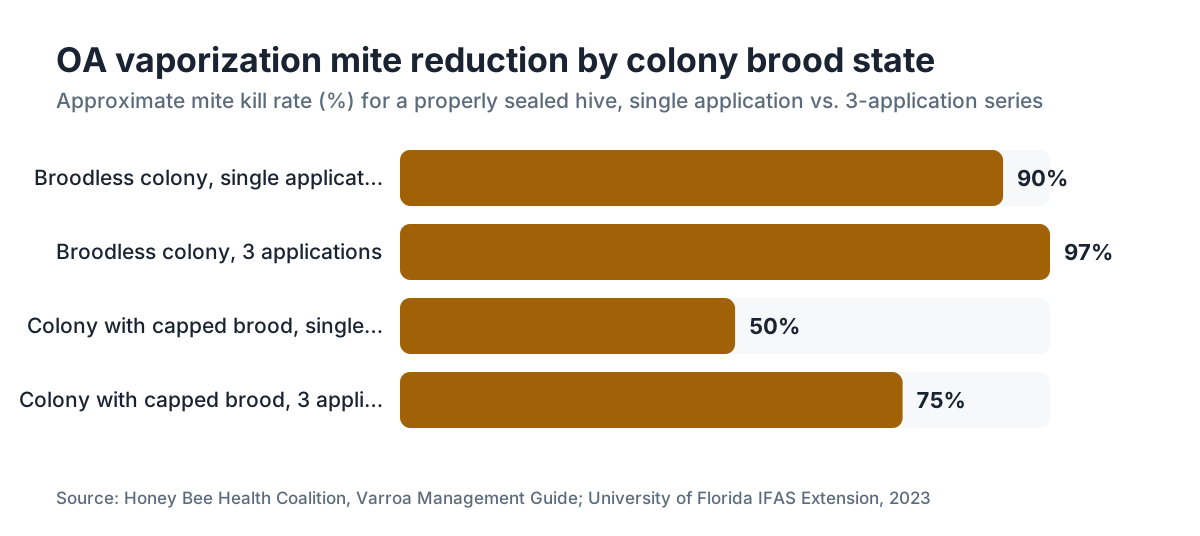
Multiple applications help because vapor doesn't reach capped brood. Mites in sealed cells are protected. Across a 5-day cycle, mites that hid under cappings during the first pass emerge onto adult bees and catch the second or third dose. In a broodless colony (natural or induced through swarm control), a single application can hit very high kill. University of Florida IFAS research found a single OA vaporization in broodless colonies cut mite loads by over 90% in some trials [4].
With a lot of capped brood, one treatment does a partial job. Three well-spaced treatments still won't zero out every mite, but they can knock the population down enough to carry the colony through a hard stretch.
Some beekeepers run a varroa mite alcohol wash or sugar roll before and after a series to measure real efficacy. That feedback tells you whether your sealing and protocol are working or whether you've got a consistency problem.
Are there mistakes that ruin an otherwise good vaporization treatment?
Yes, and several trace straight back to sealing.
Not covering the screened bottom board. Probably the single most common error. Beekeepers plug the front entrance perfectly, then lose half their vapor through the floor. Results look weak, and they blame the treatment or the mites. Cover the screen.
Pulling plugs at 5 minutes because the bees seem agitated. Bees are always agitated. Wait the 10 minutes.
Sealing after you've powered the wand. Start vaporizing and then scramble to close gaps, and you're breathing OA while fumbling with foam. Seal first, then start.
Taping painted surfaces without thinking. Painter's tape is low-tack and safe on equipment. HVAC foil tape is great on screens and metal but will lift a wood finish off box joints.
Treating a colony with over 50% capped brood and expecting broodless-level results. Not a sealing error, but it's why people think their technique failed when the protocol itself has limits.
Skipping seal checks between applications. Foam plugs compress with use and may not seat as tight on the second or third round. Twenty seconds to eyeball them before each use.
For a full look at your varroa options and treatment timing, the Honey Bee Health Coalition's Varroa management guide is the most practical free resource going [3]. VarroaVault's free treatment tracking keeps a multi-hive schedule straight across a series.
Is there a difference in sealing technique for Warré, top-bar, or other non-Langstroth hives?
Yes. The principles hold, but the execution shifts with the box.
Warré hives usually have a small bottom entrance. Same approach: foam plug in the entrance, close any quilt box vents up top. The quilt box on a Warré often carries burlap or mesh that needs covering from above. A sheet of newspaper or fabric laid over the quilt layer before you close the roof helps hold vapor down.
Top-bar hives run longer entrance setups, often several holes. Plug all of them. Top-bar hives sometimes gap along the bar ends where bars don't meet the walls cleanly. Check those and tape them. Vaporizing a leaky top-bar hive is genuinely hard, and some top-bar keepers prefer the oxalic acid dribble for that reason.
Log hives, mud beehives, and other traditional builds vary so much there's no single answer. The question is always the same: can you get vapor concentration to build inside? If the structure is porous or riddled with gaps you can't control, vaporization may not be practical, and another OA delivery method might serve better.
For Langstroth gear and the materials to keep it sealing consistently, any reputable beekeeping supply companies stocks everything named in this article.
Frequently asked questions
Can I use a regular foam ear plug to seal the hive entrance?
You can, but you'd need a row of them end-to-end for a standard Langstroth entrance. Ear plugs are small and compress easily, so bees push them out. A strip of open-cell foam cut to the entrance width works far better. Pool noodle cross-sections cut to about 1.5 inches tall are a popular DIY fix and cost almost nothing.
Do I need to seal the hive if I'm using an oxalic acid vaporizer with a built-in entrance board?
Mostly, yes. A built-in board closes the main opening around the wand, but you still need to cover the screened bottom board from below and check for upper entrances or gaps. The board handles the front. Nothing replaces a quick leak check of the whole box before you start.
How tight does the foam entrance plug need to be?
Tight enough that you feel light resistance pushing it in, and it doesn't shift when you let go. You shouldn't see daylight around the edges. It doesn't need to be so tight you're driving it with a hive tool. If bees are visibly pushing the foam out in the first few minutes, it's too loose. Cut a slightly bigger piece.
What happens if I accidentally leave the entrance sealed for an hour?
In warm weather, prolonged sealing is genuinely risky. Bees can overheat and suffocate when sealed for long stretches, especially a strong colony on a hot day. In cool weather, 20 to 30 minutes is probably fine. But there's no benefit past the 10-minute minimum, and in summer you shouldn't leave a hive fully sealed for more than about 15 to 20 minutes after vaporization.
Can OA vapor leak through wood itself?
Not meaningfully through solid wood. The concern is gaps at joints, entrances, and screens, not wood porosity. Standard hive lumber is dense enough that vapor doesn't permeate it at treatment concentrations. Put your sealing effort into actual openings and mechanical gaps.
Do I need to seal the hive differently if I'm treating a two-story or three-story colony?
The entrance sealing is the same. The difference is that vapor from a bottom entrance has to climb further to reach the top boxes. Some beekeepers with tall hives do two wand insertions, one at the bottom and one through a taped hole at the top box. The Api-Bioxal label caps total dose at 2 grams per colony per treatment, so split the dose if you use two insertion points.
How do I seal the hive if I'm using a battery-powered vaporizer versus a corded one?
The sealing is identical regardless of power source. The wand shape and diameter can differ between devices, so cut your entrance board hole or foam gap to fit your specific wand. Some battery wands are thicker than corded units. Measure once, cut foam to match, and keep that foam with that device so the fit is always right.
Is oxalic acid vaporization legal in my state without a prescription?
Api-Bioxal received full federal registration from the EPA in 2015 and is legal for hobbyist use across US states under that registration, with no veterinary prescription required for the vaporization method. State rules can still vary. Check your state department of agriculture, since some states add their own requirements on top of the federal label.
Does the type of entrance reducer affect how I seal the hive?
Yes, a little. With a wooden reducer set to a small notch, you need far less foam to fill it than a fully open 4-inch entrance. Measure what you've got. Some beekeepers close the reducer to its smallest setting before adding foam, which cuts how much foam you need and makes a tighter seal easier to hit.
Should I remove my entrance feeder or boardman feeder before vaporizing?
Yes. Pull any entrance feeder, boardman feeder, or other device in the entrance before treatment. They leave irregular gaps that are hard to seal, and OA vapor contact with sugar syrup isn't something you want in a feeder you'll reuse. Take it out, treat, and reinstall after the dwell time.
Can I check for entrance seal leaks while the vaporizer is running?
You can spot escaping vapor as a faint white haze near gaps in the right light. But don't crouch to entrance level to look while the wand is active, even with a respirator on. Check for obvious leaks before you start. If you see a gap after vaporization has begun, step back upwind, take a breath, then approach to plug it. Don't hover over a leaking entrance.
How does sealing affect treatment efficacy compared to other factors like brood state?
Brood state has the largest effect. A broodless colony in a properly sealed hive can hit 90%+ mite reduction in a single application. The same colony sealed but full of capped brood might see 40 to 60%. Sealing is what lets you reach whatever maximum the brood state allows, but it can't rescue a single application on a heavily brooded colony.
Sources
- EPA, Api-Bioxal (oxalic acid) Federal Pesticide Label: Api-Bioxal label specifies hive must remain closed 10 minutes after vaporization, allows up to 2 grams per colony per application and up to 3 applications per treatment period for the vaporization method.
- OSHA, Occupational Chemical Database: Oxalic Acid: OSHA permissible exposure limit for oxalic acid is 1 mg/m³ as an 8-hour time-weighted average; respirator with OV/P100 cartridges recommended for vaporization work.
- Honey Bee Health Coalition, Varroa Management Guide (Tools for Varroa Management): HBHC recommends inspecting hives for gaps as part of OA vaporization protocol and notes that multiple applications at 5-day intervals are needed to address mites in capped brood.
- University of Florida IFAS Extension, Oxalic Acid for Varroa Control: University of Florida research found single OA vaporization treatment in broodless colonies reduced mite loads by over 90% in some trials.
- Pennsylvania State University Extension, Varroa Mite Management: PSU Extension notes that screened bottom boards must be closed during OA vaporization to prevent vapor loss and maintain effective hive concentration.
- USDA Agricultural Research Service, Honey Bee Research: USDA ARS research supports use of oxalic acid as an effective varroa miticide with low residue levels in honey when used according to label.
- EPA, Pesticide Registration for Api-Bioxal (Reg. No. 81310-1): Api-Bioxal received full Section 3 federal registration from the EPA in 2015, making it the only federally registered OA product for honeybee varroa control in the US.
- North Carolina State University Extension, Apiculture Program: Varroa Mite Control: NCSU Extension recommends PPE including an OV/P100 respirator, goggles, and gloves when vaporizing oxalic acid, and confirms OA sublimates at approximately 157°C.
- Honey Bee Health Coalition, Varroa Management Guide: Broodless Period Treatments: HBHC notes OA vaporization has limited effect on mites under capped brood and that broodless colonies are optimal targets for single-application treatment.
- Virginia Cooperative Extension, Beekeeping: Varroa Mite Control Options: Virginia Cooperative Extension confirms that entrance and bottom board sealing are required steps for effective OA vaporization and that dwell time of at least 10 minutes is critical.
Last updated 2026-07-09