Is oxalic acid treatment safe during a honey flow?

TL;DR
- Oxalic acid is EPA-registered for honey bee colonies, but the label bans treatment when honey supers are on and that honey goes to people.
- Oxalic acid already occurs in honey naturally, and registered treatments add little on top.
- The real problem during a flow isn't bee poisoning.
- It's breaking the label and picking up residue in your supers.
What does the EPA label actually say about honey supers?
The label bans it. The EPA-registered label for Api-Bioxal, the only oxalic acid product with a full Section 3 registration for U.S. beekeepers, says: "Do not use when honey supers are in place and the honey is to be used for human consumption." [1] That's the rule. It's not a suggestion.
So the legal answer to treating during a honey flow is no, not with supers on and that honey headed for people. Pull the supers first, treat, then put them back after the treatment window passes.
The label lists three approved methods: trickle (dribble), vaporization (sublimation), and extended-release oxalic acid-glycerin strips sold under the Api-Bioxal label. Each has its own timing and dose. The super restriction covers all of them. [1]
Read the wording closely. The label says "when honey supers are in place." It doesn't say "when bees are foraging" or "when nectar is flowing." No supers on means you're inside the label language even during a flow. That's a narrow situation, though, and most hobbyists won't hit it during peak season.
Does oxalic acid actually contaminate honey?
Oxalic acid is already in honey, naturally, and registered treatments add very little to that baseline. That's the honest answer to what people really mean when they ask about safety during a flow.
Oxalic acid shows up in untreated honey at levels that swing with floral source, usually 8 to 58 mg/kg. [2] A German study in Apidologie found that vaporization treatment did not raise oxalic acid residue in honey to any meaningful degree compared with untreated control colonies, and every value stayed inside the range you find in natural honey. [3]
The Honey Bee Health Coalition's Varroa management guide says the same thing: oxalic acid residue in treated honey isn't a documented human health concern under normal use. [4] "Normal use" means following the label, which means no supers during treatment.
So why does the restriction exist if residue is small? Partly regulatory caution. When EPA registers a pesticide, it builds in a buffer. The residue data came from colonies without honey supers, so the label matches the conditions the data were collected under. Call it a data-boundary restriction as much as a safety one.
Here's the practical part. If a super is on during vaporization, some oxalic acid vapor condenses on comb, including stored nectar and honey. Studies haven't turned up alarming residue even then. But nobody has run the full worst-case study with supers loaded during a heavy flow, so the uncertainty is real. The label is the only honest guide you've got.
How does oxalic acid actually work against varroa mites?
Oxalic acid kills mites on contact, and only the ones riding on adult bees. Understanding that one fact explains why timing and method matter so much.
Oxalic acid disrupts the mite's cuticle and interferes with cell function. It reaches mites in the phoretic stage, exposed on adult bees. Mites sealed inside capped brood cells are completely protected, no matter how you apply it or how much you use. [4]
That's the central limit. Treat during a honey flow and your colony almost certainly has a packed broodnest, plenty of capped cells, and plenty of hidden mites. A single treatment at peak brood kills the phoretic mites and leaves the brood-phase mites untouched. Those mites emerge over the next 12 to 21 days and start a fresh phoretic cycle.
This is why oxalic acid does its best work in broodless colonies. Late fall, when the queen has stopped laying. Or a forced broodless stretch from queen caging or a split. Some beekeepers run repeated applications through the brood-rearing season with extended-release glycerin strips, which release oxalic acid slowly over weeks and catch mites as they emerge from capped cells. [5]
For the full biology, see our article on the varroa mite.
During a heavy flow, with the colony jammed with brood and foragers, oxalic acid is your weakest knockdown tool. That's a separate issue from residue, but it matters just as much when you decide whether to treat.
What are the real efficacy numbers for OA during brood-rearing season?
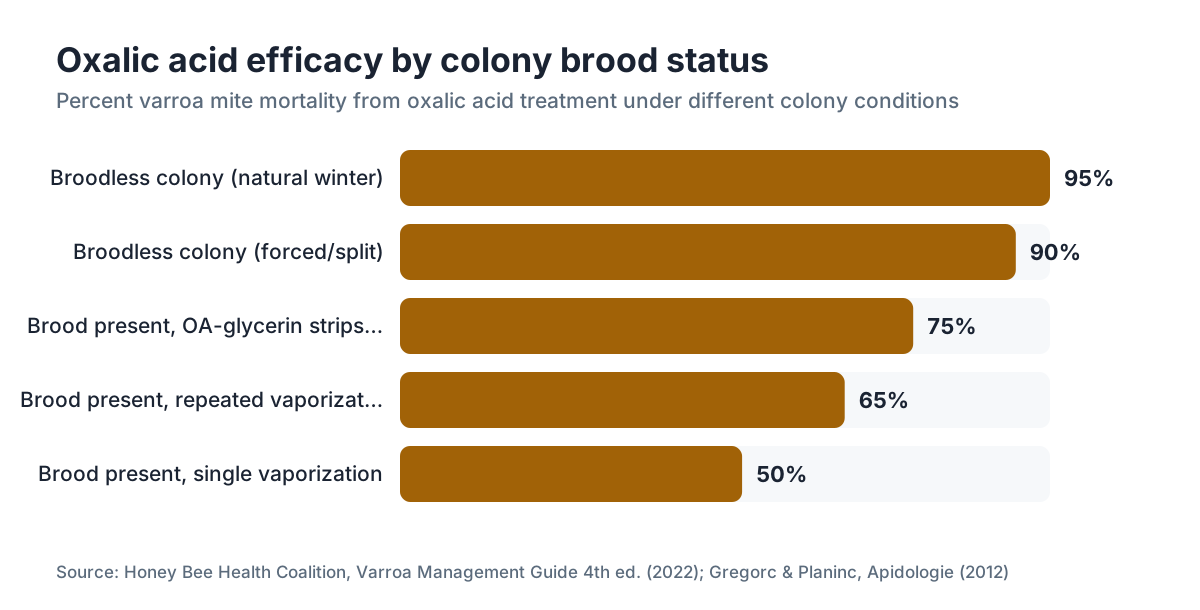
One oxalic acid dribble or vaporization in a colony with brood usually knocks down 40 to 60 percent of the mites. [4] In a broodless colony, the same treatment hits 90 to 97 percent. [6] Those are two different worlds.
Here's the range across scenarios:
| Scenario | Application Method | Typical Efficacy |
|---|---|---|
| Broodless colony (winter/fall) | Dribble or vaporization | 90-97% |
| Broodless colony (forced) | Dribble or vaporization | 85-95% |
| Colony with brood, one treatment | Vaporization | 40-60% |
| Colony with brood, repeated treatments | OA-glycerin strips (extended release) | 60-90% (cumulative) |
Sources: Honey Bee Health Coalition Varroa Management Guide, 4th ed. [4]; Gregorc & Planinc, Apidologie 2012 [6]
Repeated vaporizations spaced about 5 days apart, timed to catch mites as they emerge from capped cells, can push efficacy up during brood season. You're still running into the super restriction, though. Extended-release oxalic acid-glycerin strips are the only method built for continuous exposure during brood-rearing, and they're registered for the active season without supers.
Mid-flow with your mite count spiking, a single vaporization without supers beats nothing. It won't fix your problem. You'll have to decide: pull supers for a day, pair oxalic acid with a brood break, or switch to a different registered treatment class.
Is oxalic acid safe for bees during a honey flow?
Yes. At label rates, oxalic acid is safe for adult bees. That's a different question from whether the honey is safe for you, and the answer runs the other direction.
Api-Bioxal vaporization calls for 1 gram of oxalic acid per brood chamber. Dribble is 5 mL of 3.5% oxalic acid solution per seam of bees, 50 mL max per colony. [1] At those doses, forager mortality and queen survival don't differ from untreated colonies in published studies. Workers absorb some oxalic acid through their tarsi and integument, but their tolerance sits well above the mite's.
Heat changes the picture. At very high ambient temperatures, some beekeepers report a bit more bee die-off after vaporization, though controlled studies on this are thin. I'd think twice before vaporizing into a colony on a 95-degree afternoon, flow or no flow.
Overdosing is where bee safety breaks. More oxalic acid than the label allows can kill adult bees and damage brood. The label dose is both floor and ceiling. Beekeepers who figure "more is better" are wrong, and they're hurting their bees.
During a flow, the colony is under load. Workers fly flat out, the queen lays at peak. Every added stressor stacks up. At label rates, though, oxalic acid won't noticeably hurt a strong colony.
What happens if you treat with OA with supers on? (Residue risk in detail)
Treating with supers on is off-label use, and that's a problem no matter what the residue numbers say.
Do it and you're outside the label. You may be violating FIFRA, the Federal Insecticide, Fungicide, and Rodenticide Act, and if you sell that honey, you're carrying liability. [7] For commercial and sideliner beekeepers, that's a real business risk.
For hobbyists who eat all their own honey, the residue side is more forgiving scientifically, even though it's still off-label. Background oxalic acid in honey runs roughly 8 to 58 mg/kg depending on floral source. [2] The EU sets a maximum residue limit of 25 mg/kg for added oxalic acid in honey. The U.S. has no MRL because oxalic acid is exempt from residue tolerance requirements under its EPA registration. [8]
Vaporization lays down oxalic acid as a condensed film on hive surfaces. Bees clean it off over time, but fresh honey in supers exposed to that vapor picks up some. How much depends on how close the supers sit to the vaporizer, how long you run it, and how much capped versus uncapped honey is in there. Nobody has published a clean study on exactly this scenario under U.S. flow conditions.
My honest take: the honey residue risk is probably modest. The regulatory and liability risk is not. Pull the supers.
When is the best time to do an oxalic acid treatment relative to the honey flow?
The best window opens right after you pull supers at the end of the main flow, before the colony builds its winter cluster. Planning it around your local flow takes a little thought, but it's easy to do.
Across most of the northern U.S. that window lands somewhere between late July and October depending on your region. [5] The colony still has brood in August and September, so one treatment won't match a December or January broodless treatment. But mite pressure often peaks in late summer, and you can't wait until winter.
Some beekeepers run a late-summer oxalic acid-glycerin strip treatment while the colony is still raising winter bees, then follow with a winter dribble or vaporization once it's broodless. This two-punch approach is getting common and it's well supported by the HBHC guide. [4]
Spring is trickier. If your counts are already up before the flow, above 2 mites per 100 bees on an alcohol wash, you've got a harder call. Treating with oxalic acid before supers go on is label-compliant and sensible. A single early-spring vaporization with no supers on is fine. Then monitor through the flow without treating, and treat again after you pull supers.
For tracking counts through the season, the free monitoring calculators at VarroaVault can help you tell when the numbers are bad enough to justify pulling supers.
The worst time is smack in the middle of the flow with supers on, hoping to split the difference. That's where people break the label and get weak efficacy at the same time.
How do other varroa treatments compare during a honey flow?
Oxalic acid isn't your only option, and some alternatives carry different label language for honey flow conditions.
Formic acid (Mite Away Quick Strips, FormiVar) does something oxalic acid can't: it penetrates cappings and kills mites inside brood cells. MAQS labels allow treatment with honey supers on, which makes formic acid the most flow-compatible varroa treatment registered in the U.S. [9] The tradeoff is a higher queen-loss risk in heat above 85 degrees F and heavy bee irritation.
Thymol products (Apiguard, ApiLifeVar) aren't approved with supers on, and they need temperatures above 59 degrees F to volatilize well. They run a 4-week contact period, so the timing is fussy. [10]
Amitraz strips (Apivar) need supers off and run a 6-to-8-week treatment. Not a flow-season tool.
HopGuard 3 (hops beta acids) is labeled for use with honey supers present, but its efficacy data are weaker than oxalic or formic acid. [4]
So mid-flow, with supers on and a mite count that won't wait, formic acid (MAQS at the right temperature) is your best compliant option. Oxalic acid needs supers pulled. Thymol and amitraz need supers pulled plus extra timing constraints.
For applicators, vaporizers, and protective gear, our beekeeping supplies guide covers the equipment side.
What do extension services and the Honey Bee Health Coalition recommend?
They all say the same core thing: use oxalic acid in broodless colonies, follow the label, keep supers off. The Honey Bee Health Coalition's Varroa Management Guide (4th edition, 2022) is the most thorough practitioner resource out there, and it's free. [4] Its oxalic acid guidance is plain: use it in broodless colonies for top efficacy, follow label directions (no supers with honey for human consumption), and treat extended-release strips as a brood-season alternative.
Penn State Extension, Ohio State Extension, and UC Davis Cooperative Extension echo the same label-compliance guidance. Penn State's apiculture pages call oxalic acid the lowest-toxicity registered treatment for bees, but they're blunt that "the label is the law" and the super restriction holds. [5]
The USDA Agricultural Research Service has published work backing oxalic acid's low residue profile, and it doesn't advocate off-label use either. [11]
Everybody agrees on the shape of it. Oxalic acid is a good tool, bees tolerate it well, and honey residue isn't a real food-safety concern at label rates. The restriction on supers stands and should be respected. The consensus isn't "don't use oxalic acid during a flow." It's "pull supers, treat, replace supers."
How do you remove supers safely to treat mid-season without losing honey?
Pulling supers for a day is easier than it sounds. If you need to treat in summer and oxalic acid is your tool, the logistics won't cost you much honey.
Start the evening before with a bee escape board, or a fume board with Bee-Quick or Bee-Go, to clear the bees. Fume boards work in about 5 to 10 minutes on a warm day. [12] Once cleared, stack the supers somewhere bee-tight: sealed in a garage, wrapped in black plastic in the shade, or in a chest freezer if they aren't fully capped yet.
Treat the colony. A single vaporization dose runs about 2 to 3 minutes per hive. A dribble is faster still.
After treatment, the Api-Bioxal label sets no mandatory wait before replacing supers for vaporization, since the vapor dissipates fast. [1] Some beekeepers give it an hour to be safe. The dribble method leaves a liquid oxalic acid solution that bees clean up over 24 to 48 hours, so waiting a full day before replacing supers is reasonable, though the label doesn't require it.
At scale, pulling supers off 20 or 30 hives mid-flow is real labor. That's a fair argument for switching to formic acid, or for monitoring hard in spring so you never face a mid-flow mite crisis.
With 2 to 10 hives, pulling supers for a day is a minor hassle. Don't let it stop you from treating.
What mite count threshold should trigger treatment during honey season?
Treat at 2 mites per 100 adult bees during the brood-rearing season, measured by alcohol wash. That's the Honey Bee Health Coalition threshold, and the real question underneath it is whether you'll accept short-term honey loss to keep the colony alive. [4]
At 3 percent and up during the flow, you're probably heading for a collapse by late summer or fall. Varroa growth is exponential. A 3 percent count in July can hit 5 to 8 percent by September with no intervention.
Waiting for the flow to end is fine if your count sits at 1 percent or below in July. If you're at 2 percent in June and your main flow runs through August, waiting may be a colony-killing decision. A few frames of capped honey aren't worth the whole colony.
Alcohol wash is the gold standard. Done right with a proper 300-bee sample, it's accurate to within about 10 to 15 percent of the true mite load. [4] Sugar rolls run less accurate and tend to undercount. Sticky boards alone won't give you a true infestation rate.
Measure. Know your number. Then make a rational call about pulling supers and treating versus waiting. Don't guess.
Frequently asked questions
Can I vaporize oxalic acid with honey supers on if I'm not selling the honey?
Even if you eat all your own honey, vaporizing with supers on is still off-label use of a federally registered pesticide. Using any pesticide in a way inconsistent with its label violates FIFRA. Your personal residue risk may be low, but the legal risk is real. Pull the supers, treat, and replace them. The inconvenience is small next to the exposure.
How long do I need to wait after an oxalic acid treatment before putting supers back on?
The Api-Bioxal label sets no mandatory wait before replacing supers after vaporization, since the vapor disperses fast. Most experienced beekeepers give it one to a few hours as a precaution. After a dribble, waiting 24 to 48 hours makes sense so bees can clean up the liquid. Re-read the current label before treating, since registrations get updated.
Does oxalic acid kill varroa mites in capped brood cells?
No. Oxalic acid only kills phoretic mites, the ones riding on adult bees outside brood cells. Mites inside capped cells are completely protected. That's the core limit during brood season. Extended-release oxalic acid-glycerin strips work around it by exposing newly emerged phoretic mites continuously over weeks, which is why they beat a single application during brood-rearing.
What is the oxalic acid residue level allowed in honey?
In the U.S., oxalic acid is exempt from residue tolerance requirements under its EPA registration, so there's no established MRL for treated honey. The EU sets an MRL of 25 mg/kg for added oxalic acid residue in honey. Natural background oxalic acid in untreated honey usually falls between 8 and 58 mg/kg depending on floral source. At label rates, treatment adds minimal residue above background.
Is formic acid better than oxalic acid during a honey flow?
For an active flow with supers on, formic acid (MAQS or FormiVar) has a real label advantage: it's registered for use when honey supers are present. It also kills mites in capped brood, which oxalic acid can't. The downsides are higher queen-loss risk above 85 degrees F and stronger bee irritation. If your mite count forces mid-flow treatment, formic acid is your most practical compliant option.
How many oxalic acid vaporization treatments does it take to work during brood season?
One vaporization in a colony with brood usually reaches 40 to 60 percent efficacy. To push toward 80 to 90 percent during brood season, some beekeepers run three vaporizations spaced 5 days apart to catch mites emerging from capped cells. All treatments must be done without honey supers. Extended-release oxalic acid-glycerin strips are the more practical multi-week option registered for the active season.
Is oxalic acid safe for the queen during a honey flow?
At label rates, oxalic acid isn't harder on queens than on workers. Studies show queen survival after label-compliant treatment doesn't differ meaningfully from untreated colonies. Overdosing and treating in extreme heat are the conditions tied to queen loss. If your queen is newly mated or laying at peak during a flow, the treatment stress is minor next to a high mite load left untreated.
Can I use oxalic acid on nucleus colonies or splits during a flow?
Yes, and this is one of the best times to use it. When you make a split, the queenless half often goes broodless for 3 to 4 weeks while a new queen is raised and starts laying. A single oxalic acid treatment during that broodless window can reach 90 percent-plus efficacy. Just confirm no honey supers are on the nuc, which is almost always the case for a new split.
What's the difference between oxalic acid dribble, vaporization, and strips?
Dribble (trickle) puts a 3.5% oxalic acid solution directly onto bees between frames, and it works well in winter clusters. Vaporization sublimates dry crystals into vapor that coats bees and hive surfaces, faster per hive and effective in cold or warm weather. Extended-release glycerin strips deliver oxalic acid slowly over weeks, catching mites as they emerge from brood. All three are on the Api-Bioxal label with different dose and timing rules.
How do I measure varroa mite levels accurately before deciding to treat during a flow?
The alcohol wash is the most accurate method. Collect about 300 adult bees (roughly half a cup) from a brood frame, wash in 70 percent isopropyl alcohol, and count the mites. Divide mite count by bee count and multiply by 100 for percent infestation. Two percent or above during summer is the HBHC-recommended treatment threshold. Do this monthly during the active season, or every two weeks if counts are rising.
Will treating with oxalic acid during the flow hurt my honey yield?
Pulling supers to treat briefly interrupts curing and may stress the bees a little, but a properly timed one-day super removal for treatment barely dents total yield. Leaving a varroa infestation untreated can collapse the colony by fall, wiping out this year's remaining honey and next year's colony too. The math on treating is easy.
Does oxalic acid affect bee larvae or brood directly?
At label rates, oxalic acid doesn't harm brood in a meaningful way. The vapor condenses on surfaces and adult bees, not much on sealed brood. Overdosing can cause brood abnormalities and adult bee die-off. There's some evidence that very high oxalic acid concentrations affect open brood, another reason dribble in summer (when open brood is abundant) is less ideal than vaporization or strips.
Is oxalic acid approved for use in all U.S. states?
Api-Bioxal has a federal EPA Section 3 registration, so in most cases it's legal in all 50 states without extra state registration. Some states carry additional pesticide rules, so verify with your state department of agriculture. States like California run their own pesticide registration process, though oxalic acid is generally approved there too. Check your state's current registered pesticide list.
Can I treat during a summer dearth between honey flows?
A summer dearth between flows is one of the better mid-season windows. If you've pulled supers or haven't added them yet, treating during a dearth is label-compliant. Colony mite loads often peak in late summer as the bee population drops and varroa keeps reproducing, so treating during a dearth rather than waiting for fall can head off a serious late-season crash. Check counts, confirm supers are off, and treat.
Sources
- EPA, Api-Bioxal Oxalic Acid Product Label (Reg. No. 86203-2): Api-Bioxal label states: 'Do not use when honey supers are in place and the honey is to be used for human consumption.' Specifies approved methods: trickle, vaporization, extended-release strips.
- Bogdanov et al., Apiacta 2004: Oxalic acid, a natural component of honey: Natural OA concentrations in untreated honey range from approximately 8 to 58 mg/kg depending on floral source.
- Mutinelli et al., Apidologie 1997: OA residues in honey after vaporization treatment: OA vaporization treatment did not significantly raise OA residue levels in honey compared to untreated control colonies; all values remained within natural honey range.
- Honey Bee Health Coalition, Varroa Management Guide, 4th edition (2022): Single OA treatment in broodless colony achieves 90-97% efficacy; OA in colony with brood achieves 40-60%; treatment threshold is 2 mites per 100 bees during brood season; OA residue in treated honey not a documented human health concern under label use.
- Penn State Extension, Apiculture: Varroa Mite Management: OA is the lowest-toxicity registered treatment for bees; label restrictions must be followed; late summer through fall is the recommended OA treatment window in northern U.S.
- Gregorc & Planinc, Apidologie 2012: Acaricidal effect of oxalic acid in honeybee colonies: Oxalic acid in broodless colonies achieves 85-97% mite mortality; efficacy drops substantially in colonies with significant capped brood.
- EPA, Federal Insecticide, Fungicide, and Rodenticide Act (FIFRA): Using a registered pesticide in a manner inconsistent with its labeling is a violation of FIFRA.
- EPA, Oxalic Acid Pesticide Registration: Tolerance Exemption: Oxalic acid is exempt from residue tolerance requirements in the U.S. under its EPA Section 3 registration; no MRL is established for treated honey in the U.S.
- MITE AWAY QUICK STRIPS (MAQS) Product Label, NOD Apiary Products: MAQS formic acid strips are labeled for use when honey supers are in place, making formic acid the primary flow-compatible varroa treatment registered in the U.S.
- Apiguard Product Label, Vita (Europe) Ltd., EPA Registration: Apiguard (thymol) requires removal of honey supers and temperatures above 59 degrees F; 4-week contact period required.
- USDA Agricultural Research Service, Beltsville Bee Lab: Oxalic Acid for Varroa Control: USDA ARS research supports low residue profile of OA in honey at registered rates; all treatments conducted without honey supers.
- UC Davis Cooperative Extension, Beekeeping in California: Varroa Management: Fume boards with approved repellents clear supers of bees in 5-10 minutes; bee escape boards work overnight; both are standard methods for super removal before treatment.
Last updated 2026-07-09