Oxalic acid treatment during the broodless period: why it works
TL;DR
- Oxalic acid works best during a broodless period because the mite has nowhere to hide.
- When no capped brood exists, essentially all varroa are riding on adult bees, exposed to any contact treatment.
- A single oxalic acid dribble or vapor treatment at that moment kills 90 to 97% of the mite population, a knockdown you cannot match while brood is present.
What makes oxalic acid so effective against varroa?
Oxalic acid kills mites on contact and does almost nothing to a mite hiding inside a capped brood cell. That single fact drives every timing decision in this article. Get the timing right and one treatment kills 90 to 97% of your mites.
Oxalic acid (OA) is an organic acid found in rhubarb, spinach, and plenty of other plants. The EPA registered it for varroa control in the U.S. in 2015 under the product Api-Bioxal, the only oxalic acid product currently labeled for honey bee colonies in this country [1]. The active ingredient is dihydrate oxalic acid at 97% purity in the powder.
The mechanism is not fully worked out at the cellular level. The working model is that OA damages the mite's cuticle and disrupts nerve function. What we know with confidence is the outcome: in well-run broodless treatments, efficacy lands between 90% and 97% mite kill in peer-reviewed field studies [2]. That kill comes almost entirely from contact with phoretic mites, the ones riding on adult bees. Mites sealed inside capped brood are protected, and OA does not reach them.
This is the whole game. Understand why brood matters and you understand the entire treatment.
Why does the broodless period matter so much for oxalic acid?
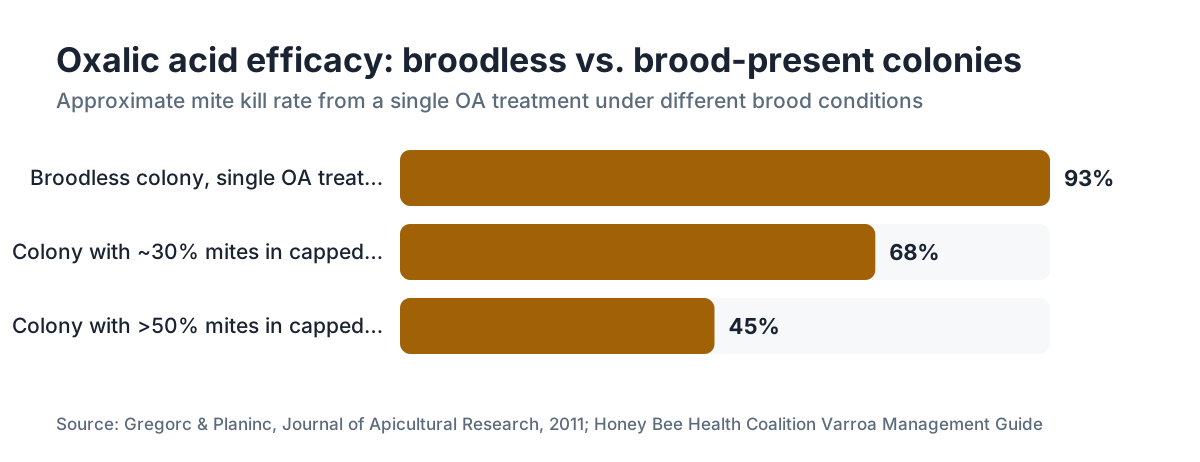
Because a broodless colony has no cells for mites to hide in. Every mite is forced onto an adult bee, where a contact treatment can reach it. That is the difference between a 93% kill and a 68% kill from the same dose of the same product.
Varroa reproduces inside capped brood cells. A female mite enters a cell just before capping, lays eggs on the developing pupa, and her daughters mate with their brothers inside that cell before emerging with the adult bee. During this reproductive phase the mite is invisible to any contact treatment.
When a colony is broodless, every mite rides on an adult bee. Researchers call this the phoretic phase. Sticky board and alcohol wash studies confirm that under true broodless conditions, essentially the entire mite population is phoretic and exposed to whatever you apply [2][3]. One properly applied OA treatment becomes a near-complete knockdown.
Now picture a colony in full spring buildup. A single frame of worker brood caps somewhere around 3,000 to 4,000 cells per side. A modest colony might carry five or six frames of capped brood at peak, giving mites tens of thousands of hiding spots. Under those conditions, even an aggressive extended-release OA treatment (more on that below) leaves a real chunk of the population untouched until those cells emerge.
The Honey Bee Health Coalition's Varroa Management Guide puts it plainly: oxalic acid treatments "are most effective when no capped brood is present" [3]. That is not a soft suggestion. It is how the mite's life cycle interacts with the chemistry.
When is a colony actually broodless, and how do you confirm it?
You confirm it by looking, not by guessing. Inspect the brood nest, and if you see zero capped brood and no young larvae, the colony is broodless. Natural windows happen in most temperate climates during winter, but the queen does not announce when she quits laying. You have to verify.
In much of the northern U.S. and Canada, colonies stop rearing brood sometime between late October and December and may stay broodless for a few weeks to two or three months depending on how cold the winter runs [4]. Southern beekeepers in USDA hardiness zones 8 and up sometimes never get a true broodless period without forcing one.
The safest approach is a two-step check. First, inspect about 23 to 25 days after you think laying stopped. That covers the full 12-day capped worker development time plus margin. No capped brood and no larvae younger than about 4 days old means you are likely clear. Second, run an alcohol wash to confirm mite load. If the load matches what your summer records predict, treat.
You can also force a broodless period by caging the queen for 24 to 27 days. It is more work, and some queens resume laying poorly afterward, but it gives you exact timing control. That makes it the most reliable option for southern beekeepers or anyone who cannot wait for a natural window [5].
One trap: a queenless colony can look broodless. That is a different problem, and you fix the queen situation before you think about mite treatments.
What are the two main oxalic acid application methods and which is better?
The Api-Bioxal label approves two methods in the U.S.: dribble (also called trickle) and vaporization [1]. Both work well in a broodless colony. Vaporization scales faster across a yard and is gentler on bees; dribble costs almost nothing in equipment and is easier to learn. A third method, extended-release via glycerin-soaked shop towels or sponges, has been used widely under experimental or state-exemption frameworks. Check your state's current label allowances before going that route.
Dribble: Mix Api-Bioxal into 1:1 sugar syrup at the label rate (about 35 grams of OA per liter of syrup), then slowly pour roughly 5 mL of solution per occupied bee space directly on the bees between frames. Bees clean each other and ingest some of the solution, which likely adds to the kill through direct contact. Dribble works well in broodless colonies but is harder on the bees than vaporization if you overdose. The label allows one dribble treatment per year.
Vaporization (sublimation): Place a measured dose of Api-Bioxal powder (usually 1 gram per brood box) into a heated vaporizer pan, seal the hive entrance, and let the OA sublime into vapor that condenses on every surface inside, bees included. The label allows up to three vaporization treatments, spaced 5 to 7 days apart. Vaporization causes less brood damage and is faster per hive once you own the gear.
Most sideliners I know default to vaporization because it scales. If you run 3 or 4 hives and already own a syringe and a scale, dribble is cheap and effective.
Safety is not optional with either method. OA vapor burns mucous membranes. Wear a NIOSH-approved respirator rated for acid vapors (a dust mask does nothing here), chemical splash goggles, and nitrile gloves every single time [1].
| Method | Label treatments allowed | Approx. cost per treatment | PPE required | Broodless required for best efficacy |
|---|---|---|---|---|
| Dribble | 1 per year | Under $1 in product | Gloves, eye protection | Yes |
| Vaporization | 3 per year (5-7 day intervals) | Under $1 in product | Acid vapor respirator, goggles, gloves | Strongly preferred; multiple treatments can partially compensate |
| Extended release (glycerin) | Varies by state label | $1-3 per hive | Gloves | Less critical; continues releasing OA as brood emerges |
What mite kill rate can you actually expect from a broodless oxalic acid treatment?
Expect 90 to 97% mite kill under genuinely broodless conditions. A 2011 field study in the Journal of Apicultural Research found single oxalic acid treatments hit 93.4% efficacy when colonies were broodless [2]. The Honey Bee Health Coalition's guide cites similar figures and notes that efficacy falls off hard when brood is present.
That 93 to 97% sounds great, and it is, but the starting number matters. Go into treatment at 3 mites per hundred bees (the standard action threshold) and a 95% kill leaves you around 0.15 per hundred, which is fine. Wait too long and treat at 8 mites per hundred, and a 95% kill still leaves 0.4 per hundred, workable but not where you want to be heading into spring buildup.
This is why a pre-treatment alcohol wash or sugar roll count earns its keep. If your fall mite level is already scary, knock the population down first with a faster-acting product like Apivar (amitraz strips), let the colony go broodless, then hit the survivors with OA. Nobody has a clean head-to-head study on that combination, but the logic holds and it matches what the Honey Bee Health Coalition's IPM framework suggests for high-load situations [3].
To track counts before and after treatment, the free protocols at VarroaVault help you log washes and see whether your timing was right.
Does oxalic acid harm the bees or the queen?
At high doses, yes. At label rates in a broodless colony, the documented harm is minimal. That is the honest answer.
Dribble carries a somewhat higher risk of bee mortality if overdosed, partly because bees ingest some of the solution. Overapplication can also cost you the queen, which is why the label caps the dose. Studies comparing dribble to vaporization generally find vaporization produces less bee mortality and lower queen loss, though at label rates the gap is small [5].
Brood is far more sensitive. OA is toxic to open larvae at relatively low concentrations, which is another reason the broodless window is so clean: there is no brood to damage. When colonies have brood and you vapor-treat anyway (which the label permits), you accept some brood loss. Extended-release formulations are built for the brood season, releasing OA slowly enough to spare larvae while keeping enough vapor pressure to kill phoretic mites.
Residue in honey is worth a word. OA occurs naturally in honey at roughly 12 to 23 mg/kg [6]. Label-rate treatments do not push honey OA above that natural background, which is why treated honey needs no withholding period under current regulations. The EPA's registration review for Api-Bioxal noted exactly this point [1].
How does oxalic acid compare to other varroa treatments during the broodless period?
For a winter broodless treatment, oxalic acid beats the alternatives on temperature range, residue, resistance, and cost. The main competitors are amitraz (Apivar), formic acid (Mite-Away Quick Strips or Formic Pro), and thymol products (Apiguard, ApiLife Var). Here is how they line up for this specific slot.
Apivar strips work all season and do not need a broodless window, but they run a 14-week label period and leave a slow-degrading residue in wax. Most protocols say pull the strips before the main honey flow. Winter Apivar use is uncommon and raises resistance concerns when repeated without rotation.
Formic acid depends on temperature, generally needing sustained readings between 50 and 85 degrees Fahrenheit for efficacy [11]. In a cold-winter broodless situation, temperatures usually sit below that range, which makes formic a poor winter choice even though its ability to kill mites under capped brood is its big advantage in summer.
Thymol products also carry temperature requirements, typically above 60 degrees Fahrenheit, and volatilize poorly in the cold.
Oxalic acid takes the broodless winter slot for most temperate beekeepers. It works down to temperatures where bees are still clustered (studies confirm efficacy at cluster temperatures), it leaves no meaningful residue, it has no established resistance in the U.S. or Europe, and it costs well under a dollar in product per hive.
Resistance is worth watching anyway. No confirmed OA-resistant mite populations have turned up in North America as of this writing, but rotating treatment modes across the year (OA in winter, amitraz in fall, formic in summer) is still good practice and what most IPM frameworks recommend [3][4].
For more on the mite itself, its life cycle and how it moves between colonies, see our guide to the varroa mite.
What is the step-by-step protocol for a broodless oxalic acid vaporization treatment?
Here is what I actually do, and what the evidence supports. This is for vaporization, my preferred method for most situations.
Step one: verify the broodless condition. I inspect 24 to 26 days after the last capped brood I saw, which usually lands mid-to-late November in the northern U.S. No capped brood and no larvae means ready. See capped brood, wait.
Step two: run a pre-treatment mite wash. Alcohol wash about 300 bees from the cluster edge. Record the count. Anything above 2 mites per hundred bees in winter cluster is a warning; above 4 and I ask whether the colony can wait or needs a faster intervention first.
Step three: gather safety gear. Acid-vapor respirator, chemical splash goggles, nitrile gloves. Skip none of them. This is the one area with no debate.
Step four: load the vaporizer with the label dose of Api-Bioxal. The current label calls for 1 gram per brood box. A double-deep hive gets 2 grams maximum.
Step five: close all entrances and openings, insert the vaporizer through the bottom entrance, and heat for the time your vaporizer's manufacturer specifies (typically 2 to 3 minutes). Keep the entrance sealed at least 10 more minutes after the unit finishes so the vapor settles and contacts the cluster.
Step six: open the hive, remove the vaporizer, open entrances. Check that the bees look normal within an hour.
You can repeat twice more at 5 to 7 day intervals for maximum knockdown, though in a genuinely broodless colony one treatment is often enough. Post-treatment alcohol washes 48 to 72 hours later are the only way to confirm you hit the population.
For beekeeping supplies including vaporizers and PPE, look for units that heat to a consistent 200 to 210 degrees Celsius. Cheap vaporizers with uneven heating can leave undissolved OA behind and drag down efficacy.
What temperature does it need to be to treat with oxalic acid in winter?
Colder than most beekeepers expect. Oxalic acid vaporization works even when bees are packed into a tight winter cluster, because the vapor fills the box and reaches the clustered bees. Efficacy studies confirm good mite kill at ambient temperatures well below 50 degrees Fahrenheit [2][5].
Dribble has a tighter window. You need bees spread across enough frames to distribute the solution, so most practitioners dribble when the cluster is loose across multiple frames, generally above about 40 to 45 degrees Fahrenheit. Below that, the bees pack too tightly and you cannot reach all of them.
The practical floor for vaporization is around 20 degrees Fahrenheit ambient and up, as long as you can seal the hive and keep the vaporizer unit from freezing before it heats. Save dribble for a warmer winter day or an early spring broodless window if you live somewhere cold.
What happens if you treat with oxalic acid when brood is present?
Efficacy drops, sometimes hard. The mites that survive are the ones sealed under capped cells during your treatment. As those cells emerge over the next 12 days, the protected mites come out riding new adult bees, and the infestation rebuilds.
Run the math. If 30% of your mites are in brood at treatment time, even a perfect 97% kill on the phoretic fraction leaves all 30% that were protected, plus the 3% of phoretic mites that survived. You wiped out maybe 68% of the total. Helpful, but nowhere near the near-total knockdown that makes a broodless treatment worth timing for.
If you have no choice (no broodless window, emergency situation), multiple OA vapor treatments spaced 5 to 7 days apart can partially make up for it by catching mites as they emerge across successive brood cycles. The extended-release glycerin method tries to solve the same problem with sustained low-level OA. Neither approach matches the simplicity and efficacy of a single treatment into a broodless colony.
One more risk with brood present: OA vapor at mite-killing concentrations can damage open larvae. Capped brood is shielded from vapor reaching the cell, but open larvae are exposed. That is why multi-treatment vapor protocols space treatments to hold down cumulative larval exposure.
How do you know if your oxalic acid treatment worked?
You test. There is no shortcut, and no visual gut-check counts.
Run an alcohol wash 48 to 72 hours after treatment. Pull about 300 bees from the cluster edge, wash them in 70% isopropyl alcohol, shake, and count the mites in the liquid. If your pre-treatment count was 4 per hundred bees and your post-treatment count is 0.3 per hundred, you got roughly 92.5% knockdown. That is a good result.
If your post-treatment count sits above 2 per hundred and the colony is genuinely broodless, something went wrong. The usual culprits: the colony was not fully broodless, the dose was off (bad scale, clumped product), the vaporizer never reached full temperature, or the hive was not sealed during treatment.
Sticky boards under a screened bottom board give a rough mite drop count in the 24 to 48 hours after treatment. Satisfying to watch, but not a precise number. The alcohol wash stays the standard for an accurate pre/post comparison [3].
Keep records. A simple spreadsheet with date, hive ID, pre-treatment count, method, and post-treatment count tells you more about your apiary's varroa trajectory than any single reading ever will.
Are there any regulations or label requirements you need to follow?
Yes, and it matters because Api-Bioxal is a federal EPA-registered pesticide. Using it outside the label directions is illegal under FIFRA (the Federal Insecticide, Fungicide, and Rodenticide Act) and voids any liability protection [7].
Here are the key label points as of the current registration.
Only Api-Bioxal brand oxalic acid is registered for U.S. hive use. Bulk oxalic acid sold for wood bleaching or other purposes is not approved for bee colonies, even though the chemistry is identical.
The label sets dose limits per box. Read the label that came with your product, because it has been updated over time and earlier versions carried different dose instructions.
Do not apply while honey supers with comb intended for human consumption are on the hive, unless those supers are removed or separated. Check the current label for exact wording.
Vaporization requires equipment compatible with the label's application method. Some states add registration requirements for the vaporizer itself.
The label reads: "Do not apply more than once per week" for vaporization treatments, and no more than 3 vaporization treatments per broodless period [1]. Follow that.
Your state department of agriculture may layer on extra requirements. The National Pesticide Information Center (NPIC) keeps current label documents and is a solid reference [8].
Is oxalic acid safe for organic beekeeping operations?
Yes. Oxalic acid is allowed in certified organic operations in the United States under the National Organic Program. The USDA's National Organic Program permits it because OA sits on the National List of Allowed and Prohibited Substances as a nonsynthetic substance [9].
That is one reason OA has become the default winter treatment for so many operations, certified organic or not. No honey withholding period, no wax residue concern at label rates, and no resistance pattern so far in North American mite populations.
For certified operations, documentation matters. Keep your Api-Bioxal purchase records and application logs as part of your organic system plan.
If you are building a full-season varroa calendar, VarroaVault's free protocol tools are organized around treatment windows including the broodless OA slot, so you can map the whole year in one place.
Frequently asked questions
Can you use oxalic acid when there is a small amount of brood present?
You can, but efficacy drops in proportion to how much brood is capped. If only one or two frames carry capped brood, a vapor treatment still kills the phoretic majority. The mites in those cells survive and re-infest as bees emerge. For a real knockdown, wait for full broodlessness or plan on follow-up treatments spaced 5 to 7 days apart to catch emerging mites.
How many times can I treat with oxalic acid in one winter?
The Api-Bioxal label allows up to 3 vaporization treatments per broodless period, spaced at least 5 to 7 days apart. Dribble is limited to 1 treatment per year. In a genuinely broodless colony, a single vaporization treatment often reaches 90 to 97% mite kill, so multiple treatments are less necessary, though running all 3 for insurance is a reasonable call.
What temperature is too cold to use oxalic acid vaporization?
There is no firm lower efficacy limit for vaporization; studies confirm it works even when bees sit in tight winter cluster at ambient temperatures well below 50 degrees Fahrenheit. The practical limit is whether your vaporizer hardware works and whether you can seal the hive. Dribble is different: it works better above about 40 to 45 degrees Fahrenheit because the cluster needs to spread across frames.
Do I need a license or certification to use oxalic acid on my hives?
In most U.S. states, hobbyist beekeepers can buy and use Api-Bioxal without a pesticide applicator license, because it is a general-use pesticide. Some states require registration or have supplemental rules, so check with your state department of agriculture. You must follow the EPA label regardless of licensing status.
Can oxalic acid vaporization harm me or bystanders?
Yes. OA vapor is corrosive to mucous membranes, eyes, and the respiratory tract. Always wear a NIOSH-approved acid-vapor respirator (a dust mask is not enough), chemical splash goggles, and nitrile gloves. Keep bystanders away during treatment. The risks are real but manageable with the right PPE. Never vapor-treat indoors or in an enclosed space.
How long does it take for oxalic acid to kill mites after treatment?
Most mite mortality from a vaporization treatment happens within 24 to 48 hours. Sticky board counts usually peak in the first 24 hours after treatment. Do a confirmatory alcohol wash 48 to 72 hours out to measure efficacy. Mite drop on the sticky board continues for a few days but stops being a reliable count after about 72 hours.
Will oxalic acid treatment kill the varroa mites already inside capped brood?
No. Neither dribble nor vaporization reaches mites inside sealed brood cells at label concentrations. This is the core reason broodless timing matters. Mites under capped brood survive any OA treatment and re-emerge with their host bees. The only OA approach with some efficacy against brood-phase mites is extended-release glycerin, and even that is partial.
Does oxalic acid leave residue in honey or wax?
At label rates, Api-Bioxal does not raise honey OA levels above the natural background range of roughly 12 to 23 mg per kilogram, which is why no honey withholding period is required. Wax residue is not a documented concern at label rates. This is one reason OA is preferred for organic operations and for treatments close to honey flows, though the label still advises against applying while honey supers intended for consumption are on the hive.
How do I induce a broodless period if I live in a warm climate with no natural winter break?
Queen caging is the most reliable method. Confine the queen in a cage inside the hive for 24 to 27 days. That covers the full capped worker brood development cycle, so all existing brood emerges during the window. After about 24 days the colony is functionally broodless and you can treat. Release the queen after treatment. Some queens have trouble resuming full laying after extended caging, so this carries some risk.
What mite count should I have before deciding to treat with oxalic acid?
The general action threshold for winter cluster is 2 or more mites per hundred bees on an alcohol wash. Below that, most colonies survive winter without treatment-caused collapse, though many beekeepers treat at any detectable level during a broodless window because the cost and risk are so low. Above 4 mites per hundred bees entering winter, the colony is in serious danger and treatment is urgent.
Is the dribble method or vaporization method better for a first-time oxalic acid treatment?
Vaporization has a steeper equipment cost upfront (a basic vaporizer runs roughly $30 to $80) but is faster per hive, causes less bee mortality at label rates, and scales well. Dribble needs only a syringe and a scale and costs almost nothing in equipment. For a beekeeper with 1 to 3 hives doing a first broodless treatment, dribble is effective and simpler to learn. For 10 or more hives, vaporization is worth the investment.
Can I use oxalic acid on nucleus colonies or package bees?
Yes, with care. Nucleus colonies get treated like full colonies, adjusted for the number of frames occupied. Package bees installed in spring are typically broodless for the first 24 days while the queen ramps up laying, which is a brief window for OA treatment if you see early mite pressure. Follow label dose guidance based on occupied frames, not hive box size.
Why does resistance to oxalic acid seem less common than resistance to synthetic miticides?
The leading hypothesis is that OA kills mites by a physical or broadly disruptive mechanism rather than hitting a single enzyme or receptor. Synthetic miticides like pyrethroids or organophosphates act at specific molecular targets where a single genetic mutation can confer resistance. OA's less specific action makes it harder for mite populations to evolve around it. No confirmed OA-resistant varroa populations have been documented in North America as of current published literature.
Sources
- EPA, Api-Bioxal Registration and Label: Api-Bioxal is the only EPA-registered oxalic acid product for varroa control in the U.S.; label specifies dose limits, application frequency, and PPE requirements
- Journal of Apicultural Research, Gregorc & Planinc 2011, 'Acaricidal effect of oxalic acid in honeybee colonies': Single OA treatments achieved 93.4% efficacy under broodless conditions in field trials
- Honey Bee Health Coalition, Varroa Management Guide: OA treatments 'are most effective when no capped brood is present'; IPM framework recommends rotating treatment modes across the year
- Penn State Extension, Varroa Mite Management: Northern U.S. colonies may be broodless from late October through December or longer depending on climate; rotating treatment modes reduces resistance risk
- USDA Agricultural Research Service, Oxalic Acid Efficacy and Bee Safety Studies: Vaporization generally produces less bee mortality and lower queen loss than dribble at label rates; efficacy confirmed at low ambient temperatures during cluster
- Journal of Agricultural and Food Chemistry, Bogdanov et al., natural oxalic acid levels in honey: Natural background OA concentration in honey is approximately 12 to 23 mg/kg; label-rate treatments do not raise honey OA above natural levels
- EPA, Federal Insecticide Fungicide and Rodenticide Act (FIFRA): Using a registered pesticide outside label directions is illegal under FIFRA
- National Pesticide Information Center (NPIC), Oregon State University: NPIC maintains current pesticide label documents and is a reliable reference for label compliance questions
- USDA National Organic Program, National List of Allowed and Prohibited Substances: Oxalic acid is on the National List as a nonsynthetic allowed substance, permitting its use in certified organic bee operations
- University of Minnesota Extension, Varroa Mite Management for Honey Bees: Action threshold for winter cluster is 2 or more mites per 100 bees on alcohol wash; mite loads above 4 per 100 entering winter indicate serious colony risk
- NC State Extension, Apiculture, Varroa Management: Formic acid products require sustained temperatures of 50 to 85 degrees Fahrenheit for efficacy, making them poor choices for cold-winter broodless treatment windows
Last updated 2026-07-09