Minimum temperature for oxalic acid vaporization effectiveness
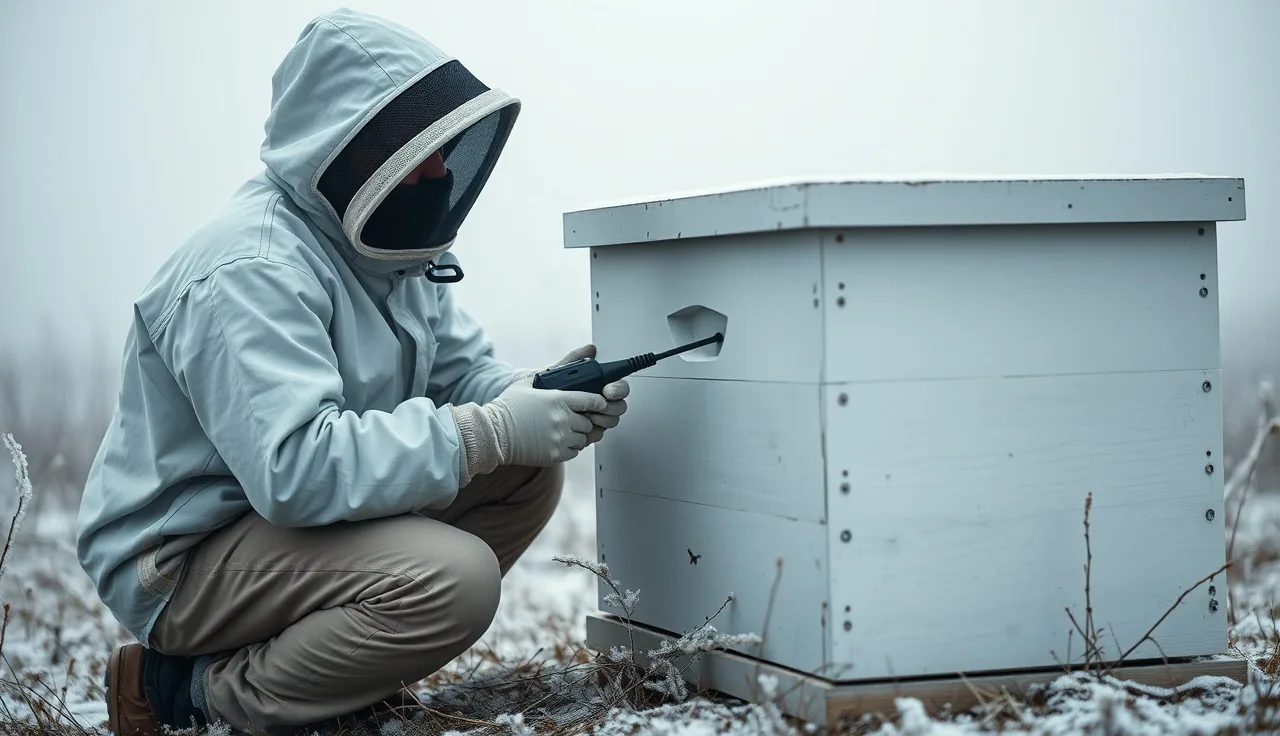
TL;DR
- For oxalic acid vaporization to kill varroa effectively, aim for at least 50°F (10°C) ambient air, with 40°F (4°C) the practical floor listed by the Honey Bee Health Coalition.
- Cold makes bees cluster tight, so vapor reaches fewer mites.
- No upper heat limit hurts efficacy, but above about 95°F you risk stressing brood.
What is the minimum temperature for oxalic acid vaporization to work?
Aim for at least 50°F (10°C) ambient air when you vaporize. The Honey Bee Health Coalition's Varroa management guide lists 40°F (4°C) as a hard lower bound, but treat that number as a survival floor, not a target. At 40°F the bees are alive and the vapor spreads, but they are packed tight and barely moving, so some mites riding deep in the cluster never touch the gas.
Why does temperature matter at all? Vaporization sublimates crystalline oxalic acid dihydrate onto bees as they move through the hive. Mites on bee bodies absorb the acid through direct contact. Cold bees cluster and stop circulating. Vapor hits fewer of them, and the mites on bees in the center of the cluster can escape exposure entirely. The chemistry of sublimation does not care how cold it is outside. A Varrox or ProVap 110 heater will sublimate the crystal at 20°F just as it does at 70°F. The threshold is about bee behavior, not chemistry.
The EPA-registered label for Api-Bioxal, the only federally approved oxalic acid product in the United States, sets no minimum ambient temperature for vaporization. It does restrict treatment to colonies with no sealed (capped) brood, which is the real biological gate. That brood rule is why winter, when colonies go broodless, is the single best treatment window no matter what the thermometer reads. [1][2]
Why does hive temperature affect varroa mite exposure to oxalic vapor?
Varroa destructor spends most of its life riding on adult bees between reproductive cycles. Cold packs bees into a tight cluster where they shiver their flight muscles for heat. The bees on the outer shell barely move. Bees in the core rotate constantly, inward and outward, but overall circulation drops sharply once the hive core falls below about 57°F (14°C), even when the air outside is warmer. [3]
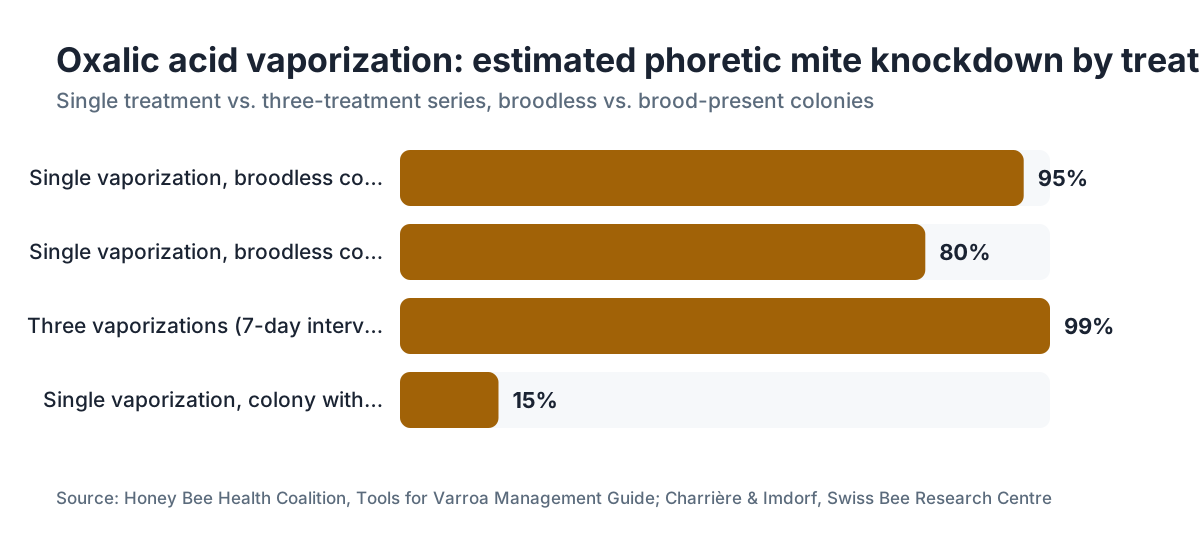
Oxalic acid vapor drifts from the vaporizer pan toward cooler surfaces and lands on bees wherever it touches them. In a tight winter cluster the outer shell of bees works as a physical wall. Vapor concentration in the core stays lower than in the open air around it. Research from the Swiss Bee Research Centre found that a single vaporization in a broodless colony kills somewhere between 90 and 97 percent of phoretic mites, depending on colony size and cluster tightness. That wide range is mostly temperature-driven cluster behavior. [4]
Here is the practical version. Treat on a mild winter day, say 45 to 55°F, when bees are loosely clustered or breaking cluster to defecate, and your vapor reaches more bee surface and kills more mites. One treatment on a 50°F January day beats the same treatment on a 25°F January day, even though both sit inside the broodless window. Three treatments spaced seven days apart in a broodless colony, a protocol common in Europe and now widely used in the U.S., catches the mites the cluster shielded on the first pass. [4][5]
What temperature range is actually safe for bees during vaporization?
Bees tolerate vaporization across a wide temperature range. Heat killing bees during treatment is not the real worry. The concern is treating a colony so cold that blocking the entrance to hold vapor drops the cluster temperature into a danger zone.
As a practical rule:
| Ambient temperature | Cluster behavior | Vaporization outcome |
|---|---|---|
| Below 40°F (4°C) | Very tight cluster, minimal movement | Vapor may not penetrate cluster; efficacy significantly reduced |
| 40-50°F (4-10°C) | Tight cluster, some edge movement | Acceptable floor; efficacy reduced but workable in broodless colony |
| 50-65°F (10-18°C) | Loose cluster or broken cluster | Good vapor distribution; near-peak efficacy for broodless treatment |
| 65-85°F (18-29°C) | Normal activity, brood likely present | High efficacy but Api-Bioxal label restricts to broodless colonies in the U.S. [1] |
| Above 95°F (35°C) ambient | Bees may beard outside; brood heat stress | No vaporization issue, but colony stress and brood risk |
The upper temperature worry is separate from vaporization mechanics. If the air is above 95°F and you seal the hive for treatment, you risk overheating brood. In practice that rarely bites, because you seal the entrance for only about 10 minutes per treatment.
One thing worth stating plainly: no peer-reviewed study shows oxalic acid vapor at label doses (roughly 2 grams of Api-Bioxal per brood box) harms bees at any ambient temperature within normal beekeeping conditions. Studies measuring bee mortality after vaporization find losses no higher than untreated controls when brood is absent. [4][6]
Does cold weather reduce how much oxalic acid vapor is produced by the vaporizer?
No. The vaporizer heats the oxalic acid crystal to roughly 315°F (157°C) or higher, which is the sublimation point of oxalic acid dihydrate. Outside air temperature has almost no effect on that localized heating element. At 20°F or 70°F, a working Varrox, ProVap 110, or similar device sublimates the full 2-gram dose in about 2.5 to 3 minutes. [7]
What cold does change is how far and how evenly the vapor spreads inside the hive before it condenses on cool surfaces. In very cold conditions the vapor condenses faster, which can deposit more acid near the entrance and less deep in the hive. One more reason a warmer treatment day, even in winter, beats the absolute minimum.
When is the best time of year to use oxalic acid vaporization?
The best time is whenever your colony is broodless. In most temperate parts of North America that runs late November through February, after the queen stops laying and before she starts again in late winter. A broodless colony is the ideal target because close to 100 percent of mites are phoretic (riding on adult bees) and fully exposed to vapor. With brood present, roughly 80 to 90 percent of mites hide inside capped cells where vapor cannot reach. [4][10]
In warmer climates where colonies rarely go fully broodless, repeated vaporization spaced 5 to 7 days apart still knocks mite loads down hard. Each pass catches the mites that emerged from capped cells since the last one. The Honey Bee Health Coalition recommends three treatments seven days apart as a broodless-period protocol to cover any mites that escaped the first application. [5]
Summer vaporization is legal on the Api-Bioxal label only when no capped brood is present, a condition you confirm by inspection, not by the calendar. Some beekeepers force a broodless window by caging the queen for 24 days (one full mite reproductive cycle plus buffer), treat three times inside that window, then release her. It works. It also adds management steps and asks for a steady hand with the queen. [1][5]
Want a seasonal plan that ties treatment windows to mite thresholds and temperature? The free tools at VarroaVault help you build one without cross-referencing a stack of extension guides.
How many oxalic acid vaporization treatments does a colony need?
In a fully broodless colony, one well-timed treatment on a day above 50°F gets you 90 to 97 percent mite knockdown. Do the math and it looks less rosy. Kill 95 of 100 mites and you still have 5 mites plus a queen about to start laying. Those 5 become 50 within a few weeks at normal mite reproduction rates.
Three treatments spaced seven days apart is the protocol most likely to hit or beat 99 percent, because each pass catches mites that the cluster shielded or that sat in a low-vapor pocket last time. The seven-day gap matters. It is long enough for cluster movement to shuffle bees (and their mites) around, but short enough that the queen has not filled the frames with fresh capped brood again. [5]
After the series, run a mite wash 48 to 72 hours after the final treatment to confirm the knockdown actually happened. Target 2 mites or fewer per 100 bees (a 2 percent infestation rate or lower) heading into spring buildup. Still above that after three treatments? Something went wrong: a leaky entrance seal, faulty equipment, or a colony that was not truly broodless. [5][8]
What safety precautions do beekeepers need for oxalic acid vaporization?
Oxalic acid vapor is corrosive to mucous membranes. Inhaling it irritates the respiratory tract, and repeated exposure is the real danger, not one brief dose. The Api-Bioxal label and EPA registration require a NIOSH-approved particulate respirator (minimum N95) rated for acid gases, or a half-face respirator with P100/OV cartridges, during vaporization. Chemical splash goggles and acid-resistant gloves are required too. [1][2]
A few practical points that do not always make it into the official guidance:
Stay upwind. Even with a respirator, standing downwind of a treating hive means more exposure than you need.
Leave the hive shut for at least 10 to 15 minutes after sealing the entrance. The vapor needs time to settle. When you do open it, step aside for a moment before you lean in.
Store Api-Bioxal cool and dry. Moisture degrades the product and can cut efficacy. Shelf life after opening is limited, so check the date on the label.
Oxalic acid is toxic to humans and animals, yet it sits on the EPA's reduced-risk list for use in beehives, meaning its risk to bees and the environment runs well below synthetic miticides. [2] Residues in honey are negligible. Oxalic acid occurs naturally in honey at concentrations that overlap treatment residue levels, according to research in the Journal of Apicultural Research. [6]
How does oxalic acid vaporization compare to oxalic acid dribble or spray?
Api-Bioxal has three approved application methods in the U.S.: vaporization (sublimation), dribble (trickle), and spray. Temperature limits and efficacy differ across them in ways that matter.
Dribble drips a 3.5 percent oxalic acid solution straight onto the bees in the cluster seams. It works down to 40°F, needs no vaporizer, and suits broodless winter colonies. It also wets the bees, which in very cold conditions can add to chilling. A single dribble in a broodless colony reaches roughly 90 to 95 percent efficacy, close to a single vaporization but without the gear. The trade-off is that you pop the lid and disturb the cluster, which stresses bees more than vapor does. [1][9]
Spray puts the same diluted solution onto drawn comb during package installation or when bees are off the frames. Narrow use case. It is not relevant to mite management in established colonies.
Vaporization brings no cluster disturbance, treats through a closed entrance with zero frame removal, and repeats fast across many hives in one session. It costs you a $100 to $300 vaporizer (battery or corded), but that pays off quickly once you run more than a few hives. [7]
Shopping for gear? Pricing and stock at beekeeping supply companies swing a lot, so compare before you buy.
Dribble has one hard upper temperature limit. Above about 50°F bees break cluster and scatter, and you cannot deliver a consistent dose to enough of them. Vaporization has no such ceiling. At 65°F a dribble treatment fades while a vaporization treatment stays fully effective (assuming the colony is broodless). That is the single biggest practical edge vapor holds over dribble in regions with mild winters.
Does ambient temperature affect how long you should leave the hive sealed after vaporization?
Seal the entrance for 10 minutes after vaporization. That holds across all practical ambient temperatures. No peer-reviewed evidence shows a longer seal in cold weather improves efficacy, and sealing longer in heat raises the risk of bee stress.
In very cold weather (below 40°F), some beekeepers stretch the seal to 15 minutes, reasoning that colder air disperses vapor more slowly. Plausible, but unconfirmed by published data. The honest answer: nobody has run a controlled trial comparing 10-minute and 15-minute seal times at different temperatures. The closest guidance is the Api-Bioxal label, which specifies a 10-minute minimum with no temperature adjustment. [1]
What matters more than seal duration is seal quality. Any gap around the bottom board or a poorly seated screen bleeds vapor out and drops the effective dose. In cold weather, hives often run reduced ventilation that happens to seal better. In warm months, with upper vents open, you have to block those too during the 10-minute treatment.
Can you vaporize oxalic acid in summer when mite levels are high?
Yes, but only legally if the colony has no capped brood, and biologically that almost never happens in summer without intervention. The Api-Bioxal label is blunt on this: treatment is restricted to colonies without capped brood in the United States. [1] Treating a brood-filled colony violates federal pesticide law under FIFRA no matter how high your mite count runs.
The restriction is part efficacy (vapor cannot touch mites in capped cells) and part a genuine safety signal from early studies, which suggested oxalic acid residues could build up in wax when brood is present and treatment repeats. The Honey Bee Health Coalition's guide notes: "Oxalic acid should not be used when honey supers are on the hive or when capped brood is present." [5]
For a summer mite emergency you have two realistic moves. First, use an approved alternative that works with brood present: formic acid (Formic Pro), thymol (Apiguard or ApiLife Var), or amitraz (Apivar strips). Second, make a split or cage the queen to create a broodless window, then treat with oxalic acid. The second route takes planning and hits honey production harder, but it delivers a cleaner knockdown.
Monitor mite levels monthly (the Honey Bee Health Coalition recommends monthly washes during the active season) and act early, and you rarely get cornered into summer emergency treatment. A colony that hits 2 percent infestation in June has time for a planned formic acid treatment before the population crash that lands in August. [5][8]
What equipment do you need for oxalic acid vaporization and how much does it cost?
You need three things: an approved oxalic acid product (Api-Bioxal in the U.S.), a vaporizer, and the right personal protective equipment.
Api-Bioxal is the only EPA-registered oxalic acid product for U.S. honey bee colonies. It ships in 35-gram and larger packages. The 35-gram package treats roughly 17 broodless colonies once (at 2 grams per application) and runs about $15 to $25, depending on the supplier. [2]
Vaporizers span simple battery-powered wand models (around $100 to $150) to corded electric units like the Varrox Eddy or ProVap 110 (around $200 to $350). Battery wands work fine for small operations. Corded units heat faster and suit anyone treating 20-plus hives per session. No evidence shows one brand kills more mites than another when dose and temperature match. [7]
For PPE: a half-face respirator with combination OV/P100 cartridges runs $30 to $60, replacement cartridges $15 to $25 per pair, and chemical splash goggles plus nitrile gloves add another $15 to $25. Total startup for one beekeeper lands around $175 to $450, depending on the vaporizer tier.
Still assembling gear? Comparing options at beekeeping supply companies is the fastest way to see current pricing, and some suppliers bundle vaporizers with Api-Bioxal starter kits.
One cost note: Api-Bioxal is prescription-free for hobbyists in many states, but some states require a veterinary client-patient relationship (VCPR) under FDA rules. Check your state's requirements before you buy. [2]
How do you know if your oxalic acid vaporization actually worked?
You verify it with a mite wash 48 to 72 hours after the final treatment in your series. Skip the sticky board for this. A board gives you raw drop numbers, not infestation rate per 100 bees, and raw drops do not compare across colony sizes. An alcohol wash or powdered sugar wash on a 300-bee sample gives you a real percentage.
Target: 2 percent or fewer mites per 100 bees going into spring, and 2 percent or fewer at any monitoring point during the active season. The Honey Bee Health Coalition uses these as action triggers. [5]
Still over 2 percent after treatment? Troubleshoot in this order. First, confirm the colony really was broodless. A single frame of capped brood can shelter dozens of mites that vapor never touched. Second, check your equipment. A vaporizer pan that never got fully hot, a dose under 2 grams, or a leaky entrance seal all cut efficacy. Third, weigh the colony size. A 60,000-bee colony is harder to treat to high efficacy with a single-dose vaporizer than a 20,000-bee winter cluster. Some practitioners run two vaporizer pans at once on big colonies, or treat twice within 24 hours in that specific case.
Tracking mite levels over time alongside treatment dates is the record-keeping that separates beekeepers who rarely lose colonies from those who lose them often. The free tracking tools at VarroaVault are built for exactly this. [8]
Frequently asked questions
What is the lowest temperature at which oxalic acid vaporization is still worth doing?
The Honey Bee Health Coalition lists 40°F (4°C) as the practical lower bound. Below that, the cluster packs so tight that vapor cannot reach every phoretic mite. If you must treat at 40°F, run three treatments seven days apart to compensate. A day above 50°F always beats the minimum.
Can you vaporize oxalic acid in freezing temperatures?
You can, but efficacy drops. The vaporizer works fine at any ambient temperature; the problem is bee behavior. Below freezing, bees pack into a very tight cluster and barely move, cutting the bee surface area the vapor contacts. If freezing weather is your only window, three spaced treatments plus a post-treatment mite wash to verify knockdown matter even more.
Does oxalic acid vaporization work with the hive entrance open?
No. Seal the entrance for at least 10 minutes after vaporization so the vapor reaches the full colony before it escapes. Any unsealed gaps, including open screened bottom boards or upper vent holes, bleed vapor out and drop the effective dose. Block every opening before treatment and reopen them after the 10-minute dwell.
How often can you repeat oxalic acid vaporization treatments?
The Api-Bioxal label allows up to three vaporization treatments per broodless period, spaced at least seven days apart. The current U.S. label sets no annual limit for vaporization, unlike the dribble method, which is limited to once per year. Some beekeepers in warmer climates run multiple broodless-period series per year after inducing broodless conditions.
Is oxalic acid vaporization safe for honey bees at high temperatures in summer?
The vapor itself does not harm bees at elevated temperatures within normal beekeeping conditions. The practical catch is that the U.S. label restricts vaporization to broodless colonies, and summer colonies almost always have brood. Treating a colony with capped brood present is a label violation. For summer mite control with brood present, formic acid or amitraz are the right tools.
Will oxalic acid vaporization contaminate my honey?
Research in the Journal of Apicultural Research found that oxalic acid residues after vaporization do not exceed levels naturally present in untreated honey. The Api-Bioxal label requires removing honey supers before treatment, both as a precaution and because treating with supers on violates the label. Follow that and residue contamination of harvestable honey is not a documented concern.
What respirator do I need for oxalic acid vaporization?
The Api-Bioxal label and EPA registration require at minimum a NIOSH-approved N95 particulate respirator, but a half-face respirator with combination OV/P100 cartridges gives better protection and is what most experienced practitioners use. Add chemical splash goggles and acid-resistant gloves. A dust mask or surgical mask is not adequate; oxalic acid vapor slips right past them.
How long does oxalic acid vaporization take per hive?
The vaporizer heats and sublimes the 2-gram dose in roughly 2.5 to 3 minutes. Add 10 minutes for the sealed dwell, plus setup and pack-down. In practice an experienced beekeeper treats 15 to 20 hives per hour once the rhythm sets in, especially with a fast-heating corded unit. Battery wands add a few minutes per hive for recharge or cool-down.
Does outdoor humidity affect oxalic acid vaporization effectiveness?
High humidity can make vapor condense faster, which may cut how far it spreads inside the hive before landing on surfaces. This ranks below temperature and cluster behavior as a factor. Treating on a cold, wet day is worse than a cold, dry day. No controlled study has pinned a specific humidity threshold, so this stays a practical observation, not a confirmed finding.
What is the correct dose of Api-Bioxal for vaporization?
The Api-Bioxal label specifies about 2.275 grams per single-story brood chamber. Most practitioners round to 2 grams for simplicity, which falls within the label range. For a two-story hive, use 2 grams per box or apply the dose once with the vaporizer centered. Always measure by weight, not volume; oxalic acid crystal density varies.
Can you use generic oxalic acid from a wood bleach supplier instead of Api-Bioxal?
Not legally in the United States. Only Api-Bioxal carries the EPA registration required for use in honey bee colonies under FIFRA. Using unregistered oxalic acid in a hive violates federal pesticide law regardless of chemical purity. Api-Bioxal is made to specific purity and filler specs; hardware-store oxalic acid may carry impurities never tested for bee safety.
How does varroa mite biology determine the timing of oxalic acid vaporization?
Varroa mites reproduce inside capped brood cells, where vapor cannot reach them. Only phoretic mites riding on adult bees die during vaporization. A broodless colony holds 100 percent of its mites in the phoretic phase. With brood present, roughly 80 to 90 percent of mites hide inside cells, which is why broodless timing is so important for this method.
Do I need a veterinary prescription to buy Api-Bioxal?
It depends on your state. FDA veterinary oversight rules brought some oxalic acid uses under veterinary supervision, but application varies by state. Many states let hobbyist beekeepers buy Api-Bioxal without a prescription. Check with your state department of agriculture or a local extension service for the current requirement in your area before purchasing.
Sources
- EPA, Api-Bioxal product label (Registration No. 86705-3): Api-Bioxal label restricts vaporization to colonies without capped brood and requires a minimum 10-minute sealed dwell time; no minimum ambient temperature is specified on the label
- EPA, Oxalic acid for use in beehives (reduced-risk pesticide): Oxalic acid is classified as a reduced-risk pesticide for use in honey bee colonies; Api-Bioxal (Registration No. 86705-3) is the only federally approved product for use in U.S. honey bee colonies
- USDA Agricultural Research Service, Bee Research Laboratory (Beltsville, MD): Honey bee cluster circulation rate drops substantially at ambient temperatures below approximately 57°F (14°C), reducing the proportion of bees contacted by treatments applied inside the hive
- Charrière, J.D. & Imdorf, A., Swiss Bee Research Centre (Agroscope), oxalic acid treatment research: Vaporization of oxalic acid in broodless colonies achieves 90-97% phoretic mite knockdown in a single treatment; efficacy varies with cluster tightness and colony size
- Honey Bee Health Coalition, Tools for Varroa Management Guide (latest edition): Three vaporization treatments spaced seven days apart recommended for broodless-period protocol; 40°F listed as practical lower temperature bound; 2% infestation rate used as action threshold; oxalic acid should not be used when honey supers are on or capped brood is present
- Bogdanov, S. et al. (2002), Journal of Apicultural Research, oxalic acid residues in honey after treatment: Oxalic acid residues in honey after vaporization treatment do not exceed levels naturally present in untreated honey; treatment residues overlap with natural honey oxalic acid concentrations
- Penn State Extension, Honey Bees and Beekeeping program: Vaporizer devices sublimate oxalic acid at approximately 315°F (157°C) regardless of ambient temperature; battery and corded models both achieve adequate sublimation; vaporizer cost range approximately $100-350
- Honey Bee Health Coalition, Varroa sampling and monitoring protocols: Monthly alcohol wash or sugar roll recommended during active season; 2 mites per 100 bees (2%) is the standard action threshold for initiating treatment
- University of Minnesota Extension, Bee Squad and honey bee program: Oxalic acid dribble method appropriate for broodless colonies at temperatures as low as 40°F; single dribble application achieves approximately 90-95% phoretic mite efficacy; dribble method limited to once per year on current label
- NC State Extension, Apiculture Program: Roughly 80-90% of mites in colonies with active brood are inside capped cells and inaccessible to contact-based treatments including oxalic acid vaporization
- Michigan State University Extension, Pollinators and beekeeping: Oxalic acid vaporization treatments can be performed through the sealed entrance without frame removal; treatment takes approximately 10-13 minutes per colony including dwell time
Last updated 2026-07-09