Can you treat for varroa mites in October?
TL;DR
- Yes, you can and usually should treat for varroa in October.
- The winter bees being raised right now will carry your colony through to spring, and if they're loaded with mites, the colony often won't make it.
- Oxalic acid (approved for broodless or capped-brood conditions), Apivar, and Apiguard all have October use windows depending on your climate and whether brood is present.
Why October varroa treatment might be the most important one you do all year
Most beekeepers think spring is the high-stakes treatment window. It's not. October is.
Here's why. Starting in late August and running through October, your queen shifts from making short-lived summer workers to making winter bees, a physiologically different bee with enlarged fat bodies and hypopharyngeal glands loaded with vitellogenin that can live five to seven months instead of six weeks [1]. Those bees are the colony's entire survival bet. They cluster, generate heat, and raise the first spring brood.
Varroa destructor doesn't care about any of that. Mites reproduce in capped brood cells, preferring worker brood at roughly a 6:1 rate over drone brood, and each cycle adds to a population that has been doubling every four to six weeks through summer [2]. By October, a colony that looked fine in July can be sitting at 5, 8, or higher percent infestation, well above the 2 percent threshold the Honey Bee Health Coalition sets as a treatment trigger [3].
The damage isn't just numerical. Mites feeding on developing pupae suppress immune function and transmit deformed wing virus (DWV) and other pathogens. Winter bees that emerge from heavily parasitized cells come out compromised, with shorter lifespans and reduced fat body development, before they've clustered a single night [4]. You can treat in March and still lose the colony, because the bees you were trying to save were already damaged in October.
Treat in October. If you already treated once this summer, test first anyway. Reinfestation from collapsing neighbor colonies happens fast.
When should you treat for varroa mites? The timing framework
There's no single correct date, but there's a logic to the calendar that most university extension programs and the Honey Bee Health Coalition's Varroa Management Guide agree on [3].
The core principle: treat when mite loads pass your threshold AND when the treatment you're using can actually work given the brood state and temperature. Those two conditions don't always line up, so you make a judgment call.
Here's the seasonal framework:
Mid-summer (July-August): Mite populations are still building and colonies are at peak population. This is a high-brood period, which limits oxalic acid (OA only kills phoretic mites, not mites sealed in cells). Apivar (amitraz strips) or Apiguard and Api-Life VAR (thymol) work here. Heat is a concern for thymol. Above 105F in the cluster area can cause queen loss [5].
Late summer to fall (September-October): The window that matters most. Colonies are drawing down brood, and in many climates October brings a natural broodless or near-broodless period that makes oxalic acid dribble or vaporization extremely effective. If brood is still present, Apivar holds up. Apiguard still works if daytime temps stay above 59F (15C) [5].
Winter (November-February in most of the US): A true broodless cluster is when oxalic acid vaporization shines. One treatment during a confirmed broodless period can hit 95 percent or higher mite kill [3]. Apivar and thymol products are not recommended below minimum temperatures and are not designed for broodless winter use.
Spring (March-May): See the dedicated section below. Short version: spring treatment is often too late to save the winter bees, but it matters for stopping a summer crash.
The Honey Bee Health Coalition's guide names late summer and fall, when winter bees are being produced, as the treatment window that most protects overwinter survival [3]. That's October for most of the continental US.
Which varroa treatments actually work in October, and what are the temperature limits?
This is where beekeepers get tripped up. The right October product depends on three things: whether brood is present, your local daytime temperatures, and whether your state requires a veterinary feed directive (VFD) or prescription.
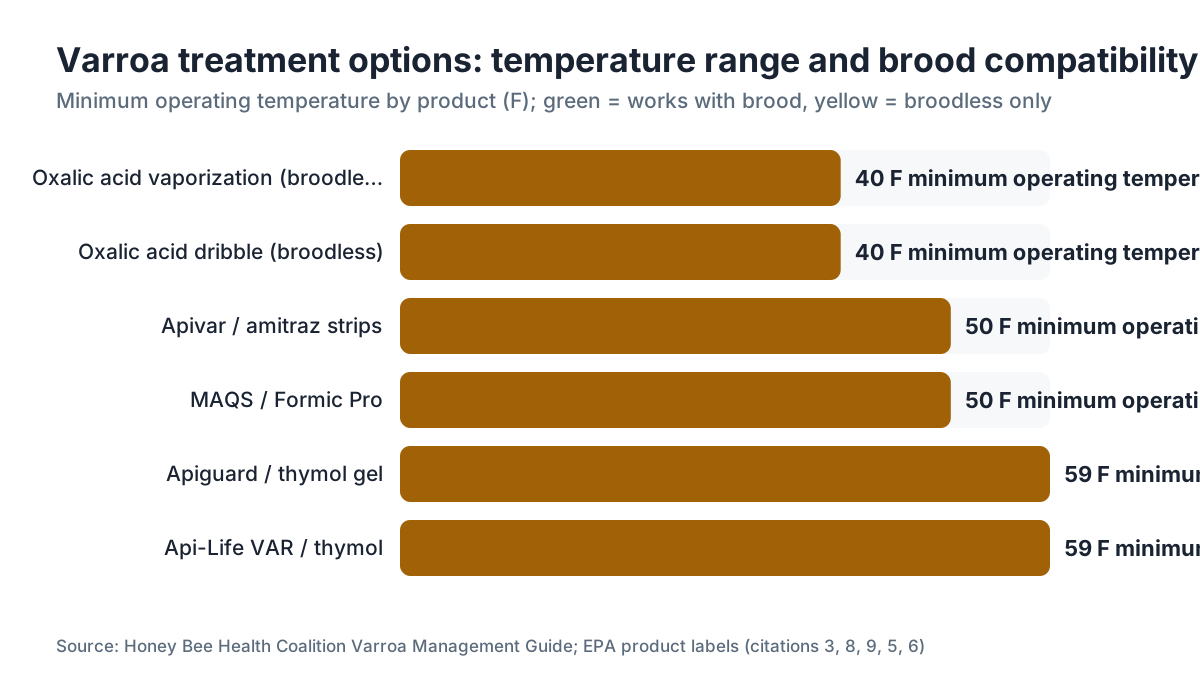
Here's a side-by-side of the main EPA-registered options:
| Treatment | Active ingredient | Works with brood present? | Min temp | Max temp | Notes |
|---|---|---|---|---|---|
| Apivar strips | Amitraz | Yes | 50F (10C) | No stated max | 42-56 day contact; remove before honey super |
| Apiguard | Thymol gel | Yes (less effective) | 59F (15C) | 105F cluster | Two-tray treatment, 4 weeks total |
| Api-Life VAR | Thymol + other | Yes (less effective) | 59F (15C) | 105F cluster | Weekly tablet replacement |
| Oxalic acid dribble | Oxalic acid | Broodless only | 40F (4C) for bees to be active enough | No stated max | Single treatment |
| Oxalic acid vaporization | Oxalic acid | Broodless only for single treatment; extended/repeated for brood | 40F (4C) | No stated max | EPA-registered; requires respirator |
| MAQS (Formic Pro) | Formic acid | Yes, kills mites under cappings | 50F (10C) | 85F (29C) | 7- or 14-day strip; queen risk above max temp [6] |
Across the northern US in October (roughly USDA hardiness zones 5 and 6), daytime highs often sit in the 50s and low 60s. That rules out Apiguard and Api-Life VAR fast. Apivar becomes the workhorse when brood is still present. MAQS (Formic Pro) kills mites under cappings, which matters if you have a lot of capped brood, but watch the ceiling: a warm October day in zones 7 or 8 can still hit 85F [6].
Oxalic acid vaporization is increasingly the first choice in zones where October brings a genuine broodless period, usually after the first real cold snap in northern states. Penn State Extension advises confirming broodlessness before committing to a single OA treatment, or running repeated vaporizations every five days for several cycles if brood is still present [4].
If you're sourcing treatments or equipment for fall, the beekeeping supply companies you use should stock EPA-registered products with current expiration dates. Don't treat with old strips or gels you can't verify.
How do you know if you actually need to treat in October?
You have to test. This is the step most hobbyist beekeepers skip, and it's why they lose colonies in February and blame the weather.
The two reliable methods are alcohol wash and sugar roll. The Honey Bee Health Coalition's consensus threshold is 2 mites per 100 bees (2 percent) as a treatment trigger during the brood-rearing season [3]. Some university programs, including University of Minnesota Extension, suggest a more conservative 1 to 2 percent fall threshold because of the winter-bee concern [1].
Alcohol wash beats sugar roll on accuracy. Pull about 300 bees (roughly half a cup) from the brood nest, not the bottom board, not foragers at the entrance, and wash them in 70 percent isopropyl alcohol in a mason jar with a mesh lid. Shake for 60 seconds, pour the liquid through a contrasting-colored pan, count the mites. Divide mites by 300 and multiply by 100 for your percentage.
Do this before treating. Do it again after to confirm efficacy. If your post-treatment count is still above 2 percent, something went wrong: the product went in wrong, the colony reinfested from a neighboring dead-out, or your local mites carry resistance.
Nobody has good data on the exact prevalence of amitraz-resistant Varroa in the US hobby population. What is documented is resistance to tau-fluvalinate (the active ingredient in old Apistan strips), which is widespread and the reason Apistan is rarely recommended anymore [2]. If Apivar keeps failing in your operation, rotating to a different mode of action, like formic acid or oxalic acid, is the sensible move.
Track your mite counts, treatment dates, and colony notes in VarroaVault's free protocol tools if you want a systematic record across seasons.
What happens if you don't treat in October?
The colony may survive. The odds are not good.
USDA and university survey data consistently show that colonies with high fall mite loads are overrepresented among winter dead-outs. The USDA National Agricultural Statistics Service reported managed colony losses from April 2022 to April 2023 at around 48 percent, with Varroa-associated losses cited as the leading cause across beekeeper categories [7]. That's a headline number, and individual loss rates vary enormously, but the pattern has held across survey years.
Untreated fall colonies follow a predictable collapse. Mite populations peak in October and November while the bee population shrinks, so the mite-to-bee ratio worsens even if absolute mite numbers plateau. Winter bees emerge damaged. The cluster forms smaller than it should. Bees die faster than normal through December. By January or February, the cluster is too small to hold temperature, brood dies, and the colony starves or freezes.
Beekeepers who open dead colonies in February often see the classic signs: a small cluster, deformed-wing bees on the comb, and plenty of mites. Sometimes they blame starvation and feed more the next year. The mites were the driver.
If you choose not to treat because you're pursuing a survivor-bee or treatment-free strategy, that's a different conversation with real trade-offs and some genuine science behind it. It's not the same as forgetting to treat.
Should you treat for varroa mites in the spring?
Yes. Spring treatment is real and necessary, but it does a different job than fall treatment, and it can't substitute for it.
In early spring (March in most northern states, February in the South), your colony comes out of winter with a small cluster and starts building population. Mite counts are usually at their annual low because mites have been reproducing in a small amount of brood, or in a broodless cluster where they can't reproduce at all. That low count is temporary. As brood production ramps up in March and April, mites reproduce right alongside it.
Spring goals differ from fall goals. In fall, you protect the specific bees that will winter the colony. In spring, you prevent a summer population explosion that would tank the colony before the fall window even opens.
The ideal spring window is after the queen resumes laying but before the colony hits full population, roughly when you see your first frames of capped brood and the colony isn't yet crowded. This is also typically after the last cold snap that would push temperatures below treatment minimums, so Apiguard and MAQS become usable again.
Oxalic acid dribble works well in early spring if you catch a brief natural broodless period before the colony ramps back up, which happens now and then after a hard winter. More often the queen is already laying in February, so oxalic acid's broodless-only limit means a single treatment won't clean things up completely.
Apivar in spring is effective and straightforward. The compliance point that bites people: you must remove Apivar strips before placing honey supers, and the label requires a minimum 14-day gap between strip removal and super addition [8]. In a strong spring colony building fast, that timing sneaks up on you. Mark your calendar when you install strips.
Skipping spring treatment isn't a disaster if your fall treatment brought counts below 1 percent and you test again in April. If you're at or below 1 percent in April with normal buildup, you might ride it through to a June or July test and treat then if needed. If you're already at 2 percent in April, treat now. The summer explosion starting in May turns a 2 percent spring problem into an 8 or 10 percent August disaster.
When to treat for varroa mites in spring: the specific timing details
Penn State Extension advises treating in spring once the colony breaks cluster and before the honey flow, which in Pennsylvania usually means March or April [4]. Virginia Cooperative Extension and other mid-Atlantic programs roughly agree.
Here's a more specific guide by region:
Gulf Coast and Deep South (zones 8-10): A winter broodless period barely exists here. Queens often lay year-round or pause only briefly. Spring treatment is less distinct because mite management is really a year-round rotation. The "spring" window may open as early as February or just run continuous with winter management.
Mid-Atlantic and Southeast (zones 6-7): Spring treatment typically starts in March. Apiguard becomes usable once daytime temps reliably clear 60F. Apivar can go in earlier since its lower limit is 50F.
Midwest and Northern states (zones 4-5): April is the practical window for most thymol products. Oxalic acid vaporization can go in earlier if a broodless period exists. Apivar in late March to April is common.
Pacific Northwest: Wet, cool springs mean thymol products are often unreliable until May. Apivar is frequently the practical spring choice.
The Honey Bee Health Coalition's Varroa Management Guide includes a treatment calendar by region and colony brood status, and it's the most consolidated reference I've seen for this kind of decision [3]. It won't replace watching what's happening in your own hive, but it's a good scaffold.
Whatever you do in spring, test first. A colony that wintered well on properly managed bees from a good October treatment might test at 0.5 percent in March. Dosing that colony with an unnecessary round of Apivar adds chemical stress and residue load for no benefit. Test, then decide.
What about oxalic acid in October specifically? When does it make sense?
Oxalic acid confuses beekeepers in fall more than any other product, because its effectiveness ties so directly to brood status.
The chemistry is simple. Oxalic acid kills phoretic mites (mites riding on adult bees) with high efficiency, roughly 90 to 97 percent in a truly broodless colony [9]. It does almost nothing to mites sealed inside capped cells. A single OA treatment in a colony with significant brood might kill only 30 to 60 percent of the total mite population, because 50 to 70 percent of mites are hiding in capped cells at any moment during brood-rearing season.
So in October, the question is: do you have brood?
In northern states (Minnesota, Wisconsin, Michigan, upper New England), a hard cold snap in mid-October can stop the queen laying within a few days, and by late October some colonies are genuinely broodless. A single OA vaporization in that window is highly effective.
In most of the mid-Atlantic, Midwest, and Pacific states, October colonies still carry substantial brood. Single OA treatment here isn't enough. Your options:
- Switch to Apivar for the brood-present October period, then follow with OA vaporization once broodless in November or December.
- Run extended OA vaporization, treating every 5 days for 3 to 5 rounds to catch mites as they emerge across brood cycles. Some EPA-registered OA vaporizers and product labels now allow this, but always read your specific product label for allowed treatment frequency [9].
- Use MAQS (Formic Pro), which penetrates cappings and kills mites in cells. It works in October if temperatures are in range.
The EPA-registered oxalic acid products in the US include Api-Bioxal, the original oxalic acid dihydrate registered product [9]. Always use the registered product, not raw oxalic acid sold as a wood cleaner, which is illegal under FIFRA and may carry different impurities.
What if it's already late October or early November and you haven't treated yet?
Treat anyway. It's not too late.
A late October or early November treatment won't save bees already damaged in September and October during winter-bee production. You can't undo that physiological harm. But a late treatment can:
- Knock the mite load down enough that the colony doesn't collapse outright over winter.
- Protect the remaining bees from continued phoretic mite feeding.
- Give the colony a fighting chance to rear a little early spring brood before mites bounce back.
The practical question now is brood status and temperature. In much of the northern US in late October, colonies are broodless or nearly so. Oxalic acid vaporization becomes very attractive: fast to apply, no temperature minimum above 40F for the bees to spread across the cluster, highly effective when broodless.
Apivar is still usable in late October if daytime temps stay above 50F (10C) and the colony is large enough to contact the strips. A colony down to three or four frames of bees may have poor enough strip contact that efficacy suffers. The label calls for direct bee contact with the strip surface for amitraz to work [8].
Don't skip treatment because you feel it's too late in the season. Even imperfect late-fall treatment beats no treatment almost every time for winter survival. The colony loss data is consistent on this.
How does your climate zone change the October treatment strategy?
Climate matters more than the calendar date. A beekeeper in Minnesota and a beekeeper in Georgia are in completely different situations in October, even on the same day.
USDA Plant Hardiness Zones are a rough proxy [10], but what actually drives October varroa management is:
- When does the queen typically stop laying in your location?
- What are your average October daytime highs?
- How variable is your October weather (can you count on a consistent treatment window)?
Zones 3-5 (Upper Midwest, New England, Mountain states): October brings real cold. Many colonies approach broodlessness by mid to late October. OA vaporization is the tool of choice for late October. Earlier in the month, while brood is still present, Apivar or a confirmed-temperature window for MAQS both work.
Zones 6-7 (Mid-Atlantic, Ohio Valley, Pacific Northwest): Brood often persists through October into November. Apivar is usually the most reliable fall treatment here. Plan a follow-up OA vaporization in November or December during the broodless period.
Zones 8-10 (Southeast, Gulf Coast, Southern California): Queens may lay year-round. True broodlessness may never happen. Thymol products can work in October if temps stay in range (which in the South means watching the upper limit more than the lower). Apivar with a strict removal schedule before any spring honey supers is widely used. The calendar here is genuinely different from the rest of the country.
For readers outside the US, the framework is similar but product registrations vary a lot by country. UK beekeepers rely heavily on oxalic acid and formic acid products under Veterinary Medicines Directorate registration, and MAQS formulations and labeling differ from the US version.
If you're running a multi-hive operation and want a seasonal protocol tailored to your zone, VarroaVault's free protocol tools let you input your location and brood status to generate a customized treatment calendar.
What do you need to actually do an October varroa treatment?
The basics are simple, and you probably already have most of what you need.
For an Apivar treatment: two strips per colony (one per five frames of bees), placed directly in the brood nest between frames of bees. Gloves recommended. Mark your calendar 42 to 56 days out for removal. That's it. Strips cost roughly $3 to $5 each depending on where you buy, so about $6 to $10 per colony [11].
For oxalic acid vaporization: a registered OA vaporizer (prices run from about $25 for basic electric pan vaporizers to $150 or more for battery-powered wand models), Api-Bioxal product, a properly fitted respirator rated for organic vapors (more than a dust mask), and a sealed hive entrance during treatment. This is the equipment purchase that pays back fast once you're managing more than a few colonies.
For MAQS (Formic Pro): open the hive, place one packet (7-day treatment) or two packets (14-day treatment) across the top bars of the brood nest, and check the temperature forecast before installing. No strip removal required. The pads evaporate completely. Cost runs roughly $5 to $8 per packet depending on source [11].
All of these products carry an EPA registration number on the label and must be used according to that label. Under FIFRA, the label is the law. The EPA registration for Api-Bioxal is EPA Reg. No. 69957-5, and for Apivar it is EPA Reg. No. 83923-1 [9][8].
You can find EPA-registered products through most beekeeping supply companies. Check that you're buying from a legitimate supplier and the product hasn't expired. Expired Apivar strips are a real problem in the secondary market.
For the mite biology itself, the varroa mite reference page is worth reading if you want to understand the reproductive cycle that makes October timing so consequential.
Frequently asked questions
Can I treat for varroa mites in October if there's still brood in the hive?
Yes. Apivar (amitraz) works well with brood present and is the most common October choice when brood is still there. MAQS (Formic Pro) also kills mites under cappings if temperatures sit between 50F and 85F. Oxalic acid is not effective as a single treatment when brood is present, since it only kills phoretic mites on adult bees, not mites sealed in cells.
When should I treat for varroa mites?
Treat when your mite count exceeds 2 mites per 100 bees (2 percent), and at minimum twice a year: once in late summer to fall (August through October) to protect winter bees, and once in spring to prevent a summer population explosion. The fall window is the more important of the two. The Honey Bee Health Coalition's Varroa Management Guide is the clearest reference for timing decisions.
Should I treat for varroa mites in the spring?
Yes, spring treatment matters, but test first. If April mite counts are at or above 2 percent, treat promptly. If you're below 1 percent after a well-managed fall treatment, you might wait and test again in June. Spring treatment prevents a summer population spike that compounds into a crisis by late summer. Apivar is the most flexible spring option given variable temperatures.
When to treat for varroa mites in spring?
Treat in early spring, after the queen resumes laying but before the colony reaches full population, typically March to April in northern states and February to March in the South. Apivar works from 50F up. Apiguard and thymol products need daytime highs reliably above 59F. Oxalic acid dribble works if you catch a brief broodless period before brood ramps up.
What temperature is too cold for varroa mite treatment in October?
It depends on the product. Apivar works down to 50F (10C). Apiguard and Api-Life VAR need at least 59F (15C) and are usually not practical in northern-state Octobers. MAQS (Formic Pro) requires at least 50F with a ceiling of 85F. Oxalic acid vaporization has no firm lower temperature limit, but bees need to be spread on the cluster rather than in a tight ball.
Is it too late to treat for varroa mites in November?
No. November treatment still helps. It won't repair bees already damaged during October's winter-bee production, but it can lower mite loads enough to improve winter survival odds. In much of the northern US, colonies are broodless by November, which makes oxalic acid vaporization highly effective. A single OA treatment in a confirmed broodless colony kills 90 to 97 percent of mites.
Can I use oxalic acid in October?
Sometimes. Oxalic acid is highly effective in October only if your colony is broodless or near-broodless, which happens in northern states after early cold snaps. In most of the country, October colonies still have significant brood, so a single OA treatment only kills the 30 to 50 percent of mites on adult bees. For brood-present October colonies, use Apivar or MAQS instead, then follow with OA in December.
How many mites is too many in October?
The Honey Bee Health Coalition sets the treatment threshold at 2 mites per 100 bees (2 percent) during the brood-rearing season. Some extension programs suggest a more conservative 1 percent threshold in fall specifically because of the winter-bee risk. If you're testing in October and getting counts of 2 percent or higher, treat immediately. Above 4 or 5 percent in October, colony winter survival becomes a real concern.
How do I test for varroa mites in October?
Use an alcohol wash. Pull roughly 300 bees from the brood nest into a jar with 70 percent isopropyl alcohol, shake for 60 seconds, strain the liquid through a light-colored pan, and count mites. Divide mite count by 300 and multiply by 100 for your percentage. Sugar rolls are less accurate and tend to undercount. Test before treating and retest two to four weeks after treatment to confirm efficacy.
Does Apivar work in October?
Yes, Apivar (amitraz strips) is one of the best October choices for colonies with brood present. Its minimum temperature is 50F (10C), which most October climates meet at least during the day. Place two strips per colony in the brood nest with direct bee contact. Leave in for 42 to 56 days. Remove before any honey supers go on. Cost is roughly $6 to $10 per colony for the strips.
Can varroa mites develop resistance to treatments?
Yes. Resistance to tau-fluvalinate (Apistan) is documented and widespread in the US, which is why Apistan is rarely recommended now. Amitraz resistance has been documented in some European populations and is an emerging concern in the US, though prevalence in the hobby sector is not well quantified. Rotating treatment modes of action (amitraz, formic acid, oxalic acid, thymol) over years is the practical mitigation strategy.
Will one October treatment be enough to get through winter?
Often yes, if it's timely and effective and you confirm with a post-treatment mite wash. If you treated in October and got counts below 1 percent, a December oxalic acid vaporization during the broodless period adds insurance without much cost or stress to the colony. If you only treat once and skip the post-treatment test, you won't know if it worked until colonies start dying in February.
Do I need a prescription to buy varroa mite treatment products?
In the US, amitraz products like Apivar currently require a veterinary feed directive (VFD) or veterinary authorization in some states, but many states still allow over-the-counter purchase. Regulations vary by state and have been changing. Oxalic acid (Api-Bioxal) and thymol products (Apiguard) do not require a prescription. Always check your state department of agriculture for current rules before purchasing.
What's the difference between a broodless and near-broodless colony for oxalic acid treatment?
Broodless means the queen has stopped laying and all previously capped brood has emerged, so no mites are sealed in cells. Near-broodless means a small amount of capped brood remains. For a single OA treatment, you want true broodlessness. Even one or two frames of capped brood means a meaningful fraction of mites are protected. If in doubt, wait another 10 to 14 days after the queen stops laying before treating with OA.
Sources
- University of Minnesota Bee Lab (Extension), Varroa mite management resources: Winter bees have enlarged fat bodies and live 5 to 7 months; University of Minnesota recommends 1-2 percent as a conservative fall treatment threshold
- USDA Agricultural Research Service, Honey Bee Research (Bee Research Laboratory): Varroa mites prefer worker brood at roughly 6:1 over drone brood; mite populations double roughly every 4 to 6 weeks during brood season; Apistan (tau-fluvalinate) resistance is documented and widespread
- Honey Bee Health Coalition, Tools for Varroa Management Guide: Treatment threshold is 2 mites per 100 bees (2 percent); late summer and fall is the most important treatment window; regional treatment calendar included
- Penn State Extension, Honey Bees and Beekeeping resources: Winter bees from parasitized cells have reduced lifespans and fat body development; extended oxalic acid vaporization every 5 days recommended when brood is present; spring treatment should begin once the colony breaks cluster
- Vita Bee Health, Apiguard product information: Apiguard minimum temperature 59F (15C); temperature above 105F in the cluster area can cause queen loss
- NOD Apiary Products, Formic Pro product information and label: MAQS/Formic Pro minimum temperature 50F (10C), maximum 85F (29C); elevated queen loss risk above maximum temperature
- USDA National Agricultural Statistics Service, Honey Bee Colonies report: Managed colony losses from April 2022 to April 2023 were approximately 48 percent; Varroa-associated losses cited as leading cause
- EPA, Pesticide Product and Label System (Apivar, Amitraz, EPA Reg. No. 83923-1): Apivar minimum temperature 50F; must be removed 14 days before honey super placement; requires direct bee contact with strip surface
- EPA, Pesticide Product and Label System (Api-Bioxal, Oxalic Acid, EPA Reg. No. 69957-5): Api-Bioxal is the EPA-registered oxalic acid product for US use; single treatment in broodless colony achieves 90 to 97 percent efficacy; extended vaporization protocols allowed per label
- USDA Plant Hardiness Zone Map (Agricultural Research Service): USDA hardiness zones used as climate proxy for regional treatment timing guidance
- Dadant and Sons, Apivar and Formic Pro retail pricing: Apivar strips cost approximately $3 to $5 each; Formic Pro packets approximately $5 to $8 each at time of writing
Last updated 2026-07-09