How to treat for varroa mites with honey supers on

TL;DR
- Only one treatment is EPA-approved for use while honey supers are on the hive: oxalic acid applied by vaporization.
- Formic acid (MAQS/Formic Pro) can be used with supers on in some situations but carries label restrictions.
- All other common varroa treatments, including Apivar, Apiguard, and HopGuard, require supers to be off before you apply them.
Why treating with supers on is such a hard problem
Honey contamination is the core issue. Every synthetic miticide approved for varroa in the United States leaves residues. Amitraz, the active ingredient in Apivar strips, persists in wax and honey at measurable levels. Tau-fluvalinate (Apistan) and coumaphos (CheckMite+) do the same. Regulators and beekeepers have known this for decades, and it's why the EPA product labels for those treatments carry explicit language requiring supers to be removed before treatment begins and kept off until treatment ends.
Varroa mites don't care about your honey flow. Mite populations build fastest during brood-rearing season, which overlaps almost perfectly with nectar flows in most of North America. By late summer, when you pull supers and finally get to treat, many colonies have already crossed the 2-to-3 percent infestation threshold that triggers serious bee loss. The Honey Bee Health Coalition's Varroa Management Guide puts it plainly: colonies crossing that threshold during brood-rearing season can collapse before winter regardless of fall treatment timing [1].
So beekeepers are left looking for any approved option that lets them treat earlier, or during the flow, without contaminating harvested honey. The options are narrow but real.
Which varroa treatments are approved for use with honey supers on?
The short answer: oxalic acid by vaporization, and formic acid under specific label conditions. That's it.
Oxalic acid (Api-Bioxal, generic OA products)
The EPA-registered label for Api-Bioxal, and for generic oxalic acid dihydrate products registered for vaporization, permits use "when honey supers are present, but the honey in those supers must not be used for human consumption" with the dribble and spray methods. The vaporization method label language is different and more permissive. The Brushy Mountain/Mann Lake labels for oxalic acid vaporization state that the treatment may be used with honey supers in place and that honey in supers present during vaporization can still be harvested for human consumption, because oxalic acid is a naturally occurring organic acid already present in honey [2]. Read your specific product label, because wording varies slightly between registrations.
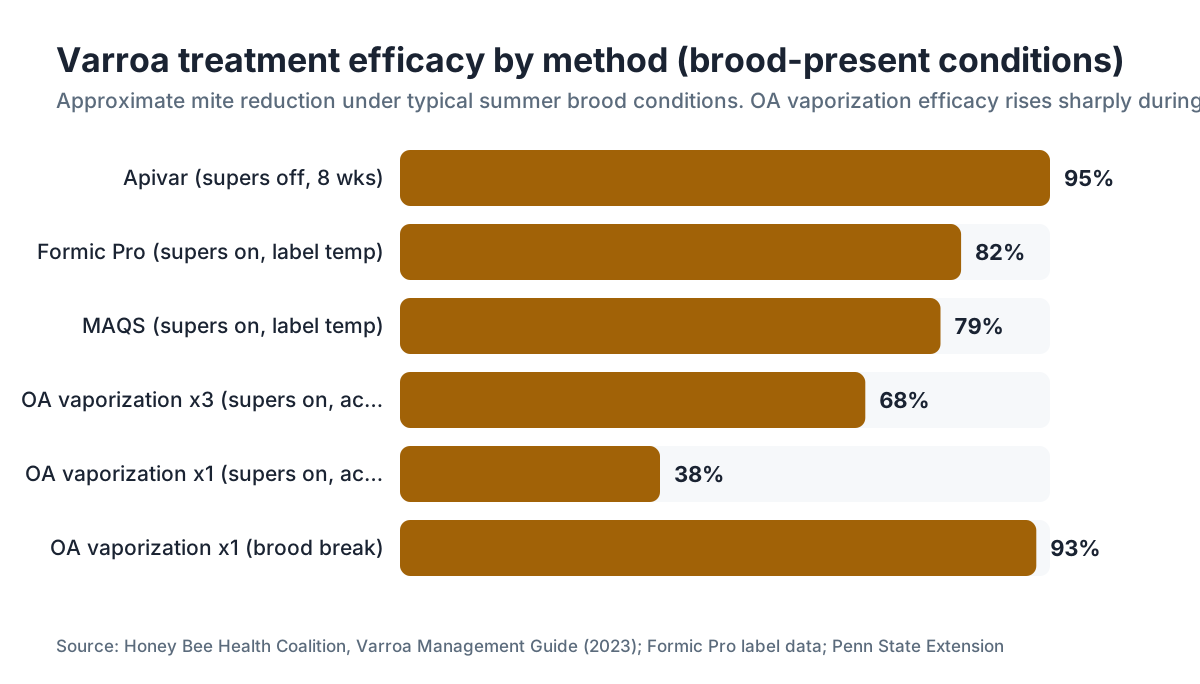
Oxalic acid vaporization works by sublimating OA crystals into a hot gas that coats adult bees and exposed mites. It does not penetrate capped brood, which is its big limitation. A single treatment during a brood break kills mites on adult bees but leaves mites under wax caps untouched. That means vaporization does its best work when brood is minimal or absent. During a full honey flow with several frames of capped brood, you'll need repeated treatments (typically 3 vaporizations, 5 days apart) to catch mites as they emerge, and even then efficacy is lower than a full Apivar treatment applied correctly off-supers [3].
Formic acid (MAQS, Formic Pro)
Formic acid products can penetrate capped brood, which gives them a real advantage over oxalic acid for mid-season use. The Formic Pro label explicitly allows application "with honey supers in place" and states the honey may be harvested for human consumption [4]. MAQS (MiteAway Quick Strips) also permits honey super use, though its label requires that the ambient temperature be between 50°F and 85°F at application and for the following week.
Formic acid is not a free lunch with supers on. Above about 85°F, formic acid off-gasses aggressively and can damage brood and even kill queens. Brood mortality in hot weather is real and documented. The Honey Bee Health Coalition notes that formic acid applications above the recommended temperature range increase the risk of queen loss significantly [1]. If you're in a hot climate mid-summer, this is a genuine concern. I'd be cautious.
Everything else requires supers off
Apivar (amitraz strips), Apistan (tau-fluvalinate), CheckMite+ (coumaphos), Apiguard (thymol gel), ApiLife VAR (thymol blend), and HopGuard 3 (hop beta acids) all require supers to be removed before treatment and kept off during and for a specified period after. This isn't a technicality. Using them with supers on is an EPA label violation and a food safety issue.
| Treatment | Active ingredient | Supers on allowed? | Brood penetration | Temp range |
|-----------|------------------|--------------------|-------------------|------------|
| Api-Bioxal vaporization | Oxalic acid | Yes, harvest OK | No | Below 50°F brood-break preferred; any temp usable |
| Formic Pro | Formic acid | Yes, harvest OK | Yes | 50°F to 85°F |
| MAQS | Formic acid | Yes, harvest OK | Yes | 50°F to 85°F |
| Apivar | Amitraz | No | No | 50°F to 105°F |
| Apiguard | Thymol | No | Partial | 60°F to 105°F |
| HopGuard 3 | Hop beta acids | No | No | Any |
| Apistan | Tau-fluvalinate | No | No | Any |
How do you apply oxalic acid vaporization with supers on?
The process is identical to off-season vaporization except for one extra step: seal the hive more carefully. With supers on, there are more gaps, more entrance points, and sometimes screened inner covers between boxes. OA vapor needs to stay inside the hive long enough to coat the bees, typically 10 minutes minimum.
Here's the practical sequence:
- Check your mite count first. If you're below 1-2 mites per hundred bees in early summer, you may have more time than you think. If you're at 3 percent or above, treat immediately regardless of the flow [1].
- Weigh or measure your oxalic acid. The Api-Bioxal label specifies 1 gram of oxalic acid dihydrate per brood box per application, with a maximum of 2 grams total per hive regardless of configuration [2]. Follow your specific product label precisely. Going over doesn't improve efficacy and can harm bees.
- Seal all upper entrances, any gaps between boxes, and the screened bottom board if you have one. Foam plugs, tape, or a folded cloth work fine. This matters more with tall super stacks because vapor rises.
- Insert the vaporizer through the bottom entrance. Most beekeepers use a Varrox, ProVap 110, or similar device. Heat the OA charge to sublimation (the device will signal this, typically 2-3 minutes), then leave the vaporizer in place and seal the entrance for 10 minutes.
- Stand clear and wear your respirator. OA vapor is irritating to mucous membranes. A NIOSH-approved particulate respirator is the minimum; a half-face respirator with acid gas cartridges is better [5].
- Unseal, remove the vaporizer, and let the colony air out before you open it.
For mid-season treatment during a flow, repeat the vaporization every 5 days for 3 total treatments. This is the protocol recommended by the Honey Bee Health Coalition to address mites emerging from capped brood between treatments [1]. You won't get perfect efficacy, but you can knock populations down meaningfully without pulling a single super.
You can use the free mite monitoring and treatment timing tools at VarroaVault to track whether your counts are falling between treatment rounds. Watching the trend is more useful than a single post-treatment sample.
How do you apply formic acid with honey supers on?
Formic Pro and MAQS are gel or pad products that you lay directly on top of the bottom brood box frames, under the next box above. The acid off-gasses slowly over one to two weeks (Formic Pro) or seven days (MAQS), and the vapor permeates the cluster including sealed brood cells. That brood penetration is what makes formic acid genuinely useful mid-season when you have significant sealed brood.
The step-by-step for Formic Pro with supers on:
- Confirm ambient temperature is between 50°F and 85°F for the treatment period and at least the first few days after. If a heat wave is forecast, delay. Seriously.
- Suit up. Formic acid fumes are irritating and can be dangerous at high concentrations. Work quickly and stay upwind.
- Open the hive. Remove supers temporarily to access the top brood box, slide one or two Formic Pro pads (depending on colony size, per label instructions) directly onto the top bars of the upper brood box with the perforated side up, then replace supers immediately. Total exposure time to the open brood box is just a few minutes [4].
- Leave an upper entrance open if possible. Formic acid vapor needs to escape; without ventilation, concentrations can build to queen-damaging levels. The label addresses this.
- Do not open the hive for at least 3 days after application. The acid off-gasses unevenly and early inspection disrupts distribution.
- Leave pads in place for the full 14 days (Formic Pro) or 7 days (MAQS). Remove spent pads and dispose of them away from the hive.
Expected efficacy with a single Formic Pro treatment on a colony with brood: the manufacturer reports 90 to 95 percent mite kill in clinical trials conducted under label conditions [4]. Real-world numbers run somewhat lower, especially if temperature swings hit during treatment. Treat in early June during a flow and recount in late July, and 70 to 85 percent knockdown is a reasonable range to expect. Nobody has perfect data on this under all flow conditions; the closest studies come from university trials in the Pacific Northwest and Ontario at ambient temperatures well below 80°F.
When should you treat mid-season rather than waiting until after the flow?
The honest threshold: 2 mites per 100 bees during brood season. Some extension programs use 2 percent as the action threshold during the brood-rearing period and 1 percent before overwintering preparation [6]. Hit that number in June or July, and waiting until August to treat after pulling supers is a choice that likely costs you bees and potentially the colony.
Mite populations double roughly every 4 to 6 weeks under normal brood-rearing conditions. A colony at 2 percent in late June can be at 4 to 6 percent by early August, and at that point you're watching bees with deformed wing virus crawling in front of the hive. The time to treat is before it gets there.
The practical calculation is simple. If you expect 4 more weeks of honey flow and your mite count is above 2 percent, the lost honey from cutting the flow short to treat is probably less than the colony loss risk from waiting. One strong colony lost to varroa is worth far more honey-producing potential than one super pulled early.
You can find your state's extension-recommended thresholds through your land-grant university's apiculture program. NC State, Penn State, University of Minnesota, and Ohio State all publish threshold guidance [6][7].
For beekeepers tracking multiple hives, a structured monitoring log makes this decision easier. VarroaVault's free varroa management tools are built for exactly this kind of threshold-based timing.
Does oxalic acid actually contaminate honey in supers?
This question matters because if OA vaporization raised honey residue levels significantly, the "supers OK" label approval would be misleading. The research says it doesn't, at least not at the doses used in beekeeping.
Oxalic acid occurs naturally in honey at concentrations ranging from about 8 to 55 milligrams per kilogram depending on floral source, with average values around 12 to 15 mg/kg [2][8]. Studies measuring honey from hives treated with OA vaporization have found residue increases generally within the natural background range. A 2016 study published in the Journal of Apicultural Research measured OA residues in honey supers present during repeated vaporization treatments and found residues did not exceed natural honey background levels [8].
The EPA and USDA reviewed this evidence in approving the label language permitting harvest from vaporization-treated hives. That approval doesn't make contamination literally impossible at very high doses, but at the registered label rate of 1 gram per brood box, the evidence supports the conclusion that the honey is safe to harvest.
Formic acid is even more benign on this front. It is a naturally occurring compound in honey, produced by bees themselves, and it evaporates readily. Residue studies show no significant elevation above background in honey harvested after Formic Pro or MAQS treatment per label [4].
What if your mite counts are very high and you need stronger treatment fast?
If you're counting 5 or 6 mites per hundred bees in summer, oxalic acid vaporization alone probably won't save the colony fast enough. OA without brood penetration, even at three treatments, typically reduces mite loads by 60 to 90 percent depending on brood levels. A colony at 6 percent might still be above 1 percent after treatment, and the remaining mites keep reproducing.
In that situation, you have a hard choice. Option A: pull all supers now, treat with Apivar or a full formic acid course, and accept the lost honey. Option B: treat with formic acid (which does penetrate brood) while supers are on, accept the temperature risk, and accept somewhat lower efficacy than Apivar.
I'd choose Option A. A colony at 6 percent infestation in summer is already in serious trouble, and a few extra weeks of honey doesn't outweigh the colony. Apivar is the most reliable and forgiving treatment for high mite loads because amitraz keeps killing newly emerging mites over the full 8-week treatment period [9].
The Honey Bee Health Coalition's Varroa Management Guide is explicit that colonies with high mite loads in late summer are the primary cause of fall and winter colony losses in the United States [1]. That's not a scare tactic. It's the consistent finding across multiple large-scale colony loss surveys.
Are there any label or legal issues beekeepers need to know about?
Using any pesticide in a manner inconsistent with its label is a federal violation under FIFRA, the Federal Insecticide, Fungicide, and Rodenticide Act [10]. The label is the law. If Apivar's label says supers off, and you apply it with supers on, you've broken federal law whether you keep two hives or run a commercial operation. The practical risk to a small-scale beekeeper is low, but the honey contamination risk is real, and that matters if you sell.
For certified organic honey production, the situation is tighter. USDA National Organic Program regulations require that any treatment used be permitted under your certifying agency's program. Oxalic acid is permitted under the National Organic Program [11]. Synthetic miticides are not. Formic acid is permitted by some certifying agencies and not others, so verify with your certifier before treating.
State regulations occasionally add restrictions beyond federal labels. Some states require a veterinary feed directive or a licensed applicator for certain treatments. Check your state department of agriculture's pesticide program for specifics. Your state's extension apiculture specialist is the fastest way to get a reliable answer.
The key product labels are publicly available through the National Pesticide Information Center and EPA pesticide registration databases [10].
What does monitoring look like before and after treating with supers on?
Alcohol wash or sugar roll before treatment, alcohol wash 3 to 4 weeks after treatment. That's the protocol.
A sticky board count tells you relative mite fall but not the infestation rate, and infestation rate is what drives treatment decisions. Alcohol wash on a 300-bee sample gives you mites per 100 bees, the number you compare to action thresholds [1][6].
For mid-season treatment with supers on, time your post-treatment check at about 3 to 4 weeks after the treatment ends, not immediately after. OA vaporization without full brood penetration leaves surviving mites under capped cells, and those mites don't show up in a wash until they've had time to reproduce and move back onto adult bees. A count at 2 weeks post-treatment can be misleadingly low.
If your post-treatment count is still above 2 percent and you're still in brood season, treat again. Retreatment is not a failure. Varroa management is an ongoing process, not a single annual intervention. Research from the Bee Informed Partnership's annual loss surveys consistently finds that colonies treated once a year have higher winter mortality than colonies getting threshold-based treatment [7].
For deeper background on the biology driving all this, the varroa mite overview explains the reproductive cycle that makes mid-season treatment timing so consequential.
Can you use any non-chemical methods to manage varroa with supers on?
Yes, and some of them are genuinely useful as part of an integrated approach, though none are sufficient on their own.
Drone comb removal. Varroa mites prefer drone brood, at rates roughly 8 to 10 times higher than worker brood. Removing frames of capped drone brood removes a disproportionate number of mites. The practical limitation is labor: you need to pull and freeze drone frames before they're sealed, or catch them right as they're capped. It cuts mite load but typically by only 20 to 30 percent at best, and only if done consistently through the season [1].
Brood breaks. Cage a queen for 14 to 21 days during a flow, creating a broodless period, and oxalic acid vaporization becomes dramatically more effective because all mites are phoretic (on adult bees, exposed to the vapor). A single OA treatment during a brood break can hit 90 to 95 percent efficacy. The downside is reduced brood and temporarily lower honey production. Some beekeepers find this acceptable mid-season if the colony is strong.
Screen bottom boards. The evidence for screen bottom boards as a meaningful varroa control is weak. Some mites do fall through, but the effect on overall infestation rates is small enough that most researchers don't recommend screens as a treatment, only as a monitoring tool [6].
None of these replaces approved chemical treatment when you're above threshold. They're useful additions to a program, not substitutes.
What are beekeepers' most common mistakes when treating with supers on?
The biggest one: assuming "organic" means "safe at any dose." Oxalic acid is organic and approved with supers on, but at higher-than-label doses it can kill bees, damage brood, and potentially push honey residues above natural background levels. More OA is not better OA.
Second: ignoring the temperature restriction on formic acid. Beekeepers in hot climates apply MAQS in 90°F weather, lose queens, and blame the product. The label temperature limits exist because the off-gassing behavior of formic acid really does change with heat. Respect the range.
Third: single-treatment thinking. One OA vaporization is almost never enough during active brood season. The protocol is three treatments five days apart. Stopping after one because the bees look fine ignores the mites still sealed in brood.
Fourth: not counting mites before or after. Treatment without monitoring is management by hope. Mite-resistant colonies, treatment timing, and efficacy variation mean a "treated" hive may still be above threshold. Count before and count after.
Fifth: waiting too long to act. This is the one that costs the most colonies. Beekeepers who wait until after the honey flow to treat, every year, without exception, will eventually lose colonies to varroa. The mite population doesn't pause for honey season.
Frequently asked questions
Can I use Apivar strips with honey supers on?
No. The Apivar label explicitly requires that honey supers be removed before treatment and kept off during the entire treatment period of 6 to 8 weeks. Amitraz, Apivar's active ingredient, leaves residues in wax and can contaminate honey. Using Apivar with supers on is a federal label violation under FIFRA and a food safety concern if you sell or give away honey.
How many oxalic acid vaporizations do I need with supers on?
Three vaporizations, 5 days apart, is the standard protocol recommended by the Honey Bee Health Coalition for use during brood season. A single treatment only kills phoretic mites on adult bees, not those under capped brood. The repeat treatments catch mites as they emerge. Even with this schedule, expect lower efficacy than off-season treatment during a true brood break.
Will formic acid hurt my honey bees or queen during a flow?
It can, particularly above 85°F. Formic acid off-gasses more aggressively in heat, raising concentrations inside the hive to levels that can kill brood and, less commonly, queens. The Formic Pro and MAQS labels restrict use to temperatures between 50°F and 85°F for this reason. Below that range, queen and brood effects at label dose are generally low but not zero.
Does oxalic acid affect the taste of honey when supers are present?
Research to date shows no detectable change in honey flavor from OA vaporization at label rates. Oxalic acid already occurs naturally in honey, and the residue increase from vaporization treatments falls within the natural background range found in untreated hives. The EPA label approval for harvest from vaporization-treated hives reflects this evidence.
What's the minimum mite count that should make me treat mid-season?
Most extension programs, including NC State and the University of Minnesota, set the action threshold at 2 mites per 100 bees during brood season. Some use 3 percent, but waiting until 3 percent gives mite populations less margin before the colony crosses into dangerous territory. Count with an alcohol wash on a 300-bee sample from the brood nest for the most accurate result.
Is oxalic acid vaporization safe for beekeepers to apply?
OA vapor is irritating to the respiratory system and mucous membranes. The EPA requires use of a NIOSH-approved respirator during vaporization. A half-face respirator with acid gas and P100 particulate cartridges gives better protection than a dust mask alone. Work outdoors, stay upwind, and wait the full 10 minutes before unsealing the hive entrance. Follow your product label's personal protective equipment requirements.
Can I apply HopGuard 3 with supers on?
No. The HopGuard 3 label requires honey supers to be removed before treatment. Despite being derived from hops, a natural source, HopGuard's label restrictions exist because the strips can contact honey. It's a common misconception that natural or organic-approved products automatically allow super-on use. Always read the specific product label.
How soon after pulling supers can I apply Apivar?
You can apply Apivar the same day you pull supers. There's no waiting period between super removal and strip placement. The 6-to-8-week treatment window begins at application, so removing supers as early as possible and treating immediately gives you the best chance of completing treatment before your overwintering prep window closes, typically targeting completion by mid-October in most of North America.
What mite treatments are approved for certified organic honey production?
Oxalic acid is permitted under the USDA National Organic Program. Formic acid is permitted by some certifying agencies but not all, so verify with your certifier before using it. Synthetic miticides including Apivar, Apistan, and CheckMite+ are not permitted in certified organic production. Thymol-based products occupy a gray area; check your certifier's approved materials list.
How do I monitor mite levels accurately before deciding to treat?
Alcohol wash is the most accurate field method. Take a 300-bee sample from the brood nest area (not the entrance or top bars), add 70% isopropyl alcohol, shake for 60 seconds, and count mites in the wash. Divide mites by 3 to get mites per 100 bees. Do this every 30 days during the season. Sticky boards are only useful for relative comparison, not absolute infestation rate.
Can I use thymol products like Apiguard while collecting honey?
No. Apiguard and ApiLife VAR labels require supers to be removed before treatment because thymol can taint honey flavor at detectable levels even at low concentrations. Thymol also requires ambient temperatures above 60°F to off-gas effectively, which limits its timing further. Wait until supers are fully off before applying any thymol-based treatment.
Does treating with oxalic acid vaporization disrupt foraging or honey production?
Minimal disruption in practice. The treatment takes about 15 minutes per hive including sealing and waiting time. Some beekeepers report a brief increase in bees clustering at the entrance after treatment, which settles within an hour or two. There's no documented effect on foraging activity or honey production from OA vaporization at label rates, and you don't need to open the hive.
What happens if I treat with supers on using a product that requires supers off?
You risk contaminating the honey with miticide residues, which is a food safety problem. You also violate the product's EPA label, which is a federal offense under FIFRA regardless of scale. If you sell honey, contaminated honey that reaches consumers creates liability. The practical testing risk is low for hobbyists selling locally, but the ethical and legal problem is real.
Should I treat in spring before supers go on, or mid-season while supers are on?
Both, if your counts justify it. A spring treatment before population buildup, when the colony is still relatively small and brood is limited, is highly effective and avoids the super timing problem entirely. If your fall treatment was effective and your spring count is below 1 percent, you may not need spring treatment. Always base the decision on an actual mite count, not the calendar.
Sources
- Honey Bee Health Coalition, Varroa Management Guide (2023 edition): Action threshold of 2-3 mites per 100 bees during brood season; repeated OA vaporization protocol (3 treatments, 5 days apart); formic acid temperature risk to queens; fall colony losses linked to summer mite loads
- EPA, Api-Bioxal (Oxalic Acid Dihydrate) Product Label, Reg. No. 83923-1: 1 gram OA per brood box, maximum 2 grams per hive; vaporization method permits harvest from supers present during treatment; dribble/spray methods require supers not used for human consumption
- Penn State Extension, Varroa Mite Management: OA vaporization without brood penetration; efficacy 60-90% depending on brood levels; lower efficacy than full Apivar treatment
- NIOSH, Respiratory Protection for Pesticide Applicators: NIOSH-approved respirator required during OA vaporization; half-face acid gas cartridge recommendation
- NC State Extension, Varroa Mite Management thresholds: 2 percent action threshold during brood season, 1 percent before overwintering; screen bottom boards recommended for monitoring not treatment
- Bee Informed Partnership, Annual Colony Loss Survey: Colonies treated once per year have higher winter mortality than colonies receiving threshold-based treatment; consistent finding across annual loss surveys
- Journal of Apicultural Research, Oxalic Acid Residues in Honey (2016): Natural OA in honey 8-55 mg/kg; residues after vaporization treatment within natural background range; no significant elevation above untreated hive honey
- Elanco, Apivar (Amitraz) Product Label: Apivar 8-week treatment period; honey supers must be off before and during treatment; amitraz persists in wax
- EPA, FIFRA Federal Insecticide Fungicide and Rodenticide Act Overview: Using pesticide inconsistent with label is a federal violation under FIFRA; label is the law
- USDA National Organic Program, Allowed and Prohibited Substances: Oxalic acid permitted under National Organic Program; synthetic miticides not permitted in certified organic production
- University of Minnesota Extension, Varroa Mite Management for Beekeepers: 2 percent action threshold during brood season; alcohol wash protocol on 300-bee sample; monitoring frequency recommendation
Last updated 2026-07-09