How to treat varroa during a honey flow without contaminating supers
TL;DR
- During a honey flow, your safest legal option is oxalic acid vapor applied only when supers are off.
- Formic acid (MAQS or Formic Pro) is the one product the EPA labels for use with supers on, though it leaves residue risk at high temperatures.
- Synthetic miticides like Apivar must never go in a hive with honey supers on.
Why does treating varroa during a honey flow feel impossible?
Here's the tension every beekeeper hits around May or June. Mite loads are climbing, brood is packed wall to wall, and the supers are filling fast. You know you need to treat. You also know that the wrong product in a hive with honey supers contaminates food people are going to eat, including your own crop.
The frustration is real, and it's more than a feeling. Mite populations follow a roughly exponential curve through spring buildup. A colony sitting at 1 percent infestation in April can be at 3 to 4 percent by July if you do nothing, because the ratio of mites to capped brood keeps climbing while worker brood stays high [1]. The Honey Bee Health Coalition puts the economic damage threshold at 2 percent for colonies in summer buildup, and at 1 percent in late summer when the winter bees are being raised [1]. Miss the flow window and you'll either wreck your crop or arrive at August with a mite-bombed hive.
So the question isn't whether to treat. It's which products the EPA actually allows with supers on, what the residue data really shows, and how to squeeze every legal option out of a tight calendar.
Which varroa treatments are legal to use when honey supers are on?
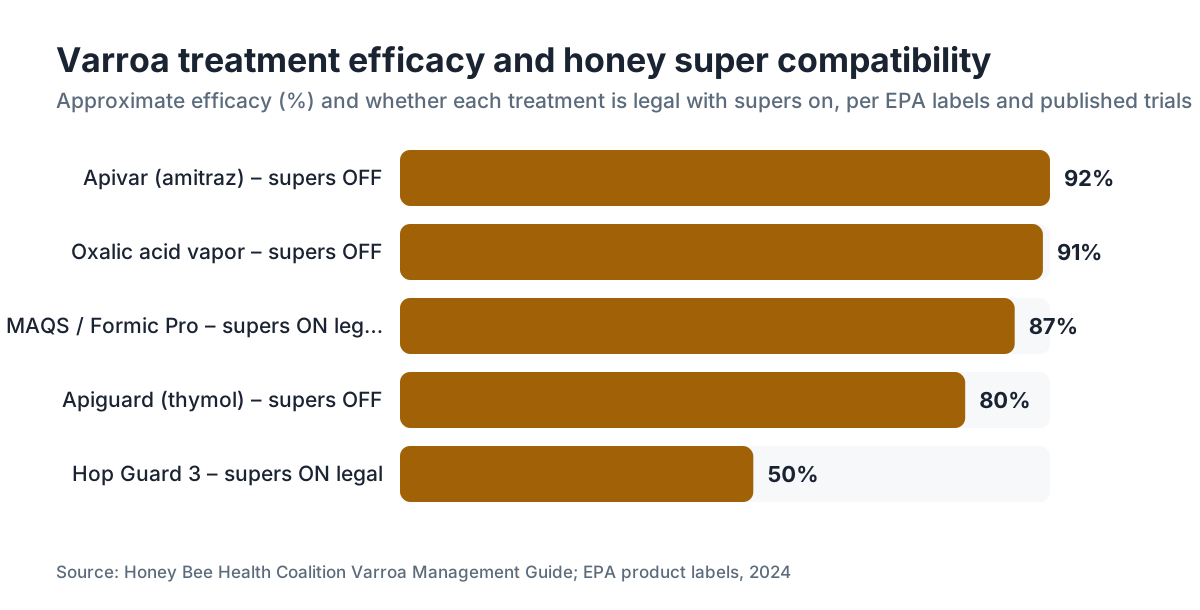
The list is short, shorter than most beekeepers think. Two products are legal with supers on: formic acid (MAQS or Formic Pro) and Hop Guard 3. Everything else requires supers off.
Formic acid (MAQS and Formic Pro) are the only acid miticides with an EPA label that explicitly permits use with honey supers present. MAQS (Mite Away Quick Strips) can be applied with supers on when ambient temperatures sit between 50 and 79 degrees F (10 to 26 C) [2]. Formic Pro has a slightly wider label. Both release formic acid vapor, which penetrates capped brood cells and kills mites under the cappings. Most other treatments cannot touch a mite once it's sealed in with developing brood.
The catch: formic acid above about 80 degrees F can kill brood, damage queens, and push formic acid residues in honey higher. The EPA label is the legal ceiling. It's also the practical floor for safety. If your daytime highs are pushing 85 during a July flow, MAQS is a bad idea regardless of what the label technically allows.
Oxalic acid (Api-Bioxal) applied as vapor or dribble is EPA-approved, but the label specifies use when supers intended for human consumption are NOT on the hive [3]. Extended-release oxalic acid methods, like the shop-towel trick, are not EPA-registered and are not legal in the US no matter what a forum tells you. Some commercial extended-release oxalic devices are working through registration, but as of mid-2025, none carry a label that clears honey supers.
Hop Guard 3 (beta acids from hops) has an EPA label that allows use with supers on [4]. Efficacy is lower than formic acid, running roughly 40 to 60 percent in most university trials, which makes it a partial tool rather than a standalone treatment [5]. Use it when your mite load is low and you need to buy a few weeks.
Apiguard and ApiLife Var (thymol-based) are not approved with honey supers on. Thymol taints honey flavor at very low concentrations.
Nothing else is legal with supers on. Not Apivar (amitraz strips). Not CheckMite+ (coumaphos). Not oxalic acid dribble. If someone tells you otherwise, ask to see the product label.
| Treatment | Active ingredient | Legal with supers on? | Efficacy vs varroa | Temp constraints |
|---|---|---|---|---|
| MAQS / Formic Pro | Formic acid | Yes [2] | 80-95% | 50-79°F for MAQS |
| Hop Guard 3 | Beta acids | Yes [4] | 40-60% [5] | None specified |
| Api-Bioxal (OA vapor) | Oxalic acid | No [3] | 90%+ on phoretic mites | Below 50°F risky |
| Apivar | Amitraz | No | 90-95% | 50-105°F |
| Apiguard / ApiLife Var | Thymol | No | 74-93% | Above 59°F needed |
Does formic acid actually contaminate honey when supers are on?
Formic acid occurs naturally in honey. Typical background levels in North American honeys run from about 50 to 180 mg/kg [6]. Studies that measured residues after MAQS treatment found formic acid levels in honey rose during and just after treatment, then dropped back to near background within two to three weeks in most samples [6]. The European Food Safety Authority has set no maximum residue limit for formic acid in honey, because it's considered a natural component.
The residue story isn't uniformly clean, though. High ambient temperatures speed up formic acid volatilization, which means more acid ends up in the hive and potentially in nectar being processed. Some beekeepers report fermented or sour flavor notes in honey pulled soon after a warm-weather MAQS treatment. The safe play, even when the label allows it, is to wait at least two weeks after treatment before harvesting supers whenever you can.
The Honey Bee Health Coalition's guide notes that formic acid is the only compound that penetrates cappings and kills mites in capped brood, which is exactly why it earns a place during a flow [1]. That same penetration is why temperature matters so much. The vapor has to generate at the right rate to work without cooking bees or tainting product.
Formic acid in honey supers is a manageable risk when you follow the label temperature limits and give a post-treatment buffer before harvest. It is not zero risk. Treat it like a tool with a sharp edge.
What happens if you use Apivar or oxalic acid while supers are on?
Short version: Apivar with supers on is an illegal residue problem, and oxalic acid vapor with supers on breaks the label even though the human-food risk is lower. Neither is worth it.
Apivar (amitraz strips) is one of the most effective varroa treatments available, with documented efficacy above 90 percent in properly run trials [7]. Its label flatly prohibits use when honey supers intended for human consumption are present. Amitraz and its breakdown product DMPF accumulate in beeswax and honey, and the FDA has no approved tolerance for amitraz residues in honey sold in the US [7].
Put Apivar in with supers on, and if anyone tests that honey, you're holding an illegal crop. European buyers test for amitraz routinely. This is not theoretical.
Oxalic acid vapor is gentler from a human-food angle, because oxalic acid degrades quickly and shows up naturally in lots of foods. The Api-Bioxal ban on supers isn't mainly about consumer residue. It's part labeling caution and part the fact that oxalic acid vapor in an enclosed space full of nectar is hard on bees and can damage their exoskeletons at higher concentrations. The label language is plain: it directs beekeepers not to apply when honey supers are in place [3]. Follow it.
The practical answer for most hobbyists: when mite pressure demands a supers-off treatment, pull the supers, treat, and put them back after the required wait. Yes, you might lose a few days of flow. That beats a contaminated crop or a dead hive in September.
How do you time varroa treatment to protect both the flow and the colony?
Timing is the whole game, and you work backward from two dates: when your main flow ends, and when your winter bees start being raised.
Across most of North America, the window for raising healthy winter bees runs August 1 through September 15. Those bees carry the colony to spring. If they emerge into a hive at 3 to 5 percent mite load, they'll be parasitized, immune-compromised, and short-lived. Mite loads need to be under control by early August at the latest [1].
Now count back. Apivar takes about 6 to 8 weeks for a full treatment cycle [7]. To finish by August 1, you need supers off and strips in by early June. On a light-flow hive, that might mean pulling supers early or skipping them.
Formic acid works on a shorter clock. MAQS is a 7-day treatment. Formic Pro runs as a one-application or two-application protocol over 14 days. You can run formic during the flow if temperatures cooperate, then switch to a longer treatment after the flow if you still need it.
A staging plan that works for a lot of experienced beekeepers:
- Monitor mite loads monthly starting in April (alcohol wash or sugar roll).
- If loads stay below 1 percent through the flow, hold off and treat hard right after pulling supers.
- If loads hit 2 percent or more during the flow, apply formic acid (temperature permitting) or Hop Guard 3 to slow the climb, then treat properly with Apivar after the flow.
- Never enter August without a completed treatment cycle behind you.
For monitoring tools and a calendar you can actually follow, the free protocol builder at VarroaVault takes your flow dates and returns treatment windows that account for local temperature norms.
Can you remove supers temporarily to treat and then put them back?
Yes, and for a lot of situations it's the cleanest fix. Pull supers, treat with oxalic acid vapor or Apivar, wait the required interval, and return the supers.
Oxalic acid vapor works fastest in broodless or low-brood conditions. If you can find the queen and cage her for a week to force a brood break, a single OAV treatment in a broodless hive can hit 90 percent efficacy or better [3]. That's hard during a heavy flow because brood is everywhere. But if you catch a gap between flows, say after the main clover flow ends and before the fall flow starts, it's worth doing.
Apivar is different. The label requires strips to stay in for a minimum of 6 to 8 weeks. You can't pull supers for 48 hours, drop in Apivar, and put supers back. You need the full duration with no honey supers present.
For the short-removal approach to work with OAV, you need three things:
- A stretch of low or no incoming nectar (so bees aren't processing fresh nectar in the brood nest)
- Supers stored where bees can't raid them
- Multiple OAV treatments spaced 5 to 7 days apart to catch mites emerging from capped cells
Two or three OAV treatments over two weeks, supers off, will knock loads down hard before you return the supers for a fall flow. That's a real option, and it beats doing nothing during a spring flow and hitting July with a mite crisis.
What mite load is high enough that you should treat even during the flow?
Treat at 2 percent infestation during summer buildup (roughly May through July) and at 1 percent in late summer when winter bees are being raised (August through September). Those are the Honey Bee Health Coalition's current thresholds, built from colony loss data, and they're about as solid as numbers get in this field [1].
A 2 percent load means 2 mites per 100 bees in an alcohol wash. Wash 300 bees, find 6 or more mites, and you're at threshold. At that level during a July flow, mites are reproducing faster than the colony can compensate, and you're looking at a crash by September.
Some extension services set the bar a hair differently. Penn State Extension recommends treating above 2 percent in summer and notes that colonies tolerate somewhat higher loads early in the season, before winter bees come into play [8]. The University of Minnesota Extension puts the summer threshold at 2 to 3 mites per 100 bees [9]. There's no perfect consensus. Anything above 2 percent during the flow is a clear treat-now signal, however inconvenient the timing.
Don't judge by a sticky board alone. Sticky board counts swing with hive population, temperature, and any mite-killing agent already in the hive. Alcohol wash is the accurate method for an infestation percentage [1].
Are there non-chemical options that help during a honey flow?
Mechanical and cultural controls slow mite buildup and buy time during a flow, but they won't replace a chemical treatment once you're at threshold.
Drone comb removal is the most useful non-chemical tool. Varroa reproduce in drone brood at a rate about 8 to 10 times higher than in worker brood [1]. Put a frame of drone foundation in the brood nest, then remove it once it's capped, and you physically pull out a big chunk of the reproducing mite population. Studies suggest it cuts mite loads by 30 to 50 percent on its own, though nobody has great data on how that interacts with heavy honey flows [1]. It works best as prevention starting in early spring, not as a rescue once loads are high.
Brood breaks through queen caging or splitting can sharply reduce mite reproduction for 3 to 4 weeks. No capped brood means no protected cells for mites to breed in. Pair a brood break with OAV during the broodless window and efficacy gets very high. The cost during a flow is obvious: caging the queen or splitting hard drops your forager count and your honey.
Screened bottom boards reduce mite loads by roughly 10 to 15 percent in studies, which won't save you if you're at threshold [1]. Nice to have. Not a treatment.
For beekeepers chasing resistant stock, some Varroa Sensitive Hygiene (VSH) and Minnesota Hygienic lines show measurably slower mite buildup. Requeening with hygienic stock before a flow year begins is a long-game strategy, not a quick fix. The varroa mite overview on this site covers VSH genetics and what to realistically expect.
How do you store and handle honey supers during treatment to prevent contamination?
If you're pulling supers to treat, storage matters more than most beekeepers assume. Keep them dry, keep them away from active treatments, and extract early if you can.
Supers full of capped honey sit for several weeks without spoiling as long as they stay dry and warm. Humidity is the enemy. Above about 60 percent relative humidity, exposed honey cells absorb moisture and ferment. Store pulled supers in a dry space, and run a dehumidifier if your climate is damp.
Don't stack pulled supers on treated hives or anywhere near an ongoing OAV treatment. Oxalic acid vapor doesn't penetrate capped cells, but it can settle on exposed honey and wax. The residue risk is low. Why add uncertainty.
If supers hold uncapped nectar, harvest promptly or return them to a hive after treatment. Uncapped nectar left off the hive ferments, dries unevenly, and pulls in small hive beetles and wax moths fast.
One tip that solves the whole problem: extract right after pulling supers. Fresh honey extracts easier, especially from new comb, and you wipe out the storage contamination risk entirely. Then you're free to treat the hive with whatever the situation calls for.
What do extension services and the EPA actually recommend for flow-season treatment?
The EPA's position is simple: use products according to their registered labels, full stop. Under FIFRA (the Federal Insecticide, Fungicide, and Rodenticide Act), the label is the law [10]. Any use that contradicts it, including Apivar with supers on, is an illegal pesticide application.
University extension services line up on the same core advice. Monitor monthly. Treat at threshold. Use formic acid products if you must treat during a flow. Get a full post-flow treatment done before August brood-raising begins.
The Honey Bee Health Coalition, which pulls together researchers, USDA scientists, and industry experts, publishes the most widely cited varroa guidance in US beekeeping. Its guide identifies formic acid products as the only treatments labeled for use with honey supers on the hive in the United States [1]. That's the authoritative summary in one line.
Penn State Extension advises beekeepers to time treatments around honey supers and to use formic acid as a bridge treatment when they need to act during the flow [8]. The University of Florida IFAS Extension recommends that hobbyists learn to spot the end of their local main flow and plan Apivar treatment to begin within one week of super removal [11].
If your local flow calendar is a mystery, state apiarist offices often publish region-specific guidance. Find your state's extension apiculture program; many post their material free online. To build a protocol around your exact location and hive count, the free tools at VarroaVault are worth a look.
What are the real risks if you skip treatment entirely during a honey flow?
Skipping treatment during a flow to protect the crop is a common call. It's also one of the most common roads to fall colony collapse.
Run the population math. A varroa population doubles roughly every 27 to 28 days in a colony loaded with capped brood [1]. A hive at 1 percent in May can realistically hit 4 to 8 percent by August with no intervention. At 5 percent mite load, most colonies show visible deformed wing virus, brood disruption, and a shrinking adult population. Many die or go into October too weak to overwinter.
The economics of choosing the honey over the bees don't hold up. A healthy hive that makes honey for 5 to 10 years is worth far more than one extra super followed by a dead colony in November. Replacing a package in spring costs $150 to $200 or more depending on region and year. A bottle of Apivar or a pack of Formic Pro costs $20 to $35. Do that math once and the decision makes itself.
The other risk is drift and robbing. A collapsing, mite-heavy colony in late summer turns into a mite dispenser for every hive within 2 to 3 miles as bees drift and robbing spreads mites mechanically. Your neighbor's bees pay. Your own splits and nucs pay. An untreated colony during the flow is more than a personal loss. It's a problem for the whole neighborhood of hives.
Frequently asked questions
Can I use oxalic acid vapor when honey supers are on the hive?
No. The EPA label for Api-Bioxal prohibits use when honey supers intended for human consumption are present. This isn't just guidance; using a pesticide contrary to its label is illegal under FIFRA. Pull supers first, treat, then return them after the required interval. If you need to treat during the flow, formic acid products (MAQS or Formic Pro) are the legal alternative.
How long after a formic acid treatment can I harvest honey?
Neither MAQS nor Formic Pro sets a pre-harvest interval for honey the way some pesticides do, because formic acid is naturally present and has no established maximum residue limit in the US. As a practical buffer, most beekeepers and extension services suggest waiting at least two weeks after treatment completes before pulling supers, so formic acid levels return to natural background concentrations.
What's the best varroa treatment to use right before the honey flow starts?
Apivar (amitraz) placed in early spring, at least 6 to 8 weeks before supers go on, is the cleanest option. It gives you time for a full cycle and strip removal before any supers are added. Starting in early March across most of North America means strips can come out before a late April or May flow. Confirm it worked with a mite wash in mid-April.
Does Hop Guard 3 really work well enough to use during a honey flow?
It's legal with supers on and safe for honey, but efficacy runs roughly 40 to 60 percent in university trials, well below formic acid or amitraz. Hop Guard 3 works best as a stopgap when mite loads are low (under 1 percent) and you need to slow reproduction until the flow ends. Don't lean on it alone if you're at or above the 2 percent threshold.
Can I split a hive during the flow to reduce mite pressure without treating?
Splitting creates a brood break in the queenless half, which interrupts mite reproduction for 3 to 4 weeks while the new queen develops and starts laying. That's a real mite tool. The cost is fewer foragers and less honey. Splitting works best against mites when paired with OAV during the broodless period. On its own, it delays the problem more than it solves it.
How do I monitor mite levels during a honey flow without disturbing the hive too much?
An alcohol wash takes about 15 minutes and is the most accurate method. Collect roughly 300 bees (half a cup) from a brood frame, wash with isopropyl alcohol, and count mites. Do this once a month during the active season. Sticky board counts are easier but less reliable because they don't give you a percentage infestation. The Honey Bee Health Coalition's guide has a free step-by-step alcohol wash protocol.
Will treating with MAQS during a nectar flow hurt my queen?
Formic acid at high temperatures or in a poorly ventilated hive can cause queen loss. MAQS instructions say to use only when temperatures sit between 50 and 79 degrees F and to keep hive ventilation good. Queen loss rates in studies have run about 5 to 15 percent when MAQS is used outside the recommended temperature range. Within label conditions, queen mortality is low but not zero. Keep a backup queen in mind.
What if my mite load hits 3 percent in the middle of a June flow?
That's a treat-now situation. At 3 percent in June you're looking at 6 to 8 percent by August if you do nothing. Apply MAQS or Formic Pro if temperatures stay below 79 degrees F, or make the call to pull supers, run a brood break with OAV, and accept the production loss. A partial crop with living bees beats a full crop followed by a dead colony.
Are there any varroa treatments safe enough to leave in the hive year-round?
No registered treatment is approved for continuous year-round use. Apivar is labeled for one or two treatment cycles per year to reduce resistance risk. Oxalic acid and formic acid allow more frequent use but still carry label limits on timing and frequency. Constant chemical pressure also speeds resistance in mite populations. Monitor and treat at threshold; that beats prophylactic year-round dosing.
How does drone brood removal reduce mite loads, and is it worth doing during a flow?
Varroa preferentially enter drone cells, with infestation rates 8 to 10 times higher than in worker brood. Insert a frame of drone foundation, then remove it once capped, and you physically pull out a large number of reproducing mites. Studies suggest it cuts mite population growth by 30 to 50 percent. During a flow it's easy to maintain without hurting production, and it complements chemical treatment rather than replacing it.
Can I use oxalic acid dribble instead of vapor to treat during a honey flow?
No. The Api-Bioxal label prohibits dribble or vapor application when supers intended for human consumption are present, for both methods. Dribble is also much less effective than vapor when brood is present, because it only kills phoretic mites (those riding adult bees), not mites sealed in capped cells. Neither method is appropriate with supers on.
What temperature is too hot to use MAQS during a honey flow?
The MAQS label ceiling is 79 degrees F (26 C) daytime high. Above that, formic acid volatilizes too fast, raising the risk of queen loss, brood damage, and bee mortality. If your forecast shows 80 or above during the 7-day treatment window, wait or switch to Formic Pro, which has a slightly different formulation and temperature handling. Formic Pro's extended-release design is a bit more forgiving of warm weather, but check its specific label first.
Do I need to worry about varroa treatment residues if I'm selling honey locally?
Yes, even for local sales. If you sell honey, you're subject to state food safety laws and potentially FDA oversight, depending on volume and state cottage food exemptions. Amitraz residues from illegal Apivar use with supers on would be an adulterant under federal law. Formic acid residues from labeled MAQS use are generally not a legal problem because formic acid is naturally present and has no US or EU maximum residue limit. Keep your treatment records regardless.
Sources
- Honey Bee Health Coalition, Varroa Management Guide (current edition): Treatment thresholds of 2% in summer buildup and 1% in late summer; formic acid is the only treatment labeled for use with honey supers on; drone brood infestation rate 8-10x higher than worker brood; mite population doubling time roughly 27-28 days
- MAQS (Mite Away Quick Strips) EPA-registered product label, NOD Apiary Products: MAQS is registered for use with honey supers present at ambient temperatures between 50°F and 79°F
- Api-Bioxal EPA-registered product label, Véto-pharma: Api-Bioxal label directs users not to apply when honey supers are in place; approved as oxalic acid varroacide with 90%+ efficacy on phoretic mites
- Hop Guard 3 EPA-registered product label, BetaTec Hop Products: Hop Guard 3 is labeled for use when honey supers are present
- Rademacher E. & Harz M., Oxalic acid for the control of varroosis in honey bee colonies, Apidologie 2006: Hop Guard and similar beta-acid formulations show efficacy of approximately 40-60% in varroa control trials
- Bogdanov S. et al., Residues of miticides and other acaricides in honey and beeswax, Apidologie 1998: Natural formic acid background levels in honey run approximately 50-180 mg/kg; levels increase after MAQS treatment but return near background within 2-3 weeks
- Apivar (amitraz) EPA-registered product label, Véto-pharma: Apivar is prohibited for use when honey supers intended for human consumption are present; treatment duration 6-8 weeks; efficacy above 90% in properly conducted trials; amitraz has no FDA-approved tolerance in US honey
- Penn State Extension, Varroa Mite Management in Honey Bee Colonies: Summer treatment threshold at 2% infestation; timing treatments around honey supers; formic acid as bridge treatment during flow
- University of Minnesota Extension, Varroa Mite: Summer varroa threshold of 2-3 mites per 100 bees for Minnesota colonies
- US EPA, Federal Insecticide, Fungicide, and Rodenticide Act (FIFRA): Pesticide use contrary to label instructions is illegal under FIFRA; the label is the law
- University of Florida IFAS Extension, Varroa Mite Treatments for Honey Bee Colonies: UF IFAS recommends hobbyist beekeepers begin Apivar treatment within one week of super removal after the main flow
Last updated 2026-07-09