Varroa treatment with honey supers on: what's actually safe

TL;DR
- Almost no varroa treatment is legal or safe with honey supers in place.
- Oxalic acid vaporization is the one widely used exception, permitted in the U.S.
- with supers on when you follow the EPA-registered label.
- Apivar, Apistan, and Mite Away Quick Strips all require super removal first.
- Read the current product label before you crack the lid.
Why does having honey supers on change your treatment options so much?
The short answer is contamination. Honey in a super is food, and it goes straight from the frame into a jar and onto someone's table. So regulators and manufacturers hold anything that touches a supered hive to a completely different standard than a hive running only brood boxes. That standard lives in one place: the EPA-registered product label, which is a federal legal document, not a friendly suggestion.
Most miticides are lipophilic. They dissolve in fats and waxes, and beeswax in drawn comb soaks them up like a sponge. Once a miticide settles into comb, it leaches back out into honey over weeks or months. Researchers have measured fluvalinate (the active ingredient in Apistan) and coumaphos (the active ingredient in CheckMite+) in commercial honey, and the contamination almost always traces back to strips left in too long or used when supers were present [1].
Oxalic acid is the odd one out. It's a naturally occurring organic acid found in plants and in honey itself at low background levels. That chemistry, plus EPA review, is why it's the single treatment you'll see cleared for use with supers on.
Which varroa treatments are approved for use with honey supers on?
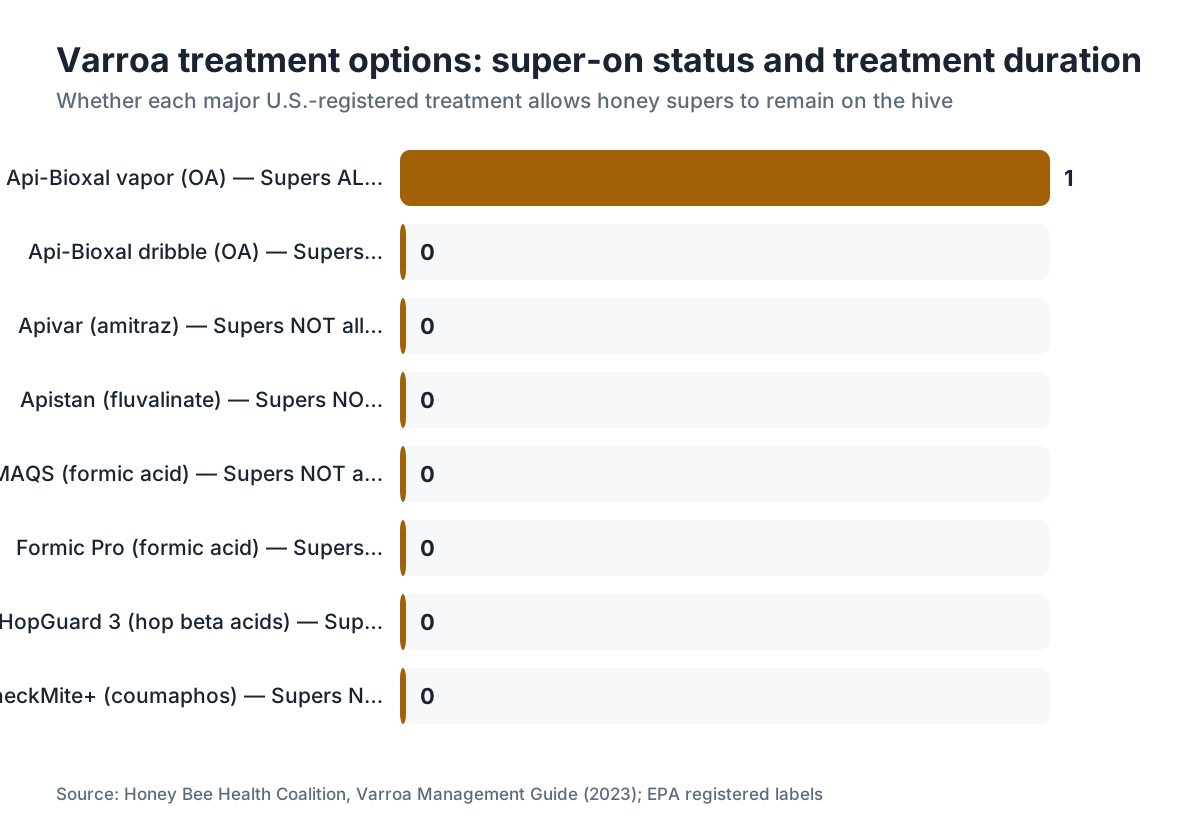
In the United States, oxalic acid is the only varroa treatment with an EPA-registered label that explicitly permits use when honey supers are present. It's sold under names including Api-Bioxal [2]. The label allows the vaporization (sublimation) method with supers on. It does not allow the dribble method with supers on. Same chemical, two methods, two very different legal answers.
Here's where the major U.S. treatments stand:
| Treatment | Active Ingredient | Supers Allowed? | Notes |
|---|---|---|---|
| Api-Bioxal (vaporization) | Oxalic acid | Yes | EPA label explicitly permits it [2] |
| Api-Bioxal (dribble/trickle) | Oxalic acid | No | Not approved for use with supers |
| Apivar | Amitraz | No | Remove supers before treatment [3] |
| Apistan | Fluvalinate | No | Remove supers; contamination risk is high [1] |
| CheckMite+ | Coumaphos | No | Remove supers; persistent wax residue documented [1] |
| Mite Away Quick Strips (MAQS) | Formic acid | No | See the note below |
| Formic Pro | Formic acid | No | Supers must be removed |
| HopGuard 3 | Hop beta acids | No | Remove supers |
MAQS deserves its own line. An older MAQS label once allowed a single-strip treatment with supers on under specific temperature and colony conditions, but that language has shifted across label revisions and it varies by country. Canada has permitted MAQS with supers on under restricted conditions. In the U.S., read the current EPA label, because that governs what's legal on your hive today, not what somebody posted to a forum two seasons back [4].
Not sure which products to stock? Beekeeping supply companies carry the main registered treatments, and most list label requirements right on the product page.
How does oxalic acid vaporization work, and is it effective enough during a honey flow?
Oxalic acid vaporization heats solid OA crystals on a metal pan inside the hive until they sublimate into a fine aerosol. Mites riding on adult bees (phoretic mites) contact the acid and die. Here's the catch. OA does nothing to mites sealed inside capped brood. During a flow, your queen is laying hard, brood is wall to wall, and most of the mite population is hidden in capped cells where the vapor never reaches.
A single OA vaporization treatment in a colony with brood kills roughly 90 to 95 percent of phoretic mites but leaves most of the total population alive [12]. That sounds like a win until you do the math. If 70 to 80 percent of your mites are tucked in brood, one treatment buys you a temporary dip and nothing more. The colony can still crash after the flow ends and the mite-to-bee ratio catches up.
To make OA vapor a real tool during a flow, you have to repeat it. Roughly every 4 to 5 days, across 4 to 6 applications, to hit each wave of mites as it emerges from brood. The Honey Bee Health Coalition's Varroa management guide describes this extended-treatment approach and notes it works best when you start before infestation climbs [5]. The commitment is real. That's multiple sessions with your vaporizer, PPE on every time.
OA vapor with supers on is legal and legitimate. It's also not a rescue treatment during a heavy brood cycle. Treat early, monitor often, keep your expectations honest. Knowing what a varroa mite does at each life stage helps you time everything more precisely.
What does the EPA label actually say about oxalic acid and honey supers?
The Api-Bioxal label registered by the EPA, under the vaporization section, directs the user to apply the treatment with honey supers on or off the hive above a set ambient temperature, and it restricts the trickle method when consumable honey supers are on the colony [2]. That distinction is the anchor for every practical decision here.
Two things jump out. The label sets a temperature floor of 50°F ambient, which gives you a wide seasonal window. And the trickle-method restriction is explicit. Plenty of beekeepers blur the two methods together. Using the dribble method with supers on is off-label, which makes it illegal under FIFRA (the Federal Insecticide, Fungicide, and Rodenticide Act) and strips away any liability protection you'd otherwise have [9].
The label also pins the dose: 1 gram of OA per brood box, up to 2 grams per hive per application, three applications maximum per brood cycle [2]. Don't push past those numbers thinking more equals better. OA at higher doses hurts bees and can push residue in honey above natural background.
Labels change. Download the current one directly from the EPA before each season instead of trusting a printout from a couple years ago.
What's the contamination risk if you use a non-approved treatment with supers on?
It's real, it's documented, and it reaches past your honey.
A 2010 study in PLOS ONE by Mullin and colleagues analyzed 887 wax samples and 259 pollen samples from across the U.S. and found 121 different pesticides and metabolites, miticides included. Fluvalinate showed up in 98 percent of wax samples and coumaphos in 80 percent [1]. Those residues sit in wax for years. Honey stored in contaminated comb picks up the chemicals even if you never apply another strip.
Sell honey commercially and residue above the maximum residue levels (MRLs) becomes a regulatory headache. Sell to your neighbor down the road and nobody tests it, but that doesn't make it safe for the people eating it.
Then there's liability. Apply an off-label treatment, have something go wrong with your colony or your buyer, and you've already broken federal law by misusing a registered pesticide [9]. That's a bad place to argue from.
What long-term miticide buildup does to your bees is its own worry. Sublethal coumaphos exposure has been linked to queen reproductive problems in lab work, and researchers are still untangling how pesticide mixtures in wax interact with bee physiology. Nobody has a clean final answer. The direction of the data is not reassuring.
What should you actually do if mite levels spike during a honey flow?
This is the real question, and the honest answer is a trade-off you have to pick.
Start by monitoring. Don't guess. An alcohol wash or a sticky board tells you where you actually stand. The Honey Bee Health Coalition recommends treating when phoretic mite levels hit 2 percent or higher during the active season, meaning 2 mites per 100 bees in an alcohol wash [5]. At or past that line during a flow, you've got a decision to make.
Option one: pull the supers, treat properly, put them back after the treatment window closes. Conservative and legally clean. You lose some honey from frames you harvest early or from the flow days you miss, but the colony survives the season. Wait times depend on the product. Apivar (amitraz strips) runs 6 to 8 weeks with no supers during that stretch [3]. MAQS moves faster, around 7 days, but needs super removal and carries queen-loss risk in hot weather. OA dribble is approved only when there's no brood, so it's really a winter tool.
Option two: use OA vaporization with supers on and accept the limits. You knock down phoretic mites, buy time, keep the supers in place. Repeat every 4 to 5 days, and commit to the full course. Monitor again 2 to 4 weeks after you finish to confirm it worked.
Option three: do nothing during the flow, then treat the moment supers come off. This is a gamble if you're already over threshold, because mite populations can double roughly every 4 to 7 weeks during brood rearing [5]. You're betting the colony holds together long enough to finish the flow before the mites break it.
Running more than a few hives? VarroaVault's free protocol tools let you log mite counts and map treatment windows by colony, which keeps the timing out of your head and in one place.
For the applicators and protective gear these methods need, beekeeping supplies from a reputable source make your treatments more consistent.
How long do you have to wait after treatment before adding supers back?
It depends on the product, and the label is the authoritative source. Here are the numbers beekeepers actually work with.
Oxalic acid vaporization has no re-entry interval for supers, because the treatment is approved with supers on in the first place. You could add supers immediately after vaporizing. Most experienced beekeepers still wait a day to let residual vapor clear, but that's a personal preference, not a label rule.
Apivar (amitraz strips) requires that strips come out before supers go on, and that no supers sit on the hive during treatment [3]. Treatment runs 6 to 8 weeks. Once the strips are out there's no mandatory extra wait, but amitraz needs time to off-gas from wax. Several extension services suggest waiting at least a few days to a week after strip removal before supering, though published guidance varies.
MAQS and Formic Pro (formic acid) require super removal during the 7-day treatment. When treatment finishes and strips are out, supers can return. Formic acid clears fast compared to synthetic miticides, which is one of its selling points.
Apistan and CheckMite+ are a different animal. These synthetic strips stay in for 6 to 8 weeks and leave persistent wax residue. There's no meaningful safe re-entry window once wax is contaminated. That's a big reason many extension services and the Honey Bee Health Coalition no longer put them on the first-line list [5].
Download the current label every time. Registrations update, and the label language is what the law goes by.
Does oxalic acid affect honey quality or residue levels?
Oxalic acid already lives in honey. Background levels in untreated honey run roughly 8 to 40 milligrams per kilogram depending on floral source [6]. Studies of OA vaporization at label rates found honey OA concentrations don't rise meaningfully above that natural background [6].
The EU sets some of the tightest food residue standards anywhere, and it hasn't established a specific MRL for oxalic acid in honey. The reason is straightforward: it's a natural component, and label-rate treatment doesn't push levels past what already occurs. The EPA's approval of OA with supers on runs on the same logic.
Go above label dose and the picture changes. Excess OA can raise honey acidity and nudge the flavor. Stick to label rates.
One more thing. OA is corrosive to skin and mucous membranes at treatment concentrations. The label requires a respirator (minimum NIOSH-rated OV/P100 cartridge) and eye protection. Vaporizing without proper PPE is a genuine respiratory hazard, and that risk is worse than the legal one.
What do university extension services recommend for managing varroa during a honey flow?
Extension apiculture programs have thought hard about this, because it's one of the most common problems beekeepers drag into diagnostic clinics. The message across Penn State, University of Minnesota, NC State, and Oregon State lands the same way: during a honey flow, prevention and monitoring are the only tools you really have [7][11].
The plan is to enter the flow with low mite loads. Treat the previous fall, run an oxalic acid broodless treatment in winter, monitor in early spring, treat again before populations build, and you might start a June or July flow around 0.5 to 1 percent infestation. At that level a colony can carry a 6-week flow without crashing even if you never touch it during the flow.
Penn State Extension puts it plainly on its varroa page: treat before mite levels reach the economic threshold, because reactive treatment during a flow is either legally restricted or a band-aid [7]. That's practitioner wisdom in extension clothing.
The University of Minnesota Bee Lab has done serious work on extended OA treatments, multiple vapor applications across a brood cycle, as a way to stretch OA's usefulness during brood rearing. Their data generally show repeated OA vaporization can reach mite reduction on par with some synthetic treatments when you do it consistently. The labor is the price [8].
Building your first seasonal protocol? The Honey Bee Health Coalition's Varroa management guide (free PDF) is the single most useful reference for U.S. beekeepers. Thresholds, timing, treatment comparisons, all in one document [5].
Are there any natural or organic treatments you can use with supers on beyond oxalic acid?
In the U.S., no, not legally. Oxalic acid (Api-Bioxal via vaporization) is the only EPA-registered treatment with a label that explicitly permits super-on use [2]. Some beekeepers point to thymol products like Apilife VAR or ApiGuard, which are common in Europe. Neither carries a U.S. label allowing application with supers on, and ApiGuard is registered in only some states [4].
Formic acid (MAQS, Formic Pro) is a naturally occurring organic acid too, but the current U.S. labels demand super removal. At treatment concentrations, formic acid is volatile enough to taint honey flavor, which is part of why the label draws that line.
The picture shifts outside the U.S. In some Canadian provinces and EU member states, thymol products are registered for use with supers on inside specific temperature windows, usually below about 25°C (77°F) to limit volatilization into honey. Operating under a different regulatory framework? Check your national or provincial pesticide registration database.
For organic-certified operations, oxalic acid is listed as an approved substance under the USDA National Organic Program [10]. That gives it formal standing beyond the EPA registration alone.
How should you monitor mite levels before and after a honey flow?
Monitoring is non-negotiable. The alcohol wash is the most reliable method (people also call it the sugar roll, but alcohol reads more accurately). Collect roughly 300 bees (about a half cup) from brood-nest frames, wash them in isopropyl alcohol, and count the mites that drop. Divide mites by bees, multiply by 100, and you have your infestation percentage [5].
The Honey Bee Health Coalition recommends this minimum schedule: monitor in early spring before buildup, again in late spring or early summer before the main flow, once during the flow if you're worried, and immediately after supers come off [5]. That post-flow check matters most, because mite populations often peak right as the main flow ends and your attention swings to harvest.
A sticky board (mite drop counted on a screened bottom board over 24 to 72 hours) reads less accurately than an alcohol wash. It gives you a drop rate, not a true infestation percentage, and the relationship between the two shifts by colony and season. Use it for trending between washes, not as a standalone threshold.
If your post-flow wash comes back above 2 percent, treat now. Don't wait for fall. A well-timed September treatment saves more colonies than a late October one, when bee populations are already sliding.
Tracking counts across multiple hives over time is where a tool like VarroaVault beats a messy notebook, and it flags the colonies that keep running hot.
What are the biggest mistakes beekeepers make with varroa treatment and honey supers?
The most common one is ignoring mites during the flow. The reasoning sounds fine: I don't want to mess with my honey, I'll deal with it after harvest. That works if you went into the flow clean. If you didn't, the colony can hit a cliff in late summer and collapse before you circle back.
Second is assuming any organic treatment is safe with supers on. Organic doesn't mean unrestricted. MAQS is formic acid. Apply it off-label with supers on and you risk formic acid residue in your honey plus a legal violation.
Third is dosing OA vapor above label rate thinking it works better. It doesn't improve mite kill enough to justify the harm to bees, and it can push OA in honey above natural background.
Fourth is treating once and calling it done. One round of OA vapor during a brood cycle usually isn't enough. The repeated-treatment protocol exists for a reason.
Fifth is skipping PPE for OA vaporization. The vapor is corrosive. Beekeepers have developed reactive airway disease from repeated unprotected exposure. Wear your respirator every single time.
Frequently asked questions
Can I use Apivar with honey supers on?
No. The Apivar label requires that honey supers come off before treatment and stay off during the treatment period. Apivar strips contain amitraz, a synthetic acaricide that builds up in wax. Using it with supers on is an illegal off-label application under FIFRA and creates real honey contamination risk. Remove the supers, treat for the full 6 to 8 weeks, then super up again.
Is oxalic acid vaporization safe for the bees in the hive while supers are on?
At label rates (1 gram per brood chamber, up to 2 grams total per hive), OA vaporization hasn't been shown to significantly harm adult bees, brood, or queens when applied correctly. High doses do cause bee mortality and brood damage, so quantities matter. The treatment hits mites harder than bees at proper doses, which is exactly why the EPA cleared it.
Can I use formic acid (MAQS or Formic Pro) with honey supers on?
In the U.S., no. Both MAQS and Formic Pro labels require that consumable honey supers come off before treatment. Formic acid at treatment concentrations can taint honey flavor. In Canada, older MAQS labels allowed a single-strip treatment with supers on under specific conditions, so always check the current label registered in your jurisdiction.
How many times can I vaporize oxalic acid during a honey flow?
The Api-Bioxal label allows up to three applications per brood cycle. For extended treatment aimed at mites emerging from brood, many practitioners and researchers have used applications every 4 to 5 days across a brood cycle while staying inside overall label parameters. Check the current label for the maximum applications per season and per brood cycle before you start a course.
Will oxalic acid leave residue in my honey that I need to worry about?
Studies show OA vaporization at label rates doesn't raise honey OA levels significantly above the natural background range of roughly 8 to 40 mg/kg. The EU hasn't set a specific MRL for OA in honey because it's a naturally occurring compound. Apply at label rates and there's no documented human safety issue with the residue level.
What mite level is too high to wait out a honey flow?
The Honey Bee Health Coalition's treatment threshold during the active season is 2 percent infestation in an alcohol wash, meaning 2 or more mites per 100 bees. Above that line when supers go on, the safest move is pulling supers and treating, or committing to a full course of repeated OA vaporization with close monitoring. Past 3 to 4 percent during a flow, collapse risk is real.
Does the type of honey flow affect whether I should treat?
Yes, indirectly. A strong nectar flow suppresses some swarming and keeps bees busy, but it also drives fast brood expansion, which grows the mite population in sealed brood right along with it. A late-summer flow after the main spring season is especially risky because mite counts are already high going in. Monitor before each distinct flow, and more than once early in the season.
What PPE do I need for oxalic acid vaporization?
The Api-Bioxal label requires a NIOSH-approved OV/P100 (organic vapor plus particulate) cartridge respirator, chemical splash goggles, and chemical-resistant gloves. A basic dust mask and a bee veil are not enough. OA vapor is corrosive to mucous membranes and lung tissue, and repeated unprotected exposure has caused documented respiratory injury. Treat PPE as mandatory, not optional.
Can I split a colony to create a broodless period for an OA dribble treatment while honey supers are on the parent colony?
Yes, and it's a legitimate strategy. A walkaway split or artificial swarm creates a broodless window in the nuc or the parent hive, which lets you run a highly effective OA dribble in the broodless unit. The parent colony keeps its supers. It takes planning and timing, but it's one of the best ways to get mite control without treating the supered hive itself.
How do I know if my mite count is accurate enough to make a treatment decision?
Use an alcohol wash with at least 300 bees pulled from brood-nest frames, not from the entrance or the top of the hive. Sample two frames if you can. Wash in isopropyl alcohol (70 percent or higher), count every mite in the jar, and divide by the bee count. One wash per colony is the minimum; two washes give you a better read on a borderline result.
Is there any treatment I can apply as a preventive measure with supers on?
Oxalic acid vaporization can run preventively during a flow. If your pre-flow count is low (under 1 percent) but you want to hold it down, one or two OA vapor treatments early can keep the phoretic population suppressed. This works as maintenance when you start from a low baseline. It's not a rescue treatment for an infestation that's already high.
What happens if I accidentally leave Apivar strips in when I add honey supers?
You've applied a pesticide off-label, which violates FIFRA. Pull the strips immediately, harvest that honey separately, and don't sell or give it away for human consumption. Consider testing it for amitraz residue, since amitraz and its metabolites are detectable in honey. The responsible path is to treat that honey as compromised and keep it out of the human food supply.
Are there countries where more treatments are approved for use with honey supers on?
Yes. In several EU member states and in Canada, thymol products like Apilife VAR and ApiGuard carry labels permitting use with supers on under specific temperature conditions, typically below 25°C (77°F) to limit volatilization into honey. Formic acid (MAQS) has been used with supers on in Canada under specific conditions. Always follow the label registered in your own jurisdiction, which may differ a lot.
Does treating with oxalic acid affect the taste or quality of my honey?
Studies haven't found a detectable change in honey flavor or quality from OA vaporization at label rates. Because OA is already present in honey, the small increase from treatment sits below sensory detection thresholds. High doses are a different story and can raise honey acidity noticeably, which is one more reason to stay at or below label rates.
Sources
- Mullin et al., PLOS ONE (2010), 'High Levels of Miticides and Agrochemicals in North American Apiaries': Fluvalinate detected in 98% of wax samples and coumaphos in 80% of wax samples from 887 U.S. apiaries; miticide residues persist in beeswax long-term
- EPA, Api-Bioxal (oxalic acid) registered label, Registration No. 86322-1: Api-Bioxal vaporization method is approved for use when honey supers are on or off the hive; dribble method not approved with supers on; dose is 1g per brood chamber, max 2g per hive, max 3 applications per brood cycle
- Elanco Animal Health, Apivar (amitraz) registered label: Apivar label requires removal of honey supers before treatment and prohibits supers during treatment period; treatment duration 6 to 8 weeks
- EPA, Pesticide Product Label System (PPLS), Mite Away Quick Strips and ApiGuard registrations: MAQS and ApiGuard label language regarding honey super use and registration status varies; ApiGuard is registered only in certain U.S. states
- Honey Bee Health Coalition, Varroa Management Guide (2023 edition): Treatment threshold of 2% phoretic mite infestation (alcohol wash) during active season; mite populations can double approximately every 4 to 7 weeks during brood rearing; extended OA vaporization protocol described; repeated alcohol wash monitoring schedule recommended
- Bogdanov et al., 'Residues of Amitraz and Oxalic Acid in Beeswax, Honey and Bees', Apidologie (2002): Natural background oxalic acid levels in honey range approximately 8 to 40 mg/kg by floral source; OA treatment at recommended doses does not significantly increase honey OA above natural background
- Penn State Extension, Varroa Mite Management in Honey Bee Colonies: Extension recommendation: best treatment timing is before mite levels reach economic threshold; reactive treatment during honey flow is legally restricted or insufficient
- University of Minnesota Bee Lab, Oxalic Acid Treatment Research: Repeated OA vaporization treatments (every 4 to 5 days over a brood cycle) can achieve mite reduction comparable to some synthetic treatments when consistently applied; labor commitment is high
- EPA, Federal Insecticide, Fungicide, and Rodenticide Act (FIFRA) overview: Off-label pesticide use is illegal under FIFRA; product labels are federal legal documents
- USDA National Organic Program, Allowed and Prohibited Substances: Oxalic acid is listed as an approved substance under the USDA National Organic Program for use in certified organic bee operations
- NC State Extension Apiculture, Varroa Mite Control: Extension guidance consistent with HBHC threshold recommendations; monitoring before and after honey flows recommended as standard practice
- Gregorc & Smodiš Škerl, 'Possibilities for oxalic acid use in the control of Varroa destructor', Acta Veterinaria Brno (2007): Single OA treatment in colonies with brood kills approximately 90 to 95 percent of phoretic mites while leaving mites in sealed brood unaffected
Last updated 2026-07-09