How amitraz works against varroa mites: mode of action explained
TL;DR
- Amitraz kills varroa mites mainly by jamming their octopamine receptors, the same signaling pathway that controls arousal and movement in arachnids.
- Mites get hyperexcited, lose their grip on bees, drop off, and die.
- It also blocks monoamine oxidase.
- Sold in the US as Apivar strips, it's one of the most effective varroa treatments left, though resistance has surfaced in some populations.
What is amitraz and how is it used in beekeeping?
Amitraz is a synthetic acaricide in the formamidine chemical class. Farmers and vets have used it since the 1970s. In beekeeping it's registered in the United States under the brand name Apivar, a slow-release polymer strip you hang between frames in the brood nest. The strips let amitraz out gradually over six to ten weeks, so the chemical keeps contacting mites as bees walk past.
For beekeepers fighting varroa mites, amitraz is one of the few synthetic options that reaches mites inside capped brood cells, not only on adult bees. It volatilizes at hive temperature and works its way through the wax cap to a degree. That's a real edge over contact-only treatments. It hits mites in the phoretic stage (riding on adult bees) and, less completely, in the reproductive stage inside sealed cells. [1]
Apivar is an EPA-registered product. The label bans use on colonies making honey for people during treatment, restricts timing, and sets two strips per brood box. Read the current label every time. It's the legal document that governs how you can use the product. [2]
What is amitraz's primary mode of action against varroa?
The core mechanism is octopamine receptor activation. Octopamine is an invertebrate neurotransmitter that does roughly what adrenaline does in vertebrates, setting arousal, movement, and behavior in insects and arachnids. Varroa are arachnids, and they lean hard on octopamine signaling to coordinate their legs and cling to a bee. Amitraz binds these receptors and switches them on abnormally (it acts as an agonist, not a classic blocker), which floods the mite's nervous system with nonstop stimulation. [3]
Hyperexcitation comes first, then coordinated movement falls apart. Mites lose their grip, drop off the bee, and can't reattach. Push the concentration high enough and the nervous system overload kills them outright. Picture the mite's accelerator pinned to the floor with the steering wheel gone.
A second mechanism stacks on top. Amitraz inhibits monoamine oxidase (MAO), the enzyme that clears biogenic amines like octopamine. So the receptor is over-stimulated and the mite can't wash out the signaling molecules that would normally quiet it down. The two effects feed each other. [3]
Vertebrates, including you and your bees, don't run on octopamine the way invertebrates do. That gap is why amitraz is fairly selective: it wrecks a pathway varroa need but bees and mammals mostly don't. Honey bees do carry some octopamine receptors tied to learning and foraging, which is part of why overdosing can still poison bees, but under normal label use the safety margin is wide. [4]
Does amitraz kill mites outright or just detach them?
Both, and which one dominates depends on dose and exposure time. High concentration or long exposure kills directly. Lower concentration mostly disrupts behavior: mites go hyperactive, lose coordinated leg movement, and drop to the hive floor. In a hive with a screened bottom board, those detached mites fall through and die. In a solid-bottom hive, some fraction can recover or get groomed off.
Milani and Della Vedova reported that sublethal amitraz caused mites to release their grip on bees within hours, before any mortality set in. That detachment effect is useful for diagnosis. A 24 to 48 hour sticky board count after you insert strips shows a spike in mite drop even from mites that survive. [5]
Apivar strips do both jobs over the six to eight week window. The slow-release format holds concentrations in the detach-plus-kill range instead of the instant-kill range, and that's on purpose. Big concentration spikes would hurt bees and crank up resistance selection pressure.
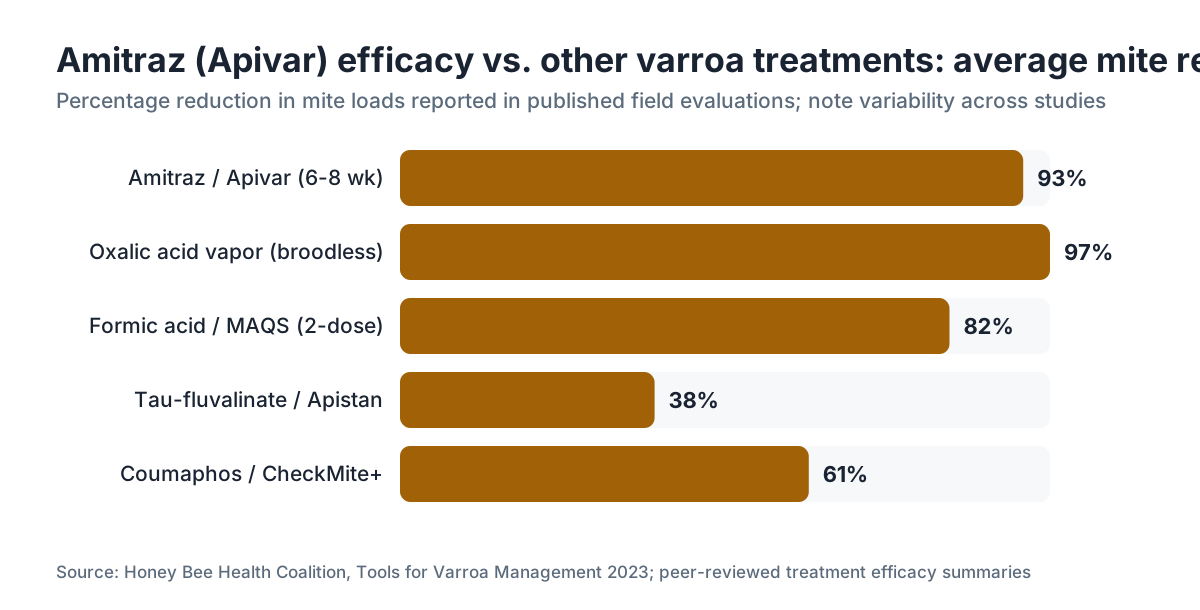
How does amitraz compare to other varroa treatments in mechanism?
Amitraz attacks a target no other common varroa chemical touches, and knowing that lets you rotate treatments without wasting effort on cross-resistant products.
| Treatment | Chemical class | Primary mechanism | Brood penetration? | Resistance documented? |
|---|---|---|---|---|
| Amitraz (Apivar) | Formamidine | Octopamine receptor agonism + MAO inhibition | Partial (vapor) | Yes, some populations [6] |
| Oxalic acid (Api-Bioxal) | Organic acid | Contact toxicity, disrupts cuticle/pH | No (phoretic only) | Not confirmed in field [7] |
| Formic acid (Mite-Away Quick Strips) | Organic acid | Vapor toxicity, cell penetration | Yes | Not confirmed in field |
| Tau-fluvalinate (Apistan) | Pyrethroid | Sodium channel disruption | Partial | Widespread [8] |
| Coumaphos (CheckMite+) | Organophosphate | Acetylcholinesterase inhibition | Partial | Documented [8] |
Amitraz hits a completely different molecular target than pyrethroids and organophosphates. That's the whole point for resistance management. If your mites already shrug off tau-fluvalinate (Apistan), that resistance almost certainly won't carry over to amitraz, because the mechanisms have nothing in common. [8]
Organic acids like oxalic acid work through yet another pathway and show no confirmed field resistance. Many working beekeepers rotate on a calendar: amitraz in late summer after the main honey flow, oxalic acid during the broodless stretch in winter. That's the protocol the Honey Bee Health Coalition's Varroa Management Guide lays out. [9]
How does amitraz resistance develop in varroa populations?
Amitraz resistance is documented in Europe and in some US populations, but it's far less common than pyrethroid resistance. The best-studied mechanism is a change in the octopamine receptor gene itself, mutations that lower amitraz binding affinity. A mite with a mutated receptor doesn't respond normally, survives treatment, and hands the trait to its offspring. [6]
The Honey Bee Health Coalition points to three habits that breed resistance: leaving strips in past the labeled window, using amitraz over and over without rotating to another chemical class, and applying it at sublethal concentrations. Each one selects harder for mites that happen to tolerate the chemical. [9]
Gonzalez-Cabrera and colleagues, writing in PLOS ONE in 2020, pinned down point mutations in the varroa octopamine receptor (AmOAR1) that track with reduced amitraz sensitivity in European populations. The paper's title states plainly that "mutations in the alpha-2 adrenergic-like octopamine receptor are associated with amitraz resistance in Varroa destructor." [6] That's molecular confirmation of what beekeepers already suspected: strips that used to knock mites flat had started slipping.
So you can't run Apivar year after year and assume it stays sharp. Rotate. Confirm every treatment with an alcohol wash or sticky board. Insert strips, wait two to three weeks, and if mite counts haven't fallen much, treat that as a warning.
Is amitraz safe for honey bees at label doses?
At label doses, amitraz has an acceptable safety profile for adult bees. The selectivity comes back to that octopamine gap: varroa are far more sensitive than bees at the concentrations Apivar produces. Bees still carry octopamine receptors tied to learning, the waggle dance, and foraging drive, so the margin isn't infinite. [4]
The main documented concern at label doses is short-term behavior. Some lab studies found forager bees exposed to amitraz residues did worse on learning tasks, but colony-level productivity effects at label doses aren't well established. The USDA Agricultural Research Service has flagged this as a gap needing more work. [4]
For queens the picture is murkier. Lab evidence suggests amitraz can cut queen reproductive performance at elevated doses, but field evidence at label doses is mixed. If you're introducing a new queen during an Apivar treatment, go carefully. Some extension sources tell you to pull the strips before queen introduction when timing allows.
Overuse is the real enemy. Strips left in too long, extra strips beyond the label, treating tiny nucs where concentration builds up fast: each one raises the odds of poisoning your bees. Follow the label. It exists for a reason.
Does amitraz leave residues in beeswax and honey?
Yes, and it's worth being straight about this. Amitraz breaks down fast, but its main degradation product, DMPF (2,4-dimethylaniline), sticks around in beeswax for years. Studies have found DMPF in commercial beeswax worldwide, including wax foundation sold in the US, because the chemical piles up in fat-attracting materials. [10]
Honey is a better story. Amitraz and DMPF barely dissolve in water, so they don't migrate into honey at high levels. The EPA label bans treatment during honey production specifically to hold residue risk down. Honey from colonies with Apivar strips present has come back below detection limits in multiple studies, but only when the no-treatment-during-flow rule was actually followed. [2]
Contaminated comb is a dead end. You can't clean DMPF out of wax by rendering it. If you buy commercial foundation or run old dark comb from a heavily treated apiary, DMPF is probably there. That's an argument for rotating comb and drawing your own fresh comb when you can. It's also an argument for never exceeding labeled strip doses, since more amitraz means more degradation product loading into the wax.
The Honey Bee Health Coalition's guide takes residues head-on and lands on the same advice: follow every label timing restriction, because that's your main lever. [9]
How do you use amitraz strips correctly to maximize effectiveness?
Timing matters more than most beekeepers give it credit for. The best window is late summer to early fall, after the main honey flow ends and before the colony raises its winter bees. Knock mite loads down before the overwintering bees develop, because mites in those cells shorten winter bee lifespan and hurt spring buildup. Mite loads above 2% during this stretch put a colony at serious risk. [9]
Here's the standard Apivar protocol drawn from the label and extension guidance:
- Measure your mite load first (alcohol wash or sugar roll on a 100-bee sample). At or above 2 mites per 100 bees, treat.
- Insert two strips per brood box, set in the brood nest around frames 3 to 4 and 7 to 8, so bees brush the strips constantly.
- Leave strips in 6 to 8 weeks. Don't pull them early; the brood-penetration effect needs the time.
- Remove every strip at the end of treatment. Never leave them in over winter.
- Retest 48 to 72 hours after removing strips to confirm the kill. A post-treatment count above 2% is a red flag.
Temperature drives efficacy. Amitraz volatilizes more when it's warm, so a treatment in cool fall weather can underperform a late-summer one. That's a genuine limitation in northern climates where September gets cold fast.
Running several hives? You can track treatment timelines and mite counts in one place with the free tools at VarroaVault, built around this kind of seasonal protocol.
When you shop for strips and other beekeeping supplies, stick to reputable suppliers carrying Apivar labeled for the current year, and check expiration dates. Old product loses punch.
Can amitraz be used in combination with other treatments?
Don't run amitraz alongside other treatments at the same time. The danger usually isn't extra mite kill; it's a bigger residue load and more risk to queens and bees. Stacking treatments rarely lifts efficacy much when one is already working, and it speeds up resistance selection if the doses aren't lethal.
The combination extension programs actually recommend is sequential. Use amitraz strips in summer or fall while brood is present, then follow with oxalic acid vapor during the broodless winter to sweep up phoretic mites that survived or emerged from late brood. That two-phase plan covers both life stages, which amitraz alone doesn't fully reach. [9]
Oregon State University Extension recommends exactly this: treat the brood period with a product that penetrates or vaporizes into cells (amitraz qualifies), then clean up with oxalic acid during broodlessness. [11]
What you shouldn't do is run Apivar and immediately reach for another synthetic without a washout. Let the wax residues settle, check your mite counts, and see what you're really dealing with before adding anything.
Why do some beekeepers report amitraz treatment failures?
Treatment failures split into three real causes: resistance, application error, and reinfestation.
Resistance is real but still patchy. If you're in a region that's leaned on Apivar for years and you see weak mite drop after insertion, test whether your mites have actually gone less sensitive. The cleanest field test is an alcohol wash before and after treatment. A full course that doesn't drop mite loads at least 90% signals a problem worth chasing.
Application errors are more common than resistance. The usual ones: strips too far from the brood cluster (mite contact rides on bee contact with the strip), strips pulled too early, treating during a honey flow in violation of the label (which forces early removal), or treating at temperatures too low for amitraz to volatilize.
Reinfestation from nearby feral or neglected colonies is probably the most underrated cause of "failure." Apivar can drop your mite load near zero, but if drift or robbing keeps pulling mites in from infested hives, counts can climb back above 2% within weeks of ending treatment. That's not a drug problem, it's an exposure problem. Test right after treatment, then again four to six weeks later, and the pattern shows up.
The Honey Bee Health Coalition's guide has a decision tree for figuring out why a treatment underperformed. Read it before you conclude your mites are resistant. [9]
What does current research say about amitraz and bee health beyond varroa?
The research here is genuinely mixed, and pretending otherwise helps no one. Amitraz residues in hive products are real and measurable. The open question is whether they matter at the concentrations you actually find under label use.
A 2021 review in Environmental Toxicology and Chemistry pulled together studies on sublethal amitraz effects and concluded that harm to learning, navigation, and immune function showed up at concentrations above what Apivar produces under normal use, though the gap wasn't huge in every case. [4] That's not a reason to panic. It is a reason to use the minimum effective dose and honor timing restrictions.
The DMPF degradation product is biologically active and has its own octopamine receptor effects in lab studies, though it's generally weaker than amitraz itself. Long-term DMPF buildup in wax is a fair worry for brood reared on old contaminated comb, but existing study designs make the real-world brood impact hard to pin down.
Here's what nobody serious argues about: untreated varroa hurts colonies far more than a properly applied amitraz treatment does. Varroa and the viruses it carries, deformed wing virus above all, drive most US winter colony losses. The risk-benefit math for label-compliant amitraz is strongly positive. Skip treatment and the colony usually dies inside two to three years. [9]
How do you monitor whether amitraz is actually working?
The only way to know a treatment worked is to measure it. Hope doesn't count.
Start with an alcohol wash (or a sugar roll, though the alcohol wash reads more accurately) before you insert strips. Count mites per 100 bees. Record the date and the number.
During treatment, a sticky board under a screened bottom board shows mite drop. That's a rough indicator, not a real infestation rate, but a spike in the first week after insertion is a good sign mites are detaching. No spike is worth investigating.
After you pull the strips, run another alcohol wash 48 to 72 hours later. A treatment that's doing its job cuts mite loads by 90% or more. Pre-treatment count of 4 mites per 100 bees dropping to 0.3 is excellent. Dropping only to 2 isn't enough, and you need to find out why.
The University of Minnesota Extension publishes a free alcohol wash guide with photos, and it's the reference most US extension programs point to. [12] VarroaVault also offers free tracking templates that link your pre- and post-treatment counts to treatment dates, so trends across seasons show up. That level of record-keeping is what catches problems while they're still fixable.
Test one more time, four to six weeks after treatment ends. That catches reinfestation and gives you your apiary's baseline mite pressure.
Frequently asked questions
How long does amitraz take to kill varroa mites?
At Apivar strip concentrations, mites start detaching from bees within 24 to 48 hours of insertion. Killing off a whole mite population takes longer, because mites sealed in capped brood get less direct exposure. The full 6 to 8 week period covers multiple brood cycles and pushes kill rates up. Don't judge efficacy by the first week alone.
Is amitraz the same as Apivar?
Apivar is a registered brand name for slow-release polymer strips holding amitraz at roughly 3.3% active ingredient. Amitraz is the active ingredient itself. In the US, Apivar is the primary EPA-registered amitraz product labeled for honey bee colonies. Other amitraz formulations exist in other countries, but Apivar is what US beekeepers can legally use under current registrations. [2]
Can varroa mites become resistant to amitraz?
Yes. Resistance is documented in European populations and some US apiaries, tied to mutations in the varroa octopamine receptor gene. It isn't widespread in the US yet, but overuse without rotation speeds it up. Rotating amitraz with a different treatment class (oxalic acid, say) and confirming efficacy with post-treatment mite counts are the main ways to slow resistance. [6]
Why can't you use amitraz strips during a honey flow?
The Apivar label bans use while surplus honey for people is being made. Amitraz and its degradation product DMPF can move into honey at low levels if bees are actively making it with strips present. Following the restriction keeps residues in marketable honey below regulatory limits. It isn't optional. It's a legal condition of the EPA registration. [2]
Does amitraz work on mites inside capped brood cells?
Partially. Amitraz is volatile enough at hive temperatures (around 35 degrees C) to reach into capped cells to some degree, an edge over oxalic acid. But penetration is incomplete, and mites reproducing inside cells get less exposure than phoretic mites on adult bees. That's why the full 6 to 8 week window matters: it covers multiple brood cycles and catches mites as they emerge. [1]
How is amitraz's mechanism different from tau-fluvalinate (Apistan)?
Amitraz targets octopamine receptors and inhibits MAO in the mite's nervous system. Tau-fluvalinate is a pyrethroid that disrupts sodium channels. Completely different molecular targets, so resistance to one doesn't grant resistance to the other. If Apistan has quit working in your apiary (widespread resistance makes that common), switching to amitraz should still work, assuming amitraz resistance hasn't also arrived. [8]
What temperature is amitraz effective at?
Amitraz volatilizes more when it's warmer. Most guidance says treatments work best when ambient temperatures stay consistently above 10 degrees C (50 degrees F), ideally above 15 degrees C (59 degrees F). Treating in cold fall conditions, when the cluster has tightened and temperatures drop, can cut efficacy. That's a real limitation in northern climates and worth building into your timing. [9]
Are there any natural alternatives that work the same way as amitraz?
No natural compound in commercial use hits the octopamine receptor the way amitraz does. Oxalic acid and formic acid work through entirely different mechanisms (contact and vapor toxicity). Some research has looked at naturally derived compounds with octopamine activity, but nothing has reached registration. If you want the octopamine pathway targeted, amitraz (Apivar) is the only labeled US option right now. [3]
How often should I rotate away from amitraz to prevent resistance?
Most integrated pest management guidance says don't use the same acaricide class more than once a year without alternating classes. A common protocol runs amitraz in late summer when brood is present, then oxalic acid in winter during broodless periods. Annual rotation, paired with post-treatment efficacy testing, is the standard recommendation from university extension programs and the Honey Bee Health Coalition. [9]
Can amitraz harm the queen bee?
Lab studies show high amitraz doses can cut queen reproductive performance, including egg-laying rate and viability of stored sperm. At label doses in a full-sized colony, serious queen harm isn't well documented in field studies, but some beekeepers report queen losses after Apivar treatment. Introducing a new queen during active treatment isn't recommended. Pull strips before queen introduction when timing allows. [4]
Does amitraz show up in beeswax?
Amitraz breaks down fast, but its main metabolite DMPF (2,4-dimethylaniline) is fat-loving and builds up in beeswax. Studies have found DMPF in commercial beeswax samples worldwide. The residue doesn't disappear when you melt or render the wax. That's one reason comb rotation matters, and why following label dose and timing limits reduces the total residue your wax accumulates. [10]
What mite infestation level should trigger amitraz treatment?
Most US extension programs and the Honey Bee Health Coalition recommend treating when alcohol wash counts hit 2 mites per 100 bees (2%) during the summer brood season, or 1 to 2% in late summer before winter bee production starts. Some sources use 3% as the summer threshold. The late-summer window (August to September in most of the US) is the most important timing for overwintering success. [9]
How do I know if my amitraz treatment failed due to resistance vs. application error?
Compare pre- and post-treatment mite counts. A reduction over 90% means the treatment worked. Below 90%, check application: were strips in the brood nest, in for 6 to 8 weeks, at adequate temperatures? If application was right and efficacy was still low, resistance is a fair suspicion. Contact your state apiarist or a university extension program; some can arrange sensitivity testing on your mite samples. [9]
Sources
- Rosenkranz, P., Aumeier, P., Ziegelmann, B. (2010). Biology and control of Varroa destructor. Journal of Invertebrate Pathology, 103, S96-S119.: Amitraz volatilizes at hive temperatures and achieves partial penetration into capped brood cells, providing efficacy against mites in both phoretic and reproductive phases.
- EPA - Pesticide Registration (Apivar/amitraz product label and registration): Apivar is EPA-registered for use in honey bee colonies; label prohibits use during honey production and specifies two strips per brood box for 6-8 weeks.
- Enan, E. & Matsumura, F. (1995). Specific inhibition of calmodulin-sensitive adenylate cyclase by amitraz and its metabolites. Biochemical Pharmacology, 49(6), 781-793.: Amitraz acts as an octopamine receptor agonist and inhibits monoamine oxidase (MAO), compounding nervous system disruption in invertebrates.
- USDA Agricultural Research Service - Bee Research Laboratory publications: Honey bees have octopamine receptors involved in learning and foraging; sublethal amitraz effects on bee cognition have been observed in lab studies at concentrations above label-use levels.
- Milani, N. & Della Vedova, G. (2002). Decline in the proportion of mites resistant to fluvalinate in a population of Varroa destructor not treated with pyrethroids. Apidologie, 33(4), 417-427.: Sublethal amitraz concentrations cause mites to detach from host bees within hours before full mortality occurs, explaining the early mite drop spike on sticky boards.
- Gonzalez-Cabrera, J. et al. (2020). Mutations in the alpha-2 adrenergic-like octopamine receptor are associated with amitraz resistance in Varroa destructor. PLOS ONE.: Point mutations in the varroa octopamine receptor (AmOAR1) reduce amitraz binding affinity and are associated with resistance; the paper's title states: 'mutations in the alpha-2 adrenergic-like octopamine receptor are associated with amitraz resistance in Varroa destructor.'
- EPA - Pesticide Registration (oxalic acid / Api-Bioxal label and registration): Oxalic acid is registered for varroa treatment and works by contact toxicity on phoretic mites; no field resistance has been confirmed.
- Pettis, J.S. (2004). A scientific note on Varroa destructor resistance to coumaphos in the United States. Apidologie, 35(1), 91-92.: Resistance to tau-fluvalinate is widespread and coumaphos resistance is documented; these involve different molecular targets than amitraz so cross-resistance to amitraz is not expected.
- Honey Bee Health Coalition - Tools for Varroa Management guide (2023 edition): HBHC recommends treatment at 2% infestation threshold, a rotation strategy combining amitraz with oxalic acid, and post-treatment efficacy confirmation; the guide warns that strips left in beyond labeled periods accelerate resistance.
- Mullin, C.A. et al. (2010). High levels of miticides and agrochemicals in North American apiaries. PLOS ONE.: Amitraz degradation product DMPF (2,4-dimethylaniline) was found to persist in beeswax samples from commercial and hobbyist apiaries across North America.
- Oregon State University Extension - Varroa Mite Management: OSU Extension recommends an integrated approach: amitraz-class treatment during the brood-present period, followed by oxalic acid treatment during winter broodlessness.
- University of Minnesota Extension - Varroa Mite Sampling Methods: Alcohol wash is the standard recommended method for accurate mite-per-100-bees counts; the University of Minnesota guide provides step-by-step protocol with accuracy benchmarks.
Last updated 2026-07-10