Amitraz varroa treatment strips: the complete how-to guide
TL;DR
- Amitraz strips (brand names Apivar and Apitraz) are polymer strips loaded with amitraz, an acaricide that kills varroa mites on contact as bees walk across them.
- A full 6 to 8 week treatment in a brood-present hive usually knocks down 90 to 95% of mites.
- Pull all honey supers before you hang strips, and wait at least 14 days after removal before adding supers back.
What are amitraz varroa treatment strips and how do they work?
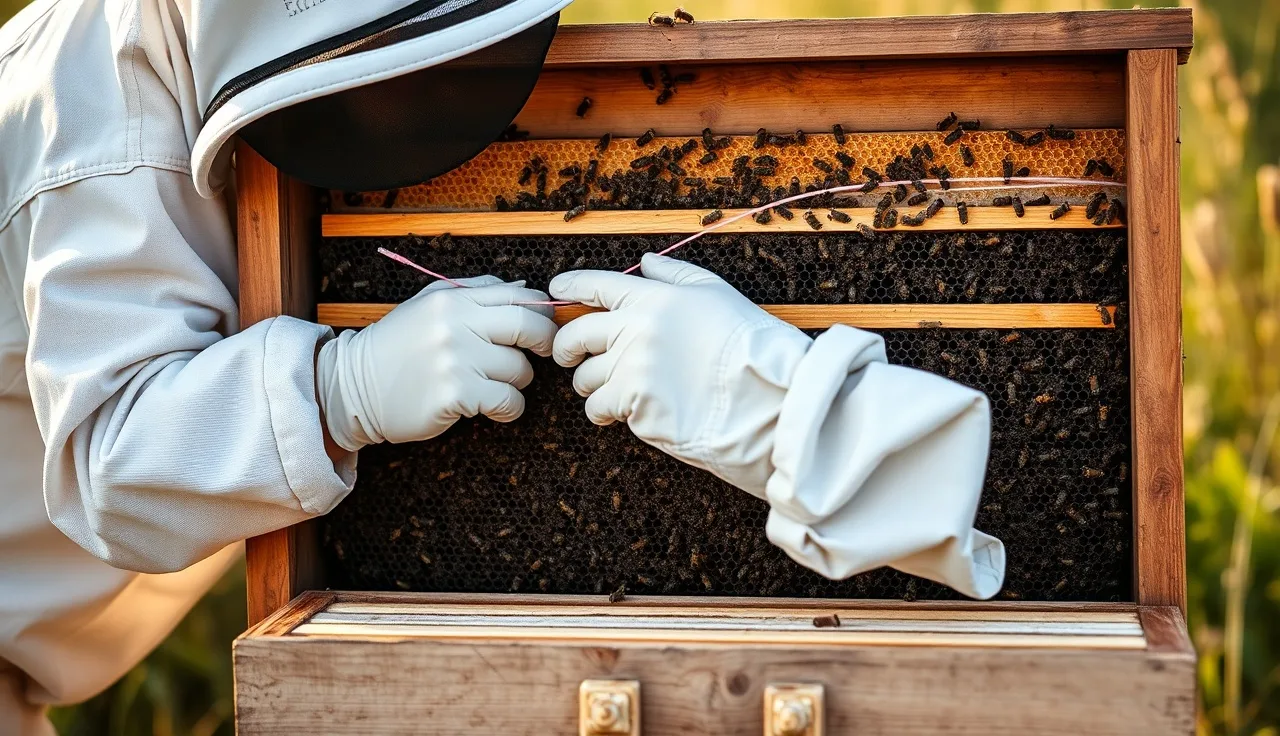
Amitraz strips are slow-release pesticide strips you hang between frames inside the brood nest. Each strip is a polymer matrix loaded with amitraz, a formamidine-class acaricide. Bees move through the hive, brush against the strips, pick up trace amounts of amitraz on their bodies, and spread it around through normal grooming and contact. The mite absorbs amitraz through its cuticle. The compound then jams the octopamine receptors in the mite's nervous system, and the mite gets paralyzed and dies. [1]
This is contact action, not fumigation. The strips don't release a gas that fills the hive. That distinction matters. Coverage across the brood nest depends almost entirely on bee traffic across the strips. A packed colony with bees moving constantly through the brood nest spreads the active ingredient far better than a thin, declining one.
Two amitraz strip products are registered for use in the United States: Apivar (Veto-Pharma) and Apitraz (Laboratorios Calier). Both hold 3.33% amitraz per strip. The EPA registers them under separate product registrations, but the active ingredient, concentration, and use protocol are the same in practice. [2]
Here is what people get wrong. Amitraz does not kill mites inside capped brood cells. It gets the phoretic mites, the ones riding on adult bees between reproductive cycles. That is exactly why the label demands a full 6 to 8 weeks of strip contact. You need several mite reproductive cycles to run their course, so that newly emerged mites, protected until then, get exposed before you pull the strips. [1]
How effective are amitraz strips against varroa?
Amitraz strips knock down 90 to 95% of mites when used correctly. That figure holds up across field and lab data. A 2017 review in PLOS ONE ranked amitraz-based treatments among the most effective registered varroa controls, with efficacy staying well above oxalic acid vapor or formic acid under certain brood conditions. [3]
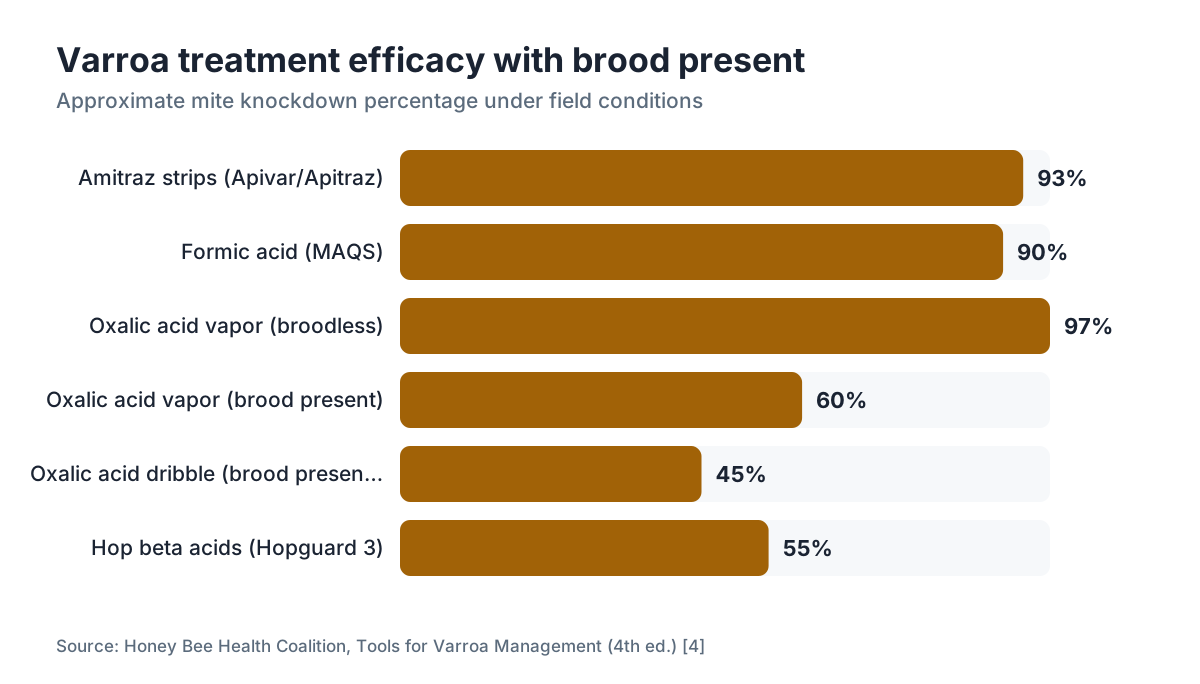
The Honey Bee Health Coalition's "Tools for Varroa Management" guide puts amitraz strips in its highest efficacy tier for colonies with capped brood present. The same guide notes that oxalic acid dribble falls to roughly 40 to 50% efficacy when brood is present, because it can't reach mites hiding in capped cells. Amitraz strips hold high efficacy across the brood cycle precisely because they stay in the hive long enough to catch mites as brood emerges. [4]
Trial numbers can mislead you in a real apiary, though. Several things drag actual mite kill below the average. Colonies with tiny bee populations spread the active ingredient poorly. Strips placed wrong, outside the brood nest where few bees walk, give weak results. And resistance, which I'll cover later, is a growing problem in some regions.
One honest qualifier. The 90 to 95% figures come from studies where resistance wasn't a factor and application was near ideal. If your mite counts barely budge after a full treatment, resistance is the likeliest culprit, not a bad batch of strips.
What is the correct dose and placement for amitraz strips?
The EPA-registered label for Apivar and Apitraz calls for two strips per brood box for a standard colony. That is the legal dose and the recommended one. Very strong colonies running two brood boxes get two strips per box, four total. Don't use one strip and hope for the best. Underdosing is a well-documented driver of resistance. [2]
Placement is everything. Hang the strips in the center of the brood cluster, touching or very near capped brood frames, where bee traffic runs highest. In a ten-frame box, pull two adjacent frames toward the center, hang one strip between frames 3 and 4, and the second between frames 7 and 8. In an eight-frame box, split them as evenly as you can through the active brood area. Each strip should hang freely and touch the comb on both sides.
Strips can't touch each other. They can't sit wedged behind an outer frame where bees rarely go. And they can't stay in longer than eight weeks. That eight-week ceiling is the label maximum. Strips left in indefinitely give you no extra protection and only build selection pressure for resistance. [2]
For two-story colonies, move one strip up into the second brood box partway through if you see the queen shifting between boxes. Always keep strips close to where brood is actively reared and where the mites concentrate.
Shopping for strips or application tools? Solid beekeeping supply companies stock both Apivar and Apitraz year-round, though Apitraz can be spotty outside major distributors.
When is the best time of year to use amitraz strips?
Amitraz strips work year-round wherever bees stay active, but two windows matter most for varroa: late summer (July through September across most of North America) and early spring before the main nectar flow.
The late summer treatment saves colonies. Mite populations peak here after building all summer on brood, and it's your last real chance to knock mites down before the colony raises its winter bees. Winter bees live for months and get hit with high mite loads during their larval stage, which damages their fat bodies and cuts their lifespan short. A colony heading into winter above 2 to 3% infestation, roughly 2 to 3 mites per 100 bees on an alcohol wash, is at serious risk of winter collapse. [4]
Spring treatment, usually April or May depending on your region, catches mites that survived winter before they build on a fast-expanding brood nest. The trick is to treat after the colony has a good stack of brood but before honey supers go on, because the label demands supers off during treatment.
Amitraz strips have no temperature minimum for efficacy. Formic acid gets too volatile above 85F, and oxalic acid vapor works best during broodless spells, but amitraz doesn't care. Use it in midsummer heat with confidence. Some extension programs note a mild efficacy drop at very low ambient temperatures, but a colony raising brood holds its cluster near 95F no matter what the weather does outside, so this rarely limits anything in practice. [5]
For a full seasonal calendar, tools like the VarroaVault protocol planner map treatment windows against your local nectar flows and mite counts.
Can you use amitraz strips with honey supers on?
No. This is not a gray area. The EPA-registered label for both Apivar and Apitraz flatly prohibits use when honey supers meant for human consumption sit on the hive. Pull every honey super before you hang strips, and don't put them back until the strips are out and a withdrawal period has passed. [2]
The worry is amitraz residue in honey. Amitraz and its breakdown metabolite, dimethylformamidine (DMF), show up in beeswax and honey at trace levels. The Codex Alimentarius Commission sets a maximum residue limit (MRL) for amitraz in honey at 200 micrograms per kilogram (µg/kg). The European Union uses the same 200 µg/kg standard. [6] The label restriction exists to keep honey produced during treatment off the market, not because every jar tests positive, but because residues during active treatment are unpredictable and the regulatory exposure to you is real.
Most beekeepers treat in spring and late summer, both windows that fall outside peak honey production anyway. Trouble shows up with early spring colonies that build fast and start stacking surplus honey while you're still partway through a treatment cycle. Set your strip removal date before you put strips in, not after.
Wax is a separate issue. Amitraz builds up in beeswax over repeated treatments. Studies have found amitraz and DMF residues in both commercial and hobbyist-sourced beeswax at levels that can hurt queen rearing in foundation made from recycled wax. [7] That's not a reason to skip amitraz. It's a reason to rotate treatments, avoid leaning on it alone, and swap out old brood comb every few years.
How do you monitor mite levels before and after treatment?
The alcohol wash is the gold standard for measuring varroa infestation rate. Take a roughly 300-bee sample (about half a cup) from a brood frame, not the frame the queen is on, and roll them in 70% isopropyl alcohol for 30 to 60 seconds. Count the mites in the liquid. Divide mites by bees, multiply by 100, and you have your percentage. Above 2% in the main brood season, or above 1% going into fall, is the widely accepted action threshold. [4]
For a primer on the mite itself, our varroa mite overview covers the biology and why that 2% threshold has real teeth.
Time your pre-treatment wash within a day or two of hanging strips so you have a clean baseline. Wash again 8 to 10 days after strip removal to see how much you knocked down. If your post-treatment count still sits above 2%, or the reduction comes in under 80%, you have a problem. It's resistance, reinfestation from a nearby collapsing colony, or poor application.
Sticky boards track relative mite fall over time but won't give you the percentage-based infestation rate you need for treatment decisions. Natural mite drop swings too much by colony population and season to trust on its own. Use sticky boards between treatments to watch trends. Use the alcohol wash to make the call.
The Honey Bee Health Coalition's varroa management guide, free to download, has a monitoring calendar and action thresholds that hold up across geographic regions. [4]
Is amitraz resistance in varroa mites a real concern?
Yes, and it's growing. Amitraz resistance in varroa turned up in the United States in the early 2000s and has been confirmed in multiple countries since. [8] The mechanism runs through mutations in the octopamine receptor gene that dull the mite's sensitivity to amitraz. Mites carrying resistant alleles survive treatment, breed, and hand resistance down to their offspring.
The warning signs are simple. A post-treatment mite count that barely moves. Or mite levels that bounce back near pre-treatment numbers within weeks of pulling strips. If two properly run, full-duration amitraz treatments in the same season fail to bring counts below 1%, resistance is a fair working assumption.
Rotating active ingredients is your main defense. The Honey Bee Health Coalition and most university extension programs tell you not to lean on a single treatment class all season. Treat in spring with amitraz strips, then reach for oxalic acid vapor or formic acid in late summer. [4] [5] Coming back to amitraz the next spring, after at least one full cycle with a different mode of action, is a sensible rotation.
Underdosing drives resistance directly. That means one strip instead of two, or pulling strips at three weeks instead of six. Resistant survivors breed faster than you're killing them. Follow the label dose and duration every single time.
Nobody has clean real-time resistance data at the county or state level. The closest ongoing U.S. work comes from the USDA ARS Beltsville lab, which has tracked resistance allele frequency in commercial populations, but hobbyist regional data stays sparse. If you suspect resistance, switch treatment classes now and re-check amitraz after a full rotation cycle.
What are the safety precautions when handling amitraz strips?
Amitraz is a pesticide, and the label is a legal document. Read it before your first use, not after. [2]
The Apivar label calls for chemical-resistant gloves (nitrile works fine), long sleeves, and eye protection if you're handling several strips at once. Amitraz absorbs through skin, and repeated low-level exposure is the real concern, not one-time handling. Wash your hands well after any contact.
Amitraz is an octopamine agonist, so it can affect mammals as well as mites, though mammalian toxicity runs much lower. It's moderately toxic to rats (LD50 around 800 mg/kg oral). The human health flag is that amitraz is a monoamine oxidase inhibitor (MAOI), so it can interact dangerously with certain medications, especially antidepressants. If you or anyone helping you takes an MAOI-class antidepressant, talk to a physician before handling strips. This isn't hypothetical. It's a labeled precaution. [2]
Used strips still carry residual amitraz. Don't burn them. Don't compost them. Don't leave them in the bee yard where livestock or pets might reach them. The label says to throw used strips in the trash in line with local regulations. In most states that means sealed in a bag in household trash.
Store unopened strips in their original sealed packaging, away from heat and direct sun. Shelf life after opening drops fast. Many beekeepers find strips from a partly opened package lose efficacy within a season if the package isn't resealed carefully.
How do amitraz strips compare to other varroa treatments?
The table below stacks the main registered varroa treatments against the things that actually matter to hobbyist and sideliner beekeepers.
| Treatment | Active Ingredient | Brood Present? | Temp Range | Treatment Duration | Approx. Cost (10 colonies) | Efficacy |
|---|---|---|---|---|---|---|
| Apivar / Apitraz strips | Amitraz 3.33% | Yes | Any (bees active) | 6 to 8 weeks | $40 to 60 | 90 to 95% |
| Mite Away Quick Strips | Formic acid 68.2% | Yes | 50 to 85F | 7 days | $35 to 50 | 85 to 95% |
| Oxalic acid vapor | Oxalic acid | No (best) | Above 50F | 1 application | $15 to 25 (acid only) | 90 to 99% broodless |
| Oxalic acid dribble | Oxalic acid | No (best) | Above 40F | 1 application | $10 to 20 | 40 to 95% (drops with brood) |
| Hopguard 3 | Hop beta acids | Yes | Any | 30 days | $25 to 40 | 40 to 70% |
Sources: Honey Bee Health Coalition Tools for Varroa Management [4], University of Minnesota Extension [5], EPA registered labels.
Amitraz strips are the best single option for a brood-present colony when you want reliable knockdown and don't want to fuss over temperature windows. The tradeoff is duration (six to eight weeks versus one week for formic acid) and resistance risk with repeated use.
Formic acid (MAQS) is faster but genuinely temperature-sensitive and can kill queens at high temps. Oxalic acid vapor is brutally effective but only during broodless periods, which limits its summer usefulness. Hopguard runs lower efficacy but carries no honey super restriction, which earns it a niche.
Getting started with mite management means having the right gear on hand. Sourcing options for equipment and treatments come up in our beekeeping supplies overview, including where to find amitraz strips when the local farm store is out.
What does Apitraz varroa treatment offer compared to Apivar?
Apitraz is the Laboratorios Calier brand of amitraz strips, registered in the U.S. as a direct alternative to Apivar. Both hold 3.33% amitraz per strip (each strip carries roughly 800 mg of amitraz). Both carry EPA registration and follow the same label protocol: two strips per brood box, six to eight weeks, supers off. [2]
In use, the two are interchangeable. Apitraz has picked up U.S. market share partly through competitive pricing and partly through distribution deals that put it in front of suppliers who were previously Apivar-only. Some beekeepers say Apitraz strips run slightly thicker and stiffer, which can make them easier to hang without bending, but that's anecdotal and I wouldn't pick between them on it.
The one practical difference is availability. Apivar has been in the U.S. market longer and sits on more shelves. During supply disruptions, a supplier relationship that carries Apitraz gives you a backup. For a sideliner running 50 hives into a late summer treatment window, scrambling for product is the last thing you want.
On price, Apivar typically runs $1.80 to $2.50 per strip at U.S. retail as of 2024 to 2025, with Apitraz landing at a similar or slightly lower point depending on the supplier. A ten-strip pack covers five standard colonies. Packs of fifty or more are the economical buy for sideline operations.
What happens if you overdose or leave amitraz strips in too long?
Leaving strips in past eight weeks doesn't protect bees any better. It just builds selection pressure for resistance and runs up amitraz residue in wax and propolis. The eight-week label maximum is a ceiling, not a target to beat. Pull them on schedule. [2]
Overdosing, meaning more strips than labeled, is not a shortcut to better results. More strips mean more amitraz in the hive, more residue in wax, and more resistance pressure. The two-strips-per-brood-box dose was set to deliver enough contact exposure without piling on residue. Stick to it.
Accidental queen loss from amitraz strips shows up in anecdotes but isn't strongly supported in controlled trials, the way queen loss from formic acid at high temps is documented. The main queen risk with amitraz is mechanical: the queen walking across a strip and getting stuck, or getting temporarily disrupted by a slab of plastic hanging in the brood nest. Beekeepers who cage the queen for the first two weeks to break the brood cycle and sharpen efficacy (a common advanced move) report no jump in queen loss.
If a colony crashes during amitraz treatment, don't blame the strips before you rule out other causes. Mite damage to winter bees, queen failure, pesticide drift, and nosema all produce colony decline on a timeline that overlaps with treatment.
Are amitraz strips legal and registered for use in your state?
Amitraz strips are federally registered by the EPA and legal to use in all 50 U.S. states, as long as you follow the label. Apivar's federal registration number is EPA Reg. No. 86466-1; Apitraz carries its own separate number. In every case, the label is the law. Using the product against the label (applying to hives with honey supers on, say) is a federal violation under FIFRA. [9]
Some states require a licensed pesticide applicator to buy or apply certain restricted compounds, but amitraz strips for beekeeping are generally sold over the counter without a restricted-use pesticide license. Check with your state department of agriculture if you're unsure. Requirements vary. The National Pesticide Information Center keeps state-level pesticide regulatory contact information if you need to look up your state's rules. [10]
Amitraz is not approved for organic operations certified under the USDA National Organic Program. Certified organic beekeepers are limited to oxalic acid, formic acid, thymol, and a handful of other softer treatments. If you're chasing organic certification, amitraz is off the table entirely. [11]
On import and export: the EU, Canada, and most major honey-buying markets set MRLs for amitraz in honey. The EU standard is 200 µg/kg, as noted above. U.S. commercial honey producers selling into export markets should know that residue monitoring is real, and label-compliant use is the main protection against exceedances. [6]
How should amitraz strips fit into a full-season varroa management plan?
Amitraz strips are a tool, not a whole program. A solid varroa plan for a hobbyist or sideliner running 5 to 50 colonies looks roughly like this: monitor every four to six weeks through spring and summer, treat when infestation crosses 2%, rotate treatment classes between seasons, and run a reliable late-summer treatment no later than August across most of North America to protect the winter bee cohort.
The Honey Bee Health Coalition's "Tools for Varroa Management" guide, now in its fourth edition, is the best free resource for building a full-season protocol. It covers monitoring techniques, action thresholds, registered treatment options, and resistance management in one document. [4] As the guide puts it, "no single treatment will be effective for all situations, and beekeepers are encouraged to use an integrated approach."
For sideline operations where record-keeping across dozens of colonies gets messy, VarroaVault's free protocol tools let you log alcohol wash counts by hive, track treatment history, and flag colonies due for monitoring or treatment. Staying organized across 30 hives is a different job from managing 5, and uneven treatment execution across a big apiary carries real resistance risk.
Here's something that goes unsaid too often. Reinfestation from neighboring collapsing colonies is a major reason post-treatment counts rebound. Treat perfectly and watch mites flood back? Look within a three-mile radius. Robbing in late summer can dump thousands of mites into your hives in days. Entrance reducers through August and September, plus prompt removal of any dead-outs in your apiary, cut this risk without erasing it.
For more on bee health and colony biology, and how mite loads translate to colony outcomes, the varroa mite explainer is a good companion read.
Frequently asked questions
How many amitraz strips do I need per hive?
The label specifies two strips per brood box. A standard single-brood-box colony gets two strips. A two-box colony with brood in both boxes gets four strips total, two per box. Using only one strip is underdosing and raises resistance risk. Don't try to stretch a pack across more hives than the label allows.
How long do amitraz strips take to work?
You'll usually see meaningful mite drop within the first week or two as phoretic mites pick up amitraz from strip contact. But the full 6 to 8 week duration is necessary because newly emerged mites from capped brood keep entering the phoretic pool. Pulling strips early, even when your sticky board looks good, leaves survivors to repopulate the colony fast.
Can I use amitraz strips while honey supers are on?
No. Both Apivar and Apitraz labels prohibit application when honey supers meant for human consumption are in place. Remove all supers before hanging strips and don't replace them until strips are out and the withdrawal period has passed. Amitraz and its metabolite DMF can appear in honey at trace levels during active treatment.
What temperature do amitraz strips work at?
Amitraz strips have no practical lower temperature limit for efficacy, unlike formic acid or thymol. The brood nest stays near 95F year-round in an active colony. You can apply amitraz strips in fall or early spring as long as the colony is raising brood and bees are moving through the cluster. They don't work in a fully clustered, broodless winter colony because bee traffic stops.
Are Apivar and Apitraz the same thing?
They're functionally equivalent. Both hold 3.33% amitraz per strip, both carry EPA registration, and both use identical label protocols: two strips per brood box, 6 to 8 weeks, no honey supers. Apivar (Veto-Pharma) has been in the U.S. market longer; Apitraz (Laboratorios Calier) is a registered alternative. The practical difference is usually just price and supplier availability.
Can varroa mites become resistant to amitraz strips?
Yes, resistance is real and documented in the U.S. and multiple other countries. The main drivers are underdosing (one strip instead of two), pulling strips early, and using amitraz every cycle without rotating to other active ingredients. If post-treatment counts don't drop much after a proper 6 to 8 week treatment, resistance is likely. Switch treatment classes and return to amitraz after at least one rotation cycle.
What should I do if mite counts are still high after amitraz treatment?
First, verify your application: two strips per brood box, positioned in the brood cluster, for the full 6 to 8 weeks. If application was correct and counts still sit above 2%, suspect resistance or heavy reinfestation from nearby collapsing colonies. Switch to a different treatment class (oxalic acid vapor or formic acid) immediately and check neighboring hive health. A single failed treatment doesn't prove resistance but warrants serious suspicion.
Is amitraz safe for bees and queens?
At labeled doses, amitraz is well-tolerated by adult bees and causes no measurable harm to brood or queens under normal conditions. Anecdotal reports of queen loss exist, but controlled trials don't show a strong effect. The risk of not treating, losing a colony to varroa, far outweighs the theoretical queen risk from properly applied amitraz strips. Follow label placement instructions and the risk stays minimal.
Can I use amitraz strips in a nuc or small colony?
Yes, but use only one strip in a nuc or very small colony (fewer than 5 frames of bees). The label covers standard colonies; for small nucs, drop to one strip and still run the full 6 to 8 week duration. Make sure the strip sits where bees actually travel. A thin colony with low bee traffic gets poorer amitraz distribution no matter how many strips you hang.
How do I dispose of used amitraz strips safely?
Used strips still carry residual amitraz. Don't burn them; burning amitraz produces toxic breakdown products. Don't compost them or leave them in the bee yard where livestock or pets can access them. The EPA label says to dispose of used strips in the trash according to local regulations. Seal them in a zipper bag before tossing. Keep out of reach of children and animals during disposal.
What is the withdrawal period for amitraz strips before adding honey supers?
The label requires honey supers off during the entire treatment period and until after strips are removed. Current U.S. labels state no fixed post-removal day count the way pharmaceutical withdrawal periods work; the restriction is specifically 'do not apply when honey supers are present.' Most beekeepers wait at least two weeks after strip removal before adding supers, and that matches standard extension guidance.
Do amitraz strips work for Africanized honey bee colonies?
Amitraz strips work the same way regardless of bee subspecies. The varroa mite doesn't distinguish between Africanized and European stock, and neither does amitraz as a contact acaricide. If you keep bees in Africanized range, your varroa protocol doesn't change, though colony management and safety protocols differ a lot. See our overview on africanized honey bee biology for more on working with those colonies.
How do I know if my mite problem is bad enough to treat with amitraz strips?
The action threshold used by most extension programs and the Honey Bee Health Coalition is 2% infestation during the brood season, meaning 2 mites per 100 bees on an alcohol wash. In late summer (August), some programs lower that to 1 to 2% because of the outsized hit to winter bee quality. Above threshold, treat. Below but trending up fast, treat. Don't wait for visible symptoms; by then the colony is already in serious trouble. [4]
Can I use amitraz strips in combination with other varroa treatments at the same time?
Generally, no. Simultaneous combination treatment is not labeled, not well-studied for safety interactions, and not recommended by extension programs. Sequential treatment within a season is fine and sometimes necessary: finish one treatment, wait a week, assess your mite count, then decide whether a second round with a different active ingredient is needed. Running two treatments at once increases bee stress and muddies resistance attribution if something goes wrong.
Sources
- EPA, Apivar Pesticide Registration Label (EPA Reg. No. 86466-1): Apivar and Apitraz labels specify two strips per brood box, 6 to 8 week treatment duration, no honey supers during treatment, and handling precautions including MAOI interaction warning.
- Rosenkranz, P. et al., PLOS ONE (2017), comparative varroa treatment efficacy review: Amitraz-based treatments ranked among the highest-efficacy registered varroa controls in comparative review conditions.
- Honey Bee Health Coalition, Tools for Varroa Management Guide (4th ed.): Action threshold of 2% infestation rate; amitraz strips in highest efficacy tier for brood-present colonies; rotation of active ingredients recommended to manage resistance.
- University of Minnesota Bee Lab / Extension, varroa management guidance: Temperature considerations for varroa treatments and recommendation to rotate treatment classes across seasons to manage resistance.
- Codex Alimentarius Commission, Maximum Residue Limits for Amitraz in Honey: Maximum residue limit for amitraz in honey set at 200 micrograms per kilogram (µg/kg) by Codex Alimentarius; EU uses the same standard.
- Mullin, C.A. et al., PLOS ONE (2010), 'High Levels of Miticides and Agrochemicals in North American Apiaries': Amitraz and its metabolite DMF accumulate in beeswax over repeated treatments; residues found in commercially and hobbyist-sourced beeswax at levels potentially affecting queen rearing.
- USDA ARS, Beltsville Bee Research Laboratory, amitraz resistance monitoring: Amitraz resistance in varroa mites documented in U.S. populations; resistance allele frequency monitored in commercial colonies.
- EPA, Federal Insecticide, Fungicide, and Rodenticide Act (FIFRA) pesticide use requirements: Using a registered pesticide in a way that contradicts the label is a federal violation under FIFRA.
- National Pesticide Information Center (NPIC), Oregon State University: State-level pesticide regulatory contact information and applicator licensing requirements by state.
- USDA National Organic Program, Organic livestock and apiculture standards: Amitraz is not permitted for use in USDA NOP-certified organic beekeeping operations.
Last updated 2026-07-09