Apivar strips (bag of 10): complete guide to using amitraz for varroa
TL;DR
- Veto-Pharma Apivar strips hold 3.33% amitraz and ship in bags of 10, enough for five two-story colonies.
- Each hive gets two strips hung in the brood nest for 6 to 10 weeks.
- Field trials show 90 to 99% mite kill when you apply them right, supers off.
- A brood break pushes results higher.
What is Apivar, and what is actually in each strip?
Apivar is an acaricide strip made by Veto-Pharma and registered with the EPA (Registration No. 84833-1) for use in honey bee colonies in the United States [1]. Each strip is a slow-release polymer matrix loaded with amitraz at 3.33% (w/w). Adult bees walk across the strip, groom each other, and spread the amitraz through the colony. The mite dies because amitraz jams the octopamine receptor system in arachnids, which causes paralysis and death.
The bag of 10 is the standard retail unit sold to hobbyists and sideliners. Ten strips treat five colonies at the standard two-strip dose. Or two colonies at a five-strip dose if you follow the label instruction for hives occupying three or more boxes. Count your boxes before you buy. That math decides how many bags you need.
The strip is a tan rectangle, roughly 14 cm by 2.5 cm, with a small hole at the top so you can hang it on a frame top bar. Veto-Pharma sells a bag of 50 for bigger outfits. For most hobbyists the bag of 10 is the right size to start with.
How do you use Apivar strips correctly in a hive?
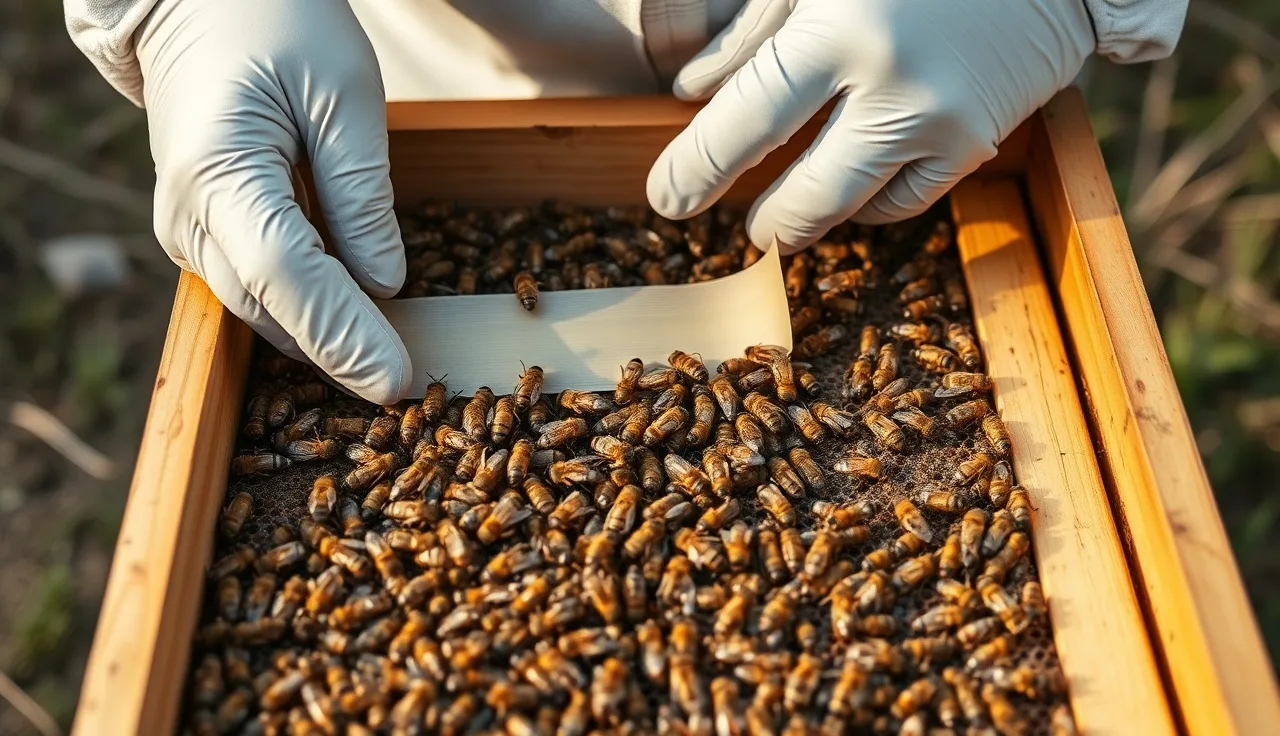
Two strips per colony, hung in the brood area, one on each side of the brood nest, suspended between frames. The strips have to sit in the cluster so bees touch them all day. A strip shoved into a corner away from the cluster does almost nothing. The EPA-registered label is the legal ceiling on what you can do, and it is specific [1].
Leave the strips in for a minimum of 6 weeks and a maximum of 10 weeks. Pulling them early is the single biggest mistake beginners make. Capped brood shields mites from amitraz during treatment, so you need at least two full brood cycles (about 6 weeks) for enough mites to emerge and hit the strips. Going past 10 weeks is also off-label and adds to residue buildup in wax [2].
For colonies in three or more boxes, the label allows up to four strips per hive. Brood in a strong spring colony spreads across several boxes, and two strips may not reach all of it.
Never run Apivar with honey supers on. Amitraz and its breakdown products can taint honey meant for people to eat [1]. Add supers only after the full treatment ends and the strips come out. If a nectar flow starts mid-treatment, you face a real choice: keep supers off and lose the flow, or pull the strips early and risk an incomplete kill. Most experienced beekeepers give up the flow and finish the treatment. The mites matter more.
Wear nitrile gloves when you handle strips. The label requires it. Wash your hands after [1].
How effective is Apivar at killing varroa mites?
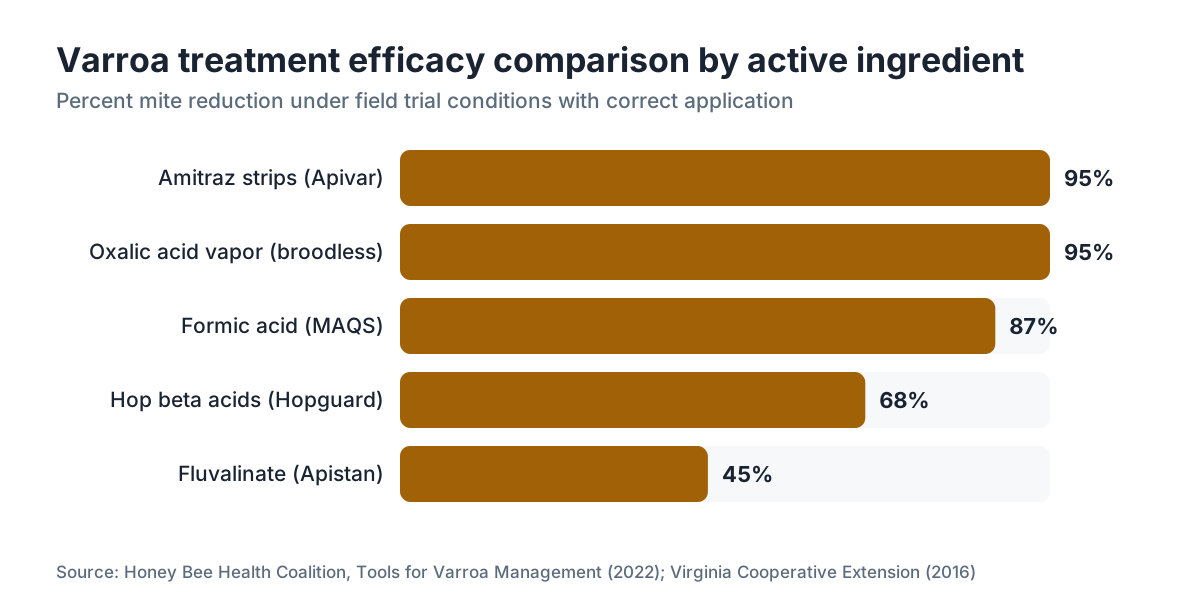
Peer-reviewed efficacy for amitraz strips lands between 90% and 99% mite reduction when you follow the protocol [3]. A 2016 Virginia Cooperative Extension review of field trials reported efficacy above 90% for amitraz strips when colonies were treated broodless or given a full 8-week exposure [4].
The Honey Bee Health Coalition's Tools for Varroa Management guide (updated 2022) rates amitraz strips among the highest-efficacy chemical options open to U.S. beekeepers, on par with oxalic acid vapor for overall kill [5]. The guide's own language: "amitraz strips remain among the most effective registered treatments for Varroa destructor when applied according to label directions."
Two things drop that number. First, resistance. Some U.S. apiaries have documented amitraz-resistant mites, mostly where beekeepers ran amitraz products year after year without rotating modes of action [6]. Second, heavy brood. A big share of mites hides under capped cells the whole treatment window, safe from the strips. Cage the queen for 24 days before treatment to force a brood break, and you push efficacy toward the top of the range.
Measure. A mite wash (alcohol wash or sugar roll) before treatment sets your baseline. Repeat it 6 to 8 weeks after you pull the strips. Still above 2 mites per 100 bees after a full course? Suspect resistance and switch to oxalic acid or another mode of action.
When is the right time of year to apply Apivar?
Apivar works spring through fall, but two windows carry most of the weight: late summer (July through September) and early spring before the main flow.
Late summer is the one that matters most. The bees raising your overwintering workers in late August and September need to be nearly mite-free. Mites feeding on those pupae wreck fat body development in winter bees, shorten their lives, and thin the cluster. A colony that hits October with a mite load above 2 to 3% probably won't reach spring in good shape [5]. Start an Apivar treatment in late July or early August and you get the full 6 to 10 week window before the colony contracts for winter.
Spring treatment makes sense when a mite wash reads above 2% before the main flow. The trap is timing. If the flow starts 6 to 8 weeks after you place strips, you pull them right as supers go on, and that works. If the flow comes sooner, you're in the conflict I described above.
Temperature limits Apivar less than it limits organic acids. The polymer releases amitraz at a fairly steady rate across normal in-hive temperatures (above 50°F / 10°C). The label sets no temperature minimum the way oxalic acid labels do [1]. Treating a tightly clustered colony in deep winter still works poorly, though, because the bees barely move across the strips.
What does a bag of 10 Apivar strips cost, and is it worth it?
A 10-strip bag of Apivar has generally run $25 to $40 in the U.S., depending on the supplier and the year. Prices moved with supply chain conditions, so check your current source. At the low end, treating five colonies costs $5 to $8 per colony per cycle, one of the lower per-colony costs among registered varroa treatments [7].
Compare that. Oxalic acid vaporization needs a vaporizer (roughly $150 to $200 upfront), but the consumable runs about $1 to $2 per colony. Mite-Away Quick Strips (formic acid) cost roughly $6 to $12 per colony and carry tighter temperature windows. Hopguard (hop beta acids) costs about the same per colony but has weaker published efficacy.
For a hobbyist with one to five hives, the bag of 10 is hard to beat on simplicity and cost. No special equipment. No fussing over temperature windows. The strips do their work over 6 to 10 weeks with no repeat application in that window.
The honest caveat is resistance. If amitraz efficacy in your yard is fading, paying $30 for a bag and getting a 60% mite drop is a bad deal at any price. Rotate modes when you suspect resistance. See the varroa mite article for how to test for treatment failure.
How does Apivar compare to other varroa treatments?
| Treatment | Active ingredient | Efficacy range | Temperature limits | Honey super restriction | Approx. cost per colony |
|---|---|---|---|---|---|
| Apivar strips | Amitraz 3.33% | 90-99% | None specified (in-hive temps) | Yes, remove supers | $5-$8 |
| Oxalic acid (vaporized) | Oxalic acid | 90-99% (broodless) | Above 50°F recommended | No restriction | $1-$2 (consumable) |
| Mite-Away Quick Strips | Formic acid 65% | 80-95% | 50-85°F | No supers | $6-$12 |
| Hopguard 3 | Hop beta acids | 50-85% | No restriction | No supers | $5-$10 |
| Apistan strips | Fluvalinate | Variable (resistance widespread) | None specified | Yes, remove supers | $5-$8 |
Data sources: Honey Bee Health Coalition Tools for Varroa Management [5], EPA product labels [1], extension reviews [4].
Apivar and oxalic acid vapor sit at the top for raw kill. The practical split: oxalic acid works best on broodless colonies, while Apivar works right through the brood cycle. If you can't or won't force a brood break, Apivar is the simpler pick for a brood-present colony.
Apistan (fluvalinate) is largely a waste of money across most of North America now. Pyrethroid resistance in varroa is so widespread that many colonies show near-zero mite drop from it [5]. Don't run it as your primary treatment unless a before-and-after mite wash confirms your local mites are still susceptible.
New to sourcing treatments? The beekeeping supply companies guide covers reputable vendors and what to check before you order.
Can Apivar leave residues in wax or honey?
Yes. This is the part of the Apivar story that deserves a straight answer instead of hand-waving.
Amitraz and its main breakdown product, DMPF (2,4-dimethylaniline formamide), bind to beeswax. Studies of commercial beeswax have found amitraz-related compounds in a large share of samples. A 2010 study in the journal Apidologie detected amitraz residues in most wax samples from treated apiaries [2]. Wax is lipophilic (it grabs fat-soluble compounds) and amitraz is fat-soluble, so repeated treatments over the years build up.
Honey is a different case. Follow the label, keep supers off during treatment, and honey residue stays very low, usually below detection or well under U.S. regulatory limits. The EPA registration rests on that use pattern [1]. Break the rule and run supers during treatment and the risk climbs. That's illegal, and it's a genuine food-safety problem.
For wax, brood comb from hives dosed with amitraz year after year carries residues. Some research suggests these residues may affect developing brood at high concentrations, though the evidence at field-realistic levels is mixed. The clean fix is to rotate out old dark comb every 3 to 4 years anyway, which handles this concern along with other comb hygiene benefits.
Follow the label, keep supers off, retire old wax on schedule.
What does the EPA label actually require for Apivar?
The EPA-registered label for Apivar (EPA Reg. No. 84833-1) sets the legal rules for U.S. use [1]. The points that matter:
- Two strips per colony for standard two-story hives; up to four strips for hives in three or more boxes.
- Strips hung vertically in the brood area, between frames.
- Treatment duration: minimum 6 weeks, maximum 10 weeks.
- Remove all honey supers before treatment; no supers until after strips come out.
- No more than two treatments per year.
- Protective gloves (nitrile or chemical-resistant) when handling strips.
- Store unused strips in original packaging in a cool, dry spot away from children and animals.
- Dispose of used strips in household trash; do not burn.
The label also notes amitraz is toxic to fish and aquatic invertebrates, so keep used strips away from water. Under the Federal Insecticide, Fungicide, and Rodenticide Act (FIFRA), the label is the law. Off-label use (wrong dose, wrong timing, supers on) is a federal violation on top of being bad beekeeping [8].
One more note: two treatments per year, maximum. For most people that's a spring treatment if needed plus a late-summer treatment. Trying to squeeze in three cycles is illegal and just piles up residue without buying you meaningful mite control.
How do you know if Apivar is working, and what if it isn't?
The only way to know is to count mites before and after. Feeling hopeful is not data.
An alcohol wash (more accurate than a sugar roll) on about 300 bees before treatment sets your baseline [9]. The clear treat-now threshold is 2 or more mites per 100 bees (2%) during brood rearing, though many extension programs push treatment at 1 to 2% in late summer to protect winter bees [5]. Repeat the wash 3 to 4 weeks after you pull the strips to check the kill.
Still above 2 mites per 100 bees after treatment? You likely have one of three problems. Resistance to amitraz is one. Reinfestation from neighboring colonies or feral swarms is another, and it can hide a real kill if you sit in a high-pressure area. Bad strip placement is the third, and it's more common than people admit.
Suspected resistance calls for a switch to a different mode of action. Oxalic acid, a plant-derived chemistry with no known cross-resistance to amitraz, is a reasonable next step, run on a broodless colony [10].
VarroaVault's free mite tracking tools let you log before-and-after wash results across colonies and seasons. That makes a slow decline in treatment response easy to spot before it turns into a dead-out. The tools sit at the top of this site.
For a closer look at what varroa does inside a colony and how infestation builds, see the varroa mite guide.
Are there any safety concerns for the beekeeper or the bees?
The EPA classifies amitraz in Apivar strips as slightly toxic (Toxicity Category III) [1]. The main risk during handling is dermal absorption. Gloves aren't boilerplate: amitraz crosses skin, and at high enough doses can cause drowsiness, bradycardia (slowed heart rate), and other effects. Swallowing it is far worse. Keep strips away from children.
For bees, properly dosed Apivar at label rates causes no measurable queen loss or serious brood disruption in healthy colonies, based on field experience and the data package from EPA registration [1]. That said, queens in weak colonies are sometimes lost during treatment, and some beekeepers see it more at higher doses (four strips in a strong colony). The mechanism isn't clear. An old or already-stressed queen faces added disruption risk during any treatment.
Don't stack amitraz with other acaricides containing the same or similar active ingredients. Read the label on anything else you're running in the hive at the same time.
The colony usually shrugs the strips off. You may see more bees on the bottom board and a little extra agitation right after placement. It settles within a day or two.
Where can you buy a bag of 10 Apivar strips, and what should you watch for?
Most major U.S. beekeeping supply retailers stock Apivar, and the 10-strip bag is the standard hobbyist unit. Check the lot number and expiration date on the bag. Strips stored badly (heat, humidity, or too long) can release amitraz at inconsistent rates, cutting efficacy without any sign you can see.
Buy from suppliers who move inventory fast. A strip that baked in a hot warehouse for two summers is not the same product as a fresh one. High-volume online beekeeping retailers usually give you the best stock turnover. The beekeeping supply companies guide breaks down well-regarded U.S. suppliers, including ones with volume discounts if you scale up.
Apivar sells internationally under slightly different registrations. Reading this outside the U.S.? Confirm the version you're buying matches your national registration. Same active ingredient, but label requirements shift by country.
For general beekeeping supplies, including hive tools, protective gear, and feeders that pair with a treatment program, there are good options across price points. If free delivery matters to your budget, the free shipping honey bee supply companies guide is worth a look. Treatment is one piece of hive management, not the whole job.
How does amitraz resistance develop, and can you slow it down?
Amitraz resistance in varroa follows the standard pest arc. Mites with slightly lower sensitivity survive treatment at a higher rate than susceptible ones. Those survivors breed, their offspring inherit the reduced sensitivity, and over generations of repeated treatment the resistant share of the population climbs until efficacy falls off a cliff [6].
The best-documented mechanism involves mutations in the octopamine receptor gene, the primary amitraz target. European apiculture institutes have confirmed these mutations in field populations, and U.S. monitoring programs are now finding similar patterns in high-treatment-pressure apiaries [6].
Slow it down by rotating modes. Don't reach for Apivar every single cycle. Alternate with oxalic acid, a completely different chemistry with no known cross-resistance [10]. The Honey Bee Health Coalition recommends an integrated approach: choose treatments by season, colony condition, and brood status rather than defaulting to one product year after year [5].
Don't undertreat. One strip where two are required, or pulling strips at week four instead of six, exposes mites to sublethal doses and selects hard for resistant individuals. That is the fastest way to breed a resistant population in your own yard. Full dose, full duration, every time.
Frequently asked questions
How many hives does a 10-strip bag of Apivar treat?
A bag of 10 treats five standard two-story colonies at the label dose of two strips per hive. For colonies in three or more boxes, the label allows up to four strips each, so one bag covers only two or three of those larger hives. Count your boxes before you buy.
Can I use Apivar strips with honey supers on?
No. The EPA-registered label prohibits use while honey supers meant for harvest are on the hive, because amitraz and its breakdown products can contaminate honey. Remove all supers before placing strips, and don't add any until the full treatment ends and strips are out. Running Apivar with supers on is off-label and a federal violation under FIFRA.
How long do Apivar strips stay in the hive?
The label requires a minimum of 6 weeks and a maximum of 10 weeks per treatment. Six weeks covers roughly two full brood cycles, giving emerging mites time to contact the strips. Leaving strips past 10 weeks is off-label and adds wax residue without meaningful extra kill. Mark your calendar the day you place them.
Do Apivar strips work in cold weather?
Apivar lacks the temperature restrictions that formic and oxalic acid carry. The polymer releases amitraz across a broad range of in-hive temperatures. In practice, winter treatment of a tightly clustered colony works poorly because the bees barely move across the strips. Late summer and early fall, while the colony is still active, is the window you want.
How do I know if varroa mites in my hive are resistant to Apivar?
The clearest signal is a post-treatment alcohol wash still showing 2 or more mites per 100 bees after a full 6 to 10 week course with proper strip placement. Before you call it resistance, rule out reinfestation from nearby colonies and placement errors. If timing and placement were right and counts stay high, switch modes of action and contact your state apiarist.
Can I use Apivar and oxalic acid at the same time?
The label doesn't explicitly ban combining Apivar with oxalic acid, and some beekeepers do apply a single oxalic dribble or vapor dose alongside a strip course. But controlled data on combined use is thin. The safer, evidence-based route is sequential: finish one product, check results, then apply the other if you still need it.
What should I do with used Apivar strips after treatment?
Toss used strips in your regular household trash. The label specifically says do not burn them, because combustion of amitraz material releases formamide compounds. Don't bury strips near water. Some towns have their own agricultural pesticide disposal guidance, so check with your local extension office if you're unsure.
How many times per year can I apply Apivar?
The EPA label permits two Apivar treatments per year, maximum. Most beekeepers use one late-summer treatment as the main intervention plus a spring treatment if counts warrant it before the flow. Going past two treatments is off-label and piles up wax residue without buying meaningful extra mite control.
Do Apivar strips hurt the queen or the brood?
At label doses in healthy colonies, Apivar usually causes no queen loss or serious brood disruption. Some beekeepers report occasional queen loss in weak colonies during treatment, but that seems tied to underlying colony stress more than a direct amitraz effect. A queenright, reasonably strong colony tolerates the strips well under normal conditions.
How should I store unused Apivar strips?
Keep unused strips in their sealed original packaging in a cool, dry spot away from direct sun and heat. Heat speeds amitraz off-gassing from the polymer, which weakens the strips before you ever place them. Keep them out of reach of children and away from food or feed. Don't refrigerate unless the label specifically says to.
Where exactly in the hive do I place Apivar strips?
Hang strips vertically in the brood cluster, one on each side of the brood nest, between frames where bees are clustered and moving. Proper placement puts bees in constant contact with the strip surface. Strips set outside the cluster, in empty frames, or against outer walls get far less contact and much worse kill. Placement is arguably the most important step in the whole process.
Is Apivar safe for package bees or newly installed colonies?
The label doesn't restrict use in newly installed packages. A fresh package usually carries a low mite load, though, since the bees were shaken off their original colony and brood. Many beekeepers wait 4 to 6 weeks to get a baseline count before treating a new package instead of treating on reflex. If the source apiary had high mite pressure, earlier treatment can be warranted.
What is the difference between Apivar and Apistan?
Apivar uses amitraz, which disrupts the octopamine receptor system in mites. Apistan uses fluvalinate, a synthetic pyrethroid. Fluvalinate resistance in varroa is now so widespread across North America that Apistan efficacy often falls below 50% in treated apiaries. Amitraz resistance exists but is less common across most U.S. regions. For most beekeepers, Apivar is the far more reliable synthetic strip.
Sources
- EPA - Apivar pesticide registration label (EPA Reg. No. 84833-1): Label requirements for dosage (2 strips per colony standard, up to 4 for 3+ hive bodies), treatment duration (6-10 weeks), honey super restrictions, maximum 2 treatments per year, and PPE requirements.
- Apidologie journal - Amitraz and wax residue study: Amitraz and its degradation products were detected in beeswax samples from treated apiaries; wax accumulates lipophilic amitraz residues with repeated treatments.
- USDA Agricultural Research Service - Varroa management research: Amitraz strip treatments show 90-99% mite reduction efficacy in field trials when applied according to label protocol.
- Virginia Cooperative Extension - Varroa Mite Management publication: Virginia Cooperative Extension 2016 review reported amitraz strip efficacy consistently above 90% in field trials with full exposure periods.
- Honey Bee Health Coalition - Tools for Varroa Management guide (2022): HBHC rates amitraz strips among the highest-efficacy registered treatments for Varroa destructor; mite load above 2-3% entering October associated with winter colony loss; late summer treatment recommended to protect winter bees.
- USDA AMS National Honey Report / apiculture resistance monitoring: Amitraz resistance linked to octopamine receptor gene mutations has been documented in field varroa populations in high-treatment-pressure apiaries in the U.S. and Europe.
- Penn State Extension - Varroa Mite Treatment Options: Amitraz strip treatments cost approximately $5-$8 per colony per treatment cycle, placing them among the lower-cost registered varroa treatment options.
- EPA - Federal Insecticide Fungicide and Rodenticide Act (FIFRA) overview: FIFRA prohibits off-label pesticide use; applying Apivar with honey supers present or at non-label doses constitutes a federal violation.
- University of Minnesota Extension - Varroa Mite Management for Honey Bees: Alcohol wash is more accurate than sugar roll for mite counting; treatment threshold of 2 mites per 100 bees recommended during brood-rearing season, with late-summer treatment particularly important for winter bee health.
- North Carolina State University Apiculture Program - Varroa management resources: Rotating treatment modes (e.g., amitraz and oxalic acid) slows resistance development; there is no known cross-resistance mechanism between amitraz and oxalic acid.
Last updated 2026-07-09