Apivar resistance in varroa mites: how to detect it

TL;DR
- Apivar (amitraz) resistance in varroa mites is confirmed in multiple U.S.
- apiaries.
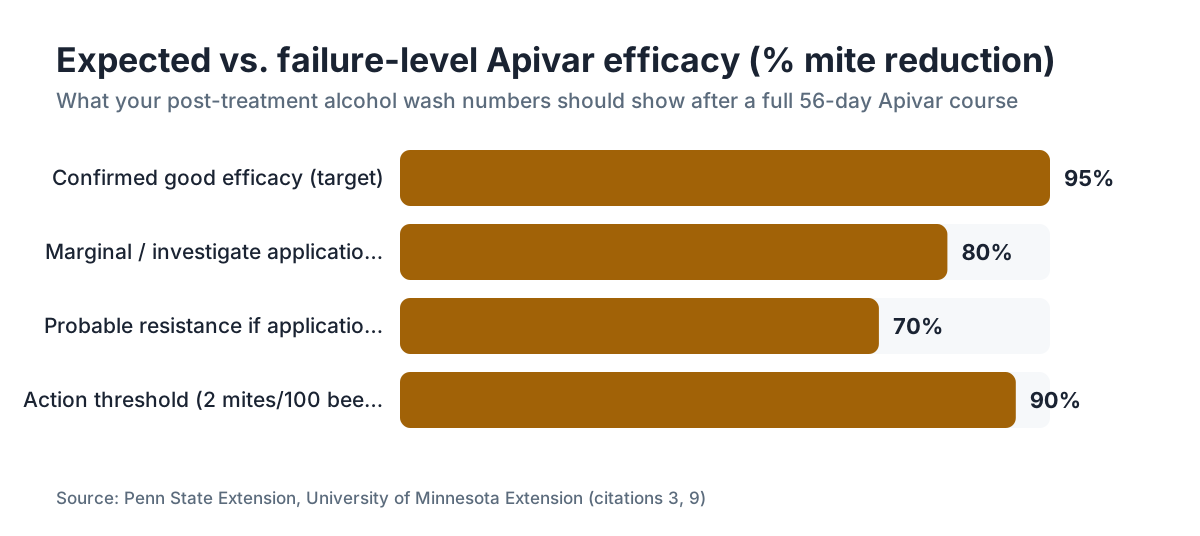
- You detect it by comparing pre- and post-treatment wash counts: a correctly applied 56-day Apivar course should cut live mite loads by at least 90 to 95%.
- A drop below that, with no application errors, is the clearest field signal of resistance.
- A lab bioassay can confirm it.
What is Apivar resistance and why does it happen?
Apivar's active ingredient is amitraz, a formamidine acaricide. It kills varroa by binding octopamine receptors and scrambling the mite's nervous system. The strips release amitraz slowly across the full 56-day treatment, and that slow, continuous exposure is exactly the pressure that selects for resistant mites. Any mite carrying a mutation that dulls amitraz sensitivity survives, breeds, and hands the trait down. Repeat that across enough colonies over enough seasons and you have built a resistant local population.
Resistance to amitraz in varroa was first documented in European apiaries in the early 2000s. U.S. researchers confirmed it here too. A 2021 study in Scientific Reports found amitraz-resistant varroa in multiple states, with mutations in the octopamine receptor gene (Oa1) strongly tied to treatment failure [1]. This is not a worst-case scenario paper. It is a peer-reviewed finding from hives whose keepers believed treatment was working.
The mechanism matters for detection. Resistance is not all-or-nothing. Partially resistant colonies may show a 70 to 80% mite drop instead of the expected 90 to 95% plus. That partial response is easy to write off as an application error. It usually is not.
How common is Apivar resistance in the U.S. right now?
Honest answer: nobody has great national prevalence data. The closest we have is the 2021 Scientific Reports study, which screened colonies across multiple states and found the Oa1 resistance-associated variant in a meaningful share of tested populations [1]. The Honey Bee Health Coalition's Varroa Management Guide notes that amitraz resistance has been detected in the U.S. and recommends rotation as prevention [2].
What state apiarists and extension programs describe is a middle ground. Resistance is not everywhere yet, but it is no longer rare in regions with high Apivar use over many years. The Northeast and parts of the mid-Atlantic see the most reports, though that may reflect heavier monitoring rather than a real geographic pattern. Operations that run Apivar as their only miticide season after season are the highest-risk group by a wide margin.
Used Apivar exclusively for three or more years straight? Stop assuming it works. Start testing efficacy after every course.
What mite count threshold signals Apivar is not working?
The efficacy benchmark is a reduction of 90 to 95% or greater in live mite load after a full treatment course [2][9]. Some sources, and the product label, describe the expectation as near-complete knockdown in a well-managed hive.
Here is how to measure it. Run an alcohol wash or sugar roll before the strips go in, counting mites per 100 bees (roughly 300 bees pulled from the brood nest). Write that number down. After the full 56 days, pull the strips and run another wash within a week. Divide the post-treatment count by the pre-treatment count, then subtract from 1. That is your efficacy percentage.
Example: 8 mites per 100 bees before, 2 mites per 100 bees after. That is a 75% reduction. That should worry you.
If your post-treatment count sits above 2 mites per 100 bees and your pre-treatment count was moderate (say 4 to 8), you have a problem. The University of Minnesota Extension recommends an action threshold of 2 mites per 100 bees during the brood-rearing season, which means a post-treatment result at or above that level after a full Apivar course is a treatment failure regardless of cause [3].
One caveat. A single bad result does not prove resistance. Rule out application errors first.
How do you rule out application errors before assuming resistance?
This is where most beekeepers cut the corner too soon. Amitraz gets the blame when the real culprit is poor strip placement, a short treatment, or a sublethal dose from strips left in too long and then reused.
Check every one of these before you say the word resistance:
- Strip placement. Apivar needs direct bee contact to work. Strips hang in the brood cluster, between two frames of open or capped brood. A strip dropped to the bottom board or hung in a honey super does almost nothing. The EPA-approved label specifies hanging strips between frames in the brood area [4].
- Treatment duration. 56 days minimum, no shorter. Pulling strips at 42 days is common and it costs you efficacy. Set a calendar reminder.
- Brood load. Varroa hiding under capped brood is not directly exposed to amitraz. A heavily capped colony at treatment start will not hit 95% knockdown on any realistic timeline. That is not resistance. That is biology. A brood break before treatment, or a second cycle, handles it.
- Queen status. A laying queen means capped brood, which means mites shielded from contact. Supersedure or a failing queen muddies your efficacy math.
- Reused strips. Apivar strips are labeled single use, one cycle [4]. Reuse delivers a fraction of the dose and creates the low-level, sublethal exposure that speeds resistance selection.
- Strip count. The label calls for 2 strips per hive body occupied by bees. A two-deep hive with bees in both boxes needs 4 strips total. Under-dosing is one of the most common mistakes there is.
Only after your application checks out clean should you start thinking about resistance.
What is a varroa bioassay and can you do one yourself?
A bioassay exposes live mites to a known concentration of acaricide and measures how many survive. It is the most direct way to confirm resistance rather than inferring it from field wash counts.
Lab bioassay: a few U.S. university labs and some state apiarists run amitraz bioassays on mailed-in samples. You collect live varroa (usually by alcohol wash, then filter and recover the live ones), expose them to standardized amitraz concentrations on filter paper or in a container, and count survival at 24 to 48 hours against a susceptible control. The result is a lethal concentration ratio compared to baseline. An LC50 (the concentration that kills half the mites) that runs 10x or more above the susceptible baseline is treated as confirmed resistance in the research literature [1].
DIY contact bioassay: researchers at the USDA ARS Bee Research Lab have published simplified contact protocols that a motivated beekeeper can run with basic materials. You treat mites on filter paper with amitraz solution at a fixed dose and score knockdown. It is not plug-and-play. Your result depends heavily on how well you handle live mites and keep your solutions consistent. For most hobbyists and sideliners, field wash comparisons are more practical and more honest than a home bioassay.
The USDA ARS Bee Research Lab in Beltsville, MD is the primary federal resource for this kind of diagnostic work [5]. Running a commercial-scale operation and suspecting widespread resistance? Contact your state apiarist to coordinate sample collection. That is the right move.
What field signs in the hive suggest Apivar has stopped working?
Wash numbers are the gold standard. There are also softer signals worth watching during and after treatment.
Natural mite drop. A sticky board under the hive during the first two weeks of treatment should show a clear spike in dead mites. That early drop is amitraz knocking down phoretic mites. Little to no drop in the first 7 to 14 days, in a correctly placed fresh treatment in an infested hive, means something is wrong. Follow it up with a post-treatment wash.
Colony trajectory. A colony still showing brood damage (chewed cappings, deformed wing presentation, discolored larvae) through and after a full course probably still carries a high mite load. Deformed wing virus does not vanish the moment mites drop, but it should ease off noticeably if treatment is working.
Mid-treatment wash. Some beekeepers run a wash at day 28 for an early read. Not a bad idea. If mite levels have not dropped much by day 28 with strips in place, that is meaningful. A working treatment does most of its knockdown in the first few weeks, not at the end.
Compare across the yard. If one colony responds poorly while others with the same strips and the same application knock down normally, the problem is that colony, not resistance. Uniform poor response across the whole operation is the red flag.
How do you run an alcohol wash to measure Apivar efficacy?
An alcohol wash is the most accurate field method for measuring live mite load, and it is what you want for both your pre- and post-treatment counts. The Honey Bee Health Coalition's Varroa Management Guide walks through the protocol in detail, and University of Florida IFAS Extension covers it as well [2][11].
You need a wide-mouth jar with a mesh lid (or a commercial wash kit), 70% isopropyl alcohol, and a measuring cup. Shake about 300 bees (roughly half a cup by volume) from a brood frame into the jar. Seal it, add enough alcohol to cover the bees, shake 30 seconds, then rest a minute. Pour the liquid through the mesh into a second container, add more alcohol, and shake again. Count the mites in the combined liquid and divide by the number of bees to get mites per 100 bees. Pull from a brood frame, because nurse bees carry the highest mite load and give you the most relevant sample.
The number that matters for resistance is the ratio between your pre- and post-treatment counts, not either figure alone. Run both washes the same way: same method, same frame location, same time of day if you can manage it. Sloppy technique is the biggest source of noise in this data.
Free mite monitoring log templates live in VarroaVault's tools section if you want a structured way to track pre- and post-treatment numbers across hives and seasons.
For gear, beekeeping supply companies carry mite wash kits and sticky boards.
What should you do if you confirm Apivar is not working?
Switch active ingredients. That is the core answer. Varroa carries separate resistance mechanisms for different chemical classes, so a colony resistant to amitraz is not automatically resistant to oxalic acid or synthetic pyrethroids. Rotate to a different mode of action.
Oxalic acid works by direct contact and fumigation. Mites have shown essentially no field resistance to it in the research literature so far, which makes it the primary fallback [6]. The catch: oxalic acid, whether vaporized or dribbled, works best when little or no capped brood is present, because mites tucked in capped cells never touch it. Timing matters.
ApiLife VAR (thymol) is another option and a different chemical class entirely. It is fussy about temperature and performs best between 59 and 69 degrees F ambient. Thymol resistance is not well documented in U.S. populations, though European data shows some tolerance has crept into heavily exposed apiaries [7].
CheckMite+ (coumaphos) is a third registered option, but coumaphos resistance is actually more widespread in the U.S. than amitraz resistance based on historical data. Running to coumaphos as your fallback is a poor bet [8].
Rotation going forward: do not run Apivar two consecutive cycles in the same year. At minimum, alternate it with oxalic acid. Most extension programs now recommend oxalic acid in winter during the broodless window and Apivar in spring or fall, when brood presence makes oxalic acid less effective [2][3].
And report the suspected resistance to your state apiarist. That is genuinely useful surveillance data, and most state apiculturists want to hear about it.
How does amitraz resistance spread between apiaries?
Drifting drones are the main vector. Varroa hitch rides on drones, and drones wander freely into hives that are not their own. A drone from a resistant colony can carry resistant mites into a susceptible hive in your neighbor's yard half a mile off. That is how resistance moves through a region even when individual beekeepers do everything right.
Robbing is the other main route. When a strong colony robs out a collapsing, mite-heavy one, the workers haul mites home. If those mites carry resistance alleles, the robbing colony now carries them too.
This regional spread is why resistance management is a shared problem rather than a private one. A beekeeper with perfect rotation discipline can still inherit resistant mites from neighbors who have none. It also means treating resistant and susceptible populations as geographically sealed off is wrong. In dense beekeeping areas, gene flow between apiaries runs high.
The practical takeaway: monitor your efficacy even when you think your management is clean. And if your club has members reporting treatment failures, that is a signal worth sharing and acting on together.
Are there genetic tests for amitraz resistance in varroa?
Yes, and they are getting more reachable. The research literature points to mutations in the Oa1 (octopamine receptor) gene as the primary molecular marker for amitraz resistance in varroa. The 2021 Scientific Reports study by Tausch et al. used PCR-based genotyping of the Oa1 locus to screen for resistance alleles in field-collected mites [1].
The Oa1 F319Y mutation in particular shows a strong tie to amitraz treatment failure. As the authors put it in their paper: "We found a significant association between the Oa1 F319Y mutation and survival after amitraz treatment" [1]. That is a direct quote from the study.
For routine beekeeper use, genetic testing is not a practical first-line tool yet. It needs PCR equipment, primers, and some lab skill. A few commercial diagnostic labs are moving toward acaricide resistance genotyping for beekeepers, but as of 2025 it is not a widely available consumer service in the U.S.
What is available now: the USDA ARS lab and some land-grant university apiculture programs can run molecular diagnostics on samples if you contact them about a suspected case, especially if you bring documented field efficacy data with the samples [5]. Including your pre- and post-treatment wash numbers makes the sample far more useful to them.
How do you prevent Apivar resistance from developing in your apiary?
Prevention is simpler than the science makes it sound. Three practices carry most of the weight: rotation, dose discipline, and monitoring.
Rotation means never treating with the same active ingredient twice in a row within a season or year. Alternate Apivar with oxalic acid, thymol, or another labeled acaricide [2]. A schedule that works for temperate climates: Apivar in fall after the honey harvest, oxalic acid vaporization in December or January during the broodless period. Two treatment hits, two different modes of action, one annual cycle.
Dose discipline means using the right number of strips, for the full labeled duration, and never reusing them [4]. Sublethal amitraz exposure from under-dosed or reused strips selects directly for resistance. This is not a theoretical risk. It is what the resistance research shows happening in practice.
Monitoring means actually counting mites before and after every treatment, every time. A lot of resistance goes undetected for years because keepers assume the treatment is working. The Honey Bee Health Coalition's Varroa Management Guide, updated in 2022, offers free downloadable monitoring worksheets [2]. Managing a handful of hives and want a structured tracker? VarroaVault's free tools include mite log templates built for exactly this pre- and post-treatment comparison.
You can read more about the biology behind what you are managing at varroa mite.
What does the Apivar product label actually say about resistance?
The EPA-approved Apivar label (EPA Reg. No. 86243-2) carries a resistance management statement. It tells beekeepers to rotate Apivar with acaricides of different modes of action and to monitor treatment efficacy [4]. The label also sets the 56-day minimum treatment and limits use to one treatment per hive per spring and one per fall.
The label gives no specific numerical efficacy threshold for what counts as failure. That quantitative guidance comes from the research literature and extension programs like the University of Minnesota and Penn State Extension, not from the label [3][9].
One thing the label is blunt about: do not exceed two cycles per year, one spring and one fall. Running strips longer than labeled or leaving them in year-round buys you no extra protection. It buys more resistance selection pressure with a shrinking mite kill as the amitraz in the strips runs down.
No current copy of the label? The EPA pesticide label database and the label holder's website both carry the full current version as a PDF [4].
Frequently asked questions
How do I know if my Apivar treatment failed due to resistance vs. a bad application?
Check strip placement (in the brood cluster, not on the floor), strip count (2 per occupied box), duration (full 56 days), and whether strips were new or reused. If all of that was correct and your post-treatment alcohol wash still shows more than 2 mites per 100 bees after a moderate pre-treatment count, suspect resistance. A uniform poor result across multiple colonies in the same yard strengthens that suspicion.
What percentage mite reduction should I expect from a full Apivar course?
A correctly applied 56-day Apivar treatment should reduce live mite loads by 90 to 95% or more. Some studies and extension programs cite efficacy above 95% under good conditions. A result below 90%, with confirmed correct application, is a treatment failure worth investigating. The University of Minnesota Extension cites a 2 mites per 100 bees action threshold, so any post-treatment count at or above that level in a brood-rearing colony is a problem.
Can varroa mites develop resistance to oxalic acid like they did to amitraz?
Resistance to oxalic acid has not been documented in field populations as of current research. Oxalic acid works by direct chemical contact and probable pH disruption, a mechanism that appears harder for mites to evolve around. Europe uses it as a resistance fallback for exactly that track record. That said, sustained heavy use of any single treatment can in principle select for tolerance over time, so rotation still makes sense even with oxalic acid.
How long does it take for amitraz resistance to develop in an apiary?
There is no reliable single-apiary timeline in the literature. Resistance can in theory emerge in 3 to 5 years of single-mode-of-action pressure under ideal selection conditions, based on population genetics modeling and the European experience. But some apiaries run Apivar-heavy programs longer without documented failure. Genetic drift, mite immigration from other colonies, and treatment discipline all shift the rate. Monitoring efficacy after every treatment is the only reliable early warning.
Is Apivar resistance the same as coumaphos resistance?
No. Amitraz and coumaphos are different chemical classes with different resistance mechanisms. A varroa population resistant to amitraz (Apivar) is not automatically resistant to coumaphos (CheckMite+), and the reverse holds too. Coumaphos resistance is actually more historically prevalent in U.S. mite populations than amitraz resistance, so CheckMite+ is a poor resistance fallback. Oxalic acid, with its distinct mode of action, is the more reliable alternative.
Can I send varroa mites to a lab for resistance testing?
Yes, in principle. The USDA ARS Bee Research Lab in Beltsville, MD and some land-grant university apiculture programs can run bioassays or molecular diagnostics on mite samples. Contact your state apiarist first. They can coordinate collection and submission, and your pre- and post-treatment wash data makes the sample more useful. Commercial diagnostic services for amitraz resistance genotyping are not yet widely available to individual beekeepers in the U.S. as of 2025.
How many Apivar strips do I need per hive?
The label calls for 2 strips per hive body occupied by bees. A single-deep hive needs 2 strips. A two-deep hive with bees in both boxes needs 4. Under-dosing with fewer strips than labeled is one of the most common errors and creates exactly the sublethal amitraz exposure that speeds resistance selection. Count the boxes your bees actually occupy, not the boxes you have stacked.
Does Apivar resistance vary by region?
Yes, based on available data. Regions with heavier Apivar use and a longer history of amitraz-based management show more confirmed cases. The Northeast U.S. has the most reported instances in the literature and from state apiarists, though that may partly reflect better monitoring there. Commercial operations running continuous Apivar programs in any region face higher risk than hobbyists who rotate. Regional surveillance data stays limited.
Should I do a brood break before Apivar treatment to improve efficacy?
A brood break (confining the queen for 24 to 28 days so all brood emerges) sharply improves Apivar efficacy by exposing mites that would otherwise sit protected in capped cells. It is especially useful in fall before your main treatment. It is not required, but colonies treated during a natural break or after an induced one hit the 90 to 95% benchmark more consistently. Some beekeepers cage queens specifically for this.
What is the Oa1 gene and why does it matter for resistance detection?
Oa1 encodes varroa's octopamine receptor, the protein amitraz binds to kill mites. A specific mutation in this gene, F319Y, cuts the receptor's sensitivity to amitraz. Mites carrying it survive treatment and pass the trait on. A 2021 study in Scientific Reports found a significant statistical association between the Oa1 F319Y mutation and amitraz treatment survival in field-collected mites. PCR-based genotyping of this locus is the molecular basis for lab resistance confirmation.
Can I use Apivar and oxalic acid together to overcome resistance?
You can use them in the same season but not at the same time. Pull the Apivar strips before applying oxalic acid. Running Apivar in fall (strips in for the full 56 days) followed by oxalic acid vapor in winter during the broodless period is a well-supported sequential protocol. It is not a resistance cure if full amitraz resistance is already established, because resistant mites survive the Apivar phase. Oxalic acid then works on the survivors, which helps but does not fully cover for the failed first treatment.
How often should I test mite levels to catch resistance early?
At minimum, run an alcohol wash before and after every treatment course. That pre/post comparison is your efficacy data. Beyond that, monitoring every 30 days during the brood-rearing season (roughly April through September in temperate climates) gives you a population trajectory that makes a treatment failure obvious fast. The Honey Bee Health Coalition recommends monthly monitoring during the active season. Waiting for sick bees or a collapsing colony means you are already 60 to 90 days behind.
Does reusing Apivar strips cause resistance?
Yes, almost certainly. Reused strips have badly depleted amitraz, delivering a sublethal dose. Continuous sublethal exposure is one of the strongest known drivers of resistance selection in any pest. The label restricts strips to a single treatment cycle. Reuse is both off-label and a direct resistance risk. Strips cost roughly $3 to $5 each depending on where you buy them. The cost of resistance runs much higher than the cost of new strips.
Sources
- Scientific Reports (2021), Tausch et al., 'Association of Oa1 F319Y mutation with amitraz resistance in Varroa destructor': Amitraz-resistant varroa populations confirmed in U.S. apiaries; Oa1 F319Y mutation significantly associated with treatment survival after amitraz exposure
- Honey Bee Health Coalition, Varroa Management Guide (2022 edition): Amitraz resistance detected in the U.S.; rotation with different modes of action recommended; monthly monitoring during brood-rearing season recommended
- University of Minnesota Extension, 'Varroa mite monitoring and treatment': Action threshold of 2 mites per 100 bees during brood-rearing season; post-treatment count at or above threshold indicates treatment failure
- EPA, Apivar (amitraz) pesticide label, EPA Reg. No. 86243-2: Strips must be placed in brood area; 56-day treatment duration; 2 strips per occupied hive body; single-use only; one treatment per spring and one per fall; resistance management rotation statement included
- USDA ARS Bee Research Laboratory, Beltsville MD: Primary federal research facility for varroa acaricide resistance bioassay and molecular diagnostics in the U.S.
- Penn State Extension, 'Varroa Mite Treatment Options for Honey Bees': Oxalic acid (Api-Bioxal) effective as a resistance management fallback; best efficacy during broodless periods; no documented field resistance in U.S. populations
- Journal of Apicultural Research, thymol tolerance review, European populations: Some tolerance to thymol-based treatments has developed in heavily exposed European varroa populations; U.S. resistance to thymol not well documented
- USDA ARS, 'Coumaphos resistance in Varroa destructor' research summary: Coumaphos resistance historically more prevalent in U.S. mite populations than amitraz resistance; CheckMite+ not ideal as primary resistance fallback
- Penn State Extension, Mite-A-Thon and varroa monitoring protocols: 90 to 95% mite reduction as the efficacy benchmark for a successful Apivar treatment course
- EPA, Pollinator Protection, acaricide resistance management guidance: EPA pesticide guidance for acaricide rotation and resistance management in honey bee hives
- University of Florida IFAS Extension, 'Varroa Mite Management in Florida Honey Bee Colonies': Alcohol wash protocol details; pre- and post-treatment wash comparison as standard field efficacy measurement
Last updated 2026-07-09