Colony collapse disorder and varroa: what actually kills the hive
TL;DR
- Varroa destructor is the single biggest driver of managed honey bee colony losses in the U.S., but colony collapse disorder (CCD) is a specific, narrower syndrome with disputed causes.
- Most winter die-offs labeled 'CCD' are actually varroa-driven viral collapse.
- Annual colony loss rates have run 40-50% in recent survey years, and high mite loads remain the clearest, most actionable risk factor.
What is colony collapse disorder, exactly?
Colony collapse disorder is a specific syndrome, not a catch-all term for dead bees. The U.S. Department of Agriculture and EPA defined it by a cluster of symptoms first documented at scale in 2006-2007: a living queen is present, there is capped brood, and there are food stores, but the adult worker population has vanished. No dead workers pile up inside or outside the hive. That disappearing-workers picture is what sets CCD apart from a normal winter cluster that just starved or froze. [1]
That narrow definition matters a lot. Many beekeepers say their hive 'collapsed from CCD' when what they actually found was a dead cluster with Varroa destructor mites visible on capped brood, or a population crash that bled down to nothing over six weeks. That is Varroa-driven viral collapse, which is the most common cause of colony death in the U.S., but it is not technically CCD by the original case definition. The distinction is not pedantic. If every winter loss gets labeled CCD, the data become useless.
True CCD reports peaked roughly between 2006 and 2010. USDA surveys since then have shown the syndrome, defined strictly, has become less common, even as colony loss rates have stayed stubbornly high. [2] So CCD the syndrome appears to be declining. Colony loss the problem absolutely is not.
What causes colony collapse disorder?
Nobody has a single confirmed cause. That is the honest answer, and it has frustrated researchers, beekeepers, and the media for nearly two decades.
The USDA and EPA published a joint report in 2013 identifying four main categories of likely contributors: pathogens (especially the Nosema gut fungus and a suite of RNA viruses), parasites (Varroa destructor foremost among them), pesticides (particularly neonicotinoids and fungicides), and poor nutrition from monoculture forage. [1] Their stated conclusion was that CCD is probably not caused by any single factor but by the interaction of several stressors hitting a colony at once.
Neonicotinoids got the most press. Imidacloprid, clothianidin, and thiamethoxam can impair bee navigation and immune function at sublethal doses, and several European studies found correlations with colony decline. [3] The EU banned outdoor use of three neonicotinoids in 2018 partly on this basis. The U.S. EPA reviewed the evidence and issued interim decisions requiring label changes and certain application restrictions, but stopped short of full bans, citing uncertainty in the field-realistic dose data. [4]
Varroa's relationship to CCD is indirect but probably central. The mite itself does not make workers vanish. What it does is vector a set of RNA viruses, especially Deformed Wing Virus (DWV), that compromise bee immune function, shorten adult bee lifespan, and produce neurologically damaged bees that may leave the hive and fail to return. [5] That mechanism looks a lot like CCD. Many researchers suspect a heavily mite-infested colony under pesticide stress and on poor forage tips into a CCD-like collapse that wouldn't happen from any one of those stressors alone.
How much of a role does Varroa specifically play in bee colony losses?
Varroa destructor is the dominant cause of managed colony mortality in the United States, full stop. The Bee Informed Partnership (BIP) annual surveys, which have tracked losses since the 2006-2007 winter, consistently rank uncontrolled Varroa as the top predictive factor for colony death. Beekeepers who report treating for mites lose significantly fewer colonies than those who do not treat. [6]
The mechanism is well-established. Varroa feeds on honey bee fat bodies (not hemolymph, as was believed for years; a 2019 study by Samuel Ramsey et al. corrected the record), and this feeding weakens bees' ability to synthesize vitellogenin, detoxify pesticides, and mount immune responses. [5] The mite also transmits DWV and several other viruses during reproduction in the brood cell. A colony that reaches a mite infestation level of 2-3% (2-3 mites per 100 bees) in late summer is at high risk of collapse before spring.
Here is the key number. A 2018 analysis of BIP survey data found that colonies treated for Varroa had about half the winter mortality of untreated colonies. [6] That is a larger effect size than any other single management variable the surveys measured. Pesticide exposure, nutrition, queen age, and apiary location all matter, but none of them shift the mortality curve as sharply as mite control does.
For a detailed look at the mite's biology and life cycle, the varroa mite overview covers that ground thoroughly.
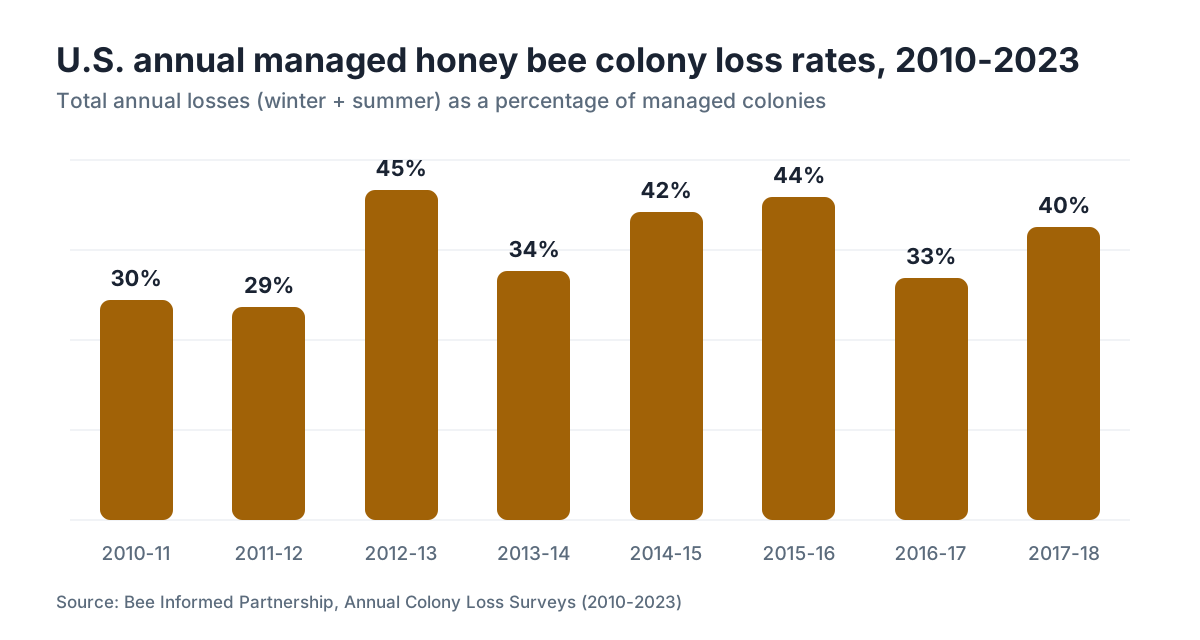
The table below shows U.S. annual managed colony loss rates from BIP surveys, which puts the scale of the ongoing crisis in perspective. These are not CCD numbers specifically. They are total losses from all causes, with Varroa consistently cited as the leading factor. [2]
How do annual colony loss rates compare to pre-Varroa baselines?
Before Varroa destructor arrived in the U.S. in 1987, normal overwintering losses ran roughly 5-10% annually. Experienced beekeepers expected to lose some colonies to starvation, winter kill, or queen failure, but a 30% loss would have been alarming. [7]
The Bee Informed Partnership survey data since 2006-2007 show a sustained elevation well above that historical baseline. Annual total losses (winter plus summer) have ranged from about 29% to 45% depending on the survey year. The 2022-2023 survey reported total annual losses of 48.2%, the highest on record at that time. [2]
This does not mean all those deaths are Varroa. Winter starvation, queen failure, pesticide incidents, and small hive beetles all contribute. But the timing is telling. Loss rates began climbing in the late 1980s as Varroa spread through U.S. apiaries, and they have never returned to pre-Varroa norms despite decades of research and management improvements in nearly every other area of beekeeping.
What viruses does Varroa spread, and why do they matter for CCD?
Varroa is primarily dangerous as a virus vector. The mite reproduces in capped brood cells, and during that process it transmits RNA viruses directly into developing pupae. Deformed Wing Virus is the best-studied. A colony with high Varroa loads almost always has high DWV titers, and experimental work has shown that Varroa actively selects for more virulent DWV strains by providing a transmission route that bypasses the bees' normal oral-fecal exposure pathway. [5]
Other viruses associated with Varroa-infested colonies include Sacbrood Virus, Black Queen Cell Virus, Acute Bee Paralysis Virus, and Israeli Acute Paralysis Virus (IAPV). IAPV got heavy attention early in the CCD investigation because it showed up consistently in samples from collapsed colonies analyzed in a 2007 Science paper. [8] Later work suggested IAPV was a correlate, not necessarily a direct cause, but it remains a marker for high viral load.
Why this connects to CCD specifically: neurologically impaired foragers produced by high DWV loads may navigate poorly and fail to return to the hive. A colony losing foragers faster than it produces them will depopulate in a way that looks, superficially, like the vanishing workers of CCD. That is probably the main reason CCD and Varroa look so intertwined even if the strict CCD case definition and the typical Varroa collapse do not perfectly overlap.
Do pesticides or neonicotinoids cause CCD independently of Varroa?
The evidence for neonicotinoids as an independent cause of CCD at field-realistic doses is weaker than the media coverage of 2012-2014 suggested. Most of the laboratory and semi-field studies showing strong effects used doses higher than what foragers typically encounter in the field. Studies designed to replicate realistic field exposure have produced mixed results. [3]
That said, the interaction effect is real and documented. A 2012 study by Pettis et al. found that sublethal imidacloprid exposure increased bees' susceptibility to Nosema infection, illustrating how two stressors combine to do more damage than either alone. [9] The current scientific consensus, reflected in the Honey Bee Health Coalition's 'Tools for Varroa Management' guide, is that pesticides are a significant co-stressor but are unlikely to cause the specific CCD syndrome in the absence of other factors. [10]
Fungicides deserve more attention than they usually get. Multiple studies have found that fungicide residues in pollen and wax, which are often ignored in single-pesticide risk assessments, impair bees' ability to metabolize other toxins. Bees fed pollen with fungicide residues also show higher Nosema infection rates. This is an active research area and the data are still coming in.
Is CCD still happening, or has it gone away?
Strict CCD (the vanishing-workers syndrome) appears to have declined since its 2006-2010 peak, at least based on beekeeper reports and USDA survey data. [2] Colony losses as a general phenomenon have not declined. The two things get conflated constantly.
One plausible explanation for the apparent CCD decline is that beekeepers got much better at mite management after 2010. Oxalic acid gained EPA registration for use in the U.S. in 2015 [4], and the adoption of alcohol wash monitoring spread through the beekeeping community. Better mite control means fewer colonies reaching the kind of catastrophic viral load that produces CCD-like collapse.
Another possibility is that the specific environmental conditions of 2006-2010, including wide deployment of certain neonicotinoid seed treatments and a particularly virulent DWV strain, have shifted. Nobody can say this with confidence. What is certain is that beekeepers cannot afford to declare victory. Loss rates above 30% annually are not a solved problem.
How can beekeepers tell if their colony loss is Varroa-driven vs. something else?
The fastest diagnostic tool is a mite count. An alcohol wash or sugar roll performed on a sample of 300 nurse bees from the brood nest gives you a percentage. A result above 2% in late summer (July-August in most of the U.S.) means the colony is at high risk of collapse before spring. Above 3%, the risk is severe and immediate treatment is indicated. [10]
Beyond mite counts, look at the pattern of death. Varroa-driven collapse usually shows a population that dwindles over weeks, scattered dead bees with deformed wings on the bottom board, and visible mites on capped drone brood when you pull frames. True CCD leaves empty frames, food stores, and a queen with only a small cluster of young bees, no pile of dead workers. Starvation looks different again: a dead cluster with heads buried in cells, usually in a late-winter pattern.
Tools for tracking mite loads over time, including threshold calculators and treatment timing guides, are available through VarroaVault's free protocol tools. The Honey Bee Health Coalition also publishes a free, peer-reviewed 'Tools for Varroa Management' guide that covers monitoring methods in detail. [10]
If you are tracking your colonies through the season and keeping good records, Varroa is almost always detectable before it kills the colony. The colonies that die suddenly and unexpectedly are usually the ones that were not monitored.
What treatments actually work against Varroa, and are they approved?
The EPA-registered treatments fall into two broad categories: organic acids and synthetic miticides.
Oxalic acid (OA) is the most widely recommended first-line treatment for mite loads in broodless colonies or in late fall and winter. It kills phoretic mites (those on adult bees) with very high efficacy, over 90% in broodless conditions. The EPA registered oxalic acid dihydrate for use in the U.S. in 2015, and Api-Bioxal is the only EPA-registered oxalic acid product currently approved for use in hives with honey supers for human consumption at certain application methods. [4]
Formic acid (in products like Mite-Away Quick Strips) penetrates capped brood cells and kills mites in the reproductive stage, which oxalic acid cannot do. This makes it useful when brood is present, but it requires temperature management (ideally 50-85°F) and can cause brood loss if used in heat.
Synthetic acaricides include amitraz (Apivar) and two tau-fluvalinate products (Apistan). Apivar is effective but requires a 56-day treatment period and cannot be used when honey supers are on. Resistance to tau-fluvalinate is widespread in U.S. Varroa populations, so efficacy of Apistan varies significantly by region. [10]
The Honey Bee Health Coalition's 'Tools for Varroa Management' guide states: "Varroa management is the single most important thing a beekeeper can do to keep colonies alive." [10] That reflects where the evidence sits.
For sourcing treatments and monitoring equipment, the beekeeping supply companies page has a roundup of major vendors.
What does the research say about the future of CCD and Varroa resistance?
Two research directions look genuinely promising. The first is breeding for Varroa-sensitive hygiene (VSH) and mite-biting behavior. Colonies with high VSH scores detect and remove mite-infested brood, which interrupts the mite reproductive cycle. USDA-ARS has maintained VSH breeding lines for over two decades, and several commercial queen producers now offer VSH or Varroa-tolerant stock. [7] These bees are not a replacement for monitoring, but trials have shown they can hold lower mite loads with less chemical intervention.
The second is RNAi (RNA interference) technology. The EPA registered Remebee, the first RNAi-based pesticide for Varroa, in late 2023. It works by feeding bees a double-stranded RNA that silences a gene essential to Varroa survival. Early efficacy data look promising, though field-scale deployment and cost will decide whether it becomes a mainstream tool.
On the CCD front, ongoing USDA and university monitoring programs continue to track the syndrome. The general picture from researchers at Penn State, University of Maryland, and USDA-ARS is that Varroa-virus interactions remain the dominant threat, and that solving the mite problem, whether through better treatments, resistant bees, or new biocontrol methods, is the most direct path to stable colony populations. [7]
The honest uncertainty is this: nobody knows whether a new viral strain, a new pesticide class, or a climate-driven shift in forage patterns could trigger another acute CCD wave. The 2006-2010 event surprised everyone. Keeping mite loads low is the best insurance available right now, because heavily mite-infested colonies are far more vulnerable to any additional stressor that comes along.
What should beekeepers actually do differently after understanding the Varroa-CCD link?
Monitor mites on a schedule, more than when something looks wrong. An alcohol wash every 4-6 weeks from April through September gives you a trendline. A single snapshot count in October is too late for most of the U.S. The threshold that should trigger treatment is 2% (2 mites per 100 bees) during the brood-rearing season, according to the Honey Bee Health Coalition's current guidelines. [10]
Treat in late summer, before the winter bees are produced. The bees that overwinter the colony are raised in August and September. If they are raised in a high-mite environment, they are nutritionally depleted and virally compromised before winter even starts. A treatment in late July or August protects the winter cluster. This is the single timing decision that matters most.
Do not skip monitoring just because the colony looks strong. Strong colonies in midsummer often have high and rising mite loads because the mite population grows with the bee population. A booming July colony can be in serious trouble by September.
If you want to go deeper on treatment timing, thresholds, and seasonal protocols, VarroaVault's free tools walk through the full year-round management sequence with printable monitoring logs and treatment calendars.
Accept that no single action eliminates the risk entirely. The Honey Bee Health Coalition's research synthesis, combined with BIP survey data, paints a picture of a problem that responds well to consistent, evidence-based management but does not disappear. Beekeeping right now takes active mite management every single season, without exception.
Frequently asked questions
Is Varroa the main cause of colony collapse disorder?
Varroa is the main driver of U.S. colony losses, but it is probably an indirect cause of CCD specifically. The mite vectors viruses that can produce CCD-like symptoms, and researchers believe Varroa combined with pesticide exposure and poor nutrition creates the conditions for true CCD. High mite loads are the clearest, most controllable risk factor for colony death regardless of which label you use.
What is the difference between CCD and regular colony death from Varroa?
True CCD leaves a living queen, capped brood, and food stores with no adult workers present. Varroa-driven collapse usually shows a dwindling population over weeks, dead bees with deformed wings, and mites visible in brood. Most of what beekeepers call CCD is actually Varroa-virus collapse. The USDA's original case definition requires the vanishing-workers pattern to count as CCD.
Has colony collapse disorder gotten better or worse over time?
Strict CCD reports appear to have declined since 2006-2010. Colony loss rates have not improved much: the Bee Informed Partnership survey for 2022-2023 recorded 48.2% total annual losses, among the highest on record. Better mite management may have reduced CCD specifically while other stressors keep total losses elevated.
What mite level is dangerous enough to cause colony collapse?
The Honey Bee Health Coalition recommends treating when mite loads reach 2% (2 mites per 100 bees) during the brood-rearing season. Colonies above 3% in late summer face high collapse risk before spring. Mite counts above those thresholds in July or August consistently predict winter mortality in Bee Informed Partnership survey data.
Do neonicotinoid pesticides cause CCD on their own?
Probably not at field-realistic doses, though the question remains active. Most laboratory studies showing strong effects used doses higher than typical field exposure. The strongest evidence is for interaction effects: neonicotinoids combined with Varroa, Nosema, or fungicide residues do more damage than any one factor alone. The USDA and EPA both identify pesticides as a contributing co-stressor, not a standalone CCD cause.
What viruses does Varroa transmit that are linked to colony losses?
Deformed Wing Virus (DWV) is the most important. Varroa actively selects for more virulent DWV strains during brood-cell reproduction. Other viruses associated with mite-infested colonies include Israeli Acute Paralysis Virus, Acute Bee Paralysis Virus, and Black Queen Cell Virus. High viral loads from Varroa transmission shorten bee lifespan, impair navigation, and compromise immunity.
When should I treat for Varroa to prevent winter collapse?
Late July to mid-August is the critical window for most of the U.S. This protects the winter bees produced in August and September. Colonies that raise winter bees in a high-mite environment produce nutritionally depleted, virally compromised workers that struggle to survive until spring. A single oxalic acid or formic acid treatment in this window has more impact on winter survival than any other timing.
Is oxalic acid effective against Varroa, and is it EPA-approved?
Yes on both counts. Oxalic acid kills phoretic mites on adult bees with over 90% efficacy in broodless conditions. The EPA registered oxalic acid dihydrate (sold as Api-Bioxal) in 2015. It is the preferred treatment in late fall or winter when little or no brood is present. It does not penetrate capped cells, so timing around brood breaks is important for maximum efficacy.
Can I breed Varroa-resistant bees to avoid treating?
Varroa-sensitive hygiene (VSH) and mite-biting traits genuinely reduce mite population growth. USDA-ARS has maintained VSH lines for over 20 years. Colonies with strong hygienic behavior can hold lower mite loads with less intervention. They are not a complete replacement for monitoring and treatment, particularly in high-mite-pressure apiaries, but they are a legitimate long-term management strategy.
Why did so many bees die in 2006-2007 specifically?
The exact trigger is still debated. Varroa had been spreading through U.S. apiaries for nearly 20 years, and widespread deployment of neonicotinoid-treated corn and soybean seed was accelerating. Research points to a convergence of high Varroa-virus loads, pesticide stress, and possibly a particularly virulent DWV strain circulating that year. No single cause has been confirmed definitively by subsequent research.
Does Nosema contribute to CCD?
Nosema ceranae, a gut microsporidian fungus, was identified in CCD colonies and initially flagged as a possible cause. Later research found Nosema present in healthy colonies too, weakening the causal argument. It is considered a co-stressor that worsens outcomes in Varroa-infested or pesticide-exposed colonies rather than an independent cause of CCD.
How do I know if my colony died from CCD or just from Varroa collapse?
Check for worker bees. True CCD leaves empty frames with food and brood but almost no adult workers, living or dead. Varroa collapse shows a small remaining cluster or scattered dead bees with deformed wings, usually with mites visible on drone brood. Starvation shows a dead cluster with heads in cells. The absence of dead workers is the defining CCD sign; most hive deaths do not show it.
Are new treatments for Varroa coming that might help with CCD prevention?
The EPA registered Remebee, the first RNAi-based treatment targeting Varroa, in late 2023. It works by silencing a gene essential for mite survival. Early efficacy data are promising. VSH queen breeding programs continue to advance. Neither replaces monitoring, but expanded treatment options reduce reliance on the existing acaricides where resistance has developed, particularly to tau-fluvalinate.
Sources
- Bee Informed Partnership, Annual Colony Loss Survey 2022-2023: 2022-2023 total annual colony losses were 48.2%, among the highest recorded; annual survey loss rates have ranged 29-45%+ since 2006
- European Food Safety Authority, Neonicotinoids Review: Neonicotinoids at sublethal doses can impair bee navigation and immune function; most strong lab effects used doses higher than typical field exposure
- U.S. EPA, Oxalic Acid Registration and Neonicotinoid Interim Decisions: EPA registered oxalic acid dihydrate (Api-Bioxal) in 2015 for use in honey bee hives; EPA issued interim decisions requiring label changes for certain neonicotinoids
- Ramsey et al. 2019, PNAS, Varroa feeds on fat bodies not hemolymph: Varroa destructor feeds on honey bee fat bodies, not hemolymph, impairing vitellogenin synthesis and immune function; mite transmits DWV during brood cell reproduction
- Bee Informed Partnership, Management Survey Analysis: Colonies treated for Varroa had approximately half the winter mortality of untreated colonies in BIP survey data analysis
- Cox-Foster et al. 2007, Science, Israeli Acute Paralysis Virus in CCD colonies: Israeli Acute Paralysis Virus (IAPV) was consistently found in samples from collapsed colonies in a 2007 Science paper; later identified as a marker rather than confirmed direct cause
- Pettis et al. 2012, Naturwissenschaften, sublethal imidacloprid and Nosema susceptibility: Sublethal imidacloprid exposure increased bees' susceptibility to Nosema infection, demonstrating pesticide-pathogen interaction effects
- Honey Bee Health Coalition, Tools for Varroa Management Guide: Treatment threshold is 2% mites per 100 bees during brood-rearing season; guide states Varroa management is the single most important thing a beekeeper can do to keep colonies alive
- Penn State Extension, Bee Health Program: Varroa-virus interactions remain the dominant threat to colony health; Penn State researchers contribute to ongoing CCD and colony loss research
- University of Maryland, Bee Health Lab: Ongoing university monitoring programs track CCD and colony loss, with Varroa consistently identified as primary driver
Last updated 2026-07-09