How to distinguish a starvation deadout from varroa collapse
TL;DR
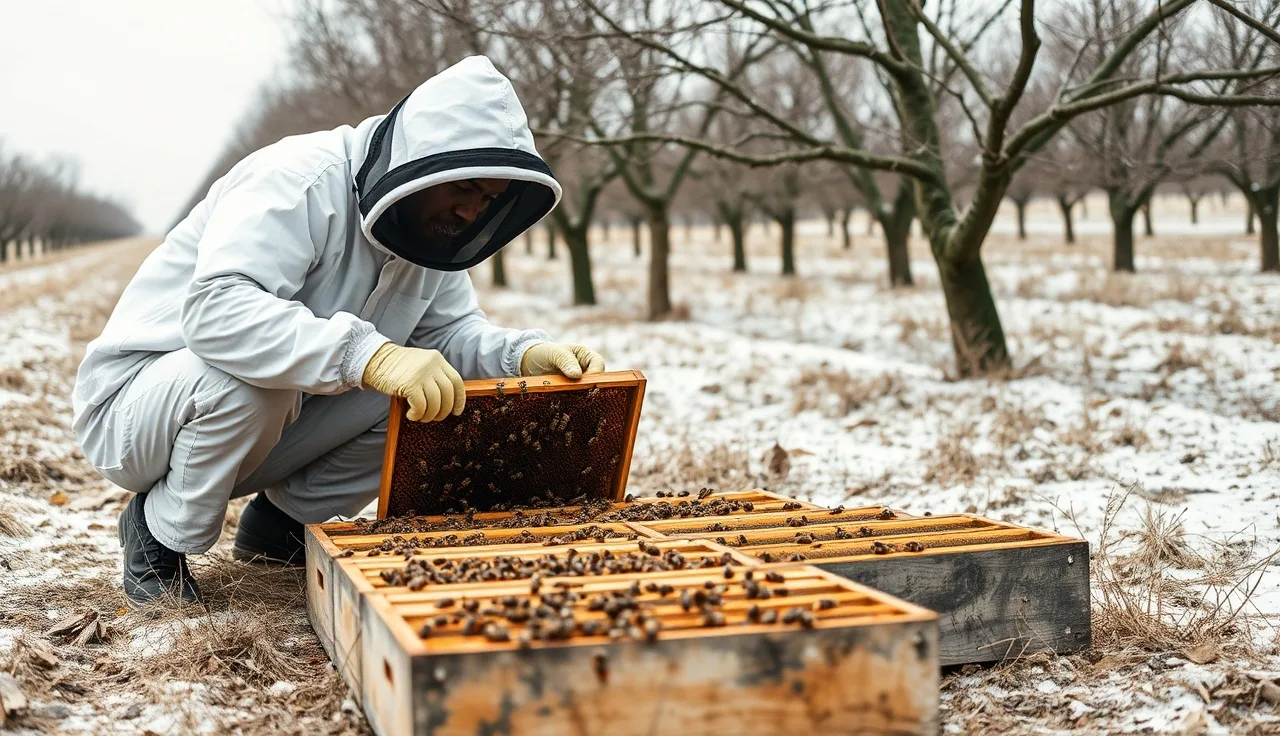
- Starvation deadouts show bees head-first in empty cells, a light hive, and clean brood.
- Varroa collapse looks different: deformed wings on the dead bees, spotty or greasy brood, mites in the debris, and a cluster that shrank fast even with honey nearby.
- Read the scene correctly and you learn what killed the colony and what to fix before next season.
Why does it matter which one killed your colony?
Because the fixes have nothing in common. Misread a varroa collapse as starvation and you'll spend the winter stuffing extra honey into your survivors, then walk into spring still blind to a mite problem that kills those hives too. Misread starvation as varroa and you might dose a healthy nuc with oxalic acid or amitraz, waste money, and stress bees you're trying to build up.
Most winter deadouts involve both to some degree. That's the honest truth. Heavy mite loads wreck a bee's ability to hold heat, so the cluster burns through stores faster than a healthy one would. You open a dead hive, spot capped honey three frames from the corpses, and think "that's varroa." Maybe. The story is usually messier. A good post-mortem finds the primary driver, not one tidy cause.
The Honey Bee Health Coalition's Varroa Management Guide puts it plainly: "Varroa and the viruses it transmits are the primary drivers of colony loss in the United States." That's your baseline. Mites are statistically the more likely killer in a mystery winter deadout, especially if you skipped fall mite counts. But starvation is real, it's common in certain regions and management styles, and it leaves a scene you can read.
Work the checklist below. The more boxes you tick in one column, the more you can trust the call.
What does a starvation deadout actually look like?
Starvation has a signature you can spot from a foot away. The cluster died in place, bees jammed head-first into empty comb, reaching for food that ran out. That head-in-the-cell posture is the single most reliable sign of starvation, and it's hard to fake.
Here's what you typically find:
The cells are empty. Pull a frame from the cluster area. The cells around the dead bees are bare or hold nothing but a faint smear of old pollen or crystallized honey. The bees scavenged the last traces and still came up short.
The hive is light. Lift the back before you open it. A starved colony feels like an empty box. A healthy overwintered colony in January runs somewhere in the 50 to 80 lb range depending on region and equipment [2]. A starved-out one feels like it's got nothing in it, because it doesn't.
Food stores are gone or stranded. You might find capped honey two or three frames from the dead cluster. That tells you the bees ate everything nearby and couldn't break cluster to reach the rest. Classic late-winter pattern, usually after a long cold snap. The food was in the hive. The temperature just wouldn't let them move to it.
The final cluster is small but not crashed. Starved colonies show a tight, small cluster at the end. The population thinned gradually as old bees died off through winter without replacements. No sudden freefall.
No deformed wings. Grab a handful of dead bees and spread them on a white surface. In a starvation deadout the bees look normal, maybe shriveled from dehydration, but the wings lay flat and the abdomens look right.
Clean brood frames. If any capped brood is still present (sometimes it is in early-winter starvation), the cappings look normal. No sunken, discolored, or punctured caps. No greasy larvae.
What does a varroa collapse look like?
Varroa collapse can mimic almost every other cause of death, which is exactly why it gets missed. But it has tells.
The loudest one is Deformed Wing Virus. Pick up a few dozen dead bees and check the wings. In a mite-collapsed colony you'll nearly always find some fraction with crumpled, stubby, or twisted wings that never unfolded, because Varroa destructor injects Deformed Wing Virus (DWV) while feeding on developing pupae [3]. One or two deformed-wing bees in a winter cluster is a warning. Ten percent or more is a near-certain mite call.
Here's what else turns up:
The population crashed fast. Beekeepers who check often report a colony going from fine to empty in three or four weeks. Mite-parasitized bees have shortened lifespans, and once the summer bees die, the winter bees (raised in brood cells full of mites) are already compromised. The floor drops out.
You find mites. Shake the dead bees into a white bin. Look for reddish-brown, sesame-seed-sized dots. Those are adult female Varroa. You'll find them stuck to bees or loose in the debris. Come spring, run an alcohol wash on any live bees in nearby survivor hives and you'll often turn up high counts next door to a collapse [4].
The brood pattern was probably a mess. If you can still read the brood frames, look for sunken, discolored caps. Mite-linked brood problems (sacbrood, European foulbrood pushed along by mite stress) leave a shotgun pattern of missing, sunken, and irregular cells. That's different from American Foulbrood, which has its own smell and a ropey pull test, but any compromised brood is worth noting.
Honey present, colony dead anyway. This one carries a lot of weight. Open a hive, find two, three, four frames of capped honey and a dead cluster, and starvation is almost off the table. Something else killed those bees, and mite-borne viruses lead the suspect list [1].
The cluster left the brood. As the population drops, the cluster sometimes shrinks away from capped brood it can no longer cover. You'll find abandoned brood, sometimes with half-emerged bees stuck in cells, on frames the colony simply ran out of bodies to keep warm.
What are the 7 physical clues that separate starvation from varroa collapse?
Here's the side-by-side you want in your head while you're standing over a dead hive in February.
| Clue | Starvation | Varroa Collapse |
|---|---|---|
| Bees head-first in empty cells | Yes, very common | Rare |
| Deformed or shriveled wings on dead bees | No | Yes, often present |
| Visible mites on dead bees | Rare | Common |
| Food stores at time of death | Absent or distant from cluster | Often present nearby |
| Hive weight | Light | Normal to heavy |
| Brood cappings (if present) | Normal | Sunken, discolored, irregular |
| Speed of population decline | Gradual | Often sudden, late summer into fall |
No single clue settles it. Use the table as a scorecard. Four or more marks in one column gives you a working diagnosis. Split down the middle? Default to mites, because the Honey Bee Health Coalition and nearly every university extension program treat mite load as the prior-probability cause of unexplained winter death [1].
One more move: check your records. Did you run alcohol washes or sticky boards in July, August, and September? If not, you have no baseline, and a mite cause gets more likely by default. Extension apiculturists at Penn State report that colonies over a 2% mite threshold (2 mites per 100 bees on an alcohol wash) in August face significant risk of winter failure if left untreated [5].
How do you check for varroa mites in a dead colony?
You can still pull useful mite data from a deadout, though the standard alcohol wash doesn't run the same way without live bees.
Simplest method: shake or brush the dead bees from several frames into a white plastic bin. Spread them out and hunt for reddish-brown mites. You won't get a clean count, but seeing mites confirms they were there. Heavy loads at death usually mean mites are scattered all through the dead-cluster debris.
For a tighter read, run a modified wash on bees that died recently (within a week or two in cold weather). Scoop roughly 300 bees into a jar, add isopropyl alcohol or windshield washer fluid, shake 60 seconds, and pour through a strainer over a white container. Count what falls out. In a mite-driven death you'll usually find elevated counts even on dead bees, though seeing mites at all matters more than the exact number [4].
Zero mites after a thorough search of the debris is a point toward starvation. Not proof, but it counts.
Check the bottom board too. Mite bodies and mite feces pile up there through the cluster period. A thick layer of debris with mite-shaped particles is another data point.
For the biology behind how infestations build, the varroa mite page pairs well with this post-mortem guide.
Can a colony die from both starvation and varroa at the same time?
Yes, and it's the most common real-world scene. It's rarely clean.
The mechanism: Varroa and the viruses they carry cut bee lifespan and stunt hypopharyngeal gland development, so workers make less brood food and store less fat body [3]. A colony going into winter heavy with mites ages faster. Those bees burn honey quicker because they're less efficient, and they can't cluster as tightly, so they lose heat and burn even more. The result is a colony that would have had enough honey under normal conditions but runs dry because the bees were compromised.
So you open the hive, find bees head-first in cells with honey two frames over, and the immediate cause is starvation, but the root cause is varroa. Treat it as plain starvation next year (just leave more honey) and you'll lose the hive again. Fix both.
The working rule: any evidence of varroa (deformed wings, visible mites, a history of ugly brood) sitting next to starvation signs means you call it varroa-driven starvation. Build a fall mite treatment plan for next season no matter what you decide about winter feed.
What other causes can mimic starvation or varroa collapse?
A handful of scenarios look close enough to these two that they're worth ruling out.
Queenlessness. A colony that loses its queen in September raises no winter bees. By December the population is too low to hold cluster temperature no matter how much honey is stacked around it. The hive feels dead but has food, which reads like varroa collapse. Look for no eggs or young brood in fall inspections, laying-worker signs (scattered, multiple eggs per cell), or a dead queen on the bottom board.
Pesticide kill. An acute pesticide event kills fast and often leaves a pile of dead bees at the entrance or on the bottom board, not head-first in cells. You may see tongues extended (an extended proboscis is a classic organophosphate or neonicotinoid sign). Suspect pesticides? Contact your state department of agriculture. Some states have bee-kill reporting rules and can test samples [6].
American Foulbrood. AFB kills brood, not adults directly, but a heavy infection can take down a colony. The smell is distinctive (rotting-sweet, like something decomposing), the ropey-pull test is positive (poke a twig into a cell, pull, and it strings out), and it's reportable in most states [11]. Don't mix up AFB caps with mite-linked brood abnormalities.
Small Hive Beetle. In warmer climates, beetle larvae can wreck a colony fast and leave a slimy, fermented mess. Hard to confuse with starvation, but it can pass for a general collapse. The slime and the smell give it away.
Nosema. Nosema ceranae weakens bees and can feed into spring dwindling or winter loss, though the evidence for it as a primary winter killer is weaker than it looked a decade ago. You can't confirm Nosema by eye. It takes microscopy or PCR.
How do you do a proper post-mortem inspection on a dead hive?
A careful inspection takes about fifteen minutes and beats a quick glance by a mile.
Bring a white plastic bin or sheet, a phone for photos, a notepad, and a magnifying glass. Work this sequence:
1. Weigh the hive before opening it. A fish scale or luggage scale hooked under the back gives you a rough number. Write it down. First data point.
2. Pull the top cover and look for moisture. Heavy condensation dripping onto the cluster points to a ventilation problem that can chill bees. Note it.
3. Pull frames one at a time and photograph both sides. Where are the bees? How are they positioned? What's in the cells they're buried in, and what's on the frames beside them?
4. Spread bees on the white bin and check for deformed wings and mites. This is your varroa read. Spend two or three minutes here.
5. Estimate food stores. How much capped honey per frame? A full deep frame of honey weighs roughly 6 to 8 lbs. How many frames? Were they next to the cluster or stranded across the box?
6. Check brood frames for disease. Smell them. Run the ropey-pull test. Study cap color and texture.
7. Examine the bottom board. Mite debris, dead bees, beetle larvae, odd residue. It all tells you something.
8. Record everything. The Honey Bee Health Coalition's Varroa Management Guide includes a colony inspection worksheet worth printing for this exact job [1]. Your state apiary inspector is a good backstop if you see something that doesn't fit any of these patterns.
VarroaVault's free hive health tools include a printable post-mortem form and a seasonal protocol checklist if you want a set framework to carry into the yard.
Shoot photos of all of it. A year from now, when you're trying to remember what you saw, those photos beat any notes you scribbled.
What should you do with a deadout hive after diagnosis?
The answer rides on your diagnosis.
If starvation: The equipment is almost certainly safe to reuse. Clean up any moldy comb (a little white surface mold from moisture is common and harmless; heavy black mold is a bigger problem). Drawn comb is worth real money, so save it. If you traced the starvation partly to leaving too little honey, your fix is fall management, not treatment.
If varroa collapse: Assume every bee left in the box carries mites. Live colonies nearby will rob a dead hive, and robbers haul those mites straight home. Close the entrance the second you finish inspecting. Freeze the equipment for 48 hours to kill mites before you reuse it [4]. Extension guides and the American Bee Journal both warn against leaving deadout gear open to robbing.
If AFB: Do not reuse any wooden equipment or comb without treatment or incineration. Call your state apiary inspector. AFB spores survive in equipment for decades [11]. This is the one case where the math on saving gear doesn't apply. Burn it or follow your state's protocol.
For every deadout: Update your records. Last known mite count, colony history, treatment history, post-mortem findings. Beekeepers who keep records across seasons start seeing patterns, like which colonies run lower mite loads or which timing decisions line up with better winter survival.
While you're at it, look over your beekeeping supplies and equipment inventory. Deadouts sometimes surface gear problems (poor ventilation, thin insulation in cold climates) that drove loss on their own, separate from disease.
How do you prevent starvation versus varroa collapse going forward?
The prevention playbooks barely overlap, which is one more reason the diagnosis matters.
Preventing starvation:
Leave enough honey going into winter. The common extension guideline is 60 to 80 lbs of capped honey for a full-size colony in the northern US, roughly 6 to 8 full deep frames or the equivalent [2]. Feed 2:1 sugar syrup in early fall, before nighttime temps drop below 50 degrees F, so bees can still process and cap it. Keep fondant or candy boards on hand for late-winter emergency feed when liquid won't work. Good hive placement (wind protection, morning sun) cuts caloric burn.
Preventing varroa collapse:
Here the calendar and the thresholds run the show. The Honey Bee Health Coalition and Penn State Extension both recommend monitoring at least three times: late spring (May or June) before populations peak, midsummer (July or August) to catch buildup, and the post-harvest fall window (late August through September) for treatment [1][5]. The threshold most people cite is 2% on an alcohol wash (2 mites per 100 bees) during brood rearing, though some researchers use 3% as the action line. Nobody serious argues that waiting until winter is fine.
EPA-registered treatments for Varroa destructor include oxalic acid (effective during broodless periods or as extended release with Api-Bioxal), amitraz (Apivar strips), fluvalinate (Apistan), coumaphos (CheckMite+), and thymol products (Apiguard, ApiLifeVar) [8]. Each has its own temperature window, timing, and resistance history. Read the label. The label is legally binding and spells out application temperatures, durations, and honey-super removal rules you can't ignore.
If you haven't built a monitoring routine yet, the varroa mite primer covers why timing matters and how to run an alcohol wash right.
What do the numbers say about colony loss causes?
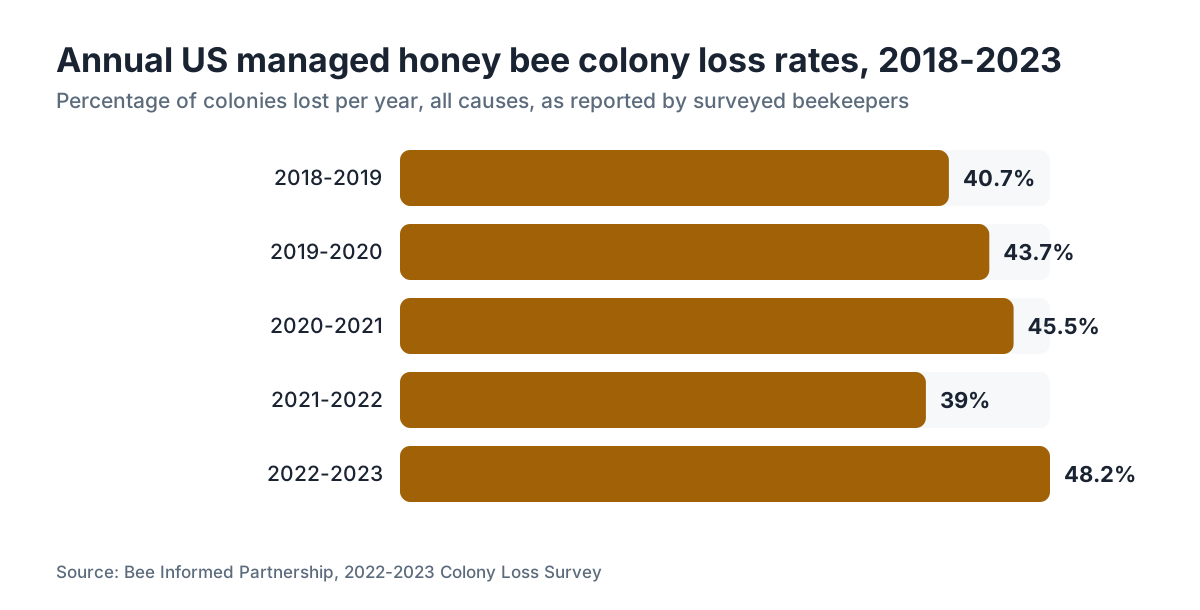
The USDA and Bee Informed Partnership annual loss surveys give us the best population-level data we have, though pinning a cause on any single colony is always harder than counting total losses.
The 2022-2023 Bee Informed Partnership survey put the total US managed colony loss rate at 48.2% over the year, with winter losses (October through April) making up the largest share [9]. That's not new. Annual losses have run in the 30 to 50% range since large-scale monitoring started around 2006.
Varroa and mite-linked viruses keep showing up as the leading identifiable cause. A 2022 analysis in PLOS ONE found mite load was the single strongest predictor of winter survival in a multi-factor model, beating out forage availability, queen age, and other colony-strength measures [10].
Starvation runs the other way. It's mostly preventable with solid fall feeding, and it spikes in years with weak fall nectar flow or early cold snaps. In most cases it's a management miss, not an unavoidable hazard.
The takeaway: lose a colony and don't know why, and the base rate alone says varroa beats starvation. That's not a reason to skip the post-mortem. It's the right prior to carry into it.
Frequently asked questions
My dead colony has honey left but the bees are all dead. What happened?
This pattern almost always points to varroa collapse, queenlessness, or chilling rather than starvation. Starved colonies die when stores run out, so honey near the cluster means the bees died of something else. Check dead bees for deformed wings, look for visible mites on the bodies, and note how close the honey frames sat to where the cluster died. Food present makes varroa your first suspect.
Can I reuse frames and equipment from a deadout?
For starvation and varroa deadouts, yes, with precautions. Close the hive right away to stop robbing by neighboring colonies, which spreads mites. Freeze equipment for 48 hours to kill mites before reuse. For American Foulbrood, do not reuse comb or wooden gear without contacting your state apiary inspector. AFB spores survive in wood for decades and the disease is highly contagious.
How do I tell if bees died from cold versus starvation?
Cold-killed (chilled) clusters tend to die in a tight ball with brood at the center, sometimes with honey nearby, but the bees aren't jammed head-first into empty cells the way starved bees are. Chilling usually hits undersized clusters that can't make enough heat. Starved bees die with their heads in the cells. In practice a tiny cluster often starves and chills at once, so both factors show up together.
What does varroa-damaged brood look like compared to healthy brood?
Healthy brood caps are tan to brown, slightly convex, and uniform. Mite-linked brood problems show sunken, discolored (darker brown or purplish), or punctured caps. The pattern runs irregular, with scattered empty cells where bees uncapped and pulled out infested pupae (hygienic behavior). You may also see half-emerged bees with malformed bodies stuck partway out of cells.
Is it normal to find mites on dead bees in a winter cluster?
A few mites isn't automatically diagnostic, but the more you find, the stronger the varroa case. A colony that died of unrelated causes with a low mite load might show none at all. In a mite-collapsed colony, mites are often scattered visibly through the dead bees. Any mites you find should push you to monitor and likely treat surviving colonies right away.
What is the alcohol wash threshold that means a colony is at risk?
Most university extension programs and the Honey Bee Health Coalition recommend treating at 2 mites per 100 bees (2%) on an alcohol wash during brood rearing, roughly June through September. Penn State Extension notes that colonies over this threshold in August face high risk of winter failure if left untreated. Some sources use 3% as the action line. Either way, crossing these levels by fall without treatment strongly predicts winter loss.
How quickly does a varroa collapse happen compared to starvation?
Varroa collapse looks sudden to the beekeeper but has been building for months. The visible crash, where a colony goes from seemingly alive to dead, can run three to six weeks in late summer and fall as the mite-compromised summer bees die off. Starvation usually kills more gradually over weeks, with population declining steadily as food runs out, unless a sudden cold snap traps the cluster away from stores.
Can Nosema mimic a varroa collapse?
Nosema can cause spring dwindling and population decline that loosely resembles a slow varroa collapse, but you can't tell them apart by eye. Nosema needs microscopy or molecular testing to confirm. The absence of deformed wings and visible mites in a slowly declining colony could point toward Nosema, queenlessness, or pesticide exposure. Contact your state apiary lab or a university extension diagnostics lab if you suspect it.
Should I treat my surviving colonies after finding a varroa-collapsed deadout nearby?
Yes, strongly consider it. Robbing means bees from neighboring colonies almost certainly visited the dying hive before it fully collapsed and picked up mites. Check your live colonies with an alcohol wash right away. If any run above the 2% threshold, treat according to current temperatures with an EPA-registered product. Don't wait for the next scheduled monitoring window after confirming a varroa collapse next door.
What information should I record when I find a deadout?
Record the date, estimated population at your last live inspection, the last mite count and its date, any treatments and when you applied them, food stores present at death (frames of honey, rough weight), presence of deformed wings or visible mites, brood condition if any brood remains, smell, and any other odd findings. The Honey Bee Health Coalition offers a colony inspection worksheet in its Varroa Management Guide that works well as a post-mortem form.
Do I need to report a deadout to anyone?
For starvation and varroa deadouts, most states have no legal reporting requirement. If you suspect American Foulbrood, pesticide poisoning, or an unusually fast mass die-off, contact your state department of agriculture and state apiary inspector. Many states run free diagnostic services for disease confirmation. Pesticide kills may be reportable depending on your state, and some states have compensation programs for documented pesticide-related bee losses.
How much honey does a colony need to survive winter in the northern US?
The commonly cited range is 60 to 80 lbs of capped honey for a full colony in the northern United States, roughly 6 to 8 full deep Langstroth frames or 8 to 10 medium frames. Colonies in milder climates need less. The estimate comes from university extension guidelines and accounts for normal winter cluster metabolism. Small colonies or nucs need proportionally less, but they also have a harder time making enough heat without adequate population.
Can I still treat a live colony for varroa after finding a collapsed hive in the same apiary?
Yes, and move fast. Check live colonies with an alcohol wash first to confirm elevated loads before treating. Pick a treatment that fits current temperatures and brood status. Oxalic acid dribble or vaporization works best during broodless periods. Amitraz strips (Apivar) work with brood present and take about six to eight weeks for full effect. Always follow the EPA-registered label for the specific product you use.
Sources
- Honey Bee Health Coalition, Varroa Management Guide: Varroa and the viruses it transmits are the primary drivers of colony loss in the United States; colony inspection resources and treatment thresholds
- Penn State Extension, Preparing Honey Bee Colonies for Winter: Recommended winter food stores of 60-80 lbs of honey for colonies in northern US; hive weight guidelines
- USDA Agricultural Research Service, Varroa destructor biology: Varroa destructor transmits Deformed Wing Virus while feeding on developing pupae; mite parasitism shortens bee lifespan and impairs fat body development
- Penn State Extension, Varroa Mite Management: Alcohol wash methodology for mite counting on dead and live bees; recommendation to freeze equipment 48 hours to kill mites
- Penn State Extension, Mite-A-Thon and alcohol wash thresholds: Colonies exceeding 2% mite threshold on alcohol wash in August are at significant risk for winter failure if untreated
- EPA, Protecting Bees and Other Pollinators from Pesticides: State departments of agriculture handle bee pesticide kill reporting and sample testing
- EPA, Varroa Mite Treatments and Registered Products: EPA-registered treatments for Varroa destructor include oxalic acid, amitraz, fluvalinate, coumaphos, and thymol-based products with specific label requirements
- Bee Informed Partnership, 2022-2023 Colony Loss Survey: Total US managed colony loss rate of 48.2% for 2022-2023 survey period
- PLOS ONE, Predictors of winter honey bee colony survival (2022): Mite loads were the single strongest predictor of winter colony survival in a multi-factor analysis, outweighing forage availability and queen age
- University of Minnesota Extension, Diagnosing Honey Bee Diseases: Visual diagnosis of American Foulbrood including ropey-pull test and smell; differential diagnosis from other brood diseases
Last updated 2026-07-09