Freezing comb from a deadout to kill remaining varroa mites
TL;DR
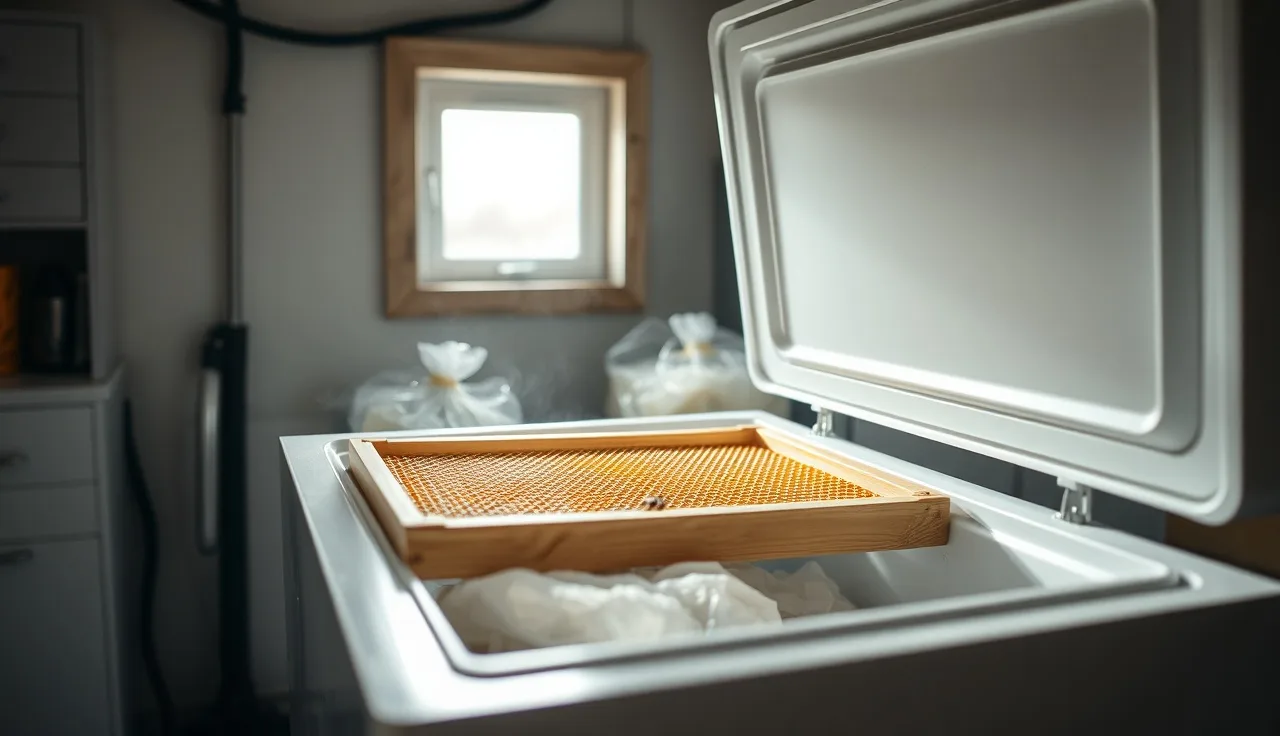
- Freezing drawn comb at 0°F (-18°C) for 48 hours kills every varroa mite on it, plus wax moth and small hive beetle at all stages.
- Twenty-four hours works if your freezer runs cold.
- Freeze clean comb before reusing it from a deadout.
- It does nothing to American foulbrood spores, so inspect first and burn diseased comb.
Does freezing comb actually kill varroa mites?
Yes. A proper freeze kills every mite on comb from a deadout. Varroa destructor is an obligate ectoparasite of honey bees, which means it cannot heat itself or survive real cold without a warm host body underneath it. Take that host away, drop the temperature, and the mites die.
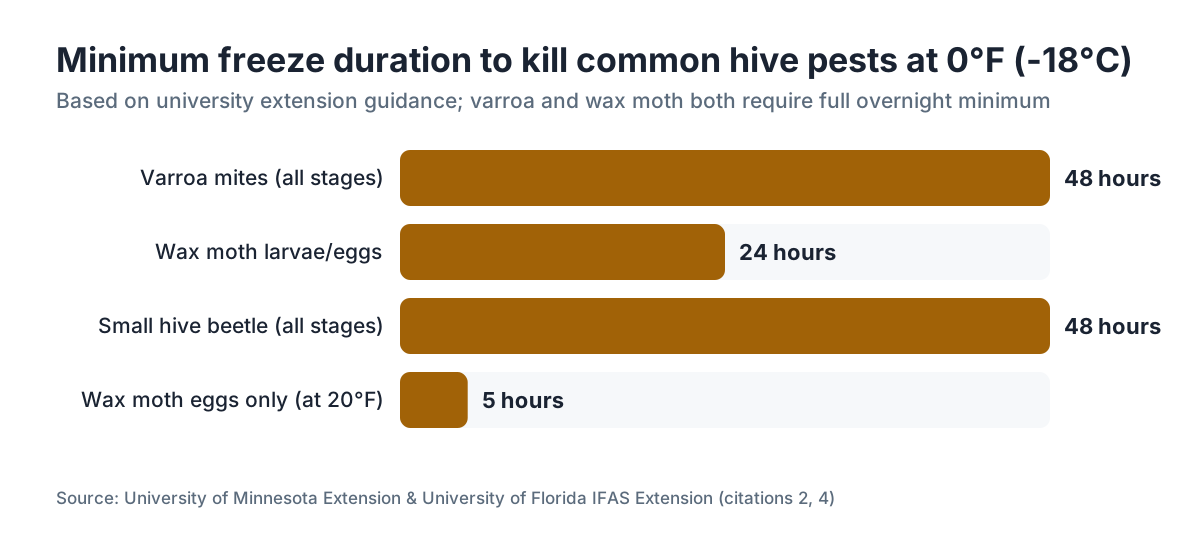
The research is old and settled. Ritter and Ruttner, writing in the Journal of Apicultural Research in 1980, found varroa dies at temperatures between -2°C and -4°C (28°F to 25°F) once held long enough [1]. At 0°F (-18°C), a normal chest freezer, that happens fast. University extension programs settle on a 24-hour minimum, and plenty of beekeepers run 48 hours for a cushion [2].
Phoretic mites riding the comb surface are your main target. Mites sealed inside capped brood cells are the other group, and deadout comb usually has both. Here's the part that helps you: the brood in a deadout is already dead, so those capped cells aren't a heated shelter anymore. A mite trapped in a cell with a dead pupa is just as exposed to cold as a mite sitting in the open.
Freezing works. It's free if you own a freezer. It takes almost no labor. Put it in your comb-reuse routine and stop worrying about residual mites.
What temperature and how long do you need to freeze the comb?
Set the freezer to 0°F (-18°C) and hold the comb 24 to 48 hours [2]. That's a chest freezer or upright freezer, not a refrigerator. Forty-eight hours is the number I'd use, because it covers a freezer that runs warm and a frame that's slow to chill through.
A few specifics change the outcome:
- A refrigerator at 35°F to 38°F (1°C to 3°C) will never kill mites. You need a true freezer.
- A chest freezer on its coldest setting usually holds -5°F to 0°F (-20°C to -18°C). That's the sweet spot.
- Twenty degrees F (-7°C) for 24 hours probably kills the mites [1], but the margin is thin. A freezer that doesn't run cold needs more time.
- Forty-eight hours at 0°F is the standard most extension entomologists give, and it's the one I stick to.
Comb insulates itself. A fully drawn frame packed with capped honey or pollen holds thermal mass, so its core reaches temperature slower than empty comb does. Stack frames tight in a freezer and you slow that down further. Give a packed load more time, not less, and leave a little air space between frames so cold can move around them.
One more step people forget. After the freeze, let the comb warm back to room temperature inside a sealed bag or wrapped in plastic before you open it to the air. Cold wax meeting warm room air pulls condensation right onto the surface, and wet wax grows mold.
What mite stages does freezing kill, and does it miss any?
It kills all of them. Eggs, protonymphs, deutonymphs, and adult mites all die in a proper freeze. Varroa has no cold-hardy diapause the way some other arthropods do, so there's no dormant stage waiting out the cold [1].
In a deadout the brood is dead, so you're only dealing with two groups of mites: phoretic ones on the comb surface hunting for a bee that never comes, and mites sealed in capped cells next to dead larvae or pupae. Both die.
There is exactly one case where freezing leaves a gap, and it doesn't apply to a deadout. If living brood is in the comb, the pupae throw off metabolic heat and the tight cell cappings slow the cell core to temperature. That's a concern with comb pulled from a live colony, not comb from a dead one. Worth knowing, not your problem here.
Freezing does nothing to Paenibacillus larvae, the bacterium behind American foulbrood. Those spores shrug off freezing and stay alive for decades [3]. That's why the cause of the colony's death decides everything. Comb from an AFB deadout gets burned, not frozen and reused. Identify what killed the colony before you touch the freezer.
Should you freeze comb from every deadout, or only some?
No. Some deadout comb should never go back in a hive at all, freeze or not. The freeze step is for comb you've already judged safe to reuse. So the real question is whether the comb is a reuse candidate in the first place.
Freeze and reuse comb when:
- The colony died from starvation, cold cluster failure, or a queen problem, with no signs of disease.
- Varroa overload is the suspected cause, the comb looks clean, and cells aren't sunken, perforated, or discolored.
- The comb is sound and reasonably new, without heavy propolis or dark staining.
Do not reuse comb (freeze or no freeze) when:
- You see sunken, greasy, or perforated cappings that point to AFB or European foulbrood. Test it or call your state apiarist first [3].
- The comb smells foul. Healthy comb smells like honey and wax. Diseased comb smells sour or rotten.
- The comb is old and black, or the cells have shrunk from cycle after cycle of brood. Old black comb carries pathogen loads no freezer will touch.
- You're in high small hive beetle country and the comb has larval slime in it. That slime is a fermentation mess, and freezing won't clean it up.
A varroa collapse with otherwise clean comb is the textbook candidate. Freeze it, kill the leftover mites, put it back to work.
Does freezing comb kill anything else besides varroa mites?
It does, and that's a bonus when you're clearing out a deadout. Small hive beetle and wax moth both die in the same freeze that handles varroa.
Small hive beetle (Aethina tumida) eggs, larvae, and adults all die within 24 to 48 hours at standard freezer temperatures [4]. If beetles moved into the deadout, the freeze takes care of them.
Wax moth larvae and eggs (Galleria mellonella and Achroia grisella) die too. Freezing is the go-to wax moth defense for stored comb, and extension programs have recommended it for decades [2]. Twenty degrees F (-7°C) for 4 to 5 hours kills wax moth eggs. At 0°F (-18°C) it happens much faster.
What freezing does not handle:
- AFB spores. These survive nearly anything short of fire [3].
- Nosema spores (Nosema apis and Nosema ceranae) ride out freezing fine. Suspect a heavy Nosema load in a deadout, and you're better off replacing the comb [10].
- Chalkbrood fungal spores (Ascosphaera apis) also live through the cold.
The rule is simple. Freezing kills anything with an active metabolism: insects, mites, live larvae. It does nothing to dormant biology like bacterial endospores or fungal spores. It's a pest killer, not a sterilizer.
How do you actually freeze comb from a deadout step by step?
The mechanics are easy. A few details separate doing it right from making a moldy mess.
- Inspect first. Before a single frame goes in the freezer, pull every one and study the comb. Check for AFB signs (the ropiness test, sunken and greasy cappings), sacbrood, and general condition [3]. If anything looks wrong, stop. Freeze diseased comb and drop it in a hive, and you've just moved the disease you were trying to dodge.
- Bag the frames. Slide each frame into a contractor-grade trash bag or a purpose-made frame bag and seal it. That keeps wax moth adults off the comb after it warms, keeps freezer smells out of the wax, and stops condensation on the way back up to room temperature.
- Freeze 48 hours at 0°F (-18°C). Don't rush. Two full days gives you a real margin. A kitchen freezer holding -5°F to 0°F is fine. Don't pack it so tight that air can't move.
- Thaw inside the sealed bag. This is the step almost everyone skips. Open the bag while the comb is still cold and you get condensation on the wax, which invites mold. Leave it sealed for several hours until it reaches room temperature.
- Store or use. Clean comb goes straight back into service. Storing it until next season? Keep the bags sealed in a cool, dry spot. A light dose of paradichlorobenzene (PDB) crystals on top of stacked supers holds off wax moths during storage, but air any treated comb thoroughly before bees ever see it [9].
Total hands-on time runs about 15 minutes spread across two days.
How does freezing compare to other ways of dealing with mites in stored comb?
Freezing isn't the only option, but for varroa in deadout comb it's the one that fits a hobbyist's shelf and budget. Everything else either needs bees in the box or a commercial facility.
| Method | Kills varroa? | Kills wax moth? | Kills AFB spores? | Cost | Risk |
|---|---|---|---|---|---|
| Freezing (0°F, 48 hrs) | Yes | Yes | No | Near zero | Condensation if rushed |
| Oxalic acid vapor | On bees, not stored comb | No | No | ~$75-150 for vaporizer | No labeled use on empty comb |
| Formic acid (MAQS/Formic Pro) | Yes, needs bees present | No | No | ~$25-40/treatment | Requires active colony |
| Acetic acid (80%) | Partial | Yes | No | Low | Fumes, hard to source in US |
| Irradiation (gamma) | Yes | Yes | Yes | High, commercial only | Facility access required |
| Replacing/rendering comb | N/A | N/A | N/A | Wax value | Loss of drawn comb |
Oxalic acid and formic acid both need bees in the hive to work. They're not built for comb sitting on a shelf. Api-Bioxal, the EPA-registered oxalic acid product in the US, is labeled for package bees, swarms, and colonies, not for treating stored equipment without bees [5].
Acetic acid means 80% glacial acetic acid, not household vinegar, which is nowhere near strong enough. It's used in some European programs and does kill wax moth eggs and Nosema spores, but it's rarely sold to US hobbyists and it burns skin and lungs.
Gamma irradiation sterilizes comb completely, AFB spores included. Australia uses it widely. It's out of reach for almost every hobbyist and sideliner here.
For a real backyard or sideline operation, freezing is the answer for varroa and wax moth, and it costs nothing extra if a chest freezer already lives in your garage.
Will putting frozen comb back into a live hive reinfest it with varroa?
No. Freeze the comb correctly (0°F for 48 hours) and every mite on it is dead. Comb can't carry living varroa after a proper freeze.
The mite risk in reusing deadout comb comes from the source colony's infestation, and that population died with the colony. You're not moving a live mite colony onto new equipment. You're moving empty, frozen wax.
What you are moving is drawn comb, which has real value. Bees burn roughly 6 to 8 pounds of honey to make one pound of wax [6]. Reuse good comb and a new package or split builds up faster instead of eating its stores to draw foundation.
One honest caveat. Drop this comb into a hive that already has its own mites, and the comb changes nothing about that hive's mite load. You still monitor and treat on your normal schedule. Frozen comb is not a treatment for the colony that receives it.
If you're tracking mite loads across an operation, the protocol resources at VarroaVault help you build a system that folds equipment-reuse calls like this one into the plan.
What should you check for before freezing to make sure the comb is safe to reuse?
The freeze is step two. Step one is a hard look at the comb, and it's the step that actually protects your bees.
American foulbrood ends the discussion. AFB is a reportable disease in most US states, and the standard for infected equipment is burning, not treatment [8]. The Honey Bee Health Coalition's Tools for Varroa Management guide notes AFB spores can survive in comb for 50 years or more [3]. A freeze does absolutely nothing about that.
Run the ropiness test. Uncap a few sunken or discolored cells and push in a twig or toothpick. Healthy larvae won't rope. AFB-infected larvae stretch into a brown, ropy strand when you pull the stick out slowly, usually 1 to 2 cm. See that and you don't freeze anything. You call your state apiarist.
Past AFB, check:
- Cell walls for chalkbrood mummies (white or gray chalky lumps). The comb's reusable if it's otherwise healthy, but clean the mummies out.
- Sacbrood (deflated, waterlogged-looking pupae). Usually manageable; requeen and the colony clears it.
- Overall darkness. Very dark brood comb has stacked up shed larval skins, feces, and pathogen load over many cycles. A lot of experienced beekeepers rotate this comb out every 3 to 5 years no matter how the colony died [2].
- Honey stores for fermentation (an alcohol or vinegar smell) that can give a new colony dysentery.
Pass all of those, and freeze it with confidence.
How do you store frozen comb after thawing so mites and pests don't come back?
Post-freeze storage is where the work unravels. People do everything right, then wax moths eat the stored supers over winter.
The principle is simple. Wax moths can't establish in comb they can't reach, in continuous cold, or in the presence of PDB crystals. Deny them one of those and you're fine.
For short storage (a few weeks to a couple of months), sealed bags in a cool, dark spot do the job. Wax moths can't infest comb they can't get into.
For longer storage, extension programs point to stacking supers with PDB (para-dichlorobenzene) crystals, not naphthalene mothballs [9]. PDB is a fumigant that drives off wax moth adults and kills larvae at high enough concentration. Put 3 to 6 ounces of PDB crystals on a paper plate on top of each stack, seal the stack with a lid and tape, and store it above 70°F, since cooler air weakens the fumigant. Replace the crystals every 6 to 8 weeks.
One rule you can't skip. Air all PDB-treated comb for at least 1 to 2 weeks before bees can reach it [9]. Bees won't enter comb that still smells of PDB, and the chemical harms them at high concentration. Air it in a ventilated space at outdoor temperatures to drive the fumigant off.
Storing comb somewhere that stays below 45°F all winter, like an unheated garage? Wax moths won't be active and you can skip the PDB. The cold handles it for you.
Is freezing comb enough on its own, or does it need to be part of a larger varroa management plan?
Freezing deadout comb is good housekeeping. It is not a varroa management plan. Your mite problem lives in your live hives, and no freezer touches those.
Varroa management happens on living colonies through monitoring and treatment built around the mite-to-bee ratio. Freezing dead comb removes a small mite reservoir, which is worth doing, but it never moves the needle on the mites feeding in your active boxes.
The Honey Bee Health Coalition's Tools for Varroa Management guide, the closest thing the US industry has to a consensus document, builds management on four pillars: monitor, decide on treatment against a threshold (typically 2 to 3 mites per 100 bees in the brood season), treat with approved products used correctly, and evaluate the result [3]. Comb management shows up as a supporting practice, not a core treatment.
For a hobbyist or sideliner, the honest sequence looks like this. Monitor live colonies with alcohol washes or sugar rolls on a schedule. Treat when you cross a threshold. Handle deadout equipment responsibly (freeze clean comb, destroy diseased comb). Track it colony by colony. A free protocol framework is available at VarroaVault if you want a seasonal tracking system already laid out.
For the biology behind all of this, the varroa mite overview page has the lifecycle detail that explains why each step of a comb protocol earns its place.
Frequently asked questions
Will a regular kitchen freezer get cold enough to kill varroa mites in comb?
Yes, as long as it actually reaches 0°F (-18°C) or below. Most modern household freezers run between -5°F and 5°F, cold enough for the job. The catch is a freezer packed too full or an aging unit that doesn't seal well may not hold those temperatures. Check it with a freezer thermometer before you trust it. Run the comb 48 hours to be safe.
Can I freeze comb that still has honey in it?
You can. Honey-laden frames are heavy and the thermal mass slows the freeze, but the honey itself isn't harmed by cold. Give the core of the frame extra time to reach temperature, and thaw inside a sealed bag so moisture from crystallized honey doesn't pull in and start fermentation. Capped honey from a deadout has real value: freeze it, thaw it carefully, and give it to a strong colony that can use the stores.
How do I know if the deadout died from varroa versus American foulbrood?
Run the ropiness test. Push a twig into sunken or discolored capped cells and pull it out slowly. AFB-infected larvae stretch into a sticky, caramel-brown rope, usually 1 to 2 cm long, and the colony carries a sour, glue-like smell. Varroa collapse looks different: deformed wings on the dead bees, a small leftover cluster, and often plenty of food still present. Unsure? Get a confirmed diagnosis from your state apiarist before reusing anything.
Do I need to freeze comb if the colony just starved over winter?
Good practice, less urgent from a disease angle. A starvation deadout usually had low mite loads (it was already fading) and no active infection. Still worth a freeze before reuse to clear any residual mites and wax moth eggs, especially if the comb sits in storage for months before it goes back in. The time cost is tiny, and the downside of skipping it is small but real.
How long can I store comb after freezing before I need to use it?
Comb stored right, either kept frozen or stacked with PDB crystals in sealed supers, lasts for years. Wax moth damage from bad storage is usually what ruins it, along with comb getting brittle from repeated freeze-thaw cycles. Drawn comb is worth protecting: invest in sealed storage and it'll still be good two or three seasons out. Inspect it again before use after any long storage.
Can freezing damage wax comb or make it crack?
Cold makes wax more brittle, and a fast thaw can cause stress fractures, especially in old, dark comb. Handle frozen frames gently and don't rush the thaw. Old black brood comb is already fragile and may not be worth saving anyway. Newer, lighter comb takes freezing without real damage almost every time. Let frames reach room temperature fully before you put them in a hive or handle them roughly.
Are there varroa mites that are resistant to cold, similar to how some are resistant to treatments?
No. Varroa has no known cold-resistant strain and no diapause. Treatment resistance comes from genetic change in mite populations; cold tolerance would need physiological adaptations that varroa simply hasn't developed. Every current population of Varroa destructor dies at sustained temperatures at or below 0°F (-18°C). This is physics, not chemistry, so resistance never enters the picture.
Does freezing comb work for small hive beetles too?
Yes. Small hive beetle eggs, larvae, and adults all die during a standard 48-hour freeze at 0°F. If the deadout had a beetle infestation with larvae in the comb, the freeze kills them. One caveat: the slime and fermentation damage beetle larvae leave behind doesn't vanish after freezing. Heavily slimed comb should be rendered or discarded even after the beetles themselves are dead.
What do I do with comb from a deadout that I can't freeze right away?
Seal it immediately. Wax moths can infest unprotected comb in days during warm weather, and robbing bees from other hives will strip the honey and possibly carry off pathogens. Put frames in sealed garbage bags and keep them cool and dark. In a warm climate at peak summer, freeze within a week. Don't leave supers stacked outdoors with the covers off and figure you'll get to it later.
Is there any reason NOT to reuse comb from a deadout?
Several. Disease is the biggest: never reuse comb if AFB is suspected. Very old, dark comb carries built-up pathogen and pesticide residue that makes replacement worth it regardless. Comb wrecked by small hive beetle larvae isn't salvageable. And comb from a colony that died mid-treatment with a chemical miticide deserves caution, since some products (coumaphos in particular) persist in wax and can harm queens and drones in future colonies.
Do oxalic acid treatments work on stored comb the same way freezing does?
No. Oxalic acid treatments, including the EPA-registered Api-Bioxal, work by contacting mites on adult bees. Stored comb has no bees, so oxalic acid has nothing to act on and no labeled use in that context. Freezing is the tool made for stored comb and equipment. The two methods answer different situations and don't substitute for each other.
Should I freeze the whole hive body or just the frames?
Just the frames. The box itself doesn't need freezing for mite control, since varroa can't survive on bare wood. If wax moth is a concern for the box, scraping out wax and propolis buildup is enough. Some beekeepers do freeze boxes to kill wax moth eggs on interior surfaces, but it's far lower priority than getting the frames processed.
How many mites might actually be in a deadout's comb, and does it matter?
A colony that crashed from varroa might have run 5 to 10 or more mites per 100 bees before collapse. Phoretic mites survive only briefly on comb once the bees are gone, maybe a few days. So the actual mite count on the comb by the time you process it is probably low. Freezing is still sensible as insurance, but comb-borne reinfestation is a modest risk next to your ongoing monitoring duty in live colonies.
Sources
- Journal of Apicultural Research, Ritter & Ruttner 1980, cold tolerance of Varroa: Varroa mites die at temperatures between -2°C and -4°C when held for sufficient time; no cold-hardy life stage exists
- University of Minnesota Extension, Bee Lab, Comb Storage and Wax Moth Management: Freezing at 20°F for 4-5 hours kills wax moth eggs; 0°F for 24-48 hours recommended for full pest kill in stored comb; old dark comb rotated every 3-5 years
- Honey Bee Health Coalition, Tools for Varroa Management Guide (6th edition): AFB spores can persist in comb for 50 years or more and are not killed by freezing; recommended management pillars include monitoring, treatment thresholds of 2-3 mites per 100 bees, approved treatments, and evaluation
- University of Florida IFAS Extension, Small Hive Beetle Management: Small hive beetle eggs, larvae, and adults are killed by freezing within 24-48 hours at standard freezer temperatures
- EPA, Api-Bioxal (oxalic acid) product registration and label: Api-Bioxal is approved for use on package bees, swarms, and colonies with and without brood; not labeled for treating stored comb without bees present
- Penn State Extension, Honey Bee Biology and Comb Construction: Bees consume approximately 6 to 8 pounds of honey per pound of beeswax produced, making drawn comb a significant colony resource
- USDA ARS, Varroa destructor biology and lifecycle: Varroa destructor is an obligate ectoparasite of honey bees with no known cold-resistant strains or diapause capability
- Oregon State University Extension, Recognizing and Preventing American Foulbrood: AFB is a reportable disease in most US states; infected equipment should be burned; ropiness test described as standard diagnostic
- North Carolina State University Extension, Wax Moth Control in Stored Combs: Para-dichlorobenzene (PDB) crystals recommended at 3-6 oz per stack for wax moth control; comb must be aired 1-2 weeks before bee exposure; naphthalene not recommended
- Honey Bee Health Coalition, Tools for Varroa Management Guide (6th edition): Nosema spores survive freezing temperatures; Nosema ceranae and Nosema apis cannot be eliminated from comb by freezing
Last updated 2026-07-10