Where do varroa mites come from? The full origin story
TL;DR
- Varroa destructor originated on the Asian honey bee Apis cerana in South and East Asia.
- The mite jumped to European honey bees (Apis mellifera) in the mid-20th century, spread through international bee trade, and reached the United States by 1987.
- Because Apis mellifera never co-evolved with varroa, it has almost no natural defenses, which makes the mite the leading driver of managed colony loss worldwide.
Where does the varroa mite come from originally?
Varroa mites come from Asia. The species now wrecking beehives around the world, Varroa destructor, evolved as a parasite of the Asian honey bee Apis cerana, a species native to South and East Asia from Afghanistan to Japan [1]. For thousands of years the two lived with an uneasy truce. The mite could reproduce in sealed brood cells, but the bees had defenses that held its numbers down: hygienic behavior (detecting and uncapping infected cells) and grooming that dislodges and bites mites [2].
The trouble started when people moved Apis mellifera, the European honey bee that most Western beekeepers keep, into Asia to boost honey production. Apis mellifera had never met varroa. It had no instinctive defenses. The mite found a new host that was essentially defenseless, and it thrived.
There are two closely related varroa species: Varroa destructor and Varroa jacobsoni. Both originated on Apis cerana. Varroa jacobsoni lives in parts of Southeast Asia and Papua New Guinea, and researchers have recently documented it reproducing in Apis mellifera in Papua New Guinea, which has them watching closely [3]. But Varroa destructor is the one that made the global leap, and it is the one every beekeeper in North America, Europe, and beyond now fights.
When did varroa mites first become a problem for beekeeping?
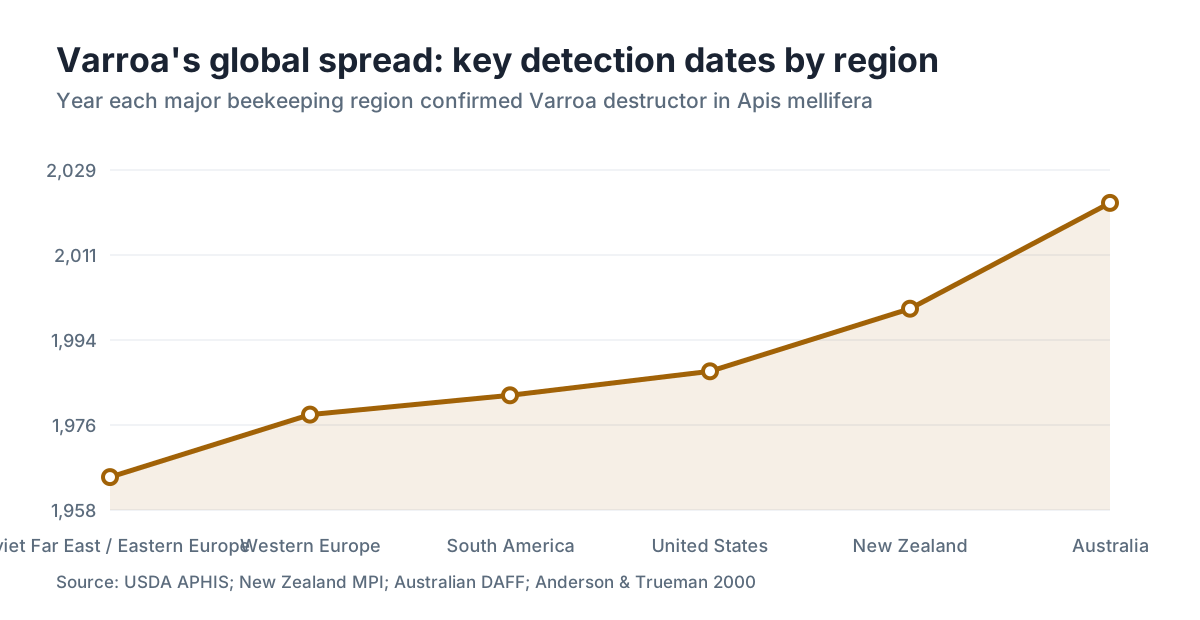
The host switch, varroa jumping from Apis cerana to Apis mellifera, appears to have happened in the 1950s and 1960s in Asia, where the two bee species were kept together or close by [1]. The first reports of varroa infesting Apis mellifera colonies came from the Soviet Far East and Eastern Europe in the 1960s.
After that the spread was fast, driven almost entirely by the international trade in queens and package bees. By the 1970s varroa had reached Western Europe. By the early 1980s it was in South America. The mite is a hitchhiker. It clings to adult bees during transport, and once a single infested colony lands in a new region, it spreads to wild and managed colonies through normal bee behavior like robbing and swarming.
The genetic picture is sobering. A 2000 study by Anderson and Trueman established that two distinct haplotypes of Varroa destructor, the Korean and Japanese haplotypes, made the jump to Apis mellifera [4]. The Korean haplotype spread worldwide and drives the global epidemic. One host switch, probably just once or a handful of times, seeded the entire infestation we deal with today.
How did the varroa mite get to the United States?
Varroa was first confirmed in the US in 1987, in Wisconsin [5]. The country was one of the last major beekeeping nations to get hit, partly because of import restrictions on honey bees. The exact entry route was never proven, but the prevailing view is that the mite arrived through illegal or undetected importation of bees or queens, possibly from South America, where varroa was already widespread.
The USDA's Animal and Plant Health Inspection Service (APHIS) had banned importing Apis mellifera from countries with known varroa infestations. The mite got through anyway [5]. Within a few years of that first Wisconsin detection, it had reached nearly every state. By the early 1990s it was everywhere.
The US had no experience with varroa and no established treatment protocols. Colony losses were brutal. Feral honey bee populations, once dense enough to restock managed hives on their own, were largely wiped out within a decade. Precise national numbers on feral collapse are hard to pin down, because feral colonies are difficult to survey in the first place.
If you want the mite itself in detail, the varroa mite article here covers its biology and life cycle. For the broader picture of bee species, read the beekeeping species overview.
Why are European honey bees so vulnerable to varroa?
This is the core of the problem. Apis cerana and varroa co-evolved over a very long time. Apis cerana colonies show strong hygienic behavior, detecting and removing varroa-infested pupae before the mite finishes its reproductive cycle. They groom each other well, biting and maiming mites. And varroa can only reproduce successfully in Apis cerana drone brood, not worker brood, which caps population growth [2].
Apis mellifera has none of that. The mite reproduces in both worker and drone brood, preferring drone brood because its longer capped period lets more offspring mature per foundress mite. Grooming is weaker. Hygienic behavior exists in some lines but usually is not enough to hold mite numbers below damaging levels without help from the beekeeper.
The result is exponential growth. A colony starting spring at 1% infestation can hit 3 to 5% by midsummer and collapse by fall if left untreated. The Honey Bee Health Coalition's varroa management guide states that colonies with mite levels above 2 to 3% during the brood-rearing season are at significant risk of collapse [6].
Variation exists. Some Apis mellifera populations have developed partial resistance through natural selection, most famously the Africanized honey bee population in the Americas. Africanized honey bees have shorter brood cycles and stronger hygienic behavior that limits varroa reproduction, one reason their feral colonies survive untreated where European colonies cannot.
What is the geographic origin of varroa and how did it spread globally?
The map of varroa's spread tracks the map of international bee trade over the 20th century. Starting in Southeast Asia, the mite moved west and north through the Soviet Union and Eastern Europe in the 1960s and 1970s. It reached Western Europe, including the UK, France, and Germany, in the late 1970s and 1980s. South America was infested by the early 1980s. Australia and New Zealand stayed varroa-free for decades through strict biosecurity, though New Zealand confirmed its first detection in 2000 [7], and Australia, long the last major varroa-free beekeeping nation, confirmed an incursion in New South Wales in June 2022 [8].
Genetics helped trace these pathways. Because the global pandemic goes back to one or two original host switches, mite populations worldwide are genetically similar. Small differences in mitochondrial haplotypes let researchers reconstruct the routes.
Here is a simplified timeline:
| Period | Event |
|---|---|
| Pre-1950s | Varroa destructor exists only on Apis cerana in Asia |
| 1950s-1960s | Host switch to Apis mellifera, first reports in Soviet Far East |
| Late 1960s-1970s | Spreads through Eastern and then Western Europe |
| Early 1980s | Established in South America |
| 1987 | First US detection, Wisconsin [5] |
| 1992 | Confirmed in all 48 contiguous US states |
| 2000 | New Zealand first detection [7] |
| 2022 | Australia first detection, New South Wales [8] |
Every region that gets hit runs the same sequence: initial detection, rapid spread, collapse of feral populations, then a painful learning curve for beekeepers figuring out treatment.
How does varroa spread from hive to hive today?
Knowing where varroa came from is history. Knowing how it moves through your apiary right now is what saves colonies. The main vectors are robbing, swarms, and beekeeper error. When a strong colony robs a weak, collapsing (often varroa-killed) colony, the returning robbers carry mites home. Swarms carry mites from the parent colony. Queens bought from infested operations bring mites along. Even drifting drones, which move freely between colonies, ferry mites.
Beekeeper habits move mites too. Shuffling frames of brood between colonies, splitting without checking mite levels first, and installing packages from high-mite sources all spread the problem around. A 2019 University of Maryland extension publication noted that robbing events from collapsing colonies are one of the biggest mite redistribution mechanisms in an apiary [9].
That is why managing varroa is about more than your own hives. A collapsing neighbor colony, wild or managed, is a mite bomb for every hive within a few kilometers. You cannot treat your way out of a bad neighborhood completely. You can cut your losses by monitoring on a schedule and treating before your colonies become the ones collapsing.
VarroaVault's free monitoring protocol tool can set you up with a consistent schedule if you want a structured starting point.
Did any honey bee populations survive varroa without treatment?
Yes, but survival is the exception, and it cost a lot of dead colonies over a long time. The best-documented case is the Gotland population in Sweden, studied by researchers at Uppsala University. Beekeepers left a population of Apis mellifera untreated on the island of Gotland starting in 1999. About 80% of the colonies died in the first few years. The survivors and their descendants showed measurable gains in mite-resistance traits, especially higher rates of mite infertility and stronger hygienic behavior [10]. That population has stabilized and now serves researchers as a model for natural selection against varroa.
Similar stories show up in other isolated populations: parts of Africa where Apis mellifera capensis and related subspecies show partial resistance, and some Africanized bee populations in the Americas. The Arnot Forest population in New York, feral colonies that have persisted for decades in a forest preserve, has also been studied for resistance traits.
These examples share three things: geographic isolation that limits reinfestation from outside, high initial mortality, and decades of selection pressure. That is not a practical path for most beekeepers, who cannot afford to lose the majority of their colonies waiting for natural selection to do its work. It does inform breeding programs that select for hygienic behavior and mite-biting traits in managed bees.
What does current research say about varroa's origins?
The foundational genetic work came from Dennis Anderson and John Trueman, published in Experimental and Applied Acarology in 2000. Their mitochondrial DNA analysis showed that varroa on Apis mellifera worldwide belongs mostly to one haplotype (the Korean haplotype), meaning the global infestation traces to a very small number of original host switches [4].
Newer research has sharpened the picture. Studies of how varroa's reproductive biology changed after the host switch find that the mite's ability to reproduce in Apis mellifera worker brood, not only drone brood, is a key adaptation that happened during or after the switch. Anderson and Trueman's 2000 study concluded that "Varroa destructor is a new species that is distinct from V. jacobsoni" [4]. That mattered, because it meant the global pest was a biologically distinct species, not a geographic variant.
Two areas get the most attention now. First, Varroa jacobsoni's recent documented reproduction in Apis mellifera in Papua New Guinea is watched carefully as a possible second varroa species capable of going global [3]. Second, researchers are mapping the genetics of surviving resistant populations like Gotland to pin down which gene variants matter, aiming to speed up breeding programs.
What treatments exist now that varroa is established?
Varroa is here to stay in North America, so the practical question shifts from origin to management. The EPA has registered several treatments for honey bee colonies, and the Honey Bee Health Coalition publishes a regularly updated guide covering all of them [6].
The main categories:
Organic acids: Oxalic acid (Api-Bioxal is the registered US formulation) works on phoretic mites (mites riding adult bees) and is EPA-registered for vaporization, dribble, or extended-release sponge methods [11]. Formic acid (Mite-Away Quick Strips, Formic Pro) kills mites under cappings and is useful when brood is present.
Synthetic miticides: Amitraz (Apivar strips) and tau-fluvalinate (Apistan) work but carry resistance risk with repeated use. Coumaphos (CheckMite+) is another option, though resistance is widespread in some regions.
Thymol-based products: Apilife VAR and Apiguard use thymol, a plant-derived compound, and work in warm weather.
No treatment works perfectly in every condition. Temperature limits, brood presence, and local resistance patterns all shape which product makes sense. The EPA product labels are the legal authority on application rates and restrictions [11]. University extension services publish state-specific advice; Cornell's guidelines and the University of Minnesota bee lab resources are among the most detailed [12].
For sourcing equipment and treatments, the beekeeping supply companies guide lists vetted suppliers.
How bad is the varroa problem for beekeeping today?
Pretty bad. The USDA National Agricultural Statistics Service annual honey bee survey tracks colony loss rates, and varroa lands at the top of the stressor list year after year. The Bee Informed Partnership's 2022-2023 survey reported total annual colony losses of 48.2% among surveyed beekeepers, with varroa and varroa-associated viruses cited as the leading biological cause [13].
The mite does more than weaken bees by feeding on them. It feeds mainly on bee fat body tissue, not hemolymph as beekeepers believed for decades, per a 2019 study by Ramsey and colleagues [14]. It also vectors at least a dozen bee viruses. Deformed Wing Virus (DWV) is the worst: varroa feeding transmits the virus at far higher titers than bees would otherwise face, producing the shriveled wings and shortened abdomens you see in heavily infested colonies. A colony can look fine and then crash hard in fall as varroa-reared winter bees, loaded with virus, replace the summer population.
The money at stake is real. Honey bees pollinate an estimated $15 billion worth of crops a year in the US, by USDA estimates [5]. Varroa-driven colony loss hits the entire pollination services industry, not only honey production.
This is why monitoring matters as much as treating. The Honey Bee Health Coalition recommends an alcohol wash or sugar roll to count mites per hundred bees, with a 2% threshold triggering treatment [6]. VarroaVault's tools are built around exactly this kind of threshold-based decision.
Can varroa mites survive without honey bees?
No. Varroa destructor is an obligate parasite of honey bees. It cannot finish its life cycle on any other host, and it cannot last more than a few days off a bee. A mite that falls to the hive floor or drops during an inspection dies within roughly 24 to 72 hours without a host, depending on temperature and humidity.
This fact drives some management strategies. Brood breaks, periods when a colony has no capped brood (either naturally during a swarm or deliberately by caging the queen), leave every mite in the phoretic phase on adult bees, where oxalic acid hits them hardest. A single oxalic acid vaporization during a brood break can knock mite levels down by 90% or more.
The mite also cannot set up in other insects or wild habitats. When a colony dies, any mites in it die too, unless they catch a ride on a bee from another colony first. That is one reason collapsing colonies are such an acute reinfestation risk for nearby hives: the mites are pushed to move because their host is dying under them.
Frequently asked questions
Where does the varroa mite come from?
Varroa mites come from Asia, where they evolved as a parasite of the Asian honey bee Apis cerana. The species behind the global epidemic, Varroa destructor, jumped to European honey bees (Apis mellifera) in the mid-20th century when both bee species were kept together in Asia. International bee trade spread the mite worldwide within a few decades.
Where did varroa mites originate?
Varroa mites originated in South and East Asia as a parasite of Apis cerana, the Asian honey bee. Genetic analysis, especially the 2000 study by Anderson and Trueman, confirmed that the global infestation of Apis mellifera traces to a single species, Varroa destructor, and likely just one or two original host switches from Apis cerana populations in the Soviet Far East or surrounding regions.
When did varroa mites become a problem?
Varroa became a problem for Apis mellifera beekeepers starting in the 1960s in the Soviet Union and Eastern Europe. It reached Western Europe in the late 1970s and 1980s, South America by the early 1980s, and the United States in 1987. Australia, the last major varroa-free beekeeping country, confirmed its first detection in New South Wales in June 2022.
How did the varroa mite get to the US?
Varroa was first confirmed in the US in Wisconsin in 1987. The exact route of entry was never established, but it most likely arrived through undetected importation of bees or queens, possibly from South America. Within a few years of the first detection it had spread to all 48 contiguous states, largely through natural bee movement, swarms, and beekeeper bee transfers.
Is varroa in all 50 US states?
Varroa destructor is established across all 48 contiguous US states and is present in Hawaii. Alaska has detected varroa as well, though its colder climate and more isolated bee populations limit some spread dynamics. There is no varroa-free region in the continental US, which is why consistent monitoring is the baseline expectation for any managed colony.
What does varroa actually feed on inside the hive?
For decades the textbook answer was bee hemolymph (blood), but a 2019 study by Ramsey and colleagues at the University of Maryland showed varroa feeds mainly on bee fat body tissue, not hemolymph. This distinction matters because fat body tissue stores proteins and lipids that support bee immune function and winter survival, which better explains why varroa-infested bees are so immunocompromised.
Can varroa mites infest other insects besides honey bees?
No. Varroa destructor is an obligate parasite of honey bees and cannot complete its reproductive cycle on any other host. It cannot infest bumblebees, solitary bees, or other insects. Off a bee host it survives only 24 to 72 hours. This host specificity matters for management: brood breaks starve out mites in the hive because phoretic mites have nowhere else to go.
Why do Apis cerana bees survive varroa but Apis mellifera bees don't?
Apis cerana co-evolved with varroa over a very long period and has behavioral defenses: strong hygienic behavior (detecting and uncapping infested cells), effective mutual grooming, and a brood cycle that limits mite reproduction. In Apis cerana, varroa reproduces only in drone brood. In Apis mellifera, the mite reproduces in both worker and drone brood, giving it much greater population growth potential against a host with far weaker defenses.
Are there honey bee populations resistant to varroa?
Yes, partially. The Gotland (Sweden) feral population survived without treatment after about 80% initial mortality and now shows measurable resistance traits. Africanized honey bees in the Americas also show higher natural tolerance. Some breeding programs select for Varroa Sensitive Hygiene (VSH) traits. No commercial Apis mellifera line is fully resistant, but progress is real and some lines need far fewer treatments than conventional stock.
What is the difference between Varroa destructor and Varroa jacobsoni?
Both species originated on Apis cerana in Asia. Varroa destructor is the species behind the global pandemic affecting Apis mellifera worldwide. Varroa jacobsoni was long thought not to reproduce in Apis mellifera, but recent reports from Papua New Guinea show some V. jacobsoni populations can reproduce in Apis mellifera there. Researchers are monitoring this closely as a possible second varroa threat, though it has not spread globally so far.
How do I check if my hive has varroa mites?
The two standard methods are the alcohol wash and the sugar roll. Alcohol wash is more accurate: collect about 300 adult bees (roughly half a cup) from a brood frame, wash in alcohol, and count the mites in the liquid. Divide mites by bees and multiply by 100 for a percentage. The Honey Bee Health Coalition recommends treatment if mite levels hit 2% or higher during the brood-rearing season. Check monthly at minimum.
What is the most effective varroa treatment?
No single treatment is best in all situations. Oxalic acid vaporization during a brood break (when there is no capped brood) is highly effective, with no resistance reported yet. Formic acid works with brood present but needs temperatures between roughly 50 and 85 degrees Fahrenheit. Amitraz (Apivar) is reliable, though resistance has been documented in some regions. Match the treatment to your conditions, brood status, and local resistance patterns, and always follow the EPA-registered label.
Will varroa ever be eradicated?
Realistically, no. Varroa destructor is established on every continent with honey bees (except Antarctica) and in essentially every beekeeping region. Eradication requires wiping it out of both managed and feral populations, which is not achievable at scale. Australia's 2022 incursion response was the most aggressive eradication attempt in recent memory, destroying tens of thousands of colonies, but even that outcome remains uncertain. The long-term answer is resistance breeding and better treatments, not eradication.
How quickly does a varroa infestation grow in a colony?
Varroa populations grow exponentially during the brood-rearing season, roughly doubling every four to six weeks under typical conditions with a productive queen. A colony at 1% infestation in early spring can exceed 5% by August without treatment. The Honey Bee Health Coalition's management guide sets 2 to 3% as the threshold for immediate action. Waiting until you see shriveled-wing bees means the mite population is already very high.
Sources
- USDA Agricultural Research Service, Varroa Mite Overview: Varroa destructor originated as a parasite of Apis cerana native to South and East Asia
- Honey Bee Health Coalition, Tools for Varroa Management guide: Apis cerana has behavioral defenses including hygienic behavior and grooming that limit varroa population growth; Apis mellifera lacks comparable defenses
- Roberts JMK et al. (2015), Absence of deformed wing virus and Varroa destructor in Australia, Applied and Environmental Microbiology (reporting Varroa jacobsoni reproduction in Apis mellifera in Papua New Guinea): Varroa jacobsoni has been documented reproducing in Apis mellifera in Papua New Guinea, raising concern about a possible second varroa species going global
- Anderson DA, Trueman JWH (2000), Varroa jacobsoni is more than one species, Experimental and Applied Acarology 24(3): Genetic analysis identified two haplotypes (Korean and Japanese) of Varroa destructor that made the host switch to Apis mellifera; the global epidemic traces to primarily the Korean haplotype; study concluded 'Varroa destructor is a new species that is distinct from V. jacobsoni'
- Honey Bee Health Coalition, Tools for Varroa Management (6th edition): Colonies with mite levels above 2-3% during brood-rearing season are at significant risk of collapse; recommends alcohol wash with 2% threshold triggering treatment
- New Zealand Ministry for Primary Industries, Varroa mite: New Zealand confirmed its first varroa detection in 2000
- University of Maryland Extension, Honey Bee Health and Varroa Management: A 2019 University of Maryland extension publication noted robbing events from collapsing colonies are among the most significant mite redistribution mechanisms in an apiary
- Uppsala University, Department of Ecology and Genetics, Gotland bee study: Feral Apis mellifera colonies on Gotland island left without varroa treatment showed measurable resistance traits after initial 80% mortality and stabilized as a surviving population
- EPA, Pesticide Registration (Api-Bioxal oxalic acid): Api-Bioxal is the EPA-registered oxalic acid formulation for varroa treatment by vaporization, dribble, or extended-release sponge methods; EPA labels are the legal authority on application rates
- Cornell University, Pollinator Network (Dyce Lab for Honey Bee Studies): Cornell extension publishes detailed varroa management guidelines including state-specific treatment recommendations
- Bee Informed Partnership, Colony Loss Survey 2022-2023: Bee Informed Partnership 2022-2023 survey reported total annual colony losses of 48.2% among surveyed beekeepers, with varroa and associated viruses as the leading biological cause
- Ramsey SD et al. (2019), Varroa destructor feeds primarily on honey bee fat body tissue, PNAS 116(5): 2019 study by Ramsey and colleagues established that varroa feeds primarily on bee fat body tissue rather than hemolymph as previously believed
Last updated 2026-07-09