Beehive varroa mites: what they are, how bad they get, and how to fight back
TL;DR
- Varroa destructor is a parasitic mite that feeds on honey bee fat bodies and transmits deadly viruses.
- A hive with more than 2-3 mites per 100 bees needs treatment immediately.
- Left untreated, most colonies collapse within one to two years.
- Effective options include oxalic acid, formic acid, amitraz, and thymol, all used according to temperature, brood state, and label directions.
What are varroa mites and why do they matter so much?
Varroa destructor is a reddish-brown, eight-legged external parasite about 1.1 mm wide and 1.6 mm long, roughly the size of a sesame seed sitting on a bee. You can see it with the naked eye. That is both reassuring and sobering: if you spot mites on adult bees without even looking for them, your infestation is already severe.
The mite originated in Asia on Apis cerana, a bee that evolved defenses against it over thousands of years. When Varroa jumped to Apis mellifera, the European honey bee, sometime in the mid-twentieth century, it found a host with almost no natural resistance. Varroa was first detected in the United States in 1987 [1] and has been the leading driver of colony loss ever since.
What actually kills bees is not the feeding itself, though tissue damage matters. The mite carries at least 16 known bee viruses, the worst being Deformed Wing Virus (DWV). DWV causes bees to emerge with stunted, crumpled wings that leave them unable to forage or hold hive temperature. A 2016 study in PLOS Pathogens found that Varroa-mediated DWV transmission has spread a single hypervirulent DWV variant across the globe, replacing the diverse viral population that was less lethal to bees [2]. That is what changed the game. The mite is a parasite, and it injects a specific killer into every new host.
Colonies rarely die of Varroa alone in summer. They die in fall and winter, when the mite load built up all season crashes into a small cluster of winter bees, almost all of them parasitized or virus-infected. The colony goes into winter already broken.
How does varroa reproduce inside the hive?
The mite's life cycle is what makes it so hard to control. A reproductive female, called the foundress, slips into a larval cell just before it is capped, hides under the larval food, and starts laying eggs roughly 60-70 hours after capping. She lays one male egg first, then a run of female eggs at roughly 30-hour intervals. The male mates with his sisters inside the cell. Only mated females emerge with the adult bee. The male and any unmated females die.
In worker brood, the capped period runs about 12 days. In that window a foundress typically produces one to two reproductive daughters [3]. In drone brood, the capped period runs about 15 days, and the foundress can produce three or more daughters. That is why varroa favors drone comb: more time sealed means more offspring.
The phoretic phase is when the mite rides on an adult bee between reproductive cycles, feeding on fat body tissue in the abdomen. This is also when miticides can reach mites best, because no wax cap is in the way. During the active season the mite spends roughly 5-8 days in this phase, which means the capped-brood phase hides 80-90% of mites at any given time [4]. That is the core problem with treating varroa: most of the population is out of reach when you apply anything.
How do you test for varroa mites in a beehive?
You cannot manage what you do not measure. Eyeballing adult bees or reading a sticky board gives you anecdotes, not data. Two methods hold up: the alcohol wash and the sugar roll. Alcohol wash is more accurate. Sugar roll is gentler but undercounts by 20-40% every time.
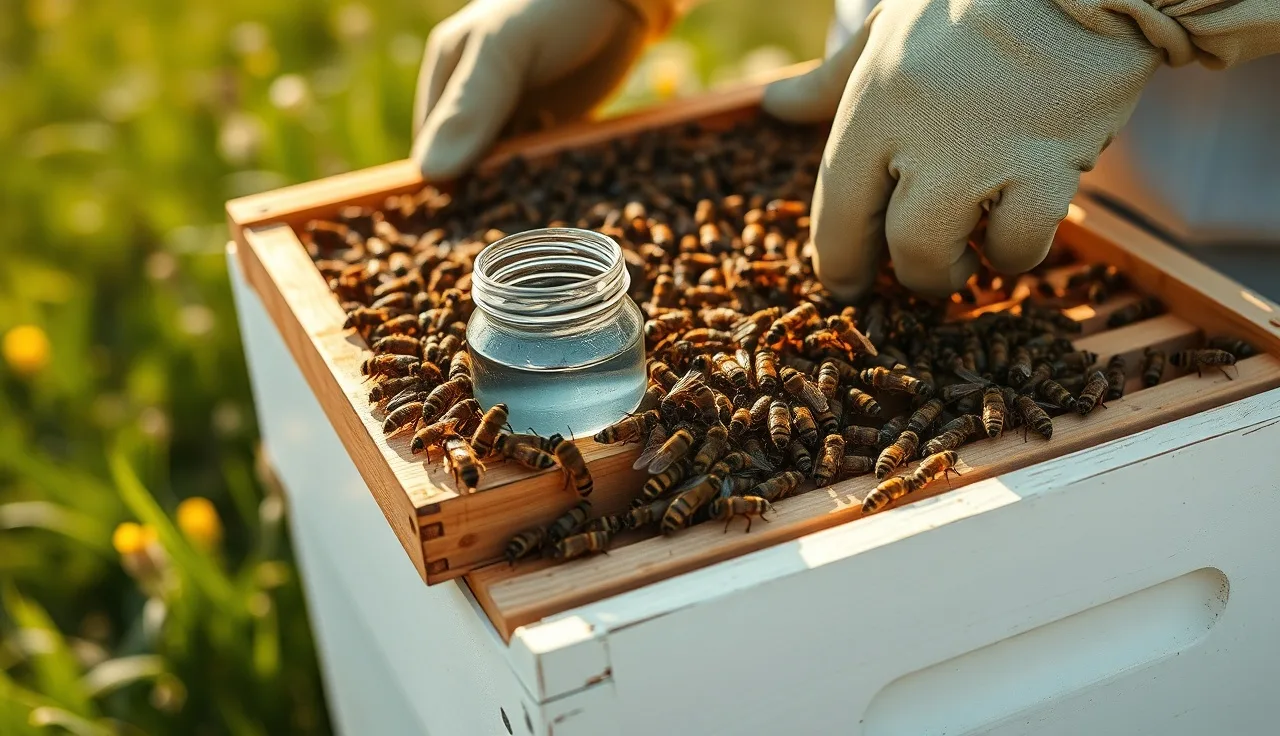
For an alcohol wash, collect about 300 bees (roughly half a cup) from a brood frame, avoiding the queen. Add isopropyl alcohol at 70% or higher, shake for 30-60 seconds, pour through a fine-mesh strainer, and count the mites in the alcohol. Divide the mite count by 3 to get mites per 100 bees. The Honey Bee Health Coalition's "Tools for Varroa Management" guide is the clearest protocol document out there and it is free to download [5].
Sugar roll uses the same bee sample with powdered sugar instead of alcohol. The bees survive, but the sugar clumps in warm weather and mites cling to bees in cool weather, both of which drag your count down. If your result will drive a treatment decision, use alcohol wash.
Test frequency matters as much as the method. During the active season, test every 30 days. Test in late summer (August in most of the US) with extra care, because that is when the mite-to-bee ratio spikes as the bee population drops heading into fall. If you only test once a year, test in August.
Some beekeepers use a sticky board under a screened bottom board as a passive count. It shows mite fall per 24 hours but never gives you an infestation percentage, so it cannot replace a wash. Use it to track trends between real tests.
What varroa mite levels are too high to ignore?
Action thresholds sit at the center of any IPM (integrated pest management) plan for varroa. The threshold is not zero. Some mite load is normal, and over-treating carries real costs: chemical resistance, residue in wax, and harm to bees. The question is when infestation crosses from manageable to dangerous.
The Honey Bee Health Coalition and most university extension programs use the following thresholds [5]:
| Season / Timing | Action Threshold (mites per 100 bees) |
|---|---|
| Spring build-up (Apr-May) | 2% (2 mites per 100 bees) |
| Active season (Jun-Jul) | 2% |
| Late summer / pre-winter (Aug-Sep) | 2% |
| Winter cluster (no brood) | 2% |
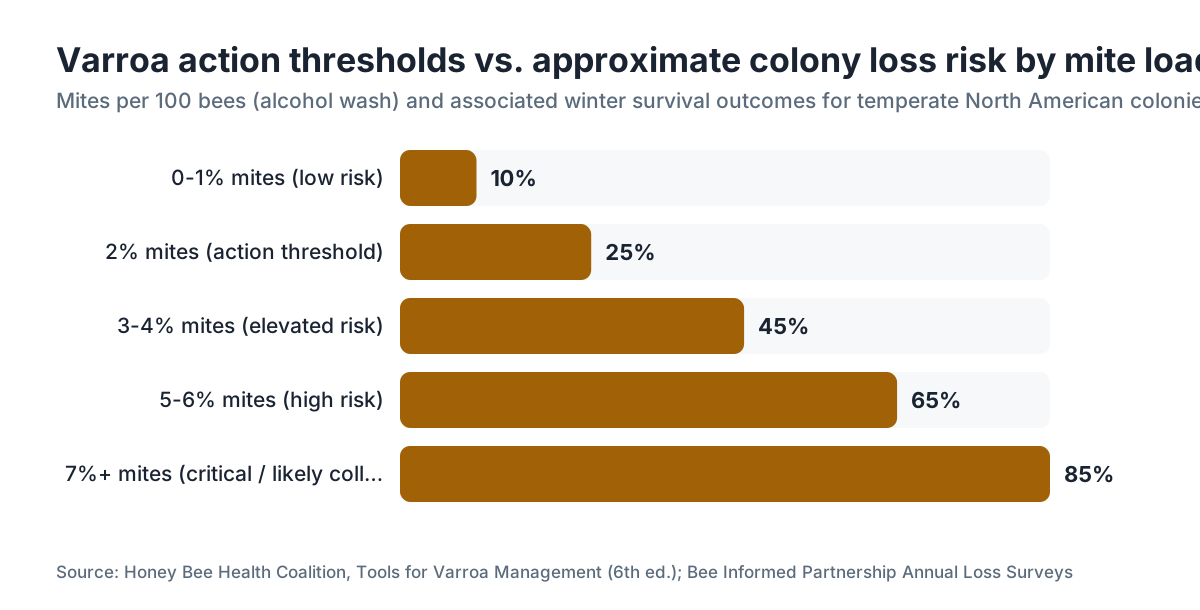
Two percent is the standard threshold across seasons for most regions, though some extension programs raise it to 3% in early spring when the colony is small and mite reproduction is slower. At 2%, treatment prevents exponential growth instead of trying to rescue a collapsing colony.
A hive at 4% is in trouble. A hive at 6% or higher in August has a very poor chance of surviving winter without treatment, and even with treatment, the virus damage already done to the winter bee cohort may be permanent. Treat early, before thresholds are badly exceeded, not after.
One more number worth knowing: a single untreated colony can act as a mite bomb for neighboring hives through robbing and drifting bees. This is bigger than your own apiary. It is a neighborhood problem.
What treatments actually work for varroa in a beehive?
Four categories of treatment are approved in the US: oxalic acid, formic acid, amitraz, and thymol. Each has a specific use case, temperature window, and brood-state requirement. No single treatment works in every condition. Here is the honest breakdown.
Oxalic acid (OA) is the most widely used treatment for broodless colonies, especially winter treatment and packages. It works by direct contact. The vaporization method (a wand vaporizer sublimates OA crystals inside the hive) reaches mites in brood cells to a limited degree and beats dribble when brood is present, though it still works best broodless [6]. The dribble method (an OA-syrup solution poured over bees between frames) is highly effective in broodless colonies but nearly useless with capped brood, because it cannot get through wax. OA is EPA-registered under several products including Api-Bioxal [7]. Extended-release OA products like ApiVar Oxalic Acid Strips and Oxalic Acid Trickle give prolonged contact, which helps in brood-present situations. OA has no known resistance issues as of 2025.
Formic acid (FA) is the one treatment that penetrates capped brood and kills mites under the wax. That makes it genuinely useful during the active season with brood present. Formic Pro (the successor to Mite Away Quick Strips) is the main commercial form. The application window is 10-29.5°C (50-85°F) ambient temperature. Above that, formic acid off-gasses too fast and can kill brood and queens [8]. One Formic Pro treatment is two pads applied 7 days apart. Bees get disrupted during treatment, so keep the entrance open and never apply during a hot spell.
Amitraz (Apivar strips) is a contact miticide applied as plastic strips hung between brood frames. It works over 6-8 weeks and stays effective with brood present, which makes it a workhorse for the active season. Amitraz resistance is documented in Europe and emerging in North America [9]. Rotate your treatments. Do not run Apivar every cycle.
Thymol (Apilife VAR, Apiguard) is a naturally derived miticide that works well between 15-25°C (59-77°F). It loses punch in cooler climates or late-season treatments when temps drop, and it can suppress queen laying for a while. Decent spring or early-fall option in moderate climates.
For a free way to track which treatments you have used and when, VarroaVault has a protocol management tool built around treatment rotation and seasonal timing.
A couple of things do not work well enough to lean on: drone brood removal alone does not cut mite levels enough to protect a colony long-term, though it helps as a supplement. Powdered sugar dusting has no peer-reviewed evidence of meaningful mite reduction [10].
When buying treatments, check the beekeeping supply companies that carry EPA-registered products with proper storage and freshness dating.
What is a seasonal varroa treatment protocol?
No single protocol fits every climate, but this framework is close to what most university extension programs and the Honey Bee Health Coalition recommend for temperate North American beekeepers.
Early spring (March-April): Test before the colony expands. If above 2%, treat. Oxalic acid vaporization works here if the colony is still mostly broodless or has limited brood. Formic acid works if temps allow.
Late spring through summer (May-July): Test monthly. This is your highest-risk window for mite population growth. If above 2%, amitraz strips or Formic Pro are the go-to options because brood is present. Oxalic acid dribble or vaporization will not control an established infestation with full brood.
Late summer (August): The single most important treatment window. Colonies are raising the long-lived winter bees right now. Mites parasitizing those bees cause permanent immune and physiological damage. Treat if at or above 2%, even if treatment is inconvenient. A formic acid or amitraz treatment in August can decide whether a colony survives winter or collapses by December.
Fall (September-October): Once the colony goes broodless or nearly so, oxalic acid is highly effective, cheap, and leaves no residue. This is the treatment most experienced beekeepers rely on for fall cleanup. Vaporize once, wait seven days, vaporize again, repeat for three total treatments to catch late-emerging mites.
Winter: If you missed the fall window or results are still high in a broodless cluster, OA dribble or vaporization can go on during a warmish day (above 4-5°C or 40°F so bees are not clustered too tightly). Do not open the hive in freezing temperatures.
The biggest mistake hobbyists make is skipping the August treatment because the colony looks healthy. It always looks healthy in August. The collapse comes in November.
Can bees develop resistance to varroa treatments?
Yes, and it is already happening. Amitraz resistance (along with resistance to tau-fluvalinate, the active in the old Apistan strips) is the best documented. A 2020 study in Scientific Reports found amitraz resistance-associated mutations in Varroa sampled from commercial apiaries across several US states [9]. Coumaphos, the active in CheckMite+, shows widespread resistance in US mite populations.
Oxalic acid resistance has not shown up as a field problem as of 2025, which is one reason it stays the preferred choice for broodless treatments. Thymol resistance is possible in theory but has not been confirmed in significant field populations.
The practical takeaway: rotate your treatments. If you used amitraz strips in summer, use oxalic acid or formic acid next cycle. Do not run the same product in consecutive seasons. Resistance builds faster when a single compound gets applied over and over at sub-lethal doses, which is exactly what happens when timing or temperature is wrong.
Also remember that a treatment killing fewer mites than expected is not always resistance. It could be the brood state at treatment time, the temperature during application, or product age (oxalic acid and formic acid both degrade if stored badly).
Are there varroa-resistant bee breeds, and do they actually work?
This is one of the more honest conversations in beekeeping right now. The answer is: some do, with caveats.
VSH (Varroa Sensitive Hygiene) bees are the most studied. They are Apis mellifera bred specifically to detect and remove mite-infested pupae. The USDA Baton Rouge Bee Lab, which developed VSH bees, has published data showing high-VSH colonies suppress mite reproduction significantly compared to unselected colonies [11]. A colony with 95%+ VSH trait expression can sometimes hold low mite levels without chemical treatment, though very few commercial VSH queens carry that level of expression.
Russian bees, also developed with USDA involvement, show grooming behavior and lower mite reproduction rates than Italian bees. Field results are more variable than the VSH data.
Hygienic lines from programs like the Minnesota Hygienic project show measurable improvement in mite management but usually still need chemical help in high-pressure mite environments.
Pure Carniolan or Italian bees have no meaningful varroa resistance.
The honest reality: genetics-based resistance is a supplement, not a replacement, for monitoring and treatment. Even well-bred VSH colonies have bad years. Source a VSH queen and the queens later raised in your apiary from local drones will dilute the trait fast. This is an active and promising area of research, but a hobbyist betting a hive on VSH genetics alone without monitoring is taking a real risk.
What are the signs of a varroa-infested colony?
Early varroa infestation has no visible signs. That is the trap. By the time you can see obvious symptoms, you are already behind.
Late-stage or high-infestation signs include:
- Bees with shriveled, crumpled wings at the hive entrance (Deformed Wing Virus)
- Crawling bees unable to fly, found near the entrance or on the landing board
- Spotty or sunken brood pattern (secondary infections like Sacbrood take hold when mite loads are high)
- A visibly smaller population than a neighboring hive, especially in fall
- Mites visible on adult bees as small reddish-brown dots, often lodged between the thorax and abdomen
If you see crawling bees with deformed wings, do an alcohol wash immediately. A wash is the only way to know how bad it is. Then treat regardless of the season and regardless of whether you think it is too late. Even a damaged colony can overwinter if mite levels drop fast enough and queen quality holds up.
A spotty brood pattern alone does not diagnose varroa. American Foulbrood, Sacbrood, and chilled brood all cause spotty patterns. But spotty brood plus a high mite count is a double emergency.
How does varroa spread between hives and apiaries?
Varroa does not jump or fly on its own. It spreads almost entirely by bee movement: robbing, drifting, and swarms.
Robbing is probably the most efficient varroa vector in a managed apiary. When a weak or dying colony gets robbed by bees from neighboring hives, those robbers carry mites home. A collapsing varroa-bombed colony can infect every hive within foraging range before it dies. That is why culling or treating severely infested colonies promptly matters beyond the single hive.
Drifting, the habit of foragers and drones entering the wrong hive by mistake, constantly shuffles mites between hives in the same apiary. Drones drift at higher rates than workers and carry mites at higher rates too, thanks to varroa's preference for drone brood. Staggering hive entrances and painting hives different colors cuts drift somewhat, but it does not stop it.
Swarms carry mites to new locations. A swarm from a high-mite colony starts with a mite load proportional to the parent colony's infestation. If you catch a swarm or split a colony, test within 30 days and treat if needed.
Buying packages or nucs from an outside source is another common way mites get in. Always test new packages or nucs within the first few weeks and treat if they arrive with mites, which many do.
How much does varroa treatment cost, and is it worth it?
The cost argument is simple: treating is cheaper than replacing colonies.
A replacement package of bees in the US costs $170-$250 as of 2025, and that price has climbed steadily for years. A replacement nucleus colony (nuc) with a mated queen runs $200-$350 or more depending on region. A mated queen alone runs $35-$80.
Here is what common treatments cost per hive:
| Treatment | Approximate cost per hive per treatment |
|---|---|
| Oxalic acid vaporization (Api-Bioxal) | $2-5 (bulk OA) + vaporizer cost amortized |
| Formic Pro strips (one course) | $18-25 |
| Apivar strips (one 6-8 week course) | $15-22 |
| Apiguard (thymol, one course) | $12-18 |
| Oxalic acid dribble (broodless) | $1-3 |
A vaporizer is a one-time purchase in the $150-$350 range for a quality wand. Spread over many hives and years, the per-use cost is trivial. If you run more than two or three hives, a vaporizer pays for itself in the first season.
The math is not subtle. One round of Apivar at $20 against a $220 replacement package is an 11-to-1 return. Treat preventively, not reactively.
For treatments and basic monitoring gear, look at established beekeeping supply companies that stock EPA-registered products.
What does the research say about untreated varroa colonies?
The evidence is unambiguous, and there is a lot of it.
A long-term study by Seeley and colleagues tracking feral colonies in the Arnot Forest in New York found that wild colonies in that isolated population have developed some tolerance to varroa over decades of natural selection, with smaller colony sizes and more frequent swarming holding mite buildup down [12]. That is real science, and it is interesting. It is also emphatically not a model for managed apiaries. Those wild colonies had no contact with outside managed populations, lived in small cavities, and went through 25 years of intense selection with enormous colony mortality.
For managed colonies anywhere hives touch, the data on untreated survival is grim. USDA APHIS National Honey Bee Survey data shows colonies with mite loads above 3% at the start of winter have much higher winter mortality than treated colonies [1]. The Bee Informed Partnership annual loss surveys, which have tracked US colony losses since 2006, consistently show annual losses of 30-40% nationally, with varroa named the primary contributing factor in most cases [13].
The Honey Bee Health Coalition states it plainly: "Varroa mites are the single most detrimental pest of honey bees" [5]. That is a direct quote from their Tools for Varroa Management guide, and it matches the consensus of every major US apiculture organization.
If you are reading online arguments for "treatment-free" beekeeping based on natural selection in managed apiaries, demand survival data from real colonies over multiple winters. Good data on this is rare, and the survival rates in most documented treatment-free programs are low enough to sink a new beekeeper's hives.
For a closer look at the biology of the varroa mite itself, the extended biology and taxonomy article goes deeper on the parasite.
Is there a free tool to help plan and track varroa treatments?
Keeping track of test results, treatment dates, which product you used last season, and what your threshold triggers are gets complicated fast once you run more than three or four hives. A paper notebook works, but it is easy to lose the thread on rotation schedules or miss the August window when life gets busy.
VarroaVault has a free varroa management protocol tool built around the seasonal monitoring and treatment framework in this article. You log test results, the tool flags threshold exceedances, and it keeps your treatment rotation history so you can avoid repeating the same active ingredient back to back. It does not replace reading the actual label on whatever product you buy, but it does the scheduling math that is easy to forget.
What you need beyond software: a good alcohol wash jar or commercial wash kit, a scale or measuring cup calibrated to 300 bees (roughly 100 mL of bees), and your chosen treatment stocked before you need it. Do not wait for a 4% result to order Formic Pro. By the time it arrives, you have lost two weeks.
Frequently asked questions
How do I know if my beehive has varroa mites?
The only reliable way is an alcohol wash or sugar roll of about 300 bees from a brood frame. If results are at or above 2 mites per 100 bees, you need to treat. Visible signs like bees with crumpled wings or crawling bees appear only at high infestation levels, by which point serious virus damage has already occurred.
What kills varroa mites in a beehive?
Approved treatments include oxalic acid (Api-Bioxal, effective in broodless colonies), formic acid (Formic Pro, effective with brood present at 50-85°F), amitraz strips (Apivar, for active season use with brood), and thymol-based products (Apiguard, Apilife VAR, best at 59-77°F). Each has specific temperature and brood-state requirements. Always follow EPA label directions.
At what mite count should I treat my hive?
The Honey Bee Health Coalition and most university extension programs recommend treating when mite levels reach 2% or higher, meaning 2 mites per 100 bees sampled by alcohol wash. This threshold applies year-round, with some programs allowing up to 3% in early spring when colony population is small and mite reproduction is slower.
Can varroa mites kill a beehive?
Yes. Varroa directly weakens bees by feeding on fat body tissue and transmits deadly viruses, especially Deformed Wing Virus. Most untreated managed colonies collapse within one to two years. The Bee Informed Partnership has tracked US annual colony losses of 30-40% per year, with varroa identified as the primary contributing factor in most cases.
Is oxalic acid safe to use in a beehive?
Yes, when used according to the EPA-registered label for Api-Bioxal. Oxalic acid occurs naturally in honey and beeswax at low concentrations. Residue in honey from treated colonies is not a food-safety concern at label-compliant doses. Wear a respirator rated for acid vapors when vaporizing OA; the fumes are harmful to human lungs.
Can I treat for varroa while honey supers are on?
Most varroa treatments require that honey supers be removed before application to prevent contamination of honey intended for human consumption. Oxalic acid products, formic acid strips, and amitraz strips all carry this restriction on the EPA label. Always read your specific product label before treating. Failing to remove supers can result in unmarketable honey and a label violation.
How often should I test my hive for varroa?
Test at least once a month during the active beekeeping season, and always test in August before the critical winter bee-rearing period. If you can only test once a year, do it in late July or August. After any treatment, retest 4-6 weeks later to confirm the treatment worked.
What is the best time of year to treat for varroa?
Late August is the single most important treatment window in temperate North America. Colonies are raising long-lived winter bees then, and mites parasitizing those bees cause permanent damage. A second key window is fall, once the colony is broodless, when oxalic acid is highly effective and cheap. Spring treatment helps prevent early-season mite buildup.
Does sugar dusting or powdered sugar kill varroa mites?
No. There is no peer-reviewed evidence that powdered sugar dusting reduces varroa populations to meaningful levels. It may cause minor temporary mite dropping, but it does not kill mites and does not substitute for an effective miticide. Several university extension programs have explicitly tested this and found no significant mite control.
Are there bee breeds that resist varroa mites?
VSH (Varroa Sensitive Hygiene) bees, developed by the USDA Baton Rouge lab, show the strongest documented resistance through the trait of detecting and removing mite-infested pupae. Russian bees and Minnesota Hygienic lines also show measurable improvement. None eliminate the need for monitoring and occasional treatment, especially in apiaries with exposure to outside bee populations.
How do varroa mites spread from hive to hive?
Primarily through robbing behavior and bee drifting. When bees rob a collapsing mite-infested colony, they carry mites back to their own hive. Drones drift between hives at high rates and carry proportionally more mites due to varroa's preference for drone brood. Swarms from infested colonies also carry mites to new locations.
What is the difference between an alcohol wash and a sugar roll for varroa?
Both sample about 300 bees from a brood frame to estimate mite load per 100 bees. Alcohol wash kills the bees and is the more accurate method, consistently used in research. Sugar roll spares the bees but undercounts mites by 20-40% because sugar clumps in heat and some mites cling in cool weather. For treatment decisions, alcohol wash gives you better data.
How long does a varroa treatment take to work?
Formic acid (Formic Pro) works over about 3-5 weeks with two pad applications. Amitraz strips (Apivar) require 6-8 weeks of continuous contact to clear mites through multiple brood cycles. Oxalic acid vaporization gives rapid knockdown in broodless colonies, typically within days, but repeat treatments (three over 3 weeks) are recommended to catch emerging bees.
Can varroa mites affect human health?
Varroa mites do not infest humans and pose no direct human health risk. They are obligate parasites of honey bees and cannot complete their life cycle on any other host. Oxalic acid vapors used during treatment are hazardous if inhaled, so beekeepers should wear appropriate respiratory protection during vaporization.
Sources
- PLOS Pathogens, Wilfert et al. 2016, Deformed Wing Virus global spread: Varroa-mediated DWV transmission has driven global spread of a single hypervirulent DWV variant, replacing a less lethal diverse viral population.
- Honey Bee Health Coalition, Tools for Varroa Management Guide (6th edition): In worker brood a foundress mite typically produces one to two reproductive daughters per cell; drone brood allows three or more.
- Honey Bee Health Coalition, Tools for Varroa Management Guide: Threshold of 2 mites per 100 bees (2%) recommended as action threshold; 'Varroa mites are the single most detrimental pest of honey bees.'
- EPA, Api-Bioxal Registration and Label: Api-Bioxal (oxalic acid dihydrate) is EPA-registered for Varroa treatment in honey bee colonies with specific instructions for dribble and vaporization methods.
- Scientific Reports, Erban et al. 2020, Amitraz resistance in Varroa: Amitraz resistance-associated mutations were found in Varroa populations sampled from commercial apiaries across several US states.
- University of Florida IFAS Extension, Varroa Mite Management: Powdered sugar dusting does not reduce varroa populations to meaningful levels; no peer-reviewed evidence supports it as a standalone control method.
- Seeley et al. 2015, PLOS ONE, wild honey bee colony survival in Arnot Forest: Isolated feral colonies in the Arnot Forest have developed some varroa tolerance over decades through natural selection, smaller colony sizes, and frequent swarming.
- Bee Informed Partnership, Annual Colony Loss Survey: Annual US colony losses have tracked at 30-40% per year since 2006, with varroa identified as the primary contributing factor in the majority of cases.
Last updated 2026-07-09