Varroa mites in beekeeping: what every beekeeper must know
TL;DR
- Varroa destructor is a parasitic mite that feeds on honey bee fat bodies and spreads viruses, killing untreated colonies within one to three years.
- Treatment thresholds start at 2 percent infestation in summer and drop to 1 percent before winter bees are raised.
- Good management combines monthly monitoring, accurate mite counts, and treatment matched to your season and brood status.
What are varroa mites and why do they destroy colonies?
Varroa destructor is an external parasitic mite. It evolved on the Asian honey bee Apis cerana, jumped to the Western honey bee Apis mellifera sometime in the mid-20th century, and spread from there. Today it lives on every continent except Australia. [1]
The mite is easy to see with the naked eye. It runs about 1.1 mm wide and 1.6 mm long, reddish-brown, shaped like a tiny crab. Female mites wedge between a bee's abdominal segments, pierce the cuticle, and feed on fat body tissue. That fat body is the bee's liver, immune organ, and energy store rolled into one. A bee carrying even one mite is a weaker bee. A bee that developed in a cell with two or three mites feeding on it is compromised for life.
The real damage is viral. Varroa spreading Deformed Wing Virus (DWV) is what actually collapses colonies. When a mite feeds on a developing pupa, it injects and amplifies DWV straight into the bee's hemolymph. Bees from infested cells often emerge with shriveled wings and stubby abdomens, but plenty look normal while carrying huge viral loads. The Honey Bee Health Coalition puts it plainly: "Varroa mites weaken bees by feeding on them and by spreading viruses." DWV is the main driver of colony death in infested hives. [2]
Untreated, mite populations grow exponentially through summer. A colony that starts spring at 1 percent infestation can hit 10 to 15 percent by August. By then the winter bees being raised in late summer are heavily parasitized, viral loads are enormous, and the colony rarely survives to spring. Beekeepers call this autumn collapse. It is the leading cause of overwinter loss in North America. [3]
How do varroa mites reproduce inside a hive?
Varroa reproduction happens entirely inside capped brood cells. A mated female (the foundress) slips into a brood cell just before nurse bees cap it, buries herself under the larval food, and waits. Once the cell is capped and the larva defecates, she starts feeding on the pupa and lays her first egg, which is male, on the pupa's ventral surface. After that she lays female eggs roughly every 30 hours. [4]
The male and female offspring mate inside the cell. When the adult bee emerges, the foundress and any mature mated daughters ride out on that bee to hunt for new cells. Immature daughters and the male are left behind and die. In a worker cell, capped about 12 days, a foundress usually produces one to two reproductive daughters per cycle. In a drone cell, capped about 14.5 days, she produces two to three because there is more time. [4]
That extra time is why drone brood is a mite magnet. Mites prefer drone cells at a ratio near 8:1 over worker cells, which is the whole basis of drone comb trapping. It also explains why a colony pumping out drones in spring can build mites faster than you expect.
Pheromones from large larvae about to be capped are what pull the foundress into cells. Interrupt the brood cycle and you interrupt reproduction. That is the logic behind brood breaks, one of the most underused non-chemical tools in the box.
How do you monitor varroa mite levels accurately?
You cannot manage what you do not measure. The two standard methods are the alcohol wash and the sugar roll. Alcohol wash is more accurate. Sugar roll spares the bees but underestimates mite loads by 20 to 40 percent in some studies, so use it only if you genuinely cannot stomach killing 300 bees. [2]
For an alcohol wash, collect about 300 adult bees (roughly half a cup) from a frame of open brood where nurse bees are thick. Dump them into a jar with 70 percent isopropyl alcohol, seal it, and shake for 60 seconds. Pour the liquid through mesh into a white container and count the mites. Divide mites by bees, multiply by 100, and that is your percent infestation. Three hundred bees is the standard sample. It gives you a reliable number without gutting the colony. [2]
Never collect bees off honey storage frames. Those are foragers, not nurse bees, and they carry far fewer mites. You will undercount badly.
A sticky board under the screen bottom tells you whether mites are present but cannot give you a percent. Use it to detect arrival in a new colony or as a rough trend line, not as a substitute for a wash or roll.
The Honey Bee Health Coalition recommends sampling every 30 days from spring through fall, plus once more before any treatment to set a baseline. [2] That sounds like a lot. A wash takes about 10 minutes once you have the gear. Miss a July population spike and you lose the colony in November.
For a closer look at varroa biology alongside your monitoring work, the varroa mite reference page covers the parasite's taxonomy and global spread.
What infestation level triggers treatment?
Treat at 2 percent infestation in summer and at 1 percent in late summer before winter bees are raised. Those thresholds come from the Honey Bee Health Coalition's Varroa Management Guide and from university extension programs. [2][12] Below threshold, keep monitoring. At or above it, treat now, not in two weeks.
| Season | Treatment Threshold |
|---|---|
| Spring (March-May) | 2% or higher |
| Summer active season (June-August) | 2% or higher |
| Late summer / winter bee production (August-September) | 1-2% (treat sooner) |
| Winter cluster | 2% (oxalic acid only on broodless colony) |
The late summer window is the one most beekeepers miss. The bees raised in August and September become your winter cluster. They need fat bodies and clean immune systems before temperatures drop. A 2 percent count in August looks harmless, but those mites are packed into the cells raising your winter bees. Treat at 1 percent in late summer if you want a colony alive in April.
Thresholds assume you sampled right. If you did a sugar roll, bump your number up in your head. The real infestation is almost certainly higher than the roll showed.
What treatment options are available and how do they work?
Every treatment approved for U.S. honey bee colonies has gone through EPA registration and carries a label you are legally required to follow. [6] Breaking the label is a federal violation. The options split into two families: organic acids and essential oils, and synthetic miticides.
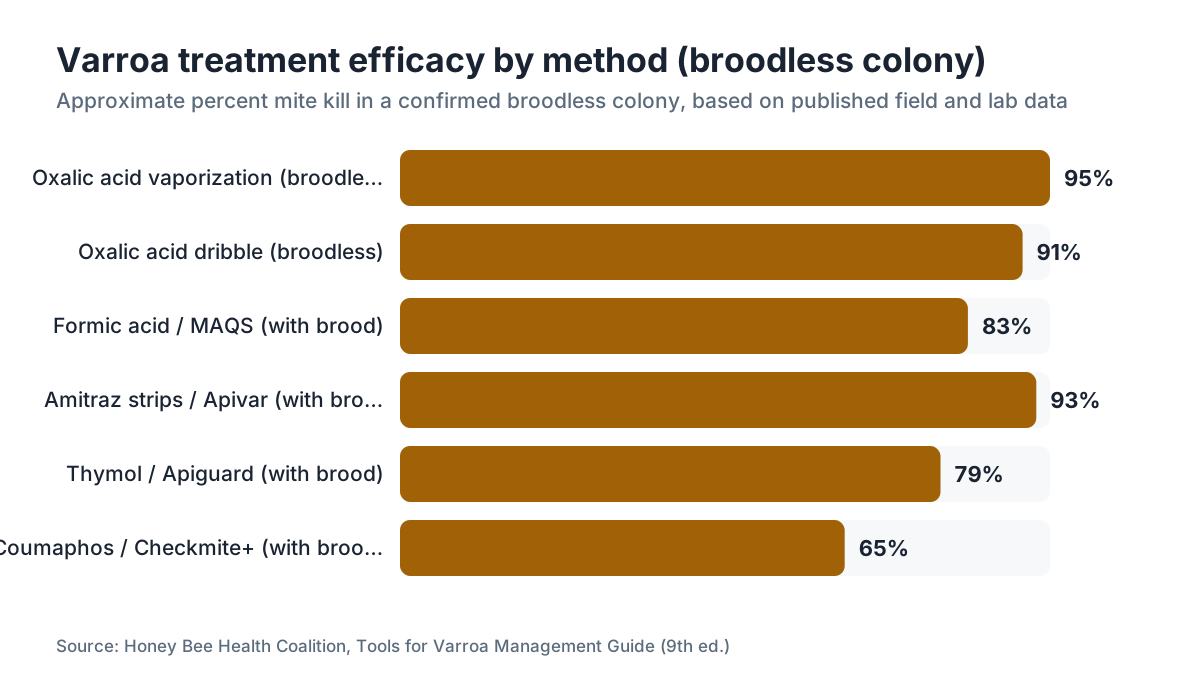
Oxalic acid (OA) is the best treatment for a broodless colony. When mites are only on adult bees and not hidden inside capped cells, a single OA treatment kills 90 to 95 percent of the mites in the colony. Approved methods are dribble (solution poured directly onto bees between frames), vaporization (crystals sublimated into hive air), and extended-release strips. Vaporization during a brood break is the strongest single application a hobbyist can do. [7]
For colonies with brood, use extended-release OA (the Api-Bioxal shop towel method under label) or repeat vaporizations every 5 days for 3 treatments. Repeating catches mites as they emerge from capped cells between rounds.
Formic acid (MAQS or Formic Pro) penetrates capped cells and kills mites inside the brood. That is its edge over oxalic acid. MAQS can go on with honey supers in place, which makes it useful in honey season. Temperature matters a lot. It needs to stay roughly between 50°F and 85°F to work without harming queens or brood. Read the label. [2]
Thymol (Apiguard) is an essential oil gel. It works well in warm weather, generally above 60°F, because the thymol has to volatilize. Slower than formic acid but queen-safe at label doses.
Amitraz (Apivar) is a synthetic miticide in strip form. Consistently hits 90 to 95 percent efficacy when used to label. Resistance has been documented in some U.S. populations, so rotating chemistry matters. [8] Cannot be used with honey supers on.
Coumaphos (Checkmite+) is another synthetic, but resistance is widespread and it leaves residues in wax. Most extension apiarists now recommend it only as a last resort or for specific jobs like small hive beetle control.
VarroaVault's free protocol tool matches treatment type to your current brood status, season, and local temperature range, so you do not have to juggle all these variables in your head.
If you are still sourcing supplies, beekeeping supply companies and free shipping honey bee supply companies are worth comparing on cost per treatment cycle.
How does varroa mite resistance develop and how do you prevent it?
Resistance is real, not hypothetical. Coumaphos resistance in North American Varroa has been confirmed since the early 2000s. [9] Amitraz resistance has been documented in the U.S. since at least 2017, and researchers have also flagged tau-fluvalinate resistance markers in field populations. [8]
The mechanism is simple. Apply the same chemical over and over without killing 100 percent of the mites, and the survivors carry slightly higher tolerance. Their offspring inherit it. Over a few generations you select for a resistant population. Mite generation time is roughly 10 days in brood, so resistance can build inside a single season of single-chemistry management.
Managing resistance means rotating modes of action. Do not run Apivar (amitraz) in both spring and fall year after year. Alternate with oxalic acid during brood breaks, or drop in formic acid mid-summer. The rotation does not have to be fancy. It just has to happen.
Monitoring after treatment is not optional. Do a wash 48 to 72 hours after a completed treatment course. If efficacy comes in below 90 percent, you have either a resistance problem or an application error. Figure out which one before you treat again.
What are non-chemical varroa management strategies?
Chemical treatment is necessary for most operations, but it works better paired with biological and mechanical tactics. Three carry real weight: brood breaks, drone comb trapping, and resistant genetics.
Brood breaks are the strongest mechanical tool. Cage the queen for 24 to 28 days and the colony goes broodless. Every mite has to ride an adult bee, where oxalic acid vaporization can reach it. A single OA vaporization during a confirmed brood break clears 95 percent or more of the mite population. Planned breaks are easy to fit in when you are requeening anyway.
Drone comb trapping exploits the mite's taste for drone brood. Insert a frame of drone-sized foundation, let the colony fill it with drone brood, then pull and freeze the capped frame before the drones emerge. Repeat every 24 days. Done rigorously in spring, this suppresses mite buildup with zero chemical input. It does not replace monitoring or treatment at threshold. It delays the threshold.
Hygienic genetics reduce varroa reproduction. Bees with high hygienic scores detect and yank mite-infested brood before the mites finish reproducing. VSH (Varroa Sensitive Hygiene) and SMR (Suppressed Mite Reproduction) are the most studied traits, and Minnesota Hygienic queens have strong field records. Requeening with selected stock is a real tool, not a hobbyist fantasy. The University of Minnesota Bee Lab has published widely on hygienic trait genetics. [10]
Small colony size protects nobody. Packages and nucs start with low mite loads, then build fast. The most dangerous belief in beekeeping is that a new colony does not need monitoring. It does, starting 4 to 6 weeks after installation.
How does varroa affect colony health beyond direct mite damage?
Mite feeding stresses bees, but the viral amplification is what kills colonies at scale. Varroa is an efficient vector for at least seven honey bee viruses, including DWV, Sacbrood, Acute Bee Paralysis Virus (ABPV), and Black Queen Cell Virus. DWV is the worst of them. In high-infestation colonies nearly every bee can carry high DWV titers, which suppress immune function, cut adult lifespan, and wreck learning and foraging. [3]
Shortened lifespan is the colony-level kill mechanism. A healthy summer worker lives 40 to 45 days. A DWV-affected worker may live 10 to 15. When deaths outpace emergence, the population crashes fast. That is how a high-mite colony can look busy in September and be a dead cluster of 2,000 bees by December.
Nosema, a gut fungal parasite, is not caused by varroa but often rides along with high-mite colonies because both thrive in immunocompromised bees. If you are losing colonies and have ruled out varroa, check for Nosema ceranae as a co-factor.
Pesticide exposure interacts with mite load in ways nobody has fully mapped, but the evidence points one direction: sublethal pesticide exposure weakens the bees' ability to fight the viruses varroa spreads. Managing forage quality and pesticide risk in your apiary is part of the health picture, even if it sits behind mite control.
What is a varroa management calendar and when should you treat?
Timing treatments to the bee's seasonal biology is what separates real management from reactive damage control. Here is a workable annual framework for temperate North America.
Late winter / early spring (February to March): If the colony was broodless and you skipped a November or December oxalic acid treatment, do it now on the first warm day (above 40°F) before brood rearing takes off. Count mites again in April.
Spring buildup (April to May): First full alcohol wash of the year. Above 2 percent, treat with formic acid or amitraz. Below 2 percent, monitor monthly.
Honey flow (June to July): Keep monitoring monthly. Formic acid (MAQS) is the only option with honey supers on. Oxalic acid cannot be used while supers are present. If you are not chasing honey, amitraz strips work well.
Late summer, pre-winter bee production (early August): The single most important treatment window of the year. Wash before and after. Treat at or above 1 percent. The winter bees being raised right now decide your spring. Extended-release OA or formic acid both fit here.
Winter cluster (November to January): Once the colony is confirmed broodless, an oxalic acid dribble or vaporization hits the highest efficacy you can get. This is the most cost-effective treatment on the calendar, and plenty of beekeepers skip it.
Missing the August window is the most common mistake behind dead colonies in spring. Mark it now.
How do you interpret and act on mite wash results?
You did a wash. You counted 9 mites in a sample of 300 bees. That is 3 percent infestation. Now what?
First, confirm the sample came from nurse bees on a brood frame, not the entrance or a honey frame. If it was not representative, redo it. Assuming the sample is good, 3 percent in the active season means treat now, not in two weeks.
Choose treatment on three factors: current brood status (broodless or active brood), the temperature forecast for the treatment window, and whether honey supers are on. A quick decision framework:
- Broodless colony, any season: oxalic acid vaporization is the best option.
- Active brood, honey supers on, temps 50 to 85°F: MAQS (formic acid) is your only super-safe legal option.
- Active brood, no supers, temps in range: amitraz strips or formic acid.
- Late fall with some brood still present: extended-release OA or formic acid, depending on temperature.
Test again after treatment. For fast-acting products, wash 48 to 72 hours after the course finishes. For strips, wash at the end of the labeled duration. Efficacy below 90 percent means a resistance issue, an application error, or both. Do not assume the problem is solved without a post-treatment wash.
VarroaVault's protocol builder walks this exact decision tree from your inputs, which helps when you are running several hives with different brood conditions at once.
Are there varroa-resistant honey bee lines and do they actually work?
Yes, and the evidence is genuinely promising, though not yet at the point where you requeen once and forget about mites. VSH (Varroa Sensitive Hygiene) bees, developed largely through USDA Baton Rouge research, show 80 to 90 percent suppressed mite reproduction in research settings. In commercial and hobbyist fields the suppression is real but lower, usually 50 to 70 percent, because the VSH trait dilutes as workers age out and drones from other colonies mate with locally raised queens. [10]
The practical upshot: VSH or hygienic stock cuts how often you treat, but it does not end monitoring, and in most apiaries it does not end treatment unless you are in a very isolated spot. Think of it as bending your mite load trajectory downward, not solving the problem.
Breeders selling VSH, SMR, or Minnesota Hygienic stock are doing real work. Buying from them is a reasonable investment. Just keep monitoring.
For how Apis mellifera compares to Apis cerana, which co-evolved with varroa and suffers far less, the beekeeping species article covers the managed bee species and their traits.
What does varroa management cost and is it worth the investment?
Treating for varroa is cheaper than replacing dead colonies. That is the whole argument, and the numbers back it.
A replacement package runs $150 to $200 in most U.S. regions as of 2025. A nuc runs $175 to $250. An Apivar treatment (two strips per hive at label dose) costs roughly $4 to $8 per hive per treatment, depending on supplier and volume. An oxalic acid vaporization setup costs $80 to $200 upfront for a decent vaporizer, then about $1 to $3 per hive in product per treatment.
For most hobbyists running two to ten hives, total annual treatment cost lands at $20 to $80 per hive, depending on how many cycles you complete and which products you use. That is a fraction of replacement cost, and it does not count the time and gut-punch of opening a dead hive in March.
Monitoring supplies (a good wash jar, 70 percent isopropyl) cost under $15. The test takes 10 minutes. There is no honest cost argument for skipping monitoring.
If you are comparing supplier pricing, beekeeping supplies and bulk options through beekeeping supply companies can cut per-treatment cost for sideliners running 15 or more hives.
Frequently asked questions
How do I know if my hive has varroa mites without buying special equipment?
An alcohol wash needs only a mason jar, a small piece of mesh or window screen, 70 percent isopropyl alcohol, and a white bowl or plate. Collect about 300 nurse bees (half a cup) from a brood frame, shake in alcohol, pour through the screen into the white bowl, and count the mites. Total cost is under $10. You do not need a commercial mite wash kit, though they are more convenient.
Can varroa mites spread from one hive to another?
Yes, readily. Mites travel between colonies through drifting bees, robbing, and shared equipment. A collapsing high-mite colony gets robbed by neighbors, who carry mites home. Beekeepers call this a mite bomb. Keep robbing screens on during dearth periods, avoid swapping frames between hives without checking mite loads, and treat all colonies in an apiary at the same time when you can.
Does powdered sugar do anything to varroa mites?
No, not meaningfully. Powdered sugar rolls became popular as a non-lethal monitoring method, but the treatment effect on mite populations is negligible. Multiple studies failed to show a significant drop in mite loads from sugar dusting. It is not a treatment. The Honey Bee Health Coalition does not list it among effective management strategies. If you use sugar rolls to monitor, remember they underestimate infestation by 20 to 40 percent versus alcohol washes.
How often should I treat for varroa during the year?
Treatment frequency follows your mite counts, not a fixed calendar. The standard minimum is to test monthly from April through September and treat any time you exceed the threshold for your season (2 percent in summer, 1 to 2 percent in late summer). Most managed colonies in North America need at least one summer treatment and one winter-cluster treatment per year. High-pressure apiaries sometimes need three cycles.
Is oxalic acid safe to use with honey supers on the hive?
No. Under current EPA labeling, oxalic acid products like Api-Bioxal cannot be applied when honey supers intended for human consumption are on the hive. This is a hard label requirement and federal law. Formic acid as MAQS is the main option approved for use with honey supers present, within its temperature and application guidelines.
What is a brood break and how does it help with varroa?
A brood break is a period when a colony has no capped brood, either naturally (overwintering) or forced by caging or removing the queen. With no capped cells, every mite must ride an adult bee, where oxalic acid vaporization reaches it at 90 to 95 percent efficacy in a single treatment. A planned brood break paired with OA vaporization is one of the most effective knockdown strategies you can run without synthetic miticides.
Can new packages or nucs have varroa problems in their first year?
Absolutely. Packages start with low mite loads, but populations grow fast in a building colony. A package installed in April can reach treatment threshold by July or August. Nucs installed with existing brood may already carry meaningful mite levels. Start monitoring 4 to 6 weeks after installation and continue monthly. First-year colonies are not immune, and many beekeepers lose them overwinter after assuming early low counts would hold.
What temperature does oxalic acid vaporization work best at?
Oxalic acid vaporization works at almost any temperature as long as bees are clustered and present, which makes it viable in winter down to about 25 to 35°F. You are not relying on volatilization into warm air the way thymol needs. The key requirement is that the colony is broodless or nearly so, not a specific temperature. Always follow the Api-Bioxal label and use proper respiratory protection.
How do I know if my varroa treatment actually worked?
Do a post-treatment alcohol wash. For fast-acting treatments like oxalic acid or formic acid, wash 48 to 72 hours after the course finishes. For strip treatments like Apivar, wash at the end of the labeled period (typically 6 to 8 weeks). Aim for 90 percent efficacy or better. If your post-treatment count is still above 2 percent, you have a resistance issue, an application error, or both.
What viruses do varroa mites spread to honey bees?
Varroa vectors at least seven honey bee viruses, including Deformed Wing Virus (DWV), Acute Bee Paralysis Virus (ABPV), Sacbrood, Black Queen Cell Virus, and Kashmir Bee Virus. DWV is the most damaging, causing wing deformities, shortened lifespan, and immune suppression. Mite-transmitted DWV is the main cause of the population collapse that kills colonies through winter, not the mite feeding itself.
What is the difference between VSH bees and regular honey bees for varroa resistance?
VSH (Varroa Sensitive Hygiene) bees carry a genetic trait that drives workers to detect and remove mite-infested pupae before the mites finish reproducing. USDA research shows 80 to 90 percent suppressed mite reproduction in controlled settings. In field use the suppression is real but lower, around 50 to 70 percent, because the trait dilutes as queens mate with non-VSH drones. VSH stock reduces treatment frequency but does not end monitoring.
Can varroa mites cause my queen to fail?
Indirectly, yes. Heavy infestations rarely kill queens outright, but viral loads spread by varroa can reduce queen quality and shorten her productive life. DWV and Black Queen Cell Virus have both been tied to queen failure. Colonies collapsing from varroa also sometimes supersede queens in a last-ditch survival response, ending up with an unmated or poorly mated replacement that then fails over winter.
Should I treat a swarm or a freshly caught wild colony for varroa?
Yes. Swarms from managed colonies often carry mites from their source. Wild swarms can carry any load. A swarm that just cast has a temporary brood break because the queen has not started laying in the new spot yet, which makes it an ideal window for oxalic acid vaporization. Treat within the first week after catching a swarm, before new brood is capped, for maximum efficacy from a single OA application.
How do varroa mites affect the bee's fat body specifically?
For decades beekeepers thought varroa fed on hemolymph (bee blood). Research published by Samuel Ramsey and colleagues in 2019 showed the primary feeding site is the fat body, a diffuse organ like the liver. The fat body stores protein, lipids, and vitellogenin, a key immune and longevity protein. Fat body damage from mite feeding directly impairs immune function, winter survival, and a nurse bee's ability to produce brood food.
Sources
- USDA Agricultural Research Service, Bee Research Laboratory: Varroa destructor is present on every continent except Australia and is the primary pest of managed honey bee colonies worldwide.
- Honey Bee Health Coalition, Tools for Varroa Management Guide (9th edition): Varroa mites weaken bees by feeding on them and by spreading viruses, and the Coalition recommends alcohol wash sampling every 30 days from spring through fall.
- Nazzi F, Brown SP, et al. PLOS Pathogens 2012: Synergistic Parasite-Pathogen Interactions Mediated by Host Immunity Can Drive the Collapse of Honeybee Colonies: DWV amplified by Varroa feeding is the primary driver of winter colony collapse, with infested bees showing dramatically shortened lifespans and immune suppression.
- University of Florida IFAS Extension, Varroa Mite (EDIS): Varroa mites prefer drone brood at roughly 8:1 over worker brood, and a foundress produces 1-2 reproductive daughters per worker cell cycle and 2-3 per drone cell cycle.
- U.S. EPA, Pesticides program: Every miticide used in honey bee colonies must be EPA-registered, and use contrary to label directions is a violation of federal pesticide law.
- EPA, Api-Bioxal (Oxalic Acid) product registration, EPA Reg. No. 84436-1: Api-Bioxal is the only EPA-registered oxalic acid product for U.S. honey bee colonies; it cannot be applied when honey supers intended for human consumption are present.
- Journal of Apicultural Research, research on amitraz resistance in Varroa destructor: Amitraz resistance in North American Varroa populations has been documented since at least 2017, confirming the need for treatment rotation.
- Elzen PJ et al., Detection of coumaphos resistance in Varroa destructor in the United States, Apidologie, 2000: Coumaphos resistance in North American Varroa populations was confirmed in peer-reviewed research from the early 2000s.
- University of Minnesota Bee Lab, hygienic behavior and VSH research: Minnesota Hygienic queens and VSH lines show measurable field reductions in mite load compared to unselected stock; the UMN Bee Lab has published extensively on hygienic trait genetics.
- Ramsey SD et al., Varroa destructor feeds primarily on honey bee fat bodies, PNAS, 2019: Ramsey et al. 2019 demonstrated that Varroa destructor feeds primarily on bee fat body tissue, not hemolymph, fundamentally changing understanding of mite-caused damage.
- Penn State Extension, Varroa Mite Management: Treatment thresholds of 2 percent infestation in summer and 1-2 percent in late summer ahead of winter bee production are standard recommendations from multiple university extension apiculture programs.
Last updated 2026-07-09