How to distinguish varroa from other honey bee parasites
TL;DR
- Varroa destructor is a reddish-brown, crab-shaped mite about 1.1 mm wide and 1.6 mm long, visible to the naked eye on adult bees and pupae.
- The parasites most often confused with it are Tropilaelaps mites (smaller, faster-moving), Acarapis woodi (microscopic, internal), and small hive beetles (much larger, six-legged insects).
- Correct ID changes your entire treatment response.
Why getting the ID right matters before you treat
Misidentifying a parasite in your hive is not a minor paperwork problem. It changes whether you reach for oxalic acid or fumagillin, whether you call your state apiarist or handle it yourself, and whether your colony survives the next 60 days. Treating for varroa when you actually have Tropilaelaps does not work the same way. Treating for Acarapis (tracheal mites) when varroa is the real culprit leaves a deadly infestation untouched.
The good news is that most of these parasites have distinct visual signatures. A hand lens, a white tray, and five minutes of careful observation will separate varroa from nearly every other organism that attacks honey bees. This guide walks through each parasite systematically so you know exactly what you're looking at before you act.
One framing note: this article focuses on organisms that are actual parasites of honey bees, not pathogens like Nosema or bacteria like American foulbrood. Those are a separate diagnostic category. We're covering the arthropod and related external and internal parasites that beekeepers most commonly encounter or worry about.
What does Varroa destructor actually look like?
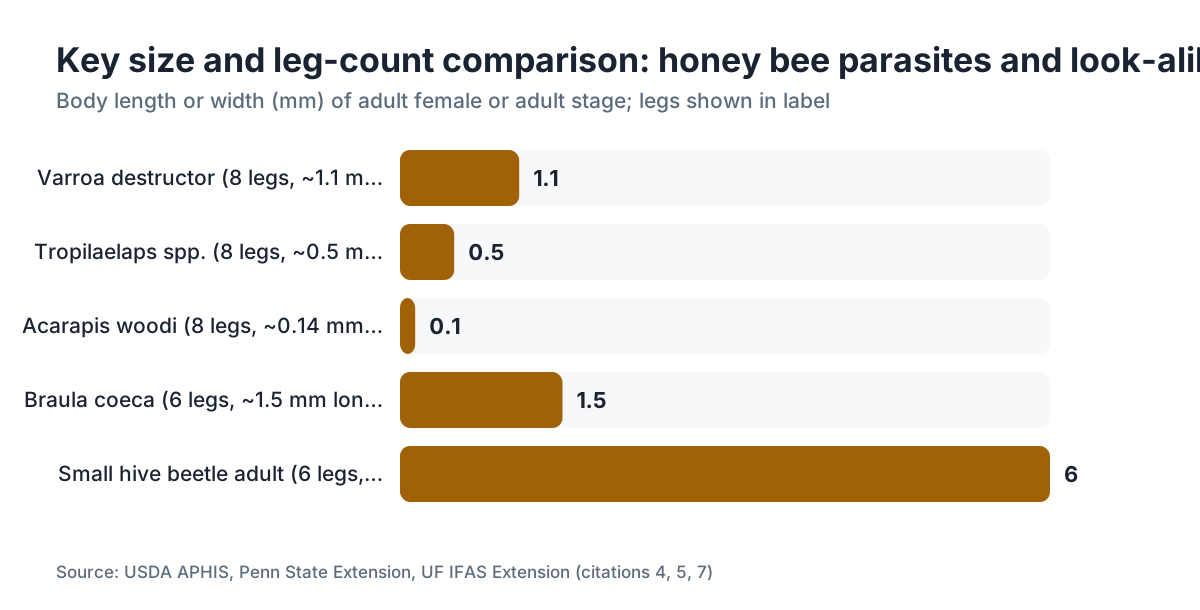
Varroa destructor is the mite you need to know first, because everything else gets compared to it. The adult female is reddish-brown to dark mahogany, shaped like a tiny shield or flattened crab, about 1.1 mm wide and 1.6 mm long [1]. That wider-than-long body shape is the single most reliable visual clue. She is wider than she is tall when viewed from the side, and that lateral compression lets her hide between a bee's abdominal segments.
Males are smaller and paler, almost yellowish. You rarely see them because they die in the capped cell after mating. Nymphs are whitish and pearl-like inside capped brood.
You can see a female varroa mite with the naked eye on a light-colored background. On a bee's dark body, she's easy to miss against the junction between tergites. The standard sticky board or alcohol wash [2] spreads mites against a white surface where they become obvious. On a drone uncapping, look for the creamy nymphs clinging to the developing pupa, sometimes so numerous on a single pupa that the cell looks frosted.
A finding worth memorizing: varroa prefers drone brood at a ratio of roughly 8:1 over worker brood [3], so seeing mites disproportionately in drone cells is consistent with varroa. Any mite that appears in roughly equal numbers across worker and drone brood is a signal to look harder at the ID.
For a deeper look at the biology of this parasite specifically, see the full varroa mite reference on this site.
What is Tropilaelaps and how is it different from varroa?
Tropilaelaps mites (mainly Tropilaelaps clareae and T. mercedesae) are the parasite most likely to be confused with varroa, and they are not currently established in the United States or Europe [4]. That matters because if you spot something that looks like varroa but behaves differently, reporting it immediately to your state apiarist is the right call.
Here is the key visual difference: Tropilaelaps is elongated rather than wide. It runs about 1 mm long but only 0.5 mm wide, giving it a narrower, more oval profile compared to varroa's crab shape [4]. The color is similar, reddish-brown, so color alone won't separate them. Watch behavior instead. Tropilaelaps moves fast. Very fast. Varroa moves slowly and deliberately across a bee's body. Tropilaelaps scurries like a tiny spider, which is startling to see if you're expecting the sluggish movements of varroa.
The other behavioral tell: Tropilaelaps cannot survive on adult bees for more than one to two days without brood [4]. Varroa can ride adult bees for weeks during broodless periods. A colony that has been broodless for two weeks and still shows heavy external mite loads almost certainly has varroa, not Tropilaelaps.
Tropilaelaps also reproduces faster than varroa, which is part of why researchers consider it potentially more damaging if it ever establishes in temperate beekeeping regions.
| Feature | Varroa destructor | Tropilaelaps spp. |
|---|---|---|
| Shape | Wide, crab-like (wider than long) | Narrow, oval (longer than wide) |
| Size | ~1.1 mm wide x 1.6 mm long | ~0.5 mm wide x 1.0 mm long |
| Color | Reddish-brown to dark mahogany | Reddish-brown |
| Movement | Slow, deliberate | Fast, scurrying |
| Survives on adult bees? | Yes, weeks | No, 1-2 days max |
| US status | Established nationwide | Not present (as of 2025) |
| Preferred brood type | Drone-biased | Worker and drone equally |
What are tracheal mites (Acarapis woodi) and can you see them without a microscope?
No. You cannot. That is the whole diagnostic challenge with Acarapis woodi, the tracheal mite. These are microscopic endoparasites that live inside the prothoracic tracheae (breathing tubes) of adult bees [5]. The female mite is roughly 0.14 mm long, invisible without magnification, and she spends her entire reproductive life inside the trachea.
The only field sign that suggests tracheal mites is a behavioral one: K-wing. Bees with heavy infestations sometimes hold their wings in a dislocated, asymmetric Y-shape rather than the normal folded position. K-wing is not specific to Acarapis, it can have other causes, but in combination with crawling bees in front of the hive and population decline in late winter, it was historically diagnostic enough to prompt a lab check.
Formal diagnosis requires dissecting a bee under a dissecting microscope and examining the tracheae. Healthy tracheae are pearly white. Infested tracheae look tan, brown, or black and scarred [5]. Your state diagnostic lab or the USDA can run this. You cannot do it in the field.
Here is something that surprises new beekeepers: tracheal mites were the great threat to beekeeping in the 1980s. Varroa largely eclipsed that concern, and many beekeeping programs now treat Acarapis as a secondary issue, especially in colonies that have been treated with grease patties containing vegetable shortening. The Honey Bee Health Coalition notes that tracheal mite populations have declined relative to the varroa problem, though they remain present in North American colonies [6].
How do you tell varroa from small hive beetles?
This one is actually pretty easy once you know both organisms, but panicked beekeepers have called their extension office convinced they had a mystery mite when they were looking at small hive beetle (Aethina tumida) larvae or adults.
Adult small hive beetles are insects, not arachnids. Six legs, not eight. Club-shaped antennae. They are 5 to 7 mm long, dark brown to black, and roughly the size of a watermelon seed [7]. Nothing about them looks like varroa. The confusion usually happens with larvae, which are whitish, worm-like, and found in the comb. Varroa nymphs are tiny, round-ish, and found only inside capped cells. Hive beetle larvae are elongated, have three pairs of true legs, and leave a trail of feeding damage through pollen and comb.
Small hive beetles are established in the southeastern United States and have spread to parts of the west coast and other countries [7]. They are a real problem, but a different problem. A colony overwhelmed by hive beetles needs beetle traps, reduced entrances, and strong population management, not an oxalic acid treatment.
For any parasite you've never seen, take a clear close-up photo and send it to your state apiarist or a university extension bee lab. That beats guessing every time.
Are there any wax moths that look like varroa?
Wax moths (greater wax moth, Galleria mellonella, and lesser wax moth, Achroia grisella) are another organism that alarms beekeepers who haven't seen them before. The larvae are pale, leggy caterpillars that tunnel through comb and leave silken webbing behind. Adults are small gray moths. Neither larval nor adult stage looks remotely like a flat, brown, crab-shaped mite.
Wax moth larvae do sometimes get embedded partially in comb in a way that makes new beekeepers think they've found something burrowing into pupae, but the size and body shape are completely different from any mite. Wax moths are opportunists in weak colonies, not true bee parasites [12]. A strong colony evicts them. They matter as a symptom of colony decline rather than a cause on their own.
The webbing wax moth larvae leave across comb cells is distinctive, and nothing else creates it.
What about Braula fly, sometimes called "bee lice"?
Braula coeca, the bee louse, is a wingless fly that clings to adult bees and steals food from the bee's mouth parts. It is genuinely similar to varroa at a casual glance: small, brownish, sitting on a bee. But there are clear differences.
Braula has six legs (it's an insect) and three distinct body segments. Varroa has eight legs and a more fused, shield-like body with no obvious segmentation from the dorsal view [11]. Braula is about 1.5 mm long, slightly larger than varroa, and more oval from above. It tends to park near the bee's head rather than on the abdomen between segments.
Braula is not present in North America or Australia, having been eradicated or never established, depending on the region. It remains present in parts of Europe, Asia, and Africa. North American beekeepers are extremely unlikely to encounter it. European beekeepers should keep it in mind as a diagnostic possibility, though it's now uncommon even there.
If you are in North America and you see a brownish organism with six legs on a bee, a small hive beetle adult or one of its relatives is a more likely candidate than Braula.
How do you do a quick field ID using an alcohol wash or sugar roll?
The alcohol wash is the gold standard for varroa detection, and it doubles as a first-pass screen for anything riding adult bees [2]. The method: collect roughly 300 adult bees (about half a cup) from a brood frame into a jar, add 70% isopropyl alcohol, shake for 60 seconds, pour through a mesh screen onto a white tray, and count organisms in the liquid.
In a normal varroa wash, you'll see flat, reddish-brown ovals. If you see anything that moves quickly before the alcohol kills it, note that, since Tropilaelaps would be more active pre-kill. If you see six-legged organisms, those are insects, not mites. If you see nothing but still suspect mites, the problem might be tracheal mites (invisible here) or brood disease rather than an external parasite.
The sugar roll is a non-lethal alternative, though it's slightly less accurate than the alcohol wash [8]. The principle is the same: roll bees in powdered sugar to dislodge external organisms, shake them out onto a white surface, count. Sugar rolls reliably detect varroa but may undercount compared to alcohol wash.
What neither method tells you: whether you have Acarapis (you need microscopy), whether you have Tropilaelaps (look at morphology carefully), or whether your brood symptoms come from disease rather than parasites. Combine the wash with a brood inspection and you get a much more complete picture.
The Honey Bee Health Coalition's Varroa management guide [6] recommends treating when counts exceed 2 mites per 100 bees during the brood-rearing season and 1 to 2 mites per 100 bees going into winter. Those thresholds are varroa-specific and do not apply to other parasites.
What visual symptoms on the colony suggest varroa vs. other problems?
Varroa has a recognizable symptom cluster: deformed wing virus (DWV) expressed as crumpled, stubby wings on emerging bees [3], spotty brood from mite-related brood death, a mix of healthy-looking and visibly damaged bees in the same colony, and a general population crash in late summer or fall if the mite load has been left unchecked. The classic varroa death spiral happens fast once the mite population crosses a threshold in late summer.
Contrast that with tracheal mite symptoms: crawling bees, K-wing (dislocated fore and hind wing), cluster failure in winter in cold climates, and adult bees unable to fly normally. K-wing can occur with varroa-related DWV too, so it's not perfectly specific, but the crawling behavior and winter cluster failure pattern lean more toward Acarapis.
Small hive beetles present with slimed combs, a fermented smell (beetle larvae contaminate honey), and dark, slimy brood frames in severe infestations. The smell is distinctive. Varroa doesn't produce that.
Wax moths present with webbing, chewed comb, and debris on the bottom board that looks like sawdust. Again, totally different from mite damage.
One useful heuristic: varroa damage tends to show up as a developmental defect (wings, bodies, pupae) because varroa attacks developing bees. Tracheal mite damage shows up as adult locomotion trouble because those mites attack adult respiratory systems. That distinction isn't absolute, but it points you toward the right diagnostic tools.
For beekeepers thinking about monitoring schedules, the free protocol resources at VarroaVault are built around alcohol wash counts and seasonal thresholds specifically for varroa.
How do you collect and send samples to a diagnostic lab?
When field ID isn't enough, a state or USDA diagnostic lab gives you a definitive answer. Here's how to collect samples that give you usable results.
For suspected varroa or external mites: 100 to 200 adult bees in 70% isopropyl alcohol in a sealed plastic vial. Collect from a brood frame, not the entrance. Label the vial with your name, state, collection date, and hive ID. Ship with a completed submission form.
For suspected tracheal mites: 50 to 100 fresh adult bees (ideally alive or just-dead, not alcohol-fixed) in a sealed vial, chilled on ice for shipping. Some labs accept alcohol-preserved bees for Acarapis, but fresh is better for microscopy. Check your specific lab's instructions.
For brood diseases (to rule out a disease being mistaken for mite damage): cut out a section of affected comb, about 4 inches square, wrap in paper (not plastic, which speeds up degradation), and ship in a sturdy box. The Beltsville Bee Lab at USDA ARS is the main federal resource [9].
Your state apiarist's office is the best first call. Most states have a submission process and some offer free basic diagnostics. Links to state apiarist offices are maintained by USDA APHIS [10].
Turnaround times vary by lab and season. During spring, labs are often backlogged. Don't wait for lab results to treat if you already have clear varroa evidence and counts above threshold.
Are there any parasites that look like varroa but are actually beneficial or harmless?
Yes, and this trips up new beekeepers fairly often. Phoretic mites in the family Laelapidae sometimes appear on bees. Some Hypoaspis and Stratiolaelaps species are predatory mites used in biological control of fungus gnats and occasionally show up in hives placed in or near treated greenhouse operations. These are not parasites of bees.
Various pollen mites and grain mites also turn up on sticky boards and get mistaken for varroa by beekeepers doing their first sticky board check. These are much smaller than varroa (often 0.2 to 0.4 mm), usually white or translucent, and found scattered among pollen debris rather than in the numbers and distribution pattern varroa creates.
A simple size check helps: varroa at 1.1 mm wide reads as a distinct spot to the naked eye. Pollen mites are specks you'd need magnification to identify. If you're not sure, a 10x hand lens shows the crab shape and leg count (eight legs, arachnid body plan) of varroa.
Harmless book lice (psocids) also show up in hives on old comb. They are pale, soft-bodied, six-legged, and considerably larger than mites. Nothing about them resembles varroa.
The short version: if it's reddish-brown, flat, crab-shaped, about the size of a sesame seed, and on a bee's body or in capped brood, it's almost certainly varroa in a North American context. Everything else earns a second look.
What tools and supplies do you need to make accurate parasite IDs?
You don't need much. Here's the basic kit every beekeeper should already own.
A 10x hand lens or loupe. Around $10 to $20 from any beekeeping supply source. This alone separates varroa from almost everything else. For a broader look at equipment sourcing, the beekeeping supply companies guide covers reputable vendors.
A white plastic tray or sheet of white paper. This goes under your mesh screen during an alcohol wash and makes mites pop against a bright background.
Isopropyl alcohol at 70%. Standard pharmacy grade. Jar with a tight lid.
A half-cup measuring scoop. Approximately 300 bees. You do not need to count bees one by one.
For anything beyond field ID, a dissecting microscope (10 to 40x) lets you examine bee anatomy for Acarapis and gives you a much cleaner look at mite morphology. These run $100 to $400 for a basic model and are worth owning if you manage more than five or six hives.
A camera phone with a macro mode or a clip-on macro lens (under $20 online) lets you photograph specimens and send them to extension specialists for remote ID. Phone camera macros have gotten good enough that extension entomologists can often give you a confident answer from a photo.
VarroaVault has free printable monitoring worksheets and threshold calculators built for the alcohol wash protocol, which take some of the guesswork out of what to do after you count.
When should you call your state apiarist instead of handling ID yourself?
Call your state apiarist in any of these situations: you see something that does not match varroa's description and you cannot explain what it is, you suspect Tropilaelaps (not established in the US, so any suspicion is a reportable event), you find colonies dead in a pattern across an apiary that doesn't fit the usual varroa death spiral, or you are seeing symptoms in brood that don't match standard varroa-related deformed wing virus.
Tropilaelaps is on USDA APHIS's list of regulated pests [4]. Reporting a suspected exotic pest is not bureaucratic overhead. It is the mechanism that keeps a new parasite from spreading to every beekeeper in your region.
State apiarists are easier to reach than people expect, and most are genuinely interested in unusual finds. Your state's department of agriculture website will have contact information. USDA APHIS also maintains a pest reporting system [10].
For routine varroa management, you don't need the apiarist. But for anything outside the normal varroa-plus-SHB landscape of North American beekeeping, get a second set of eyes. That phone call costs nothing. Misidentifying a new invasive pest and treating the wrong thing while it spreads costs plenty.
Frequently asked questions
Can I see varroa mites without a microscope?
Yes. Adult female varroa mites are about 1.1 mm wide, roughly the size of a sesame seed, and visible to the naked eye on a white surface. Against a bee's dark body they're harder to spot, which is why an alcohol wash onto a white tray is the standard detection method. A 10x hand lens makes them very easy to see and confirms the characteristic crab shape.
What is the difference between varroa and tracheal mites?
Varroa destructor is external, visible, clings between abdominal segments of adult bees, and reproduces in capped brood. Acarapis woodi, the tracheal mite, is microscopic and lives entirely inside the bee's breathing tubes. You cannot see tracheal mites without dissecting a bee under a microscope. Their symptoms also differ: varroa causes deformed wings and brood death; tracheal mites cause crawling bees and K-wing in adults.
How do I tell varroa from small hive beetles?
Count the legs. Varroa is an arachnid with eight legs and a wide, flat, crab-shaped body about 1.1 mm wide. Small hive beetles are insects with six legs, club-shaped antennae, and a body 5 to 7 mm long, roughly the size of a watermelon seed. Beetle larvae are elongated, worm-like, and found trailing through comb. Varroa nymphs are small and round, found only inside capped cells.
Is Tropilaelaps present in the United States?
No, Tropilaelaps is not established in the United States as of 2025. It is found in parts of Asia and is treated as a regulated exotic pest by USDA APHIS. If you see a reddish-brown mite that moves very fast, is narrower than varroa, and cannot survive more than a day or two on adult bees without brood, contact your state apiarist immediately. Do not treat and move on.
What does K-wing look like and which parasite causes it?
K-wing is a posture where a bee's hindwing separates from the forewing and sticks out at an angle instead of lying flat, making the wings look like the letter K or Y from above. It's classically associated with heavy tracheal mite infestation but can also occur with some viral infections related to varroa. Seeing K-wing alone isn't enough to diagnose either parasite; combine it with a lab exam or alcohol wash.
How accurate is the alcohol wash for detecting varroa vs. other mites?
The alcohol wash is highly accurate for external parasites like varroa, with research showing it captures more mites per sample than sugar rolls [8]. It does not detect Acarapis woodi at all, since those mites are internal. It can technically show Tropilaelaps if present, but you'd need to examine morphology carefully to tell it from varroa. Use the wash for varroa counting and brood inspection for everything else.
What does varroa damage to brood look like vs. American foulbrood?
Varroa-damaged brood typically shows sunken or perforated cappings over dead pupae, sometimes mummified or discolored pupae with body deformities, and a spotty brood pattern. American foulbrood (AFB) cappings are also sunken and discolored, but the telltale sign is a ropy, brown, foul-smelling mass that strings when you insert a twig. AFB smells like rotting glue. Varroa damage does not produce that smell or ropy consistency.
Can wax moths be confused with varroa?
Not really, though new beekeepers sometimes panic at the sight of wax moth larvae in comb. Wax moth larvae are pale, elongated caterpillars with distinct legs, tunneling through wax and leaving silken webbing. Varroa are flat, round, brownish mites found on bees and in capped cells. Adults are small gray moths, clearly insects. The webbing and sawdust-like debris wax moths leave behind is completely unlike any mite damage.
How do I send bees to a diagnostic lab for parasite identification?
For external mites, preserve 100 to 200 bees in 70% isopropyl alcohol in a sealed vial with your name, hive ID, and collection date. For tracheal mite suspicion, send fresh or chilled (not frozen) bees in a sealed vial. Your state apiarist's office or the USDA ARS Beltsville Bee Lab are the standard resources. Check each lab's submission requirements, since fresh vs. preserved preferences vary by the organism suspected.
What mites on a sticky board are not varroa?
Sticky boards often catch pollen mites, grain mites, and other non-parasitic arachnids that are far smaller than varroa, usually 0.2 to 0.4 mm, and white or translucent. Predatory Hypoaspis or Stratiolaelaps mites sometimes appear near hives placed in agricultural settings. None of these harm bees. Varroa on a sticky board are reddish-brown, visibly larger, and often present in clusters near the brood area of the board.
At what mite count should I worry about non-varroa parasites instead?
There's no specific count threshold that points away from varroa toward another parasite. The signal is a mismatch instead: adult bee symptoms (crawling, K-wing) with low or zero alcohol wash counts suggests Acarapis. Very fast-moving mites in brood suggests Tropilaelaps if you're outside the US. Six-legged organisms in wash fluid means insects, not mites. Parasite ID is about morphology and behavior, not count thresholds.
Does varroa prefer drone brood over worker brood?
Yes, consistently. Varroa infests drone brood at roughly 8 times the rate of worker brood because drone cells are capped longer, giving the mite more time to complete reproductive cycles [3]. This preference is so reliable that drone brood trapping, removing capped drone frames, is a legitimate cultural control method. If you see mites distributed equally across worker and drone brood, take a closer look at mite morphology.
Is Braula fly (bee louse) present in North America?
No. Braula coeca, the wingless fly sometimes called bee louse, is not established in North America or Australia and is rare even in parts of Europe where it once occurred. North American beekeepers who see a small brownish organism on an adult bee are looking at varroa, an immature small hive beetle, or occasionally a non-parasitic pollen or grain mite, not Braula. The six legs and three body segments of Braula distinguish it from varroa's eight legs.
What's the fastest way to get a varroa ID confirmed in the field?
An alcohol wash onto a white tray gives you a definitive yes or no on varroa in under five minutes. If you want to examine morphology, add a 10x hand lens. For any organism that doesn't match varroa's crab shape, take a macro photo with your phone and send it to your state apiarist or university extension bee lab. Most extension entomologists can confirm varroa from a decent close-up photo within a business day.
Sources
- USDA Agricultural Research Service, Bee Research Laboratory (Varroa destructor description): Adult female Varroa destructor is approximately 1.1 mm wide and 1.6 mm long, reddish-brown, with a distinctive crab-like flattened oval shape.
- Honey Bee Health Coalition, Tools for Varroa Management: Alcohol wash using 70% isopropyl alcohol and counting mites per 100 bees is the recommended standard detection method for varroa.
- University of Minnesota Extension, Varroa Mite Management: Varroa mites prefer drone brood at an approximately 8:1 ratio over worker brood due to longer capping period; deformed wing virus is the primary varroa-associated pathology.
- Penn State Extension, Tracheal Mites in Honey Bees: Acarapis woodi females are approximately 0.14 mm long, live inside the prothoracic tracheae of adult bees, and can only be diagnosed via microscopic dissection; infested tracheae appear tan to black.
- Honey Bee Health Coalition, Varroa Management Guide: The Honey Bee Health Coalition recommends treating when alcohol wash counts exceed 2 mites per 100 bees during brood-rearing season and 1 to 2 per 100 bees going into winter; tracheal mite populations have declined relative to varroa as a primary concern.
- University of Florida IFAS Extension, Small Hive Beetle: Aethina tumida adults are 5 to 7 mm long, dark brown to black, six-legged insects established in the southeastern United States and parts of the west coast.
- American Bee Journal, comparison of varroa sampling methods: Alcohol wash captures more mites per sample than sugar roll methods and is considered the more accurate field diagnostic for varroa counts.
- USDA Agricultural Research Service, Beltsville Agricultural Research Center Bee Research Laboratory: The USDA ARS Beltsville Bee Lab provides diagnostic services for bee diseases and parasites including tracheal mite microscopy.
- Ohio State University Extension (honey bee parasite identification): Braula coeca, the bee louse, is a six-legged wingless fly not established in North America; its presence distinguishes it from varroa by leg count and body segmentation.
- NC State Extension, honey bee health and wax moth information: Wax moths (Galleria mellonella) are opportunistic pests of weak colonies producing silken webbing and sawdust-like debris distinctly different from varroa or mite damage patterns.
Last updated 2026-07-09