Combining a weak varroa-laden colony with a strong one: the real risks

TL;DR
- Merging a varroa-laden weak colony into a strong one dumps the weak hive's entire mite population into your best bees.
- Mite loads add up.
- They don't average out.
- A colony at 2-3% infestation can collapse within weeks, and a bad merge can push a healthy hive past that line in a single day.
- Treat the weak colony first, confirm counts drop below 1-2%, then decide if combining makes sense at all.
What actually happens to mite levels when you combine two colonies?
Merge a weak colony into a strong one and every varroa mite riding on the weak bees or hiding in its brood comes along. The mite load doesn't average out between the two populations. It adds. If your strong hive carries 1% infestation and your weak hive carries 4%, the combined colony can land well above 2% almost immediately, depending on the relative bee counts and how much capped brood the weak hive brings.
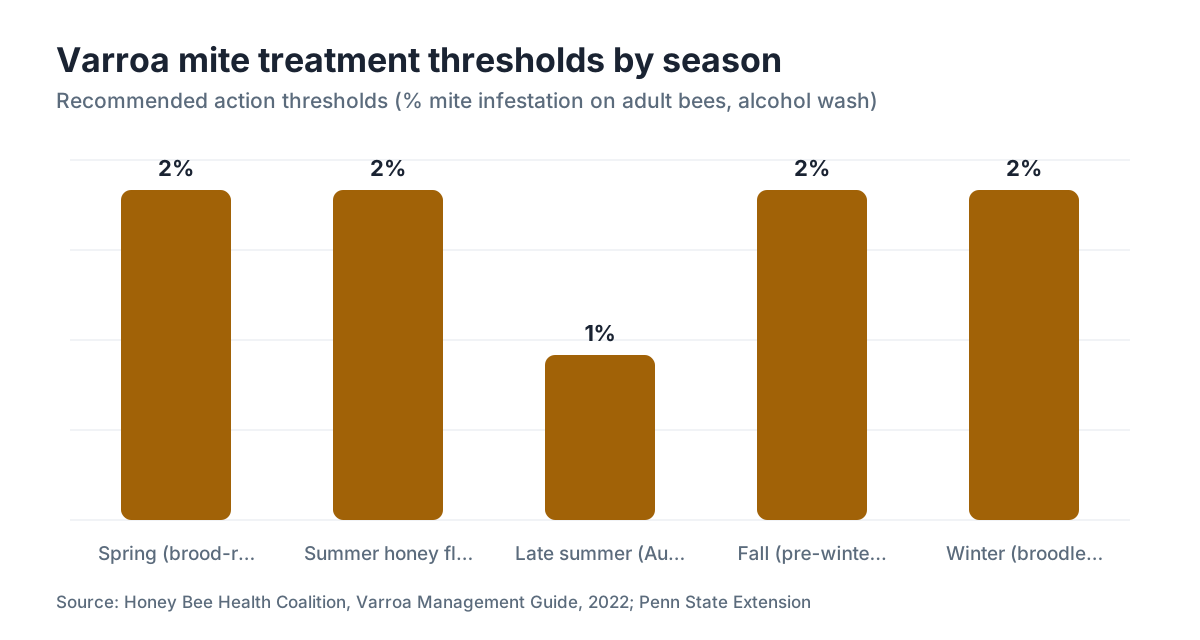
The Honey Bee Health Coalition's Varroa Management Guide puts the economic injury threshold near 2% during the brood-rearing season and recommends treating at or before that point to head off collapse [1]. A merger that crosses that line isn't a rescue. It's a way to lose two colonies instead of one.
Brood matters as much as adult bee counts. Varroa reproduces inside capped cells, so a frame of sealed brood from a mite-heavy hive is a timed-release mite bomb. Those in-cell mites don't show up on an alcohol wash or a sugar roll, and they'll emerge fully reproductive into your previously healthy colony over the next 12 days [2]. Work published in Apidologie found that colonies carrying more than about 1,500 mites (roughly 3% on a colony of 50,000 bees) showed measurable virus titer increases within a single brood cycle [3].
The math is unforgiving. Treat before you combine, never instead of treating.
Why does a 2-3% mite level signal real danger for the receiving colony?
Varroa doesn't kill bees mostly by feeding. It suppresses the immune system and vectors deformed wing virus (DWV) and a handful of other pathogens while feeding on developing pupae [2]. A colony that looks fine at 2% often shows crumpled DWV wings within 4-6 weeks, because the newly emerging bees were already damaged by in-cell mite feeding before they ever chewed their way out.
The Honey Bee Health Coalition's guide is blunt: colonies with mite levels above 2% during the honey flow period are at significant risk of collapsing before winter [1]. That threshold isn't arbitrary. It marks the point where varroa's reproductive rate outpaces the colony's ability to replace healthy bees.
A strong receiving colony already carries some mite pressure just by living through a normal season. Add the weak colony's mites and you compress the timeline hard. Beekeepers who watch a vigorous hive go from thriving to dead in six weeks almost always find, on honest review, that levels were already climbing and something (a merge, a robbing spree, a neighboring collapse) pushed the load over the edge.
The brood pattern falls apart faster than you'd expect. Varroa-vectored viruses impair nurse bee behavior, larval feeding quality drops, and the colony struggles to rebuild even after you treat [3].
How bad can mite drift and robbing from a dying colony get?
You don't have to combine colonies to move a mite problem. A collapsing hive becomes a robbing target on its own. Strong colonies send foragers in to steal the honey, and those foragers come home carrying hitchhiker mites. Research summarized by the USDA Agricultural Research Service shows robbing events can move hundreds of mites per day from a dying colony into neighboring hives [4].
Sit with that for a second. If a weak, unmanaged colony is parked in your apiary right now, your strong colonies are probably already pulling mites out of it through robbing and drift. The question was never whether to act. It's whether a treated merge, a full combine-and-treat, or euthanizing the weak colony makes the most sense.
One collapsing mite-bomb hive can drag a hobbyist yard of 4-10 colonies into crisis inside a single season. Sideliners lose whole apiaries this way. The plain term is a "mite bomb," and extension apiculturists at Penn State use it specifically for this robbing-transfer scenario [5].
Reducing the weak colony's entrance to a one or two bee width cuts robbing pressure, but it's a stopgap. It buys you a week or two to make a real decision. It isn't the decision.
Should you ever combine a varroa-infested colony with a strong one?
Sometimes, yes. The order of operations is what saves you.
Step one: treat the weak colony. Don't combine first. Run an oxalic acid vaporization or an approved miticide that fits the season. If the weak colony holds a lot of capped brood, a single OA treatment won't touch the mites in cells, so reach for an extended-contact product like oxalic acid in glycerin strips or a synthetic acaricide with residual activity [1]. Wait until mite wash counts fall below 1%, ideally below 0.5%, before you think about merging.
Step two: figure out why the colony is weak. Queenless and shrinking means low population, high mites, and no brood break to slow mite reproduction. That's a candidate for euthanasia or hard treatment plus a requeen, not a quick merge into your best hive.
Step three: treat the receiving colony at the same time. Combine without treating both and the strong hive's own mite load runs wild through the disruption of the merge and the population bump. Both colonies need a mite wash 2-4 weeks after combining to confirm the level didn't spike [1].
When you do combine, use the newspaper method or a screened divide and let the colonies join slowly. The slow join cuts fighting losses and gives you a day or two to change your mind if something looks off.
VarroaVault's free mite tracking tools let you log alcohol wash results over time and flag when counts cross thresholds, which turns that pre-merge call into something less like a guess.
What treatment should you use on the weak colony before combining?
The right treatment depends on the season, whether a honey super is on, and whether the colony has capped brood. Here's how the common options stack up.
| Treatment | Works in brood | Honey super safe | Temp range | Application notes |
|---|---|---|---|---|
| Oxalic acid vapor (OA) | No (broodless only for max efficacy) | Yes (no super on) | Above 50°F | Multi-treatment in winter broodless period most effective |
| Oxalic acid dribble | No | No | Above 50°F | One-time; broodless colonies only |
| Formic acid (MAQS/Formic Pro) | Yes | See label | 50-85°F | Can cause queen loss above 85°F |
| Apiguard / ApiLife VAR (thymol) | Partial | No | 60-105°F | Slower; good late summer |
| Apivar (amitraz strips) | Yes | No | Above 50°F | 42-56 day treatment; rotate to avoid resistance |
| HopGuard 3 (hop beta acids) | Partial | Yes | No temp limit | Lower efficacy than synthetics |
For a weak colony you plan to combine within a few weeks, formic acid (Formic Pro or MAQS) is often the right call in summer and early fall. It reaches mites in capped brood, it's EPA-registered, and it works inside the 7-day MAQS window or the 14-day Formic Pro window [6]. That lets you combine on a reasonable timeline instead of waiting out a 42-day Apivar course.
In late fall or winter with a broodless cluster, oxalic acid vaporization is the strongest option and the one most university extensions point to for low-brood or broodless conditions [5][7]. Three OA vapor treatments spaced 5 days apart in a broodless colony can knock mite loads down by 90-95% [7].
Read and follow the current EPA-registered label. The label is the law under FIFRA [8]. Dosing, temperature limits, and honey super rules shift between product versions, so don't trust an old memory of how a product worked.
What's the risk to the strong colony's genetics and queen?
A combine doesn't only move mites. It sets up a fight over who runs the hive. The stronger colony's queen usually wins, but not always. If the weak colony is queenright, cage or remove that queen before combining, or let the bees settle it through the newspaper method (they nearly always kill the weaker queen, but a queen battle during heavy mite pressure is a bad pairing).
Here's the sneakier problem. Even if the strong queen survives, the combined population now includes bees raised under heavy mite pressure in the weak hive. Some of them carry DWV or sacbrood. They won't magically recover in a cleaner house. The virus is already expressed in their bodies. As those old weak-colony bees die off over 4-6 weeks and the surviving queen's brood replaces them, the health picture should improve, but that handoff period is a window of real vulnerability [3].
If your strong colony has a queen with known hygienic or varroa-sensitive hygiene (VSH) traits, adding thousands of non-VSH bees doesn't change the genetics of her offspring. It does temporarily drag down colony-level hygienic behavior, because a chunk of the workforce (nurse bees from the weak colony) doesn't share that behavior. You can read more about varroa biology and why the colony-level response matters in our varroa mite overview.
How do you monitor mite levels before and after a merge?
Alcohol wash is the standard. Pull a half-cup sample (roughly 300 bees) from the brood nest area of each colony, shake in 70% isopropyl alcohol, count the mites, divide by bee count, and multiply by 100 for the percentage [1]. Do it for both colonies before you decide to combine. Do it again 2-3 weeks after.
Sugar rolls are gentler on the bees, but they undercount mites by 30-40% next to an alcohol wash, so they're not reliable enough for a call this heavy [5]. Sticky boards measure mite fall and give you trend lines, but they don't tell you the actual infestation rate.
What numbers trigger action? Penn State Extension recommends treating at 2% during the brood-rearing season and at 1% in late summer (August-September), because that's when mite populations climb fastest and winter bees start developing [5]. The Honey Bee Health Coalition lands on similar thresholds [1].
If the weak colony washes above 3%, treat it before anything else. Period. Above 5%, ask whether combining makes any sense, or whether euthanizing the colony and freezing its brood frames (which kills all the mites in cells) protects the apiary better.
Wash several hives together and you start seeing apiary-level mite pressure, which is honestly the more useful view. Beekeepers sorting out gear can find sampling jars and testing kit through beekeeping supply companies that sell quality tools.
What are the signs that a colony is too far gone to save through combining?
A handful of signs tell you the weak colony is past the point where a merge helps.
Bees with deformed, crumpled wings crawling at the entrance or on the landing board. That means DWV is already expressed at scale. Those bees won't recover.
A population too small to hold brood nest temperature. Chilled brood, spotty capping, or larvae dying in open cells mean the colony can't support itself, and its contribution to a merge is mostly sick bees and mite-loaded frames.
A mite wash above 6-8%. At that level the colony is in collapse, and combining it into a healthy hive is more likely to kill the healthy hive than save anything.
No queen, no eggs, high mites, low population. Laying workers may have set in. This colony has nothing to add genetically, and every bee in it is a mite taxi.
In these cases the responsible move is to pull the colony from the apiary, freeze all brood frames for at least 48 hours (which kills the mites in capped cells), and either clean the equipment or retire frames older than 3-4 years. This is hard. Nobody enjoys writing off a colony. It's still the call that protects the rest of your bees.
Does the time of year change how risky the combination is?
Yes, and late summer is the worst window for it.
Across most of North America, August and September are when colonies raise the long-lived winter bees that have to last until spring. Those bees live 4-6 months against a summer bee's 6-week run. A mite feeding on a winter bee pupa during development can wreck fat body growth, protein storage, and immune function. Research in PLOS ONE found that winter bees from high-mite colonies carried significantly lower vitellogenin levels, a protein tied to winter survival, than bees from treated colonies [9].
Combine a mite-laden colony in August or September and you're doing more than gambling on this season. You may be compromising next spring's population, because the winter bees being raised right now are the colony's bridge to next year.
Spring merges carry lower immediate risk, but only if both colonies are treated first, because the brood cycle is expanding and there's a whole season to rebuild. Merging an untreated mite-heavy winter survivor into a clean nuc or package is still a bad idea, for the same additive-load reason.
Winter merges of broodless clusters are actually the safest timing, assuming both colonies get treated first with OA vaporization. No capped brood in either colony means no in-cell mites to transfer, and OA works best when the bees are broodless anyway.
What should you do with the equipment from the weak colony after combining?
Drawn comb from a mite-heavy colony isn't safe to reuse right away. Any capped brood frames still hold live mites. Freeze them for 48-72 hours, then store or use them. The cold kills varroa and leaves the comb intact.
Old dark comb (4+ years, many brood cycles) from a collapsing hive is worth retiring for good. Propolis and cocoon residue packed into old cells can hold pathogen spores, and wax quality drops with each recycle. Rendering old comb and dropping in fresh foundation is good practice regardless, and a collapsed colony's frames are a fine place to start a comb rotation [5].
Hive bodies, covers, and bottom boards carry far less risk. Scrape off propolis and burr comb, scorch the interior lightly with a torch if you have one, and let them air out. Varroa doesn't survive off bees for more than a day or two, so woodenware that's sat empty for a week is clean of live mites.
Don't stack empty gear from a collapsed hive next to a healthy colony. Residual honey smell invites robbing, and that's the robbing-transfer-mite scenario all over again.
How does this fit into a full varroa management protocol?
The combining question rarely shows up on its own. It surfaces because someone missed rising mite levels, caught them and stalled on treatment, or inherited a colony mid-season with no history. That context matters, because the real fix lives upstream of the crisis.
The Honey Bee Health Coalition recommends checking mite levels at least monthly through the brood-rearing season and treating before counts hit 2% [1]. That cadence catches the problem while treatment is still simple and long before you're staring at a collapsing-colony decision.
Running several hives, a year-round rhythm usually looks like this: a spring mite wash once the first brood frames are capped, a treatment decision from those results, a late-summer treatment regardless of counts (to protect the winter bees), and a winter broodless OA treatment for any hive that went into fall with elevated counts [1][5]. Follow that and you're almost never stuck with one hive at 6% mites while another sits clean.
VarroaVault's free protocol tools let you build and schedule that monitoring cadence for each hive, which makes it easier to spot a strong colony and a weak colony diverging before the weak one turns into a mite bomb.
Starting out? Mite testing gear, including good sampling jars and rubbing alcohol from beekeeping supplies, is cheap and honestly the highest-return money you can spend on hive health.
Frequently asked questions
Can I combine a weak mite-infested colony with a strong one without treating first?
No. Combining without treating first transfers the weak colony's full mite population straight into your strong hive. Mite loads add up, they don't average. The Honey Bee Health Coalition puts the treatment threshold at 2% during the brood season, and merging an infested colony can push a healthy hive past that line in a single day. Treat the weak colony first, confirm counts drop below 1%, then evaluate the merge.
What mite percentage is too high to safely combine colonies?
There's no firm universal cutoff, but most extension apiculturists would call a colony washing above 3-4% too risky to combine without treating first. Above 6%, the colony is likely collapsing and combining it is more likely to kill the receiving hive than save anything. Treat first, retest in 2-3 weeks, and only combine if the count drops below 1-2%.
How long should I wait after treating before combining the two colonies?
For formic acid products (MAQS or Formic Pro), the treatment window runs 7-14 days, after which you can run an alcohol wash. If counts sit below 1%, combining is reasonable. Apivar (amitraz strips) needs a full 42-56 day course, which may be too long if the colony is fading fast. Oxalic acid vapor in a broodless colony works fastest, three treatments over about 15 days.
Will the mites from a merged colony hurt the strong hive's genetics?
They won't change the queen's genetics, but they can drag down colony-level hygienic behavior for a while. Bees from the weak colony that grew up under mite pressure may already carry deformed wing virus. As those bees die off over 4-6 weeks, the surviving queen's offspring gradually take over the population and the health picture improves, assuming mite loads have been cut by treatment.
Is it better to euthanize a mite-bombed colony than combine it?
Sometimes, yes. If the weak colony washes above 5-6%, shows visible deformed wing virus, has no queen, and low population, euthanasia protects the rest of your apiary. Remove the colony, freeze all brood frames for 48-72 hours to kill in-cell mites, and clean the equipment. It's a harder call emotionally, but often the right one for the yard as a whole.
Can robbing bees from a collapsing colony spread mites to my other hives without a merge?
Yes. A dying mite-heavy colony is a robbing target, and foragers coming back from a robbing spree bring mites home. USDA research notes robbing events can transfer hundreds of mites per day. Reducing the weak colony's entrance to one or two bee widths slows this, but it's a short-term measure. Treating or removing the colony is the real fix.
What's the best time of year to combine a treated weak colony with a strong one?
Winter, during the broodless period, is actually the safest window if both colonies are treated first. With no capped brood in either colony, there are no in-cell mites to transfer, and oxalic acid vaporization works best when bees are broodless. Late summer is the riskiest time, because any mite influx damages the winter bees being raised right then, the bees that have to survive until spring.
How do I monitor mite levels accurately before deciding to combine?
Use an alcohol wash. Pull a half-cup sample (roughly 300 bees) from the brood nest area, shake in 70% isopropyl alcohol, count the mites that drop out, and divide by bee count for a percentage. Sugar rolls undercount mites by 30-40% and aren't reliable enough for this call. Wash both colonies, and wash again 2-3 weeks after combining to confirm counts didn't spike.
Do I need to remove the weak colony's queen before combining?
Yes, if the weak colony is queenright. Cage or remove her before combining, or the bees fight and the losing queen's death adds stress during an already vulnerable stretch. If the weak colony is queenless, no action needed there. The newspaper method gives the colonies a day or two to adjust before full contact, which cuts fighting losses.
What should I do with comb frames from the mite-infested weak colony?
Freeze any capped brood frames for 48-72 hours before using them. The cold kills varroa in capped cells. Old dark comb (4+ years, many brood cycles) from a collapsing hive is worth retiring rather than reusing. Clean and scorch hive bodies and woodenware before reuse. Don't stack empty equipment near healthy hives, since the honey smell can trigger robbing.
Can a strong colony's hygienic behavior overcome mites introduced by combining?
Partially, but it's no cure. Colonies with VSH (varroa-sensitive hygiene) genetics remove some mite-infested pupae before the mites reproduce, but no colony hygienes its way out of a 4-6% mite load without help. Hygienic behavior buys time and slows mite growth; it doesn't replace treatment. Count on treatment, not behavior, as your primary control.
How do I know if the weak colony's bees are already compromised by deformed wing virus?
Look at the landing board and the ground just outside the entrance. Bees with visibly crumpled, stubby, or misshapen wings are expressing DWV. Watch for crawling bees that can't fly, too. Once you see these signs at scale, the colony's health is badly compromised. Those bees won't recover in a better home, and they'll die within days of emerging no matter where they live.
Is there any scenario where combining without treating first makes sense?
Very rarely, and even then it's a compromise, not best practice. If a colony has crashed so fast that no living bees can be treated effectively and all you have left is comb and a few bees, the decision shifts to salvaging equipment. Freeze the brood frames before adding them to any hive, and treat the receiving colony immediately and hard. Combining untreated is never the plan; it's the last-resort fallback.
Sources
- Honey Bee Health Coalition, Varroa Management Guide (2022): Treatment threshold of 2% mite infestation during brood-rearing season; recommendation to monitor monthly; statement that colonies above 2% during honey flow are at significant risk of collapsing before winter
- USDA ARS, Varroa destructor biology and vectoring of deformed wing virus: Varroa feeds on developing pupae, suppresses immune function, and vectors deformed wing virus; mites inside capped brood cells emerge fully reproductive within 12 days
- Apidologie, journal article on mite load and virus titer in honey bee colonies: Colonies with more than approximately 1,500 mites showed measurable DWV titer increases within a single brood cycle; varroa-vectored viruses impair nurse bee behavior and larval feeding quality
- USDA Agricultural Research Service, robbing behavior and mite transfer between colonies: Robbing events can transfer hundreds of mites per day from a collapsing colony to neighboring hives
- Penn State Extension, Varroa Mite Management: Treatment recommended at 2% during brood season and 1% in August-September; sugar rolls undercount mites by 30-40% compared to alcohol wash; old dark comb retirement and OA vaporization for broodless colonies recommended
- EPA, Formic Pro and MAQS pesticide registration documents: Formic acid products Formic Pro (14-day) and MAQS (7-day) are EPA-registered miticides effective against mites in capped brood; temperature restrictions apply above 85°F
- University of Minnesota Extension, Oxalic Acid Treatment for Varroa Mites: Three OA vapor treatments spaced 5 days apart in a broodless colony can reduce mite loads by 90-95%; OA vaporization most effective in late fall or winter broodless period
- EPA, Federal Insecticide, Fungicide, and Rodenticide Act (FIFRA) pesticide labeling: Pesticide labels are legally enforceable under FIFRA; dosing, temperature restrictions, and honey super rules must be followed as stated on the current registered label
- PLOS ONE, Varroa mite infestation and vitellogenin levels in winter honey bees: Winter bees from high-mite colonies had significantly reduced vitellogenin levels compared to bees from treated colonies, impairing fat body development and winter survival capacity
- University of California Agriculture and Natural Resources, Honey Bee Pest Management: Varroa management and monitoring protocols for hobbyist beekeepers; guidelines on brood comb rotation and equipment sanitation after colony loss
Last updated 2026-07-09