First year beekeeper varroa management schedule: a month-by-month guide
TL;DR
- Varroa mites can kill a first-year colony before winter if you ignore them from May on.
- Test with an alcohol wash or sugar roll every 4-6 weeks starting one month after you install bees.
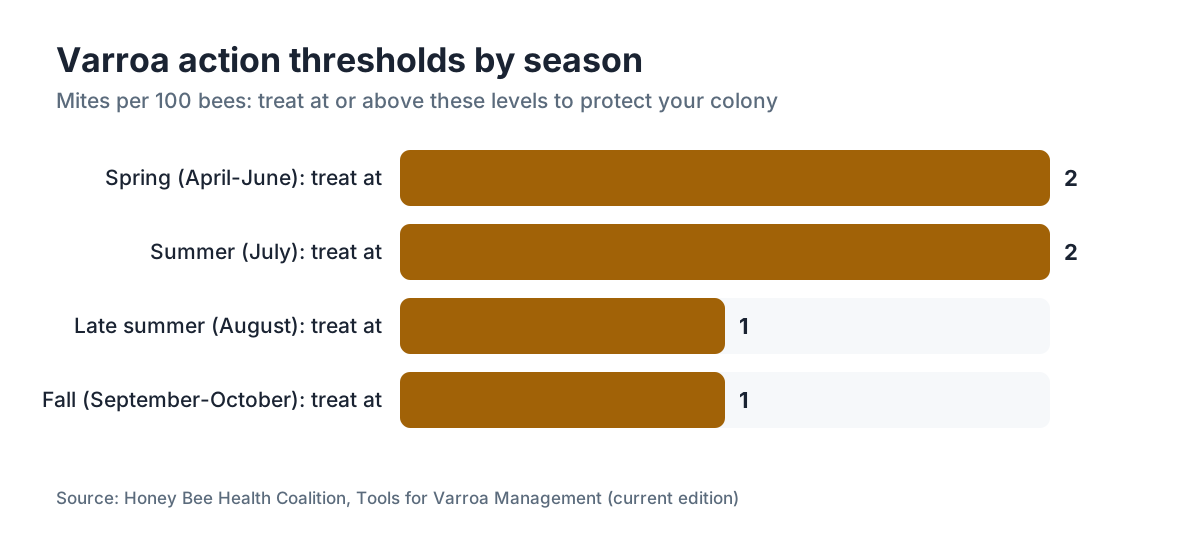
- Treat when mites hit 2 per 100 bees, or 1 per 100 from August onward.
- Most first-year colonies need at least one late-summer treatment.
- Miss that window and you lose the hive.
Why does varroa matter so much in your first year?
Most new beekeepers kill their first colony by doing nothing about varroa until it's too late. That sounds harsh. The data backs it up. The Honey Bee Health Coalition ties varroa-related losses to a large share of the roughly 40% annual colony loss rates U.S. beekeepers have reported in recent years [1].
Your first year is the riskiest one, and here's why: you're learning everything at once. You're still figuring out how to find the queen, how to read brood patterns, how to keep your smoker lit. Varroa monitoring feels like one more complicated chore, so it slides. Meanwhile mite populations roughly double every month during peak brood season, and a colony that looks great in June can be collapsing by September.
The good news is the actual job is simple. Test on a schedule. Treat when the number crosses the line. Write down what you did. That's it. This guide walks you through it month by month so you always know the next move.
One definition before we start. Varroa mites are external parasites that feed on honey bee fat bodies and carry viruses like Deformed Wing Virus. They breed inside capped brood cells, so the mites crawling on adult bees are only about 30% of what's actually in the hive at any moment [2]. That gap between what you see and what's really there is exactly why eyeballing a frame doesn't work. You need a count.
What testing method should a beginner use for varroa?
Two methods earn their keep: the alcohol wash and the sugar roll. A sticky board tells you mites exist but not how many per 100 bees, so it hands you nothing you can act on. Skip it as a primary tool.
The alcohol wash is the accurate one and it takes about 10 minutes. Scoop roughly 300 bees (about half a cup) off a brood frame, drop them in 70% isopropyl alcohol, shake 30 to 60 seconds, pour through a mesh strainer, and count the mites in the liquid. The bees die. That bothers a lot of beginners, but 300 bees out of a colony of 50,000 is a rounding error. The Honey Bee Health Coalition's Varroa management guide calls the alcohol wash the gold standard for accuracy [2].
The sugar roll swaps powdered sugar for alcohol. Same bee sample, two tablespoons of powdered sugar, roll the jar for two minutes, dump onto a white surface, count. The bees live. The catch: sugar rolls consistently undercount by 25 to 40% next to alcohol washes in university comparisons [3]. If you sugar roll, bump your count up in your head.
For a first-year beekeeper, I'd use the alcohol wash. It sounds scarier and it isn't. It gives you a number you can trust, and a number you can trust is the only kind worth having.
The math is easy. Divide the mite count by the bees sampled (usually 300), multiply by 100, and you get mites per 100 bees. Two or higher means treat. Some researchers push for a threshold of 1 per 100 bees in late summer (July and August), because mite loads climb fast while the colony's own population starts shrinking into fall [2].
What is the month-by-month varroa schedule for year one?
The schedule below assumes a temperate Northern Hemisphere spot (most of the U.S. outside Florida and the Deep South) with bees installed in April or May. Shift it 4 to 6 weeks earlier in a warm climate where bees never fully stop raising brood.
| Month | Action | Threshold to treat |
|---|---|---|
| April (install) | No testing yet; let colony establish 30 days | N/A |
| May | First alcohol wash test | Treat at 2+ mites per 100 bees |
| June | Second test | Treat at 2+ mites per 100 bees |
| July | Third test; this one matters a lot | Treat at 2+ mites per 100 bees |
| August | Fourth test; critical window | Treat at 1+ mites per 100 bees |
| September | Fifth test; last effective oxalic acid window if brood present | Treat at 1+ mites per 100 bees |
| October/November | One extended-release oxalic acid treatment after brood break (or when brood is minimal) | Treat regardless of count if you skipped September |
| December-March | No broodless OAV if colony is actively clustering; monitor for winter bee health | N/A |
July and August is where most first-year beekeepers get burned. Mite loads peak in late summer at the exact moment the colony starts raising its long-lived winter bees. Winter bees reared in cells crawling with varroa emerge damaged by Deformed Wing Virus, and damaged winter bees don't survive to spring. A colony that looks healthy in July can be dead by January for this one reason [4].
So don't skip the August test. Don't tell yourself the bees look fine. Fine means nothing without a number.
Which varroa treatments are legal and safe for a first-year hive?
Every varroa treatment sold in the U.S. has to be EPA-registered, and federal law requires you to follow the label directions [5]. The label is a legal document, not a suggestion. Inside those rules, the options are beginner-friendly enough.
Oxalic acid (OA) is the easiest entry point for new beekeepers. Two forms: a vaporizer (sublimation) that fills the hive with vapor, and a dribble (trickle) applied straight over the bees. Vaporized OA hammers mites riding on adult bees but doesn't reach capped brood, so it works best when the colony has little or no brood. Extended-release oxalic acid products (Api-Bioxal glycerin-soaked strips) got EPA approval around 2022 and stay active for weeks, which covers you when brood is present [5]. Api-Bioxal is the only EPA-registered oxalic acid product for honey bee hives in the U.S. as of this writing [6].
Formic acid products (Mite-Away Quick Strips, known as MAQS, and Formic Pro) penetrate capped brood, which is a real edge. You can run them with honey supers on, so they earn their spot in spring and early summer. The downside: they need temperatures between roughly 50°F and 85°F (10 to 29°C), and they can kill your queen if you apply them wrong or during a heat spike. Read the label twice on these.
Amitraz strips (Apivar) work well and go in easier than formic acid, but you can't use them with honey supers on. They need 6 to 8 weeks of contact time in the hive. Amitraz resistance is a growing worry in some regions, though not yet widespread across the U.S. [7].
Thymol products (ApiLife Var, Apiguard) work too, but they're highly temperature-dependent and generally fussier to manage. I wouldn't start a first-year beekeeper on thymol.
My actual recommendation for most first-year beekeepers in North America: keep oxalic acid vaporizer supplies on hand, and have Formic Pro or MAQS ready for a summer treatment when supers are on and brood is present. That covers nearly every situation you'll hit.
How do you treat varroa in a package or nuc colony you just installed?
Wait. Seriously, wait a month.
A freshly installed package has no capped brood for the first week or two, because the queen hasn't hit her stride yet. In theory you could run an oxalic acid treatment during that broodless window and knock down a pile of mites. Some experienced beekeepers do exactly that. But poking a stressed, newly installed colony before it settles is a fine way to lose or crush a queen during an inspection you didn't need to do.
Install in April, give the colony 30 days, do your first test in May. By then you have capped brood and a real read on how things are establishing. If that first test comes back under 2 mites per 100 bees, good, test again in June. At 2 or above, treat.
Nucs are different. A nucleus colony usually starts with more mites than a package because it arrives with established brood already carrying them. Test a nuc at installation, or within two weeks of it, instead of waiting the full 30 days. A nuc that reads above 2 per 100 bees on arrival gets treated right away.
What varroa count is too high, and when should you treat immediately?
The action threshold from the Honey Bee Health Coalition and most university extension programs is 2 mites per 100 bees in spring and summer, dropping to 1 mite per 100 bees from August on [2]. Those numbers come from research on colony survival, not from a gut feeling.
Some beekeepers hold out until 3 or higher and get away with it. But stretching the threshold in August or September is a bet against your winter bees, and losing your winter bees means losing the hive. I wouldn't take that bet.
Above 5 mites per 100 bees at any point in the season, the colony is in real trouble. Treat immediately and rethink how often you're monitoring. Above 10 per 100 bees, the colony may already carry virus damage that no treatment can undo.
In untreated colonies, varroa can double every 15 to 30 days during peak brood season [4]. That's not a slow creep you watch casually. A hive at 1.5 mites per 100 bees in late June can sit at 5 or 6 per 100 by mid-August if you skip one test. Test on schedule.
How do varroa mites spread between hives, and what does that mean for your schedule?
Varroa move between colonies two main ways: drifting bees (bees that land in the wrong hive) and robbing (strong hives raiding weak ones for honey). Both are common, and both mean your neighbor's untreated hive is a direct threat to yours.
Robbing season in late summer (August and September) lines up almost exactly with the period when mite loads run highest in untreated colonies. A collapsing, high-mite hive gets robbed by healthy colonies nearby, and the robbers haul mites home. Beekeepers call it a mite bomb, and it's as bad as it sounds. Your hive can go from clean to infested in a few weeks during robbing season [2].
This is why the August test is non-negotiable even when your June test came back clean. You have zero control over what other beekeepers around you are doing, or not doing. If you belong to a local club, get a feel for how seriously the group takes monitoring. A cluster of new beekeepers in one neighborhood can build a reinfestation loop that keeps everyone's numbers high.
Reducing hive entrances during late-summer robbing season slows the spread. So does never leaving empty comb or honey sitting out. These are hygiene basics, not replacements for testing and treating.
What records should a first-year beekeeper keep for varroa management?
At minimum: test date, method used, number of bees sampled, mite count, the calculated rate (mites per 100 bees), and any treatment (product name, dose, application date, removal date).
This looks like paperwork. It's actually your early warning system. Mite data only means something as a trend. One number tells you where you stand. A string of numbers tells you whether you're winning or losing. If your rate went 0.8 in May, 1.9 in June, 3.5 in July, that line tells you plenty: the population is climbing fast, a treatment underperformed, or both.
Keep records in whatever format you'll actually open again. A notes app, a paper hive log, a spreadsheet. VarroaVault has free digital tracking tools that log test results and flag when you hit an action threshold, which helps once you're running more than one hive or trying to remember what you did three months ago.
Getting your beekeeping supplies organized from day one, including a record sheet clipped inside your kit, makes it far more likely you fill it out on inspection day instead of promising yourself you'll remember.
How do you prepare your varroa treatment schedule for winter?
Late fall treatment is probably the most important treatment of the year, and it's the one many new beekeepers skip because the bees look fine heading into October.
Here's the October picture across most of the U.S.: the colony has slowed or stopped brood rearing. Mites that were hiding in capped cells are now almost all riding on adult bees. That's the best possible moment for oxalic acid vaporization, because OA vapor kills mites on adults at high efficacy (85 to 95% or better) and there's no brood left to shelter them [6].
For an OAV treatment in a broodless or near-broodless hive, the standard protocol is 3 treatments spaced 5 days apart. Some beekeepers do a single treatment. Research suggests multiple rounds give better knockdown when you can't be sure every brood cell has hatched [2].
If your colony still has active brood in October (common in warm climates, or with Carniolans that ramp up fall brood), extended-release OA strips are the better call because they keep working as brood hatches.
After the fall treatment, do a wash a week later to confirm it worked. If you're still reading 1+ mites per 100 bees, run the series again before the bees cluster. A hive going into December carrying high mite loads almost never sees spring.
In truly warm climates where bees never stop raising brood, the late-fall broodless window never opens. You lean on extended-release products year-round, and your whole calendar shifts. Ask your local cooperative extension office for regional guidance [8].
What are the most common varroa mistakes first-year beekeepers make?
Skipping the August test. This one is so common it deserves its own article. The most dangerous stretch for mite growth overlaps with the busiest weeks for hobby beekeepers (late honey flow, extracting, end of summer). People miss the August window, then wonder why the hive is dead in January.
Using the wrong treatment for the conditions. Vaporizing oxalic acid over a colony packed with brood kills only the mites on adults. Maybe 30% of the total. You feel like you treated. You actually left 70% of the mites alive. Match the product to your hive's brood status.
Treating once and calling it solved. A good treatment drops mites by 85 to 95%. Start at 3 per 100 bees and you might land at 0.2. Great. But mite populations rebound. Test 4 to 6 weeks after treatment to confirm you're still under threshold.
Not testing at all, just treating on a calendar. The opposite mistake. People dose every 6 weeks no matter what. Treatment without monitoring means you're either under-treating (your threshold got crossed weeks before the scheduled dose) or over-treating (dumping chemicals in when mites are genuinely low). Both cost you. Amitraz resistance is real, and overusing any miticide speeds resistance along [7].
Buying "varroa resistant" bees and then doing nothing. VSH (Varroa Sensitive Hygiene) and similar traits lower mite reproduction. They don't erase varroa. You still test. The University of Minnesota's bee lab documents this plainly: VSH colonies still need monitoring, just less frequent treatment [9].
What should you budget for varroa testing and treatment supplies in year one?
New beekeepers sometimes cut corners here because year one already drains the wallet. Between the hive, the bees, the suit, and the tools, you can drop $300 to $600 before you ever crack a lid. Varroa supplies on top of that feel like one more line item.
Here's the math that matters: a dead colony costs you 100% of that investment. Testing and treatment supplies cost a sliver of it.
| Item | Approximate cost |
|---|---|
| Isopropyl alcohol (70%), 32 oz | $3-6 |
| Mesh sample jars (DIY or purchased) | $5-15 |
| Oxalic acid vaporizer (basic models) | $30-80 |
| Api-Bioxal OA solution (35g packet) | $20-30 |
| Formic Pro (2 strips) | $12-18 |
| Apivar strips (10 pack) | $25-40 |
| Hive record logbook | $5-10 |
You don't need all of this at once. For year one, I'd buy an alcohol wash kit (a jar, some mesh, a bottle of isopropyl), one package of Api-Bioxal or Formic Pro for a summer treatment if the count calls for it, and either buy or borrow an OA vaporizer for fall. Total spend: roughly $50 to $100 if you borrow the vaporizer, $80 to $180 if you buy one.
Some local clubs and extension programs loan OA vaporizers to members. Ask before you buy. You might also find used ones at a local beekeeping supply companies meetup or swap.
To compare pricing before you order, check delivery options at free shipping honey bee supply companies.
Where can first-year beekeepers get reliable varroa management guidance?
Start with the Honey Bee Health Coalition's "Tools for Varroa Management" guide. It's free, peer-reviewed, and updated regularly. The current edition states: "Monitoring mite levels is the most important action a beekeeper can take to prevent colony losses from Varroa" [2]. Print that sentence and tape it to your hive box.
Your state cooperative extension service is the next stop, and many publish region-specific treatment calendars. Virginia Tech, Penn State, UC Davis, and the University of Minnesota all run active apiculture programs with free online materials [8][9][10].
The EPA's pesticide registration database lists every legally registered varroa treatment. That matters the day someone on a forum tells you to try something you've never heard of. If it's not on that list, it doesn't go in your hive [5].
Local mentorship is underrated. An association that pairs new beekeepers with experienced mentors can spot varroa problems in person that are hard to diagnose from a photo. Find associations through the American Beekeeping Federation or your state's department of agriculture [11].
VarroaVault's free protocol tools build a personalized treatment calendar from your region, install date, and hive type, so you get reminders instead of relying on memory during a packed season.
Frequently asked questions
When should I do my first varroa test on a new package?
Wait about 30 days after installing a package before testing. The colony needs time to establish, and testing too early stresses a fragile new hive. Your first alcohol wash should land around one month post-install, usually May if you installed in April. For a nuc, test sooner, within two weeks of installation, because nucs arrive with established brood and often carry higher starting mite loads.
How often should I test for varroa in my first year?
Every 4 to 6 weeks during the active season (May through October). That's roughly 5 to 6 tests in your first year. Never skip the August test, which catches the late-summer mite surge that arrives just as your colony raises its winter bees. Test more often if your count is trending upward, or right after a treatment to confirm it worked.
Can I use any oxalic acid product in my hive, or does it have to be Api-Bioxal?
In the United States, Api-Bioxal is the only EPA-registered oxalic acid product legal for honey bee colonies. Using unregistered oxalic acid, like the wood bleach sold for deck cleaning, violates federal pesticide law even though the active ingredient is chemically identical. The label is the law. Stick with Api-Bioxal to stay compliant and protect yourself legally.
Do I need to remove honey supers before treating for varroa?
It depends on the treatment. Oxalic acid (Api-Bioxal) requires super removal. Formic acid products (MAQS, Formic Pro) are labeled for use with supers on, a real practical advantage during honey flow. Apivar (amitraz) requires super removal. Always read the current label before applying anything; label requirements can change between product editions.
My varroa count was 0.5 per 100 bees in May. Do I still need to test in June?
Yes. Mite populations can double in 15 to 30 days during peak brood season. A 0.5 reading in May can become 1.5 or 2.5 by late June with no visible warning in the hive. A single clean test doesn't clear you for the season. Keep testing every 4 to 6 weeks through October.
What is a mite wash and how do I do one?
An alcohol wash (also called a mite wash) is the most accurate varroa counting method. Collect about 300 bees (half a cup) from a brood frame, put them in a jar with 70% isopropyl alcohol, seal and shake 30 to 60 seconds, pour through a mesh strainer onto a white plate, and count the mites in the liquid. Divide mite count by bees sampled, multiply by 100, and you get mites per 100 bees.
Is a sugar roll accurate enough for varroa monitoring?
Sugar rolls are less accurate than alcohol washes, consistently undercounting by roughly 25 to 40% in comparative studies. They work in a pinch and the bees survive, but if your sugar roll shows 1.5 mites per 100 bees, your real count is probably closer to 2 to 2.5. For a beginner who needs reliable numbers to make treatment calls, the alcohol wash wins despite the small bee loss.
Can varroa mites kill a first-year colony before winter?
Yes, and it happens more than new beekeepers expect. Left unmanaged from June on, a colony can hit population collapse by September or October, before any cold arrives. Deformed Wing Virus, carried by varroa, destroys worker bees and eventually the colony's ability to keep its numbers up. Many hives that "mysteriously" die in fall were killed by varroa all summer.
Should I treat varroa if I plan to harvest honey this year?
Most first years produce little honey anyway, because new colonies spend their energy on comb and population. But if you do have supers on, use a treatment labeled for supers present, like Formic Pro or MAQS. Never apply Apivar or oxalic acid with honey supers on. Pull supers before those treatments, wait the full label withdrawal period, then put them back.
How do I know if my varroa treatment worked?
Do an alcohol wash 5 to 7 days after finishing a treatment (or after the treatment period ends for extended-contact products). If your count dropped below 1 per 100 bees, it worked. If mites still sit at or above 2 per 100 bees, retreat or switch products. Record both the pre- and post-treatment counts; that data tells you which products work against your local mite population.
Do I need to worry about varroa resistance to treatments?
Amitraz (Apivar) resistance has been documented in some U.S. and European mite populations, though it's not yet widespread. Incomplete treatments and reusing the same chemical class speed it up. Rotating between chemical classes (amitraz, formic acid, oxalic acid) and always treating for the full labeled duration lowers the risk. Oxalic acid resistance has not been documented in field populations in current literature.
What happens if I just don't treat varroa my first year?
In most cases the colony dies by winter or early spring. Without treatment, varroa in a typical colony reach killing levels within one to two brood cycles of exponential growth. The Honey Bee Health Coalition documents that untreated colonies rarely survive past their second winter, and many collapse in their first. Treatment isn't optional in modern beekeeping. It's standard care.
Are there varroa-resistant bee breeds that don't need treatment?
No breed available to hobby beekeepers is varroa-proof. Bees with VSH (Varroa Sensitive Hygiene) genetics or from treatment-free breeding programs show lower mite reproduction and may need less frequent treatment. They still need monitoring. Researchers at the University of Minnesota and elsewhere document this clearly: even VSH colonies can reach damaging mite levels if you stop watching.
What's the difference between a varroa mite infestation and a small hive beetle problem?
Two separate pests. Varroa mites are tiny reddish-brown dots on adult bee bodies and in brood cells; they weaken bees by feeding and spreading viruses. Small hive beetles are larger, dark insects that scavenge and lay eggs in comb; they usually become a major problem in warm climates with weaker colonies. You can have both at once. The monitoring and management for each are completely different.
Sources
- Honey Bee Health Coalition, Varroa management guide: Varroa-related losses contribute significantly to the roughly 40% annual colony loss rates reported by U.S. beekeepers
- Honey Bee Health Coalition, Tools for Varroa Management (current edition): Alcohol wash is the gold standard testing method; action threshold is 2 mites per 100 bees spring/summer, 1 per 100 in August onward; mites in brood cells represent roughly 70% of total population; robbing spreads varroa between colonies in late summer; multiple OAV treatments spaced 5 days apart recommended for broodless hives; 'Monitoring mite levels is the most important action a beekeeper can take to prevent colony losses from Varroa'
- University of Minnesota Extension, Apiculture program, varroa monitoring comparison: Sugar rolls undercount mites by 25-40% compared to alcohol washes in comparative studies
- Penn State Extension, Varroa mite management in honey bee colonies: Varroa populations can double every 15-30 days during peak brood season; late summer mite surge damages winter bees
- U.S. EPA, Pesticide registration for varroa treatments: Every varroa treatment sold in the U.S. must be EPA-registered and label directions are legally required to be followed; extended-release oxalic acid products were EPA-approved around 2022
- USDA Agricultural Marketing Service, Api-Bioxal registration and label: Api-Bioxal is the only EPA-registered oxalic acid product approved for use in honey bee hives in the U.S.; OAV achieves 85-95% efficacy in broodless colonies
- USDA Agricultural Research Service, Bee Research Laboratory, amitraz resistance documentation: Amitraz resistance in varroa has been documented in some U.S. and European mite populations; resistance is accelerated by incomplete treatments and repeated use of the same chemical class
- Virginia Cooperative Extension, Beekeeping and varroa management: Regional cooperative extension offices publish climate-specific varroa treatment calendars; warm-climate beekeepers may never have a broodless window
- UC Davis Department of Entomology, Honey Bee Research Program: University apiculture programs provide free online varroa management resources for beekeepers
- American Beekeeping Federation, beekeeper association directory: Local beekeeping associations provide mentorship and can help new beekeepers diagnose varroa problems in person
Last updated 2026-07-09