Varroa management expectations in your first beekeeping year
TL;DR
- In year one, varroa is the biggest threat to your colony.
- A new package or nuc starts with few mites, but the population can double every 4 to 6 weeks.
- Monitor monthly with an alcohol wash, treat when counts hit 2 to 3 mites per 100 bees, and plan one treatment before winter.
- Most first-year losses trace back to ignored mite loads.
Why does varroa matter so much in the first year?
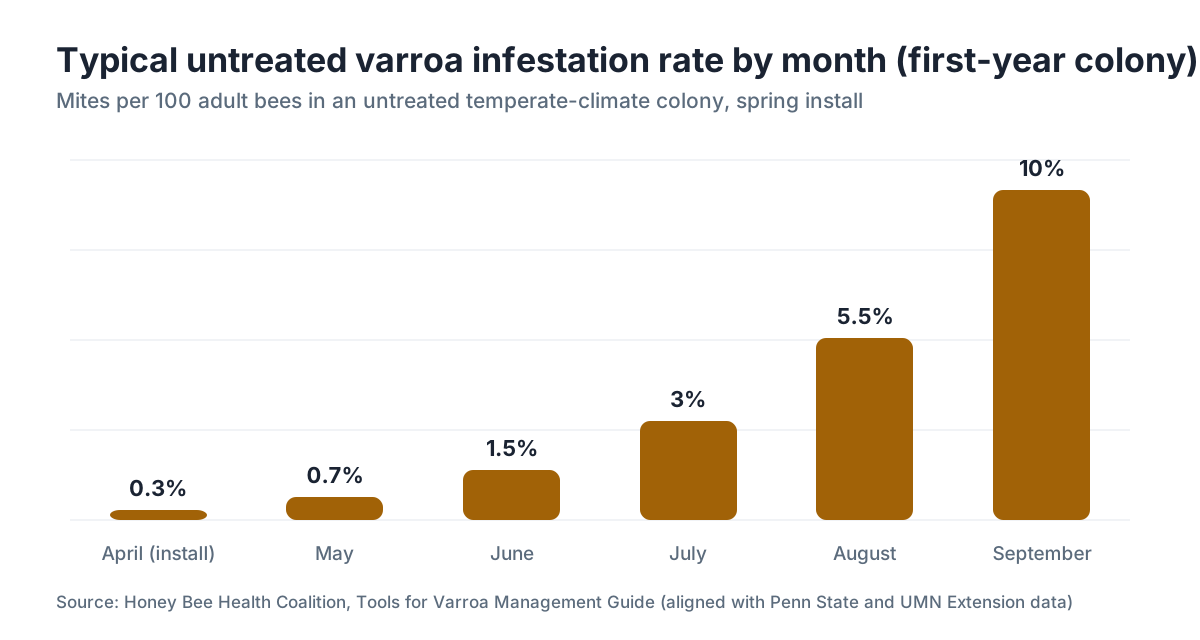
Most new beekeepers know varroa exists. Few understand how fast it moves. Varroa destructor is an external parasitic mite that feeds on developing pupae and adult bees, weakening them and spreading viruses, especially Deformed Wing Virus (DWV). A colony that starts spring at 1 to 2 percent infestation can pass 5 to 10 percent by late summer if you do nothing.[1]
The first year is deceptive. Your package or nuc arrives with a low mite count, the colony feels healthy, and everything looks fine through June. That's the trap. The colony is building fast, brood is everywhere, and varroa is breeding inside every capped cell. By the time you spot deformed wings on the landing board, the population is already through the roof.
The Honey Bee Health Coalition, which publishes the most widely used best-practice guide for varroa, says it plainly: "Varroa mites are the greatest single driver of honey bee colony losses in the U.S."[1] That's not hype. Extension programs across the country say the same thing. The difference between a beekeeper who keeps colonies alive for years and one who loses hive after hive usually comes down to one habit: monitoring and treating on a schedule, not getting lucky with genetics.
If you're just starting, learn what you're up against first. Our varroa mite overview covers the biology in more detail and is worth reading before you make any treatment decisions.
What mite levels should a first-year beekeeper expect?
A new package installed in spring usually arrives with very few mites, sometimes close to zero. That doesn't last. Varroa reproduces only in capped brood, so once your colony raises brood at scale, mite counts climb with it.
The economic threshold used by most U.S. extension programs and the Honey Bee Health Coalition is 2 mites per 100 adult bees (2 percent) during active brood rearing, dropping to 1 to 2 percent heading into fall.[1][2] Some programs set the August action threshold even lower, at 1 mite per 100 bees, because populations accelerate as the colony starts contracting.
Here's a rough trajectory for a typical first-year package in a temperate U.S. climate:
| Month | Expected mite level (untreated) | Action needed? |
|---|---|---|
| April (install) | 0-0.5% | No, just monitor |
| May | 0.5-1% | Monitor monthly |
| June | 1-2% | Watch closely |
| July | 2-4% | Often yes, treat |
| August | 3-8%+ | Almost certainly yes |
| September | 5-15%+ | Emergency territory |
Numbers vary by region, local mite pressure, and colony genetics, but the shape of the curve holds. Every extension program that tracks first-year hives reports the same mid-to-late summer surge.[2][3]
One point people miss: a nuc starts with a higher mite load than a package, because a nuc comes with capped brood already in place. If you bought a nuc, your first monitoring check matters more, not less.
How do you actually monitor for varroa as a new beekeeper?
Two sampling methods dominate for hobbyists: the alcohol wash and the sugar roll. The alcohol wash is more accurate. The sugar roll is gentler on bees but consistently undercounts by 30 to 50 percent.[4] Most extension programs recommend the alcohol wash as your default and treat the sugar roll as a fallback only if you cannot accept any bee mortality in your sample.
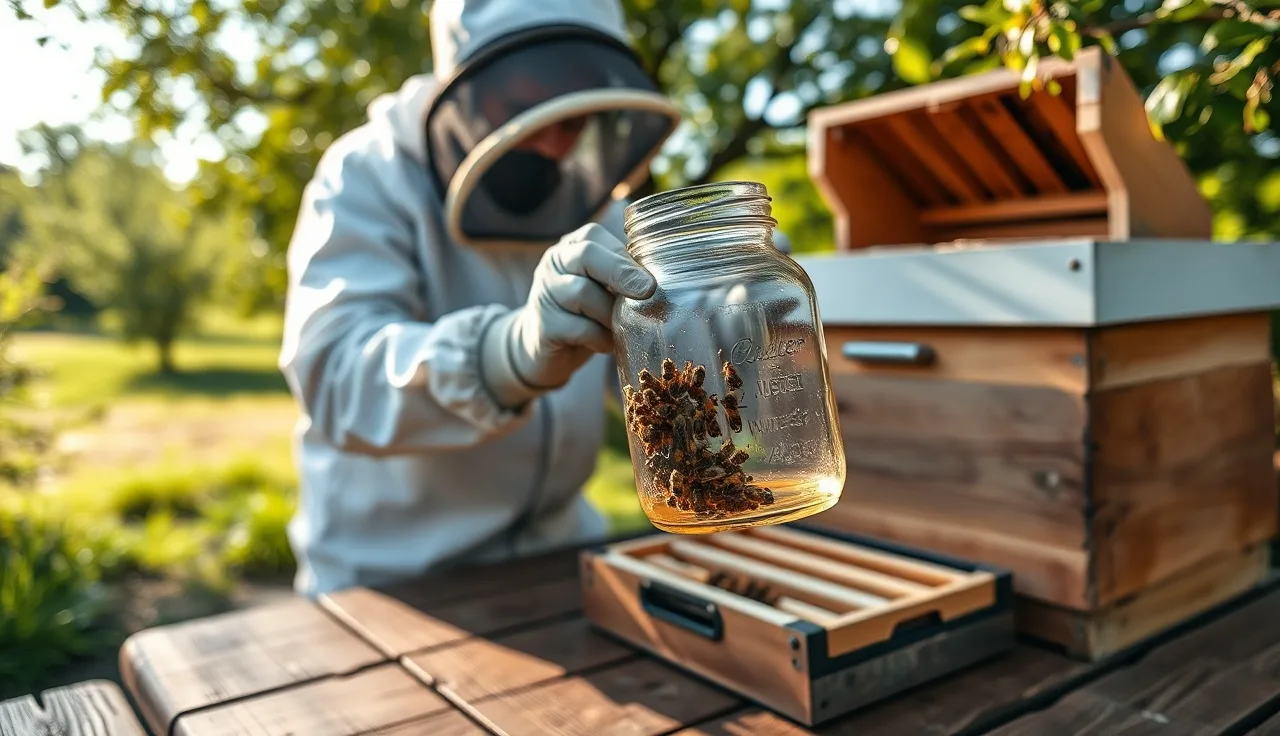
Here's the alcohol wash. Collect about 300 adult bees (roughly half a cup) from a brood frame, keeping the queen out of your sample. Add isopropyl alcohol (70 percent is fine), shake for 60 seconds, pour through a mesh strainer, and count the mites in the liquid. Divide mites by 3 for your percentage per 100 bees. The Honey Bee Health Coalition publishes free step-by-step instructions with photos.[1]
A sticky board under a screened bottom board for 24 to 48 hours gives you a rough directional read, but natural mite drop is not reliable for treatment decisions. Use it as a supplement, never as a substitute for an actual bee sample.
How often? Monthly during the active season is the practical minimum for year one. Plenty of experienced beekeepers check every 3 to 4 weeks from May through September. After you treat and see counts fall, recheck 3 to 4 weeks later to confirm the treatment worked and to catch reinfestation, which happens when mite-loaded bees from a collapsing neighbor drift into your hive.
If you want a monitoring calendar with threshold triggers already built in, VarroaVault has free protocol tools that map the process to your region and hive type.
Which varroa treatments are realistic for a first-year beekeeper?
This is where a lot of beginners freeze. The options look overwhelming, the labels read like tax law, and the fear of doing something wrong is real. Here's the honest rundown.
Every legal varroa treatment in the U.S. requires EPA registration.[5] Never use a product that isn't registered for use in a honey bee colony. The main categories:
Oxalic acid (OA): The easiest entry point for most beginners. EPA-approved, and it works extremely well against phoretic (non-capped) mites. Dribble application is simple but only effective with no capped brood present. Vaporization reaches mites even with some brood around and works better across the board, though it needs a vaporizer (about $50 to $150) and proper respiratory protection.[5][6]
Amitraz (ApiVar): Plastic strips hung in the brood nest for 6 to 8 weeks. Effective and beginner-friendly because you hang it and leave it. The downside is resistance building with overuse, and you cannot leave strips in past the label window. Strips are available through beekeeping supply retailers (see beekeeping supply companies for sourcing options).
Formic acid (MAQS or Formic Pro): Works through capped brood, which oxalic acid alone cannot. More temperature-sensitive, with an application window around 50 to 85 degrees F. There's a small but real risk of queen loss at higher temps. Not the first thing I'd hand a brand-new beekeeper, but it earns its place with the right timing.
Thymol (Apiguard, ApiLife VAR): Temperature-dependent (best above 60 degrees F), needs 4 or more weeks, and can disrupt brood. Less common in the U.S. than the others, but legal and effective in the right conditions.
For a genuine first-year beekeeper doing a mid-summer treatment, oxalic acid vaporization or ApiVar strips are the most forgiving. Heading into fall with brood winding down, an oxalic acid dribble or vaporization during a broodless period (natural or induced) can crush mites before winter. Virginia Cooperative Extension notes that "a single oxalic acid treatment during a natural broodless period in late fall can reduce mite loads by more than 90%."[6]
What is a realistic treatment schedule for the first year?
You don't need a complicated protocol. You need to be consistent and honest with yourself about your counts.
Here's a realistic first-year schedule for a temperate-climate colony started in spring:
May: Install, let the colony settle for 2 to 3 weeks, then run your first alcohol wash. Under 1 percent, just monitor. At or over 2 percent, treat now. Packages rarely need treatment this early. Nucs sometimes do.
Late June / early July: Second alcohol wash. This is when many first-year hives start climbing. Hit 2 percent or above and you treat. Oxalic acid vaporization works here, or hang ApiVar strips and pull them after 6 to 8 weeks per the label.
August: Third alcohol wash. This is the one that matters most. Late summer is when mite counts surge hardest, because the colony is contracting (fewer bees, same mites) and the winter bees being raised now are the ones that carry the hive to spring. High mite loads during this window damage those winter bees for good. Treat at or before 2 percent.
October / November (or whenever brood stops): Final treatment. An oxalic acid dribble or vaporization during a broodless stretch is highly effective and very low risk. This is probably the single most useful treatment a first-year beekeeper can do. The colony then goes into winter with almost no mites.
The Penn State Extension apiculture program recommends this fall broodless treatment as standard practice.[3] Most first-year winter losses come from skipping it.
Add monitoring checks between these anchor points whenever you can. More data is better. But four monitoring events with treatment triggers is a sustainable floor.
What mistakes do most first-year beekeepers make with varroa?
The mistakes are predictable. They repeat every season.
Waiting for visible symptoms. By the time you see shriveled wings on the landing board, your mite load is likely 5 to 10 percent or higher. DWV symptoms are a lagging indicator, not an early warning. Treat on counts, not on what you see.
Trusting the eyeball check. Mites are about 1.5mm across and dark brown against orange-brown bee cuticle. You cannot reliably spot them during a casual frame inspection. A proper sample is the only way to know your load. No shortcuts here.
Skipping the fall treatment. This is the most common single cause of first-year winter loss. Beekeepers get busy in September and October, decide the colony looks fine, and skip it. The hive enters winter carrying a high mite load, the winter bees are short-lived, and the colony collapses somewhere between December and February.
Using treatments wrong. Leaving ApiVar strips in too long. Doing an oxalic acid dribble with capped brood present, which does almost nothing to mites inside cells. Applying formic acid above 85 degrees F. Always read the current EPA-registered label, which is the legal document governing use.[5] Labels change, and the copy on some random website may not match current rules.
Blaming everything else. Small hive beetles, a bad queen, robbing, pesticides. All real problems. But if your colony is declining without an obvious cause, check your mites first. Mite-vectored viruses mimic almost any other health problem in a hive.
How does varroa treatment interact with honey production in year one?
Most spring-installed packages and nucs won't make a harvestable surplus their first year, and that's fine. Colony energy goes to building comb, raising bees, and storing enough food to overwinter. Some first-year hives in a strong nectar year will cap surplus honey by late summer, but it swings hard by region and colony strength.
The timing question is real, though. With honey supers on, you cannot use most registered treatments. Oxalic acid has a zero-day honey withdrawal period, so it's the one treatment you can technically apply with supers on, though most guidance still says treat only when supers are off, to keep things simple.[5][6] Amitraz (ApiVar) and formic acid (MAQS/Formic Pro) require that honey supers meant for human food come off before treatment.
For a first-year beekeeper, the practical answer is this. Don't chase honey at the expense of mite control. The colony you save now is the one that produces honey next year. If your count hits threshold with a super on, pull the super, treat, and feed the colony back up if it needs it. A dead colony makes no honey ever again.
See beekeeping supplies if you're still sourcing monitoring gear and treatment equipment. Having the right tools before you need them beats scrambling while counts climb.
Will your colony survive the first winter if you manage varroa correctly?
Honestly? Managing varroa well gives you a much better shot, but it's no guarantee. Winter survival rides on mite load, food stores, queen quality, local weather, and a little luck.
The data is consistent, though. USDA National Agricultural Statistics Service surveys show annual U.S. colony loss rates in the 30 to 40 percent range, with varroa and varroa-linked viruses named as the primary factor in most loss events.[7] Beekeepers who monitor and treat on a schedule fare far better than those who don't. The Bee Informed Partnership's annual loss surveys have found the same pattern for years.[10]
A colony heading into winter should have:
- Mite load below 1 to 2 percent (ideally under 1 percent after fall treatment)
- At least 60 to 80 lbs of stored honey in most temperate climates
- A young, well-mated queen, ideally raised that year
- A healthy adult population covering at least 5 to 6 frames
Do your fall treatment and get your stores adequate, and you've done your job. The rest is partly out of your hands. But the beekeepers who lose colony after colony over winter are almost always the ones who skipped the fall mite treatment. That pattern holds remarkably well.
How do you know if your varroa treatment actually worked?
Efficacy varies by product, method, temperature, and how much brood was present. So you verify.
Recheck your mite load 3 to 4 weeks after finishing any treatment. You want a count below 2 percent, ideally under 1 percent. If it's still above 2 percent, a few things could be true: the treatment wasn't applied right, the window (temperature or broodless timing) was wrong, or you're reinfested from drift or robbing tied to a collapsing neighbor.
Resistance to amitraz is documented in some varroa populations, mostly where ApiVar use has been heavy.[8] If you've done everything right and counts stay high after ApiVar, rotate to an organic acid like oxalic acid. That's not a first-year worry for most people, but it's worth filing away.
A quick gut check: a successful treatment usually drops counts by 70 to 95 percent. Start at 4 percent, end at 3.5 percent, and something went wrong. Start at 4 percent, end at 0.5 percent, and it worked. Penn State Extension recommends retesting 2 to 3 weeks after treatment to assess efficacy.[3]
What resources should a first-year beekeeper use for varroa guidance?
The best starting point, full stop, is the Honey Bee Health Coalition's "Tools for Varroa Management" guide. It's free, updated regularly, covers every registered U.S. treatment, and it's the document most extension programs point to.[1] Download it and read the treatment chapters before you need them.
Beyond that:
University extension programs are your most reliable local resource. Penn State, University of Minnesota, NC State, UC Davis, Virginia Tech, and others publish monitoring and treatment protocols specific to their regions. Find your state's land-grant university extension and look for its apiculture or bee health pages.[2][3]
Your state apiary inspector is an underused resource. Most states have one, and many will do free or low-cost hive inspections or at least steer you to local varroa training. The National Association of State Departments of Agriculture (NASDA) keeps a directory.[9]
Your local beekeeping club is worth joining for the same reason: local knowledge. Mite pressure changes by geography, and someone who's kept bees in your county for 10 years knows things no guide will tell you.
For a year-round protocol you can follow without building it yourself, VarroaVault's free management tools are worth a bookmark. They map treatment options and monitoring schedules to your region and flag action thresholds automatically.
Avoid random forum advice that pushes unregistered treatments or claims mites aren't a problem with the right genetics. Mite-resistant stock exists and helps, but even resistant colonies need monitoring. No genetics wipe out varroa.
Is it normal to feel overwhelmed by varroa in the first year?
Yes. Completely normal.
Varroa management stacks chemistry, biology, timing, and equipment decisions all at once, and you're learning to handle bees at the same time. Most experienced beekeepers look back on year one and cringe at what they didn't know. That's the norm, not the exception.
The anxiety usually shrinks once you've run two or three alcohol washes and can read the results without second-guessing. The mechanics are genuinely not hard once you've done them. Monitoring is the hard part only because it takes discipline to check even when everything looks fine.
The beekeeping community tends to make things more complicated than they need to be. For year one, you need three things: a way to sample (an alcohol wash kit, maybe $5 to $10 in supplies), a threshold to act on (2 mites per 100 bees), and at least one reliable treatment ready before you need it. Everything else is refinement.
For the full range of gear decisions in year one, the beekeeping supplies guide can help you prioritize what actually matters.
Frequently asked questions
When should a first-year beekeeper do their first varroa check?
Run your first alcohol wash 3 to 4 weeks after installing a package or nuc. By then the colony has its first round of capped brood, which is when mite populations start climbing. Waiting until midsummer is too late. A baseline count in May gives you something to compare against as the season moves on.
Do you have to treat for varroa if your mite count is low?
No. If your alcohol wash comes back below 1 to 2 mites per 100 bees during the active season, monitor again in 3 to 4 weeks and hold off. Treating at low counts isn't harmful, but it's needless chemical exposure and feeds resistance over time. The threshold exists for a reason. Trust your numbers.
Can a new colony die from varroa in its first season?
Yes. A package or nuc installed in spring can collapse by August or September if mites go unchecked. The colony builds fast, mites build faster, DWV spreads through the brood nest, and the adult population crashes before winter. First-season losses are common in colonies whose owners monitor but don't treat promptly when counts pass threshold.
What is the easiest varroa treatment for a beginner?
Oxalic acid by dribble during a broodless period is technically simplest, but it only works with no capped brood. For mid-season treatment with brood present, ApiVar (amitraz) strips are probably the most beginner-friendly: hang them in the brood nest, leave them 6 to 8 weeks per the label, remove them. Oxalic acid vaporization is also very effective once you own the equipment.
How much does varroa treatment cost in the first year?
Budget roughly $20 to $50 for a basic monitoring kit (alcohol wash supplies, measuring cups, fine mesh strainer). Treatment costs vary: ApiVar strips run about $25 to $35 for a two-pack, which treats one hive twice. Oxalic acid from a registered product like Api-Bioxal runs $15 to $30 per container. A vaporizer adds $50 to $150 upfront but lasts for years. Total first-year varroa management can reasonably run $75 to $150.
Is the sugar roll as accurate as the alcohol wash for detecting varroa?
No. The sugar roll consistently undercounts mites versus the alcohol wash, often by 30 to 50 percent. That matters, because it can hand you a false sense of security. A sugar roll showing 1.5 mites per 100 bees may hide a real count over the 2 percent threshold. Most extension programs treat the alcohol wash as the standard. Use the sugar roll only if sampling mortality is truly unacceptable.
Can you use oxalic acid with honey supers on?
Oxalic acid (Api-Bioxal) has a zero-day pre-harvest interval for honey, so it can technically be applied with supers on. Even so, most guidance recommends treating with supers off, for simplicity and to sidestep residue concerns. Amitraz and formic acid products have clear label requirements that honey supers come off before treatment. Always read the current product label, which is the legal authority.
How do varroa mites spread between hives?
The two main routes are drifting workers and robbing. Bees from a heavily infested collapsing colony drift into or get robbed out by neighboring hives, carrying mites along. Beekeepers call these mite bombs. It's one reason your count can spike even after a successful treatment: you're getting reinfested from a neighbor's dying colony, possibly one you don't even know exists.
What does deformed wing virus look like in a hive?
Workers with DWV usually have small, crumpled, or shriveled wings and cannot fly. You may see them crawling in front of the hive or on the landing board. Affected pupae can show shortened abdomens. These symptoms appear only at very high mite loads. If you're seeing visible DWV, your count is almost certainly above 5 percent, and you need to treat now rather than wait for a formal sample.
Does using local or mite-resistant bees mean you don't need to monitor for varroa?
No. Mite-resistant or locally adapted stock (VSH, Russian, Varroa Sensitive Hygiene lines) can cut mite reproduction rates, which buys you more management margin. But no commercially available genetics eliminate varroa. Even resistant colonies need periodic alcohol washes to confirm populations stay in check. Genetics are an asset, not a replacement for monitoring.
How do you do a varroa alcohol wash step by step?
Collect about 300 adult bees (half a cup) from a brood frame, avoiding the queen. Pour them into a jar, add 70 percent isopropyl alcohol to cover, and shake hard for 60 seconds. Pour the liquid through a fine mesh strainer into a white tray. Count every mite in the liquid. Divide the count by 3 for mites per 100 bees. Above 2 percent during the active season means treat now.
When is the best time to treat varroa before winter?
Treat in late summer or early fall, before the colony raises the winter bees that carry it to spring. In most temperate U.S. climates that means August or September. A second treatment after the colony goes broodless in late fall (October or November), using oxalic acid dribble or vaporization, can drop residual loads by over 90 percent. Missing the fall treatment is the most common cause of first-year winter loss.
What's the difference between phoretic and reproductive varroa mites?
Phoretic mites ride on adult bees between reproductive cycles and are reachable by most treatments. Reproductive mites sit inside capped brood cells, shielded from dribble-applied oxalic acid and some other treatments. Roughly 70 to 80 percent of mites in a colony with normal brood are inside capped cells at any moment. That's why timing treatments to a broodless period, or using vaporization and formic acid that penetrate cells, raises efficacy so much.
Sources
- Honey Bee Health Coalition, Tools for Varroa Management Guide: Varroa mites are the greatest single driver of honey bee colony losses in the U.S.; 2% action threshold and monitoring protocols
- University of Minnesota Extension, Varroa mite management: Monthly monitoring schedule and 2% threshold recommendations for temperate U.S. climates
- Penn State Extension, Varroa Mite Treatment and Control: Fall broodless period treatment as standard best practice; recommend retesting 2-3 weeks after treatment to assess efficacy
- NC State Extension, Apiculture Varroa Monitoring Methods: Sugar roll undercounts mites by 30-50% compared to alcohol wash
- U.S. EPA, Pesticides: Regulating Pesticides: All legal varroa treatments in the U.S. require EPA registration; label is the legal authority for use; oxalic acid pre-harvest interval
- Virginia Cooperative Extension, Varroa Mite Control in Honey Bee Colonies: A single oxalic acid treatment during a natural broodless period in late fall can reduce mite loads by more than 90%
- USDA National Agricultural Statistics Service, Honey Bee Colonies report: Annual U.S. colony loss rates consistently in the 30-40% range nationally; varroa and associated viruses cited as primary factor
- USDA Agricultural Research Service, Honey Bee Research: Amitraz (ApiVar) resistance documented in some varroa populations in areas with heavy use
- National Association of State Departments of Agriculture, State Apiary Programs: State apiary inspectors available as a resource; NASDA maintains a directory of state programs
- Bee Informed Partnership, Annual Colony Loss Survey: Annual loss surveys consistently show higher winter survival rates for beekeepers who monitor and treat on a schedule
- UC Davis Department of Entomology, Honey Bee Research Facility: Varroa population dynamics and doubling rates in colonies under normal brood conditions
Last updated 2026-07-10