How many Apivar strips per hive: the complete dosing guide
TL;DR
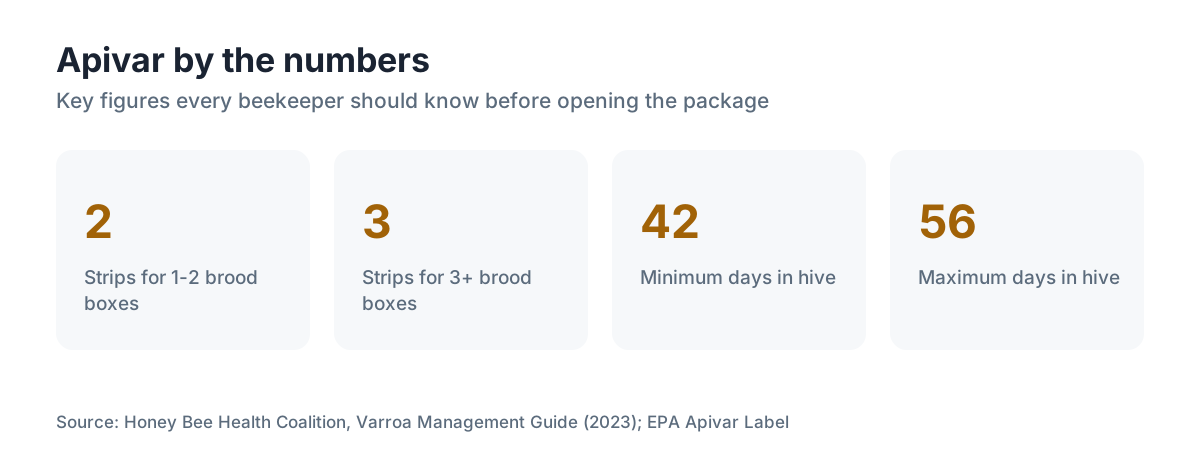
- The Apivar label calls for 2 strips per colony in a single or double brood box.
- Colonies with three or more brood boxes get a third strip.
- Strips stay in 42 to 56 days (6 to 8 weeks), then come out.
- Leaving them longer breeds amitraz-resistant mites and violates federal label law.
What is Apivar and how does it work against varroa?
Apivar is an amitraz-based strip treatment registered by the EPA for varroa control in honey bee colonies [1]. Each plastic strip holds 500 mg of amitraz, a contact acaricide. Bees walk across the strips and spread the chemical through normal hive traffic. It reaches mites riding on adult bees, and it reaches mites emerging from capped brood as those bees chew their way out.
Amitraz does not go through cappings. That single fact drives the whole treatment schedule. A worker brood cycle runs about 21 days, so mites hiding under caps in week one stay untouched until that brood emerges. The 42-to-56-day window exists to catch two full brood cycles, which is why you cannot rush it [2].
Apivar comes as a pack of 10 strips. The amitraz releases slowly and degrades over the treatment period, so day 56 delivers a weaker dose than day one. That slow release is by design. It also means spent strips are dead weight. You cannot reuse them for a second colony or a second round.
How many Apivar strips does a hive actually need?
Two strips per colony is the standard dose on the EPA-registered label [1]. That covers everything from a single-box colony up through a full double-deep brood nest.
Move to three or more brood boxes and the label adds a third strip. The logic is straightforward. More bees mean more volume, and the strips need enough foot traffic to spread amitraz through the whole cluster. Cramming extra strips into a small colony does nothing except waste product.
Here is the dosing broken down by hive setup:
| Brood boxes occupied | Strips required |
|---|---|
| 1 box (single deep or medium) | 2 strips |
| 2 boxes (standard double brood) | 2 strips |
| 3 or more boxes | 3 strips |
That table is straight label language, echoed by the Honey Bee Health Coalition's Varroa Management Guide [3]. Do not set your strip count by eyeballing the population or guessing whether the bees look heavy. The label is a federal document. Using Apivar at a dose or duration that differs from the label is a federal pesticide violation under FIFRA [4].
Running 8-frame mediums stacked three high as a brood nest? That third strip is required, legally and practically. Standard double deeps? Two strips, every time.
Where exactly do you place Apivar strips in the hive?
Placement matters as much as count. The label says to hang strips vertically between frames in the brood nest, one in the center third of the brood area and one toward the outer edge of that same area [1]. For a double-deep colony with 20 frames, a common starting point is frames 4 and 7 in the lower box, counting from one side, so both strips sit in the warm core where nurse bees cluster.
Strips have to hang free so bees can walk both faces. Do not lay them flat on top of frames. Do not wedge them so tight that bees skip the gap. The tab at the top hooks over a top bar and holds each strip at the right depth.
Got a single box with a tight cluster? Put both strips inside the cluster, not out at the edges. Contact is everything here.
One practical note. Some beekeepers split the two strips between boxes in a double brood nest, one per box. The label allows it, and several university extension sources prefer it because the upper box population gets direct exposure too [2]. Both in the lower box, or one per box, either works. Pick one and stick with it so you can read your own results over time.
How long do you leave Apivar strips in the hive?
The label window is 42 to 56 days, meaning 6 to 8 weeks [1]. Most beekeepers settle around 6 weeks as a working default, especially in late summer when the point is clean bees heading into fall. The full 8 weeks helps when the colony has a lot of capped brood at treatment start, because every emerging cohort gets time to touch the strips.
Penn State's bee program and other extension services note that 42 days is enough when you catch mites early and brood volume is modest [2]. Waiting the full 56 days does not hurt efficacy, but it stretches your risk window if honey supers are waiting to go back on.
Apivar is not approved for use with honey supers intended for human consumption on the hive [1]. That is the main constraint on your timing. A common fall schedule puts strips in after the last honey pull in late July or early August, runs 6 to 8 weeks, then pulls them before the colony forms its winter cluster.
Set a calendar reminder the day you install strips. Do not guess. Six weeks is day 42. Eight weeks is day 56. Remove them inside that window.
Can you leave Apivar strips in the hive longer than 8 weeks?
No. This is one of the spots where a well-meaning hobbyist causes real long-term damage.
Past 56 days, bees keep getting chronic sub-lethal doses of amitraz as the strips off-gas at very low levels. That kind of prolonged low-dose exposure is one of the documented paths toward amitraz-resistant varroa [5]. Resistance is already confirmed in varroa populations across parts of the United States and Europe, and lazy strip removal feeds it.
Resistance aside, leaving strips past the label window breaks federal pesticide law under FIFRA Section 12 [4]. That matters for a sideliner selling honey. It matters for hobby use too, because the label is the law regardless of scale.
Strips also leave amitraz residue in wax. Studies of beeswax from managed colonies found amitraz and its breakdown product 2,4-dimethylaniline in comb, with residue levels tracking how long the strips stayed in [6]. Shorter windows plus prompt removal keep comb contamination down. You cannot undo residue once it builds up, but you can stop adding to it.
Forgot to pull strips on time? Pull them now. Log the overage. Monitor mite load after your next treatment to see if efficacy is slipping, which is an early warning of developing resistance.
When should you remove Apivar strips from a hive?
Pull strips at day 42 at the earliest, day 56 at the latest. Take them out with your hive tool, bag them, and toss them in household trash. Do not burn them, compost them, or leave them lying in the apiary where robbing bees could pick up residue.
Here is a protocol that works. When you install strips, write the install date on a frame end bar or a hive record card. Mark your calendar. When you come back to remove them, run an alcohol wash or sticky board count at the same visit so you have before-and-after data on your mite load.
One timing debate comes up every fall. Treatment started in early fall, the colony is still raising brood in late October, and the beekeeper wants the full 56 days. Fine, as long as you get back in before the cluster locks up and frame work gets miserable. If your climate means a hard cluster by October 15, an August 15 start gives you a September 26 to October 12 removal window. Plan backward from your last reasonable inspection date.
For tracking Apivar treatments alongside alcohol wash results, the free tools at VarroaVault let you log strip-in and strip-out dates with mite count data so you can watch treatment effectiveness across seasons.
Does the number of strips change for a nuc or a weak colony?
The label calls for 1 strip per colony for nucs or colonies that cover only one side of a brood box, meaning a cluster on fewer than about 5 frames [1]. A true 5-frame nuc gets 1 strip, centered in the brood.
A weak full-size colony down to a cluster on 4 to 6 frames in a 10-frame box also gets 1 strip. The label's 1-strip threshold kicks in when the colony is small enough that a single strip still gets solid bee contact. Some beekeepers reach for 2 strips out of habit, but a tiny cluster may ignore the second strip entirely if it sits outside the cluster footprint.
Here is the harder truth. If a colony is weak enough to make you second-guess Apivar dosing, it is weak enough to make you ask whether it survives at all. Requeen or combine before treating if the population is below a viable threshold. Dosing a dying colony with Apivar does not save it, and it wastes product.
What is the difference between one and two brood boxes for dosing?
This one comes up constantly, and the answer is simpler than people expect. The label counts brood boxes, not frames or colony weight. One or two brood boxes: 2 strips. Three or more: 3 strips.
The reasoning behind that threshold is that amitraz spreads well through bee contact in a double-brood setup. Bee density is high, two strips cover enough ground, and the cluster reliably blankets the strips. A third box adds enough volume, and enough physical distance from the main cluster, that you need a third strip to keep contact up throughout the hive.
Running medium supers as brood boxes, like a lot of 8-frame beekeepers do, means you count boxes with active brood rearing. Three medium brood boxes with brood in all three: 3 strips. Two medium brood boxes with a honey medium on top: 2 strips, because the honey super has no cluster that needs treatment exposure.
This matters for varroa mite monitoring too. Your wash samples should reflect the whole colony, more than the bottom box, which means sampling frames where bees pack in, usually the middle of the brood nest.
Can you treat with Apivar while honey supers are on?
No. The label flatly prohibits use when honey supers intended for human consumption are on the hive [1]. There is no gray area.
Amitraz is lipophilic, so it binds to wax and fat-soluble substances. Honey is mostly water and sugar, so direct honey contamination stays low, but the prohibition is a precautionary standard and you follow it regardless.
Here is the practical fallout. Apivar is a fall treatment in most of the US. You pull honey supers, let the flow end, then install strips. In a climate with a fall nectar flow (asters, goldenrod), you time this carefully. Some beekeepers pull supers, treat for 6 weeks, then put supers back on if there is still real fall forage. Strips must be fully out before supers go back on.
Spring Apivar treatments work if mite loads justify them, but the full treatment window has to finish before any spring honey supers go on. In much of the US that means a February or very early March install to wrap up before the main spring flow in April or May. It is tight, and it takes planning.
How effective is Apivar and what do the efficacy numbers actually show?
Apivar in properly run trials typically knocks down 90 to 99 percent of mites when used as directed [3]. The Honey Bee Health Coalition's Varroa Management Guide cites that range across multiple field and lab studies.
That number sounds great until you do the math. A colony with 3,000 mites at 95 percent efficacy still has 150 mites left. If your pre-treatment load was already at crisis level, even a strong treatment can leave enough mites to wreck your winter bees. That is exactly why monitoring before and after is not optional.
Temperature drives efficacy too. Amitraz works best between 50 and 90 degrees F [1]. In cool fall weather, the inside of the cluster stays warm (bees hold 92 to 95 degrees F in the brood nest), so treatment still works because the bees are active. But in a region where colonies go dormant and cluster tight in September, bee contact with the strips drops and so does efficacy. In those climates, finishing Apivar by early September beats stretching into October.
Wondering what triggers treatment? The Honey Bee Health Coalition recommends treating when mite loads pass 2 percent of the bee population in summer, meaning 2 mites per 100 bees on an alcohol wash [3]. Some extension programs use 3 percent as a spring action threshold. No single number fits every case, but 2 percent in August or September sends you straight to the strips.
How much does Apivar cost and where can you buy it?
A 10-pack of Apivar strips runs roughly $30 to $45 depending on supplier and shipping [7]. That treats 5 standard colonies at 2 strips each, or 3 colonies plus a little bench stock if you run any 3-box hives.
Scale it out. Treating a 5-colony hobby operation twice a year (fall plus a spring insurance round if warranted) costs about $60 to $90 in product per year, or $12 to $18 per colony per treatment. That puts Apivar among the cheaper varroa treatments per colony once you factor in efficacy.
Apivar is available through most beekeeping supply companies without a veterinary prescription, unlike certain oxalic acid formulations. That makes it easy for hobbyists who have no vet-client relationship. Some suppliers offer free shipping on honey bee supply orders above a minimum, which trims the per-strip cost further.
Buy from licensed dealers. Skip the unverified sources. Counterfeit or badly stored amitraz strips have shown up in some markets, and they will not perform.
How do you monitor whether the Apivar treatment actually worked?
Run an alcohol wash or sugar roll before treatment starts, then again 3 to 4 days after you pull the strips. The post-treatment wash gives you a clean read on the mites left behind once the treatment is done.
If that post-treatment wash comes back above 1 mite per 100 bees in September or October, the colony is heading into winter with an elevated load and you have a problem to solve. Your options are a follow-up oxalic acid treatment (Apivar cannot go back in right away; the label limits it to 2 applications per year with proper spacing [1]) or a cold look at whether the colony is worth saving.
If the post-treatment wash comes back at zero or near zero, that is a win. Log it. Those records pay off two years from now when you are trying to work out whether your local varroa are developing amitraz resistance.
The Honey Bee Health Coalition's guide has a downloadable monitoring log you can print and keep with your hive tool. Its stated recommendation: "Monitor mite levels before treatment, 3 to 5 days after treatment concludes, and monthly during the active season" [3]. Building that habit is what separates beekeepers who overwinter colonies year after year from those who lose hives and blame the weather.
Frequently asked questions
How many Apivar strips do I use for a single deep hive?
Two strips. The label specifies 2 strips per colony for any hive occupying one or two brood boxes, including a single deep. Hang them vertically between frames in the center of the brood nest. A single-deep colony with a normal population gets the same strip count as a full double-deep. Only a nuc or a very weak colony covering fewer than half a box gets just 1 strip.
How long to leave Apivar strips in the hive?
The EPA label requires a minimum of 42 days (6 weeks) and a maximum of 56 days (8 weeks). Most beekeepers target 6 weeks as a practical default. Mark your calendar the day you install strips and remove them inside that window. Going shorter than 42 days cuts efficacy. Going past 56 days risks resistance and violates federal label law.
Can I leave Apivar strips in the hive over winter?
No. Leaving strips in over winter means chronic low-dose amitraz exposure for months past the approved window, which is both a federal label violation and a documented driver of amitraz resistance in varroa. Remove strips by day 56. If you want mite protection going into winter, treat in late summer, pull the strips before cluster formation, then check whether a follow-up oxalic acid treatment is needed.
How many Apivar strips for a double deep hive?
Two strips, same as a single deep. The label does not raise the dose for double-brood setups because 2 strips distribute well in colonies occupying up to two boxes. You can put one strip in each box or both in the lower box. One per box is a common approach when the colony has brood in both boxes at the same time.
When should I remove Apivar strips from a hive?
Remove them between day 42 and day 56 after installation. Do not wait longer. Write the install date on a frame end bar so you are not relying on memory. Pull strips with your hive tool, bag them in a zip-lock, and dispose of them in household trash. Run an alcohol wash within a few days of removal to check your post-treatment mite load.
Do I need a prescription to buy Apivar strips?
No. As of 2025, Apivar strips do not require a veterinary prescription in the United States. They are sold directly by beekeeping supply retailers. That is one practical advantage over some other registered treatments. Buy from established suppliers so the strips have been stored properly, since heat and moisture degrade amitraz.
Can Apivar strips be reused in another hive?
No. Strips are one-use only. After 42 to 56 days in a hive, the amitraz is largely spent. Used strips look a lot like fresh ones, but they will not give meaningful varroa control. The label also limits application to twice per year per colony, and reusing spent strips does not reset that count. Dispose of used strips and open fresh product for each treatment.
Can I use Apivar when honey supers are on the hive?
No. The label flatly prohibits use when honey supers intended for human consumption are present. Amitraz is lipophilic and can build up in wax and bee products. Remove all honey supers before installing strips and keep supers off until the strips are fully out. This is a hard label requirement, not a suggestion.
How do I know if Apivar is working?
Run an alcohol wash before treatment starts, then again 3 to 4 days after removing strips. A successful treatment usually drops mite counts by 90 to 99 percent. If your post-treatment wash still reads above 1 mite per 100 bees, the colony heads into winter at risk. Persistently high post-treatment counts can signal developing amitraz resistance and warrant switching treatment chemistry.
What temperature does Apivar work best at?
Apivar works best when ambient temperatures sit between 50 and 90 degrees F. The bees need to be active enough to walk the strips and spread the amitraz. Inside the brood nest, bees hold 92 to 95 degrees F no matter the outdoor temperature, so cool fall nights do not block efficacy as long as bees are still actively nursing brood. Tight cluster formation in very cold weather does cut strip contact.
How many Apivar strips do I need for a three-box hive?
Three strips. The label raises the dose to 3 strips when a colony occupies three or more brood boxes. That keeps amitraz spreading across the larger population and volume. Place two strips in the main brood cluster area and one in the additional box. If you run three medium boxes as a brood nest, all three count.
Is Apivar safe for queens and brood?
At label doses, Apivar has a strong safety record for queens and brood in field use. Lab studies show amitraz can affect queen behavior at very high concentrations, but properly dosed field treatments at label rates are used widely during queen-right brood rearing without reported queen loss tied to the strips. Do not exceed label strip counts, which is where risk climbs.
Can I use Apivar in spring as well as fall?
Yes, with careful timing. A spring Apivar treatment is valid if mite loads are up and no honey supers are on. The catch is finishing the full 42-to-56-day window before the main spring honey flow starts and supers go on. In much of the US that means installing strips no later than late February or very early March. Fall treatment is generally preferred because it cleans up mites before winter bees are raised.
Sources
- EPA, Apivar (amitraz) Pesticide Registration and Label: 2 strips per colony for 1-2 brood boxes, 3 strips for 3+ boxes, 42-56 day treatment window, prohibited when honey supers are present
- Penn State Extension, Varroa Mite Management in Honey Bees: Apivar placement between brood frames, minimum 42-day exposure window, strip placement options in double brood nests
- Honey Bee Health Coalition, Varroa Management Guide (2023): Apivar efficacy 90-99% mite knockdown; 2% mite load action threshold in summer; recommendation to monitor before and after treatment
- EPA, Federal Insecticide, Fungicide, and Rodenticide Act (FIFRA) Overview: Using a pesticide in a manner inconsistent with its label is a federal violation under FIFRA Section 12
- USDA ARS Bee Research Laboratory, Amitraz Resistance in Varroa destructor: Prolonged sub-lethal amitraz exposure is a documented pathway to resistance in Varroa destructor populations
- Journal of Apicultural Research, Amitraz and DMPEA residues in beeswax (multiple study reference): Amitraz and its metabolite 2,4-dimethylaniline (DMPEA) accumulate in beeswax at levels correlated with duration of strip use
- Mann Lake (retail price reference): Apivar 10-strip pack retails in the $30-$45 range from major US beekeeping suppliers
- University of Minnesota Extension, Varroa Mite Management: 2-3% mite infestation thresholds referenced for action; fall treatment timing recommendations
- NC State Extension Apiculture, Varroa Treatment Options: Apivar use window, strip removal guidance, and temperature constraints for amitraz efficacy
- Oregon State University Extension, Honey Bee Varroa Mite Control: Strip placement recommendations, nuc dosing (1 strip), and fall treatment scheduling guidance
Last updated 2026-07-09