How long do Apivar strips stay in the hive (and why it matters)
TL;DR
- Apivar (amitraz 3.33%) strips must stay in the hive at least 6 weeks and no longer than 10, per the EPA-registered label.
- Most beekeepers target 8 weeks to balance kill rate against resistance risk.
- Pull every strip at the end of treatment.
- Leaving them past 10 weeks is off-label and speeds up amitraz resistance in your mites.
What does the Apivar label actually say about treatment duration?
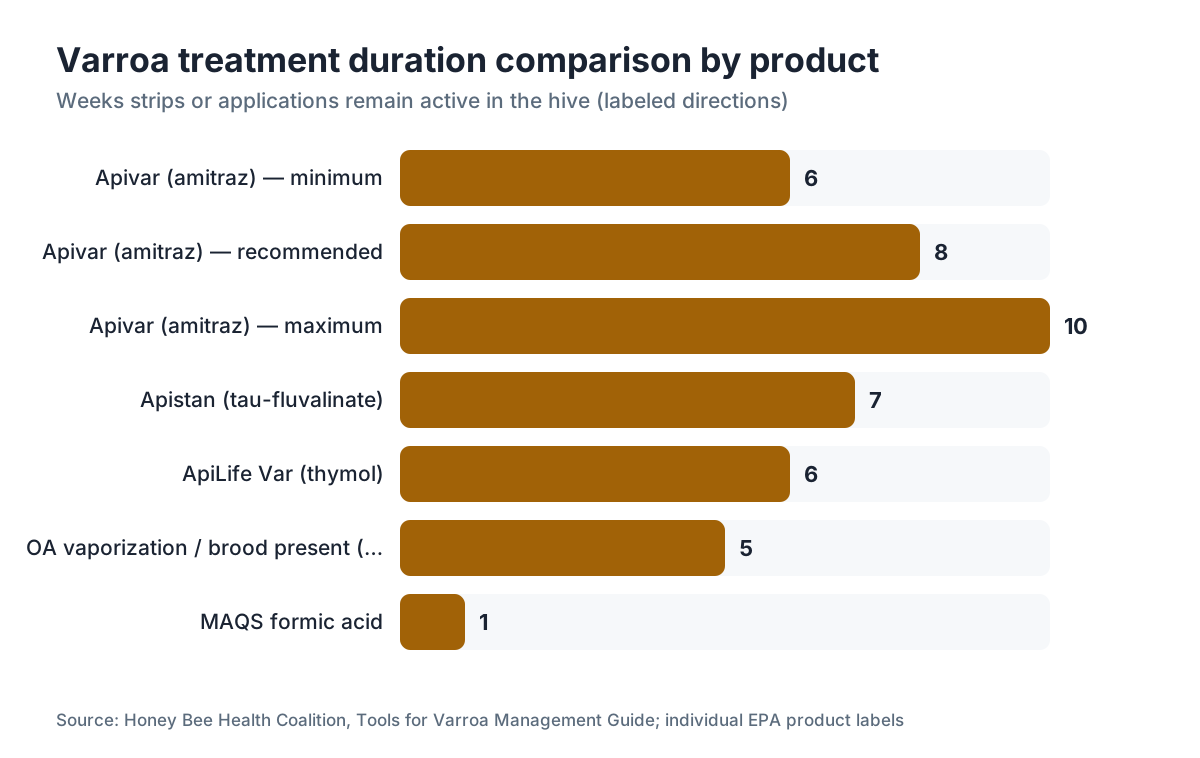
Six to ten weeks, and that range is not a suggestion. The EPA-registered Apivar label sets a minimum contact time of 6 weeks and a maximum of 10 weeks per treatment [1]. Those two numbers exist for two different reasons. The minimum is about kill rate: amitraz works by contact, and bees emerging from capped brood need time to walk across the strips and pick up a lethal dose. The maximum is about resistance. Strips left in longer than they need to be keep applying weak selection pressure on surviving mites, and that nudges the population toward amitraz tolerance season after season.
Most extension apiculturists and the Honey Bee Health Coalition's Varroa Management Guide point to 8 weeks as the practical target [2]. Eight weeks gives every worker brood cycle (about 21 days) at least two full chances to dose newly emerged adults, without running past the label's outer edge.
One detail beekeepers miss: the label's "6 to 10 weeks" is total strip-in-hive time, not time after you notice results. The clock starts the day you hang the strips. Not the day the mite drop spikes.
Why can't you just pull Apivar strips out early?
Because the mites you can't see are the ones that matter. Beekeepers sometimes want to pull strips at four or five weeks because the wash looks clean, or because they're nervous about wax contamination. The instinct feels right. The biology says no.
Amitraz does not touch mites inside capped cells. A worker brood cycle runs 21 days. Treat for only four weeks and you've dosed bees from roughly one capped cycle. The mites sealed under cappings when you started, then emerged and bred during your short window, can still carry a heavy load [3]. That's the whole reason the minimum sits at six weeks: two full brood cycles give the active ingredient a real shot at the mites hiding under cappings.
There's a mechanical reason too. Apivar releases amitraz slowly as bees contact the strip. Peak kill isn't day one. It builds over the first couple of weeks as bees chew and walk across the polymer. Pull the strips before week six and you cut treatment off mid-swing.
Mite count dropped fast and you want to call it? Do an alcohol wash or sugar roll at week six before you decide anything [4]. A clean wash at week six, strips still in, is your green light. A clean wash at week three is just noise.
What happens if you leave Apivar strips in longer than 10 weeks?
Past 10 weeks, you're off-label. Full stop. That carries both a practical cost and a legal one.
Start with resistance. Strips left in year-round, or dragged across several months, become chronic low-dose exposure. Amitraz resistance in Varroa destructor is documented across the U.S. and Europe, and one consistent risk factor in the research is prolonged or continuous exposure to sublethal doses [5]. The Honey Bee Health Coalition flags extended treatment periods as a resistance driver in its guide [2].
Then the wax. Amitraz and its breakdown products build up in beeswax over long exposure. A 2010 study by Bogdanov and colleagues in Apidologie found amitraz residues in wax from treated colonies, and while the levels were generally below acute toxicity thresholds for humans, the accumulation is real and it stacks across repeated treatments [6]. If you sell comb or make wax products, this is your problem.
And the law. Leaving strips past the label maximum means you're no longer following the federally registered use pattern. That breaks FIFRA, the Federal Insecticide, Fungicide, and Rodenticide Act, which requires pesticides to be used according to their labels [7].
Pull the strips at or before week 10. Set a calendar reminder the day you hang them. That's the entire fix.
How many Apivar strips do you use, and where do you put them?
Two strips per colony for standard Langstroth equipment, one or two deeps with a normal adult population [1]. Very strong colonies or triple-deep setups can run up to four strips per the label. You hang them between frames in the brood nest, in the two spaces with the most bee traffic, roughly the third and seventh frame positions in a 10-frame box.
Placement matters more than most beekeepers expect. Apivar depends on bees physically touching the strip. A strip hanging in a frame space the bees ignore because it's off the cluster underperforms, plain and simple. In cold-weather fall treatments, put the strips where the cluster actually sits, not where it will sit in three weeks. If the colony contracts during treatment, check at week two or three and reposition.
For two-story colonies, both strips go in the lower deep if that's where the brood is concentrated. The bees carry amitraz through the colony by trophallaxis and grooming even when strips sit in one box, but contact in the brood zone is where kill rate peaks [3].
Need strips or a scale for mite washes? The beekeeping supply companies page has a vetted list, and some offer free shipping honey bee supply companies options worth a look if you're ordering in bulk.
When is the best time of year to do an Apivar treatment?
Apivar is approved for spring and fall use in the U.S. [1]. The real question is which window does the colony the most good. For most temperate-climate beekeepers, that's fall.
Here's why fall wins. The bees that overwinter are raised in late August through October. If those bees emerge into a colony carrying high mite loads, they haul a heavy viral burden into winter, deformed wing virus especially. A fall Apivar treatment that starts in late July or early August and runs into mid-September knocks mites down before that winter bee cohort is even raised [8].
Spring treatments earn their keep when colonies come out of winter with high counts, or when you missed the fall window. The catch is nectar flow. Apivar is not approved with honey supers on [1]. You either finish the full course before the flow starts, or you accept that supers stay off for the whole 6-to-10-week window. In areas with early flows, that constraint makes spring Apivar awkward [10].
Splits and packages are a legit third window. A package installed in April with two strips has no brood-cycle problem for the first couple of weeks, and the strips run their full course before any surplus honey is possible.
Can Apivar strips be used when honey supers are on?
No. The Apivar label flatly prohibits use when honey supers meant for human consumption are on the hive [1]. This isn't caution for caution's sake. It's a hard label requirement. Amitraz residues in honey are a real possibility with extended treatment, and the EPA label reflects that.
So you plan treatment around your harvest calendar. If your main flow ends mid-July, pull supers, run a mite wash, and if counts sit above the 2-mites-per-100-bees action threshold, hang strips right away [4]. A treatment that starts August 1 and runs to September 12 (six weeks) or September 26 (eight weeks) keeps you clear of most fall flows and gives the winter bees a clean start.
Some beekeepers try to sneak treatment in after pulling a late super but before a fall goldenrod or aster flow. It can work. But you'd have to pull strips before that fall flow opens, and that risks cutting treatment short of six weeks. The math rarely favors it. Better to skip one round of late-fall honey than run a compromised treatment.
How do you know if the Apivar treatment actually worked?
You monitor. Treatment is not set-and-forget.
Before you start, do a baseline alcohol wash or sugar roll. That gives you a real number: mites per 100 bees [4]. The Honey Bee Health Coalition recommends the alcohol wash as the most accurate method for hobbyists, and it consistently reads higher than a sugar roll across validation work [2].
At the end of the window, after you pull strips at 6 to 8 weeks, wash again. A treatment that worked usually drops mite loads below 2 per 100 bees, often below 1. Still sitting at 3 or higher after a full 8-week course? You have a few suspects: resistance (uncommon but real), reinfestation from neighboring colonies, or an installation problem where the strips never touched enough bees.
The University of Minnesota Extension recommends monitoring at least four times a year: early spring, late spring or early summer, late summer (post-treatment), and fall [4]. That schedule catches reinfestation windows and tells you whether your Apivar treatment held through the late-summer stretch that decides winter survival.
Running more than a few hives? The free tools at VarroaVault give you a dashboard to log strip install dates, removal dates, and wash results in one place, which keeps the math straight across a yard.
Want the mite's life cycle and why brood timing matters this much? Start with the varroa mite overview.
Does colony size or brood volume change how long strips should stay in?
Colony size changes how many strips you use, not how long they stay in. The 6-to-10-week window holds whether you're treating a two-deep monster or a five-frame nuc [1].
Brood volume does change what you should expect, though. A colony packed wall-to-wall with capped brood at install will show slower mite drops on a sticky board, simply because so many mites are protected under cappings. That's exactly why the minimum is six weeks and not three. A colony that went in broodless (rare, but it happens in late fall or after a queen loss) shows fast, dramatic drops because the mites have nowhere to hide. Even then, the label minimum still applies.
Nucs and splits need a word. Small colonies sometimes have fewer bees than frames, so a strip hanging in a low-traffic space gets poor contact. Some beekeepers cut strips in half and run one half per nuc. That's an off-label adaptation, and you're making that call on your own. The label is written for full colonies. If you use Apivar in a nuc, hang one full strip in the single best-trafficked frame space and watch the results closely.
What is the Apivar treatment schedule for a full beekeeping year?
Here's a realistic annual protocol for a temperate-climate beekeeper in the northern U.S., built from the label and Honey Bee Health Coalition recommendations [1][2]:
| Treatment window | Start date range | Strip removal | Notes |
|---|---|---|---|
| Spring (if needed) | Late March to April | 6-8 weeks later | Only if spring wash shows 2+ mites/100 bees; no supers |
| Summer (splits/packages) | April to June | 6-8 weeks later | Install with new package; no honey concerns |
| Late summer / fall | Late July to mid-August | Mid-September to early October | Most important window; targets winter bee cohort |
The fall window is the one you can't afford to skip. If you do nothing else all year, treat in late July or early August with strips in for a full 8 weeks. That covers the period when your overwintering bees are raised, and it's the single highest-leverage move in the annual cycle [8].
Spring treatments are reactive, not routine. Let your spring wash decide. Come out of winter below 1 mite per 100 bees and you can skip spring Apivar, saving your strips and your resistance budget for fall. Sitting at 3 or above? Treat before the flow, or accept supers off until the course ends.
Good beekeeping supplies to keep on hand year-round: spare strips, a reliable postal scale for washes, and a notebook or app for logging dates.
Can Apivar strips be reused, and how should you dispose of them?
No. Used Apivar strips can't go into another colony or another season. The amitraz in the polymer runs down through contact and evaporation over the treatment period, and there's no reliable way to know how much active ingredient is left. Reusing strips is off-label and would likely hand you a failed treatment at best, with the same resistance-selection downside as any chronic low-dose exposure [1].
Disposal is simple. Used strips go in household trash in the U.S. The label does not require hazardous waste handling for used Apivar strips at hobbyist scale [1]. Don't burn them. Don't compost them. Don't leave them in the yard where bees keep contacting depleted material after you've pulled them.
Unused strips store in the original sealed packaging at room temperature, out of direct sun. The label shelf life is typically two years from manufacture; check your package for the date. Strips baked in a hot barn or car for a summer may have degraded active ingredient and could underperform when you finally hang them.
What are the signs that Apivar isn't working in your hive?
A few warning signs are worth knowing. First, a sticky board drop that stays minimal even after two to three weeks. Some natural mite fall from emerging brood is normal in the first week, followed by a spike as the strips take hold. See essentially nothing on the board after week two or three? Check your strip placement.
Second, a post-treatment wash that's still high. Pull strips at 8 weeks and wash out 3 or more mites per 100 bees, and something went wrong. Either the strips never made good contact, the colony reinfested from robbing or drift off a nearby collapsing hive, or you're facing amitraz-resistant mites [5].
Amitraz resistance is still fairly rare in North American Varroa compared to pyrethroid resistance, but it's confirmed. A 2019 study in Scientific Reports documented reduced amitraz efficacy in mite populations carrying specific mutations in the octopamine receptor gene [5]. USDA's Bee Research Laboratory reports the same pattern: amitraz resistance is documented here but stays less common than tau-fluvalinate resistance [11]. Persistent Apivar failures across multiple seasons? Resistance testing through a university apiculture lab is a real option.
The more common culprit is reinfestation. Mites ride robber bees and drifting foragers off collapsing colonies, so if your neighbor runs an untreated hive, your post-treatment count can climb back up within weeks. That's not Apivar failing. That's the landscape problem no single-hive treatment fully solves.
How does Apivar compare to other varroa treatments in treatment duration?
Duration swings hard across product categories, and it's one of the real reasons beekeepers pick one treatment over another in a given season.
| Treatment | Active ingredient | Treatment duration | Honey super restriction |
|---|---|---|---|
| Apivar strips | Amitraz 3.33% | 6-10 weeks | No supers during treatment |
| Oxalic acid dribble | Oxalic acid | Single application | Can use with supers (check label) |
| Oxalic acid vaporization | Oxalic acid | 3 applications over 5 weeks (brood present) | Consult label |
| Mite Away Quick Strips (MAQS) | Formic acid | 7 days | Allowed with supers present |
| ApiLife Var | Thymol blend | 3 applications over 6 weeks | No supers; temp-sensitive |
| Apistan strips | Tau-fluvalinate | 6-8 weeks | No supers; widespread resistance |
Apivar's 6-to-10-week window sits on the long end next to oxalic and formic acid options, but its kill rate in colonies with capped brood generally beats a single oxalic acid application [2]. The Honey Bee Health Coalition notes, "Amitraz (Apivar) treatments have demonstrated high efficacy against Varroa when used according to label directions, typically achieving 90%+ kill rates in colonies with normal brood cycles" [2].
Formic acid (MAQS) is the main summer competitor because supers can stay on, but it's temperature-boxed (above 50°F, below 85°F) and can cost you a queen in a small share of colonies. Oxalic acid vaporization in brood-present colonies needs several treatments over weeks to come close to Apivar's kill rate. None of this crowns Apivar the automatic answer. It makes Apivar one real option in a toolkit that should rotate chemistries to slow resistance [9].
Frequently asked questions
How long do Apivar strips stay in the hive exactly?
The EPA-registered Apivar label requires a minimum of 6 weeks and a maximum of 10 weeks in the hive. Most beekeepers and extension apiculturists target 8 weeks as the standard. Removing strips before 6 weeks risks incomplete treatment; leaving them past 10 weeks is off-label and raises resistance risk.
Can I leave Apivar strips in over winter?
No. Leaving strips in over winter blows past the 10-week label maximum and is an off-label use under FIFRA. It creates prolonged sublethal amitraz exposure, which is tied to resistance development in Varroa populations. Treat in late summer so strips come out by early to mid-October, well before winter cluster formation.
What happens if I forget to remove Apivar strips on time?
A week or two past 10 weeks, pull them immediately and note the overage. A few extra weeks probably won't cause acute harm, but don't make it a routine. Chronic extended exposure is one of the documented risk factors for amitraz resistance in Varroa. Going forward, set a phone alert the day you install strips.
How many Apivar strips per hive do I need?
Two strips per standard colony in one or two deeps. For very strong colonies or triple-deep setups, the label allows up to four. Hang them in the two most heavily trafficked frame spaces inside the brood nest. Nucs are trickier since the label is written for full colonies; one strip in the best contact position is common practice, though technically off-label.
Can I use Apivar when I have honey supers on the hive?
No. The Apivar label prohibits use when honey supers meant for human consumption are on the hive. Amitraz can build up in honey and wax. Pull supers before installing strips, and don't add supers back until after strips are removed and at least one full honey-to-wax turnover cycle has happened.
Is Apivar safe for the queen and brood during treatment?
At labeled rates, Apivar is generally well-tolerated by queens and brood. There are occasional reports of queen loss during treatment, but far less often than with formic acid products. If a queen-right problem shows up mid-treatment, don't automatically blame the strips; check the colony for other causes before pulling them early.
How do I know Apivar is working during the treatment period?
A sticky board under a screened bottom board will show mite drops climbing in the first one to two weeks as bees contact the strips and mites die. You should see a visible bump over your pre-treatment baseline. No drop at all after two weeks points to a placement problem; recheck that the strips sit in active bee traffic zones.
What is the best time of year to use Apivar strips?
Late July to early August is the most important window for temperate-climate beekeepers. That timing lets the full 6-to-8-week treatment cover the period when overwintering bees are raised, the single highest-impact move in the annual varroa cycle. Spring treatments are secondary, used reactively when post-winter counts top the 2-per-100-bees threshold.
Can Apivar strips be cut in half for nucs or small colonies?
Cutting strips isn't on the label, so technically it's off-label use. Some beekeepers do it for nucs anyway. If you do, use one half-strip per nuc in the best-trafficked frame space, monitor closely, and never extend duration past 10 weeks. Full strips in a small colony work too; the extra contact area won't hurt, and some practitioners prefer it.
How should I dispose of used Apivar strips?
Used strips go in household trash per the U.S. label. No hazardous waste handling is required at hobbyist scale. Don't burn, compost, or leave them in the yard. Remove all strips from hives before disposal so bees can't contact depleted material outside the hive.
Can Varroa mites become resistant to Apivar?
Yes, though amitraz resistance stays less common in North America than pyrethroid resistance. A 2019 study in Scientific Reports confirmed reduced amitraz efficacy in Varroa carrying specific octopamine receptor gene mutations. Prolonged or continuous exposure to sublethal amitraz is a known resistance driver, which is why the 10-week maximum and annual chemistry rotation both matter.
How long after removing Apivar strips can I add honey supers?
The label sets no mandatory waiting period after strip removal before supers can go on; the restriction is only that supers stay absent during treatment. Still, many beekeepers and extension advisors suggest waiting at least a few days after removal to let any residual amitraz on frames dissipate. Check the current label for any updates to this guidance.
Can I do two Apivar treatments back to back in the same season?
The label doesn't prohibit sequential treatments, but two full Apivar courses in one season raises cumulative amitraz exposure and resistance pressure. If a first treatment fails, diagnose why before repeating: check for reinfestation, resistance, or placement issues. Need a second miticide the same season? Rotating to oxalic or formic acid is the better resistance-management move.
Sources
- EPA / Apivar (amitraz) registered product label, Véto-Pharma: Apivar strips must remain in the hive 6 to 10 weeks; prohibited when honey supers are present; two strips per standard colony.
- Honey Bee Health Coalition, Tools for Varroa Management Guide (latest edition): 8-week treatment target recommended; amitraz treatments achieve 90%+ kill rates at labeled directions; extended treatment periods flagged as resistance driver.
- Pennsylvania State University Extension, Varroa Mite Management: Amitraz does not kill mites inside capped cells; brood cycle timing explains the 6-week minimum; trophallaxis distributes amitraz through colony.
- University of Minnesota Extension, Varroa Mite Monitoring and Management: Alcohol wash recommended as most accurate hobbyist monitoring method; four monitoring events per year recommended; 2-mites-per-100-bees action threshold.
- Mitkov A. et al., Scientific Reports 2019, 'Amitraz resistance in Varroa destructor': Reduced amitraz efficacy confirmed in Varroa populations with mutations in the octopamine receptor gene; prolonged sublethal exposure linked to resistance.
- Bogdanov S. et al., Apidologie 2010, 'Residues of acaricides in beeswax and honey': Amitraz and breakdown products accumulate in beeswax with prolonged treatment; levels generally below acute human toxicity thresholds but cumulative across treatments.
- EPA, Federal Insecticide, Fungicide, and Rodenticide Act (FIFRA) overview: FIFRA requires pesticides to be used in accordance with their registered labels; off-label use is a federal violation.
- North Carolina State University Apiculture, Varroa Mite Control: Fall treatment window (late July, August) identified as highest-impact intervention for protecting overwintering bee cohort.
- Michigan State University Extension, Integrated Pest Management for Honey Bees: Rotating miticide chemistries across seasons recommended to slow resistance development; amitraz resistance less common than pyrethroid resistance in U.S. populations.
- Oregon State University Extension, Varroa Mite Management in Oregon: Spring Apivar treatments should be completed before primary nectar flow; logistical constraints of no-supers requirement discussed.
- USDA Agricultural Research Service, Bee Research Laboratory: Amitraz resistance in North American Varroa populations documented but remains less prevalent than tau-fluvalinate resistance.
Last updated 2026-07-09