How long should Apivar strips be left in the beehive?
TL;DR
- Apivar (amitraz 3.3%) strips must stay in the hive at least 6 weeks and no longer than 8 weeks per the EPA-registered label.
- Pull them early and efficacy drops hard, because amitraz kills by contact over time, not on the first touch.
- Two strips per brood box is the standard dose.
- Remove every strip at 8 weeks to hold down resistance.
What does the Apivar label actually say about treatment duration?
The EPA-registered Apivar label is both the floor and the ceiling for how you use the product in the United States. Strips have to stay in the colony a minimum of 6 weeks and must come out no later than 8 weeks after you put them in [1]. That window is not a suggestion. Break it in either direction and you buy a real problem: too short leaves surviving mites to rebound, too long pushes hard on resistance selection with nothing gained.
The active ingredient is amitraz at 3.3%, baked into plastic strips. Bees touch the strips as they move through the hive, pick up amitraz on their bodies, and pass it to other bees and to mites. The mechanism is contact transfer, not fumigation, so exposure has to build over weeks. A single bee brushing a strip once does not deliver a lethal dose to every mite riding her. The effect stacks up [2].
State pesticide rules can sit on top of the federal label. They can be stricter, never looser. Check your state department of agriculture site before you treat. The 6-to-8-week window itself holds across every U.S. jurisdiction that allows amitraz in hives.
Why does the 6-to-8-week window exist? What is amitraz actually doing?
Amitraz is an acaricide that scrambles the nervous system of Varroa destructor by hitting octopamine receptors. Those receptors run arthropod neurotransmission and are absent in vertebrates, which is why the stuff stays relatively safe for bees and mammals at label doses while killing mites [2].
Six weeks is about the brood cycle. Worker brood stays capped for roughly 12 days. Mites sealed inside capped cells the day you insert strips are shielded from amitraz that whole time. They emerge with the adult bee and finally get exposed, but by then another round of brood may be capped, protecting the next batch of mites. You need enough weeks to cover several brood cycles so every mite, even the ones buried deep in sealed cells on day one, eventually walks out and touches the amitraz [3].
The Honey Bee Health Coalition's Varroa management guide reports that efficacy trials showing 90%+ knockdown ran over the full 6-to-8-week exposure [3]. Pull strips at 4 weeks and efficacy drops noticeably. Nobody has clean head-to-head field data comparing exactly 6 vs. 7 vs. 8 weeks across every colony size, but the reasoning behind the minimum is solid.
The 8-week cap is about resistance. Leaving strips in longer than needed just means prolonged low-dose amitraz on whatever mites survived, which is the exact condition that breeds resistance. Pull the strips when the work is done.
How many Apivar strips should you use per hive?
The label calls for 2 strips per brood chamber [1]. A colony spread across two brood boxes gets 2 strips per box (4 total), one hung in each box between frames of brood where traffic runs heavy. Some keepers running big double-brood colonies push extra strips per box, but that's off-label. I wouldn't do it as routine. The standard dose shows high efficacy in normal-strength colonies, and adding strips doesn't lift results in proportion. It just adds resistance pressure and more amitraz residue in your wax.
Placement matters more than most beekeepers think. Hang strips between frames 3 and 4 and between frames 6 and 7 in a 10-frame box, or the rough equivalent in 8-frame gear. You want them where nurse bees pile up around open and capped brood. A strip parked in a quiet corner underperforms.
Nucs and small colonies get 1 strip per the label. A nuc has less bee mass and less brood, so a single strip worked by a tight cluster does the job. Two strips in a nuc is overkill and can stress a small population.
Can you leave Apivar strips in longer than 8 weeks if mite counts are still high?
No. Leaving strips past 8 weeks is off-label, which violates FIFRA (the Federal Insecticide, Fungicide, and Rodenticide Act), and it doesn't fix a high count anyway [4]. If your mite load is still over threshold after 8 weeks of Apivar, the strips aren't delivering meaningful amitraz anymore. You've got a different problem to diagnose.
High counts after treatment usually trace to one of three causes. Reinfestation is the first: Apivar kills the mites in your hive but does nothing about mites flying in from a collapsing colony down the road. Resistance is the second. Amitraz resistance in Varroa is documented in the U.S., parts of Europe, and beyond [5]. Run Apivar as your only treatment for several years without rotating and resistance belongs on your radar. Poor coverage is the third: strips out of brood contact, a colony so large that 2 strips reach too little surface, or treatment started too late during a population explosion.
After a failed Apivar round, pull the strips at 8 weeks, run a real mite wash (alcohol wash or sugar roll), and switch to a different mode of action. Oxalic acid, formic acid, or a thymol product depending on your temperatures and brood state [3]. Do not slap in a fresh set of Apivar strips for a second treatment that season without a concrete reason the next round would work differently.
Can you remove Apivar strips before 6 weeks if mite counts drop fast?
You could. You shouldn't. The 6-week minimum exists because an alcohol wash can look great before the job is actually finished. Mites inside capped brood are invisible to a wash of adult bees. Pull a wash at week 4, see a 95% drop in phoretic mites, feel great. But the mites sealed in cells right now emerge over the next 10 to 12 days and start breeding. If the strips are gone, they land in an untreated hive.
Early removal also leaves half-spent strips lying around your beeyard. Partially used strips should not be stored and reinserted. The polymer matrix releases amitraz at a rate set for one 6-to-8-week deployment. A strip that spent 3 weeks in a warm hive and then sat in a bag has unknown residual content. Run the full window.
The one exception I'd weigh is unexplained queen loss or brood disruption that you have strong reason to blame on amitraz toxicity, which is rare at label doses but not impossible in very small colonies. Then pulling strips and moving to oxalic acid beats pressing on. That's a judgment call, not routine practice.
What temperature range does Apivar need to work effectively?
This is where Apivar earns its name as a reliable year-round option. Formic acid and thymol products both stall in the cold. Apivar has no practical lower temperature limit for efficacy. The contact-transfer mechanism works as long as bees move through the hive and touch the strips, which they do even in winter clusters well below anything formic or thymol can handle [3].
The Honey Bee Health Coalition's Varroa management guide lists amitraz strips as appropriate for cold conditions where other treatments fail. That makes Apivar a common pick for late fall treatments in northern climates where temperatures drop below 50°F before the treatment window closes [3].
There's no stated upper temperature limit that kills efficacy. Hot summers don't degrade the product meaningfully inside the 8-week window. Treating in midsummer carries its own trouble, though: your colony is loaded with capped brood and sitting on honey supers, and the label bans use when honey supers meant for human consumption are on the hive [1]. So summer timing has to work around super removal.
Can you use Apivar when honey supers are on the hive?
No. The Apivar label flatly prohibits strips when honey supers headed for human consumption are on the hive [1]. Amitraz and its metabolites migrate into honey and wax. The restriction keeps those residues out of your crop.
In practice, you build treatments around your honey flow. The usual protocol: pull supers in late summer or early fall, insert Apivar strips right away, run the 6-to-8-week treatment, remove strips, then let the colony pack winter stores on any late flow without harvest supers on.
Here's the trap. Pull supers, treat with Apivar, and then a late flow starts and tempts you to add supers back. Now you'd have to pull the Apivar (maybe before it hits 6 weeks) to stay legal, cutting treatment short. Timing your start to dodge that conflict is the only clean answer. Across much of the northern U.S., strips in right after Labor Day and out by mid-to-late October lands cleanly and misses any real fall flow. The South runs a different clock.
How do you monitor mite levels before and after an Apivar treatment?
Run an alcohol wash before you insert strips to confirm you actually need to treat and to set a baseline. The Honey Bee Health Coalition and most university extension programs use a threshold of about 2% (2 mites per 100 bees in an alcohol wash) as the point where treatment is warranted spring through summer, with some sources using 3% in fall [3].
After pulling strips at 8 weeks, wait a few days, then wash again. You want mite loads under 1%, ideally near zero. Confirm the treatment worked before you count the colony protected.
The alcohol wash beats sticky boards and sugar rolls for accuracy. Sugar rolls miss roughly 30 to 40% of mites compared to alcohol washes in side-by-side testing, so they can hide how bad your load really is [8]. Sticky boards show relative change over time but are shaky for absolute thresholds. A 300-bee alcohol wash (about half a cup of bees) is the standard sample size Penn State Extension and the Honey Bee Health Coalition recommend [8].
If you want help organizing your treatment calendar and mite records, VarroaVault's free varroa management tools let you log pre- and post-treatment washes next to your strip insertion and removal dates, so efficacy trends across seasons actually show up.
For a closer look at the mite itself and how it breeds inside brood cells, the varroa mite overview on this site covers the biology in detail.
Does Apivar work during a broodless period, and should you time treatment that way?
Apivar during a broodless period is very effective, and it's underused. With no capped brood, every mite is phoretic (riding on adult bees) and fully exposed to amitraz contact. You get near-total knockdown faster and with less treatment time.
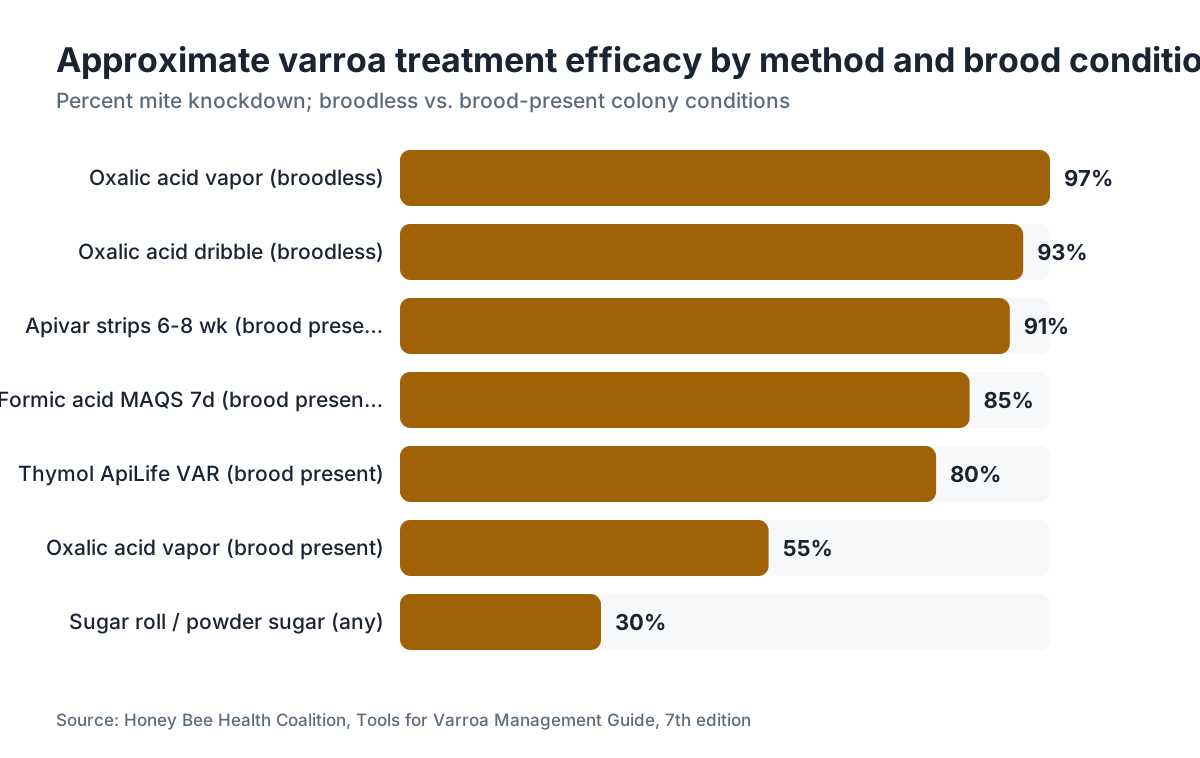
Still, Apivar isn't my first pick for an intentional broodless window. Oxalic acid vaporization or dribble hits extremely high efficacy (often 95 to 99%+) against phoretic mites in a single shot and costs far less and works far faster [3]. If you went to the trouble of forcing a broodless colony, oxalic acid makes more economic and practical sense than a 6-week Apivar run.
Where Apivar and a natural broodless spell line up is in overwintered colonies in late fall or winter. If your colony goes broodless on its own in November and you already have Apivar strips in from an October insertion, running through the broodless stretch up to the 8-week removal date is fine. There's simply nothing left to shield the mites from the amitraz at that point.
Stocking up on beekeeping supplies in fall for winter treatment planning is smart, but Apivar strips have a shelf life of about 2 years stored cool, dry, and sealed [10]. Buy what you'll use this season instead of stockpiling several years' worth.
How do you dispose of used Apivar strips correctly?
Used strips still hold residual amitraz. Don't toss them in the compost, leave them in the beeyard, or drop them in regular recycling. The label tells you to wrap used strips in newspaper or seal them in a plastic bag and put them in the household trash [1].
Don't burn strips. Amitraz combustion products can be harmful. And don't leave strips in the hive past 8 weeks figuring they'll just degrade. They do eventually, slowly, and prolonged low-level exposure is exactly what you're working to avoid.
Keep used strips away from children and pets. Amitraz poisoning in dogs is a documented veterinary concern. Dogs that chew used strips can develop serious neurological symptoms. If dogs run in your beeyard, treat used strips like any pesticide waste: bag them, seal the bag, and get rid of them fast [6].
What does an Apivar treatment cost, and how does it compare to other varroa treatments?
A pack of 10 Apivar strips (enough for 5 colonies at 2 strips each) runs roughly $25 to $35 depending on the supplier, so about $5 to $7 per colony [7]. That's competitive with oxalic acid vaporization once you count the vaporizer ($80 to $250 for a decent unit) but pricier than oxalic acid dribble, which costs pennies per application.
The table below compares the main varroa treatments across the numbers that matter in the field.
| Treatment | Approx. cost per colony | Min. temp | Works with brood? | Treatment duration |
|---|---|---|---|---|
| Apivar (amitraz strips) | $5 to $7 | No practical limit | Yes | 6 to 8 weeks |
| Oxalic acid vaporization | $0.50 to $2 (+ vaporizer) | 30°F+ (bees moving) | Broodless only for 1 app | 1 application or 3x weekly |
| Oxalic acid dribble | $0.25 to $1 | 40°F+ | Broodless only | Single application |
| Mite Away Quick Strips (formic) | $5 to $8 | 50 to 85°F | Yes | 7 days |
| ApiLife VAR (thymol) | $3 to $5 | 59 to 69°F | Yes | 6 to 8 weeks |
Apivar's edge is the wide temperature range and the fact that it works through a brood cycle. Its drawbacks are the long window, the honey super restriction, and resistance risk under long-term exclusive use. I run Apivar as a fall workhorse and rotate to oxalic acid for broodless-period treatments to slow resistance selection.
You can find reputable Apivar suppliers through beekeeping supply companies, and some offer free shipping on honey bee supply orders over a set dollar threshold.
How do you prevent Apivar resistance in your mite population?
Amitraz resistance in Varroa is confirmed in multiple countries and documented in the U.S., especially in areas with dense apiaries and a long history of amitraz use [5]. Resistant mites detoxify amitraz metabolically, and the trait can move through a mite population fast under selection pressure.
Rotation is the core defense. Don't reach for Apivar on every treatment every year. A workable protocol for most hobbyist and sideliner beekeepers: use Apivar for one major treatment a year (usually fall) and oxalic acid for any supplemental treatments, or alternate Apivar years with formic acid years. The Honey Bee Health Coalition's Varroa management guide recommends rotating acaricide modes of action as standard practice [3].
Always finish the full window. Pulling strips at 4 or 5 weeks leaves the toughest, most resistant mites alive and breeding. On a single apiary, that's probably the fastest road to resistance there is.
Buy strips from reputable suppliers and check lot numbers. Counterfeit or substandard amitraz has shown up in some markets and can mimic resistance when the real culprit is product quality. Authentic Apivar from Veto-Pharma, the manufacturer, carries a specific label and lot traceability [1].
VarroaVault's treatment rotation planner helps you build a multi-year protocol that doesn't lean on any single acaricide, which is the practical way to keep your options open long-term.
What should your Apivar treatment calendar look like across the full year?
Most beekeepers in temperate climates run one Apivar treatment a year, timed to the late summer or fall window after honey supers come off. Here's a typical northern U.S. schedule.
Mid-to-late August: run a pre-treatment alcohol wash. If mites hit 2% or higher, pull supers and get ready to treat.
Early September: insert 2 Apivar strips per brood box in the brood nest. Write down the date.
Early-to-mid October (6 to 8 weeks later): remove every strip. Wash again after a few days.
October to November: if counts are still up after Apivar, consider oxalic acid vaporization once the colony goes broodless or nearly so. If counts sit under 1%, the colony is set for winter.
Spring (March to April): wash as the colony builds. If counts run above 2 to 3%, treat again, but weigh whether formic acid or oxalic acid with a brood break beats another immediate Apivar round. University of Minnesota Extension recommends late summer to early fall timing to protect the winter bee cohort raised from August through October [9].
In southern climates where bees never fully go broodless, the timing shifts but the logic holds: one primary Apivar window, usually after the main flow, with monitoring driving every supplemental call.
New to beekeeping and want the broader context on hive health and pests? Reading the varroa mite biology first makes these timing decisions click.
Frequently asked questions
Can I put Apivar strips in while I still have honey supers on?
No. The label explicitly prohibits inserting Apivar when honey supers intended for human consumption are on the hive, because amitraz migrates into honey. Pull all harvest supers before inserting strips. If you have supers you plan to leave as winter food for the bees rather than harvest, that's a gray area, but the safest and most compliant move is to treat only after all supers are off.
What happens if I forget to remove Apivar strips at 8 weeks?
Remove them the moment you catch the mistake. Strips left past 8 weeks are off-label, add resistance pressure, and build unnecessary amitraz residue in your wax. The residual amitraz is largely spent by 8 weeks anyway, so extended exposure adds little mite kill. Pull them, note the date, and run a mite wash to see where you stand.
How many Apivar strips do I need for a nuc?
One strip per nuc, per the label. A nucleus colony has a smaller population and brood area, so a single strip placed between brood frames gives good contact coverage. Two strips in a nuc is off-label and risks stressing a small cluster. Set the strip centrally in the brood nest and leave it the same 6-to-8-week window.
Can Apivar strips be reused for a second treatment?
No. Once strips spend 6 to 8 weeks in a hive, the amitraz is largely gone from the polymer matrix. Reinserted, they won't deliver an effective dose. Each treatment needs new strips. Partially used strips from a treatment cut short also should not be reused, because the remaining concentration is uncertain and using them is off-label.
Does Apivar kill mites inside capped brood cells?
No, and that's exactly why the 6-to-8-week window is necessary. Amitraz works by contact with bees and mites moving through the hive. Mites sealed inside capped brood are physically protected during capping. As each successive cohort of capped brood emerges over the treatment period, those mites become exposed. Several brood cycles have to complete during treatment for full efficacy.
How do I know if Apivar is working?
Check your sticky board during the first 2 to 3 weeks of treatment. You should see mite fall rise above your pre-treatment baseline, and a big initial drop is a good sign. At treatment end, after 8 weeks, run an alcohol wash on a sample of adult bees. Effective treatment usually brings phoretic loads below 1%. Counts staying above 2% afterward point to reinfestation or resistance.
What is the best time of year to use Apivar?
Late summer to early fall, right after the main honey flow and after supers come off, is the most common and generally most effective window. Treating then knocks the mite population down before winter bees are raised (late August to October), the long-lived bees the colony rides through winter on. High mite loads during winter bee rearing are strongly linked to colony loss going into spring.
Is Apivar safe for the queen and brood?
At label doses with proper placement, Apivar is generally well tolerated by queens, brood, and adult bees. There are anecdotal reports of queen loss tied to amitraz, but controlled studies haven't established a clear causal link at label-compliant doses. Off-label use (more strips, longer duration, or use in very small colonies) raises the risk of brood disruption. Follow label rates.
Can I use Apivar at the same time as other varroa treatments?
You should not run Apivar alongside another acaricide at the same time without specific label guidance. Mixing amitraz with formic or oxalic acid in the same window isn't tested for safety or efficacy interactions and is generally off-label. Sequential treatments (finish one, remove it, then start another) are fine and common, but concurrent use of multiple acaricides isn't standard practice for hobbyist beekeepers.
Where exactly in the hive should I place Apivar strips?
Hang strips vertically between frames in the active brood nest where bee traffic runs highest. In a 10-frame box, that's typically between frames 3 and 4 and between frames 6 and 7. The strip should drop into the space between frames so bees walking across and under it pick up amitraz. Strips tucked into empty space or outer frames with no brood or traffic underperform badly.
Does Apivar work in cold weather?
Yes. Apivar's contact-transfer mechanism has no practical lower temperature limit for efficacy, unlike formic acid (needs 50°F+) or thymol products (need 59°F+). As long as bees move through the cluster and touch the strips, amitraz transfers. That makes Apivar one of the only effective options in climates where temperatures fall below 50°F before the fall treatment window closes.
How does Apivar compare to oxalic acid for varroa control?
Apivar works with capped brood present and needs 6 to 8 weeks. Oxalic acid is faster and cheaper but only hits high efficacy (95%+) when the colony is broodless, because it doesn't penetrate capped cells. For a colony with active brood in fall, Apivar is usually more practical. For broodless winter colonies, oxalic acid vaporization is highly effective and sidesteps honey contamination entirely.
How do I store unused Apivar strips before use?
Store unopened strips in their original sealed packaging in a cool, dry spot out of direct sunlight. The manufacturer's stated shelf life is about 2 years from the production date when stored right. Don't leave them in a hot shed or vehicle where summer temperatures top 100°F for long stretches. Once a package is opened and strips come out, use them promptly rather than resealing and storing partial packs.
What should I do if my mite count is still high after removing Apivar strips?
First rule out reinfestation by checking neighboring colonies and signs of robbing. If reinfestation is unlikely, consider amitraz resistance, especially after using Apivar as your primary treatment for several years running. Switch modes of action: oxalic acid vaporization for a broodless colony, formic acid for one with brood. Don't reinsert Apivar expecting a different result without understanding why the first round fell short.
Sources
- EPA / Veto-Pharma, Apivar EPA-Registered Label (Registration No. 87243-1): Apivar strips must be inserted for a minimum of 6 weeks and removed no later than 8 weeks; 2 strips per brood chamber; prohibited when honey supers for human consumption are present
- USDA Agricultural Research Service, honey bee and Varroa research: Amitraz acts on octopamine receptors in arthropods; efficacy depends on cumulative contact exposure over weeks, not single-dose knockdown
- Honey Bee Health Coalition, Tools for Varroa Management Guide (7th edition): Amitraz strips achieve 90%+ efficacy over full 6-to-8-week exposure; 2% mite threshold for treatment; alcohol wash preferred over sugar roll; amitraz appropriate for cold-weather treatment; rotation of acaricide modes of action recommended
- EPA, Federal Insecticide, Fungicide, and Rodenticide Act (FIFRA): Using a pesticide inconsistent with its label, including exceeding stated duration, is a violation of FIFRA
- USDA Agricultural Research Service, amitraz resistance monitoring in Varroa destructor: Amitraz resistance in Varroa has been documented in the U.S. and elsewhere, associated with high apiary density and long-term amitraz use
- ASPCA Animal Poison Control Center: Amitraz poisoning in dogs causes serious neurological symptoms; used Apivar strips should be bagged and disposed of promptly, kept away from pets
- Mann Lake Ltd., Apivar strip retail pricing: 10-pack of Apivar strips (treating 5 colonies) retails for approximately $25 to $35 USD, or $5 to $7 per colony
- Penn State Extension, Varroa mite management resources: Alcohol wash recommended as gold standard for mite monitoring; sugar rolls undercount mites by 30 to 40% compared to alcohol wash; 300-bee sample (half cup) is standard
- University of Minnesota Extension, Varroa mite control: Late summer to early fall treatment timing (after honey harvest) recommended to protect winter bee cohort raised from August through October
- Veto-Pharma, Apivar product information: Apivar strips have a shelf life of approximately 2 years when stored in original sealed packaging in cool, dry conditions
- Spreafico et al., laboratory results of acaricide treatments against Varroa, Apidologie (2001): Efficacy of amitraz-impregnated strips depends on bee contact-transfer over the full treatment period; early removal reduces efficacy significantly
- Ohio State University Extension, honey bee Varroa mite management: Apivar treatment with no upper effective temperature limit makes it suitable across seasons; resistance management through acaricide rotation discussed
Last updated 2026-07-09