How long do you leave Apivar strips in your hive?

TL;DR
- The Apivar label requires strips to stay in the hive a minimum of 6 weeks and a maximum of 8 weeks per treatment cycle.
- Leaving them past 8 weeks does not improve the kill and raises resistance risk.
- Pull strips on schedule.
- Never leave them in over winter as passive protection; the drug barely works below 50 degrees Fahrenheit.
What does the Apivar label actually say about treatment length?
The EPA-registered Apivar label is the legal document you follow, and it sets a treatment window of 6 to 8 weeks per application cycle [1]. That range exists because amitraz, the active ingredient, needs sustained contact with mites riding adult bees across multiple brood cycles to reach the kill rate the manufacturer (Veto-Pharma) validated in trials.
Six weeks is the floor. Pull strips before that and you leave a large share of capped-brood mites untouched. Varroa spend roughly 12 days sealed in worker brood, and those emerging bees need long enough to walk across a treated strip and pick up a lethal dose. Eight weeks is the ceiling. The label does not say "up to 10 weeks." It does not say "until mite counts drop." It says 8 weeks maximum [1].
That ceiling matters legally and practically. Using a pesticide contrary to its label is a federal violation under FIFRA (7 U.S.C. § 136j) [2]. Extended exposure is also one of the documented paths to amitraz resistance in Varroa destructor [3].
Set a calendar reminder the day you install strips. Count to 42 days. Check mite loads. Remove by day 56 no matter what the numbers say.
Why 6 to 8 weeks? The biology behind the treatment window
Varroa's life cycle is the reason any acaricide has to run long enough to catch several waves of mites. A worker brood cycle runs about 21 days from egg to adult bee. Mites reproduce inside sealed cells, so a treatment lasting one brood cycle misses every mite that was capped when you started.
Apivar works by contact. Amitraz moves from the strip onto bees walking past, and those bees carry it through the nest as they groom and move. Mites on adult bees pick up the chemical and die. Mites in capped cells stay protected until the bee emerges. Then the freshly hatched bee walks the comb, picks up amitraz in her first hours, and her mite load dies before it reproduces again.
Two full brood cycles (roughly 42 days) covers most of the population. The extra two weeks in the 8-week window buys a buffer for slow colonies, cold snaps that dull bee movement, and the tail of a late-summer mite crop that was still breeding in brood when you started.
The Honey Bee Health Coalition's Varroa management guide puts amitraz efficacy in the range of 90 to 99 percent under good conditions, but notes that short exposure and heavy brood cut that figure hard [4].
Can you leave Apivar strips in all winter?
No. Leaving Apivar strips in over winter is off-label, and it is a bad idea for reasons that go well past the paperwork.
Start with the core failure: the strips barely work in a cluster. Amitraz efficacy drops sharply below about 50 degrees Fahrenheit (10 Celsius) because bee movement slows and contact with the strip surface falls toward zero [5]. A wintering colony moves as little as it can, so the mites hiding on clustered bees get almost no exposure. You get almost none of the kill you think you are getting, while low-level amitraz keeps selecting for resistant mites.
Second, residue builds up in wax. Amitraz and its breakdown product DMPF (2,4-dimethylaniline) accumulate in beeswax over time. Studies have found amitraz metabolites in wax and honey linked to prolonged or repeated treatment [6]. A four-month winter stretch stretches that exposure way out and raises the accumulation risk.
Third is the resistance math. Prolonged sublethal exposure is textbook selection pressure. Varroa with reduced amitraz sensitivity are already documented in parts of Europe and in some U.S. apiaries [3]. Keeping strips in through winter, when the drug is barely working, hands any resistant mites a slow, drawn-out chance to outbreed the susceptible ones.
Still seeing high mite loads after a full 8-week course? Run a second properly timed treatment, or switch to oxalic acid for a broodless winter application. Do not extend Apivar indefinitely.
When is the best time of year to use Apivar?
Use Apivar during active bee flight and brood rearing, because contact between bees and strips is what drives the kill. The two common windows are late summer (roughly July through September, after the honey flow and while the colony raises winter bees) and early spring (before the nectar flow and before the population peaks) [4].
Late summer is the window that counts for most hobbyists in temperate North America. Mite populations peak in late summer on a shrinking bee population, which produces the highest per-bee load and the worst colony damage. A clean 6-to-8-week treatment across August and September protects the long-lived winter bees being raised right then. Those bees have to survive 5 to 6 months, and parasitized winter bees live shorter lives with weaker immune function [4].
Apivar is not approved for use during a honey flow meant for human consumption under most label contexts, so timing protects your honey too. Read the current label for pre-harvest interval language [1].
For spring treatments, install strips once colonies are actively expanding, usually when daytime temps hold above 50 degrees Fahrenheit. Remove by 8 weeks and leave yourself a buffer before the main nectar flow starts.
How many Apivar strips do you use per hive?
The label calls for 2 strips per hive for a standard single or double brood box colony [1]. Very large colonies or triple brood boxes may take an extra strip, but the label governs your math. Hang the strips between frames in the brood nest, one on each side of the cluster.
Placement matters as much as count. Strips hung outside the active brood nest, or up in supers away from the cluster, get far less bee contact and lose efficacy. Put them where the bees are densest: the lower brood box, one frame in from each side of the cluster.
Do not cut strips in half to stretch your supply. The amitraz sits throughout the polymer matrix, so a half strip is not half the dose in any useful, concentrated way. It just cuts your coverage and breaks the validated protocol.
A 5-frame nuc takes one strip. Follow the label there too. Weak colonies and nucs need mite treatment, and underdosing is a common hobbyist mistake.
What happens if you leave Apivar strips in too long?
Leaving strips past 8 weeks carries three real risks.
First, you push more amitraz and DMPF into your beeswax. This is not hypothetical. Research published in PLOS ONE found amitraz metabolites in beeswax from apiaries running amitraz-based treatments, with concentrations tied to exposure duration and frequency [6]. Contaminated wax matters because it gets reused in drawn comb that houses brood and stores honey for years.
Second, you select for resistance. Sublethal, drawn-out exposure is exactly how resistant populations rise. The mites that survive your 8-week course are the hardiest by definition. Leave the strips in another 4 weeks and you give those survivors more time to breed and pass on their tolerance. The amitraz-resistance literature is smaller than the pyrethroid work, but the mechanism is well understood [3].
Third, long exposure can stress the colony. Amitraz is toxic to bees at high concentrations, and the strip is calibrated for a specific release rate over the validated window. Whether residue from extended use reaches harmful bee-level concentrations in the field is not well established, but it is one more reason to stay inside label limits.
Pull the strips. Mark your calendar and pull them.
Does temperature affect how well Apivar strips work?
Yes, and it is one of the most underrated variables in Apivar performance. Amitraz volatilizes off the strip surface, and that rate climbs with temperature. Warmer weather also means more bee movement and more direct strip contact. Both effects lift efficacy in warm conditions with active colonies.
Below roughly 50 degrees Fahrenheit (10 Celsius), bee activity falls off, fewer bees cross the strips, and the chemical spreads through the colony slowly. That is the core reason winter use is both off-label and simply less effective [5].
In very hot weather (above 95 degrees or so), some beekeepers see bees chewing or hauling out the strips. The bees seem to detect the chemical at higher concentration and try to remove the source. This is another reason the label's 6-to-8-week window is built for active-season use rather than extreme heat or cold.
Install strips during a heat wave and you should confirm they are still in place after a week. Replace any that got removed and count the replacement date as your new start point. A strip on the hive floor treats nothing.
Southern U.S. beekeepers who face heat through most of the treatment window should check placement routinely.
How do you know if Apivar is working? What mite counts should you expect?
Monitor mite loads before treatment and after removal. The Honey Bee Health Coalition recommends an alcohol wash or sticky board count before you install strips to set a baseline, then a follow-up count roughly 2 weeks after removal to judge efficacy [4].
An effective Apivar course should drop your mite load by 90 percent or more in a colony without resistant mites. Start at 3 percent infestation (about 3 mites per 100 bees in an alcohol wash) and land at 0.5 percent or less, and the treatment worked. Post-treatment counts still above 2 percent point to a problem: resistance, poor contact, or strips pulled too early.
The action threshold most extension services recommend for fall treatment is 2 mites per 100 bees (2 percent) from an alcohol wash [4][7]. Treat before you hit that number in August if you can, because mite populations grow exponentially. A 2 percent load in early August can hit 6 percent by September on a shrinking bee population.
For varroa mite monitoring, the alcohol wash is the standard to trust. Sticky board counts are less precise but useful for tracking trends over time.
If your post-treatment counts stay high, contact your state apiarist or a university extension apiculturist. Report suspected amitraz resistance. It is a shared problem for every beekeeper in your region.
Can you run two Apivar treatments back to back?
The label allows a second treatment in the same season [1]. Plenty of beekeepers run a spring treatment and a fall treatment in the same year, which is a legitimate, common protocol. What the label does not endorse is leaving one set of strips in indefinitely and calling it continuous protection.
Each course should be a discrete 6-to-8-week cycle with strips removed at the end. If fall counts after the first treatment sit above threshold, run a second course. Give the colony a few weeks off if you can, check counts, then install fresh strips for the second cycle.
Running Apivar back to back every year without rotating to oxalic acid or another mode of action is a resistance concern. The Honey Bee Health Coalition and most university extension programs recommend rotating acaricide classes to slow resistance [4][7].
VarroaVault's free protocol tools include a treatment rotation tracker that logs which mode of action you used each season and flags when rotation is due. Worth a bookmark if you run more than a few hives.
For sourcing strips and other treatment materials, beekeeping supply companies vary a lot on pricing and stock, especially heading into fall treatment season.
Apivar vs. other varroa treatments: how does the treatment length compare?
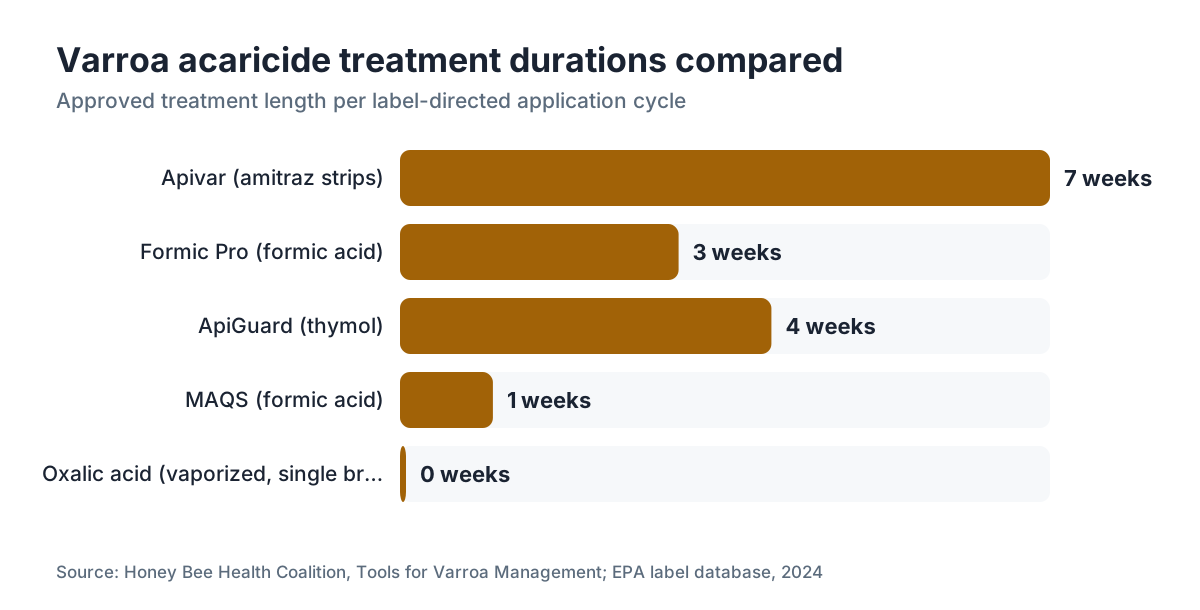
Treatment length and timing swing widely across the main approved acaricides. Here is an honest comparison from current label guidance and extension recommendations:
| Treatment | Active Ingredient | Duration | Brood Needed? | Temperature Range | Notes |
|---|---|---|---|---|---|
| Apivar strips | Amitraz | 6 to 8 weeks | Works with brood | 50 to 95°F | Off-label in honey supers |
| Oxalic acid (dribble/vaporize) | Oxalic acid dihydrate | 1 application (or 3x, 5-day intervals) | Broodless preferred | Above freezing | Most effective broodless |
| Mite Away Quick Strips (MAQS) | Formic acid | 7 days | Works with brood | 50 to 85°F | Can stress queens |
| Formic Pro | Formic acid | 14 to 21 days (2 pads) | Works with brood | 50 to 85°F | Penetrates capped brood |
| ApiGuard | Thymol | 4 weeks (2 applications) | Works with brood | Above 60°F | Requires ventilation |
Sources: EPA label database and Honey Bee Health Coalition [1][4][8]
Apivar's 6-to-8-week window is the longest of the common treatments, but it is also one of the more forgiving. It does not need the precise temperature control that thymol wants, and it does not need a broodless window the way single-dose oxalic acid does. The tradeoff is that long window, plus the residue and resistance concerns if you run past it.
How do you dispose of used Apivar strips?
Do not leave used strips in the hive, and do not compost or burn them. Used strips still hold residual amitraz. The label says to dispose of used strips per local solid waste rules, which usually means wrapping them in newspaper and putting them in household trash [1].
Do not toss strips in fields or waterways. Amitraz is toxic to fish and some invertebrates. Double-bagging used strips in zip-top bags before trashing them is a reasonable extra step.
Keep removed strips away from children and pets. Dogs are notably sensitive to amitraz, and veterinary reports describe amitraz toxicity in dogs that chewed discarded strips.
Store unused strips in their original sealed packaging, at room temperature, out of direct sunlight. Shelf life on an unopened package runs about 2 years from the manufacture date. Check the package for the expiration date. Degraded strips may carry less amitraz and treat poorly.
What are the signs that Apivar treatment failed or mites are resistant?
High mite counts after a full, correctly run 8-week treatment are the primary signal. An alcohol wash showing more than 2 mites per 100 bees post-treatment means something went wrong.
Here are the likely explanations, in rough order for most hobbyists:
- Reinfestation from nearby collapsing colonies. Very common in late summer. Mites drift in on robbing bees from high-mite hives close by. That is not treatment failure. It is re-exposure after a treatment that worked.
- Bad strip placement. Strips hung outside the cluster or in a super never got enough bee contact.
- Strips pulled too early. Six weeks is a minimum. Pull at week 4 or 5 and you leave capped-brood mites behind.
- Real amitraz resistance. Less common in the U.S. than in Europe, but documented and spreading. Rule out the causes above first, then resistance is a genuine possibility [3].
Suspect resistance? Switch your mode of action outright. Oxalic acid works by a completely different mechanism, and no cross-resistance with amitraz has been documented. Contact your state apiarist or local extension office. Confirmed cases help researchers track the spread.
You can find detailed resistance-monitoring guidance from the USDA Agricultural Marketing Service [9] and from university extension apiculture labs [7].
Frequently asked questions
Can I leave Apivar strips in for 10 weeks instead of 8?
No. The EPA label sets 8 weeks as the maximum. Ten weeks is off-label, adds amitraz residue to wax, and extends sublethal mite exposure that drives resistance. If counts are still high after 8 weeks, remove the strips, wait a couple of weeks, and start a fresh cycle or switch to a different mode of action like oxalic acid.
Do Apivar strips work in winter?
Not well. Amitraz needs bee activity and contact to move through the colony. Below roughly 50 degrees Fahrenheit, bee movement slows sharply and strip efficacy drops near zero. Leaving strips in over winter as passive protection is off-label and largely useless. A broodless oxalic acid application is the better winter option.
How long after removing Apivar strips can I add honey supers?
The current Apivar label prohibits use when honey supers for human consumption are on the hive. Remove strips before adding supers. Most beekeepers treat in late summer after pulling the honey crop, then add supers the following spring once any needed spring treatment is done. Always read the current label for pre-harvest interval language.
What happens if a beekeeper accidentally leaves Apivar strips in for 3 months?
You risk higher amitraz residue in beeswax, stronger selection pressure for resistant mites, and possible colony stress at prolonged exposure. It probably will not kill the colony outright, but it compromises wax quality and long-term resistance management across your apiary. Pull them, monitor mite loads, and tighten your protocol going forward.
How many Apivar strips do you use in a 10-frame hive?
Two strips per single or double brood box colony, hung in the brood nest between frames, about one frame in from each side of the cluster. A 5-frame nuc takes one strip. Do not cut strips in half. Extra-large colonies or triple brood boxes may warrant a third strip, but check the label for current guidance.
Can you treat a queenless hive with Apivar?
You can, but efficacy differs. A queenless hive eventually goes broodless as existing brood hatches. That broodless state makes oxalic acid a better fit, since it works best with no capped brood. Apivar needs bees walking across the strips, and a very small queenless cluster may not generate enough contact for good distribution.
Does Apivar harm the queen?
Under normal label-directed use, Apivar is not documented to harm queens the way formic acid can. Some beekeepers report more supersedure after amitraz treatment, but the causal link is not well established. The main queen risk with Apivar is indirect: extended or repeated treatments raise wax residues, which can affect brood viability over time.
How do I know when 6 weeks have passed after installing Apivar?
Write the install date directly on the strip frame or a hive record card. Forty-two days from install is your earliest removal date. Set a phone reminder. Forty-two days minimum, 56 days maximum. Simple math, but easy to lose track of in a busy season.
Is it safe to use Apivar twice a year?
The label allows it. A spring treatment and a fall treatment in the same season is a common, accepted protocol for heavily infested apiaries. Each cycle must be a complete, separate 6-to-8-week application with strips removed at the end. Running two full cycles per year for several consecutive years without rotating to another acaricide class raises resistance risk, so mix in oxalic acid years.
Can Apivar strips cause brood damage?
At label-directed doses, Apivar is not linked to significant brood damage in the scientific literature. Amitraz is toxic to bees at very high concentrations, but the strip releases the compound slowly, below harmful bee-level doses. See brood problems during treatment? Look first at other causes like queen issues, foraging pesticide exposure, or poor nutrition.
Why are my bees chewing or removing the Apivar strips?
Bees sometimes chew strips, especially in hot weather when amitraz volatilizes faster and the scent is stronger. Find a strip on the bottom board? Replace it and count that date as your new start. Check placement: strips buried in propolis or wedged between frames too tightly draw worker attention. Hang them loosely between frames to reduce it.
What is the difference between Apivar and Apistan?
Apivar uses amitraz. Apistan uses tau-fluvalinate, a pyrethroid. Apistan resistance is widespread in Varroa across North America and Europe, so it is largely ineffective in many apiaries today. Apivar (amitraz) generally performs better where Apistan has failed, though amitraz resistance is emerging, and rotation still matters.
Do I need to wear gloves when handling Apivar strips?
Yes. The label recommends chemical-resistant gloves during install and removal. Amitraz can absorb through skin and causes mild irritation in some people. Nitrile gloves work fine. Wash your hands thoroughly after handling strips even if you wore gloves, and keep strips away from your face.
Sources
- EPA Pesticide Registration - Apivar Label (Veto-Pharma): Apivar strips must be used for a minimum of 6 weeks and a maximum of 8 weeks per treatment cycle, with 2 strips per colony, and are not approved for use with honey supers intended for human consumption.
- U.S. EPA - Federal Insecticide, Fungicide, and Rodenticide Act (FIFRA), 7 U.S.C. § 136j: Using a pesticide contrary to its label is a federal violation under FIFRA.
- PLOS ONE - Amitraz resistance in Varroa destructor (Milani et al.): Varroa populations with reduced amitraz sensitivity have been documented, and prolonged sublethal exposure is a documented pathway to resistance development.
- Honey Bee Health Coalition - Tools for Varroa Management Guide: Amitraz-based treatments achieve 90-99% efficacy under ideal conditions; the action threshold for fall treatment is 2 mites per 100 bees; late-summer treatment protects winter bees; rotation of acaricide classes is recommended.
- University of Minnesota Extension - Bee Lab and Varroa Management: Amitraz efficacy drops sharply below approximately 50 degrees Fahrenheit as bee activity and strip contact decrease.
- PLOS ONE - Pesticide residues in beeswax and bee products: Amitraz and its metabolite DMPF (2,4-dimethylaniline) accumulate in beeswax; concentrations vary with exposure duration and frequency.
- Penn State Extension - Beekeeping and Varroa Mite Management: The action threshold for treatment is 2 mites per 100 bees in an alcohol wash; rotating acaricide classes is recommended to slow resistance development.
- EPA Pesticide Registration - Formic Pro, MAQS, ApiGuard labels: Treatment durations for formic acid and thymol products differ from amitraz: MAQS is 7 days, Formic Pro is 14-21 days, ApiGuard is 4 weeks.
- USDA Agricultural Marketing Service - National Honey Bee Disease Survey: USDA tracks varroa mite resistance and colony health at the national level; confirmed resistance cases should be reported to state apiarists.
- University of Florida IFAS Extension: Varroa mite populations peak in late summer on a collapsing bee population, creating the highest per-bee mite load and the most colony damage risk.
Last updated 2026-07-09