Can you leave Apivar strips in longer than 42 days?
TL;DR
- Apivar's EPA-registered label sets a 6-to-10-week (42-70 day) treatment window, and most beekeepers target 6 to 8 weeks.
- Going past that range speeds up amitraz resistance in your mites, leaves more residue in wax, and breaks the federal label.
- A few cases justify 8 to 10 weeks.
- Past 70 days is almost never smart and always off-label.
What does the Apivar label actually say about treatment duration?
The EPA-registered Apivar label (amitraz 3.3% impregnated strip) tells you to leave strips in for a minimum of 6 weeks and a maximum of 10 weeks. That works out to 42 to 70 days [1]. The window exists for a reason. Amitraz releases from the plastic matrix slowly, and the strips need at least six weeks of contact to work through a full brood cycle and reach mites emerging from capped cells.
The phrase "42 days" shows up constantly in forum threads because older references, beekeeper guides, and some supplier instructions boiled the window down to a single number. The label gives a range. So the sharper question isn't whether you can go past 42 days. It's whether you can go past 70. The answer: not legally, and almost never wisely.
The label is federal law. Under FIFRA (the Federal Insecticide, Fungicide, and Rodenticide Act), using a pesticide in a manner inconsistent with its labeling is a violation [2]. Leaving strips in beyond 10 weeks isn't a best-practice quibble. It puts you outside the registered use.
What happens biologically if you leave Apivar in too long?
The core problem with extended Apivar exposure is resistance selection. Amitraz works by binding to octopamine receptors in varroa mites. Expose mites to sublethal or declining concentrations over a long stretch and you select hard for any mite carrying genetic tolerance to the compound [3]. The strip does not release a steady dose. It gives up most of its active ingredient in the early weeks, and by weeks 8 to 10 the concentration in the colony has dropped a lot.
Run strips for 12, 14, or 16 weeks and you get a long tail of low-dose exposure after the useful phase is over. That is exactly the condition that breeds resistant mites. Research in Europe, where amitraz has been in use for decades longer than in the United States, has documented amitraz-resistant varroa strains in populations under heavy treatment pressure [3]. The U.S. is on the same road.
Resistance isn't the only cost. Longer strip presence pushes more residue into your wax. Amitraz and its breakdown product DMPF (2,4-dimethylaniline) both deposit into beeswax, and longer treatments mean higher residue loads [4]. That matters if you sell comb honey, if your bees draw comb right around the strips, or if you want to keep foundation reasonably clean across seasons.
Bees also process amitraz metabolites through their glands. There's some evidence, mostly European, that prolonged exposure can affect queen behavior, brood pattern, and worker lifespan at the colony level. That effect is harder to pin down in the field than in controlled trials, so treat it as a real but fuzzy concern.
Is there any situation where going past 42 days is acceptable?
Yes, inside the 42-to-70-day window. The call mostly comes down to whether the colony has brood when the strips go in.
Apivar hits phoretic mites hardest, the ones riding on adult bees. It does not reach into capped brood. A colony with a heavy brood nest needs more time so the strips can intercept mites as they climb out of cells. That's why the label lets you run to 10 weeks instead of stopping everyone at 6 [1]. Plenty of beekeepers treating in late summer with an active queen and a full brood nest legitimately run strips for 8 to 10 weeks and get better knockdown than the folks who pull at 6.
The Honey Bee Health Coalition's Varroa Management Guide recommends allowing the full treatment period when brood is present and confirming efficacy with a mite wash before and after [5]. That check matters. Apivar sometimes underperforms, especially if your mites carry partial resistance or the strips were stored badly.
Here's the working rule. 42 to 56 days is a sane default for broodless or low-brood treatments. 56 to 70 days is defensible for colonies with heavy brood. Past 70 days is off-label and backed by nobody: not the manufacturer, not the EPA registration, not any extension guidance I've seen.
How do you know if Apivar is actually working during treatment?
Don't assume it's working. Test it. An alcohol wash before strips go in gives you a baseline, and a second wash near the end of the window, around day 42 to 56, tells you whether the treatment did its job. If your post-treatment count is still above 2 mites per 100 bees, the treatment underperformed, and you need to figure out why before you leave strips in any longer [5].
Underperformance has a short list of causes. Resistance is one. Poor strip placement is another. Strips need to sit in the bee space between frames where adult bees stay in constant contact. A colony that clustered away from the strips, or strips wedged into empty comb with no traffic, gives poor results no matter how long they stay in. The Honey Bee Health Coalition notes that strip placement in areas of high bee traffic is necessary for adequate exposure [5].
If resistance is the culprit rather than placement, leaving strips in longer makes it worse, not better. The right move is to switch to a different mode of action: oxalic acid, formic acid (Mite-Away Quick Strips or similar), or HopGuard, depending on your season and brood status.
What mite load thresholds should trigger treatment in the first place?
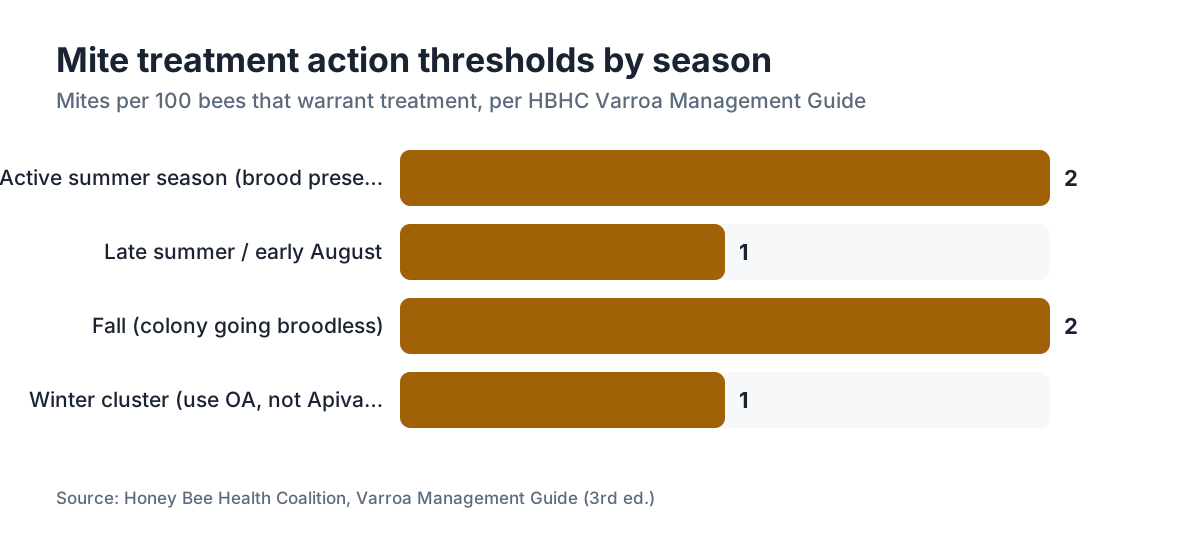
The University of Minnesota Bee Lab and most extension programs use a threshold of 2 mites per 100 bees (2%) as the point where treatment is warranted during the active season [6]. The Honey Bee Health Coalition's guide uses the same number and notes that colonies above 2% during the summer flow are at high risk of collapse before winter [5].
Some sources go lower for late-summer and early-fall timing. They recommend treating at 1% or higher in August, because varroa keep compounding through September and the mites born in those weeks are the ones that infest your winter bees [5]. Treating at 1 to 2% in late July or early August with a full Apivar course gives you the best shot at clean winter bees.
Here's threshold guidance and treatment windows across common scenarios:
| Situation | Mite threshold to treat | Recommended Apivar duration |
|---|---|---|
| Active summer season, brood present | 2% (2 per 100 bees) | 6-8 weeks |
| Late summer (Aug), brood present | 1-2% | 8-10 weeks |
| Fall, colony going broodless | 2% | 6-8 weeks (broodless = faster knockdown) |
| Winter cluster, fully broodless | Any detectable level | Use oxalic acid instead; Apivar is less effective |
Apivar is the wrong tool for a fully broodless colony. Oxalic acid (dribble or vaporization) works far better with no capped brood, because it contacts every phoretic mite directly instead of relying on strip contact through adult bees [7].
Does leaving strips in longer improve mite kill?
Mostly no, past about 8 weeks. The active ingredient drains out of the strip over time. By week 8 to 10, a big share of the amitraz has already volatilized or been soaked up by bees and wax. Studies of amitraz release from Apivar-style strips show release rates drop off sharply after the first 4 to 6 weeks [4]. You aren't getting meaningfully more mite kill in week 12 than you got in week 8. You're just parking a residue source in the hive.
The one exception: you installed strips in a colony where brood then expanded, maybe from a late queen pickup or a surprise nectar flow that kicked laying back up. There the extended window helps catch mites from a later brood cycle. That's an odd situation, not a reason to routinely run strips for 12 or 14 weeks.
If your mite counts are still high after 8 weeks of Apivar, pull the strips, wash again after a week to confirm the count, then decide on a different treatment or a repeat course. Don't leave the same strips in indefinitely.
How does amitraz resistance develop and how do you avoid it?
Amitraz resistance in varroa is documented in Europe and has been reported in some U.S. populations, though nationwide surveillance data is thin [3]. It develops through plain selection pressure. Mites with genetic variants that weaken amitraz binding or speed up metabolism of the compound survive treatment at higher rates and pass those traits on.
Three practices push resistance the hardest: running strips longer than labeled, running them below the labeled dose (cutting strips, using too few), and retreating with the same compound in a short window without rotating to a different mode of action.
Rotating treatments across seasons is the most practical tool you have. Treat with Apivar in late summer, then use oxalic acid for any supplemental fall or winter treatment. If you need a spring treatment, reach for formic acid. Come back to Apivar the following late summer if your mite load calls for it. That rotation keeps amitraz exposure episodic instead of constant and lifts the steady selection pressure that breeds resistance [5].
For tracking treatment history and timing across multiple hives, the free hive management resources at VarroaVault can keep you on schedule and document which treatments you've run, so you don't default to the same compound year after year without noticing.
What are the wax residue implications of extended Apivar use?
Amitraz and its metabolites accumulate in beeswax, and the buildup scales with treatment duration and frequency [4]. Studies have detected amitraz residues in commercial beeswax at levels ranging from non-detectable to several hundred micrograms per kilogram, depending on treatment history [4].
For most hobbyists, the practical fallout is small. You aren't selling comb honey at scale, and consumer exposure through honey is very low because amitraz partitions strongly into wax rather than honey. But if you make and sell beeswax products, or you're chasing certified organic status (which bans amitraz outright), longer treatments mean heavier wax contamination that takes multiple seasons of clean-comb replacement to clear.
The closer-to-home concern is that wax loaded with amitraz keeps releasing small amounts into the hive long after strips come out. That low-level chronic exposure is another engine for resistance selection. One more reason to stop at the label.
Can you use Apivar strips more than once per year?
The Apivar label allows two treatment courses per year [1]. Beekeepers who use it twice usually run one course in late summer (August or early September) and a second in spring (March or April). Spring treatment is less common because it collides with honey production in many climates, and strips have to come out before surplus supers go on.
You cannot leave supers on during Apivar treatment. The label bans it outright, and amitraz residues in honey are a genuine concern when strips sit in the hive during an active flow [1]. That's the main reason many beekeepers pick oxalic acid or formic acid for early-season treatment. Those compounds either clear faster or have cleaner timing around the honey flow.
Treat twice with Apivar in one year and you've used amitraz twice. That's inside the label, but it stacks total selection pressure on your mites. Pair two Apivar courses with at least one oxalic or formic treatment in the rotation to keep the pressure balanced.
What's the right way to remove and dispose of used Apivar strips?
Wear gloves when you pull strips. Amitraz absorbs through skin and acts as a monoamine oxidase inhibitor, so chronic skin contact is worth avoiding even at the low levels on a used strip. Oregon State University's National Pesticide Information Center describes amitraz toxicity and notes it affects blood pressure, heart rate, and central nervous system function in mammals through MAO inhibition [8].
Drop used strips into household trash in a sealed bag. Don't burn them, compost them, or leave them in the apiary. The plastic matrix still holds residual amitraz even after a full course.
Keep a log of when strips went in and when they came out. That's the simplest way to hit the label window and avoid drifting past 70 days because life got busy. A paper notebook works. So does a phone note or any hive app. The point is that you have a record you can check.
When should you choose a different treatment instead of extended Apivar?
Use oxalic acid if your colony is broodless or nearly broodless. This is the clearest case where Apivar is the wrong tool no matter the duration. Oxalic acid by dribble or vaporization in a broodless colony can hit 95%+ mite kill because there are no capped cells for mites to hide in [7]. Apivar in the same colony falls short, because its mechanism needs prolonged adult bee contact rather than direct mite contact.
Use formic acid if you need a mid-summer treatment without pulling honey supers. Mite-Away Quick Strips (formic acid 68.2%) can be used with supers on at certain temperatures and run a much shorter course (7 days) [9]. The temperature limits are real: formic acid is only safe for the colony above about 50°F and below about 92°F, a narrower window than Apivar gives you.
Comparing suppliers before you order? The beekeeping supply companies listing and free shipping honey bee supply companies pages are worth a look, since Apivar and oxalic acid products swing quite a bit in price across distributors.
The Honey Bee Health Coalition's Varroa Management Guide has a decision matrix for every registered treatment: efficacy by brood condition, temperature ranges, and honey super status [5]. It's the best free reference for this kind of treatment selection and gets updated as new data lands.
Want the biology behind the timing? The varroa mite overview walks through the full life cycle in plain terms.
What do extension apiculturists and researchers recommend for strip timing?
Penn State Extension recommends following the 42-to-56-day window for most situations and notes the 10-week maximum is there for colonies with heavy brood, not as a general target [10]. The University of Florida IFAS extension notes that amitraz strip efficacy is well-documented within the labeled window but that extended use has not been shown to beat a complete labeled course [11].
The Honey Bee Health Coalition's guide, now in its third edition, is probably the most cited practical reference in the U.S. for treatment timing. It states, "Follow all label directions, including the length of treatment," and recommends confirming treatment with a mite wash at the end of the window rather than extending strips in hope of a better result [5].
Nobody in the credible extension or research world recommends going past 70 days. The advice you'll hear from experienced beekeepers who routinely run strips for 12 or 14 weeks is anecdotal, ignores resistance selection over time, and puts them in FIFRA violation territory even when their colonies look fine in the moment.
For a well-run operation, the VarroaVault protocol tools can map treatment timing across all your hives, set reminders for strip removal, and track efficacy over multiple seasons, so your decisions ride on your own mite counts instead of calendar guesswork.
Frequently asked questions
Is it illegal to leave Apivar strips in longer than 70 days?
Yes. Using a pesticide in a manner inconsistent with its labeling violates FIFRA, the federal law governing pesticide use in the U.S. The Apivar label sets a maximum of 10 weeks (70 days). Exceeding that is an off-label use, which is a federal violation regardless of your intention or the outcome in your hive.
What happens to mites if I leave Apivar strips in for 3 months?
By month 3, the amitraz in the strips has largely depleted. You're no longer getting meaningful mite kill; you're leaving a low-dose residue source that selects for amitraz-tolerant mites. Extended low-dose exposure is one of the main drivers of resistance. Your mite population after a 3-month exposure may actually be harder to treat with amitraz in the future.
Can I leave Apivar strips in over winter?
No. The label maximum is 70 days, and leaving strips in over winter would far exceed that. Winter is also the wrong time for Apivar: broodless winter colonies respond much better to oxalic acid, which can hit over 95% mite kill with no brood present. Apivar's mechanism depends on adult bee contact, which is less consistent in a tight winter cluster.
Do I need to remove honey supers before putting Apivar in?
Yes, this is a firm label requirement. Honey supers must be off before Apivar strips go in and cannot go back on until strips are removed. Amitraz residues in honey are a concern during active treatment, and the label prohibition is explicit. This is the main reason many beekeepers use oxalic or formic acid for early-season treatment when a honey flow is approaching.
How many Apivar strips do I use per hive?
The Apivar label specifies 2 strips for a colony up to 5 frames of bees, and 2 strips per brood box for a two-box colony (4 strips total in some situations). Strips go between frames in the brood area where adult bees have maximum contact. Using fewer strips than labeled is an off-label use and reduces efficacy.
Can I reuse Apivar strips for a second treatment?
No. Strips are single-use. After one full course, the active ingredient has largely released from the matrix. A used strip has minimal amitraz left and won't provide effective mite control. Each treatment course requires fresh strips. Store unused strips in their original sealed packaging away from heat to preserve potency.
What mite count after Apivar treatment means the treatment failed?
If an alcohol wash at the end of treatment shows more than 2 mites per 100 bees, the treatment underperformed. Check strip placement first: strips need high bee-traffic areas. If placement was correct, consider partial resistance and switch to a different mode of action (oxalic acid or formic acid) rather than repeating Apivar immediately.
How long should I wait after removing Apivar before putting supers back on?
The Apivar label does not specify a mandatory wait period after strip removal before supers go on, but common extension guidance and the Honey Bee Health Coalition recommend waiting until strips are fully removed and the hive has had at least a brief period without active treatment. Some beekeepers wait a few days; others put supers on right after removal if a flow is starting. Follow your specific label version and any state-level guidance.
Does temperature affect how fast Apivar strips release amitraz?
Yes. Amitraz volatilizes faster at higher temperatures, so strips in a hot summer colony may release their active ingredient faster than strips in cool weather. This is one reason the label gives a range (42-70 days) rather than a fixed number. In very hot climates or during heat waves, efficacy can run high early but taper off faster than expected.
Can I use Apivar and oxalic acid at the same time?
There's no explicit label prohibition against simultaneous use, and some beekeepers vaporize oxalic acid during an Apivar course to hit remaining phoretic mites with a second mode of action. The Honey Bee Health Coalition recommends confirming need before combining treatments rather than stacking them by default. If Apivar is working, oxalic supplementation adds cost and bee stress without a matching payoff.
How do I know if my varroa mites are resistant to amitraz?
The clearest field indicator is a post-treatment mite count that stays above 2% after a full, correctly placed Apivar course. Formal resistance testing uses a bioassay method most hobbyists can't run at home. If you see repeated underperformance with correctly applied Apivar over multiple seasons, rotate away from amitraz and contact your state apiarist or a university extension lab about sampling options.
What's the difference between Apivar and generic amitraz strips?
Apivar (Véto-pharma) is the original EPA-registered amitraz strip product. Generic or unregistered amitraz strips sold outside the U.S. or through gray-market channels are not EPA-registered for U.S. beehives, and using them violates FIFRA. Some beekeepers import Taktic or other amitraz formulations for off-label use, but those products carry legal risk and have no U.S. extension or regulatory backing.
Should I treat in spring or fall with Apivar?
Late summer or early fall is the more important timing for most U.S. beekeepers, because treating in August or September protects the long-lived winter bees that determine whether your colony survives to spring. Spring treatment helps if your mite count spikes after winter, but you must pull supers before strips go in, which limits your window in areas with early spring flows.
Sources
- Véto-pharma / EPA, Apivar EPA Registration Label: Apivar label specifies a minimum of 6 weeks and maximum of 10 weeks (42-70 days) treatment duration, and prohibits use with honey supers in place.
- U.S. EPA, Federal Insecticide, Fungicide, and Rodenticide Act (FIFRA) overview: Using a pesticide in a manner inconsistent with its label is a violation of FIFRA federal law.
- Maggi, M. et al. (2010), Resistance to acaricides in Varroa destructor, Apidologie, Springer: Amitraz-resistant varroa strains have been documented in Europe under prolonged treatment pressure, with resistance linked to sublethal and extended exposure.
- USDA Agricultural Research Service, Beeswax Residue Studies overview: Amitraz and its metabolite DMPF accumulate in beeswax in proportion to treatment duration and frequency; release from strips declines substantially after the first 4-6 weeks.
- Honey Bee Health Coalition, Varroa Management Guide (3rd ed.): HBHC recommends 2% mite threshold for treatment, 1-2% in late summer, full labeled treatment period when brood is present, and strip placement in high-bee-traffic areas; states 'Follow all label directions, including the length of treatment.'
- University of Minnesota Bee Lab, Varroa Management resources: University of Minnesota recommends treatment at 2 mites per 100 bees (2%) as the action threshold during active season.
- U.S. EPA, Oxalic Acid Registration and Use in Bee Colonies: Oxalic acid applied to broodless colonies achieves over 95% mite kill by direct contact with phoretic mites; it is the recommended treatment for broodless winter colonies.
- Oregon State University, National Pesticide Information Center: Amitraz Technical Fact Sheet: Amitraz is a monoamine oxidase inhibitor; skin absorption is a route of exposure and it affects heart rate, blood pressure, and CNS function in mammals.
- NOD Apiary Products, Mite-Away Quick Strips (MAQS) EPA Label: MAQS (formic acid 68.2%) has a 7-day treatment window and can be used with honey supers on within specified temperature ranges (50-92°F).
- Penn State Extension, Varroa Mite Management in Honey Bee Colonies: Penn State recommends the 42-to-56-day window for most Apivar treatments and notes the 10-week maximum is for colonies with heavy brood, not a general target.
- University of Florida IFAS Extension, Honey Bee Varroa Mite Management: UF IFAS notes that amitraz strip efficacy is documented within the labeled window; extended use beyond labeled duration has not been shown to improve outcomes.
Last updated 2026-07-09