Hive inspection with Apivar strips in place: what to do and what to skip
TL;DR
- You can open and inspect a hive while Apivar strips are in place.
- Keep inspections brief, avoid moving or bunching the strips, wear chemical-resistant gloves, and don't put honey supers on during the 56-day treatment window.
- The two real risks are knocking a strip out of position and getting amitraz on your skin.
- Brood checks, population counts, mite washes, and queen assessments are all fine.
Can you open a hive while Apivar strips are inside?
Yes. Apivar strips don't need a sealed hive or a lockdown period. The EPA-registered label for Apivar (amitraz 3.3% slow-release strips) sets the treatment at a minimum of 42 days and a maximum of 56 days, and nothing on that label bars routine inspections in that window [1]. Bees walk across the strips, pick up amitraz on their tarsi, and spread it through grooming and contact. That transfer keeps working whether or not you lifted the lid this morning.
"You can" and "you should" aren't the same sentence, though. Every extra inspection during treatment costs the colony something: chilled brood on a cool day, a stressed cluster, and the chance you slide a strip out of place or wedge it where it barely touches bees. Keep inspections purposeful and fast. Don't skip them, and don't turn them into hobbies.
What are the actual risks of inspecting during Apivar treatment?
Two things. Amitraz getting on you, and a strip getting knocked out of position.
Amitraz absorbs through skin. The Apivar label lists it as a skin and eye irritant and notes that the active ingredient is an MAO inhibitor in mammals [1]. Handling strips bare-handed, or letting one drag across your wrist while you pull frames, is how you pick up a real dose. Thin exam gloves aren't enough for direct strip work. The label calls for chemical-resistant gloves, nitrile or butyl rubber rated for pesticide use at a minimum, for anyone handling the strips themselves [1].
Placement drives efficacy. Apivar works best when strips hang free between frames in the broodnest, where bee traffic runs highest. Lose focus during a brood check and it's easy to pinch a strip between two frames, fold it flat against the sidewall, or drop it to the floor. A folded or floored strip still leaks amitraz but touches far fewer bees. The Honey Bee Health Coalition's Varroa Management Guide names broodnest placement as one of the variables that decides whether the treatment works [2].
One more risk gets less attention. You open the hive, you find something worrying, and you feel the urge to pile on a second product for a secondary problem. Stacking a second miticide onto active Apivar strips without knowing how the two interact is a mistake beekeepers make every season. Read both labels. If you're unsure, call your state apiarist.
How should you gear up before opening a hive with strips in it?
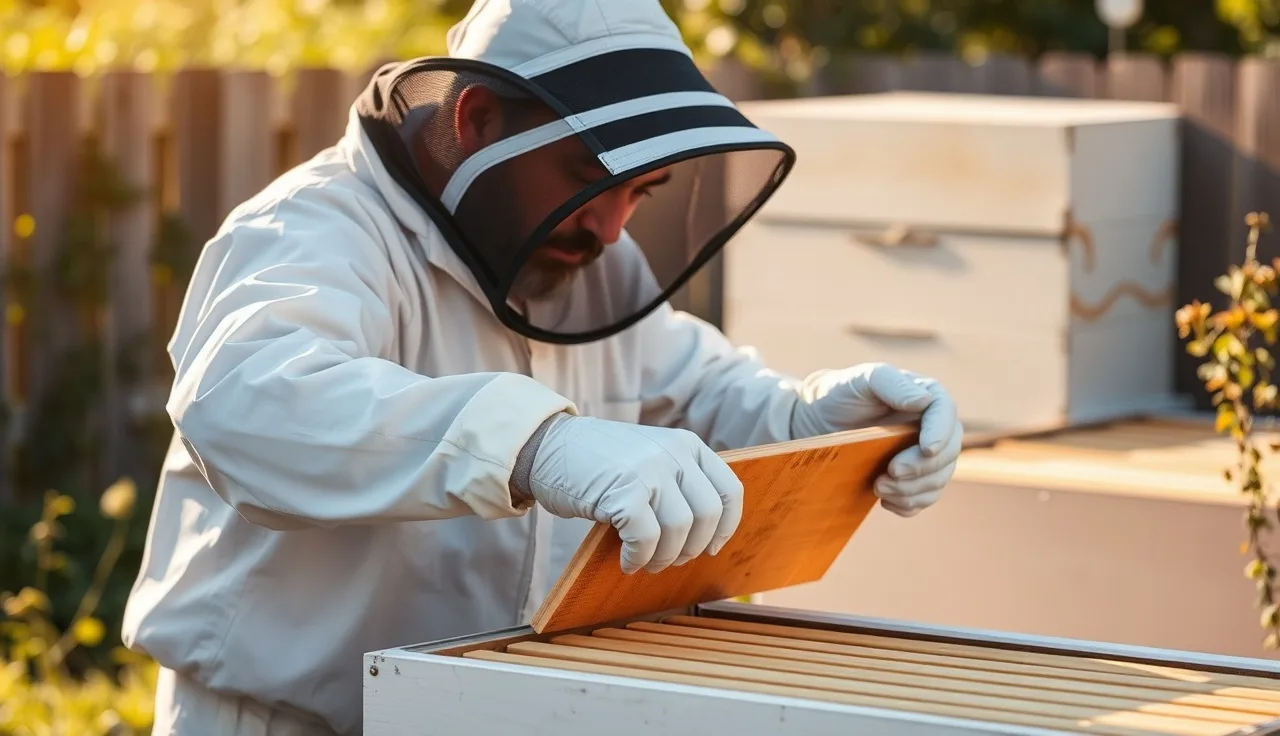
Treat it like the pesticide-handling job it is. Before the box comes open, put on your suit, veil, and chemical-resistant gloves if there's any chance you'll touch the strips. If it's a quick visual and you're sure you won't disturb them, thicker beekeeping gloves work. The cautious pick is the rated pair.
Smoke normally. Amitraz doesn't interact with smoke in any problematic way. Cool, white smoke at the entrance and under the cover is fine.
Have a plan before you crack the lid. Know which frames you actually need to see. If you only need to confirm the queen in the upper brood box, you don't need to pull all ten. A focused inspection cuts your exposure and the colony's disruption at the same time.
How do you handle frames without displacing the strips?
Apivar strips hang between frames on the wire loop they ship with, draped over a top bar. Pull a frame and the strip either rides along on the neighboring top bar or stays put. Either way, clock where it lands and put it back in the broodnest before you close up.
A few habits that keep you out of trouble:
Start from the outside frames and work inward toward the broodnest. That gives you room to lift frames without crushing a strip.
If a strip drops to the bottom board, pick it up with a gloved hand and rehang it. Don't leave it lying flat. A strip on the floor is mostly wasted miticide.
Count your strips every time the hive is open. You start with two strips per five frames of bees [1]. Confirm both are there and hanging upright in the broodnest. If you added a super or the population shifted hard, ask whether your strip count still matches the colony.
Keep bare skin off the active surface, the inner polymer matrix. The outer wrapper edges carry less risk. The matrix is where amitraz concentration runs highest.
Can you add or remove honey supers while Apivar is in place?
No. This is the hardest line on the Apivar label and the one beekeepers break most [1]. Supers meant for human consumption must not sit on the hive during treatment. Amitraz and its breakdown product (mainly 2,4-dimethylaniline) migrate into honey and wax. The label is blunt: pull honey supers before you install strips, and keep them off until the strips come out and the treatment period ends.
This isn't caution for caution's sake. Amitraz isn't approved for use in U.S. honey-production colonies at any point supers are on. Selling honey pulled from a hive treated with supers in place can be a federal violation under FIFRA, the Federal Insecticide, Fungicide, and Rodenticide Act [3].
Missing a flow because you had to hold supers off stings. Contaminated honey in your extractor or on a shelf is worse. Take the loss.
What parts of a normal inspection are still fine to do?
Nearly everything that isn't harvesting honey or adding a second miticide.
Brood pattern checks: fine. You want solid, capped brood. A spotty pattern can flag treatment stress or a problem that has nothing to do with the mites.
Queen presence and laying: fine, and worth doing at the treatment midpoint. The Honey Bee Health Coalition notes that colonies with a brood break, like one you create by requeening mid-treatment, often show better efficacy because mites have fewer capped cells to hide in [2].
Population estimate: fine. A colony shedding bees faster than expected is telling you something. Could be a failing queen, a disease unrelated to varroa, or in rare cases an amitraz sensitivity reaction.
Alcohol wash or sticky board count: fine, and encouraged. Monitor at the start of treatment, around day 42, and after strip removal. A wash during treatment tells you whether the infestation is dropping on schedule [2].
Feeding: fine. If the colony needs carbs or protein, feed through treatment. Just set the feeder so it doesn't pin or soak a strip.
How often should you inspect during the 56-day treatment window?
Two inspections cover the minimum useful cadence: one around day 21 for strip placement, brood status, and queen presence, and one around day 42 to confirm the colony's healthy and take a mite wash before you pull strips [2].
Add an early check at day 3 to 5 if you're new to Apivar. You want to see the strips hanging right and not already getting propolized shut. Some colonies try to bury strips in propolis, and you'd rather catch that on day 4 than day 40.
Past that, more frequent inspections during treatment buy you little unless something's wrong: a sudden drop in population, odd bee behavior, or a dead-out risk late in autumn. Healthy colonies with well-placed strips don't need a weekly visit. Let it run.
Running one to five hives? VarroaVault's free treatment tracking worksheet logs your strip-in and strip-out dates, mite counts per inspection, and population notes without a separate spreadsheet.
What does a mite count during treatment actually tell you?
An alcohol wash during treatment tells you whether the mite population is trending down fast enough. It does not tell you the treatment is finished, because capped cells still shield a large share of the mites from amitraz until those cells open.
A wash around day 28 to 35 should show a clear drop from your pre-treatment baseline. Start at 4% or higher and still sit at 3% by day 35, and something's off. The strips may be misplaced, the population may carry resistance, or your baseline estimate ran low.
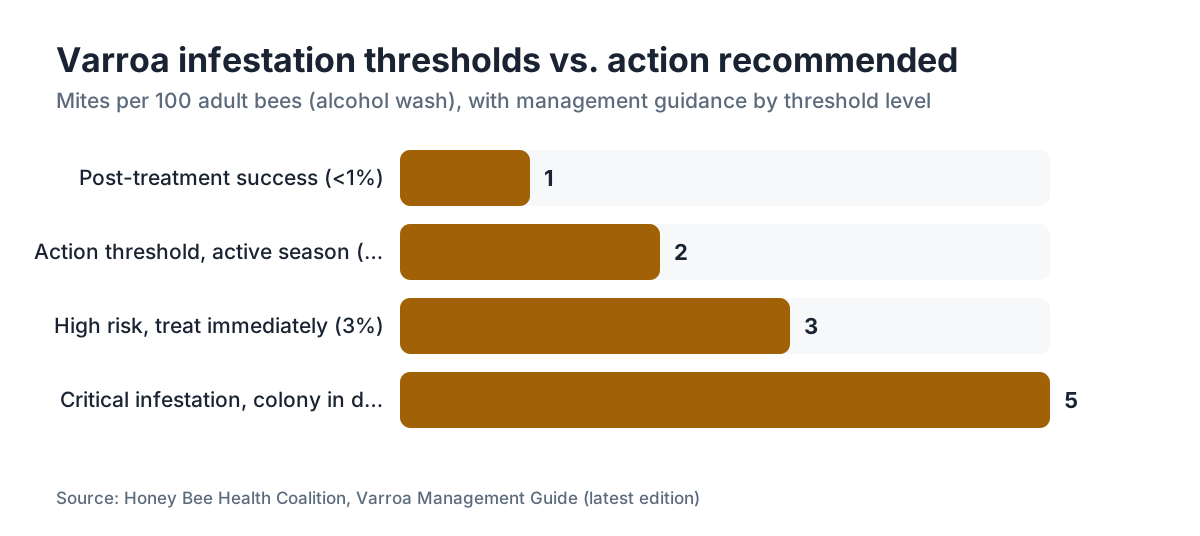
The Honey Bee Health Coalition's Varroa Management Guide sets a 2% action threshold (2 mites per 100 bees) across most of the active season, and treats post-treatment counts below 1% as successful control [2]. A wash 5 to 7 days after strip removal gives the cleanest read on final efficacy, because mites emerging from the last capped cells will have hit the strips by then.
No drop at all by day 35 points to an amitraz-resistant population. That's documented in the U.S. and Europe, and it's a real problem rather than a fringe one. A 2019 study in PLOS ONE by Morfin and colleagues found amitraz resistance-associated mutations in Varroa destructor across multiple U.S. states [4]. Reading up on varroa mite biology explains why resistance builds and why rotating chemistries matters.
How do you remove Apivar strips correctly at the end of treatment?
After 42 to 56 days, pull both strips from every hive on the same day if you can. Leaving them past 56 days is off-label and pushes selection pressure toward resistance.
Wear the same chemical-resistant gloves you used at install. The strips come out darker and thinner than they went in, the amitraz has been leaking out the whole time, but they still carry residual active ingredient.
Dispose of strips in household trash inside a sealed plastic bag. Don't burn them. Don't compost them. Don't leave them near water. Apivar disposal follows EPA requirements under RCRA guidelines for pesticide waste [1][3].
Take a wash 5 to 7 days after removal and write down the number. Above 2%, you need a follow-up treatment. Below 1%, you bought your colony real time heading into autumn cluster.
Once strips are out, supers can go back on if the flow lines up. The current label states no mandatory wait between removal and super placement, but some extension services suggest a few days to let residual amitraz in the hive air dissipate [5].
What do you do if you find a problem queen or failing colony during treatment?
Requeening during active Apivar treatment isn't prohibited, and it's often the smart play. The brood break from a queen swap opens up mites that were sitting safe in capped brood. Need to requeen? Do it. The strips stay in.
A collapsing colony is a harder call. A very small cluster, fewer than two frames of bees, may not move enough traffic across the strips to spread amitraz well. In that case you might be better off combining the failing colony with a healthy one (after ruling out disease) and treating the merged unit. Call your state apiarist if you're unsure, especially if the collapse looks like it has a pathogen behind it beyond varroa.
Never merge a failing colony into a healthy one without diagnosing why it failed first. American foulbrood rides through equipment in ways varroa never does.
Does temperature affect Apivar efficacy during inspections or between them?
Yes, and this one gets overlooked. Amitraz release from the strips depends on temperature. Below roughly 50 F (10 C), release slows sharply and bee activity drops, so fewer bees touch the strips each day [2][6]. That's a big part of why Apivar is a poor late-autumn choice, when the cluster tightens and temperatures fall.
A brief hit of cold air during an inspection won't change the strip's total release much, but it does chill the cluster and can push bees off the broodnest for a while. Keep winter and early-spring inspections faster than your warm-weather ones.
Running treatment into late September or October up north? Watch the overnight lows. If they sit consistently below 50 F, the strips aren't working as labeled. Time your treatments earlier. Most extension recommendations put the Apivar window in late summer through early fall for exactly this reason [5][6].
Stocking up for a full cycle? Beekeeping supply companies that carry both Apivar and oxalic acid vaporizers are worth bookmarking, since those two products anchor most rotation protocols.
Apivar strip inspection quick-reference
Here's what's fine, what to watch, and what's off-limits during treatment:
| Action | Status during treatment | Notes |
|---|---|---|
| Opening the hive | Fine | Keep it brief and purposeful |
| Pulling frames for brood check | Fine | Note and reposition any displaced strips |
| Alcohol wash mite count | Fine, encouraged | Do at day ~35 and 5-7 days after strip removal |
| Requeening | Fine | Brood break may improve efficacy |
| Adding honey supers | Not allowed | Off-label; amitraz contaminates honey |
| Harvesting honey | Not allowed | Same reason |
| Applying a second miticide | Use caution | Check both labels; call state apiarist if unsure |
| Feeding syrup or pollen sub | Fine | Position feeder so it doesn't soak a strip |
| Leaving strips in past 56 days | Not allowed | Resistance selection risk; off-label |
| Disposing of used strips in trash | Required | Sealed plastic bag; no burning |
This table reflects the Apivar product label requirements [1] and Honey Bee Health Coalition guidance [2]. When in doubt, the label is the law.
Want it all in one place? VarroaVault's varroa management tools include a free inspection log that cross-references treatment dates with mite count thresholds, so you can see at a glance whether a colony is on track.
Frequently asked questions
Can I do a full hive inspection the day I install Apivar strips?
Yes. A day-of inspection is useful because you can confirm strip placement, note the current brood pattern, and take a baseline mite wash. Install the strips during the inspection so you hang them in the heart of the broodnest while frames are already out. Just put everything back in the right spot before you close the hive.
Do I need to remove Apivar strips before I inspect, then replace them?
No. The strips stay in the hive through every inspection. Pulling and replacing them repeatedly is pointless and raises your amitraz exposure. Leave them hanging in the broodnest and work around them as you lift frames. If one falls or gets shoved out of place, reposition it before you close the hive.
What gloves should I wear when I open a hive with Apivar strips inside?
If you'll touch the strips directly, use chemical-resistant gloves rated for pesticide contact, nitrile or butyl rubber at a minimum. For a normal frame inspection where you won't handle the strips themselves, thicker leather or coated beekeeping gloves give reasonable protection. The Apivar label requires chemical-resistant gloves specifically for strip handling.
Will smoke interfere with how Apivar strips work?
No. Smoke works by masking alarm pheromones and triggering a feeding response. It has no documented interaction with amitraz release or distribution. Smoke your hive normally before and during every inspection. There's no reason to change your standard technique when Apivar is in place.
How many Apivar strips should be in my hive, and how do I know if one is missing?
The label calls for two strips per colony of five or more frames of bees, regardless of hive configuration [1]. For a smaller colony (fewer than five frames), one strip is used. Count strips every time you open the hive. If one is missing, check the bottom board first. A lost strip should be rehung right away, not tossed.
Can bees propolize Apivar strips and make them less effective?
Yes, though it's not the most common problem. Some colonies coat strips heavily in propolis, which cuts the surface area available for bee contact. Check strips at the 3-to-5-day mark and again around day 21. If one is badly encrusted, scrape the worst of it off with your hive tool or swap in a fresh strip if you have a spare.
Is it safe to inspect a hive with Apivar if I'm pregnant or have chemical sensitivities?
The Apivar label advises people with known amitraz sensitivity to avoid contact with the product. Pregnant beekeepers should ask their healthcare provider before handling it, since amitraz is an MAO inhibitor at the mammalian level [1]. Wear full PPE and keep direct strip contact to a minimum. Handing strip installation and removal to someone else during pregnancy is a reasonable precaution.
What happens if I accidentally leave Apivar strips in for 70 days instead of 56?
Leaving strips past 56 days is off-label and is tied to higher selection pressure for amitraz resistance. Most of the active ingredient is depleted by day 56 anyway, so late strips give little miticide benefit. Remove them as soon as you catch the timeline overrun and take a mite wash to see where you stand.
Can I run Apivar in a hive that has a propolis trap or pollen trap installed?
A propolis trap is fine. A pollen trap is trickier. A pollen trap collects material moving through the hive, and amitraz residues can turn up in pollen and wax during treatment. Don't collect pollen for human consumption while Apivar is active. The same logic behind the honey super rule applies: amitraz shouldn't be in food. Read up on beehive pollen timing before you set traps near a treated colony.
What should my mite count look like halfway through Apivar treatment?
There's no official midpoint target on the label, but an alcohol wash around day 28 to 35 should show a clear downward trend from baseline. If your pre-treatment count was 4% (4 mites per 100 bees), a midpoint count of 1 to 2% suggests things are working. No drop at all by day 35 is a red flag for resistance or misplaced strips.
Does the number of strips change if I'm running a double-deep hive?
The label dose is based on frames of bees, not boxes. Two strips per five frames of bees is the standard. A strong double-deep colony covering 10 or more frames warrants four strips. Put two in the lower brood box and two in the upper. Confirm placement during your mid-treatment inspection, especially as the cluster shifts between boxes across the season [1].
Can I use Apivar in a hive I'm planning to split during treatment?
Splitting mid-treatment complicates the math. Each resulting unit needs its own correctly dosed strips, and you'll have to restart or extend the timeline for the splits, since the 56-day clock depends on continuous strip presence. If you know a split is coming, finish the treatment first, wait a few days, then split. Plan your season around treatment windows.
What's the earliest I can put honey supers back on after Apivar strips come out?
The current Apivar label sets no mandatory wait between strip removal and super placement, but some university extension guidance suggests a few days to let residual amitraz dissipate from the hive [5]. In practice, when nectar flow timing forces it, removing strips and placing supers the same day is what many commercial beekeepers do, knowing it sits at the edge of label guidance.
What if I see signs of American foulbrood during an inspection while Apivar is in place?
Stop the inspection, close the hive, and contact your state apiarist immediately. American foulbrood is a notifiable disease in most U.S. states, and Apivar has nothing to do with treating or preventing it. Active strips don't change your AFB protocol at all. Don't move equipment, don't shake out the colony, and don't combine it with other hives until AFB is ruled out.
Sources
- Apivar (amitraz 3.3%) EPA-registered label, Veto-pharma: 56-day maximum treatment period, two strips per colony per five frames of bees, no honey supers during treatment, chemical-resistant gloves required for strip handling, MAO inhibitor notation
- Honey Bee Health Coalition, Varroa Management Guide (latest edition): Strip placement in broodnest is key to efficacy; 2% infestation action threshold; post-treatment count below 1% indicates successful control; brood break during treatment may improve outcomes; monitoring before, during, and after treatment recommended
- U.S. EPA, Federal Insecticide Fungicide and Rodenticide Act (FIFRA) overview: Using a pesticide in a manner inconsistent with the label is a federal violation under FIFRA; disposal of pesticide containers must follow RCRA guidelines
- Morfin N et al., PLOS ONE, 2019: Mechanisms of acaricide resistance in populations of Varroa destructor: Amitraz resistance-associated mutations documented in Varroa destructor populations across multiple U.S. states and in Europe
- Penn State Extension, Varroa Mite Management: Apivar recommended for late summer to early fall treatment window in northern latitudes; some extension guidance suggests brief waiting period after strip removal before super placement
- University of Minnesota Extension, Varroa Mite Control for Honey Bee Colonies: Amitraz release from Apivar strips is temperature-dependent and decreases significantly below 50°F; treatment efficacy reduced in cool conditions with contracted cluster
- North Carolina State University Apiculture Program, Varroa Mite Management: Alcohol wash methodology and mite count interpretation for monitoring before, during, and after miticide treatments
- Rosenkranz P, Aumeier P, Ziegelmann B, Journal of Invertebrate Pathology, 2010: Biology and control of Varroa destructor: Varroa mites in capped brood are protected from acaricide contact; brood breaks increase proportion of phoretic mites exposed to treatment
- USDA AMS National Organic Program, materials restrictions for certified organic operations: Amitraz-based products including Apivar are not approved for use in certified organic honey operations
Last updated 2026-07-09