Apivar cost per hive per season: what you'll actually spend
TL;DR
- Apivar (amitraz 3.3% strips) costs about $10 to $16 per hive per treatment when you buy a 10-pack at $28 to $45 and use two strips per hive.
- A full season with two treatment windows runs $20 to $32 per hive.
- Bulk packs and co-op buying cut that 30 to 40%.
What does Apivar actually cost per hive?
Plan on $10 to $16 per hive per treatment round. Treat twice a year and you're looking at $20 to $32 per hive for the season. That range is real because retail prices shift by supplier and pack size, and because one beekeeper's "hive" is a single deep while another's is a double.
Apivar sells in packs of 10 strips (one box treats 5 hives at two strips each) and packs of 50. As of mid-2025, a 10-pack retails for roughly $28 to $45 depending on the supplier. A 50-pack, when you can find one, runs $110 to $160 at most U.S. beekeeping suppliers [1][12]. Run the math and the per-strip cost drops from about $3.00 to $4.50 on the 10-pack down to $2.20 to $3.20 on the 50-pack.
Two strips per hive is the labeled rate for a single brood chamber. The EPA-registered label specifies two strips per colony for standard-sized colonies in one or two brood boxes [2]. Run three-box colonies and some beekeepers add a third strip, but that's off-label and not something the manufacturer backs.
So for a single treatment round:
- 1 hive: about $6 to $9 in strips (2 strips)
- 5 hives: about $28 to $45 (one 10-pack)
- 10 hives: about $56 to $90 (two 10-packs, or hunt down a 50-pack)
- 25 hives: about $110 to $160 (one 50-pack)
Shipping adds $8 to $15 on small orders, or nothing if you clear a supplier's free-shipping threshold (usually $75 to $100). For companies that carry Apivar, see our guide to beekeeping supply companies.
How many Apivar strips do you need per hive per year?
Two strips per colony per treatment, left in for a minimum of 6 weeks and a maximum of 10 [2]. Treat twice a year and that's four strips per hive annually. The Honey Bee Health Coalition's Varroa Management Guide recommends at least one treatment after the honey flow in late summer or fall, and a second in early spring if mite loads pass the action threshold of 2 mites per 100 bees [3].
At retail strip prices of $2.20 to $4.50, four strips runs $8.80 to $18.00 per hive per year in strips alone. Call it $10 to $18 as a working budget.
Some beekeepers in high-pressure regions treat three times: after the spring flow, after the summer flow, and again in late fall. That's six strips per hive, or $13 to $27 in strips. It's not the default recommendation, but budget for it if your counts have been ugly.
Here's what a lot of hobbyists miss. You cannot treat during a honey flow with Apivar, because amitraz contaminates honey [2]. Timing your windows around your supers is more than a legal chore. It sets how many treatment rounds fit in your year, which sets your whole-season cost.
How does Apivar cost compare to other varroa treatments?
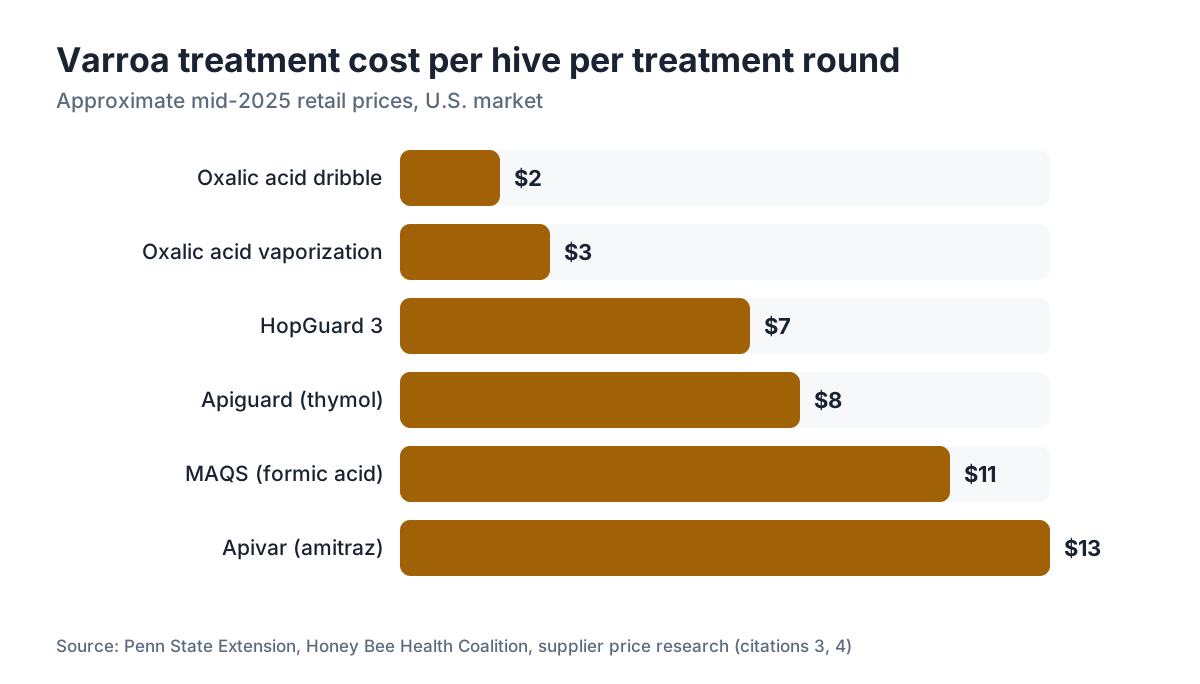
Cost shouldn't drive your treatment choice on its own, but it's real money for anyone running 5 to 50 hives. Here's a side-by-side of the common options at rough mid-2025 retail prices, per hive per treatment round [1][3][4].
| Treatment | Active ingredient | Cost per hive/treatment | Brood penetration | Honey flow safe? |
|---|---|---|---|---|
| Apivar strips | Amitraz 3.3% | $10 to $16 | No (misses mites in capped brood) | No |
| Oxalic acid dribble | Oxalic acid | $1 to $3 | No (broodless colonies only) | Yes (winter) |
| Oxalic acid vaporization | Oxalic acid | $1 to $4 per round (plus $150 to $250 vaporizer) | Extended cycles yes | Generally yes |
| Mite Away Quick Strips (MAQS) | Formic acid | $8 to $14 | Yes | Yes (with restrictions) |
| Apiguard | Thymol | $5 to $10 | Limited | No |
| HopGuard 3 | Hops beta acids | $5 to $9 | No | Yes |
Apivar sits mid-range on cost and is often the practical pick when the colony still has capped brood, because the treatment window runs long enough for most of that brood to hatch and expose its mites. The Honey Bee Health Coalition rates amitraz strips among the most effective treatments available when colonies aren't already carrying resistant mites [3].
Oxalic acid is far cheaper per treatment but needs either a broodless colony (dribble) or repeated vaporization (every 5 days for roughly 3 to 5 rounds) to work through brood cycles. Price your own time at, say, $20 an hour and that gap narrows fast.
Formic acid (MAQS) kills mites under cappings in a single application. That's a genuine advantage in late summer when you want a fast knockdown before winter bees get raised. At $8 to $14 per hive it competes with Apivar on price. The catch is temperature sensitivity and higher queen loss risk above 85°F.
What is the cheapest way to buy Apivar?
Bulk packs. The 50-strip pack cuts your per-strip cost by 25 to 35% against buying 10-packs over and over [1][12]. Keep only 3 to 5 hives and you won't burn through a 50-pack before it expires (check the box; most run 2 to 3 years from manufacture). The fix is a co-op buy with neighbors.
Beekeeping clubs run group orders all the time. A club pooling money for five 50-packs can sometimes squeeze another 5 to 10% out of a distributor, though that varies. If your club doesn't do this, be the one who suggests it.
Shipping matters more than most hobbyists expect. A 10-pack ordered by itself can run $8 to $15 to ship, adding $0.80 to $1.50 to your effective per-strip cost. Fold Apivar into a larger order that clears a free-shipping threshold (common at $75 to $99 at major suppliers) and that cost disappears. If you need other beekeeping supplies, batch the orders.
A few state departments of agriculture sell or subsidize registered treatments during varroa outbreak periods. It isn't universal. Worth a look at your state ag department's apiary program page once a year.
Local farm stores (Tractor Supply, some rural co-ops) sometimes stock Apivar below online retail, because they don't bake shipping into the price. Availability jumps around. If they have it and the expiration date is good, grab it.
Does Apivar work well enough to justify its cost?
When mite populations aren't yet resistant to amitraz, Apivar efficacy in published trials has run 90 to 99% mite mortality over a 6 to 8 week treatment period [5]. A 2016 field study in PLOS ONE reported that "amitraz efficacy in U.S. colonies ranged from 54% to 99% depending on location," the first solid sign that resistance isn't uniform across the country [6].
That resistance caveat drives your cost-benefit math. In a region with documented amitraz-resistant mites, you might spend $12 a hive on Apivar and see only 50 to 60% mite reduction, which won't save the colony. There, the cheaper treatment is formic acid or oxalic acid plus a brood break, even at a similar sticker price, because they actually work.
How do you know if you have resistance? You don't, until you treat and then monitor. The Honey Bee Health Coalition recommends a mite wash (alcohol wash or sugar roll) before treatment, again 48 to 72 hours after strips go in to gauge initial knockdown, then again at the end of the window [3]. Poor knockdown despite correct application points to resistance more than anything else.
VarroaVault has free mite count tracking tools to help you document this across seasons. Multi-season data is the only real way to watch a resistance pattern build in your own yard.
For most beekeepers most of the time, Apivar works and that $10 to $16 per treatment is money well spent. Losing a colony costs you $150 to $250 in bees alone (package or nuc prices in 2025), plus equipment, plus the honey you didn't harvest [11]. Apivar at about $30 per hive per year is cheap insurance.
How do you apply Apivar correctly so you don't waste money?
The labeled method is simple. Pull the two strips from the packaging, hang one between two frames in the brood nest, and hang the second between two other frames in the brood nest, so bees moving between frames touch them [2]. Bees walk across the strip, pick up amitraz, and pass it through trophallaxis (food sharing) across the colony.
The most common mistake is placing strips outside the brood cluster. A strip parked in an empty corner gets almost no bee contact and does almost nothing. Get them into the active brood area.
Leave them in 6 to 10 weeks. Six weeks is the floor because that's how long it takes for multiple brood cycles to complete and expose the mites that were under cappings when you started. Don't pull strips early. Don't leave them past 10 weeks either. Prolonged amitraz exposure ramps up selection pressure for resistance and can cause queen problems [2].
Always remove strips at the end of treatment and dispose of them properly. Don't let spent strips sit in the hive. The label requires removal, and residues build up in wax over repeated treatments [7].
Wear nitrile gloves when handling strips. Amitraz is a monoamine oxidase inhibitor, and while skin contact isn't acutely dangerous at these concentrations, it isn't something you want to repeat over a beekeeping career.
What is the full seasonal budget for varroa management per hive?
Run Apivar as your main tool with oxalic acid as a winter supplement and here's a realistic annual cost per hive.
| Item | Cost per hive/year |
|---|---|
| Apivar strips (4 strips, 2 treatments) | $8.80 to $18.00 |
| Oxalic acid dribble or vapor (1 winter treatment) | $1 to $4 |
| Mite testing supplies (alcohol wash or sticky boards) | $2 to $5 |
| Vaporizer amortized cost (if vapor; $200 unit over 5 years) | $4 to $10 |
| Total per hive per year | $15 to $37 |
A hobbyist running 5 hives spends $75 to $185 a year on varroa management. A sideliner with 30 hives spends $450 to $1,110 a year, and at that scale bulk buying starts to matter a lot.
Those numbers assume zero colony losses. Lose two colonies in a 10-hive operation because you under-treated and you've spent $300 to $500 replacing them (nucs run $150 to $200 each in most U.S. markets in 2025) [11]. The math favors treating before you have a problem.
The Honey Bee Health Coalition's Varroa Management Guide is the best free reference for building a seasonal calendar, and it downloads as a PDF [3]. It maps treatment windows to colony development and honey flow timing, which is exactly what you need to plan your spend.
Are there any hidden costs with Apivar?
A few worth naming.
Wax contamination is the slow one. Amitraz and its metabolites build up in beeswax with repeated use. A 2010 study in Apidologie found detectable amitraz residues in comb wax after multiple treatment seasons [7]. This doesn't harm bees at typical residue levels, but it's a reason to rotate comb out of the brood nest every few years anyway, and that's a cost in foundation and frames.
Resistance monitoring is a hidden cost paid in time. Mite washes before and after treatment are the only way to catch resistance early. Skip the monitoring and you might burn a full season treating with something that isn't working, then eat the colony loss on top.
Record keeping takes time too. Knowing when you hung strips, when you pulled them, and what your counts were before and after isn't optional if you want to make good calls. The free tracking features at VarroaVault cut that time down.
On the varroa mite itself: Varroa destructor has a reproductive cycle that makes timing genuinely tricky, and the USDA Bee Research Laboratory has documented how that brood cycle timing shapes when treatments actually reach the mites [8]. Get the timing wrong and it costs you both money (wasted treatment) and bees. Learn the biology once and it pays for itself many times over.
Does Apivar have any label restrictions that affect cost or timing?
Yes, and they shape your seasonal budget directly.
The EPA-registered label for Apivar specifies [2]:
- Do not use during honey production. Supers must be off during treatment.
- Two strips per colony in one or two brood boxes.
- Minimum 6-week treatment, maximum 10 weeks.
- Remove strips after treatment and do not reuse them.
- No more than two treatment periods per year.
The "no supers during treatment" rule is the big one for timing. Across most of the continental U.S., you get a post-summer-flow window from roughly August through October when supers are off and colonies are building winter bees. That's your primary window. Miss it and your next real one is late winter or early spring, before the spring flow starts.
That two-window structure caps you at two Apivar treatments a year per the label. Some beekeepers rotate to oxalic acid for a third round (a winter oxalic dribble on a broodless cluster, say) because it's a different mode of action and doesn't count against the Apivar limit.
State rules can add requirements on top of the federal label. California, for one, has extra pesticide use reporting requirements for commercial apiaries. Check your state department of agriculture's apiary program for local rules.
Where can you buy Apivar in the U.S.?
Apivar is a registered pesticide (EPA Registration No. 92647-1) sold through licensed beekeeping supply companies without a prescription [2]. No veterinarian's prescription needed, unlike some other treatments (Tylosin, for example, requires one).
Common sources:
- Online beekeeping suppliers (Mann Lake, Dadant, Brushy Mountain, etc.)
- Local farm and ranch stores in agricultural areas
- State and regional beekeeping club co-op orders
- Some state apiary programs during varroa response periods
For a list of suppliers with shipping options, see our overview of beekeeping supply companies. If shipping cost is your worry, check the free shipping honey bee supply companies page before you order.
One purchasing note. Apivar is made by Veto-Pharma (France) and distributed in the U.S. through authorized channels. Counterfeit or gray-market strips have shown up in some online marketplaces. Buy from established beekeeping suppliers, not random third-party sellers on general retail platforms. A fake strip costs the same as a real one and delivers none of the benefit.
How do small-scale beekeepers manage Apivar costs on a tight budget?
Keeping 2 to 5 hives and watching every dollar? Here's the practical playbook.
Join your local beekeeping association. Group buys on 50-packs are the fastest way to knock $0.80 to $1.50 off each strip. The infrastructure already exists in most clubs. You just have to ask.
Alternate Apivar with oxalic acid vaporization on a planned rotation. OA vapor costs pennies per treatment once you own the vaporizer, and rotating modes of action is good resistance management on its own. One Apivar treatment in late summer, then OA vapor in late fall when the colony is near-broodless, drops you to two strips per hive per year instead of four.
Track your mite counts honestly. Treating hives below the 2% action threshold wastes money and speeds up resistance. The Honey Bee Health Coalition sets the standard action threshold at 2 mites per 100 bees for most of the season, tightening to 1 to 2% in August when winter bees are being raised [3]. If your count is 0.5%, hold off and recount in three weeks.
Buy Apivar when it's in stock, not when you're desperate. Suppliers run promotions in late spring and early fall as demand peaks. Buying a season ahead while a 50-pack is available and on sale isn't hoarding. It's planning.
Frequently asked questions
How much does a 10-pack of Apivar cost?
A 10-pack of Apivar (10 strips, enough for 5 hives at two strips each) retails for roughly $28 to $45 at U.S. beekeeping supply companies as of mid-2025. Prices vary by supplier, and occasional promotions run lower. A 50-pack, which treats 25 hives, runs $110 to $160 and carries a meaningfully lower per-strip cost.
How many Apivar strips per hive?
Two strips per colony is the labeled rate for a standard single- or double-brood-box colony. The strips go directly into the brood nest, one between two frames on each side of the cluster. Using fewer strips than labeled cuts efficacy without saving much money. Using more is off-label and not recommended by the manufacturer.
How long do Apivar strips stay in the hive?
The EPA label sets a minimum of 6 weeks and a maximum of 10 weeks per treatment. Six weeks is long enough for multiple brood cycles to complete, exposing mites that were under cappings at the start. Don't pull strips early. Remove them at the end of the window and dispose of them properly.
Can you reuse Apivar strips?
No. The label explicitly says do not reuse strips. A spent Apivar strip has very little active ingredient left, so reusing it is both ineffective and off-label. Dispose of used strips per the label instructions, which generally means wrapping and placing in household trash. Never burn pesticide-treated materials.
Is Apivar safe to use with honey supers on?
No. The label requires honey supers off before treatment begins and kept off through the entire 6 to 10 week period. Amitraz contaminates honey. This isn't advisory language, it's a federal label requirement. Treating with supers on is illegal and produces honey that cannot legally be sold.
How does Apivar compare to oxalic acid in cost?
Oxalic acid is far cheaper per treatment: roughly $1 to $4 per hive per round for dribble or vaporization versus $10 to $16 for Apivar. But oxalic acid only kills mites not under cappings, so it works well only in broodless colonies (winter) or needs repeated vaporization to catch multiple brood cycles. Factor in your time and equipment.
How many times can you use Apivar per year?
The EPA-registered label allows a maximum of two treatment periods per year per colony. Most beekeepers treat in late summer after the honey flow (the key window) and again in early spring if counts exceed the 2% action threshold. Exceeding two treatments per year is off-label and increases resistance pressure.
Does Apivar work on mites in capped brood?
Not directly. Amitraz doesn't penetrate capped brood cells. Apivar works by killing phoretic mites (those riding on adult bees) through contact and bee-to-bee trophallaxis. The 6 to 10 week window is long enough for brood to hatch out and expose those formerly capped mites to the treatment before the strips come out.
What is the action threshold for treating with Apivar?
The Honey Bee Health Coalition recommends treating when counts reach 2 mites per 100 bees during most of the active season. The threshold tightens to 1 to 2% in August, when colonies raise long-lived winter bees. Below threshold, hold off and recount in 2 to 3 weeks. Treating below threshold wastes money and speeds resistance.
Can Apivar resistance develop, and how do I know if it has?
Yes, amitraz resistance in Varroa destructor is documented in U.S. colonies. A 2016 PLOS ONE study found efficacy ranging from 54 to 99% across locations. The practical test: alcohol wash before treatment and again 48 to 72 hours after. See poor initial knockdown (less than 50% mite drop) and suspect resistance, then ask your local extension apiculturist about alternatives.
Do you need a prescription to buy Apivar in the U.S.?
No. Apivar is a registered pesticide (EPA Reg. No. 92647-1) sold over the counter at beekeeping supply companies. It needs no veterinary prescription, unlike some antibiotics used in apiculture. You do have to follow the label as a legal requirement, but no prescription or license is needed to buy it for your own hives.
What happens if you leave Apivar strips in too long?
Leaving strips past 10 weeks increases amitraz residue in wax, raises selection pressure for resistance, and can stress the queen. The 10-week maximum isn't arbitrary. Set a calendar reminder when you hang the strips. If you forget and run a week or two long, remove them immediately and note it in your records.
Is there a generic version of Apivar that costs less?
As of mid-2025, no widely available generic amitraz strip is registered for U.S. hive use. Apivar, made by Veto-Pharma, is the primary branded product in this category here. Amitraz shows up in other veterinary products (like Taktic, registered for livestock), but those formulations aren't labeled for bees, so using them in hives is off-label and illegal.
How do I store Apivar strips before use?
Store unopened Apivar in a cool, dry spot away from direct sunlight and heat. The manufacturer recommends storage below 25°C (77°F). Check the expiration date before buying, especially in bulk. Strips stored badly or past expiration may have degraded active ingredient, which means lower efficacy and wasted money.
Sources
- Mann Lake Ltd., Apivar product listing: Retail price range for 10-pack and 50-pack Apivar strips at U.S. beekeeping suppliers
- EPA, Apivar (Amitraz) Registered Label, EPA Reg. No. 92647-1: Two strips per colony, 6-10 week treatment period, no use during honey production, maximum two treatment periods per year, do not reuse strips
- Honey Bee Health Coalition, Varroa Management Guide (2023 edition): Action threshold of 2 mites per 100 bees; late summer threshold of 1-2%; recommendation for post-flow treatment; amitraz strips are among the most effective available treatments
- Penn State Extension, Varroa Mite Treatment Options: Cost comparison and efficacy overview of registered varroa treatments including formic acid, oxalic acid, thymol, and amitraz
- University of Florida IFAS Extension, Varroa Mite Control: Apivar efficacy of 90-99% mite mortality over 6-8 week treatment periods in colonies without resistance
- Kamler M. et al., PLOS ONE (2016), 'Amitraz Resistance in Varroa destructor from USA': Amitraz efficacy in U.S. colonies ranged from 54% to 99% depending on location, documenting geographic variation in resistance
- Bogdanov S., Apidologie (2010), 'Beeswax: quality issues today': Detectable amitraz metabolite residues found in beeswax comb after multiple treatment seasons
- USDA Agricultural Research Service, Bee Research Laboratory: Background data on Varroa destructor biology, brood cycle timing, and implications for treatment window planning
- North Carolina State University Apiculture Program, Varroa Mite Management: Guidance on alcohol wash protocol before and after treatment for efficacy monitoring and resistance detection
- University of Minnesota Extension, Honey Bee Diseases and Pests: Cost estimates for package bees and nucleus colonies in 2024-2025 ($150-$200 per nuc) used in colony replacement cost calculations
- Dadant & Sons, Apivar product page: 50-pack Apivar retail pricing reference for bulk purchase cost comparison
Last updated 2026-07-09