Apivar dosage for nucleus colony vs full hive: how many strips?
TL;DR
- The Apivar label specifies one strip per five frames of bees, regardless of colony size.
- A nucleus colony with 5 or fewer frames of bees gets one strip.
- A full 10-frame hive with bees covering 10 frames gets two strips.
- Treatment runs 6 to 10 weeks, with strips removed after that window.
What is the correct Apivar dose for a nucleus colony vs a full hive?
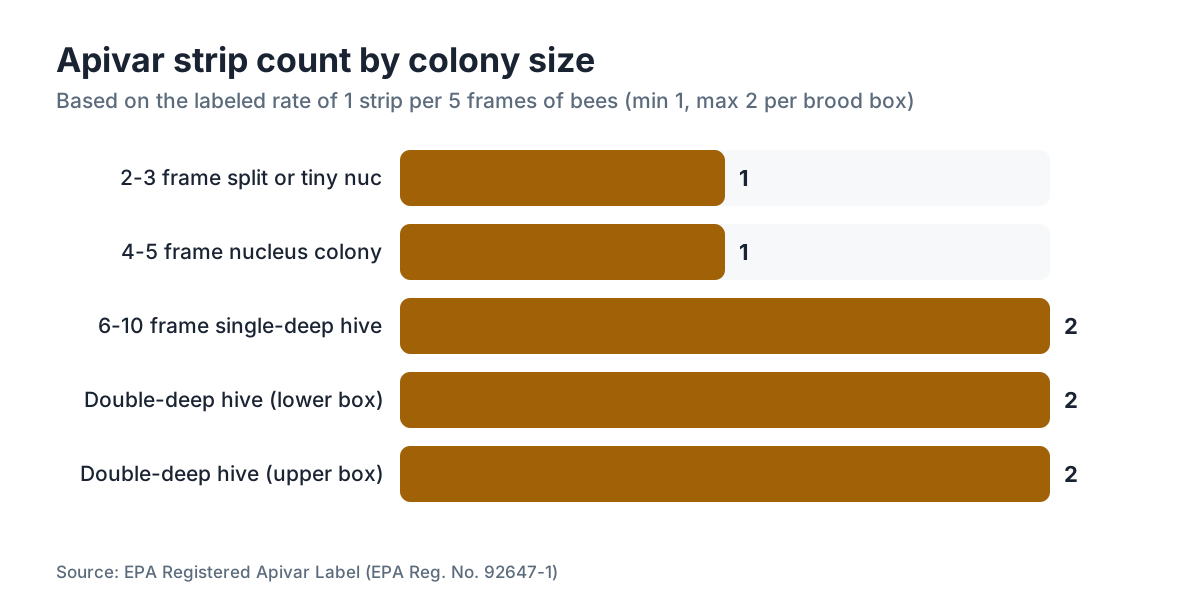
The answer is simpler than most beekeepers expect. The Apivar label, registered with the EPA, calls for one strip per five frames of bees [1]. That ratio holds for every colony size, from a three-frame split to a double-deep production hive.
A nucleus colony usually means one strip. Most nucs run 4 to 6 frames of bees, so a single strip is the standard dose. A well-built 5-frame nuc gets one strip. A 6-frame nuc that's been building hard might technically push toward needing two, but if bees are only covering 5 or fewer frames, one strip is correct per the label.
For a full 10-frame single-deep hive, dose by how many frames are actually covered with bees, not by how many frames sit in the box. A colony in August with bees on 8 frames gets one or two strips depending on whether coverage hits the 5-frame threshold on both sides. If bees cover 6 to 10 frames, use two strips. More than 10 frames (a double-deep or a single deep with a super full of bees) means three or four strips.
The label is the law under FIFRA (Federal Insecticide, Fungicide, and Rodenticide Act) [2]. Underdosing a nuc to save a strip, or overdosing a small colony, both create problems. Underdosing lets mites survive. The amitraz in Apivar can cause queen issues at excessive concentrations in very small spaces.
What does the actual Apivar label say about dosage?
The registered Apivar label (EPA Registration No. 92647-1) reads: "Use 1 strip per 5 frames of bees (both sides of frame covered with bees). Use a minimum of 1 strip and a maximum of 2 strips per brood box" [1].
That second sentence matters. Even with a monster colony packing bees across 12 frames in a single box, the label caps you at two strips per brood box. For a two-box setup, the maximum is two strips per box, so four strips total. The label also sets a floor of one strip per colony no matter how small the colony is.
Apivar strips are 20 cm plastic strips impregnated with 3.33% amitraz. Each strip releases the active ingredient slowly through contact. Bees walk over the strip, pick up amitraz on their bodies, and spread it through the colony as they groom each other. That contact-transfer mechanism is exactly why frame coverage matters. Bees need to be present on enough frames to actually touch the strip.
One thing many beekeepers miss: the label says frames of bees, not frames of brood. If you have frames of capped brood with very few adult bees (say, a newly installed package that hasn't built up yet), count only the frames where adult bees are actually sitting. The brood itself doesn't count.
How many Apivar strips does a 5-frame nuc need?
One strip. Full stop.
A 5-frame nucleus colony gets a single Apivar strip placed between the frames in the center of the cluster, ideally between frames 2 and 3 or 3 and 4 where brood and bees concentrate. The strip should hang between two frames and touch the bees directly. Don't wedge it flat on the bottom board. It works through bee contact with the strip surface.
If your nuc is unusually strong and bees are genuinely covering all 5 frames on both sides, one strip still covers it. The label formula of 1 strip per 5 frames puts a 5-frame-of-bees colony right at the one-strip threshold.
For a 4-frame nuc or smaller (a very fresh split or a small overwintering cluster), one strip is still the minimum per the label. You can't go below one strip. Some beekeepers worry about amitraz concentration in a tiny colony, and honestly that concern isn't baseless. The Honey Bee Health Coalition's Varroa Management Guide advises close monitoring during treatment in very small colonies and making sure the colony has adequate ventilation [3].
Place the strip vertically, hanging between frames, never laid horizontally. That's true for nucs and full hives alike.
How many strips for a 10-frame single-deep hive?
Two strips is typical, but count your actual bee coverage first.
A 10-frame Langstroth hive in peak season, with bees covering 8 to 10 frames, gets two strips. Place one strip toward the left side of the brood nest and one toward the right, roughly frames 3-4 and 7-8. You want the strips spread evenly through the brood area where mites and bees concentrate.
If your colony is in decline going into fall and bees are only covering 4 to 6 frames, one strip may be enough. Recount every time. A colony that looked like a two-strip hive in July might be a one-strip colony by late September after the queen slows down.
A 10-frame double-deep hive (two brood boxes) needs strips in both boxes. The label allows up to two strips per brood box, so a double-deep at full strength could need four strips total. Most hobbyist beekeepers run one deep and a super, and the super typically doesn't count for dosing because the label treatment area is the brood box. Don't put Apivar strips in honey supers [1].
For Apivar supplies and application tools, most beekeeping supply companies stock strips in packs of 10 (one full-treatment pack for five single-deep hives).
How long do Apivar strips stay in the hive?
The label sets a minimum of 6 weeks and a maximum of 10 weeks [1]. Most beekeepers in temperate climates aim for 8 weeks.
The 6-week floor exists because Apivar works slowly and cumulatively. Amitraz kills mites on adult bees right away, but it takes several weeks for treated adults to cycle through the colony and reach the mites hiding in capped brood as those bees emerge. A colony with a laying queen keeps capped brood going all through treatment, so you need enough time for every emerging bee to contact the strip.
Don't pull strips early. This is where a lot of hobbyists go wrong. They install strips for 4 weeks, see mites dropping, decide the job is done, and pull them. Mites in capped cells at week 1 haven't emerged and contacted the strips yet. Leave them in the full window.
Leaving strips in past 10 weeks raises amitraz resistance concerns. Multiple resistance monitoring programs have flagged amitraz resistance in varroa populations as an emerging problem in some regions [4]. Don't leave strips sitting in a colony over winter "just in case." Pull them at 10 weeks maximum.
Mark your calendar or use a hive tracker when you install the strips. A sticky note on the lid works. A log works better. If you want a structured protocol calendar, VarroaVault's free varroa management tools let you set treatment windows and get reminders.
Does Apivar dosage change based on colony strength or time of year?
Yes, indirectly. The dosage formula (1 strip per 5 frames of bees) stays constant. The actual number of strips changes with colony population, and population changes through the season.
Spring: many colonies come out of winter as 3-to-5 frame clusters. One strip, almost always. Install strips once daytime temps are consistently above 50F (10C) so bees are moving around the strip.
Summer peak: full colonies often need 2 strips. A booming double-deep may need 4.
Fall pre-winter treatment: this is the treatment that matters most, because you're protecting the winter bees that carry the colony through to spring. Colony population is contracting, so recount frames of bees before dosing. An August colony at 8 frames of bees might be down to 5 frames by October.
Winter: Apivar isn't effective in cold conditions. Amitraz efficacy drops sharply below roughly 50F (10C), and bees aren't moving across frames, so contact transfer is poor [3]. Many extension services recommend finishing Apivar treatment before the fall cluster forms.
After a split: if you split a hive and install Apivar in both the parent colony and the split, treat each one independently based on actual frame coverage. The parent might still need 2 strips. The new split almost certainly needs 1. Check out VarroaVault for split-specific treatment timing guidance.
A grounding in varroa mite biology and the mite lifecycle is genuinely worth your time. It's the reason timing matters so much.
Can you use less than one Apivar strip in a very small colony or split?
No. The label sets one strip as the minimum per colony, and cutting strips is not a labeled use [1].
Some beekeepers cut strips in half for tiny nucs or splits. This is an off-label application and a technical FIFRA violation, though enforcement against individual hobbyists is essentially nonexistent. The bigger problem is practical: a half-strip in a 2-frame split may deliver so little amitraz that mites survive, and any amitraz resistance in your local mite population gets reinforced by that inadequate dose.
The better move for a small 2-3 frame split is to use one full strip per the label and stay aware that the amitraz concentration relative to the small bee population runs higher than in a full colony. Ventilation in the nuc box matters here. Give the nuc a screened bottom board or crack the lid slightly if temps allow.
If the colony is so small you're genuinely worried about amitraz overexposure, ask whether it's large enough to treat on its own versus combining it with another unit first. A 2-frame split that hasn't built to 5 frames of bees is borderline viable anyway, and merging it with a slightly stronger unit before treating is a legitimate option.
What about Apivar in a queenless colony or split?
This is where timing can really work in your favor, and it's one of the most effective mite-knockdown moves you have.
A queenless colony lays no new brood. Within about 24 days (the time for existing capped brood to emerge), you get a broodless window. Mites have nowhere to reproduce and are all riding adult bees, fully exposed to the amitraz. Treatments work far better in broodless conditions because you're not fighting the protected environment of capped cells.
For a queenless split created specifically to open a broodless treatment window, one Apivar strip installed at the time of queenlessness, left for 6 to 10 weeks, can drop mite loads dramatically. Several university extension programs recommend this approach for high-infestation colonies [5].
Once you introduce a new queen and she starts laying, you're back to normal treatment dynamics. If you're treating a queenless split with 4 frames or fewer of bees, still use one strip. Don't skip the split just because it's small and queenless. Mites are still there on the adults, and they'll explode once a queen starts laying.
How do you physically place Apivar strips in a nuc vs a full hive?
The mechanics are straightforward, but a few details make a difference.
For a nuc: pull a center frame, hang the strip between two frames in the middle of the cluster. The strip should be vertical, touching bees on both sides. In a 5-frame nuc, hang it between frames 2 and 3 or 3 and 4. One strip, centered.
For a full hive: place two strips at roughly the 1/3 and 2/3 points of the brood box. In a 10-frame box, that's approximately between frames 3-4 and 7-8. The strips should sit in or next to the brood nest, not out near the walls where bees don't cluster densely.
For a double-deep: treat both boxes independently. Two strips in the lower box, two in the upper, all positioned in the brood area of each box.
Wear gloves. Amitraz absorbs through skin, and while the exposure from handling a strip briefly is low, there's no reason to skip nitrile or latex gloves when you install and remove strips [6]. Used strips go in a sealed bag in household trash. Don't compost or burn them.
Pull the strips with a hive tool and gloves after 6 to 10 weeks. Write down the date you pulled them. That record matters for tracking treatment efficacy and planning your next varroa check.
How do you know if Apivar worked? Testing after treatment
Do a varroa wash or sticky board count before and after treatment. The Honey Bee Health Coalition recommends an alcohol wash (or sugar roll) as the most accurate method for reading a live colony's infestation rate [3].
Before treatment, count your mite load to confirm you're above the treatment threshold. The widely accepted threshold for treatment is a 2% infestation rate (2 mites per 100 bees) during the active season, though thresholds shift with season and region [3]. Some researchers and extension programs use 3% for summer and 1-2% for fall.
After treatment ends, wait 48 to 72 hours for amitraz residue to clear enough that it won't inflate your sticky board count, then run a fresh alcohol wash. You're looking for infestation rates below 1% post-treatment. If mites are still above 2% after a full 8-to-10-week Apivar treatment, you may have an amitraz-resistant mite population, and you should rotate to a different active ingredient (oxalic acid, formic acid) for the next cycle [4].
USDA-ARS bee research has documented emerging amitraz resistance, and it's real in some apiaries [4]. Rotating treatment classes is not optional for long-term mite management.
Is Apivar safe to use in nucleus colonies without harming the queen?
Used per the label, Apivar is generally safe for queens. That said, queen sensitivity to amitraz is a real concern at high concentrations in small spaces.
Most queen losses tied to Apivar trace back to one of a few scenarios: strips left in past 10 weeks, poor ventilation in a small enclosed space, or off-label use of too many strips in a small colony. A single strip in a properly ventilated 5-frame nuc with an adequate entrance sits within labeled parameters and should not harm a laying queen.
University of Florida IFAS extension work and other research note that amitraz can affect queen fertility at high concentrations, but at labeled rates in adequately sized colonies the risk is low [7]. The key phrase is labeled rates. One strip in a 5-frame nuc is fine. Three strips crammed into a 5-frame nuc is not.
If you install Apivar and your queen disappears or stops laying within 2 weeks, check other explanations first (poor mating, supersedure, laying worker) before you blame the treatment. But if you keep seeing queen problems after Apivar in small nucs, review your ventilation and confirm you're not overdosing.
What are the alternatives if Apivar isn't the right fit for your nuc or hive?
Apivar works well when you have a laying queen and want a low-labor treatment. It's not always the right tool.
Oxalic acid (Api-Bioxal is the EPA-registered product) is highly effective in broodless conditions and is the preferred treatment for nucs or splits that are genuinely broodless [8]. A single oxalic acid dribble or vaporization in a broodless nuc can drop mite loads by 90% or more. Oxalic acid has a different mode of action than amitraz, so alternating helps head off resistance.
Formic acid (Mite-Away Quick Strips, or MAQS) penetrates capped brood, which is genuinely useful, but it carries temperature restrictions (above 50F/10C, below 92F/33C) and a slightly higher risk of queen loss in small colonies from the vapor concentration [9].
For most hobbyists managing nucs, the two practical options are Apivar (1 strip, labeled use) or an oxalic acid dribble in broodless conditions. They're complementary, not competing. Apivar during the brood-present phase of a nuc's life. Oxalic acid during a broodless window or to clean up after Apivar.
For equipment to support any of these treatments, a reliable beekeeping supply companies list is worth bookmarking, or check whether any offer free shipping honey bee supply companies to save on bulk purchases.
Common mistakes beekeepers make with Apivar dosing
After years of beekeepers comparing treatment results, a few patterns show up again and again.
Mistake 1: counting frames in the box, not frames of bees. You have 10 frames in the box, but bees cover only 6. Still two strips? Maybe, but only if bees are genuinely covering 6 frames. Count what's populated, not what's there.
Mistake 2: pulling strips too early. Six weeks minimum, and that's a minimum. Eight weeks is better in most climates with an active brood cycle.
Mistake 3: not treating the nuc at all because "it's too small." Small colonies carry mites too, and mite loads in small colonies can be proportionally devastating. Untreated nucs that look healthy in May can be dead by August.
Mistake 4: storing used strips in the hive as "extra insurance." Remove them after 10 weeks. Amitraz breakdown products accumulate in wax, and this adds to resistance pressure.
Mistake 5: putting strips in honey supers or near honey frames you'll harvest. Apivar is not approved for use around honey supers that will be harvested for human consumption [1]. Remove honey supers before treatment.
Mistake 6: skipping the post-treatment mite wash. You need to know whether the treatment actually worked. Hope is not a varroa management strategy.
Frequently asked questions
How many Apivar strips do I need for a 5-frame nuc?
One strip. The Apivar label calls for 1 strip per 5 frames of bees, and the minimum is always 1 strip per colony. Place it vertically between the center frames, in or next to the brood nest. Leave it in for 6 to 10 weeks. A 5-frame nuc sits exactly at the single-strip threshold, so no more than one strip is needed or appropriate.
Can I cut an Apivar strip in half for a very small 2-frame split?
The label does not allow cutting strips, and a half-strip is an off-label application. The labeled minimum is one full strip per colony, regardless of size. For a 2-frame split, use one full strip as labeled. If you're worried about a tiny colony, consider combining it with another small split first to build to at least 5 frames before treating.
How long should Apivar strips stay in a nucleus colony?
Same as any colony: 6 weeks minimum, 10 weeks maximum. The 6-week minimum accounts for the full brood cycle so mites in capped cells have time to emerge and contact the strip. Pulling strips early is one of the most common reasons Apivar treatments fail. Eight weeks is a practical target for most beekeepers in temperate climates with an active brood season.
Will Apivar hurt the queen in a small nuc?
At labeled rates (one strip in a 5-frame nuc with adequate ventilation), queen loss from Apivar is uncommon. The risk climbs if strips are left in too long, if the space is poorly ventilated, or if too many strips are used. When you treat a very small nuc, make sure it has a functional entrance and a screened bottom if possible. Don't use more than one strip in a sub-5-frame colony.
Do I need to remove honey supers before putting Apivar in a hive?
Yes, absolutely. The Apivar label requires that honey supers intended for human consumption be removed before treatment. Do not put Apivar strips in a hive while supers are on. Remove the supers, treat the brood box, and put supers back on only after the full treatment period ends and strips are removed. This is both a label requirement and common sense.
How do I count frames of bees accurately to dose Apivar correctly?
Pull each frame and look at both sides. A frame counts as one "frame of bees" when bees cover the majority of both sides. A frame with bees on one side and mostly empty comb on the other is roughly half a frame. Add up your covered frames and round to the nearest whole frame. Divide by 5 and round up to get your strip count, with a minimum of 1 strip.
Can I use Apivar in a queenless nuc or split?
Yes, and a broodless queenless window can actually make treatment more effective because mites have nowhere to hide in capped cells. One strip in a queenless nuc is the correct dose. The treatment knocks down mites on adult bees. When you introduce a new queen and she starts laying, continue treatment through the full 6-to-10-week window to catch mites that reproduce in the new brood.
What if Apivar doesn't seem to be working in my hive?
First, confirm the strips were in for the full 6-to-10 weeks and were placed in the brood area with bees contacting them. If you did everything right and mite counts are still above 2% post-treatment, amitraz resistance is a real possibility. Switch to a different active ingredient (oxalic acid or formic acid) for your next cycle and consider sending mites to a resistance monitoring program if one is available in your state.
Does Apivar work in cold weather for winter nucs?
Not well. Amitraz efficacy drops sharply below 50F (10C) because bees cluster tightly and don't move across the strip, so contact transfer is minimal. Apivar is best used when bees are actively working frames, typically spring through early fall. For cold-weather or winter treatment of a broodless cluster, oxalic acid vaporization is more effective than Apivar.
How many Apivar strips does a double-deep hive need?
Up to four strips total: up to two per brood box, placed in the brood area of each box. The label caps the maximum at 2 strips per brood box. Count frames of bees in each box separately. A strong double-deep in peak summer with bees covering 8-plus frames in each box justifies two strips per box. A lighter colony may need fewer.
How soon can I reuse Apivar in the same hive?
Apivar can be used twice per year, per the label. Most beekeepers do a spring and fall treatment, or a mid-summer and fall treatment. Wait at least several weeks between treatment courses, and ideally alternate with a different treatment class at least once per year to reduce amitraz resistance pressure on the mite population in your apiary.
What varroa mite threshold should I hit before treating a nuc with Apivar?
The Honey Bee Health Coalition recommends treating when infestation reaches 2% (2 mites per 100 bees) during the active season, and some extension services suggest a lower 1-2% threshold in fall to protect winter bees. For nucs, treat aggressively. A 3% infestation rate in a small nuc is proportionally more damaging than the same rate in a full colony because there are far fewer worker bees to absorb losses.
Where should I physically place the Apivar strip in a nuc box?
Hang it vertically between the two center frames, in or immediately next to the brood nest. In a 5-frame nuc, that's typically between frames 2 and 3 or 3 and 4. The strip needs direct contact with bees on both sides. Don't lay it flat on the bottom board, and don't put it near the outer wall frames where bee traffic is sparse.
Sources
- EPA, Apivar Registered Label (EPA Reg. No. 92647-1), Veto-Pharma: 1 strip per 5 frames of bees, minimum 1 strip, maximum 2 strips per brood box, treatment duration 6 to 10 weeks, do not use with honey supers
- EPA, Federal Insecticide Fungicide and Rodenticide Act (FIFRA): Pesticide labels are legally binding under FIFRA; using a pesticide in a manner inconsistent with labeling is prohibited
- Honey Bee Health Coalition, Varroa Management Guide (7th edition): Alcohol wash recommended as most accurate monitoring method; treatment threshold of 2% infestation rate during active season; small colony ventilation guidance during treatment
- USDA ARS, Bee Research Laboratory: Amitraz resistance in Varroa destructor is an emerging concern in some apiaries; rotating treatment classes recommended
- Penn State Extension: Broodless window in queenless colonies significantly improves varroa treatment efficacy; recommended as a management technique for high-infestation situations
- National Pesticide Information Center (NPIC), Oregon State University: Amitraz is absorbed through skin; personal protective equipment including gloves recommended when handling amitraz-containing products
- University of Florida IFAS Extension, EDIS: Amitraz can affect queen fertility at high concentrations; at labeled rates in adequately ventilated colonies risk to queens is low
- EPA, Api-Bioxal Label (EPA Reg. No. 86922-1): Oxalic acid (Api-Bioxal) registered for varroa treatment; highly effective in broodless colonies; approved for use in packages and broodless splits
- EPA, MAQS (Mite Away Quick Strips) Label (EPA Reg. No. 87220-1): Formic acid strips approved for varroa; temperature restrictions 50-92F (10-33C); higher queen loss risk in small colonies due to vapor concentration
- Oregon State University Extension: Apivar efficacy reduced below 50F (10C) due to reduced bee movement and contact transfer; fall treatment window recommended before cluster forms
- University of Minnesota Bee Lab: Fall pre-winter treatment most critical annual varroa treatment for protecting winter bees; treatment thresholds of 1-2% recommended in fall versus 2-3% in summer
- North Carolina State University Extension: Alcohol wash described as reliable method for mite infestation rate measurement; post-treatment monitoring recommended 48-72 hours after strip removal
Last updated 2026-07-09