How often to replace brood comb for hive health
TL;DR
- Replace brood comb every 3 to 5 years as a general rule, though heavily contaminated or visibly degraded comb warrants earlier action.
- Old comb accumulates pesticides, Varroa-era miticides, spores of American foulbrood and Nosema, and shrinks cell size over time.
- Regular rotation cuts pathogen pressure and keeps your chemical management options open.
Why does brood comb need to be replaced at all?
Beeswax looks inert but it isn't. It's a fatty lipid matrix, and lipophilic compounds, meaning oil-soluble chemicals, partition into it readily and stay there for years. Every time you treat for varroa mites, every time your bees forage crops treated with pesticides, residues accumulate in the wax. The brood comb in an active hive is a running chemical log of everything that colony has been exposed to.
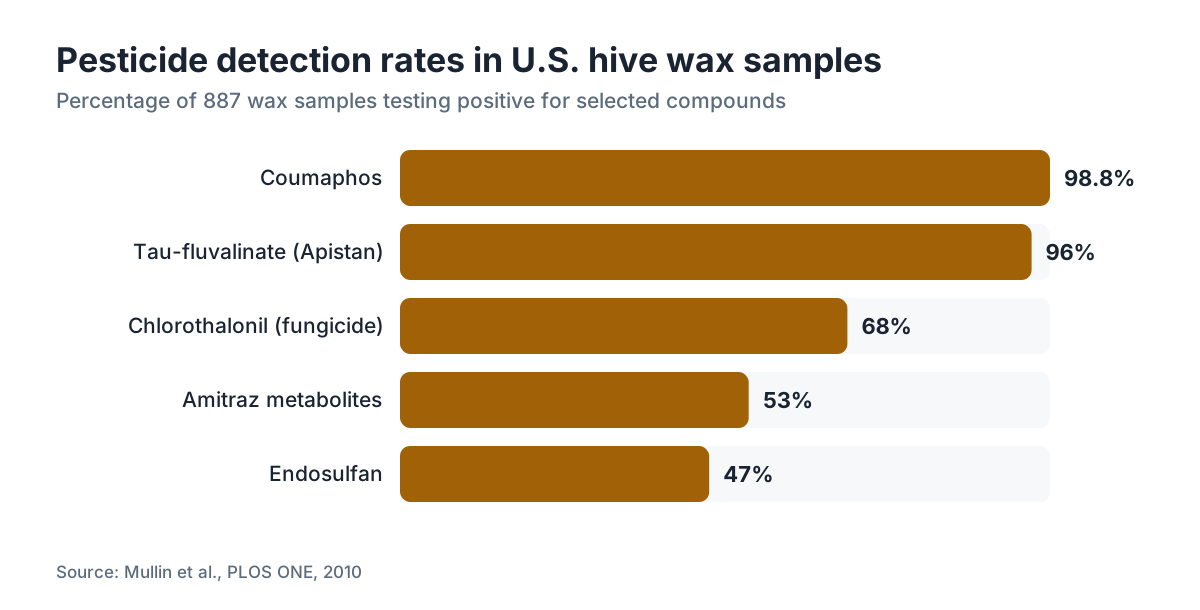
Mullin et al. (2010), published in PLOS ONE, analyzed comb wax and pollen from 887 samples across 23 U.S. states. The researchers found 121 different pesticides and metabolites, with a mean of 6.2 pesticides per wax sample [1]. That's not a fringe result. European and Canadian surveys have replicated it consistently.
Beyond pesticides, comb accumulates biological load too. Chalkbrood and American foulbrood spores are hardy, and Nosema ceranae spores can persist in drawn comb for months to years. Each brood cycle also deposits shed larval skins and fecal material, compressing cell volume over time. The cell walls get progressively thicker and the usable cell depth shrinks.
None of this kills a healthy colony overnight. But it's a slow drag on brood viability, bee longevity, and your ability to trust that a treatment is working the way the label says it should.
How often should you replace brood comb?
The most commonly cited guideline is every 3 to 5 years, and that range comes from practical extension guidance rather than a single controlled trial [2]. The Honey Bee Health Coalition's Varroa management guide references comb rotation as part of an integrated colony health program, though it stops short of mandating a specific interval because conditions vary so much between operations [3].
Here's the honest version: a hobbyist in a low-pesticide rural area who rarely treats may get 6 years out of good comb. A beekeeper near monoculture agriculture who's run oxalic acid, fluvalinate, and coumaphos over several seasons may need to retire comb at 3 years or less. Coumaphos in particular builds to high concentrations in wax because it's highly lipophilic, and lab studies have linked elevated coumaphos wax residues to queen failure and reduced drone viability [4].
A practical approach most experienced beekeepers land on: mark your frames when you draw them out (a paint pen on the top bar works fine), track the year, and pull any frame that hits 5 years regardless of appearance. Pull sooner if the comb is very dark, smells sour or musty, has a history of disease, or was in a colony you treated heavily with oil-soluble miticides.
For a sideliner running 30 or 40 hives, rotating 20% of your brood frames per year keeps the whole operation on a rolling 5-year cycle without a massive disruption in any single season.
What does old comb actually look like, and how do you know it's time?
New comb is pale yellow to white. As it ages and cycles through brood after brood, it darkens: golden, then brown, then nearly black. The color itself isn't dangerous, but very dark comb correlates with high brood cycle count and high accumulated residue load.
Hold the frame up to the light. If you can barely see through it and the wax feels dense and brittle rather than slightly pliable, it's old. Smell it too. Good comb smells like beeswax and honey. Comb with significant foulbrood history smells sour and faintly fecal. Comb with heavy chalkbrood has a chalky, musty smell.
Cell size is another indicator. Fresh foundation starts at about 5.4 mm for standard worker cells (5.2-5.3 mm on small-cell foundation). After multiple brood cycles, cocoon layers reduce the usable diameter. One study found cell volume reductions of up to 11% in heavily used comb compared to new foundation [5]. Smaller cells mean smaller bees, and smaller bees have slightly shorter lifespans and carry less pollen, though the magnitude of that effect on colony performance is debated.
Visual cues to pull comb immediately, without waiting for a rotation cycle:
- A confirmed American foulbrood diagnosis (in most states, AFB-infected equipment must be destroyed by law; check your state department of agriculture)
- Obvious sacbrood or chalkbrood at scale across multiple frames
- Physical damage: mouse-chewed corners, crystallized honey locked in cells with capped brood, or wax moth webbing throughout
- Any frame you can't identify or date
Does replacing comb actually reduce Varroa mite loads?
Comb replacement is not a varroa treatment. Get that expectation right before you start. Mites reproduce in capped brood cells, and rotating out old comb removes some mite reproductive sites, but the effect on your overall mite count is indirect and modest compared to oxalic acid, Apivar, or Mite-Away Quick Strips.
That said, comb rotation does support your varroa management in real ways. Old comb with compromised cell structure can affect how well bees remove mite-infested brood (hygienic behavior depends partly on bees being able to detect and uncap cells efficiently). Fresh comb with clean wax doesn't carry residues that could interfere with treatment efficacy or confound your alcohol wash results.
The Honey Bee Health Coalition notes in its Varroa management guide that "good colony management, which includes replacing old combs, is part of an integrated pest management approach" to keeping mite levels below economic threshold [3]. That's a measured, accurate claim. Comb rotation is support infrastructure, not a primary intervention.
If you're tracking mite loads with alcohol washes or sticky board counts and your numbers are running high despite treatment, old contaminated comb is worth investigating as a contributing factor, especially if you suspect miticide resistance. A colony living in comb saturated with coumaphos may not respond to coumaphos-based treatments the way a colony in clean wax would. The EPA's registration requirements for miticides assume normal exposure conditions, and comb that already contains baseline residues changes that math.
For a structured approach to combining comb rotation with your treatment calendar, tools like the free protocol builder at VarroaVault can help you schedule frame pulls alongside your spring and fall treatment windows.
How do you actually rotate comb without disrupting the colony?
Timing matters a lot. The best window for pulling brood comb is late winter to very early spring, just before or at the onset of buildup, when the cluster is small and the number of brood frames is at its seasonal low. You get access to frames that aren't loaded with capped brood, which makes the swap much less disruptive.
Here's a simple rotation method that works:
- Mark each frame with a paint pen on the top bar when it's drawn or introduced. Use a single digit for the last digit of the year (e.g., '1' for 2021, '6' for 2026).
- Each spring, identify the oldest 20-25% of your brood frames. Move them to the outer positions of the brood box.
- As the queen fills inward frames with new brood, the older outer frames will be used for honey storage or abandoned. Once they're empty of brood, pull and render them.
- Replace with fresh drawn comb if you have it, or with foundation. If you use foundation, put it where the bees will draw it readily: between two frames of open brood in the spring buildup.
Don't pull frames that still have significant capped brood unless you have a disease situation requiring it. Move the frame to a nuc or let the brood emerge before removing.
For a sideliner operation, a dedicated wax melter and wax press pays for itself if you're rendering any volume at all. The rendered wax from retired comb can be sold or traded to beekeeping supply companies for credit toward foundation, though wax from heavily treated combs is generally not suitable for recycling into new foundation because the miticide residues concentrate in the wax.
Can you just melt down old comb and reuse the wax for foundation?
Usually not, and this matters more than most hobbyists realize. Wax rendered from old brood comb carries the same pesticide residues the comb accumulated during use. Coumaphos, tau-fluvalinate (Apistan), and amitraz breakdown products all survive the rendering process to varying degrees.
The Pennsylvania State Bee Lab and others have documented this explicitly: commercially available foundation has been found to contain miticide residues that originated from recycled beeswax [4]. If you buy foundation and are wondering whether it starts clean, the answer is: probably not, unless you're sourcing from a supplier who tests incoming wax. This is an industry-wide issue, not a criticism of any single company.
For hobbyists, the practical answer is to render your old comb, sell or trade the wax for non-hive uses (cosmetics, candles, woodworking), and buy fresh foundation rather than introducing your contaminated wax back into the cycle. Some beekeepers use plastic foundation to sidestep the wax contamination issue entirely, though bees tend to draw plastic more reluctantly than wax.
If you want to supply your own wax, cappings wax is your cleanest option. Cappings come from honey frames, not brood frames, so they carry far lower residue loads. Keep cappings wax separate from brood-comb renderings and use that for any hive applications.
Does cell size matter, and does small-cell comb reduce varroa?
This debate has run for decades and deserves a straight answer. The small-cell hypothesis, promoted most aggressively in the late 1990s and 2000s, claimed that regressing bees to smaller natural cell sizes (around 4.9 mm) would disrupt varroa reproductive cycles and reduce mite loads without chemical treatment.
Controlled studies have not supported the claim. Research by Coffey, Breen, and colleagues in Ireland (2010) and a multi-investigator review by Berry et al. found no significant difference in varroa infestation rates between colonies on small-cell and standard foundation [6]. The Honey Bee Health Coalition does not recommend small-cell foundation as a varroa control method.
That doesn't mean cell size is irrelevant to comb replacement. If your comb has degraded through accumulated cocoon layers to the point where cells are significantly smaller than the original foundation spec, those smaller cells produce smaller, shorter-lived bees, and that's a real productivity and health drag. The fix is simple: replace the comb and return to standard cell size, not go smaller.
The fresh-start benefit of new foundation is real. Bees draw it out the way they want it, cell sizes are consistent, there's no chemical history, and the wax is pliable and easy for the bees to work. That's the case for rotation, not the cell-size theory.
What about disease: does old comb spread American foulbrood and Nosema?
Yes, and this is probably the most compelling reason for regular comb rotation aside from chemical contamination. American foulbrood (AFB), caused by the bacterium Paenibacillus larvae, produces spores that can remain viable in comb for 40 years or more [7]. That's not a typo. Spores from a colony that died of AFB decades ago can infect a new colony placed on that equipment today.
The statutory response to AFB varies by state, but most U.S. states require burning infected equipment rather than just replacing comb. Check with your state department of agriculture before doing anything else if you suspect AFB. In states like California, Iowa, and others, moving AFB-infected equipment without inspection and authorization is a violation of apiary law [8].
Nosema ceranae spores also persist in comb, though not as long as AFB spores. Studies suggest N. ceranae spores remain infective for at least several months in stored comb at ambient temperature [9]. If you've had a confirmed Nosema outbreak, replacing the comb in that colony is reasonable even if it's not at its scheduled rotation age.
Chalkbrood (Ascosphaera apis) spores are similarly persistent. A colony that cleaned up a chalkbrood outbreak and looks fine may still carry a high spore load in old comb. New bees constantly encounter those spores, which keeps the colony susceptible. Rotating out heavily affected frames and replacing with fresh foundation removes that reservoir.
For beekeepers sourcing used equipment, old comb is the single biggest biosecurity risk in second-hand gear. If you can't verify the disease history of a package of frames, render the comb before you use the boxes. The boxes and metal parts are fine after cleaning and scorching. The comb is what carries the risk.
How does comb age affect pesticide residues and treatment efficacy?
Pesticide accumulation in beeswax is cumulative and largely irreversible under hive conditions. The Mullin et al. (2010) PLOS ONE study found coumaphos in 98.8% of wax samples tested, tau-fluvalinate in 96%, and chlorothalonil (a common fungicide) in 68% [1]. These aren't trace amounts. Median coumaphos concentration was 94 parts per billion in wax, with some samples exceeding 1,000 ppb.
What does that do to your bees? Lab studies have linked sublethal coumaphos exposure to reduced drone sperm viability, impaired queen reproductive performance, and reduced worker learning and foraging [4]. The field-level impact is harder to quantify because so many variables interact, but the direction of the effect is clearly negative.
For varroa treatment specifically, there's a documented concern that colonies living in highly residue-laden wax may show tolerance to miticides at doses that would otherwise be effective. This is separate from genetic mite resistance to the acaricide. It's about whether the bees themselves are already carrying a subtherapeutic background load of the compound you're trying to treat with.
EPA product labels for registered miticides like Apivar (amitraz) and Apistan (tau-fluvalinate) specify treatment conditions that assume normal baseline wax chemistry. The agency's registration studies weren't conducted in comb with 1,000 ppb coumaphos already present. Nobody really knows the adjustment needed, which is another reason to keep comb rotation as a regular part of your management rather than treating it as optional.
You can find the current EPA registration documents for registered miticide products through the EPA's pesticide registration database [10].
What's the cost of replacing brood comb, and is it worth it?
Let's put numbers on this. A standard deep frame with wired wax foundation runs roughly $2 to $4 per frame depending on supplier and order size (prices vary and have risen with wax market fluctuations; check current pricing from your supplier). A 10-frame deep brood box holds 10 frames. Replacing 2 frames per hive per year on a 5-year cycle costs $4 to $8 per hive per year at those prices [11].
For a hobbyist with 4 hives, that's $16 to $32 per year. For a sideliner with 40 hives, it's $160 to $320 per year. That's before labor, which is real but not large: pulling, rendering, and replacing 2 frames per hive per inspection visit takes maybe 15 minutes extra per hive.
Is it worth it? Compare it to the cost of losing a colony (nucleus replacement, roughly $150 to $200 in most markets; package, $130 to $180; plus production losses). Yes, by a wide margin if comb rotation prevents even occasional disease transmission or treatment failure. The math favors rotation decisively once you've lived through one AFB outbreak or one treatment cycle that underperformed.
The equipment cost is also partially offset by wax recovery. A full 10-frame deep box of brood comb renders to roughly 1.5 to 2 lbs of cleaned wax, depending on age and cleanliness. At current craft wax prices ($8 to $15 per lb for clean beeswax), that's $12 to $30 in recovered value per box, though heavily contaminated wax shouldn't go into hive products.
For sourcing frames and foundation, see our guide to beekeeping supply companies and options for free shipping honey bee supply companies if you're ordering in quantity.
VarroaVault's free hive management tools include a comb tracking worksheet you can use alongside your treatment calendar to schedule rotations without losing track across multiple hives.
Does comb rotation fit into a broader integrated pest management plan?
It does, and the framing matters. Comb rotation is a cultural control method in the integrated pest management (IPM) framework: it reduces pest and pathogen habitat and exposure rather than directly killing anything. The Honey Bee Health Coalition's best management practices guide, one of the most practically grounded documents in North American beekeeping and freely available, treats comb hygiene as one of several colony management levers alongside monitoring, biological controls, and chemical treatments [3].
A well-structured annual cycle might look like this: alcohol wash mite counts in March and September, treatment decisions keyed to thresholds (3% infestation rate is the standard action threshold for most treatment products), comb rotation folded into the spring and fall inspections, and disease checks (AFB, Nosema) at the same time. That's a complete program, not a collection of independent tasks.
One thing comb rotation does that chemical treatment can't: it's backwards-compatible with any treatment protocol. You can rotate comb whether you're running oxalic acid, formic acid, thymol, synthetic miticides, or a treatment-free approach. It doesn't conflict with anything.
For beekeepers managing colonies that have shown signs of varroa mite pressure, pairing a scheduled comb rotation with a thorough mite monitoring plan is the most defensible approach. You reduce the chemical and biological burden on the colony while keeping your quantitative data on mite loads accurate.
Frequently asked questions
How do I know if my brood comb is too old even if it looks okay?
Color is the most reliable field indicator. Comb that's cycled through 5 or more brood generations is typically very dark brown to black. If you marked your frames when introduced, the date trumps appearance: pull any frame at 5 years regardless. Hold frames to light and check cell depth. If the wax feels brittle and cells look shallow, the comb has accumulated enough cocoon layers to reduce usable volume even if it's not visibly damaged.
Can I reuse brood frames from a dead-out colony?
It depends on why the colony died. If the cause was starvation or winter cluster failure with no disease signs, the frames can be reused after inspection. If you suspect American foulbrood, Nosema, or an unknown cause, do not reuse the comb. AFB spores survive 40-plus years in wax. Get a diagnosis if you're unsure. Boxes, stands, and metal parts can be reused after thorough cleaning and scorching; the comb itself is the risk.
What's the best time of year to replace brood comb?
Late winter to early spring is ideal. The colony is at its smallest, the cluster occupies fewer frames, and many brood frames will be empty of capped brood. You can pull old frames without sacrificing developing bees. A secondary window is late summer after the main nectar flow, when brood volume drops before winter prep. Avoid rotating heavily in the middle of a strong spring buildup unless you're dealing with disease.
How many frames should I replace per hive per year?
Two to three frames per hive per year keeps a 10-frame brood box on roughly a 4- to 5-year rotation cycle. For a single brood box operation, that means the entire complement turns over within one rotation period. If you're running double deeps, the lower box gets the most brood traffic and needs more frequent attention. Prioritize the darkest, oldest frames first regardless of where they sit in the box.
Does replacing comb help with American foulbrood?
Only if the diagnosis is caught early and the infection is limited. In most states, confirmed AFB requires burning infected equipment by law, more than replacing comb. Do not try to manage an active AFB outbreak by rotating frames out to other hives. That's how outbreaks spread. Contact your state apiarist. Comb rotation as a preventive practice reduces the accumulated spore load in a healthy hive but is not a treatment for active disease.
Is there any risk to the bees when I pull and replace brood frames?
Minimal if done correctly. The main risk is chilling brood by exposing frames to cold air during inspections, so avoid rotating comb on cold or windy days below about 55°F. If a frame you're pulling has some capped brood still present, move it to the outer position and let it emerge before pulling, or transfer it to a nuc. Don't leave a large gap in the brood nest: either slide frames together or insert foundation immediately.
Do I need to replace comb if I run treatment-free?
Arguably more so. Treatment-free colonies don't accumulate miticide residues, but they still accumulate agricultural pesticide residues from foraging and biological load from pathogens. Without chemical treatments, comb hygiene is one of the few active tools you have for reducing pathogen pressure. Treatment-free beekeepers who rotate comb regularly and keep their equipment in good condition give their colonies the best structural advantage the management approach allows.
Can I reuse plastic frames or plastic foundation instead of replacing comb?
Plastic frames and foundation can be cleaned and reused more readily than wax frames because you can scrape and sterilize the plastic substrate. However, any drawn wax built on plastic foundation still accumulates residues. When rotating, scrape the plastic foundation back to bare plastic, clean it with a dilute bleach solution, rinse thoroughly, and re-coat with a thin layer of fresh wax before reintroducing. It's more work than simply cycling fresh wax foundation.
How does comb age affect queen laying and brood quality?
Very old comb with significantly narrowed cells from accumulated cocoon layers does produce slightly smaller bees. Lab measurements have shown cell volume reductions of up to 11% in heavily used comb compared to new foundation. Smaller bees have marginally shorter lifespans and reduced pollen-carrying capacity. Whether this registers as a visible productivity loss in a field colony is genuinely hard to measure, but the direction of the effect is negative and the fix is straightforward.
What should I do with the old wax after I pull frames?
Render it separately from any cappings wax you collect. Brood comb wax from heavily treated hives carries pesticide residues that make it unsuitable for hive products like new foundation or lip balm. Your best options are: sell it for non-food craft uses (candles, wood finishing, leather care), trade it to suppliers who handle contaminated wax in bulk, or simply discard it. Never render heavily used brood comb wax and use it to coat new foundation you're putting back in your hives.
How do I track which frames need to be replaced across multiple hives?
A paint pen on the top bar with a single-digit year code is the simplest system. Write the last digit of the year the frame was introduced: '6' for 2026. At each spring inspection, scan top bars and pull any frame showing a digit that's 5 or more years old. For sideliners with many hives, a simple spreadsheet or a hive management app that logs frame dates by box position saves a lot of guesswork over multiple seasons.
Are there official guidelines from extension services on comb replacement frequency?
Yes. Several university extension services recommend a 3-to-5-year rotation as standard best practice, including guidance from Penn State Extension and University of Minnesota Bee Lab materials. The Honey Bee Health Coalition's Varroa management guide also references comb condition as part of integrated colony health management. None of these sources mandate a specific legal interval for non-AFB situations; the 3-to-5-year window reflects accumulated field experience rather than a single controlled trial.
Does replacing comb reduce pesticide residues in honey?
It can help marginally. Honey absorbs far fewer pesticide residues than wax because it's water-based rather than lipid-based, and most pesticide residues in hive products partition strongly into wax. Replacing brood comb reduces the total residue reservoir in the hive, which slightly lowers the ambient exposure the bees experience. But if your foraging area has heavy pesticide use, clean comb alone won't produce clean honey. The field exposure is the larger driver of honey residue levels.
Sources
- Mullin et al., PLOS ONE (2010), 'High Levels of Miticides and Agrochemicals in North American Apiaries': 121 pesticides and metabolites found in 887 wax and pollen samples; mean of 6.2 pesticides per wax sample; coumaphos found in 98.8% of wax samples, tau-fluvalinate in 96%
- Penn State Extension, Beekeeping resources: 3-to-5-year brood comb rotation interval cited as standard best practice guidance
- Honey Bee Health Coalition, Varroa Management Guide: Comb replacement referenced as part of integrated colony health and varroa management; 3% infestation rate cited as standard action threshold
- Haarmann et al., Apidologie (2002), coumaphos effects on drone sperm and queen reproduction: Elevated coumaphos wax residues linked to reduced drone sperm viability and impaired queen reproductive performance in lab studies
- Hepburn et al., Journal of Apicultural Research, cell size reduction in used comb: Cell volume reductions of up to 11% measured in heavily used brood comb compared to new foundation due to accumulated cocoon layers
- Berry et al., Journal of Apicultural Research, small-cell foundation and varroa review: Controlled studies found no significant difference in varroa infestation rates between colonies on small-cell and standard-cell foundation
- USDA AMS National Honey Bee Survey and USDA ARS, American Foulbrood fact sheet: Paenibacillus larvae (AFB) spores can remain viable in comb equipment for 40 years or more
- California Department of Food and Agriculture, Apiary Inspection Program: State law requires authorization before moving AFB-infected equipment; most states require burning infected comb
- Fries et al., Apidologie, Nosema ceranae spore persistence: Nosema ceranae spores remain infective for at least several months in stored comb at ambient temperature
- U.S. EPA, Pesticide Product and Label System (PPLS): Current registration documents for registered miticide products including Apivar (amitraz) and Apistan (tau-fluvalinate) available through EPA pesticide registration database
- Mann Lake Ltd., beekeeping supplies pricing (representative industry pricing reference): Standard deep frame with wired wax foundation retails approximately $2 to $4 per frame depending on supplier and order quantity
- University of Minnesota Bee Lab, extension resources on hive management: Comb hygiene and regular rotation recommended as part of integrated hive health management
Last updated 2026-07-10