When to freeze drone brood comb for varroa control
TL;DR
- Freeze capped drone brood comb when cells are fully sealed but before adult drones emerge, roughly every 24 days during spring and summer buildup.
- This trapping method exploits varroa's preference for drone brood and can remove 25-40% of mites per season when timed right.
- It's a tool, not a standalone treatment.
Why do varroa mites prefer drone brood in the first place?
Varroa don't infest drone and worker brood equally. They pile into drone cells at roughly 8 to 10 times the rate of worker cells in some studies [1]. The reason is timing: drone brood stays capped for about 24 days versus 12 days for worker brood, which gives a foundress mite a longer window to raise more mature daughters. A mite in a drone cell produces more surviving offspring than one in a worker cell.
That preference is the whole biological logic behind drone brood trapping. You give varroa exactly what they want, let them crowd into those cells, then destroy the comb before the mites can escape back onto adult bees. The Honey Bee Health Coalition describes drone brood removal as a cultural control that reduces mite reproduction when it's paired with other management steps [2].
One thing to understand before you commit: the preference is real, but it isn't absolute. Mites still infest worker brood, especially when drone brood is scarce or mite numbers are already high. So drone trapping alone will not save a heavily infested colony. It suppresses a population. It doesn't cure one.
What is the right timing to freeze drone brood comb?
Your target is fully capped drone comb, after every cell seals but before adult drones start chewing out. Miss the window in either direction and you lose most of the benefit.
Freeze uncapped or partially capped comb and many mites haven't entered the cells yet, so you kill drone larvae but remove far fewer mites than you could. Wait too long and drones start emerging, which means mites that finished reproducing are already walking out into the hive. You did the work for nothing.
Drone cells cap around day 10 after the egg is laid. Adult drones emerge around day 24. Your target runs from full capping (day 10-ish) through day 22 or 23, before emergence begins. Most beekeepers pull the comb around day 14 to 21 after laying, which leaves a reasonable margin [3].
How do you know it's fully capped? Walk up and look. Drone comb has domed, bullet-shaped cappings that stick out from the surface, clearly different from the flatter worker cappings. When the whole section of drone comb is sealed with those raised caps, you're in the window. Mark the frame with a thumbtack or paint pen the day you see the last cells close, then come back 7 to 10 days later at the latest.
Cycle length matters here. Drone development takes 24 days, so run a fresh trap frame every 24 days through the active season. That means keeping at least two drone trap frames in rotation, so one is always in the hive drawing fresh eggs while the other is frozen and thawing.
How much does freezing drone comb actually reduce varroa mite levels?
Honest answer: it varies a lot depending on how consistently you run the cycles, the overall mite load, and whether you pair it with other controls.
German extension work and Scandinavian trials found consistent drone brood removal cut mite populations by roughly 25 to 40% over a season compared to untreated controls [4]. A 2001 study by Calis and colleagues found that repeated drone brood removal could delay mite population growth in spring and early summer, but colonies still needed chemical intervention by late summer in most cases [5].
So what does 25 to 40% mean in practice? Say you start spring at a 1% infestation rate (1 mite per 100 bees). Consistent drone trapping might keep you off a damaging threshold until mid or late summer instead of early summer. That's real value. It's not transformative value.
The Honey Bee Health Coalition's Varroa management guide states that drone brood removal is "not sufficient as a sole treatment" but notes it can extend the window before chemical treatment becomes necessary [2]. That's a fair read of where the evidence sits.
What pushes you toward the high end of the range: running every single 24-day cycle without skipping, starting early in spring before mite numbers ramp, and combining it with at least one other integrated pest management (IPM) tactic like a screened bottom board or a brood break.
How do you set up a drone brood trap frame?
You have two main options. A commercial drone foundation frame, or an empty frame you let the bees draw naturally.
Commercial drone foundation has a larger cell diameter (roughly 6.4mm vs 5.4mm for worker cells) that nudges the queen to lay drone eggs. Put it in the brood nest, usually between the two warmest central brood frames, and give the bees a few days to draw it out and the queen to fill it. Once you see eggs and fresh larvae, start your clock.
The natural approach is to cut most of the foundation out of a standard frame and leave about a 2-inch strip at the top. Bees draw wild comb below the strip, and from late spring through midsummer they'll build drone comb there by preference. Some beekeepers swear this works better because the bees are drawing comb they actually want to draw. The tradeoff is less predictable timing.
Once the comb is fully capped, pull the whole frame. Bag it and freeze it for at least 24 hours at 0°F (-18°C) or colder [3]. That temperature kills the mites inside the capped cells reliably. Some beekeepers go 48 hours to be safe. After freezing you can thaw the frame and let the bees clean out the dead larvae and mites, or you can cut the comb out and re-foundation the frame. Personally, I let them clean it about half the time. The other half I cut the comb out and replace it, which is cleaner and cuts any disease risk from freezing and thawing larval material over and over.
For the basic equipment behind this kind of frame work, see our piece on beekeeping supplies.
For varroa mite biology background, which helps you time all of this correctly, that article is worth reading alongside this one.
What temperature and how long should you freeze the comb?
Freeze at 0°F (-18°C) or colder for a minimum of 24 hours. That's the standard recommendation from university extension programs including Penn State's apiculture extension [3]. Varroa do not survive that temperature for that long.
Some extension guides suggest 48 hours as insurance, especially if your freezer runs warmer than its dial claims. A $10 freezer thermometer is worth having if you take this method seriously. Don't trust the dial.
Avoid a frost-free freezer if you can. The defrost cycle warms the interior on a schedule, which can undercut the freeze if the frame is only in for a short stretch. A chest freezer with manual defrost is better for this.
Store the frame in a sealed bag before freezing so it doesn't dry out and so no mites or wax moth eggs escape into your freezer. The freeze kills wax moth eggs too, which is a nice bonus. Once the cycle finishes, the frame can sit at room temperature until you're ready to return it to the hive or process the comb.
What time of year should you run drone brood trapping?
Run it from early spring, as soon as the queen starts laying drone brood in earnest, through mid to late summer. In most of North America that's roughly April through August, though the window shifts by a few weeks depending on climate and elevation.
The method is weakest in fall. By late summer and early fall, colonies rear fewer drones on their own, and the mite population is usually at its seasonal peak. Trying to run drone trapping in September is closing the barn door after the horse is gone. That's when you want a proven acaricide, not a cultural control.
Early spring is when drone brood trapping pays off most, because mite numbers are low and every reproductive cycle you interrupt has an outsized effect on the growth curve. Varroa populations grow exponentially. Catching them early matters more than it looks. A colony that enters spring with 50 mites and no trapping might hit 2,000 mites by August. The same colony with consistent drone brood removal might hit 1,200. Neither number is good without further treatment, but the second colony has more runway.
Stop trapping by early to mid-August in most northern states and provinces, run a mite wash to read your actual infestation rate, and decide whether a fall oxalic acid treatment or another acaricide is needed. The Honey Bee Health Coalition recommends monitoring mite levels at least every 30 days during the active season and before the winter cluster forms [2].
How does drone brood trapping compare to chemical varroa treatments?
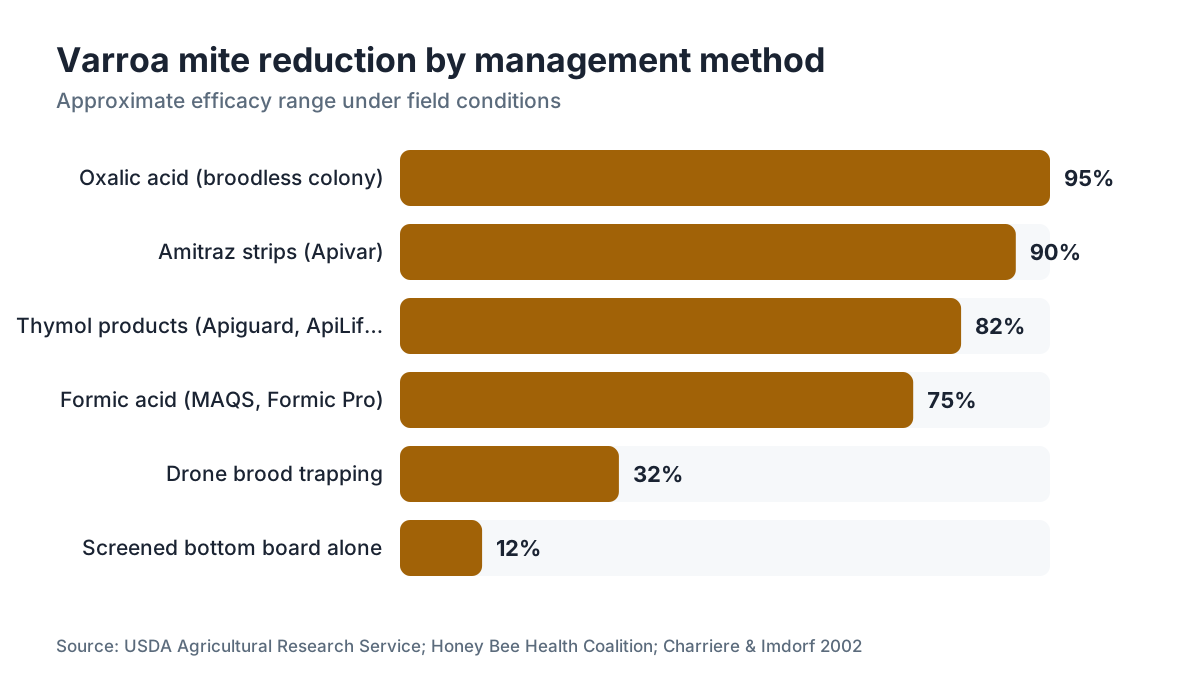
Here's a straight comparison of the main varroa methods, and where drone brood trapping lands.
| Method | Efficacy (mite reduction) | Residues in wax/honey | Best season | Resistance risk |
|---|---|---|---|---|
| Oxalic acid (dribble/vaporize) | 90-99% (broodless colony) [6] | None detected | Winter/brood break | None documented |
| Formic acid (MAQS, Formic Pro) | 60-90% [7] | Minimal, dissipates | Spring/fall | Low |
| Amitraz (Apivar strips) | 85-95% [7] | Some wax accumulation | Spring/fall | Resistance emerging |
| Thymol (ApiLife VAR, Apiguard) | 75-90% [7] | Minimal | Late summer/fall | Low |
| Drone brood trapping | 25-40% [4] | Zero | Spring/summer | N/A |
| Screened bottom board | 10-15% [2] | Zero | Year-round | N/A |
Drone brood trapping sits at the bottom of the efficacy table, and that's fine. It was never built to stand alone. Its value is buying time, cutting chemical load, and slotting into an IPM program that includes regular monitoring and a chemical knockdown when thresholds demand one.
The practical case for it: if you want to keep treatment frequency low during peak honey production, running a drone trap frame costs you almost nothing except the labor of pulling and freezing comb every three weeks. In a strong colony making surplus honey, you'd rather not apply a treatment that means removing supers. Drone trapping works with supers on.
The practical case against it: it only works if you run it every 24 days without skipping. Miss one cycle and mites released from that unchecked frame partly cancel what you gained before. If you're a set-it-and-forget-it beekeeper, this method will frustrate you.
Can drone brood trapping spread disease?
In theory, yes, if you keep returning frozen-and-thawed comb without inspecting the larval material. American Foulbrood (AFB) spores survive freezing. That's well established [8]. If the comb held infected larvae before you froze it, freezing does not sterilize it.
In practice, most beekeepers using drone trapping don't have AFB, and the risk is low in healthy colonies. But if you see any sign of AFB (ropey, foul-smelling brown larvae, sunken and perforated cappings), stop returning that comb to the hive and follow your state's AFB rules. Several states require reporting and burning of AFB-infected material.
Sacbrood, chalkbrood, and deformed wing virus travel with the mites themselves, so drone trapping that lowers mite numbers actually helps a little on that front.
My rule: when in doubt, cut the frozen comb out and render the wax instead of recycling it into the brood nest. The time you'd save reusing the comb isn't worth the disease risk on a colony I've spent a whole season building.
Does drone brood trapping work in all types of hives?
It works in any hive that uses removable frames: Langstroth, Warré with frames, long hives, and top-bar hives with a little adaptation. In a top-bar hive the principle is identical, but you work with the natural drone comb your bees build at the edges of the brood nest instead of a dedicated trap frame.
It doesn't work in fully fixed-comb systems like traditional log hives or a mud beehive, since you can't pull and replace specific comb without wrecking the colony's structure.
For Langstroth beekeepers, the most practical setup is a standard deep frame with large-cell drone foundation dropped into the lower brood box. In a two-box brood nest, put the trap frame near the center of the lower box. The queen is usually more active there during spring buildup, so you get faster laying.
Small colonies (under 5 frames of brood) may not draw drone comb fast enough to make the 24-day cycle worth it. In those cases, skip the trapping and get the colony stronger first.
How do you monitor whether drone trapping is actually working?
You need a mite count. Eyeballing the hive won't tell you whether your mite population is climbing or falling. The two practical options for hobbyists are the alcohol wash and the sugar roll, with the alcohol wash being more accurate [9].
The University of Minnesota Extension recommends sampling 300 adult bees (about half a cup) from the brood nest and checking the count against thresholds [9]. A mite level above 2% (2 mites per 100 bees) during the active season is the treatment threshold most extension programs use, though the Honey Bee Health Coalition notes some beekeepers use 1% as a more conservative line depending on the time of year [2].
Check mite levels at the start of your trapping program, then again 60 to 90 days later. If you're running the cycles correctly and your levels hold steady or drop, the method is pulling its weight. If levels climb past 2% despite trapping, add a chemical treatment. Drone trapping won't hold a colony that's already above threshold.
For tracking your trapping schedule and mite counts, tools like the free VarroaVault protocol planner can help you stay on cycle and log wash results without losing track between inspections.
Sticky board counts (dropping the bottom board insert and counting natural mite fall over 24 to 48 hours) are less precise but better than nothing when you don't have alcohol wash gear on hand.
What are the most common mistakes beekeepers make with drone brood trapping?
Starting too late is the big one. By the time a beekeeper notices a mite problem in late July or August, drone brood trapping can't catch up. The method works on prevention and delay, not rescue at high mite loads.
Pulling the frame too early is the second mistake. Pull partially capped comb and you destroy drone brood without trapping many mites. Let every cell cap before you pull.
Not running enough trap frames is third. One trap frame in a strong double-brood-box colony isn't enough. Strong colonies raise so many drones across two boxes that a single frame catches only a slice of the mites entering drone brood. Run two trap frames in strong colonies.
Treating drone trapping as a substitute for monitoring is fourth. Some beekeepers get comfortable thinking "I'm doing the drone frame thing" and skip alcohol washes for months. Don't. The mites don't care about your confidence.
Last, some beekeepers don't freeze long enough. A 12-hour freeze at a questionable temperature may not kill every mite, especially if the comb is thick and the center of the capped cells never reaches 0°F. Give it the full 24 hours minimum, and verify your freezer temperature with a thermometer.
Frequently asked questions
Can I use drone brood trapping as my only varroa treatment?
Not reliably. Drone brood trapping cuts mite reproduction by roughly 25-40% under consistent conditions, which isn't enough to keep most colonies below the 2% treatment threshold through a full season. The Honey Bee Health Coalition classifies it as a cultural control that extends the window before chemical treatment is needed, not a replacement for it. Use it alongside regular mite monitoring and keep an approved acaricide ready.
How many drone trap frames do I need per hive?
One frame per hive works for smaller colonies with a single brood box. For strong double-brood-box colonies, two trap frames in rotation is more effective and keeps you from missing cycles when one frame is frozen. You need at least two frames per hive so one is always in the hive collecting eggs while the other is in the freezer or thawing. Three frames gives you more scheduling room.
Will the queen naturally lay in a drone trap frame?
Yes, if you use large-cell drone foundation (6.4mm cell size) and place the frame in the center of the brood nest. Queens lay unfertilized eggs in larger cells by preference. Some queens are more willing than others, and in early spring they may fill drone comb slowly. If the frame sits empty for more than two weeks, move it closer to the warmest part of the brood nest or check that the foundation cell size is correct.
What happens to the bees trying to care for the frozen comb after I return it?
If you return the thawed frame, workers uncap and remove the dead larvae within a few days, cleaning the cells for reuse. This is normal hygienic behavior and the frame is safe to return. If workers ignore the frame for more than a week, the dead larvae may have started to decompose in a way that puts the bees off. In that case, cut out the comb and re-foundation the frame.
Does drone brood trapping hurt the colony's drone population significantly?
Yes, and it's worth thinking about. Removing drone brood every 24 days cuts the number of drones available for mating flights. For most managed colonies this doesn't matter in practice, since drone mating is handled by many colonies across an area. If you run a breeding program or keep isolated mating nuclei, be thoughtful about which hives you run heavy drone trapping on.
Can I freeze drone comb and store it to analyze mite levels?
You can thaw frozen drone comb and uncap cells by hand to count mites inside, which estimates the reproductive mite population (mites in cells, not on adult bees). This is separate from an adult bee alcohol wash and gives complementary information. But uncapping and counting is slow and tedious for a hobbyist. Most beekeepers skip it and rely on alcohol washes of adult bees for routine monitoring.
How do I know when the drone cells are fully capped and ready to pull?
Drone cappings are domed and raised above the comb surface, visibly bullet-shaped compared to the flatter worker caps. When every drone cell on your trap frame shows a complete raised cap with no open or empty cells left, the comb is ready. Mark the frame with a date tag when you see the last cells seal, and pull it within 7-10 days to stay inside the emergence window.
Is drone brood trapping approved or recommended by the EPA or USDA?
Drone brood removal is a mechanical/cultural practice, not a pesticide, so EPA registration doesn't apply. The USDA Agricultural Research Service and university cooperative extension programs across the country include it in integrated pest management recommendations for varroa. The Honey Bee Health Coalition's Varroa management guide lists it among recognized non-chemical management tools. No permit or registration is required to use this method.
Does the method work differently in Africanized honey bee populations?
Africanized honey bees, covered in more detail in our africanized honey bee article, tend to show higher hygienic behavior and some natural varroa resistance, but drone brood trapping applies the same biological principle regardless of bee race. If you work with Africanized colonies in areas where they're present, the timing and mechanics of drone trapping are identical. The bees' behavioral differences don't change the mite's preference for drone brood.
What month should I stop drone brood trapping in the fall?
Stop in late July to mid-August for most of the northern United States and Canada. By then colonies are naturally producing fewer drones, and the mite population is at its seasonal high. Continuing to pull drone comb won't meaningfully dent a high mite load in fall. Do an alcohol wash in August, compare your result to the 2% treatment threshold, and shift to a chemical acaricide if needed before bees raise the winter cluster.
Can drone brood trapping be combined with a brood break for better mite control?
Yes, and it's one of the best low-chemical IPM combinations around. A brood break (caging the queen or removing her temporarily) stops all capped brood, which leaves mites exposed on adult bees where oxalic acid can reach them at very high efficacy, often 90-99%. Running drone trapping before the brood break lowers the mite load going in, making the oxalic acid treatment even more effective. It's a genuinely solid approach for beekeepers who want to minimize synthetic acaricide use.
How much does setting up drone brood trap frames cost?
A commercial drone foundation frame runs roughly $5-12 depending on the supplier and whether you buy foundation separately. You need two to three frames per hive in rotation, so figure $15-35 per hive as a startup cost. That's a one-time expense since the frames last for years. The main ongoing cost is your time: pulling, bagging, freezing, and monitoring every 24 days. See options at beekeeping supply companies for current pricing.
Sources
- Fuchs S. (1990) - Preferences for specific brood stages by Varroa jacobsoni, Apidologie: Varroa mites infest drone brood at roughly 8-10 times the rate of worker brood due to the extended capping period
- Honey Bee Health Coalition, Varroa Management Guide: Drone brood removal is a cultural control that is 'not sufficient as a sole treatment' but extends the window before chemical intervention; recommends monitoring mite levels at least every 30 days during active season
- Penn State Extension, Varroa Mite Management in Honey Bee Colonies: Freeze drone comb at 0°F (-18°C) for a minimum of 24 hours; drone cells are capped around day 10 and adults emerge around day 24
- Charriere J.D. & Imdorf A. (2002) - Removal of capped drone brood: an effective means of reducing the infestation of varroa in honey bee colonies, Bee World: Consistent drone brood removal reduced mite populations by approximately 25-40% compared to untreated controls over a season
- Calis J.N.M. et al. (2001) - Modelling Varroa jacobsoni mite population growth in the honey bee brood, Experimental & Applied Acarology: Repeated drone brood removal can meaningfully delay mite population growth in spring and early summer but colonies still required chemical intervention by late summer in most cases
- EPA, Oxalic Acid Registration - Pesticide Fact Sheet: Oxalic acid achieves 90-99% mite reduction in broodless colonies; no residues detected in honey at label rates
- USDA Agricultural Research Service, Varroa Mite Treatment Efficacy: Formic acid treatments achieve 60-90% efficacy; amitraz strips achieve 85-95% efficacy; thymol-based products achieve 75-90% efficacy
- USDA Agricultural Research Service, American Foulbrood research: American Foulbrood (Paenibacillus larvae) spores survive freezing and remain viable; freezing does not sterilize infected comb
- University of Minnesota Extension, Varroa Mite Monitoring Methods: Alcohol wash of 300 adult bees (approximately half a cup) from the brood nest is recommended for accurate mite level monitoring; 2% infestation rate is a standard treatment threshold during the active season
- Honey Bee Health Coalition, Tools for Varroa Management (2nd ed.): Screened bottom boards alone reduce mite populations by approximately 10-15%; drone brood removal listed among recognized non-chemical IPM tools
Last updated 2026-07-09