Thermal imaging for detecting brood in a winter hive
TL;DR
- A thermal camera lets you see a winter honey bee cluster through the hive wall without cracking the lid.
- Brood runs at 93-95°F, so a colony rearing brood shows as a bright, tight hot spot on screen.
- Entry-level FLIR or Seek attachments run $180-$350 and clip onto a phone.
- That's enough resolution to read cluster position, rough size, and the cold gaps that warn of starvation.
What does thermal imaging actually show you about a winter hive?
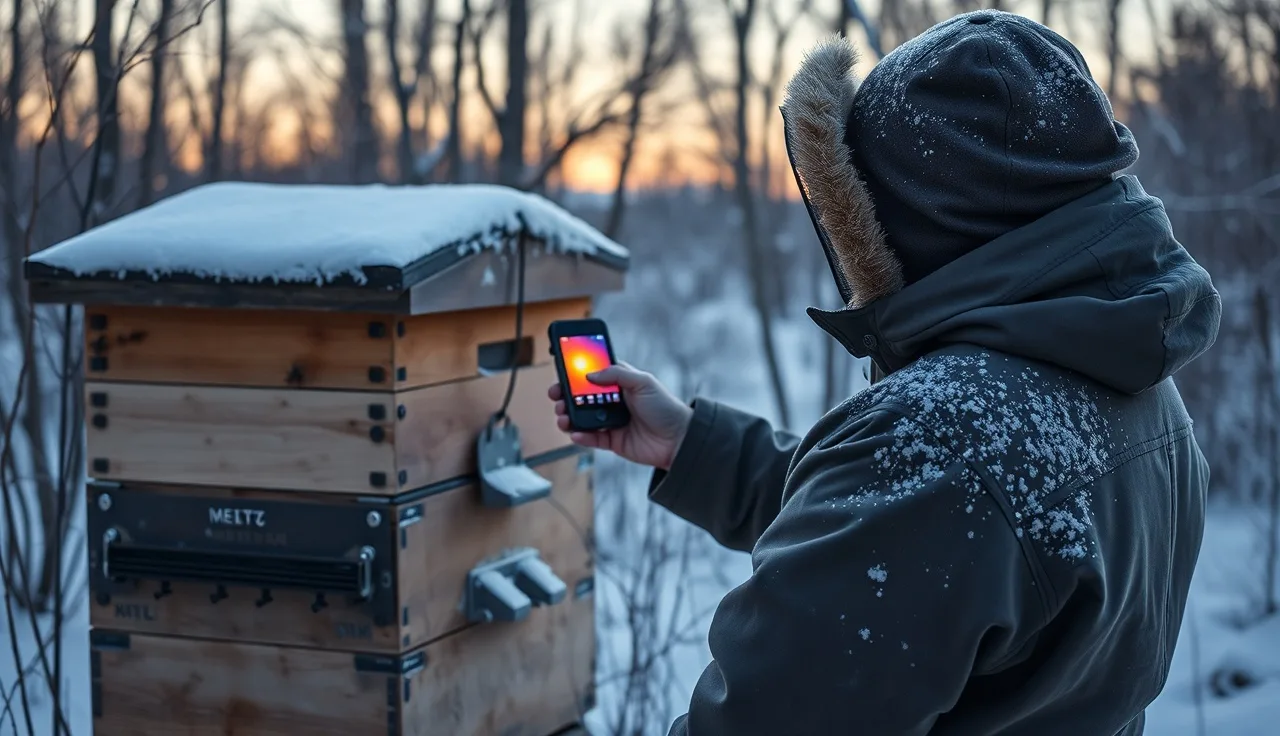
A thermal camera reads the heat that conducts through the hive wall and radiates off the outer surface. It does not see through wood like an X-ray. Where the cluster sits, the wood warms up. Where the box is empty, the wood stays near ambient. Even a few degrees of difference on the surface shows up as a clear warm patch on screen.
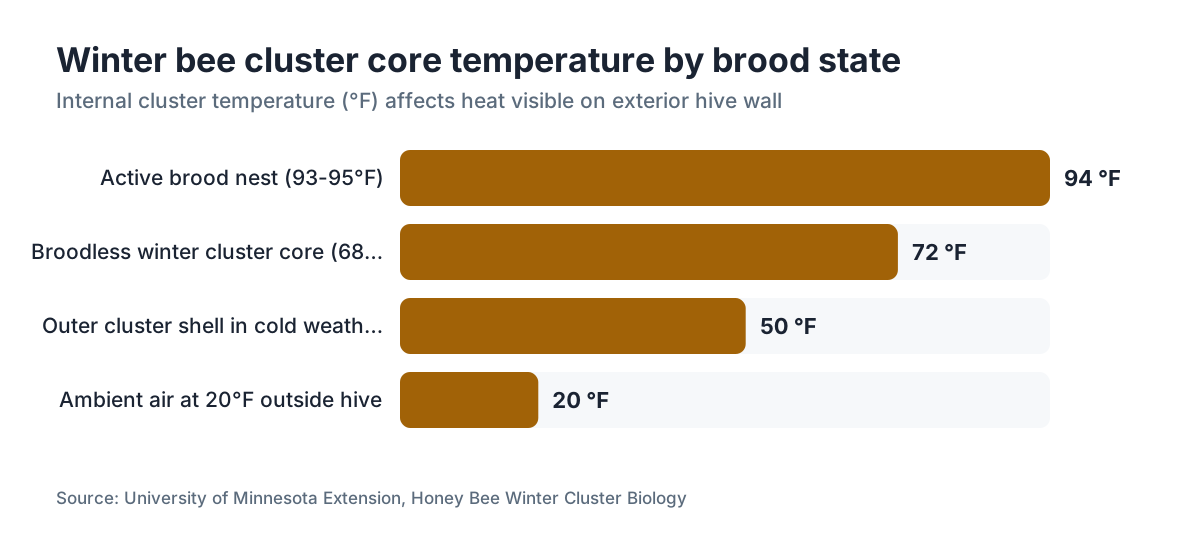
The cluster interior runs roughly 68-95°F depending on whether brood is present. A cluster rearing brood holds the nest at 93-95°F. A broodless cluster, which is normal in the coldest weeks up north, still keeps its core around 68-77°F. Both states throw a heat signature you can catch from outside, but a brooding cluster burns brighter and tighter [1].
You're reading three things. Where the cluster sits in the box (is it jammed at the bottom with no food above it?). How big the warm patch looks (a small blob in late winter means low bee numbers). And whether the heat holds together or splits apart. A colony fractured into two warm zones is often in trouble, because a broken cluster can't shift stores efficiently.
You won't get a clean picture. Thick walls, insulation, propolis, and condensation all blur the signal. For a winter check that doesn't chill the bees, though, it's the closest thing to a see-through hive that beekeepers have.
Why does brood change the thermal signature so much?
Brood forces the bees to hold a tight temperature, and that's what lights up the camera. The Honey Bee Health Coalition's varroa management guide notes that brood needs a stable warm environment, and nest thermoregulation studies have measured the brood nest holding 93-95°F (34-35°C) even when it's below freezing outside [2].
A broodless winter cluster is warm but not that warm. Bees shiver their flight muscles to keep the core near 68-77°F (20-25°C) [1]. Now look at a late-January hive that's started early brood rearing: the core jumps to 93-95°F. That 15 to 25 degree gap reads as a brighter, tighter hot spot, and the effect is strongest when the ambient air is cold and contrast peaks.
Here's the useful part. Thermal imaging can catch spring brood rearing weeks before you'd ever spot foragers on a warm afternoon. Early brood is a stress point. The colony burns honey faster to hold 93-95°F. Spot a bright, concentrated brood signature in January and you're unsure about stores? That's your cue to line up emergency feed.
It also means the tool is colony-specific. Two hives side by side, one with brood and one without, look different on screen in the same apiary on the same night.
What thermal camera specs do you actually need for hive inspection?
Thermal resolution matters most, measured in pixels. Consumer cameras run from 80x60 (barely enough for a cluster outline) up to 320x240 and beyond (enough to read cluster shape and cold gaps). For hive work, 160x120 is the floor. 206x156 or 320x240 is a real step up [3].
Temperature sensitivity comes next, listed as NETD (noise equivalent temperature difference). It tells you the smallest temperature gap the camera can pick up. Budget cameras sit around 150mK (millikelvin). A 50mK camera reads finer gradations, which helps in mild weather when contrast drops. In deep winter with ambient below 20°F, even a 150mK camera gives you a usable image, because the gap between cluster surface and cold wall is so wide.
Here are the realistic tiers for beekeepers:
| Camera tier | Resolution | NETD | Approx. price | Practical verdict |
|---|---|---|---|---|
| Smartphone attachment (Seek Compact, FLIR One) | 80x60 to 160x120 | 100-150mK | $180-$350 | Workable for cluster position, limited detail |
| Mid-range monocular (FLIR C5, Seek ShotPRO) | 160x120 to 320x240 | 70-100mK | $400-$750 | Good for most beekeepers' needs |
| Professional (FLIR E5 and above) | 320x240+ | 50mK or better | $1,000-$5,000+ | Overkill for hobby use; justified for research or commercial operations |
Most hobbyists buy the $180-$350 smartphone attachment. It's enough. You're not running precision diagnostics. You're checking whether a cluster is present, where it sits, and how big it looks. The image is grainy, but the warm blob is obvious.
One detail worth knowing. Most cameras let you switch false-color palettes. The ironbow or rainbow palette maps cold-to-hot as blue to yellow to white, and beekeepers reach for it because the warm cluster jumps off the screen. Grayscale works too, but it takes more practice to read.
When during winter is thermal imaging most useful?
Mid-winter is the sweet spot, roughly December through February across temperate North America. That's when opening the hive risks chilling the cluster, and when starvation and isolation starvation are most likely to kill a colony.
Isolation starvation is a nasty way to lose bees. A colony can starve with capped honey sitting 2 inches above the cluster if the bees can't break to reach it. A thermal camera shows you exactly where the cluster sits relative to the top of the hive. If the warm mass is pressed hard against the top board, the bees have eaten upward through most of their stores and are running out of room to climb. Open the hive on the next mild day (above 50°F) and add fondant or a candy board [4].
Late winter, roughly February into March, is the second critical window. Colonies start or ramp up brood rearing and burn stores fastest here. A bright, concentrated signature in February, paired with a light hive if you're tracking weight, is a warning. No scale? The camera is your proxy.
Early winter checks in November rank lower but still earn their keep. You're confirming the colony went in with a real population, not a thin remnant. A warm patch smaller than a softball on a Langstroth deep in November means that colony probably won't reach spring.
Summer and fall are not where these cameras earn their money. The gap between ambient and hive temperature shrinks, and the whole box runs warm during an active season. You can still chase a swarm or find a cluster in a cutout, but winter is the real use case.
How do you actually perform a thermal inspection step by step?
Start with the right conditions. Cold air maximizes contrast, and below 40°F is ideal. An overcast night beats a sunny day, because direct sun heats the hive exterior and throws thermal noise across the cluster signature. Wind matters too. It cools the surface unevenly and muddies the image. Still air on a freezing night is your best case.
Second, let the camera acclimate. Bring it in cold from the car and it needs a few minutes to settle. Most units have an auto-calibration shutter that clicks periodically. Let it run before you start reading.
Third, stand back 1 to 3 feet and scan the whole box, bottom to top. Start at the back wall if you can reach it, since the back stays less disturbed by entrance air movement. Scan the sides too. The heat usually shows brightest on the face nearest the cluster center.
Fourth, note where the warm patch sits vertically. Lower third means the colony has stores above it and looks fine. Upper third or pressed against the inner cover means act.
Fifth, read the shape. A round, cohesive oval is a healthy cluster. A smeared, diffuse patch can mean a large healthy cluster or a stressed one losing cohesion. Two separate warm patches is unusual and worth a look once you can get inside.
Sixth, screenshot each hive with a date. You don't need perfect records, but a timestamped image lets you track whether the cluster climbs week over week. That rate of upward movement is one of the most useful things the camera measures over a season.
Log those cluster positions next to your fall mite counts with VarroaVault's free winter monitoring tools. It's an easy way to see whether the colonies that struggled in January are the ones that carried varroa into October.
Can thermal imaging detect varroa mites or brood disease?
Directly, no. Mites are far too small, and their heat blends into the surrounding brood. No consumer camera resolves individual mites or mite-infested cells.
Indirectly, there's a real and somewhat studied link. Heavy varroa loads going into winter produce smaller, weaker clusters. A colony that carried 3 or more mites per 100 bees (3% infestation) into October will almost certainly show a smaller thermal signature in January than one that went in under 1% [5]. The camera won't hand you a mite count, but a suspiciously small cluster in a colony you didn't treat hard enough is a data point.
Brood disease is more of a research angle. Healthy brood at 93-95°F reads as a uniform warm block, while dead or dying brood pockets should create cold spots inside the nest. That's the logic behind using thermography to flag American foulbrood (AFB). It's a professional-camera, expert-interpretation job right now, not a hobbyist trick. The USDA Agricultural Research Service has looked into this, but there's no validated field protocol yet [6].
Here's the takeaway. Use thermal imaging for cluster monitoring, and keep your varroa mite counts on alcohol wash or sugar roll. Those physical samples are the only reliable way to know your real infestation level.
What does a normal vs. concerning thermal image look like?
Normal reads as a single warm oval or teardrop, sitting in the middle-to-upper third of the brood box or bottom super, with a clean edge between warm and cool. The stand, landing board, and the sides away from the cluster all read near ambient. In ironbow palette that's an orange-yellow blob on a blue-black field.
Concerning pattern 1, the high cluster. The warm mass is jammed against the top of the upper box. The bees have eaten upward through their stores and are near the top of the food. Open on the next 50°F day and check. Capped honey within 2 inches of the cluster means they're fine. Empty frames above the cluster means feed now.
Concerning pattern 2, no signal at all. You scan the whole hive and nothing reads warmer than the wood. That can mean a dead colony, or a very small cluster throwing off almost no heat. A colony under roughly 5,000 bees can fail to show a clear signature on a budget camera even while it's alive. Don't call it dead from a blank screen. Knock on the box and listen for the response buzz first.
Concerning pattern 3, fragmented signal. Two warm areas split by a cold gap. Sometimes it's a split brood nest going into winter (usually from poor late-season management or mites), sometimes it's the cluster forming around two empty-cell zones on mixed combs. Either way, track it closely.
Concerning pattern 4, a very bright, concentrated spot in January or February. That's likely active brood rearing and high metabolic demand. Not automatically a crisis, but pair it with a heft check. Light hive plus a bright brood signature means that colony is burning stores fast and may starve before dandelion bloom.
How does hive construction affect what the camera sees?
Wood species and thickness change the picture. A standard Langstroth built from 3/4-inch pine passes heat through fairly well. Thicker lumber or a hive wrapped in foam board for winter (common up north) drops the external surface temperature and cuts the contrast you'll see [7].
Insulated hives aren't invisible, just harder to read. The warm patch still appears, only fainter. In practice, beekeepers running foam-wrapped hives find the best scanning angle is the entrance or any seam in the wrap where heat leaks out.
Polystyrene (EPS/XPS) bodies are common in some European operations and spreading in North America. They insulate far better than wood. Through a polystyrene wall the reading is heavily muted, so you'll want colder air and better resolution to pull a usable image.
Log hives, mud beehive styles, and other thick-walled natural designs are the hardest to read. The wall mass soaks up and spreads the heat until a budget camera gives you next to nothing.
Top-bar and Warré hives with thin wooden walls read a lot like Langstroth gear. Cluster position reads differently, since bees in a top-bar move sideways rather than up, but the same rule holds. Warm blob, good. No blob, check.
Does thermal imaging help with winter feeding decisions?
It helps indirectly, and it pairs well with the two standard winter checks: hive weight and a knock-and-listen.
Weight is the gold standard. A full single deep of honey runs roughly 60-90 pounds depending on comb age and honey moisture [12]. Track weight in late fall, then again in midwinter, and you know exactly how much the colony has eaten. Thermal imaging adds what weight can't: where the cluster sits relative to the honey that's left.
The knock-and-listen confirms the colony is alive but tells you nothing about position or brood state. The camera gives you both without opening the hive.
When all three point the same way (hive lighter than expected, cluster high, brood present), the case for stepping in is strong. A fondant patty set directly above the cluster on a 50°F day is a low-disruption move that can save the colony. Don't feed syrup in January. It chills the hive, and bees can't cure liquid feed in winter. Fondant, candy boards, or dry sugar are your cold-weather options [4].
One honest caveat. Nobody has published a controlled study tying thermal cluster-position data to feeding outcomes. The practice is logical and common among experienced beekeepers, but the evidence is practitioner consensus, not a randomized trial.
What does the research say about thermal imaging accuracy for hive monitoring?
The research base is real but thin. A 2012 study in the Journal of Economic Entomology tested infrared thermography for finding honey bee colonies in tree cavities and walls, and reported that surface temperature differences of 2-5°C reliably marked occupied versus empty cavities [6]. That's the physics behind winter hive checks: it works at the resolution and temperature gaps involved.
A 2017 paper in Computers and Electronics in Agriculture studied automated thermal monitoring of hive entrance activity. Different application, but it confirmed that consumer-grade cameras can pull biologically meaningful heat signatures out of ambient background in an apiary [8].
The USDA Agricultural Research Service has investigated thermal imaging for AFB detection, with researchers noting that diseased brood creates detectable cold patches inside the nest. As of this writing that work sits in early stages, with no validated field protocol [6].
University extension programs, including Penn State Extension's apiculture work, recommend thermal imaging as a non-invasive winter tool while cautioning that camera quality and user experience shape what you can reliably read [9]. That squares with real use. A first-timer with a budget camera misreads images that an experienced keeper reads in 5 seconds.
Honest summary: the physics is solid, the tool works, and there's no large controlled study of thermal imaging's effect on overwinter survival. It's a monitoring tool, not a diagnostic device.
How does thermal imaging fit into a full winter colony management plan?
The camera is one piece of a bigger winter plan. What matters most for survival is always what happened in September and October: mite treatment timing, colony population, and food stores. A colony that went in with a clean mite load and 60-plus pounds of honey doesn't need a camera to make it. A colony that went in stressed needs everything you've got, and the camera shows you where to step in.
The Honey Bee Health Coalition's Varroa Guide recommends holding mite levels below 2% (2 mites per 100 bees) by September 1 across most of North America, specifically to protect the long-lived winter bees the colony is raising then [2]. Those winter bees are the cluster. Their quality, damaged directly by varroa and the viruses it spreads, sets the cluster's coherence and heat-holding ability. A weak, virus-hit cluster won't throw the signature a healthy colony does.
Building out a full winter protocol? Beekeeping supply companies stock candy boards, entrance reducers, and upper ventilation hardware alongside camera accessories. Treat mites in late summer, confirm stores before October, reduce the entrance, add upper ventilation to move moisture, then track cluster position with the camera through January and February. That's a coherent, practical system, and you can round out the rest of your setup through standard beekeeping supplies.
To track mite loads next to your thermal notes across the winter, the free protocol tools at VarroaVault let you log both in one place. Over a few seasons that builds a real picture of how fall mite management maps to spring cluster size.
Is a thermal camera worth buying just for winter hive checks?
It depends on how many hives you run and what peace of mind is worth to you.
With 1-3 hives, a knock-and-listen plus a heft test every 2-3 weeks gives you most of what a camera gives you, for free. You can also spend nothing by sliding a quick-read digital thermometer probe through the entrance on a cold night. If the cluster is alive and generating heat, the reading near it sits well above ambient.
With 5-15 hives (the sideliner range), a camera starts paying off. A real non-invasive scan of 10 hives takes about 15 minutes. Hefting or probing 10 hives accurately in January is a slog. The visual record of each cluster's position through winter also sharpens your read fast.
The math: a $250 smartphone attachment used across 10 hives for 3-4 winters runs about $6-8 per hive per year. That's a rounding error next to replacing a dead colony, which runs roughly $150-200 for a package or $180-250 and up for a nucleus colony in 2024-2025 pricing [10].
The camera earns its keep off-season too. Most beekeepers who buy one end up using it for home energy audits, finding water leaks, and checking electrical panels. That makes the price easier to swallow.
My honest take: run 8 or more hives and lose 2-3 a winter to starvation or isolation starvation you could have caught earlier, and a $250-$400 camera pays for itself the first season.
Frequently asked questions
Can I use a thermal camera to check if my winter colony is still alive?
Yes, this is the main practical use. A living cluster shows as a warm patch on the outside of the box, right through the wood. A dead colony reads near ambient all the way around. One caution: a very small cluster (under roughly 5,000 bees) may throw a faint signal that budget cameras miss. If you get no reading, knock on the hive and listen for the response buzz before you assume the colony is dead.
What temperature difference does a thermal camera need to see a bee cluster?
A broodless winter cluster holds roughly 68-77°F inside. With brood, the core hits 93-95°F. In air below 40°F, that produces a surface difference of at least 5-10°F on the hive exterior, well inside the range of consumer cameras rated at 100-150mK NETD. Colder ambient air makes more contrast and cleaner images.
How often should I scan my hives with a thermal camera in winter?
Every 2-3 weeks through the core months (December through February) is reasonable. You're watching the cluster climb toward the top of the hive, which signals depleting stores. Monthly scans can miss a colony that shifts fast during a cold snap. More frequent checks don't hurt, but the situation rarely changes in under a week under steady cold weather.
Does the thermal camera work through insulated hive wraps or foam boards?
It works, with reduced contrast. Foam suppresses the surface temperature, so the cluster signature reads fainter. Beekeepers running insulated hives often find the best imaging spots are seams in the wrap or the entrance area. With a budget 80x60 camera, heavily insulated hives may not give a usable image. A 160x120 or better camera with NETD under 100mK handles it better.
What time of day is best for thermal hive inspection?
Nighttime or very early morning in cold weather works best. Sunlight on the hive exterior creates thermal noise that can hide or mimic the cluster's heat. An overcast night below 32°F with no wind is ideal, because surface temperatures are low and even, which maximizes the contrast between the warm cluster and the cold wall.
Can thermal imaging replace opening the hive to check stores?
Not completely. It tells you where the cluster is and roughly how large. It doesn't tell you precisely how much honey remains on specific frames. If your scan shows the cluster pressed against the top board in January, you'll still want to open on the next 50°F day to confirm how much honey is left and whether feeding is needed. Thermal imaging is a triage tool, not a full inspection replacement.
How do I tell the difference between a healthy cluster and a struggling cluster on a thermal image?
A healthy cluster reads as a single, cohesive oval or round warm mass. A struggling one may read diffuse or fragmented, a very small spot for the time of year, or pressed hard against the top of the hive. Two separate warm zones in one hive usually signal trouble. Tiny warm patches in December or January, in a climate that had a normal fall build-up, point to a colony that likely won't survive to spring.
Does the type of hive (Langstroth vs. top-bar vs. Warré) affect thermal imaging accuracy?
Wall material and thickness matter more than style. Standard 3/4-inch pine passes heat reasonably well regardless of design. Thick-walled or heavily insulated hives (polystyrene, insulated Warré, or mud-style) suppress the signal. In a top-bar hive, the cluster moves sideways through winter rather than up, so you'd watch for the warm mass shifting toward the honey side of the bars as winter runs on.
What's the connection between varroa mite levels and what I see on a thermal camera in winter?
Heavy varroa loads in September and October damage the fat body development of winter bees and spread viruses like Deformed Wing Virus. Those damaged bees form smaller, less coherent clusters with weaker heat control. A colony that went into winter above 3% infestation typically shows a noticeably smaller, fainter signature in January than a well-treated colony of similar fall size. The camera doesn't show mites, it shows their damage.
Can I use a smartphone thermal camera or do I need a dedicated device?
A smartphone attachment (FLIR One, Seek Compact, or similar) in the $180-$350 range is what most hobbyists use, and it's enough for cluster detection and position monitoring. Dedicated handheld cameras offer better resolution and sensitivity but cost $400-$1,000 and up for useful models. For 1-15 hives, the attachment does the job. Having it on your phone also means you'll actually use it.
Is there scientific evidence that thermal imaging improves winter colony survival rates?
No controlled study has directly measured a survival improvement from thermal imaging. The physics are validated: cameras reliably detect cluster heat through hive walls, and surface differences of 2-5°C accurately separate occupied from empty spaces. The idea that earlier detection of cluster problems leads to faster feeding and better survival is logical and backed by practitioner consensus, but no formal randomized trial has been published as of this writing.
What false-color palette should I use on my thermal camera for beehive scanning?
Ironbow or rainbow palettes are most popular, because they map cold-to-hot as blue to yellow to white, making the warm cluster pop against the blue-black cold wall. Grayscale (white hot or black hot) also works, and some users prefer it for reading gradients. There's no functionally correct pick. Use whatever your eye reads fastest after a few practice sessions with your camera.
How far from the hive should I stand when scanning with a thermal camera?
One to three feet from the wall is the practical range for most consumer cameras. Too close and the full hive falls out of frame. Too far and the resolution at the hive surface drops below what a low-pixel camera can resolve. At 2 feet with a 160x120 camera, a standard Langstroth deep fills most of the frame and you can read position and rough size clearly.
Sources
- University of Minnesota Extension, Honey Bees: Winter Cluster Biology: Winter cluster temperatures range from 68-77°F without brood and 93-95°F when brood is present
- Honey Bee Health Coalition, Tools for Varroa Management Guide: Brood requires stable temperature environment; Varroa treatment threshold of 2% recommended by September 1 to protect winter bees
- FLIR Systems, Thermal Camera Specifications and Application Notes: Consumer thermal camera resolutions range from 80x60 to 320x240 pixels; NETD specifications typically 50-150mK
- Penn State Extension, Beekeeping: Winter Colony Management: Isolation starvation occurs when cluster cannot break to reach stored honey; fondant and candy boards recommended for winter emergency feeding
- Honey Bee Health Coalition, Varroa Management Guidelines, Threshold Recommendations: Mite infestation above 3% in fall correlates with higher winter colony losses and smaller spring populations
- USDA Agricultural Research Service, Honey Bee Research: Infrared thermography investigated for detecting bee colonies in cavities and for AFB brood disease diagnosis; surface temperature differences of 2-5°C reliably indicate occupied versus unoccupied cavities
- Oregon State University Extension Service, Insulating Honey Bee Hives for Winter: Foam insulation and thicker wooden walls reduce heat transmission to hive exterior, affecting thermal imaging contrast
- Computers and Electronics in Agriculture, Thermal Monitoring of Honey Bee Colonies (2017): Consumer-grade thermal cameras can distinguish biologically meaningful heat signatures from ambient background in apiary hive monitoring applications
- Penn State Extension, Apiculture Program, Non-Invasive Winter Hive Monitoring: Thermal imaging recommended as non-invasive winter monitoring tool; user experience and camera quality significantly affect interpretation accuracy
- National Agriculture Statistics Service USDA, Honey Bee Colony Pricing Data: Replacement package bees cost $150-200 and nucleus colonies $180-250+ in 2024-2025 market pricing
- University of California Agriculture and Natural Resources, Honey Bee Thermoregulation Research: Honey bee workers maintain brood nest at 93-95°F (34-35°C) through shivering thermogenesis even when external temperatures are below freezing
- Virginia Cooperative Extension, Honey Bee Wintering and Store Requirements: A full single Langstroth deep of capped honey weighs approximately 60-90 pounds depending on comb age and honey moisture content
Last updated 2026-07-09