Winter hive inspection for varroa signs: what to look for
TL;DR
- You can't run a full varroa count on a winter cluster without breaking it apart.
- You can still catch serious trouble.
- Read the bottom board debris, the dead bees at the entrance, and any exposed comb for deformed wings and chewed cappings.
- If your last pre-winter mite count was above 2 mites per 100 bees, that colony is at real risk right now.
Why does varroa inspection matter in winter at all?
Plenty of beekeepers treat hard in late summer, button up the hives, and call it done until spring. That thinking kills colonies. Varroa populations don't freeze. They slow down because brood production slows down, but the mites that survived fall are still riding your bees inside the cluster, feeding on fat bodies, and cutting short the lifespans of the exact bees your colony needs to reach March.
The Honey Bee Health Coalition's Varroa Management Guide states that colonies entering winter with mite loads above 2 mites per 100 bees face dramatically higher overwinter mortality [1]. That threshold isn't a comfort zone. It's a danger line. If you crossed it in October and did nothing, January is when the bill comes due.
Winter inspection isn't a sugar roll or an alcohol wash on a frozen cluster. You can't do either safely without chilling bees and maybe killing the colony outright. It's reading indirect evidence. What do the dead bees look like? What's on the bottom board? How far has the cluster moved? Is anything alarming showing on capped brood, if there is any? Small clues tell big stories in January.
When should you do a winter hive inspection for varroa?
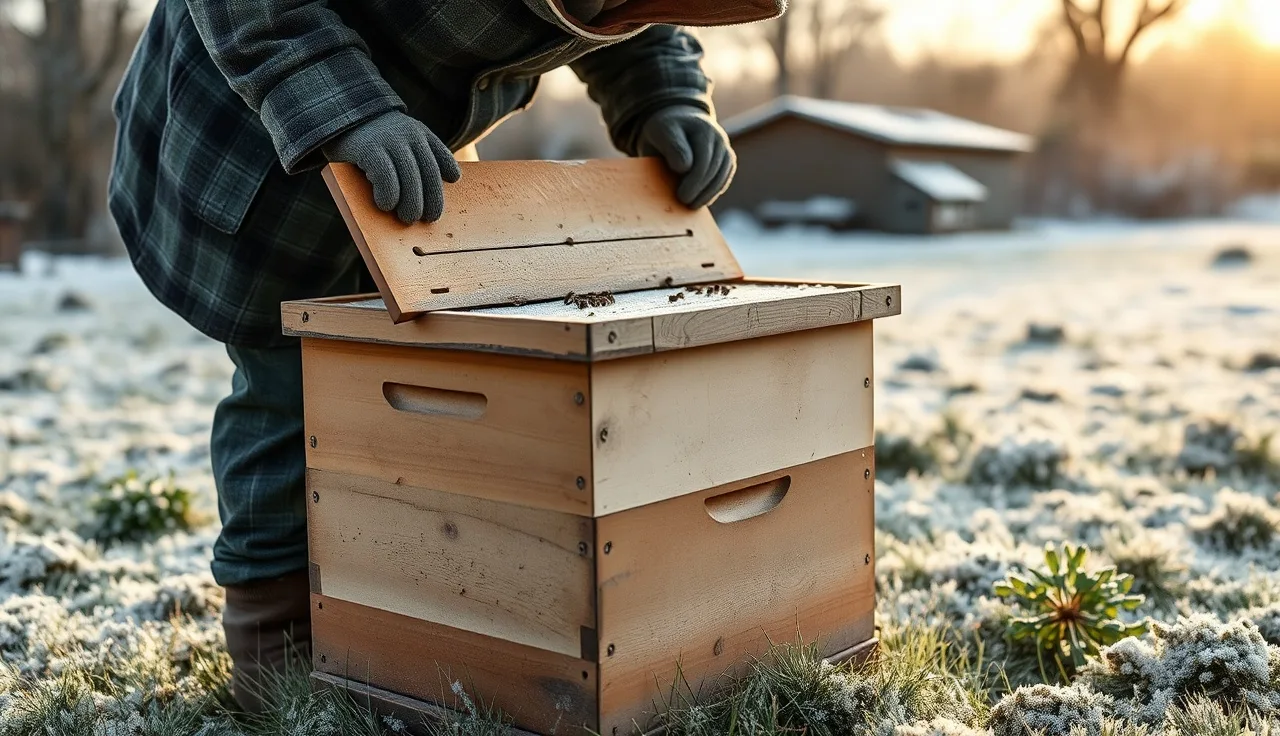
Timing depends on where you live. In the upper Midwest and Northeast, the cluster is tightest from December through February, and opening the hive then does real damage to heat retention. A quick external check every few weeks is smart. A brief internal look (five minutes, lid off, no frames pulled) is fine on a day above 40°F (4°C) with no wind.
In warmer climates (the Southeast, the Southwest, coastal California), you may have a short brood break rather than a true winter cluster. Those hives can carry a limited brood nest from November through February, and that brood means mites keep reproducing. Texas A&M AgriLife Extension tells southern beekeepers not to skip varroa monitoring in winter because mite populations can keep building through the cool season [2].
Two inspection moments earn their keep. One is a mild day in early winter to confirm the colony is alive and the cluster looks healthy. The other is late January or February, when you want to know whether the colony cleared the hardest stretch and whether spring brood is starting. See brood in February? That's your first chance to run a real mite count before the population takes off.
What varroa signs can you see without opening the hive?
Quite a bit, actually. Start at the entrance. Dead bees pile up there all winter as the cluster climbs through the honey. A normal pile has intact bees, many head-first in cells (they died searching for food or of old age). What raises a flag is dead bees with crumpled, shriveled wings, shortened abdomens, or bodies that look unusually small. That's deformed wing virus (DWV), the most common virus varroa spreads [3].
Pick up a few of those dead bees and look closely. Tiny reddish-brown oval specks on the thorax or abdomen are mites. Finding mites on dead bees isn't definitive (mites don't cause every death), but it tells you the infestation was real.
Next, pull the bottom board drawer if you run a screened bottom board. Winter debris builds up: wax flakes, pollen, dead bees, sometimes mites. Count mites over 24 hours for a rough natural drop rate. This isn't as accurate as an alcohol wash, but Penn State Extension's varroa guidance says a natural daily drop above 10 mites can point to a significant infestation [4]. Don't treat that as a precise threshold. It's directional. A drawer full of mites in January is bad news no matter how you count.
Look at the exterior too. A dead cluster shows no bee activity on warm days above 50°F while other hives take cleansing flights. If neighboring hives are flying and yours stays silent for several warm days running, open it up.
What do you look for when you briefly open a winter hive?
Keep it short. Aim for a 3-to-5 minute look, not a full inspection. Pick a day at least 40°F, calm, ideally with sun on the hive.
Lift the outer cover and inner cover together if you can. Look down at the top bars. You should see a cluster filling some number of frames. A healthy colony in midwinter usually covers 4 to 8 frames, depending on its fall size and how deep into winter you are. A cluster covering fewer than 3 frames in late January is worth worrying about, though not always because of varroa. It could be a small, queenless, or stressed colony.
If you can see any exposed capped brood (possible in mild-climate colonies or on warm midwinter days in a big cluster), check for cappings that are sunken, punctured, or holed in ways emerging bees don't make. That pattern is called shotgun brood. It's tied to brood diseases, but heavy varroa loads stress bees and weaken their hygienic response, so you can see ragged brood in a badly infested colony [5]. It's not proof of varroa on its own. Combined with other signs, it adds to the picture.
Check the feed. A cluster that has burned through its stores and sits near the top with nothing above it will starve regardless of mite load. Winter starvation and varroa damage can look alike from the outside. Slide a hive tool under the bottom back corner and lift. If it barely budges, there's probably honey left. If it lifts easy and feels light, food is the immediate problem.
Don't pull frames in cold weather. You'll chill bees and break wax-sealed connections. You might crush your queen. Save frame-by-frame work for days above 55°F (13°C) with brood present to hold the cluster stable.
Can you do a mite count during winter?
Not a reliable one, and not without risk. An alcohol wash or sugar roll needs bees pulled from the cluster, ideally nurse bees off a brood frame. In true winter there's no brood frame to pull from, and the cluster won't give up bees cleanly without a bad disturbance.
Natural mite drop from a sticky board or bottom board drawer is the practical alternative, and it's imperfect. The Honey Bee Health Coalition warns that sticky board counts are less accurate than alcohol wash counts and should be read with caution [1]. Still, if you run a screened bottom board, slide a sticky board or white paper under the screen for 24 to 72 hours in midwinter and count. A drop of 0 to 1 mites per day in a strong colony suggests a low load. A drop of 30 or 40 mites per day in winter, when mites have no brood to hide in, points to a serious problem.
Got brood in late winter (late January or February in warmer climates, March up north)? That's when a real alcohol wash works. Collect roughly 300 bees (about half a cup) from a brood frame, wash with isopropyl alcohol, and count. Above 2 per 100 bees means treat before spring buildup starts [1].
For a full picture of the varroa mite itself, including its life cycle and why treatment timing matters so much, that background makes everything you're reading during these winter checks easier to interpret.
What do the dead bees in winter tell you about varroa?
Dead bees in winter are normal. Every colony loses bees. The question is what those bees look like.
Deformed wing virus (DWV), carried by varroa, makes bees with wings that look crumpled, curled, or stunted. These bees can't fly and often crawl out to die at the entrance or inside. A few deformed-wing bees in a pile isn't panic level. Finding them in large numbers relative to the total, say 10% or more, means heavy DWV pressure, which almost always means high varroa [3].
Small, undersized bees with shortened abdomens are another tell. Varroa feeding during the pupal stage stunts development. University of Minnesota Extension lists these stunted bees as a visible marker of high mite load that shows up in dead bee samples [6].
A colony found completely dead in February or March tells a fuller story. Varroa death has a recognizable look: a small cluster of dead bees rather than the large mass you see in starvation, often with bees head-first in cells (starvation at the very end), scattered chalkbrood or deformed bees on the bottom board, and sometimes visible mites on the dead. Stored honey sitting right next to a dead cluster, while that cluster starved, points to a colony that lost population so fast it couldn't move to the food.
What does a varroa-damaged hive look like versus a starved one?
This is genuinely hard to call in some cases, because the two overlap. A varroa-wrecked colony often starves at the end because so few bees are left that it can't thermoregulate or reach food. The sequence is what matters.
Starvation deaths usually show a large cluster of dead bees, all facing the same way (head-first into cells, hunting honey), with empty frames above and around them. The colony was big enough to survive but ran out of food.
Varroa collapse shows a much smaller cluster than you'd expect from a colony that was strong in October. There's often honey still in the hive, sometimes plenty. The population crashed so fast from mite-borne viruses that the survivors clustered into a tiny knot, couldn't hold warmth, and died. Honey in a dead hive next to a tiny cluster is a classic varroa collapse signature [7].
Check the brood pattern in the drawn comb if there was a late brood nest. Shotgun brood, meaning irregular cappings with some cells open and empty while others stay sealed, points to disease or mite damage. Sacbrood virus, also linked to high varroa loads, leaves a distinctive pattern where pupae die and dry into a curved scale inside the cell [5].
Nobody has a perfect forensic test for winter colony death. The best you can do is a postmortem that weighs cluster size, honey stores, dead bee shape, and brood patterns together.
What varroa treatments actually work in winter?
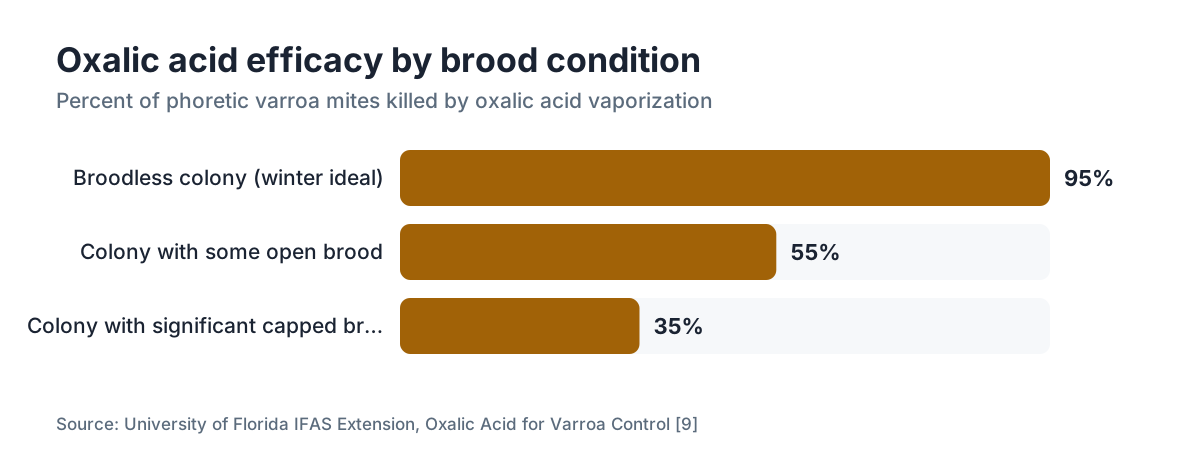
This is where it gets complicated. Most oxalic acid treatments need broodless or near-broodless conditions, because oxalic acid doesn't reach mites inside sealed cells. In full winter, when a colony has no brood, a single oxalic acid treatment by vaporization or dribble kills phoretic mites (the ones riding adult bees) at high rates.
EPA-registered oxalic acid products (Api-Bioxal is the common one) work by dribble or vaporization. The Api-Bioxal label allows one vaporization treatment every 5 days for up to 3 treatments, or one dribble application per year during a broodless period [8]. A broodless winter stretch is the ideal window: mites have nowhere to hide, and one well-timed treatment knocks loads down hard before spring.
Temperature matters. Oxalic acid dribble goes on days above 40°F (4°C) and works poorly below that. Vaporization can run at lower temperatures, but the bees have to be clustered enough to contact the vapor. Most extension guidance suggests above 35°F (1.7°C) for vaporization with bees tightly clustered [9].
Amitraz strips (Apivar) don't belong in a mid-winter cold-climate hive. They need active bee movement to spread and work better above 50°F. Formic acid (MAQS or Formic Pro) has its own temperature limits and should not go on below 50°F. Once late winter warms up and spring brood appears, those options come back.
For planning your full seasonal schedule, the tools at VarroaVault help you match treatment options to your local conditions and colony state without cross-referencing a stack of product labels by hand.
Here's a fact worth pulling out clean: oxalic acid vaporization during a broodless period kills 90 to 99% of phoretic mites, compared to 30 to 60% when brood is present, according to research summarized by University of Florida IFAS Extension [9].
How does winter cluster behavior signal varroa problems?
A healthy cluster climbs through the hive as winter runs on, following the honey. By February in most northern states, a cluster that started at the bottom of the upper brood box should sit somewhere in the middle or top of that box.
A colony weakened by varroa behaves differently. The cluster may be smaller than the fall population would predict. It may not move predictably, because it has too few bees to make heat and hold tight around the queen. In a hard winter you might find the cluster stuck low, unable to reach honey stored above it, even when food was plenty going in.
A cluster that answers a knock with a healthy buzz in deep cold but shows no activity on warm days above 50°F is more likely dead than merely cold. Bees cluster tight when cold and break to move around when it warms. A silent hive on a 55°F February afternoon, with other hives flying, is almost certainly gone.
Hive weight is another indirect signal. Plenty of experienced beekeepers heft their hives monthly, lifting the back edge to feel the load. That won't tell you about varroa specifically, but a hive losing weight faster than its size explains could mean a dwindling colony, which varroa speeds along.
What records should you keep from winter inspections?
The biggest mistake with winter inspection data is keeping it only in your head. Write it down. A notebook or a phone note is enough. What you record in January matters in April.
For each check, note the date, outside temperature, cluster size (frames covered), dead bees collected and what they looked like, sticky board mite count if you have one, honey stores estimate, any sound or behavior, and any treatment applied. If you open the hive, note the cluster's position in the box.
Compare your last pre-winter mite count from September or October against what you're seeing now, and you'll know if your fall treatment worked. A colony that ran a 3% mite load in October and got oxalic acid in November should show a far lower natural drop in December than one you left alone.
Records also flag your repeat offenders. If one hive needs emergency help every January, that's genetic information. Requeening from more hygienic or varroa-sensitive breeding stock is one of the most underused long-term moves in hobby beekeeping. The Honey Bee Health Coalition's Varroa Management Guide covers this in its genetics section, and it earns a read before spring [1].
For beekeepers tracking supplies and equipment for spring buildup, a list of what each colony needs coming out of winter saves you time. Sorting through options from beekeeping supply companies in February, before everyone panics in April, means you're actually ready.
What should you do if you find varroa signs mid-winter?
Don't panic. Don't wait either. What you do depends on what you found and when.
December or January, colony has no brood (true for most northern climates)? Oxalic acid vaporization is your best immediate move. It's fast, it hits phoretic mites, and done right it won't harm the cluster. Apply on a day above 35°F, seal entrances briefly during treatment, and follow the Api-Bioxal label [8].
Colony looks weak but alive, small cluster, and you're unsure it'll reach spring? Consider combining it with a stronger colony now instead of watching it fade. A dead hive in March is worth nothing. A small cluster merged into a strong colony in January gives those bees a shot.
Colony already dead? Record everything before you clean. Study the dead bees, the brood pattern, the honey stores, and the cluster position. Check for mites on the dead bees. This postmortem is free education. Then clean the equipment carefully before it goes back into service, because dead equipment harbors small hive beetles and invites robbing.
Warmer climate with some brood in January? Your options narrow, because oxalic acid loses efficacy when brood is present. Several vaporization treatments spaced 5 days apart across a 15-day window catch mites as they emerge from cells, but that takes more treatments and isn't as clean as a single broodless-period application [8]. Still beats doing nothing.
Spring is coming either way. The job right now is to move as many healthy bees as possible to the other side of winter, because spring buildup is exactly when varroa also explodes if the starting load is high.
Frequently asked questions
Can I do an alcohol wash on a winter cluster?
Not safely or accurately. An alcohol wash needs bees pulled from a brood frame, which doesn't exist in a true winter cluster. Disturbing the cluster in cold weather risks chilling and killing bees. Wait until late winter when some brood is present and temperatures allow a short inspection. Use sticky board natural mite drop as a rough guide instead.
What is a normal mite drop on a sticky board in winter?
There's no single accepted normal number, and sticky board counts are less precise than alcohol washes. Penn State Extension says a natural daily drop above 10 mites may signal a significant infestation in winter, when mites have no brood to retreat into. A drop of 1 to 2 per day in a healthy colony is generally low. Dozens per day warrants action.
How do I know if my colony died from varroa versus starvation?
Read cluster size and honey stores together. Varroa collapse usually leaves a very small cluster of dead bees with honey still in the hive. The colony lost population too fast to use its stores. Starvation shows a larger cluster with empty or near-empty frames directly above. Both can happen at once in severely stressed colonies, which makes a clean call hard.
What temperature is safe to open a hive in winter?
Most extension services recommend at least 40°F (4°C) with little wind for a quick lid-off look, and 55°F (13°C) or above if you need to pull frames. Below 40°F, opening the hive can drop the cluster temperature fast and harm bees. Keep the inspection to 3 to 5 minutes in cold weather no matter the temperature.
Can I use Apivar strips in winter?
Apivar (amitraz) needs bee movement to spread through the colony, and it performs poorly in the cold. Most guidance recommends using Apivar above 50°F (10°C). In a cold-climate winter cluster, the strips won't work. Oxalic acid vaporization during a broodless period is the better winter option.
How many times can I treat with oxalic acid in winter?
The Api-Bioxal label allows vaporization once every 5 days for up to 3 treatments, or a single dribble application per year during a broodless period. For a broodless winter cluster, one vaporization treatment often gives very good knockdown, since no sealed cells protect mites. Three treatments over 15 days help in colonies carrying any residual brood.
What does deformed wing virus look like in a winter dead bee pile?
Bees killed or crippled by deformed wing virus (DWV) have wings that are crumpled, stubby, or rolled instead of flat and extended. The wings often look shriveled or incomplete. The abdomen may be shorter than normal. Finding these bees in your winter dead pile, especially in real numbers, is a strong sign of high varroa load in that colony.
Should I treat with oxalic acid before or after the broodless period?
During. The whole point is catching mites while they have no capped brood to hide in. Treat during the broodless period, ideally late November or December in northern states, once you're confident the queen has stopped laying. Treating before or after, when brood is present, cuts efficacy sharply because oxalic acid doesn't reach sealed cells.
How often should I check hives for varroa signs during winter?
A quick external check every 2 to 3 weeks is reasonable, looking at entrances and bottom board debris. A brief internal look on mild days (above 40°F) once a month covers most climates. You're not monitoring weekly the way you would in summer. The goal is catching a dying colony early enough to act, not tracking real-time mite counts.
Is a small winter cluster always a sign of varroa?
No. Colony size going into winter, natural winter attrition, late-season queen problems, and how long winter has lasted all shape cluster size. A small cluster in January isn't automatically varroa. But if the colony was large in October and is tiny now, especially with deformed bees in the debris, that trajectory is suspicious. Context from your fall mite counts matters a lot.
What is the safe mite threshold for colonies entering winter?
The Honey Bee Health Coalition recommends treating if mite loads pass 2 mites per 100 bees (2%) in the fall, before the colony raises its winter bees, roughly late August through September. Colonies entering winter above this face significantly higher overwinter mortality. Some researchers argue even 1% in early fall is worth treating.
Can varroa mites survive on bees that are in a winter cluster?
Yes. Phoretic mites (those riding adult bees rather than sealed in brood cells) survive on the winter cluster. They feed on the fat bodies of adults, shortening their lifespans. In a broodless winter colony, all mites are phoretic, which is why a broodless oxalic acid treatment can be so effective: every mite is exposed.
How do I check for varroa if I don't have a screened bottom board?
Without a screened bottom board you lose the natural mite drop option. Focus on entrance dead bee inspection, hunting for deformed wing signs. In late winter, when you can safely open the hive and some brood may be present, run an alcohol wash on a 300-bee sample from a brood frame. That's your most reliable count, even if you can't get one until February or March.
Sources
- Honey Bee Health Coalition, Varroa Management Guide (latest edition): Colonies entering winter with mite loads above 2 mites per 100 bees face dramatically higher overwinter mortality; sticky board counts are less accurate than alcohol wash counts.
- Texas A&M AgriLife Extension, Beekeeping in Texas: Southern beekeepers should not skip varroa monitoring in winter because mites can continue building even during the cool season in warmer climates.
- USDA Agricultural Research Service, Bee Research Laboratory, Deformed Wing Virus overview: Deformed wing virus (DWV) is the most common virus vectored by varroa and produces bees with crumpled, shriveled wings.
- Penn State Extension, Varroa Mite Management: A natural daily mite drop of more than 10 mites can suggest a significant infestation when interpreted alongside other monitoring methods.
- University of Kentucky Cooperative Extension, Honey Bee Disease and Pest Management: Shotgun brood pattern and sacbrood virus are associated with high varroa loads; varroa stress weakens hygienic response.
- University of Minnesota Extension, Varroa Mite Identification and Monitoring: Stunted, undersized bees with shortened abdomens are a visible indicator of high mite load caused by varroa feeding during the pupal stage.
- Michigan State University Extension, Winter Colony Loss and Varroa: Finding honey remaining in a dead hive alongside a tiny cluster of dead bees is a classic signature of varroa-caused colony collapse rather than starvation.
- EPA, Api-Bioxal (oxalic acid) Registered Label: Api-Bioxal label allows vaporization once every 5 days for up to 3 treatments, or a single dribble application per year during a broodless period.
- University of Florida IFAS Extension, Oxalic Acid for Varroa Control: Oxalic acid vaporization during a broodless period achieves 90 to 99% efficacy against phoretic mites, compared to 30 to 60% when brood is present; application recommended above 35°F with clustered bees.
- USDA National Agricultural Library, Honey Bee Diseases and Pests: General reference for varroa mite biology, phoretic phase, and seasonal population dynamics.
Last updated 2026-07-09