How to confirm a broodless period without opening your hive in winter
TL;DR
- Confirm a winter broodless period without cracking the hive by combining signals: cluster sound through a stethoscope, weekly weight-loss rate, entrance pollen traffic, bottom-board debris texture, and an in-hive temperature logger.
- A true broodless window is the single best time to treat with oxalic acid, which kills over 95% of phoretic varroa in one shot.
Why does confirming a broodless period matter so much for varroa treatment?
Oxalic acid is the strongest varroa tool you have in winter, but only when there's no capped brood. Mites hide inside sealed cells where the acid can't touch them. Treat during a true broodless window and you get roughly 95% or better mite kill, according to University of Minnesota Extension guidance on oxalic acid use [1]. Treat when 30% of the brood is capped and you might knock back 40 to 60% of the mite population, leaving enough survivors to crash the colony in spring.
That gap is colony life or death. Here's the frustrating part: the broodless window doesn't open on a schedule you can predict. In USDA hardiness zones 6 and below, most colonies go broodless sometime between late November and early February, but the timing moves with weather, queen age, and colony strength [2]. A warm October followed by a hard November cold snap can trigger broodlessness weeks early. A mild December can keep a queen laying into January.
So you need to read the colony without opening it. Cracking the propolis seal and pulling frames below 50°F stresses the cluster, chills any brood that's already there, and risks killing the queen. The methods below let you read the hive from the outside.
What does cluster sound tell you about the presence of brood?
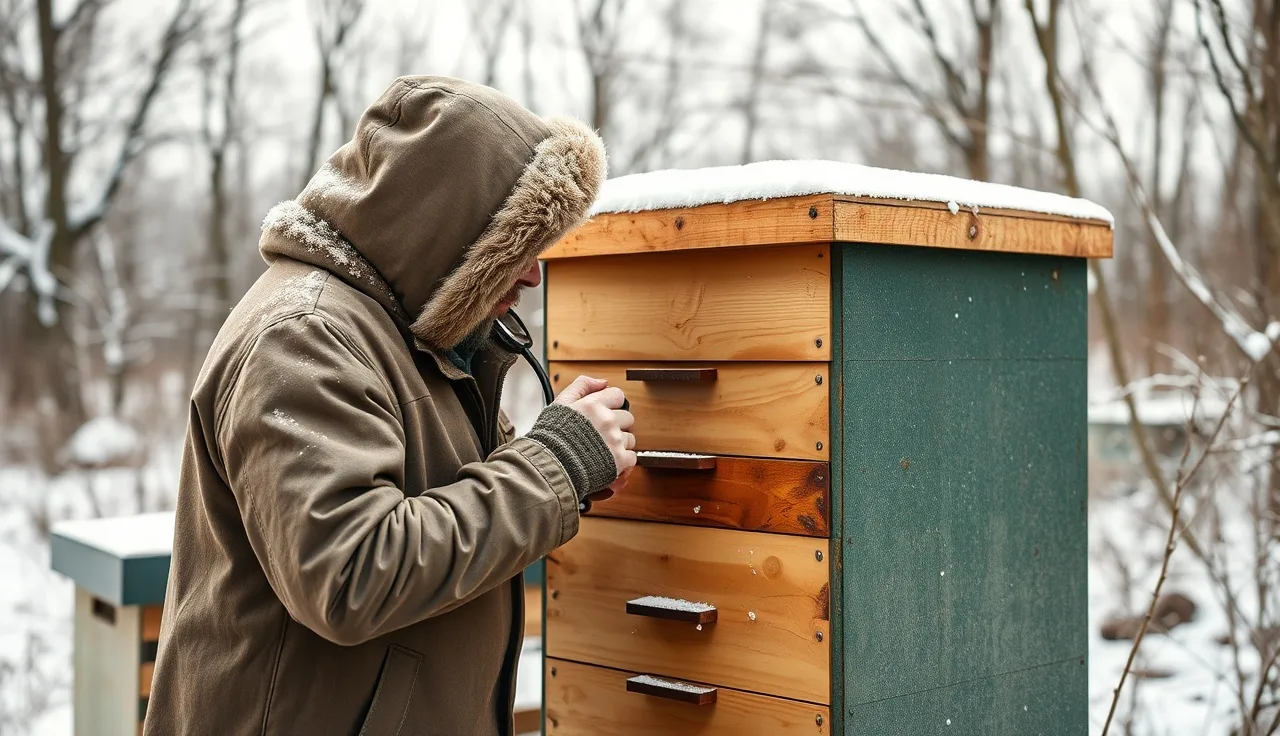
A cheap stethoscope pressed flat against the hive body is your fastest, least invasive read. Press the chest piece against the wood mid-box and hold. A tight winter cluster with no brood hums quietly and steadily, low and slow. When brood is present, the bees hold the nest at 93 to 95°F, which means they're working harder. The hum runs louder, more active, higher in pitch [3].
This isn't a calibrated test. Nobody has published a formal acoustic threshold for broodless versus brood present in peer-reviewed literature that I know of. But experienced beekeepers lean on it, and the heuristic is simple. If the colony sounds like it's working hard on a cold day (below 40°F outside), it's probably keeping brood warm. If it sounds sleepy and minimal, it's more likely broodless.
A stethoscope costs $10 to $20 at any pharmacy. Knock gently on the hive first, listen for the response buzz to locate the cluster, then press and hold for 30 seconds without knocking again. Do this on a day below 40°F for the clearest signal. Warm days pull clusters apart no matter what the queen is doing, and the sound gets muddy.
Can hive weight changes confirm a broodless colony?
A hive scale is probably the most useful thing a hobbyist can add after a basic mite-monitoring kit. Weight data can help you infer broodless status, though the signal is indirect.
Here's the logic. A colony holding a brood nest burns roughly 2 to 4 times more food energy than a broodless cluster at rest [4]. A broodless winter cluster in a cold climate loses weight slowly, often 1 to 3 pounds per week, mostly from honey and moisture respiration. A colony raising brood burns stores faster and can drop 5 to 8 pounds a week or more, depending on cluster size. If you've logged weight since fall, a sudden slowdown in the weekly loss rate is a real signal the colony has gone broodless.
A few caveats. Weight-loss rate swings with colony size, outside temperature, and how concentrated the stored honey is. A large colony going broodless in a warm week can still look different from a small colony with active brood in a cold week. You need 3 to 4 weeks of baseline to read the trend. One week tells you nothing.
Affordable scales run from about $50 for a DIY load-cell rig to $300 or more for a connected monitor with cloud logging [5]. Managing more than 5 hives? The data pays for itself in colonies saved. The BroodMinder system also carries a temperature sensor that slots between frames without opening the hive, which sets up the next method.
How do internal temperature sensors detect whether brood is present?
This is the most direct non-invasive method available. Bees hold brood at 93 to 95°F. A broodless winter cluster sits much cooler, often 68 to 77°F at the cluster surface and dropping toward ambient at the hive walls [6]. Install a small temperature sensor between frames before winter seals the hive, and you can read brood presence all winter from your phone.
The BroodMinder W3 and T2 sensors are built for exactly this. They're thin enough to sit in the bee space between frames, and they transmit over Bluetooth to a phone app. Put one in during your last fall inspection and don't touch the hive again until spring. A sustained reading of 90°F or above at the center of the cluster on a cold day is strong evidence of brood. When that temperature falls to 70 to 75°F and holds there, the colony has probably gone broodless [5].
Placement is the catch. If the sensor lands at the edge of the cluster instead of the center, you'll read near-ambient temperatures even with brood nearby. Set it in the middle of your center frame or one frame off center, right where the brood nest sits in late summer. That's where the signal lives.
Nobody has a peer-reviewed cutoff that definitively separates brood present from broodless in a hive-sensor context. The 93 to 95°F brood nest figure comes from decades of colony physiology research [6], and the practical threshold most beekeepers use is this: below 85°F consistently for 5 or more days on cold nights, and the broodless window is likely open. Treat cautiously, and pair it with one other method before you commit.
What does bottom board debris reveal about brood status?
The debris itself tells a story, separate from any mite count. A colony raising brood produces wax cappings as nurses uncap cells to feed larvae. You'll see small irregular wax flakes in the debris, often cream or tan. A broodless cluster drops mostly pollen granules, larger and more translucent wax flakes from honey consumption, dead bees, and the odd leg or antenna.
The wax texture shifts noticeably when broodlessness sets in. There's no clean formal study I know of comparing debris particle composition between broodless and brooding colonies, but the difference is real enough that experienced beekeepers mention it across multiple extension discussions [7].
This needs a screened bottom board plus a sticky board or a smooth surface you can examine. Slide the sticky board in for 24 hours, pull it, and look with a hand lens. You're not counting mites here (though you can). You're reading the debris. Lots of small, irregular, soft wax fragments with obvious cell-capping texture points to active brood. Mostly granular, crystalline debris points to a resting broodless cluster.
Pair this with the stethoscope check and you've got a two-signal confirmation that's hard to argue with.
Does pollen foraging activity tell you whether the colony is broodless?
Mostly, yes. Bees haul pollen to feed larvae. A broodless winter colony has almost no use for fresh pollen, and foragers generally skip it when there's no brood to eat it. So watch your entrance on a mild winter day (above 50°F, bees flying), and if you see real pollen loads coming in, the colony probably has active brood [8].
The qualifier is "real." In late winter, bees start hauling pollen again as the queen ramps up, sometimes earlier than you'd expect. A few bees with light loads in February might be early foragers grabbing what little is out there, not proof of heavy brood rearing. Look for consistent, heavy loads on 10 to 20% or more of returning foragers.
In December or early January in most temperate climates, any steady pollen at all is worth noting. No pollen on flying days across a two-week stretch is decent indirect evidence the colony has gone or stayed broodless.
Winter flight also reads general health. A colony flying on mild days is alive and active. One that won't fly at all even at 55°F on a sunny afternoon needs a closer look, but that's a different question from broodlessness.
How do you combine multiple signals to make a confident call?
No single method gives you certainty. That's the honest answer. A temperature sensor is the most reliable one signal, and even it depends on placement. The real protocol is triangulation.
Here's how I stack the signals:
First, wait for the seasonal window. In USDA zones 5 to 7, that's usually mid-November through January. A colony still raising brood in late October usually goes broodless within 4 to 6 weeks of sustained cold nights [2].
Second, check the weight-loss rate if you have a scale. Look for a slowdown against your fall baseline.
Third, on a cold day (below 40°F), run the stethoscope check. You want a quiet, slow hum.
Fourth, pull and read your sticky board. Look for the shift away from fresh wax cappings.
Fifth, on a mild day, watch the entrance for 10 minutes. You want no pollen coming in.
Three or more signals pointing toward broodless? Treat. A temperature sensor reading below 85°F for 5 or more days plus one other signal is enough for most experienced beekeepers to pull the trigger on oxalic acid.
The Honey Bee Health Coalition's Varroa Management Guide, the most widely used reference for U.S. beekeepers, recommends treating with oxalic acid "when colonies are broodless or have minimal brood" and notes that a single treatment during a true broodless period is highly effective [9]. That's the bar.
Want a structured protocol and free mite-tracking tools to plan your timing? VarroaVault's free varroa management tools give you a seasonal schedule you can adapt to your region.
When is the typical broodless window in different U.S. climate zones?
This is where beekeepers get burned: they assume the colony is broodless because it's December. That assumption kills colonies.
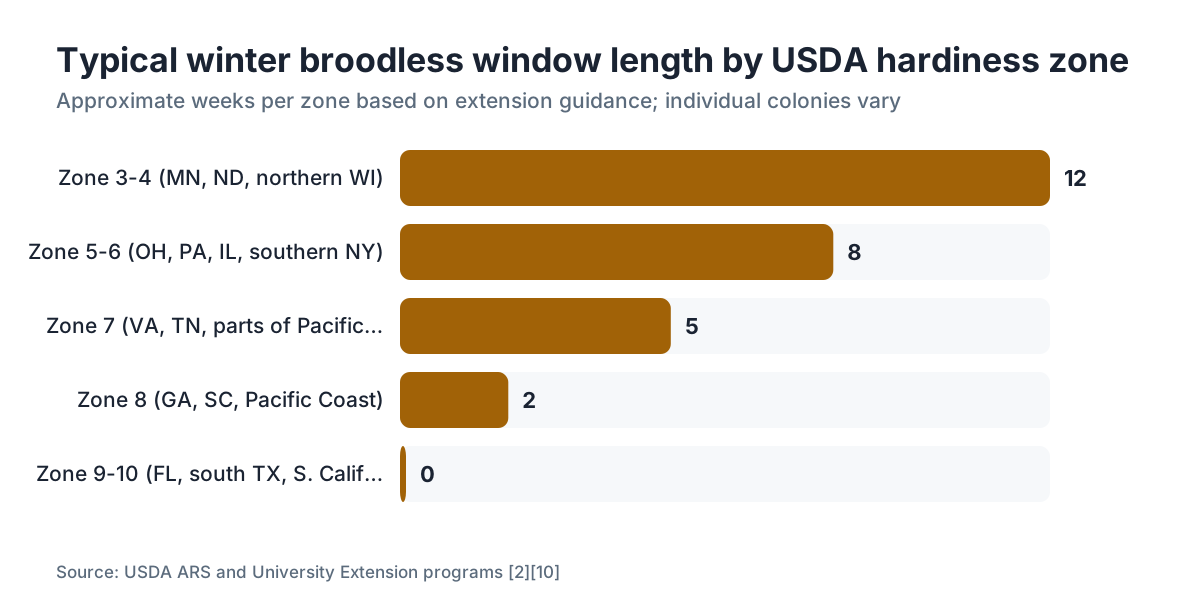
The window is highly variable. USDA and NRCS climate data put broodless periods in temperate northern states (zones 4 to 6) from late November through late January, often 6 to 8 weeks [2]. Southern states and warm winters shrink that window hard or erase it. Some colonies in zone 8 and south rarely go fully broodless at all.
| USDA Hardiness Zone | Typical Broodless Window | Approximate Duration |
|---|---|---|
| Zone 3-4 (MN, ND, northern WI) | Late Oct - early Feb | 10-14 weeks |
| Zone 5-6 (OH, PA, IL, southern NY) | Mid-Nov - mid-Jan | 6-10 weeks |
| Zone 7 (VA, TN, parts of Pacific NW) | Dec - early Jan | 4-6 weeks |
| Zone 8 (GA, SC, Pacific Coast) | Inconsistent, some years none | 0-4 weeks |
| Zone 9-10 (FL, south TX, S. California) | Rarely fully broodless | Near zero |
These ranges come from extension guidance and regional apiculture research [2][10]. Colony variation is large. A queen raised the same year lays later into fall and starts earlier in spring than an older queen. Size matters too. A big, strong colony keeps the queen warmer, and she may never stop.
The takeaway: don't treat by the calendar. Use your detection methods and treat when the signals say broodless, not when the date reads December 1st.
What's the risk of treating with oxalic acid when brood might still be present?
Two risks, different in kind.
The first is efficacy. Oxalic acid does not penetrate capped cells. Mites reproducing inside are fully protected. Treat when even 10 to 15% of the colony's normal brood is still capped, and you leave a mite reservoir that re-infests the colony the moment those cells open. A treatment that should have hit 95% or more of your mites hits maybe 60 to 70% instead, and that gap matters a lot when you're trying to get under the 2 to 3% infestation threshold heading into spring [1].
The second is safety to the brood. High concentrations of oxalic acid vapor can be hard on open larvae if you're vaporizing. The EPA registration for oxalic acid dihydrate (Api-Bioxal is the registered product in the U.S.) directs use when brood is absent [11]. Using it with brood present is off-label and may cause brood mortality. Low-level brood presence with the dribble method looks less damaging than vaporizing, and European researchers have studied multiple treatments during brood-present periods, but that's a different protocol and the U.S. label guidance is clear.
Bottom line: the EPA label says no brood. The efficacy data says no brood. The Honey Bee Health Coalition guide says no brood [9][11]. Confirm your window before you treat.
Are there electronic or remote monitoring tools worth buying for this purpose?
For a hobbyist with 1 to 5 hives, a $10 stethoscope and a cheap postal scale under the back of the hive get you 80% of the way there. Don't let anyone sell you expensive tech as a requirement.
That said, if you run 10 or more hives or you want the cleanest possible signal, temperature sensors plus weight monitoring earn their keep. BroodMinder makes the most widely used hobbyist system in the U.S., with sensors from $50 to $150 depending on model and whether you want weight, temperature, or both [5]. Arnia makes a more sophisticated (and pricier) system aimed at commercial operations, with acoustic analysis and brood-cycle detection.
For detecting a broodless window specifically, the BroodMinder T2 temperature sensor (around $50) placed between frames before winter is the highest-value tool you can buy. Install it in September during your last full inspection. You won't open the hive again until spring, and you'll have a continuous temperature record that, combined with the signals above, gives you confident timing.
Free options exist too. Some state apiarist offices and extension programs run loaner scale programs. The VarroaVault free tools include a seasonal mite management calendar that maps your detection windows against your climate zone. The Honey Bee Health Coalition's Varroa Management Guide is a free download with a clear protocol section on broodless-period timing [9].
For supplies and monitoring gear, beekeeping supply companies vary a lot in price and stock, so compare before you buy.
What if you're still not sure, and the window might be closing?
This happens. Three weeks in, mixed signals, and the forecast shows a warm spell that might get the queen laying again. What now?
If you've got three of five signals pointing broodless and the hive sounds quiet on a cold day, treat. The cost of treating during very minimal brood is lower than the cost of missing the window and going into spring with a high mite load. European researchers have used split oxalic treatments during low-brood periods with acceptable outcomes, though again, that's off the U.S. label [12].
If you genuinely have no idea because you use none of the methods above, the conservative move is a quick visual check on the warmest calm day before the cold window closes. Yes, that means opening the hive. A 2-minute look on a 55°F-plus calm day, checking only the center frames for capped brood, does less harm than treating ineffectively or missing the window. Seal it fast. Don't linger.
The worst outcome is treating in November, assuming broodless, then finding in December that mites are resurging because there was capped brood when you treated. That colony is in serious trouble by January. Better to open once and confirm than to guess wrong.
For more on varroa mite biology and treatment windows across the full year, that foundation changes how you read every one of these signals.
How do you record and track your broodless period findings over multiple winters?
Records are where hobbyist beekeeping falls apart most often. It matters here because broodless timing shifts year to year, and your own history is the best predictor of next year's window for your exact apiary, your stock, your microclimate.
At minimum, log: date of the first strong broodless signal, method(s) used, treatment date, and a mite wash result 7 to 10 days after treatment. That last number is your efficacy check. Treated and got less than 90% knockdown? You had brood present, or you had a treatment problem.
A spreadsheet works. A paper notebook works. The Honey Bee Health Coalition's downloadable hive records tool works [9]. Whatever you'll actually use is the right answer.
After two or three winters, patterns show up. Your zone 6 apiary might go broodless reliably by November 20th most years, with outlier warm winters that drag it to December 15th. That local knowledge beats any general guideline, including everything in this article.
Frequently asked questions
Can I use a thermal imaging camera to check for brood without opening the hive?
Yes, with caveats. A thermal imager shows cluster location and relative heat through the hive wall. An actively heated brood nest runs hotter than a broodless cluster, and some beekeepers use thermal imaging to spot the difference. Entry-level cameras (Seek Thermal, FLIR ONE) run $200 to $400. Resolution and wall thickness affect accuracy a lot. It's a promising method but not formally validated against direct inspection in published research I can point to.
How long does a typical winter broodless period last?
In USDA hardiness zones 5 to 6 (much of the northern and mid-Atlantic U.S.), a typical broodless period runs 6 to 10 weeks, roughly mid-November through mid-January. Zones 3 to 4 may see 10 to 14 broodless weeks. Southern zones 7 to 8 may get only 4 to 6 weeks or fewer. Colonies vary with queen age and size. University of Minnesota Extension and other northern programs plan for a 6 to 8 week window as a baseline.
Does knocking on the hive and listening work as a broodless check?
Knocking tells you the cluster is alive and roughly where it sits, but it won't separate broodless from brooding. What you want is passive sound through a stethoscope, listening to the ambient hum without stimulation. The working-hard hum of a brood-rearing colony sounds noticeably different from the quiet hum of a resting broodless cluster on a cold day, but it takes practice and works best alongside other signals.
Is it safe to open the hive for a quick check in winter to confirm broodlessness?
A brief inspection above 50°F, ideally 55°F or warmer with no wind, is far less risky than a long inspection on a cold day. Keep it under 5 minutes. Check only the center 2 to 3 frames for capped brood. The risk comes from chilling brood and breaking the cluster's heat envelope. If you have no monitoring tools and the window is closing, a quick visual check beats guessing wrong.
Will varroa mite levels drop naturally during a broodless period?
Somewhat, but not enough to matter. With no brood cells to hide in, all varroa are phoretic (riding on adult bees), which leaves them more exposed. But varroa live phoretically for several weeks, and the colony isn't actively killing them. Mite levels plateau or decline slowly on their own. The broodless period is valuable because treatments work so well during it, not because mite numbers fall on their own.
Can I do a sugar roll or alcohol wash to confirm broodlessness?
A mite wash from a broodless colony shows all mites as phoretic, which fits broodlessness, but it doesn't directly confirm no brood is present. A wash tells you your infestation rate. Get a 5% or higher result in late fall and you almost certainly need to treat during the coming broodless window regardless of timing. Mite washes complement broodless detection, they don't replace it.
What temperature outside is too cold to do a hive inspection to check for brood?
Most extension guidance says avoid inspections below 50°F and absolutely avoid below 40°F. At those temperatures, pulling frames chills brood within seconds, can cause brood death, and risks the queen. The 50°F threshold is widely cited by Penn State Extension and others. Below 50°F, rely on non-invasive methods. Above 55°F with calm winds and sun is the practical minimum for a safe visual brood check.
Do all honey bee subspecies go broodless at the same time?
No. Italian bees hold larger populations later into fall and start again earlier in spring, meaning shorter or less reliable broodless windows. Carniolan bees contract harder and may go broodless earlier and stay broodless longer. Russian bees were bred partly for varroa resistance through tight brood breaks. Your stock shapes the timing, which is one more reason local records beat general calendars.
How many times should I treat with oxalic acid during a broodless period?
The standard U.S. protocol for oxalic acid vaporization is one treatment per broodless period for healthy colonies, or up to three if mite levels were high going in. The EPA label for Api-Bioxal allows up to three vaporizations per year. A single well-timed treatment during a true broodless window usually hits 95% or more mite kill. Treatments spaced 5 to 7 days apart can catch mites that sat on the boundary of phoretic versus capped when the first treatment landed.
Can hive acoustic monitoring apps on a smartphone replace a stethoscope?
Some apps and external microphone accessories are marketed for hive acoustics, and research groups have worked on acoustic brood-detection algorithms. As of 2024, no consumer smartphone app has been independently validated for broodless detection in peer-reviewed literature I can cite confidently. A stethoscope stays the practical standard for a hobbyist. The acoustic research is real and ongoing, just not yet a reliable consumer tool.
What if my colony never went broodless and it's already February?
In warmer zones or unusually mild winters, some colonies never fully stop raising brood. Your options: wait and monitor for a natural window, use an extended oxalic acid vaporization protocol (multiple treatments every 5 days to catch mites as they emerge, on-label up to three times), or use another registered treatment like Apivar strips that work with brood present. A colony with continuous brood and unchecked mites is in serious danger by March.
Does a broodless period mean the queen has died?
No. A healthy queen voluntarily stops laying in response to shorter days, falling temperatures, and less pollen. That's normal seasonal behavior. A broodless winter colony with a live queen is exactly what you want. A dead queen shows up differently: by late January or February, a queenless colony has no eggs when you finally inspect, and it dwindles faster than expected as winter bees age out with no replacements.
Is the oxalic acid dribble method or vaporization better during a broodless period?
Both hit similar efficacy during a true broodless period. Vaporization is faster across multiple hives and disturbs the cluster less. Dribble means opening the hive slightly and applying solution onto the cluster, which works well for a few hives in mild conditions. Vaporization is the preferred method for most hobbyists running more than 2 to 3 hives. Both are registered under Api-Bioxal's EPA label for broodless use.
Sources
- University of Minnesota Extension, Oxalic Acid for Varroa Control: A single oxalic acid treatment during a true broodless period achieves roughly 95% or better varroa mite kill
- USDA Agricultural Research Service, Honey Bee Research: Broodless periods in temperate U.S. climates typically occur late November through late January in zones 5-7, with variation by region and colony
- Penn State Extension, Winter Honey Bee Colony Management: Bees maintain brood nest temperature at 93-95°F, causing measurable acoustic and thermal differences from a broodless cluster
- North Carolina State University Apiculture Program, Honey Bee Biology: A colony maintaining a brood nest burns roughly 2-4 times more food energy than a broodless cluster at rest
- BroodMinder, Hive Monitoring Products: BroodMinder T2 and W3 sensors measure in-hive temperature and weight; T2 sensor priced around $50
- Seeley, T.D., The Wisdom of the Hive, Harvard University Press (foundational colony thermoregulation research): Honey bee colonies regulate brood nest temperature at 93-95°F; broodless clusters maintain much lower internal temperatures
- Ohio State University Extension, Beekeeping in Ohio: Bottom board debris composition shifts during broodless periods, with reduction in fresh wax cappings from nurse bee activity
- University of Minnesota Bee Lab, Overwintering and Colony Management: Pollen foraging in winter is tied to brood rearing; broodless colonies collect little to no fresh pollen
- Honey Bee Health Coalition, Varroa Management Guide: The HBHC recommends treating with oxalic acid 'when colonies are broodless or have minimal brood' and notes high efficacy during true broodless periods
- University of Georgia Extension, Beekeeping in the Southeast: Southern U.S. colonies in zone 8 and warmer may have inconsistent or absent broodless periods, complicating winter oxalic acid treatment timing
- U.S. EPA, Api-Bioxal (Oxalic Acid Dihydrate) Pesticide Registration: The EPA label for Api-Bioxal specifies use when brood is absent; using it when brood is present is off-label
- Gregorc, A. et al., Journal of Apicultural Research, Multiple oxalic acid treatments during brood-present periods: European research has examined split oxalic acid treatments during low-brood periods, though U.S. label guidance specifies broodless use
Last updated 2026-07-09