How often to rotate drone brood trap frames (and why it matters)
TL;DR
- Remove and freeze drone brood trap frames every 9-14 days, before the drone pupae have been capped long enough for varroa to finish a full reproductive cycle.
- Done right, this method cuts mite population growth by 30-50% during the drone-rearing season with no chemicals, but it works best stacked with other varroa tools.
What is a drone brood trap frame and how does it work?
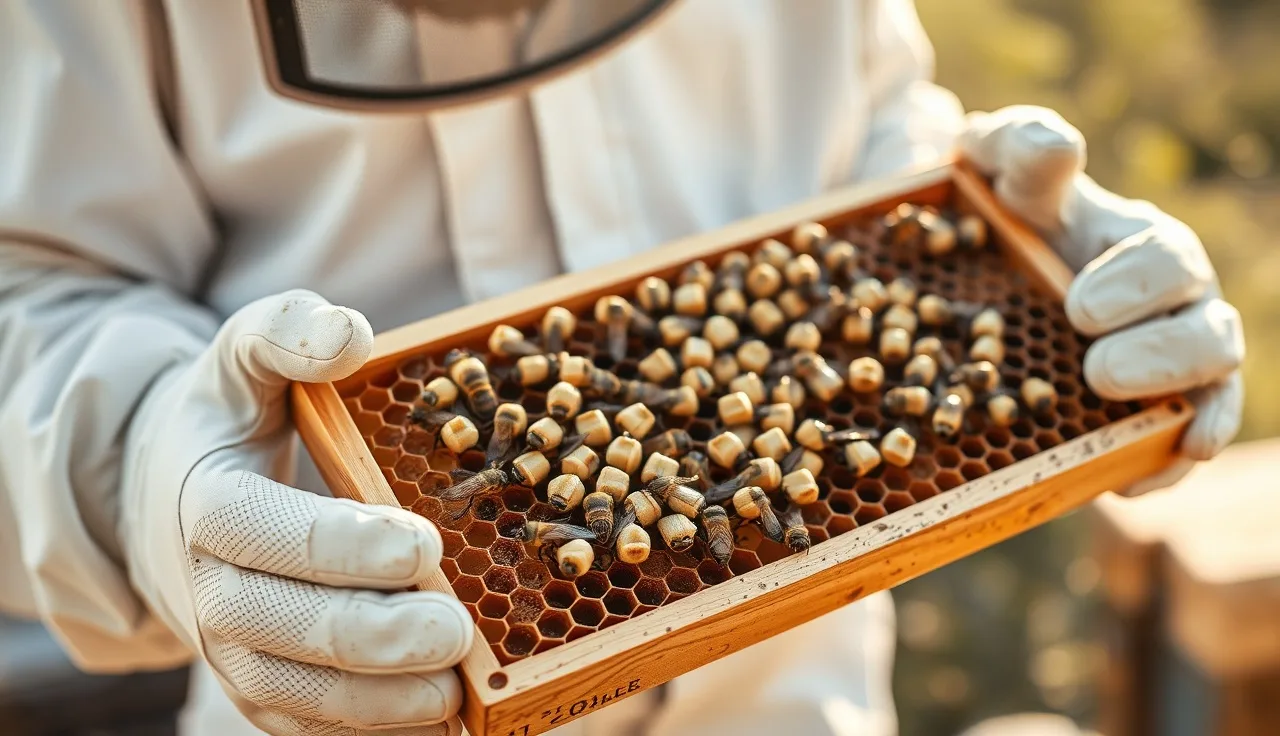
A drone brood trap frame is a comb frame, either a full-sized frame fitted with drone-cell foundation or a standard frame with a strip of drone foundation inserted near the bottom, that you place inside the hive to attract the queen to lay unfertilized (drone) eggs. Bees build drone comb when they have the space and population for it, and queens fill drone comb with drone eggs. That behavior is the whole trick.
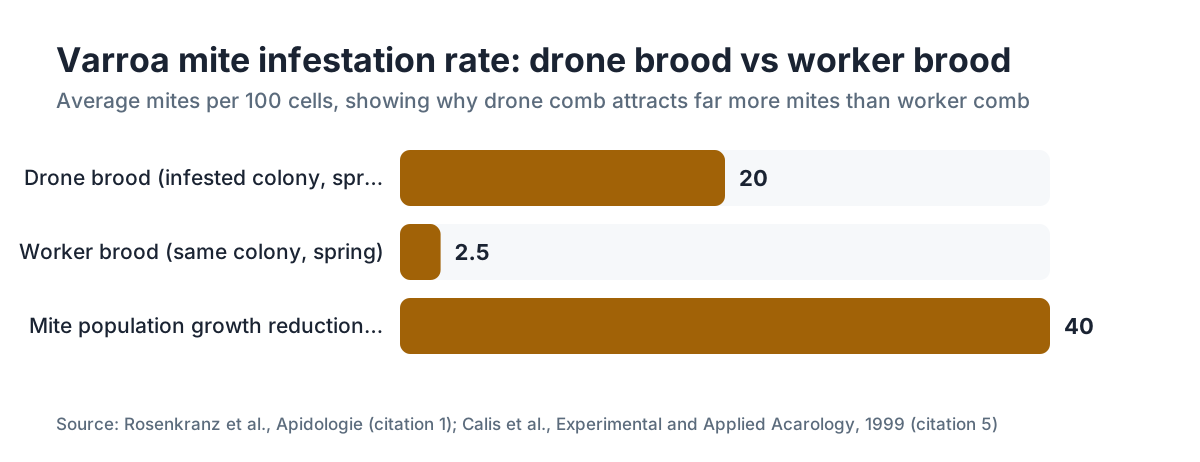
Varroa destructor reproduces only inside capped brood cells. The mite does far better in drone brood than in worker brood because drone pupae spend roughly 24 days from egg to emergence versus about 21 days for worker bees. That extra time under the cap is enough for female mites to squeeze in another reproductive cycle. Research by Rosenkranz, Rachinsky, and Stürmer in the journal Apidologie documented varroa infestation rates in drone brood running 8 to 10 times higher than in adjacent worker brood [1]. Mites go for drone brood like a magnet.
When you give the colony a trap frame, you're setting a bait station. Mites riding on adult bees and waiting to enter a cell pile into the drone cells at a far higher rate than they'd enter worker cells. You let those cells get capped, pull the frame, freeze it for at least 24 hours to kill mites and pupae, then put the frame back for the bees to clean out and refill. The bees do the luring, the queen does the laying, and you do the harvesting.
This technique is mechanical, needs no chemicals, and leaves no residue in wax or honey. It won't clear varroa on its own. Think of it as a pressure-relief valve that buys you time and stretches out the gaps between hard chemical treatments. If you want to understand what varroa mite is doing inside a cell biologically, that foundation matters for timing everything below.
How often should you rotate drone brood trap frames?
Every 9 to 14 days, timed so you pull the frame before any capped drone brood has sat under the cap for more than about 14 days. Most practitioners target the 9-10 day window after capping, which matches the varroa reproductive cycle.
Here's the biology behind that number. A varroa female enters a drone cell just before it's capped (around day 8-9 of larval development). She lays her first egg roughly 70 hours after the cell is capped, and her first adult female offspring (the one that matters for infesting the next generation) matures in about 5.5-6 days. Pull and freeze the frame before day 14 post-capping and you break that cycle before the offspring mite can mature and rejoin the phoretic pool [2]. Pull it later and you're just harvesting pupae; the mites may have already reproduced.
In practice the rotation runs like this. You put the trap frame in the hive. The queen finds it within a day or two and starts laying. Over the next week the larvae develop. Around day 8-9 after an egg hatches into a larva, bees cap those cells. You want to pull the frame somewhere between 9 and 14 days after most cells got capped. Queens don't lay all cells at once, so some cap later than others, and a hard 9-day count from when you placed the frame is too aggressive. Most beekeepers learn to read the comb: when 75-80% of the drone cells are capped and the cappings look tight and slightly convex (the classic drone capping profile), that's your pull signal.
If you run two trap frames, stagger their placement by about a week so you're always harvesting one while the other refills. This keeps steady mite-sink pressure on the colony through the whole drone-rearing season.
One thing most guides don't say clearly: the 9-14 day window is the ceiling, not the ideal. Pull at 9 days post-capping consistently and you hit the mites before they finish even one reproductive cycle in drone cells. Pull at 14 days and you still interrupt the cycle, but some foundress mites may have produced a mated daughter. Tight timing is genuinely better here, and by more than a hair.
What happens if you leave the drone frame in too long?
If drone cells stay capped more than about 14-16 days before you pull the frame, the mites inside have had enough time to reproduce. Some mated daughters die inside the cell (this happens naturally at some rate), but many emerge with the drone and rejoin the phoretic pool on adult bees. At that point the trap frame hasn't removed mites. It's just been a mite nursery.
Leaving the frame until drones actually emerge is the worst outcome. You've reared a batch of heavily mite-infested drones. Those drones fly out to mate with queens from other colonies, and every mite that rode out on a drone's back eventually falls onto a flower, dies, or gets carried back into your hive (or a neighbor's) on another bee. Drone congregation areas mean parasitized drones from one apiary can spread mites across a region. The Honey Bee Health Coalition's Varroa management guide warns against letting trap frames reach emergence [3].
If life gets in the way and you miss the window, don't put the frame back in the hive. Freeze it, let the bees clean it over 24-48 hours, then reuse it. But be honest with yourself. A frame you left in three weeks is not a net mite-removal win for that cycle.
There's a second problem with leaving drone brood too long. Older drone brood shifts its scent profile, and the queen may lose interest in refilling that comb next cycle. Fresh, clean comb that bees have recently worked gets refilled faster, which tightens your rotation and keeps the trap working.
When during the season should you use drone brood trapping?
Drone brood trapping only works when the colony is actively rearing drones, which is spring through early summer across most of the northern hemisphere (roughly March through July, depending on your climate and colony strength). Once the colony stops rearing drones in late summer, queens won't lay in drone cells and the frame just sits there. Leaving a drone trap in a colony that has no interest in it wastes comb real estate.
The best window is the build-up phase before the main nectar flow. Colonies are expanding, drone numbers are surging, and varroa is accelerating right alongside them. Stopping that early-season mite surge with trap frames can push back the point where you need a chemical intervention. The Honey Bee Health Coalition and several university extension programs, including Penn State Extension Apiculture, describe drone brood trapping as a legitimate suppression method during this high-drone-rearing window [3][4].
In warm climates where colonies rear drones nearly year-round, you can run trap frames almost continuously, but take a break during your main honey flow if you're harvesting from that colony. Bees need space for nectar, and brood rearing competes for the same workforce. Most sideliners find that running trap frames from the first warm buildup through about midsummer gives the best mite-reduction payoff for the labor of rotating frames every 9-14 days.
Once mite levels top 2-3% of the adult bee population (by alcohol wash or sugar roll), drone brood trapping alone isn't enough. At that threshold the Honey Bee Health Coalition recommends moving to a registered treatment [3]. Drone trapping is prevention and early-season suppression, not a rescue tool for a hot hive.
How much can drone brood trapping actually reduce varroa levels?
Honest answer: the numbers swing a lot depending on colony size, starting mite load, number of trap frames, and how tightly you hold the rotation schedule. The most-cited figure in extension literature comes from Calis et al. (1999) in Experimental and Applied Acarology, which found that consistent drone brood removal cut the rate of mite population growth by roughly 30-50% relative to untreated controls during spring buildup [5]. That's real suppression. It's not eradication.
A single trap frame in a strong double-brood-box colony is probably too little. Beekeepers who lean on this method often run two frames in strong colonies. Some research groups and German beekeepers (where the technique has the longest track record) use three or more in very strong colonies, but at some point you're giving up too much comb to drone brood and cutting into honey and worker population.
The key variable is how consistently you pull frames on time. A beekeeper who rotates on a tight 9-10 day post-capping schedule through April, May, and June beats someone who rotates every three weeks by a wide margin. This is one of those techniques where the method is sound but human execution decides the outcome.
For a rough sense of removal per cycle, each fully capped drone frame holds roughly 200-500 capped drone cells depending on frame size and how completely the queen filled it. If average mite infestation in drone brood is 15-25 mites per 100 cells (realistic, per studies cited in Rosenkranz et al. [1]), a full frame might hold 30-125 mites. Over a full season of consistent rotation, that adds up.
What's the step-by-step rotation protocol?
Here's the workflow most experienced beekeepers use, cut down to what matters.
Step 1: Place the trap frame. Put one drone trap frame in the lower brood box, near the center of the brood nest but one or two frames off the main cluster center. Queens lay outward from the center, so this spot gets earlier adoption than the edge.
Step 2: Check at 5-7 days. Look for whether the queen has started laying. Fresh eggs and young larvae mean you're on track. Empty after a week? Move it closer to capped worker brood.
Step 3: Watch the capping date. Once larvae are developing, start your clock. You want to pull the frame about 9-14 days after the bulk of cells cap over. If you need a physical cue, mark the frame with chalk or a pushpin on the day you first see mass capping.
Step 4: Pull and freeze. Take the frame out, bag it, and freeze for at least 24 hours (some sources say 48 to cover any disease concerns, though this is mainly a varroa-killing step). Freezing kills varroa and drone pupae reliably [6].
Step 5: Thaw and return. Let the frame thaw at room temperature for a few hours, then put it back in the hive. Workers uncap, haul out the dead pupae, clean the cells, and the comb is ready for the queen to refill. Freeze to reuse usually takes 1-3 days.
Step 6: Repeat. Your next rotation starts when the queen refills. With a staggered two-frame system you're always 7-9 days behind on one frame while harvesting the other.
A note on equipment: dedicated drone foundation (Dadant, Mann Lake, and most beekeeping supply companies carry it) saves time versus hoping bees build drone comb on their own. Bees fill pre-formed drone cells more reliably than they build new comb, especially in a colony already under pressure. You'll find this and other beekeeping supplies at most major suppliers.
How many drone trap frames should you use per hive?
One frame per hive is the minimum, two is the sweet spot for most hobbyist colonies, and three is reasonable for very strong colonies in buildup season. Past three, you start competing with the colony's honey and worker-bee capacity in a way that costs more than it gains.
The case for two frames is simple. You stagger them by 7-10 days. When you pull frame A to freeze it, frame B is halfway through its laying cycle and still pulling mites in. There's never a gap in mite-attracting capped drone brood. A single-frame rotation leaves a gap of several days while the frame sits in the freezer and gets refilled, and during that gap the colony has no active mite sink.
For a three-colony hobbyist, two trap frames per hive means rotating six frames across the season, each on a 9-14 day cycle. That's roughly one rotation task every 4-5 days if you stagger well, which fits alongside regular inspections without much strain.
Colony strength matters. A four-frame nucleus doesn't need a drone trap and won't reliably fill one. Drone rearing is a luxury behavior that strong colonies invest in only after they've covered their worker-bee needs. A colony with fewer than about 6-8 frames of brood won't put much energy into drone comb.
How does drone brood trapping fit with other varroa treatments?
Drone brood trapping cuts mite reproduction but doesn't touch mites in the phoretic phase (riding on adult bees). Chemical treatments like oxalic acid, formic acid, and thymol products work mainly on phoretic mites or penetrate capped brood to varying degrees. The two approaches cover different gaps.
The integrated pest management calendar many beekeepers run looks like this: trap frames from early spring through midsummer for ongoing suppression, plus monthly mite counts by alcohol wash. If mite load climbs above 2% during a broodless or low-brood stretch, treat with oxalic acid. If it climbs above 2-3% during the brood season, treat with a brood-penetrating product like formic acid (MAQS or Formic Pro) or a thymol product (ApiLife VAR, Apiguard), following the EPA-registered label for your region [7][8].
Running trap frames steadily through spring means you enter summer with a lower baseline mite load, which can mean fewer chemical cycles per season. That's the practical value: not cutting out treatments, but spacing them further apart and easing the chemical burden on the colony and the wax.
Oxalic acid vaporization during a broodless period (often set up by caging the queen or timing around a natural brood break) is still the standard for knocking down high mite loads [3]. Drone brood trapping fits underneath your monitoring and treatment calendar as a season-long suppression layer, not as a swap for it.
The VarroaVault protocol builder can schedule trap frame rotations alongside treatment windows if you want a season-long calendar built around your local climate and colony status.
Does freezing drone brood create any problems for the comb or hive?
Freezing doesn't hurt beeswax comb. Comb that's been frozen and thawed looks and performs the same as before. The concerns beekeepers raise are about disease transmission and about how willing the bees are to clean and reuse frozen cells.
On disease: if your colony has American Foulbrood (AFB), don't use drone trap frames, and don't return any brood comb without thorough disease testing. AFB spores survive freezing. That's a hard rule. For healthy colonies with no known disease history, frozen comb is safe to return.
On cleaning speed: bees clean frozen drone cells faster than most beekeepers expect, usually within 24-72 hours of the frame going back in. Warm weather speeds it up. In cool spring weather it can take a few days longer. The cleaner the comb (lighter in color, fewer propolis patches), the faster bees re-adopt it.
One practical note: repeated freeze-thaw cycles eventually darken comb and shrink cell volume a little as wax contracts and expands. Beekeepers replace drone trap comb every 2-3 seasons, or when cells start looking noticeably smaller or misshapen. This isn't a crisis, just normal comb management, the same logic behind rotating out old worker-bee comb every few years.
How do you track whether your trap frame rotation is actually working?
You need a mite count before you start and periodic counts through the season. The alcohol wash (or equivalent) is the most reliable method. The Honey Bee Health Coalition's Varroa guide gives the standard protocol: wash roughly 300 bees (about half a cup) in alcohol, count the mites that wash off, and calculate the percentage [3]. Do this monthly through your active trap-frame season.
If mite levels hold steady or fall through spring and early summer, your trap frames are pulling their weight. If levels rise despite consistent rotation, you've got a high starting load, real mite drift from neighboring colonies, or timing that needs tightening. Drone brood trapping won't beat heavy external mite pressure or a colony that opened the season already at 3%-plus infestation.
Keep a simple log: date the frame went in, date you pulled it, a visual estimate of how full it was, and your monthly mite count. After one season you'll have real data on whether the technique pays off in your specific situation. No tracking means no feedback loop, and no feedback loop means you're guessing.
VarroaVault's free monitoring log templates are built around exactly this data structure if you want a ready-made format.
Penn State Extension Apiculture recommends treating when alcohol wash results top 2% during the brood season (2 mites per 100 bees) and 1% during the winter cluster season [4]. Those thresholds are the tripwires that tell you when trap frames alone are no longer enough.
Are there any downsides or limitations to drone brood trapping?
Yes, several, and most guides play them down.
First, it's labor-heavy compared to a one-time chemical treatment. Every 9-14 days you're opening the hive, pulling a frame, freezing it, thawing it, and returning it. Over a 12-week spring season that's 6-10 rotation cycles per trap frame. Manage 20 hives and this becomes real work.
Second, it only helps during the drone-rearing season. Varroa populations peak in late summer and early fall, after drone rearing has largely stopped. Trap frames do nothing during that window, which is exactly when many colonies collapse from mite overload.
Third, colonies under real nutritional stress or disease pressure may not rear drone brood reliably, so the trap frame sits empty and you've burned a frame slot.
Fourth, this method has zero effect on phoretic mites (mites on adult bees between brood cycles). A high phoretic load coming out of winter goes untouched by a trap frame until those mites enter a cell. Oxalic acid vaporization hits phoretic mites directly.
Fifth, in highly hygienic colonies (especially those selected for Varroa-Sensitive Hygiene, or VSH), bees may uncap and remove drone pupae before mites finish reproducing. That reinforces the colony's natural resistance but can also blunt the trap frame's pull as a mite sink. Good news if you're breeding for VSH traits, but it makes the trap frame less useful as a standalone tool [9].
None of these kill the case for the technique. They just mean you use it with realistic expectations, as one layer of an integrated approach.
What do researchers and extension programs actually recommend?
The Honey Bee Health Coalition's Varroa Management Guide, the most widely cited practitioner resource in North American beekeeping, lists drone brood trapping as a valid cultural control and spells out the timing: "Remove and destroy drone brood frames every 9-14 days before adult drones emerge" [3]. That recommendation draws on European research and North American field practice.
Penn State Extension Apiculture and the University of Minnesota Bee Lab both include drone brood trapping in their integrated pest management protocols, filing it under mechanical controls that reduce mite reproduction without chemical residues [4][10]. The UC Davis Department of Entomology and Nematology also covers the technique in its extension varroa resources [11].
In Europe, especially Germany and Switzerland where varroa management has the longest history (the mite reached Western Europe in the late 1970s and early 1980s), drone brood trapping is mainstream among hobbyist beekeepers and is sometimes required for organic certification. The German bee research institute at Hohen Neuendorf (Länderinstitut für Bienenkunde) publishes protocols recommending the 9-14 day frame removal window based on the mite reproductive cycle [2].
Nobody claims this method alone is enough. The consensus across these sources: drone brood trapping cuts mite buildup by 30-50% during spring when used consistently, and it works best inside an integrated approach that also includes monitoring and, when thresholds are crossed, registered chemical treatments.
Frequently asked questions
Can I just leave the drone trap frame in all season and pull it every few weeks?
No. Leaving it longer than 14 days post-capping means the mites inside have finished a reproductive cycle and some may have emerged with the drones. You'd be raising mite-infested drones instead of removing mites. A 9-14 day post-capping rotation is the functional ceiling. Tighter is better. Three-week rotations undercut the whole point of the technique.
How do I know when the drone cells are capped so I can start my countdown?
Capped drone cells have a distinctly raised, rounded profile compared to the flatter cappings on worker cells. When roughly 75-80% of drone cells on the trap frame show tight, convex cappings, that's your signal to start the 9-14 day countdown. Many beekeepers chalk the date on the frame on the day they see mass capping, which removes the guesswork on the next inspection.
Does freezing the drone frame for 24 hours definitely kill all varroa mites?
Yes. Varroa destructor cannot survive sustained freezing. Standard household freezer temperatures (around -18°C or 0°F) kill mites within a few hours. The 24-hour recommendation is conservative and also kills drone pupae thoroughly. Some beekeepers do 48 hours as insurance, which is fine but not needed from a mite-kill standpoint. Don't use this method if your colony has any active AFB signs, since spores survive freezing.
How much does a drone trap frame or drone foundation cost?
Drone foundation (plastic or wax) generally runs $3-8 per sheet, and most beekeeping suppliers sell pre-made drone trap frames for $8-20 each. You can also cut a strip of drone foundation into a standard frame, which costs about $2-5 per frame in materials. The upfront cost is low. The ongoing cost is labor, not materials, since comb gets reused across many seasons.
Can I use drone brood trapping in a Langstroth top bar or Warré hive?
Drone brood trapping is easiest in Langstroth hives where frames are interchangeable. In top-bar hives, you can encourage drone comb at one end of a bar by leaving unguided space for natural comb, then harvest it on the same 9-14 day post-capping schedule. It's messier without standard frames, but the biology is identical. Warré hives with their smaller boxes make this harder to manage without disrupting the cluster.
Will drone brood trapping affect my honey production?
Slightly, yes. Every frame given to drone comb is one not producing honey or worker brood. In a strong colony, one or two drone trap frames is a small fraction of total brood space and the hit to honey yield is minimal. Running three or more during the main flow could noticeably cut honey. Most beekeepers pull trap frames entirely during peak nectar flows if honey yield is the priority.
What's the difference between a drone trap frame and just letting bees build natural drone comb?
Natural drone comb shows up in irregular patches throughout the hive, often in the gaps between frames or at the bottom of combs, which makes it nearly impossible to remove on a rotation schedule. A dedicated trap frame concentrates drone rearing in one predictable, easily removable spot. That management control is the whole advantage. Natural drone comb left in the hive still attracts mites but does you no good unless you can pull it on time.
How does drone brood trapping compare to oxalic acid for varroa control?
They hit different parts of the mite life cycle and aren't direct substitutes. Drone brood trapping removes mites during reproduction inside capped cells. Oxalic acid (vaporized or drizzled) kills phoretic mites on adult bees and works best when there's little or no capped brood. The strongest programs use both: trap frames during the brood season for suppression, and oxalic acid during broodless windows for knockdown. Leaning on only one tool invites resistance or population explosions.
Should I use drone brood trapping if I'm trying to breed VSH or hygienic bees?
It's a fair question. VSH bees detect and remove mite-infested pupae on their own, which overlaps with what you're doing mechanically with a trap frame. In a VSH colony, some cells you meant to pull will already be uncapped by the bees. That's not a problem, it's the behavior you want. You can still run trap frames in VSH colonies as a supplemental layer, but you may see lower mite counts per frame because the bees are doing some of the work themselves.
How many mites does one drone trap frame actually remove per rotation?
A fully packed drone frame holds roughly 200-500 capped drone cells. Research on varroa infestation rates in drone brood suggests 15-25 mites per 100 cells is realistic in an infested colony (Rosenkranz et al., Apidologie). That implies 30-125 mites removed per full-frame rotation cycle. With two frames and 6-10 cycles per season, cumulative removal can reach several hundred mites, which is meaningful early-season suppression even if it's not total elimination.
What time of year should I stop using drone trap frames?
Stop when your colony stops filling the frame. In most northern U.S. and Canadian climates, that's late July to mid-August. Once the colony shifts into winter preparation, drone rearing stops and the queen ignores drone comb. Leaving an empty trap frame in at that point just wastes brood space. Pull it, freeze any remaining brood as a precaution, and store the clean frame for next spring.
Can drone brood trapping spread disease between hives if I use the same frame?
The main risk is American Foulbrood, whose spores survive freezing. If you manage multiple hives, never move a trap frame from a colony with suspected AFB. For healthy colonies, using the same frame across seasons in the same hive is fine. Using it across multiple hives is not recommended practice, the same way you'd avoid moving any brood comb between unknown-health colonies. Keep each trap frame assigned to one hive to stay safe.
Is one drone trap frame enough for a strong double-brood-box colony?
Probably not for maximum effect. One frame gives you a mite sink with gaps (while it's in the freezer and being refilled). Two staggered frames keep continuous mite-attracting capped drone brood in the hive. For a strong colony through buildup season, two frames is the practical recommendation from most extension programs and from beekeepers who've actually measured results across multiple seasons.
Sources
- Rosenkranz P., Rachinsky A., Stürmer M., Apidologie, varroa infestation rates in drone vs worker brood: Varroa infestation rates in drone brood run 8 to 10 times higher than in adjacent worker brood, reflecting the mite's strong preference for drone cells.
- Länderinstitut für Bienenkunde Hohen Neuendorf, drone brood trapping protocol: German bee research institute protocols recommend removing drone trap frames 9-14 days post-capping based on the varroa reproductive cycle timing.
- Honey Bee Health Coalition, Varroa Management Guide: The Honey Bee Health Coalition describes drone brood trapping as a valid cultural control and states to remove drone brood frames every 9-14 days before adult drones emerge; also sets the 2-3% alcohol wash threshold for moving to registered chemical treatments.
- Penn State Extension, Apiculture Program, Varroa mite management: Penn State Extension recommends treating when alcohol wash mite levels exceed 2% during the brood season and includes drone brood trapping in integrated pest management protocols.
- Calis J.N.M. et al. (1999), Experimental and Applied Acarology, drone brood removal efficacy: Consistent drone brood removal reduced the rate of varroa population growth by roughly 30-50% relative to untreated controls during the spring buildup period.
- University of Minnesota Bee Lab, Varroa mite management resources: Freezing capped drone brood for at least 24 hours at standard freezer temperatures reliably kills varroa mites and drone pupae; the University of Minnesota Bee Lab includes this step in drone brood trapping protocols.
- EPA, Pesticide Registration, Formic Pro (formic acid) label: Formic acid products including Formic Pro are EPA-registered for varroa treatment in honey bee colonies; label instructions specify application temperatures and brood-season use conditions.
- EPA, Pesticide Registration, Oxalic acid (Api-Bioxal) label: Oxalic acid vaporization (Api-Bioxal) is EPA-registered for varroa treatment; label specifies use during low-brood or broodless periods for maximum efficacy.
- USDA ARS Bee Research Laboratory, Varroa-Sensitive Hygiene (VSH) trait documentation: In VSH colonies, bees detect and remove varroa-infested pupae before mites complete reproduction, which can reduce the effectiveness of drone brood trap frames as a standalone mite-sink tool.
- University of Minnesota Bee Lab, Integrated Pest Management for Varroa: University of Minnesota Bee Lab places drone brood trapping in the category of mechanical controls that reduce mite reproduction rates without chemical residues, as part of a layered IPM approach.
- UC Davis Department of Entomology and Nematology, Varroa mite management for honey bees: UC Davis Extension includes drone brood trapping in varroa management extension resources as a chemical-free suppression method during the drone-rearing season.
- Honey Bee Health Coalition, Varroa Management Guide, alcohol wash protocol: The HBHC standard alcohol wash protocol uses approximately 300 bees (about half a cup) to calculate mite infestation percentage; this is the recommended monitoring method for evaluating trap frame effectiveness.
Last updated 2026-07-09