Drone brood trapping frame method: step-by-step instructions
TL;DR
- A drone brood trapping frame is a sheet of drone-cell foundation (or empty comb) placed in the brood nest so the queen lays drone eggs in it.
- Varroa mites prefer drone brood by roughly 8 to 1 over worker brood, so the frame concentrates them.
- You pull and freeze it every 21 to 24 days, before drones emerge.
- Done consistently, it cuts mite loads 30 to 50%.
What is a drone brood trapping frame and how does it work?
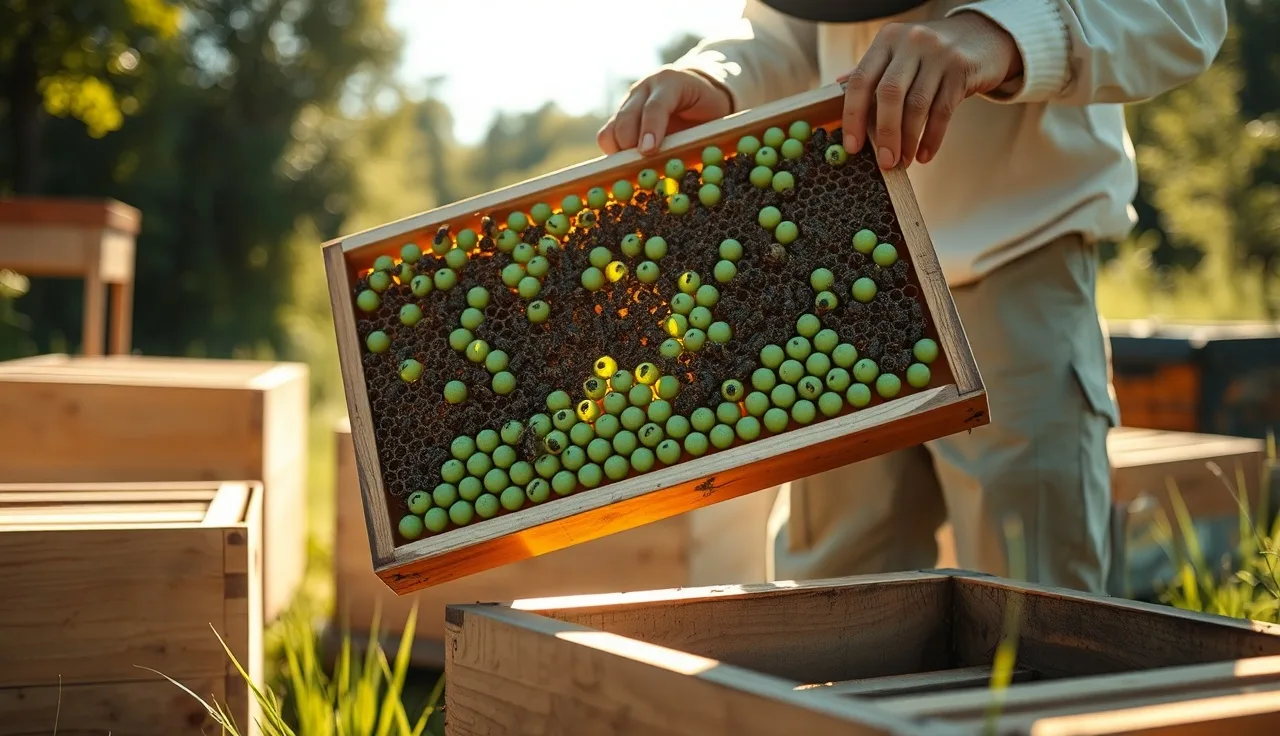
A drone brood trapping frame is one frame filled with drone-sized cells, placed on purpose in the brood nest. Worker bees draw the cells, the queen lays unfertilized (drone) eggs, and varroa mites pile in at a rate that dwarfs their interest in worker brood. Studies consistently show varroa foundresses enter drone cells at roughly 8 times the rate they enter worker cells [1]. That preference is the whole trick. You are not killing mites with a chemical. You are baiting them into a trap you can pull and freeze.
Once the trap frame is capped, you have a dense wad of mites in a single removable object. Pull it, bag it, freeze it 24 hours, and every mite in those cells is dead. Then you either uncap the comb yourself so the bees clean it and recycle the wax, or let the bees do the whole job. The frame goes back in for the next round.
This is one of the oldest and best-studied non-chemical varroa tools. It works. It also has hard limits: it demands strict timing, it only removes mites that enter drone brood during the trapping window, and it does almost nothing in a colony that is already mite-bombed or crashing. Think of it as a brake, not a cure.
How many mites can a drone trapping frame actually remove?
Enough to matter inside an integrated program. Not enough to carry a full season alone in most climates.
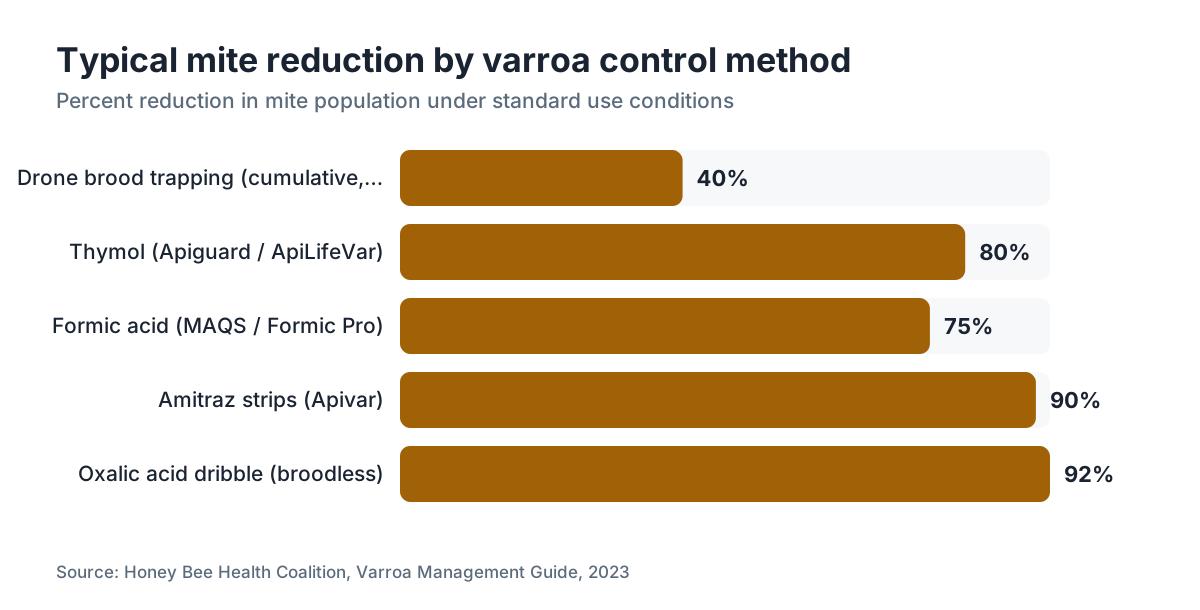
A single drone frame holds roughly 3,000 to 6,000 drone cells depending on frame size. When infestation is moderate and a good share of reproducing mites gets pulled into the trap, one removal cycle can take out several hundred mites. The Honey Bee Health Coalition's Varroa Management Guide puts mechanical methods like drone brood removal in the 30 to 50% reduction range when applied consistently [2]. Swiss researchers at Agroscope, one of the more careful groups on this topic, found that regular drone brood removal could delay the threshold breach (3% mite infestation of adult bees, or about 1 mite per 100 bees) by four to six weeks in spring and early summer [1].
That delay buys you real options. It can move your treatment window from May to July, and that changes which products you can even use. But by late summer, when colonies swing toward winter bee production and drone numbers crash, the method basically quits. The bees stop building drone comb and the trap goes idle.
Put a number on it. One well-run drone trap frame, pulled every 24 days, removes 5 to 15% of the total mite population per cycle [2]. Oxalic acid vaporization in a broodless colony can knock mites down 90% or more in a single shot [3]. Different tools, different moments.
| Method | Typical mite reduction | Broodless required? | Chemical residue? |
|---|---|---|---|
| Drone brood trapping (consistent) | 30 to 50% cumulative | No | No |
| Oxalic acid dribble | 90 to 95% (broodless) | Yes | Trace |
| Formic acid (MAQS/Formic Pro) | 60 to 90% | No | Yes (temporary) |
| Apivar (amitraz strips) | 85 to 95% | No | Yes |
| Thymol (Apiguard/ApiLifeVar) | 70 to 90% | No | Yes (temp) | [2][3]
What equipment do you need to get started?
The list is short. A frame, some form of drone-sized foundation or empty comb, and a freezer.
A standard Langstroth deep or medium frame works fine. Most beekeepers use commercial green drone foundation. The cells run visibly larger than worker foundation, and they are usually colored green so you can spot the frame at a glance. A few suppliers sell solid drone-cell plastic frames. You can also run a foundationless frame with a small starter strip and let the bees draw drone comb in the lower third on their own, though that is less predictable.
Use exactly one drone trap frame per colony. Two frames sounds like more mite removal, but it pushes the colony to suppress drone production faster than you want, strains the population, and does not proportionally raise your mite catch, per Penn State Extension [4].
A few things that help. A permanent marker for the install date. A zip-lock freezer bag big enough to hold a full frame. A dedicated trap frame you rotate back in rather than fresh foundation each cycle, because bees draw drone comb faster on previously used comb. And a notebook or a tracking app for every pull date.
Managing more than a few hives? Timing tools across colonies save you from the most common failure, which is pulling frames late. The free planning tools at VarroaVault set rotation reminders across your apiary without a spreadsheet. You can also find beekeeping supply companies that carry green drone foundation, though stock comes and goes with the season.
Step-by-step: how do you set up and use a drone trap frame?
Step 1. Pick the right colony and season. Drone brood trapping works from late-winter buildup through early summer, roughly when drones are naturally around. Across most of the continental US, that is March through July. Start late and you get fewer cycles before drones vanish.
Step 2. Prep the frame. With green drone foundation, wire and install it the way you would worker foundation, or run a foundationless frame with a 1-inch beeswax starter strip along the top. Write the install date on the top bar in permanent marker.
Step 3. Set the frame in the brood nest. Pull one frame from the middle of the brood nest and slide the drone trap frame into that gap. Bees start drawing the cells within a day or two if there is a nectar flow, or if you feed syrup. The queen usually finds and starts laying in the drone cells within a few days of the cells being drawn.
Step 4. Watch for capping. Drone brood caps about 10 days after the egg is laid, versus 9 days for worker brood. The caps sit high and domed, like bullets. Once capped drone brood covers 80 to 90% of the frame, mite load inside those cells is near peak. That usually lands 10 to 14 days after the queen starts laying in the frame.
Step 5. Pull the frame before any capped brood emerges. Drone emergence hits day 24 from egg to adult. Pull at day 21 to 23 from when you first saw eggs and every mite inside is still trapped and dies in the freezer. Pull late, after bees have chewed through caps or drones have crawled out, and you release mites right back into the colony. This is the single most important timing rule.
Step 6. Freeze it. Seal the frame in a zip-lock bag and put it in your home freezer for at least 24 hours. Forty-eight hours is safer for full deeps. Freezing kills all brood and all mites in the cells [5].
Step 7. Thaw and return, or clean it first. After freezing you have choices. Return the frozen frame straight to the hive and the bees detect the dead brood, uncap the cells, haul out the dead larvae and mites, and clean the comb for reuse. That is easier for you but leaves dead material in the colony a few days. Or uncap the comb yourself with a fork or uncapping roller and spin it briefly in an extractor to fling out the dead larvae, then return clean comb. Both work. The comb goes back in the brood nest and the cycle restarts.
Step 8. Log the dates and repeat. Each cycle runs roughly 21 to 24 days. Over a full spring you might finish three or four cycles before drone production naturally winds down.
What is the correct timing for pulling a drone trap frame?
Timing is where most beekeepers blow this method. The biology is fixed. A varroa foundress enters a drone cell just before capping, rides out the pre-pupa stage, and starts reproducing in the capped cell. If the mite has already reproduced and the drone has emerged, you have gained nothing except a small protein snack of dead larvae for the colony.
You want capped drone brood with emergence still 3 to 5 days out. In practice, pull the frame 18 to 23 days after the queen first laid eggs in it. Since you will not catch the exact moment she started, use this rule: inspect the trap frame 12 days after install. Fully capped drone brood across most of the frame means pull it within 48 hours. Still partly uncapped means wait 3 days and look again.
Penn State Extension recommends a 24-day maximum cycle no matter what [4]. You set a hard calendar date at install and pull on day 24, period. It is conservative. It accepts losing a few emerged drones now and then in exchange for never releasing mites, and it is the right default for anyone who cannot inspect often.
One more note. If the queen is on the trap frame during an inspection, leave her be. Do not shake her off. Come back in two days. Bumping the queen at the wrong moment wrecks your cycle for no gain.
Does drone brood trapping reduce varroa mites in winter bees or summer bees?
Summer bees. Full stop.
Varroa reproduction needs capped brood. In winter, or in late fall when colonies go broodless or nearly so, mites ride adult bees in their phoretic phase instead of reproducing. A drone trap frame in a broodless colony does nothing. There is no brood for the queen to lay drone eggs into, and often no laying at all if she has shut down for winter.
The Honey Bee Health Coalition is direct here: mechanical methods like drone brood trapping matter most during spring and early-summer buildup, and their effect falls off sharply as the colony pulls resources away from drone production in late July and August [2]. By the time you are worrying about winter bees, roughly August onward in most northern states, you need chemical or other interventions, not drone traps.
Still, the spring benefit helps winter bees indirectly. Lower mite loads in July mean the August and September winter bees grow up in less mite-damaged cells, tended by less mite-parasitized nurse bees. You front-load your mite control into the season where the method actually works, and that pays off in healthier winter bees even though the trap itself sits idle in fall.
Can drone brood trapping work as a standalone varroa treatment?
For most beekeepers in most climates, no. It works as part of an integrated program.
The Honey Bee Health Coalition's guide says it plainly: "No single management practice is sufficient to control varroa in most climates, and integrated pest management combining cultural, mechanical, and chemical tools produces the best outcomes." [7] Drone brood removal is a cultural and mechanical tool, and a good one. But mite populations grow exponentially, and a 30 to 50% cumulative cut still leaves enough mites to cross economic thresholds by late summer if it is your only move.
Where standalone trapping can hold: colonies with varroa-resistant queens (VSH or hygienic stock), small colonies or nucs where the starting mite population is low, regions with a natural late-summer dearth that breaks brood rearing, and beekeepers committed to treatment-free management who accept some colony loss as the trade. Those are real situations. But if you run 10 hives and want all 10 alive in April, add oxalic acid or another registered treatment at least once a year, usually in a broodless fall window [3].
On the varroa mite problem generally, no single trick closes the gap. Drone trapping hits hardest paired with summer oxalic acid vapor and a real fall knockdown.
How do you monitor whether the drone trap frame is working?
You need actual mite counts. Running the trap without measuring before and after is dieting without a scale. You might be fine, or you might be sinking and not know it.
The two standard methods are the alcohol wash and the sticky board. Alcohol wash (sometimes called a sugar roll, though the alcohol version is more accurate) is the current recommendation from the Honey Bee Health Coalition and most university extensions: shake about 300 adult bees into 70% isopropyl alcohol, agitate, and pour through a strainer to count mites [2][4]. Two mites per 100 bees (2%) is the treatment threshold most people cite. At 3% or higher, the Honey Bee Health Coalition recommends treatment regardless of season.
Do a baseline alcohol wash before you install the trap frame the first time. Wash again after two full removal cycles, roughly 6 to 8 weeks into the program. If your mite load has not moved or has climbed, the trap is not keeping pace and you need a chemical treatment. Do not wait for visible varroa damage like deformed wing virus or spotty brood. By the time those show, you are already well past the economic threshold.
Sticky board counts (24-hour natural mite fall) are less accurate but harm no bees. An average of 8 to 10 mites per day on the board roughly matches the 2% threshold, with a lot of variation [4]. Use sticky boards for trend watching between alcohol washes, never as your only decision tool.
What are the most common mistakes with the drone brood trapping method?
Pulling the frame too late is the big one. Once drones start emerging, mites walk out with them. A single missed removal cycle in a high-mite colony can undo weeks of prior work. Set a phone alarm on install day for day 21, and another for day 24. Do not trust your memory.
Using the method too late in the season. Install a drone trap in August hoping to save winter bees and the colony barely cooperates. Drone production is falling, the queen may refuse to lay in drone cells, and the bees may tear down the drone comb to reclaim wax, or simply because the colony's hormones say stop raising drones now.
Skipping mite monitoring and just assuming the trap is doing its job. See above.
Running two or three trap frames at once in one colony. More is not better. Heavy drone comb removal tells the colony to suppress drone production even harder, and you end up with half-drawn, half-laid frames that never cap cleanly. One frame, one colony, done.
Returning a frame too cold before letting bees clean it. A frame straight from the freezer can chill adjacent brood. Let it hit room temperature first, or just uncap and spin it before returning.
Forgetting to mark the frame. All drawn comb looks alike once it is back in the stack. Pull the wrong frame and you have no trap in the brood nest, plus an agitated colony for nothing.
Is drone brood trapping approved and is it safe for honey?
Yes on both. This is a mechanical management technique, not a pesticide application. There is nothing to approve in a regulatory sense. No EPA registration required, no label to follow, no pre-harvest interval to observe [3]. You are removing brood from a hive, which is standard beekeeping.
Honey from colonies managed with drone trapping carries no chemical residue concerns. The USDA Agricultural Research Service and various extension services file drone brood removal under integrated pest management cultural control, the same bucket as requeening and screened bottom boards [4][6].
One practical note. The dead drone brood you freeze and toss is not a hazard, but do not feed it back to the colony in bulk. A frame of thawed dead brood has some protein value, but it also holds dead mites and possibly mite feces. Letting the bees clean a frozen frame in place is fine, since they carry the material out and dump it. Squeezing dead larvae into sugar syrup as a protein supplement is a bad idea and nobody should be doing it anyway.
Selling honey with treatment-free or no-chemicals labels? Drone brood trapping backs those claims completely. It is the purest mechanical mite control there is.
How does drone brood trapping fit into a full-season varroa management plan?
The best season-long plan I have seen for northern-hemisphere beekeepers runs like this.
Early spring (March to April): Install drone trap frames in the colonies that survived winter. Do a baseline mite wash. The colony is building, drone production is rising, and you want to catch the first big mite reproduction pulse before it gathers speed.
Late spring through early summer (May to July): Run continuous drone trap cycles, pulling and freezing every 21 to 24 days. Wash for mites every 4 to 6 weeks. Cross 2% and you add a formic acid treatment (Formic Pro or MAQS, both EPA-registered), which penetrates capped brood and needs no frame pulling [3]. Keep the drone trap running alongside it.
Midsummer (July to August): Watch for the turn. When the trap frame comes out consistently under half filled with drone eggs and the bees start tearing down the drone comb edges, drone season is ending. Remove the trap frame. This is your most important mite wash of the year. At or above 2%, treat with Apivar strips (amitraz) or set up a late-summer oxalic acid vaporization series [3].
Fall (August to October): A broodless or near-broodless oxalic acid treatment is your strongest tool of the year. The Honey Bee Health Coalition recommends treating when the colony has less than two frames of capped brood for best effect [2]. Skip this and your winter bees pay for it.
Winter: Nothing to do for mites. Keep records. Order fresh drone foundation if your trap comb is more than three or four seasons old.
Want a pre-built version of this calendar with thresholds and treatment decision trees? VarroaVault's free protocol tools sort it by hive count and climate region. Good records are half the battle, and running multiple hives on one calendar is where most sideliners fall apart.
Where can I find reliable information and supplies for drone brood trapping?
For the science, the Honey Bee Health Coalition's Varroa Management Guide is the best single free resource in English. It is updated periodically, reviewed by working scientists, and written for practical beekeepers rather than academics [2]. Download the current edition from the HBHC website.
For university extension guidance with regional detail, Penn State Extension (extension.psu.edu) and the University of Minnesota Bee Lab (beelab.umn.edu) both post free fact sheets on drone brood trapping and integrated varroa management [4][6]. State departments of agriculture often have their own varroa guidance tuned to local mite pressure, so check your state extension service too.
For supplies, beekeeping supply companies that carry green drone foundation include most major catalog sellers. Timing matters. Order early in the year, because foundation sells out before the season starts. Some beekeepers find drone foundation at free shipping honey bee supply companies once you clear the minimum order.
Frequently asked questions
How often should I pull a drone trap frame?
Every 21 to 24 days, counted from install. The outer limit is day 24, because drones emerge at around day 24 from egg. Wait longer and mites emerge with the drones and walk back into the colony. A phone alarm set on install day is the simplest way to stay on schedule.
Can I use a drone trap frame in a nucleus colony?
Yes, carefully. A standard 5-frame nuc holds one drone trap frame, but that takes a bigger share of the brood area than it would in a 10-frame box. Watch population growth. If the nuc struggles to build up, remove the trap and let it expand before resuming. Nucs also start with fewer mites, so the urgency is lower.
What does drone brood look like so I know the trap is working?
Capped drone brood has domed, bullet-shaped caps that stand up noticeably above the comb. Worker brood caps are flatter. Uncapped drone larvae are a bit larger and sit in wider, deeper cells. Press the back of a finger across capped drone brood and you can feel the bumps. Green drone foundation makes it obvious too, since the cells are clearly larger.
Do I need to uncap the frozen drone frame before returning it to the hive?
No, but it helps. Return it capped and the bees uncap and clean it themselves over several days. Scratch-uncap it with a fork or spin it briefly in an extractor first and the bees clean it much faster, so the frame gets back to work sooner. Either way kills all mites and larvae equally well.
How do I know if varroa mites are actually entering my drone trap frame?
Check directly. When the frame is about 80% capped, uncap two or three drone cells with a toothpick and look inside. Varroa mites are reddish-brown ovals about 1.5mm across, visible to the naked eye. You should see one or more per cell in an infested colony. Find zero in 10 random cells and your mite load is likely quite low.
Will the queen always lay in a drone trap frame?
Usually yes, if the frame sits in the brood nest and the cells are properly drawn. The queen follows worker signals. If workers have drawn drone cells and are cleaning and warming them, she typically lays within a few days. If the cells are not being drawn out, which happens in a weak flow or weak colony, feed light 1:1 sugar syrup to push wax production.
Can I run drone brood trapping in a top bar hive or Warré hive?
Yes, with some adaptation. In a top bar hive, encourage a natural drone comb section by leaving a bar with only a short starter strip. Bees often draw drone comb in the lower parts of natural comb. Remove the whole bar, freeze it, and scrape out the drone brood before returning the bar. Less tidy than a Langstroth frame, same biology.
Does freezing the drone frame kill American foulbrood or European foulbrood?
No. Freezing kills varroa mites and bee brood, but it does not reliably kill Paenibacillus larvae, the bacterium behind American foulbrood. AFB spores survive freezing and stay viable for decades. If you suspect AFB, drone trap frames are the least of your worries and you should contact your state apiarist. Do not reuse comb from a diseased colony.
At what mite percentage should I stop relying on drone trapping and use a chemical treatment?
The widely accepted threshold is 2 mites per 100 adult bees on an alcohol wash, which the Honey Bee Health Coalition calls the action threshold for most of the year. At 2% or above, add a registered chemical treatment. In August and September, some extension services recommend treating at 1%, because the mites building now are the ones that will damage winter bees. Drone trapping alone will not reliably hold mites below threshold once you cross it.
How many cycles of drone brood removal can I complete in one season?
Across most of the continental US, drone season runs roughly March through July, a window of about 16 to 20 weeks. With a 21 to 24-day cycle, that is three to four complete trap-and-freeze cycles per season. In warmer regions like the Gulf Coast or California, where drone production runs longer, you may get five or six cycles.
Is there a risk that removing drone brood harms the colony?
Removing one drone frame per colony per cycle does not meaningfully hurt a healthy full-strength colony. Drones are a real metabolic cost, and workers sacrifice drone brood during dearth anyway. The risk is small next to the mite reduction benefit. The one exception is a very small or stressed colony that needs every bee, and that colony has bigger problems than the trap frame.
Can drone brood trapping be combined with queen-right oxalic acid treatments?
Yes, and this is often the best spring and early-summer combination. Drone trapping handles mites in capped drone brood while extended oxalic acid vaporization (multiple doses 5 to 7 days apart) handles phoretic mites on adult bees. The two target different mite populations and do not interfere. Follow the EPA-registered label for whichever oxalic acid product you use.
Do varroa-resistant bee stocks make drone brood trapping more effective?
Yes. Colonies led by VSH (Varroa Sensitive Hygiene) or other hygienic queens already suppress mite reproduction. Add drone brood trapping and you stack a second pressure on the mite population. Some hobbyists with VSH-headed hives report holding mite loads below threshold with drone trapping alone, though that is harder with standard Italian or Carniolan stock.
What happens if I forget to pull the drone frame and drones start emerging?
Pull it anyway and freeze it. Even if 10 to 20% of drones have emerged, most cells still hold brood and mites. You lose some benefit, but freezing the remaining capped brood still removes mites. After freezing and returning the frame, restart your 21-day clock. Try to catch it earlier next cycle. Missing once by a few days is not a disaster. Missing repeatedly is.
Sources
- Honey Bee Health Coalition, Varroa Management Guide (2023 edition): Varroa mites prefer drone brood at roughly 8 times the rate of worker brood; drone brood removal can delay threshold breach by 4 to 6 weeks in spring and early summer.
- Honey Bee Health Coalition, Varroa Management Guide (2023 edition): Consistent non-chemical mechanical methods including drone brood removal reduce mite loads 30 to 50%; treatment threshold is 2 mites per 100 bees; fall oxalic acid in near-broodless colonies is recommended.
- EPA, Pollinator Protection: Oxalic acid, formic acid (MAQS/Formic Pro), and amitraz (Apivar) are EPA-registered treatments; oxalic acid in broodless colonies achieves 90%+ mite reduction; no pre-harvest interval issues for most registered bee treatments.
- Penn State Extension, Varroa Mite Management: One drone trap frame per colony is recommended; 24-day maximum cycle time is advised; alcohol wash is more accurate than sticky board for mite monitoring; sticky board average of 8 to 10 mites/day approximates 2% threshold.
- University of Minnesota Bee Lab, Varroa Mite Resources: Freezing drone comb for 24 to 48 hours kills all brood and varroa mites inside capped cells.
- USDA Agricultural Research Service, Honey Bee Research: Drone brood removal is classified as an integrated pest management cultural control requiring no EPA registration; produces no chemical residue in honey.
- Honey Bee Health Coalition, Tools for Varroa Management: No single management practice is sufficient to control varroa in most climates; integrated approaches combining cultural, mechanical, and chemical tools produce best outcomes.
- Apiary Inspectors of America, Best Management Practices: State departments of agriculture and apiary inspectors provide region-specific varroa management guidance; contact state apiarist for disease concerns.
Last updated 2026-07-09