Which brood nest frame gives you the best varroa mite sample?
TL;DR
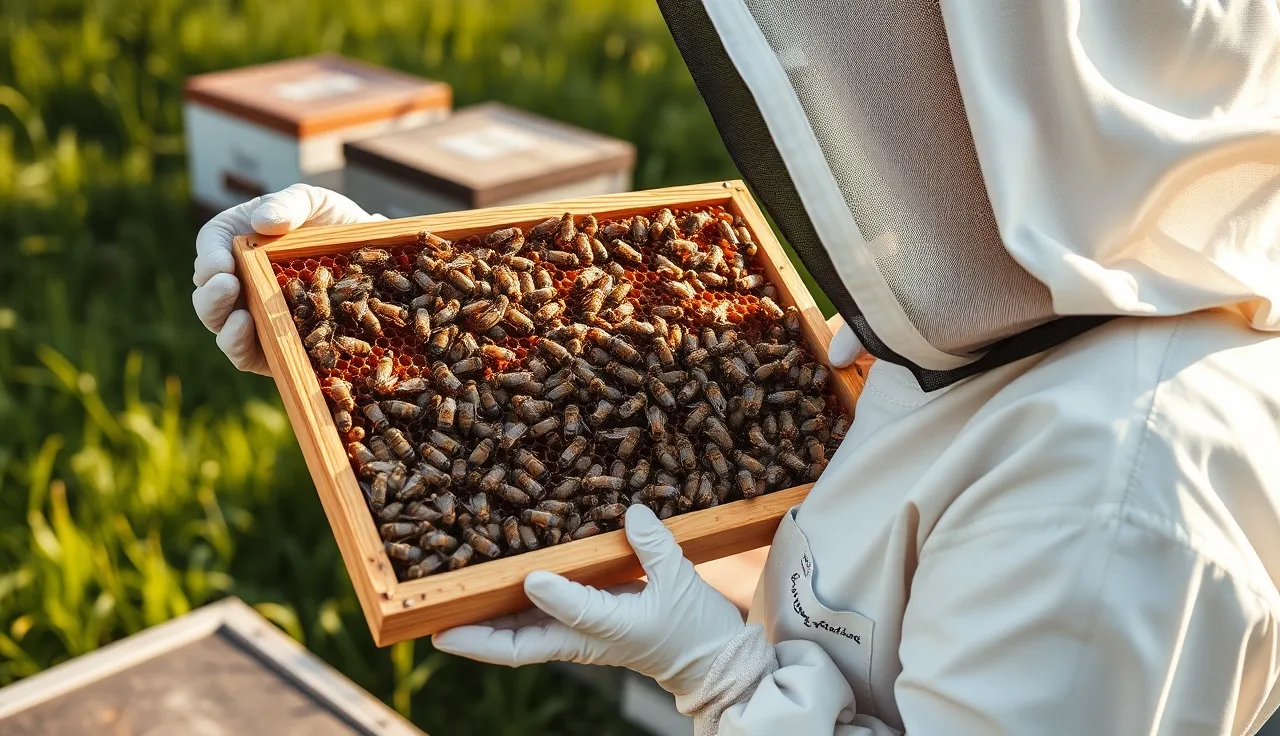
- For the most accurate varroa count, collect your alcohol wash or sugar roll sample from bees on or immediately next to capped brood frames in the warmest part of the brood nest.
- Nurse bees clustered near open and capped brood carry the highest mite loads.
- Sampling from honey frames or outer edges can undercount mites by 30 to 50 percent, enough to skip a treatment your colony needed.
Why does frame location affect mite count accuracy?
A varroa count is only as good as the bees you scoop. Grab a cup from the wrong spot and you can walk away thinking your colony is fine when it's already over the treatment threshold. That's the whole problem with casual sampling.
Varroa destructor spends most of its reproductive cycle sealed inside capped brood cells. Those mites are invisible to any surface-level method. The mites you can actually count are the phoretic ones, riding on adult bees between reproductive cycles. And those phoretic mites are not spread evenly through the hive [1].
Nurse bees, the young adults tending open larvae and capped pupae, pull far more phoretic varroa than foragers, guards, or bees loafing on honey frames. Studies of mite distribution inside colonies consistently show nurse bee populations carrying two to eight times the mite load of foragers sampled the same day [2]. That gap is wide enough to flip a borderline colony from "treat now" to "looks fine."
The Honey Bee Health Coalition's Varroa Management Guide says samples should come from "nurse bees in the brood nest" [1]. That's not a technical footnote. It's the single biggest variable you control while sampling.
Which specific frames in the brood nest should you target?
Target frames that carry a mix of open brood and capped brood, especially where cells are freshly capped but bees have not yet emerged. Those frames hold the densest concentration of nurse bees, and nurse bees carry the heaviest phoretic mite loads [2].
In a standard ten-frame Langstroth box, that's usually frames 3 through 6. In an eight-frame setup, it's the two or three frames on either side of dead center. The warmest, most central part of the brood nest is where the colony concentrates larval care. That's your zone.
If you run a two-box brood nest and can only pull from one, work the lower box's central frames. The lower brood box in a two-story setup tends to hold older capped brood, which lines up with higher phoretic mite loads on the nurses covering it [3].
Here's a common mistake. A beekeeper spots a frame absolutely blanketed in bees and assumes it's the right one. A frame packed with bees in a honey super, or one near the entrance, is not what you want. Bee density is not the test. Capped brood under the bees is the test. Pull the frame and look at the face. If you see the dull tan cappings of worker brood, ideally with open larvae nearby, that's your frame.
For a refresher on varroa mite biology before you sample, that background explains why nurse bees matter so much.
One more tip. If two or three frames all look equivalent (mixed capped and open brood, covered in nurses), take the one nearest the cluster center rather than an edge frame. Edge brood frames catch more foragers walking through, because they sit closer to the bee traffic lanes.
How do mite counts differ across hive zones? (A comparison)
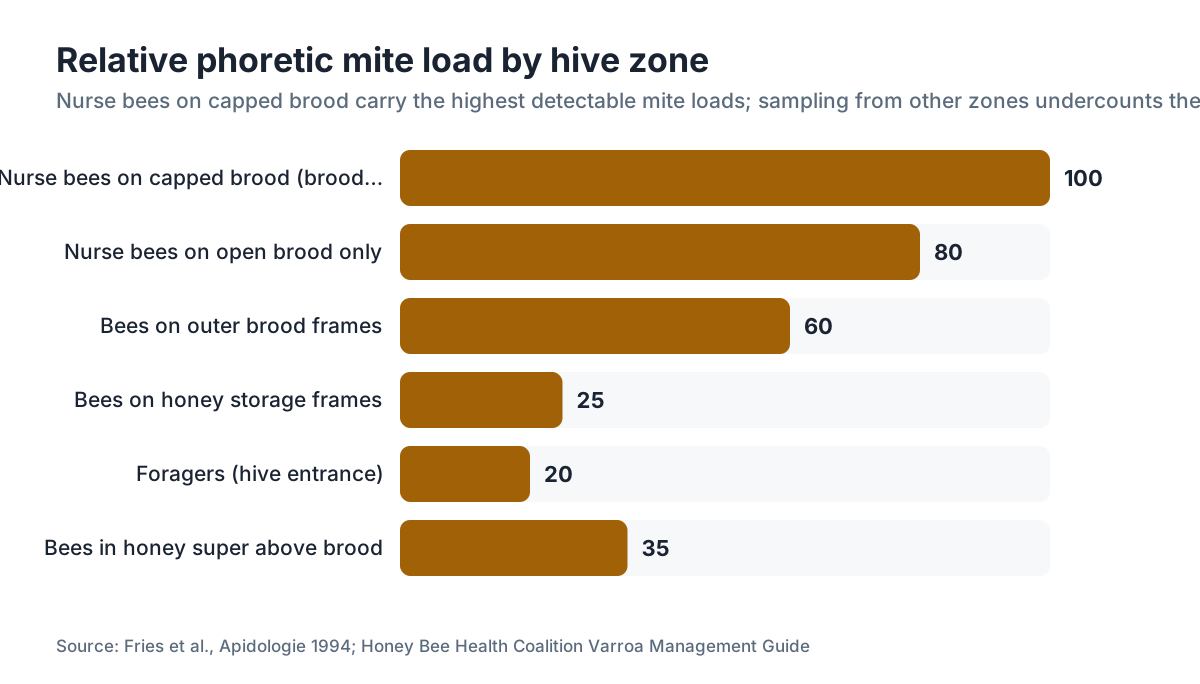
The figures below come from research comparing phoretic mite loads across different bee populations inside the same colonies. The pattern holds across multiple studies [2][3].
| Hive Zone / Bee Type | Relative Phoretic Mite Load | Notes |
|---|---|---|
| Nurse bees on capped brood (brood nest center) | Highest (baseline 1.0x) | Best sampling location |
| Nurse bees on open brood only | Moderate-high (0.7 to 0.9x) | Still acceptable for sampling |
| Bees on outer brood frames | Moderate (0.5 to 0.7x) | Edge of acceptable range |
| Foragers (hive entrance, returning) | Low (0.1 to 0.3x) | Not reliable for monitoring |
| Bees on honey storage frames | Low (0.1 to 0.4x) | Significantly undercounts infestation |
| Bees in super above brood | Low-variable (0.2 to 0.5x) | Too unpredictable to use |
These multipliers are approximations drawn from published research, not a single controlled trial, so read them as directional rather than exact. But the order-of-magnitude gap between nurse bees on brood and foragers or honey-frame bees is real and well documented [2]. A colony at 2% mite load, sampled from the entrance, could easily read 0.3 to 0.6%, which sits below most treatment thresholds. You'd skip treatment. The colony would crash.
Does it matter whether the brood frame has open or capped brood?
Yes, and even experienced beekeepers miss this. Frames with only open (uncapped) brood pull nurse bees, but the mite attachment rate on those nurses runs slightly lower than on nurses working fully capped brood [2]. The reason comes down to mite behavior: phoretic varroa actively seek cells about to be capped, so a nurse that's been hanging near about-to-cap cells carries more mites than one tending younger, open larvae.
Still, the gap between open-brood frames and mixed frames is small next to the gap between any brood frame and a honey frame. Don't overthink it. Choosing between a frame of open brood and a frame of honey? Take the open brood every time. Choosing between all open brood and mixed open-and-capped? The mixed frame is marginally better.
What you want to avoid is a frame of only sealed brood with no open larvae at all. Those frames can hold fewer nurse bees, since nurses spend more time at the younger larvae. The mix is what you're after.
During a broodless stretch, like a mid-winter break or an induced broodless window for varroa management, the whole calculation shifts. Every phoretic mite is riding an adult bee with nowhere to hide, so your count runs higher and more evenly spread than usual. In a broodless period you can sample any cluster of bees and get a reasonably accurate count. It often comes back higher than you expect, which reflects reality for once [4].
How many bees do you need, and how do you collect them from the right frame?
The standard sample for both alcohol wash and sugar roll is about 300 adult bees, roughly half a cup by volume with a standard half-cup measure [1]. That number isn't arbitrary. Statistical work from extension programs shows a 300-bee sample lands you within about 1 to 1.5 percentage points of the true load, which is enough for a treatment-threshold call [3].
Here's the collection method. Pull the target frame (center brood nest, mixed open and capped) and hold it over your container. Shake it firmly but not violently, once or twice. The bees that drop are mostly nurses, because nurses haven't developed the grip strength or behavior of older bees. Foragers hold on and fly off. Nurses fall. That's useful: a single sharp shake acts as a mild nurse-bee filter.
Don't scoop bees off the top bars or the frame face with your hand. You'll grab whatever happened to be sitting there. The shake is more representative.
Check for the queen before you shake. If she's on that frame, move her gently to an adjacent one before collecting. Losing the queen to an alcohol wash is a bad afternoon.
If the first shake doesn't fill half a cup, you have two options. Shake a second qualifying frame (an adjacent capped-brood frame), or accept a smaller sample and adjust the math. If you collected 150 bees, your mite count is per 150 bees. Double the mite number for a per-300 equivalent, then divide by 300 for the percentage. Same math, slightly lower statistical confidence.
Alcohol wash beats sugar roll for accuracy. Comparisons show alcohol wash detects mites at roughly 85 to 95 percent efficiency, while sugar roll runs 60 to 80 percent, with wide swings depending on technique [5]. Deciding whether to treat? Trust the alcohol wash number.
What is the treatment threshold, and how does sample location affect whether you cross it?
The most widely cited threshold during the brood-rearing season is 2 mites per 100 bees (2%) across most of the United States [1][6]. Some extension programs and the Honey Bee Health Coalition now recommend treating at 2% any time brood is present, while a few suggest 3% in early spring before the honey flow. Check your state extension's current number, because thresholds have dropped in recent years as colony loss data piled up.
The Honey Bee Health Coalition's Varroa Management Guide puts it plainly: "If your mite counts are above the economic threshold, treat immediately." [1]
Here's where frame location decides the outcome. A colony genuinely at 2.5% mite load, sampled from a honey frame, might read 0.8 to 1.2%. You'd skip treatment. Sampled from the brood nest center, that same colony reads 2.2 to 2.8%, clearly over the line. One sample gets you the right call. The other costs you a colony.
This isn't theoretical. USDA colony loss surveys and the Bee Informed Partnership's annual data consistently rank varroa as the leading driver of managed colony losses in the U.S., with untreated or undertreated varroa the most common proximate cause [7]. Bad sampling location feeds straight into that undertreatment.
Does colony size or season change which frame you should sample?
Colony size matters mostly because it changes how fast you find the right frame. A big summer colony in a two-box Langstroth has an obvious brood nest you can locate in seconds. A small spring colony building up may have brood spread across only two or three frames. In a small colony, take what you have: find the frame with the most capped brood and sample there.
Season shifts mite distribution more sharply. During the honey flow, forager populations swell while nurse populations shrink in proportion. The contrast between mite loads on nurses versus foragers hits its peak in summer. That makes frame choice even more important in June and July, because the penalty for grabbing the wrong bees is steepest then.
Late summer and fall, the colony is turning over. Brood rearing slows, and the winter bees raised in late August and September are high-value targets, because mites that reproduce in late-season brood send offspring riding those winter bees clear through to spring [4]. Sampling accuracy in late August arguably beats any other window. The USDA Agricultural Research Service and multiple university extension programs now flag August and September as the top-priority sampling months [3][6].
In winter, during a full brood break, the rule flips as noted earlier. Any cluster area works. Your count will likely run higher than you expect, and that's good information, not a reason to doubt the sample.
What if you can't find the brood nest or the frames look similar?
Sometimes you open a hive and the capped pattern is spotty, the frames look inconsistent, or you honestly can't tell which frames sit at the center of the nest. This shows up in overwintered colonies in early spring when brood is just resuming, and in colonies with a newly laying queen.
Hold each central frame up to the light for a second. Capped brood shows a dull tan color and a slightly convex surface. Open brood frames glisten with royal jelly in the cells. See both on one frame? That's your target. If brood is minimal, any frame with bees clustered together beats an empty frame, but your confidence drops. Write that down so you can weigh the result later.
A shortcut: bees generate heat over brood. In cool weather especially, hold your hand near (not on) each frame in turn. The frame with the warmest air around it is almost always over brood. Simple, and it works.
For logging sample results, dates, frame notes, and treatment calls, VarroaVault's free monitoring tools handle exactly this kind of record-keeping across multiple hives and seasons.
Are there any situations where you should NOT sample from the brood nest center?
A few. If the colony is hot and you can't safely pull central frames without full gear and smoke, sample the outermost brood frames where the bees are easier to reach. A count from a slightly suboptimal frame beats no count or a face full of stings.
If you're running a sticky board or a natural mite drop count (less common now, generally less accurate), frame location doesn't apply. You're counting mites that fall over 24 or 48 hours across the whole hive.
If the colony is in a swarm box, a nuc, or any setup with no established brood nest, sample wherever the cluster is densest. In a queenright colony, a tight cluster carries a disproportionate share of nurse-age bees near its core.
For Africanized colonies or africanized honey bee populations across the southern U.S., the same brood nest principle holds, but work faster and have your gear fully on before you pull frames. The biology is identical. The operational caution is higher.
What equipment do you need to sample correctly from the right frame?
Not much. For an alcohol wash: a wide-mouth jar with a mesh lid or a purpose-made kit, 70% isopropyl alcohol (rubbing alcohol is fine), a half-cup measure, and a white plate or bowl to count mites against [1]. The mesh-lid jar runs $15 to $30 from most beekeeping supply companies, or you can build your own from a mason jar and hardware cloth.
For a sugar roll: powdered sugar, the same jar-and-mesh rig, and water to rinse the sugar off. The sugar roll suits situations where you want the bees back in the hive alive, since they survive the process.
A nitrile glove helps with the alcohol. Goggles or glasses are smart, since the jar shake can spray.
The most important piece of gear for brood nest targeting is your own eyes, and the habit of actually looking at a frame before you sample it. Pull the frame. Look for capped brood. Sample. That sequence, done every time, is the whole intervention.
How should you record your sample results to catch trends over time?
A single count is useful. A run of counts over time tells you far more. Record the date, the hive ID, the sample size in bees, the mites counted, the resulting percentage, and a note on where you sampled ("frame 4 of lower box, mixed capped and open brood" is ideal). That's about 20 seconds per hive.
Tracking the trend shows you whether a colony's mite load is climbing or falling between counts. A colony at 1.5% in June that hits 2.8% by late July needs treatment. A colony at 2.0% in June that drops to 1.1% in July (maybe after a swarm or brood break) may not. The trajectory matters.
University extension programs at Penn State, NC State, and the University of Minnesota all publish free mite monitoring logs or spreadsheets for this [3][6][8]. VarroaVault has free protocol tracking tools too, if you want a structured digital format.
Run more than five or six hives and consistent records become the line between reactive management (treating when you spot dead bees) and proactive management (treating before the population spikes). The frame-selection note belongs in those records, because six months later it tells you whether a low count was real or just an artifact of poor sampling.
Frequently asked questions
Can I sample bees from the top of the frames instead of shaking?
You can, but shaking is more reliable. Bees on the top bars are a random mix of nurses, guards, and wandering foragers. A sharp shake of a brood frame preferentially drops nurse bees, because older bees grip harder and fly off. If you must scoop from the top bars, make sure you're working a frame directly over capped brood, not a honey or pollen frame at the hive's edge.
How accurate is a sugar roll compared to an alcohol wash for varroa?
Published comparisons show alcohol wash detects roughly 85 to 95 percent of mites in a sample, while sugar roll detects 60 to 80 percent, with wide variability based on how thoroughly you apply and shake the sugar. If your sugar roll reads 1.8%, the real load could be 2.2 to 3.0%. For a decision near the threshold, the alcohol wash is much more trustworthy. Sugar roll is better for routine monitoring when you want the bees back alive.
What is a nurse bee, and how do I know I'm getting them in my sample?
Nurse bees are young adults, roughly 4 to 12 days old, whose main job is tending larvae and capped pupae. Their flight muscles aren't developed and they don't forage yet. They look identical to other bees but cluster densely on brood frames. Shaking a capped-brood frame over your container exploits the fact that nurses fall while older bees fly away.
Should I sample from the same frame every time, or vary the location?
Apply the same criteria every time (center brood nest, mixed open and capped brood) rather than fixating on one physical frame position. The brood nest moves seasonally: it drifts upward in summer and contracts in fall. Always sampling "frame 5 of the lower box" could put you in the nest center some days and on its edge other days. Follow the brood, not the frame number.
Does sample frame location matter differently for Langstroth versus top-bar hives?
The biology is the same; the geometry differs. In a top-bar hive the brood nest sits on the warmer central bars and expands outward. Target the bars directly over mixed open-and-capped brood near the warmest center. In a Warré hive with multiple boxes, active brood usually sits in the box just above the lowest one. In every case: find capped brood, sample the bees on it.
How often should I be sampling my hive for varroa mites?
Most extension programs recommend sampling at least every 30 days during the brood-rearing season, with priority on late July through September when mite populations peak and winter bees are being raised. A minimum calendar hits late June, late July, mid-August, and early September. If you treat, sample again 3 to 4 weeks later to confirm it worked. One sample a year is not enough.
What mite count percentage means I should treat?
The standard threshold during the brood-rearing season across most of the U.S. is 2 mites per 100 bees (2%), per the Honey Bee Health Coalition and most state extension programs. In late summer, when winter bees are being raised, some programs now recommend treating at 1 to 1.5%, because those bees carry the colony through winter. Check your state extension for current local guidance.
What if I accidentally include the queen in my sample jar?
In an alcohol wash, you lose the queen and cripple the colony. That's why you check the target frame for her before shaking. Spot her and gently move her to a frame you won't sample. In a sugar roll the queen can theoretically survive, but the stress and handling do harm. Preventing queen capture is simple: look before you shake.
Can a low mite count from the wrong frame cause me to skip a needed treatment?
Yes, and it's the most practical consequence of poor frame selection. A colony genuinely at 2.5 to 3% mite load, sampled from a honey frame or the entrance, may read 0.5 to 1%. You'd skip treatment. By the time symptoms show (deformed wing virus, crawling bees, brood pattern collapse), the colony is already badly compromised. Correct frame selection is the cheapest thing you can do to sharpen your varroa numbers.
Does it matter what time of day I sample?
Time of day has a modest effect. Mid-morning to early afternoon, when foragers are out working, leaves a higher share of nurse bees inside. Sampling during peak forager departure (a warm morning) gives you slightly better nurse-bee enrichment for free. Early morning before foragers leave, or evening when they return, gives a more mixed population. Mid-morning from the brood nest center is ideal if you have the flexibility.
Is there a way to verify my sampling technique is consistent?
One useful check: run two samples from the same hive on the same day, from equally good brood frames. The results should land within 0.5 to 1 percentage point of each other. If your duplicates diverge wildly (say, 1.2% versus 3.1%), you probably sampled very different locations or grabbed very different bee populations. Wide variation between duplicate samples is itself a signal your technique needs work.
Do I need to sample during a nectar flow, or can I wait until it's over?
Don't wait. Mite populations grow continuously during brood rearing, flow or no flow. During a strong flow, forager numbers run high and you might undercount if you sample carelessly, but correct brood nest sampling works fine mid-flow. Some beekeepers skip summer monitoring during a flow, then find dangerous counts in August that could have been caught and treated in June. Sample on schedule.
Sources
- Honey Bee Health Coalition, Varroa Management Guide: Samples should come from nurse bees in the brood nest; treatment threshold is 2 mites per 100 bees during brood-rearing season; alcohol wash and sugar roll methods described with 300-bee sample size.
- Fries I et al., Apidologie, 1994, phoretic mite distribution in honey bee colonies: Nurse bees on capped brood carry significantly higher phoretic varroa loads than foragers or bees in peripheral hive areas; distribution is non-uniform across colony.
- Penn State Extension, Honey Bee and Pollinator health resources: 300-bee sample size, brood nest sampling location guidance, and August-September flagged as highest-priority sampling windows.
- USDA Agricultural Research Service, Bee Research Laboratory (Beltsville): During broodless periods, mite distribution is more uniform across all adult bees; late-season mites on winter bees are a critical factor in overwintering colony losses.
- Macedo et al., Journal of Apicultural Research, 2002, alcohol wash vs sugar roll efficiency comparison: Alcohol wash detects 85 to 95 percent of phoretic mites; sugar roll detects 60 to 80 percent with higher variability depending on technique.
- University of Minnesota Extension, bee pest management resources: 2% treatment threshold during brood-rearing season; late summer sampling flagged as highest priority window; sampling frequency recommendations.
- USDA NASS and Bee Informed Partnership, Annual Honey Bee Colony Loss Survey: Varroa destructor is the primary driver of managed honey bee colony losses in the United States; untreated varroa is most common proximate cause of winter loss.
- NC State Extension, Apiculture resources: Free mite monitoring logs and spreadsheets for beekeepers; consistent record-keeping guidance for tracking mite load trends across seasons.
- EPA, Pesticide Registration for Varroa Treatments (product label information): Registered varroa treatments require pre-treatment mite count documentation; treatment threshold guidance incorporated from HBHC and university extension sources.
- Delaplane KS, University of Georgia Extension, Varroa Mite Sampling and Treatment: Nurse bee enrichment in samples from capped brood frames; operational guidance on shaking technique and sample collection from brood nest frames.
Last updated 2026-07-09