How to do a shook swarm for varroa mite knockdown
TL;DR
- A shook swarm forces every bee onto fresh comb, stranding mites that need capped brood to breed.
- Done in spring or early summer, it drops phoretic mite loads hard and makes a follow-up oxalic acid treatment reach nearly every mite.
- Plan on about an hour per hive and a 4 to 6 week production setback.
- It's a rescue move, not a routine one.
What is a shook swarm and how does it reduce varroa?
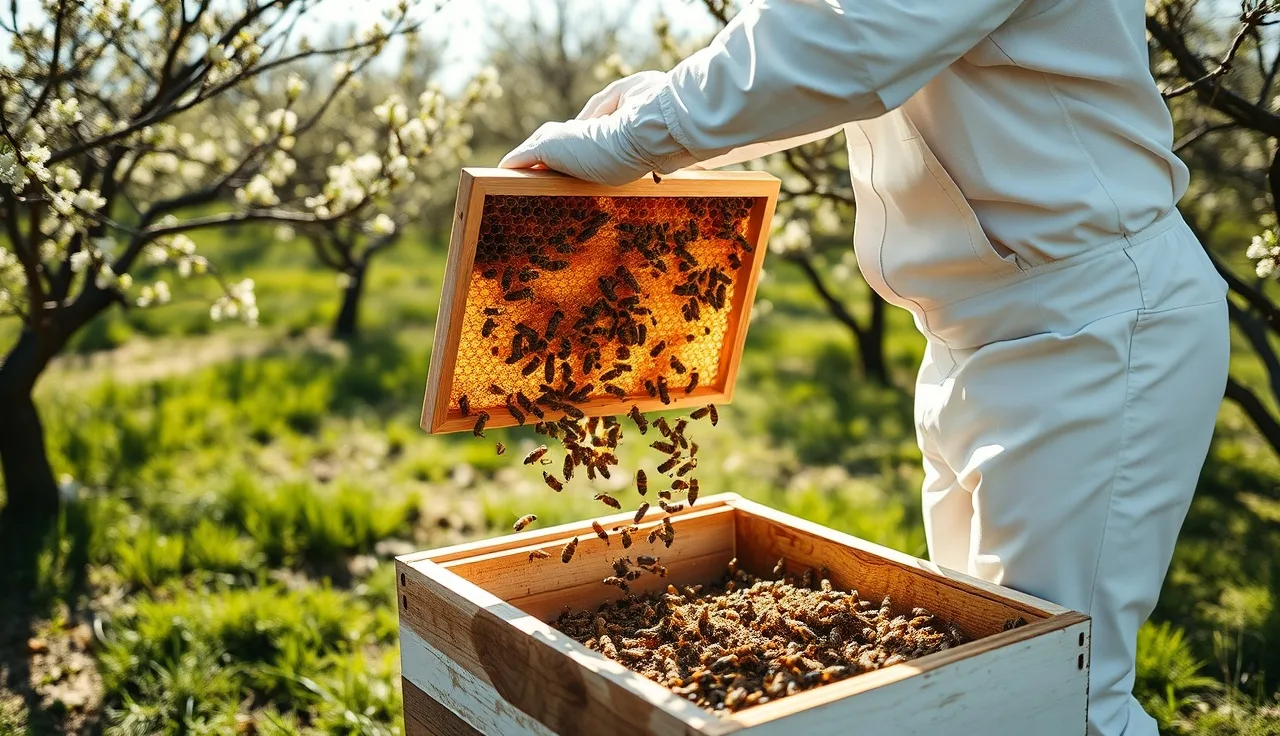
A shook swarm is exactly what it sounds like. You shake every bee off every frame into a new hive body holding only fresh foundation or drawn empty comb, close them up, and let them rebuild. The old comb, with every sealed brood cell in it, stays behind or gets destroyed.
That brood is where varroa does its damage. The mite's whole reproductive cycle runs on capped brood. A female enters a cell just before it's capped, lays eggs on the developing larva, and her offspring emerge as mature mites when the bee does [1]. Pull all the brood out of the hive and the cycle collapses in an afternoon. Every mite left is suddenly phoretic, riding an adult bee with nowhere to breed.
Phoretic mites are exposed. They can't hide in cells. A single oxalic acid drizzle or vaporization applied 24 to 48 hours after the shake, once you're confident no new brood is capped, reaches nearly every mite in the colony [2]. That combination, brood break plus OA, is what makes this method powerful rather than merely disruptive.
This is not casual. You're stressing the colony, abandoning thousands of pupae that will emerge and drift or die, and setting the hive back weeks of foraging. It's a tool for one situation: a colony whose mite load is climbing fast without the time or population to ride out a gentler fix.
When should you do a shook swarm for mite control?
Timing beats everything else here. The classic window is early spring, right as the colony builds up but before the main nectar flow starts [3]. The colony has enough adult bees to redraw comb and keep a new queen warm, and you're not throwing away foragers or a honey crop.
Early summer is the second good window, specifically when a colony crosses roughly 2 percent on an alcohol wash (2 mites per 100 bees) with weeks of brood season still ahead. The Honey Bee Health Coalition's Tools for Varroa Management guide sets the action threshold at "2% or higher during the brood-rearing season" and 1 percent or higher going into fall, so a colony at 3 percent in June is a clear candidate [4].
Skip it during the main flow if you care about a crop. The colony draws comb instead of curing nectar. Skip it in late summer and fall too. The bees you're keeping then are your winter bees, and disrupting brood-rearing at that stage shortens the colony's lifespan going into cold weather.
Never shake a weak colony. Fewer than about 5 or 6 frames of bees is a real risk line. A small cluster can't hold temperature over bare foundation, and it'll dwindle fast if the weather turns cool after the procedure.
What equipment and materials do you need before you start?
Get everything ready before you crack a single lid. Mid-procedure is the worst time to find out you're missing a box.
You need a clean brood box that has never held heavily infested comb. Reusing gear? Wash it down and let it dry. Fill it with new foundation or, better, fully drawn empty comb. Drawn comb wins because the bees start using it immediately instead of burning energy on wax. Foundation works, it just slows the rebuild.
You also need:
- A spare bottom board and cover for the new setup
- Your normal protective gear
- A spray bottle with 1:1 sugar syrup, lightly scented with a drop of lemongrass oil if you have it
- A queen clip or cage, in case you need to secure the queen briefly
- A frame rest or spare box to hold frames as you work
- Your oxalic acid ready to apply within 24 to 48 hours (a registered product per EPA label, Api-Bioxal for drizzle or vaporization) [5]
- A gallon or two of 1:1 syrup for a feeder that goes on the moment you close up
None of it is exotic. You can source most of it from any beekeeping supply company. If you already own spare equipment, the added cost beyond the OA is close to nothing.
How do you do a shook swarm step by step?
Pick a warm, calm day, above 60°F and ideally above 65°F, with no rain in the next 24 hours. Mid-morning to early afternoon is best, when foragers are out and the box holds fewer bees. Fewer bees, less chaos.
Step 1: Set the new box on the old hive's stand, or as close to the original spot as you can manage. Foragers coming back from the field fly to the location they know, so put the new box exactly where the old one sat.
Step 2: Light your smoker. Puff the entrance lightly, wait 30 seconds, then open up. You're not driving bees down. You just want them calmer.
Step 3: Move the old brood box aside. Set the new, prepared box on the original bottom board at the original location.
Step 4: Pull each frame from the old box one at a time. Find the queen before you shake anything. When you find her, let her walk into the new box on her own, or gently clip her to a frame in the new box while you work. Do not shake the frame she's on.
Step 5: Once the queen is secured, shake each frame hard over the open new box. A sharp downward snap drops most of the bees. Give it a second shake. You want essentially every bee off that frame and into the box. Mist the cluster with syrup as you go to calm them and hold them in place.
Step 6: Set each shaken frame into your spare box or onto a tarp. No old comb goes into the new box. That single mistake defeats the whole point.
Step 7: With all the bees shaken in and the queen confirmed in the new box, close it up. Put a feeder of 1:1 syrup on top right away. The colony has no stores and needs fuel to draw comb.
Step 8: The old comb goes one of two ways. If it's disease-free (no AFB or EFB, confirmed), freeze it 48 hours and reuse it elsewhere, or extract the honey. If there's any doubt, destroy it. Don't leave it open near the apiary. Robbing starts within hours.
Step 9: 24 to 48 hours later, apply oxalic acid [5]. The colony has no capped brood, and every mite is phoretic and exposed. Follow the Api-Bioxal label exactly, and check the current label before you treat, because the permitted number of drizzle and vaporization applications is set there, not by folklore.
Does a shook swarm actually work? What do the numbers say?
Honest answer: the data is real but messy, mostly because the technique gets paired with OA and the combined result is what studies measure.
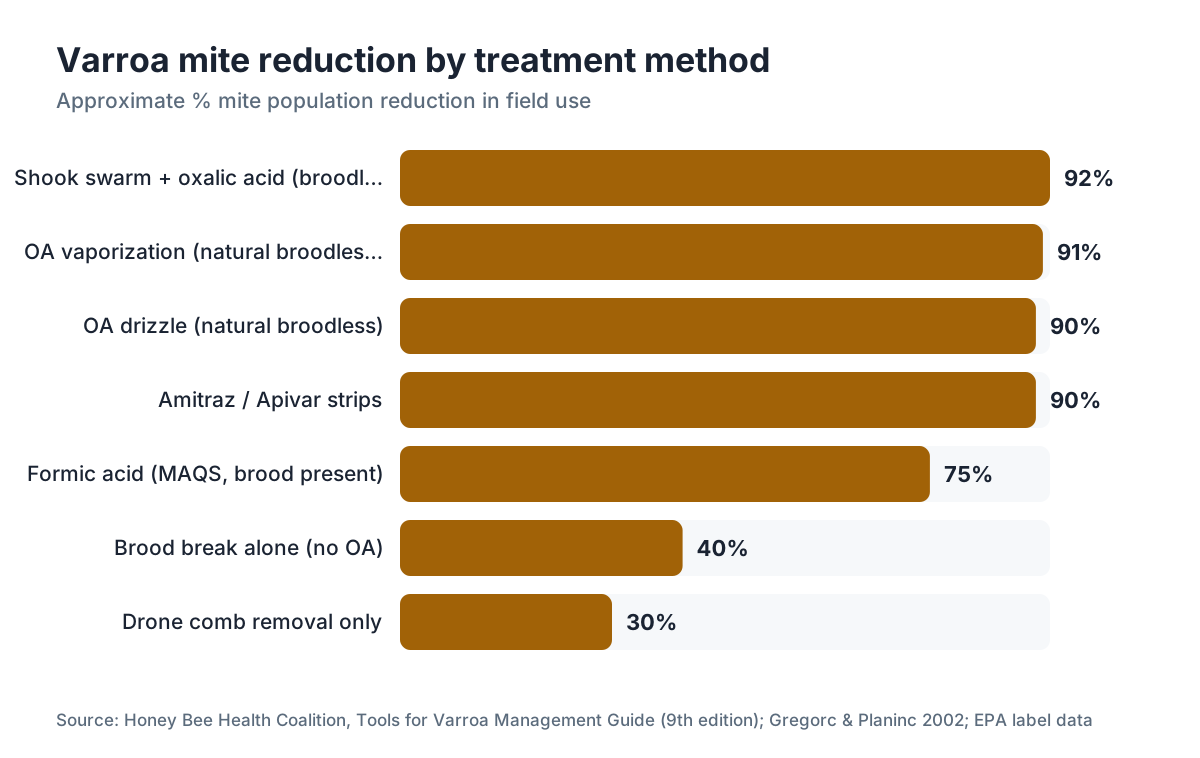
A brood break alone, with no OA, usually drops infestation by 30 to 50 percent, mostly because the mites sitting in capped cells leave with the comb [6]. Add an OA treatment right after, on a fully broodless colony, and European field trials put combined reductions at 85 to 95 percent of the mite population [7]. The Honey Bee Health Coalition guide cites oxalic acid efficacy against phoretic mites at over 90 percent on a truly broodless colony [4].
Here's the catch. That "over 90 percent" depends on the colony genuinely being broodless. Miss a frame with capped brood, or let the colony requeen and start laying faster than you expected, and the window shrinks. Wait too long and you're treating a colony that already has mites tucked back into fresh cells.
In practice, most beekeepers who use this method see a hard reset. A follow-up alcohol wash two to three weeks out often comes back under 1 percent. That's no guarantee. Colony behavior, mite pressure drifting in from neighboring hives, and whether the OA went on correctly all move the number [4].
For why mite thresholds matter as much as they do, see our overview of varroa mite biology and lifecycle.
What happens to the bees left behind in the old comb?
This is the part people feel worst about, and it deserves a straight answer.
Larvae and pupae in the old frames either emerge over the next few days or die, depending on whether any nurse bees are around to tend the uncapped ones. In a proper shook swarm, you've moved every adult bee, so no nurses remain. Capped brood keeps developing because it needs no attendance. Open larvae die.
Adults that emerge from the old comb, if you leave it somewhere accessible, drift to the nearest hive entrance. If the new box sits on the old stand, many walk right in. That's fine, even useful. Those bees emerged from brood after the mites left with the shaken comb, so they're mite-free and they pad out the adult population.
Some beekeepers deliberately stack the old frames in a super above the new box behind a queen excluder, let the remaining brood emerge over two to three weeks, then pull and process the frames. That keeps the bees and recovers the stores. The trade-off is that it stretches out the period before the colony is truly broodless, which pushes back the ideal OA window.
What are the real risks and downsides of a shook swarm?
There are several, and skating past them helps nobody.
Colony stress is real. You strip all food stores (unless you shake frames of open honey, which you should set aside and either extract or hand back as frames of honey in the new box). You force a comb rebuild from scratch. You break the brood nest's warmth gradient. A strong colony shrugs this off. A marginal one may not.
Absconding is a low but real risk, worst when the new box doesn't smell right or robbing pressure is heavy. The lemongrass syrup spray helps. Confirming the queen is in the new box before you close is the single most important step against it.
Production loss is a given for the 4 to 6 weeks it takes to rebuild a normal brood nest and return to full foraging strength [3]. Counting on that hive for a June honey crop? This technique costs you that crop.
Driving mites to neighboring hives is possible if you leave old comb sitting open, since robbers carry mites home. Deal with old comb fast and cleanly.
There's also a biosecurity point that runs both ways. Shook swarms are used deliberately in the UK to manage European Foulbrood [3], yet they can spread disease residue if you reuse contaminated gear. Never shake a colony that has American Foulbrood. Those spores survive in old comb for decades.
Can you do a shook swarm without killing the old brood?
Yes. This modified version is worth knowing. People call it a shook swarm with brood return, or a split-and-shake.
Instead of discarding the old frames, you move them into a separate nuc or hive body with no queen and let the remaining brood emerge over about 3 weeks. That small population can rejoin the main colony later, or seed a new nuc.
This takes more labor and doesn't hand you a clean broodless window for OA quite as fast. But it cuts the sense of waste and recovers more of the colony's investment in that brood. If you run a small operation where every bee counts, this hybrid earns its keep.
The OA timing shifts in this version. You treat the original colony, the shaken bees with the queen, at the 24 to 48 hour mark when it's broodless. The separate nuc holding the old brood gets treated once all its brood has emerged, which is 3 weeks at most from the day you did the shake.
How does a shook swarm compare to other varroa management methods?
Context helps. The table below lines up the main approaches on the dimensions a hobbyist or sideliner actually weighs.
| Method | Efficacy (% mite reduction) | Brood required to be absent | Colony setback | Main use case |
|---|---|---|---|---|
| Shook swarm + OA | 85 to 95% [4][7] | Yes (created by the method) | 4 to 6 weeks | High load, spring/early summer |
| OA vaporization (broodless colony) | 90%+ [4] | Yes | None if natural broodless period | Winter / natural swarm |
| OA drizzle (broodless) | 90%+ [4] | Yes | None if natural broodless period | Winter |
| Formic acid (Mite Away Quick Strips or MAQS) | 60 to 90% [8] | No | Minimal | Brood present, summer |
| Amitraz (Apivar) | 85 to 95% [9] | No | None | Fall, flexible timing |
| Drone brood removal | 20 to 40% alone [6] | No | None | Supplement only |
The shook swarm earns its spot because it hits winter-treatment efficacy in the middle of brood season, when OA alone can't get you there. It's not a default. It's the rescue move for when you need a hard reset and conditions cooperate.
If you're mapping out your annual mite calendar, the free protocol planner at VarroaVault helps you decide where a shook swarm fits against a fall Apivar or a summer MAQS run, based on your colony count and timing.
How do you confirm the shook swarm worked?
Test. Don't assume.
Wait three weeks, then run an alcohol wash or sugar roll on a 300-bee sample, roughly half a cup of bees [11]. Under 1 percent (3 mites or fewer per 300 bees) means the reset held. Still seeing 2 percent or more? Something slipped: a frame of capped brood got missed, the OA went on late, or reinfestation from neighboring colonies has already started.
The Honey Bee Health Coalition recommends monitoring every 30 days through the active brood-rearing season no matter which treatment you used [4]. One post-procedure test isn't enough. You're watching for mites drifting in from the surrounding landscape all summer.
If that three-week wash still reads high, don't panic. You have moves. Formic acid (MAQS or Formic Pro) goes onto a colony with brood present and reaches mites under the cappings [8]. Apivar (amitraz strips) is the other fallback, with the most consistent efficacy data across colony states [9].
For a closer look at what's happening inside the hive as loads climb, the varroa mite lifecycle overview is worth bookmarking next to your monitoring schedule.
Is a shook swarm legal and approved for certified organic operations?
The technique itself, physically shaking bees onto new comb, has no regulatory hook. You're applying nothing.
The oxalic acid that makes the shook swarm most effective is registered by the EPA under the product name Api-Bioxal [5]. The label is the law. As of the most recent label revision, Api-Bioxal is approved for honey bee colonies, including during a honey flow, though you should pull honey supers before the drizzle formulation and read your own label for vaporization instructions, which differ [5].
For certified organic production, oxalic acid sits on the National Organic Program approved materials list [10]. It's allowed. Your certifier may still want specific application records or prior approval, so check with them before your first treatment season.
Amitraz (Apivar) is not allowed in organic production, which is one more reason OA-based protocols, the shook swarm among them, matter for organic beekeepers. Formic acid (MAQS) is also allowed under the NOP [10].
Frequently asked questions
How long does it take to do a shook swarm?
Plan for 45 to 90 minutes per hive, depending on colony size and whether you process the old comb or just set it aside. Setup and cleanup add another 15 to 30 minutes. Doing several hives in one session? Bring a helper to hold frames and manage the spare boxes. Rushing the queen check is where most mistakes happen.
Do I need to requeen after a shook swarm?
No, not routinely. The existing queen goes into the new box with the bees. She's unharmed and starts laying on fresh comb within a day or two, often faster than you'd expect. Some beekeepers use the moment to introduce a new queen, since the colony is starting fresh anyway, but that's optional, not required.
Can you do a shook swarm on a colony with American Foulbrood?
No. Never. American Foulbrood spores survive on equipment and in old comb for decades. A shook swarm doesn't eliminate AFB. It just moves the bees to a new box while leaving contaminated comb behind. If you suspect AFB, the legally required response in most U.S. states is to contact your state apiarist. Shaking an AFB colony spreads the disease.
How soon can I add a honey super after a shook swarm?
Wait until the bees have drawn most of the brood box, which usually takes 3 to 4 weeks, and the brood nest is re-established. Adding a super too early pulls resources upward before the nest is stable. If you shook the colony during the main flow, you're probably going to miss that flow from this hive. That's the real trade-off.
What temperature is too cold to do a shook swarm?
Below 60°F is risky, below 55°F a real danger. Shaken onto fresh foundation in cool air, bees struggle to hold the 93 to 95°F cluster temperature needed to draw wax. If a cold snap is forecast within 48 hours, wait. A shook swarm on a warm day followed by a cold night can make the cluster contract and abandon the outer frames.
Should I feed the colony after a shook swarm?
Yes, immediately and generously. The bees just lost all their stored honey and pollen. Start 1:1 sugar syrup the same day, using a feeder they can reach without fighting robbers. Keep feeding until they're drawing comb steadily and foragers are hauling in natural pollen. Some beekeepers add a pollen substitute patty inside the box to restart brood-rearing faster.
Can a shook swarm cause a colony to abscond?
It's uncommon but possible. The main triggers: queen not confirmed in the new box before closing, no food available, heavy robbing pressure, or ill-timed rain or cold that makes the new box feel hostile. The lemongrass syrup spray cuts the risk by making the box smell like an established hive. Confirming the queen is present is the single best defense.
When exactly after a shook swarm should I apply oxalic acid?
24 to 48 hours after the shake is the sweet spot. The colony has no capped brood yet (laying won't resume that fast, and any eggs laid immediately won't be capped for 9 days), so every mite is phoretic and exposed. Apply per the Api-Bioxal label, and check the current version for the permitted number of applications.
How many times a year can you do a shook swarm to a colony?
Once per season is typical. It's a heavy stressor. Done in spring, it resets the colony, which then rebuilds through summer. A second shake the same season would likely weaken the colony too much to winter. If mite loads stay problematic afterward, switch to a chemical treatment (formic acid or amitraz) rather than stressing the colony again.
What mite level makes a shook swarm worth doing versus just treating with Apivar?
There's no hard cutoff, and this is genuinely a judgment call. A rough rule: at 3 percent or above during brood season, and wanting to avoid or cut synthetic miticide use, a shook swarm plus OA is a solid alternative to Apivar. If the colony is already marginal in population, skip the shake and use Apivar. The stress isn't worth it on a small cluster.
What do I do with the old comb after the shook swarm?
If the colony had no disease, freeze the frames 48 hours to kill wax moth eggs, then store them, extract the honey, or use them in other hives. Any suspicion of AFB, EFB, or heavy chalkbrood? Burn or landfill the frames. Don't leave open comb near the apiary even for an hour. Robbers will strip it and carry mites and pathogens home.
Does a shook swarm work on a colony that swarmed naturally?
It can, but the timing changes. A colony that just swarmed has already lost its original queen and a big chunk of foragers. The remaining bees are working from a new or emerged virgin queen and are partway through a brood break. You could treat with OA right after a natural swarm to use the reduced brood load, which is far less disruptive than a full shook swarm on an already-stressed colony.
Can I do a shook swarm with a nucleus colony or starter nuc?
You can, but it's rarely wise. A nuc typically holds only 3 to 5 frames of bees. Shaking them onto all-new foundation risks chilling any new brood and leaves almost no buffer for a weather swing. If your nuc has a serious mite problem, a single OA vaporization treatment (one application for a broodless period, or the approved number of vapor treatments if you time it) is a much safer move.
How does a shook swarm affect the colony's genetic diversity or local adaptation?
It has no genetic effect. You keep the same queen and the same bees. You're just moving them to a new box. Queen genetics stay exactly as they were. The only genetic wrinkle appears if you choose to introduce a new queen during the procedure, which is a separate decision with nothing to do with the mite-management logic.
Sources
- Honey Bee Health Coalition, Tools for Varroa Management Guide (9th edition): Varroa mite reproductive cycle depends on capped brood; female mites enter cells before capping and reproduce on developing pupae
- Honey Bee Health Coalition, Tools for Varroa Management Guide: Oxalic acid treatment applied to a broodless colony contacts nearly all phoretic mites
- UK National Bee Unit / Animal and Plant Health Agency, Managing Varroa: Shook swarm timing window is early spring before main flow; also used for European Foulbrood management
- Honey Bee Health Coalition, Tools for Varroa Management Guide: Action threshold is 2% or higher during brood-rearing season, 1% or higher going into fall; OA efficacy over 90% in truly broodless colonies; monthly monitoring recommended
- EPA, Api-Bioxal (oxalic acid) product label, Registration No. 84023-1: Api-Bioxal is the only EPA-registered oxalic acid product for honey bee colonies; label governs application rates, timing, and number of permitted treatments
- Rosenkranz P, Aumeier P, Ziegelmann B. Biology and control of Varroa destructor. Journal of Invertebrate Pathology, 2010: Brood break alone (no chemical treatment) reduces mite infestation by approximately 30 to 50%; drone comb removal alone achieves 20 to 40% reduction
- Gregorc A, Planinc I. The control of Varroa destructor in honey bee colonies using oxalic acid. Veterinarski Arhiv, 2002: Combined brood break plus oxalic acid treatment achieves 85 to 95% mite population reduction in field trials
- EPA, Mite Away Quick Strips (formic acid) product label, Registration No. 72967-1: Formic acid (MAQS/Formic Pro) achieves 60 to 90% efficacy and can be applied with brood present; approved for use during honey flow under label conditions
- EPA, Apivar (amitraz) product label, Registration No. 84058-3: Amitraz strips (Apivar) achieve 85 to 95% mite reduction; not approved for certified organic production
- USDA Agricultural Marketing Service, National Organic Program, Allowed and Prohibited Substances: Oxalic acid and formic acid are on the NOP approved materials list for certified organic honey bee production; amitraz is not permitted
- Penn State Extension, Varroa Mite Monitoring and Management: Alcohol wash using 300-bee sample (approximately half cup) is the recommended monitoring method for varroa load
- University of Minnesota Extension, Varroa mite management: Brood break combined with oxalic acid treatment is an effective mid-season intervention for elevated mite loads
Last updated 2026-07-10