How to prioritize which hive to treat first for varroa

TL;DR
- Treat the hive with the highest alcohol wash or sugar roll mite count first, especially any colony above 2% infestation (roughly 2 mites per 100 bees) during the brood-rearing season.
- Colonies showing clinical signs like deformed wing virus or brood die-off are emergencies regardless of raw counts.
- Never let a high-load hive sit while you treat low-load hives first.
Why treatment order matters more than most beekeepers think
Most hobbyists treat every hive on the same day with the same product. That feels efficient. It also ignores one of the harder facts about varroa: mite populations double roughly every four to five weeks under good brood conditions [1]. A hive sitting at 4% while you work through the low-load hives is not stable. It's compounding.
There's a drift and robbing problem on top of that. Heavily infested colonies tend to be weaker, and weak colonies pull robbers from neighboring hives. When a robber bee loots a mite-ridden colony, it carries mites home. The Honey Bee Health Coalition names mite dispersal through robbing and drifting as a primary pathway for reinfesting hives you already treated [1]. Your untreated hot hive is actively threatening the ones you fixed.
Order of operations is about more than saving an afternoon. It's about containing spread. The hive that needs treatment most is the one that does the most damage to the rest of your apiary if you leave it alone.
What's the threshold that makes a hive a top priority?
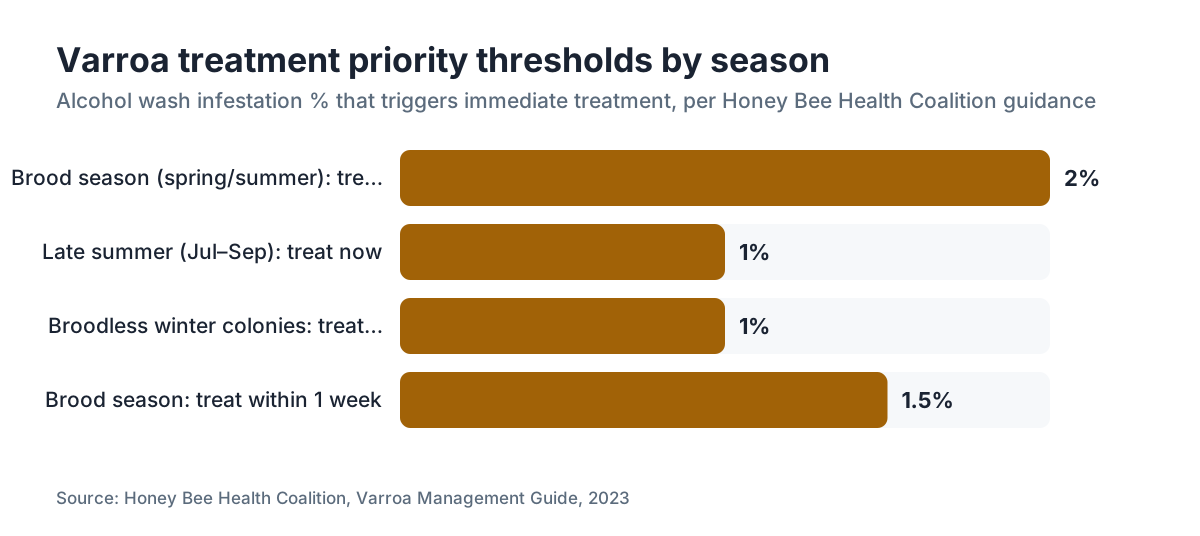
The Honey Bee Health Coalition's Varroa Management Guide sets the treatment threshold at 2% infestation (2 mites per 100 bees on an alcohol wash) during the brood-rearing season, and 1% or lower in late summer when the colony is raising long-lived winter bees [1]. Any hive above those numbers gets treated before any hive below them.
If two hives are both over threshold, treat the higher one first. The math is blunt. A hive at 5% carries roughly 500 mites in a population of 10,000 bees, and that count is before you add the mites locked in capped brood, which can be 70 to 80% of the total load [2]. The mites you see on adults are a fraction of the problem.
Below threshold does not mean ignore. It means you have time to schedule treatment within your next monitoring window instead of dropping everything today. A hive at 1.5% in June belongs on your calendar within two weeks. A hive at 0.5% in June can wait for your next routine check.
How do you actually measure mite load to rank your hives?
Alcohol wash is the most accurate method you have. The process is short: collect about 300 bees (roughly half a cup) from the brood nest, submerge them in isopropyl alcohol or windshield washer fluid, shake hard, and count the mites in the liquid [1]. Divide mites by bees, multiply by 100, and you have a percentage.
Sugar roll is gentler on the bees but it undercounts. A comparison from the University of Minnesota Extension found sugar roll misses 20 to 40% of the mites an alcohol wash catches [3]. If you sugar-rolled a hive and got 1.5%, the real number may sit at 2% or higher. Keep that bias in your head when you rank.
Sticky boards give you a 24-hour or 72-hour mite drop. They're useful for trending, meaning whether the population is climbing or falling, but they don't produce a reliable percentage. Don't rank hive priority on sticky board counts alone.
Here's a workable routine for a five-hive apiary. Alcohol wash every colony on the same day, write down the results, then rank them highest to lowest and treat the top of the list first. For larger operations, wash your most symptomatic or weakest colonies first, because those are your likely emergencies.
What clinical signs bump a hive to the top of the list even before you count mites?
Some hives announce their emergency without waiting for a wash. Deformed wing virus (DWV) is the loudest signal: bees with crumpled, stubby, or missing wings crawling in front of the hive mean mite loads have been high enough, long enough, to amplify the virus [4]. When you see crawlers, treat that colony today, then test to confirm what you're dealing with.
Scattered, sunken, or perforated capped brood can point to sacbrood or European foulbrood, but it also shows up under heavy varroa pressure, where mites feeding on pupal fat bodies weaken individual bees and break up the brood pattern. A spotty pattern paired with a high mite count is a double emergency.
A colony that lost a lot of population between your last visit and this one, especially if its neighbors look strong, may already be crashing from mite-vectored viruses. Now you're in triage. Treat immediately, then judge whether there are enough bees and a laying queen left to recover.
Want the background on the mite itself and why it does so much damage? Read the varroa mite overview.
Does time of year change which hive you treat first?
It does, a lot. Late summer, roughly July through September across the northern United States, is when getting the order right matters most. Colonies are raising winter bees then, the fat, long-lived bees that have to survive five or six months. Mite feeding in this window does outsized damage because it drains vitellogenin and fat body reserves from the exact bees that need those reserves to live [5].
The Honey Bee Health Coalition puts it plainly, calling late-summer treatment before the winter-bee rearing period "the single most impactful thing a beekeeper can do" [1]. If any hive is above 1% in August, that colony jumps to the front of the line no matter what the rest are doing.
Spring works differently. A colony that overwintered with a moderate mite load skipped the winter crash a heavily loaded hive would have taken, but it also hasn't been treated since fall. A spring wash above 1% in April or May is worth treating promptly, before the flood of spring brood hands those mites the resources to compound fast.
Winter is the exception that helps you. Where colonies go broodless for weeks, mites turn phoretic, meaning they live on adult bees instead of breeding in capped cells. That makes oxalic acid dribble or vapor unusually effective. A broodless colony at any mite percentage is a good treatment candidate precisely because efficacy peaks then [6].
How should you rank hives when you have limited treatment supplies?
This is the constraint most guides skip. One packet of Apivar strips, one dose of oxalic acid, one bottle of Formic Pro, and you treat the worst hive first. Full stop.
Here's a ranking framework I actually use:
- Any colony showing DWV crawlers or a rapid population collapse: treat immediately.
- Any colony above 3% on an alcohol wash during brood season: treat today.
- Any colony above 2% during brood season, or above 1% in late summer: treat within 48 hours.
- Any colony over threshold but below those levels: treat this week.
- Colonies below threshold: monitor on schedule.
If two hives sit at the exact same count, treat the weaker one. A small colony with fewer bees has less slack to absorb mite-driven losses. A large colony at 2% can carry the load longer.
Supply timing matters too. Ordering treatment before you need it is basic apiary management, not paranoia. Keep product on the shelf and you're never forced to choose between hives because you ran out of strips.
Does colony size or population affect which hive gets priority?
Colony size and mite percentage interact in a way that trips up new beekeepers. A 2% load in a two-frame nucleus is far fewer total mites than 2% in a ten-frame colony, yet the nuc is more vulnerable per bee. It has less redundancy in brood care, foraging, and nursing, so virus damage to individual bees hits colony function harder.
The Coalition's guide uses percentage instead of raw count as the threshold precisely because percentage accounts for colony size in a standard way [1]. Keep percentage as your primary ranking number.
A queenless or freshly requeened colony deserves extra attention. Without steady egg-laying, it can't replace mite-damaged bees at a normal pace. High mite loads compound faster in a queenless hive than in a healthy queenright one, because there's no fresh brood coming in to dilute the damaged population.
What's the right way to track and compare mite counts across multiple hives?
Paper works fine. A simple sheet with each hive's ID, wash date, mite count, bees washed, and calculated percentage gives you everything you need. The point is to sort by percentage at a glance.
With four or more hives, a tracking sheet updated after every monitoring round shows you which colonies are trending up between treatments. A hive that climbs from 1% to 2.5% in six weeks worries me more than one holding steady at 2%, because the trajectory says the treatment failed or reinfestation from neighbors is underway.
Once you're past ten colonies, digital tracking earns its keep. VarroaVault's free mite tracking tools let you log washes by hive and see the whole apiary ranked by infestation, which takes the manual sorting off your plate.
Record which product you used and when. If a colony reads high six weeks after a treatment that should have worked, that's a flag worth acting on. Amitraz resistance (amitraz is the active ingredient in Apivar) has been documented in some U.S. varroa populations, and rotating chemistry helps slow its spread [7].
Can a low-mite hive wait indefinitely, or does it need a treatment deadline?
A hive below threshold isn't a hive that never needs treatment. It's a hive whose treatment isn't urgent today. That difference is real and it matters.
Mite populations grow exponentially when conditions favor them. The University of Maryland Extension has published modeling showing a colony at 0.5% in June can hit 3% or higher by August under typical brood conditions with no intervention [8]. That's not a worst case. That's ordinary varroa biology.
Set a maximum monitoring interval and hold to it. Most extension programs recommend testing every four weeks during the active brood season [3][11]. A hive that came in below threshold in late June should be retested by late July. Still clean in late July? Test again in late August, before winter-bee rearing starts. Don't let a passing June result talk you out of the late-summer check.
One scenario flips a low-mite hive up the list: it sits directly next to a high-mite, collapsing colony. In that case a wash result can go stale within weeks, because robbing moves mites fast.
What treatment options are available and does the choice change priority order?
Product choice doesn't change which hive you treat first. It does change how fast you can act, because some products have temperature windows that stall you depending on local weather [9].
Oxalic acid vapor only touches phoretic mites, so it works best on broodless or near-broodless colonies [6]. If your top-priority hive is packed with brood, oxalic acid alone won't reach the mites sealed in cells. There you want a longer-contact product: Apivar (amitraz strips, a 42 to 56 day treatment) or Formic Pro (formic acid, 14 days at the right temperatures).
Formic Pro's label calls for 50 to 85 degrees Fahrenheit for the standard 14-day application [9]. If your top hive needs treatment in early spring and it's colder than that, oxalic acid vapor can bridge the gap until temperatures let you run formic acid.
EPA-registered varroa treatments include oxalic acid products, amitraz (Apivar), formic acid (Formic Pro, MAQS), and hop beta acids (HopGuard). Every one has to be used according to the label, which is a federal legal requirement under FIFRA [10]. Rotating between chemical classes across successive treatment cycles lowers the risk of resistance.
For a full list of products with current sourcing, the beekeeping supply companies guide has contact information for the major distributors.
How do you handle a situation where one hive is infecting the others?
This is where getting the order exactly right matters most. If your data shows one hive at 5%+ and the rest at 1% or below, the hot hive is the infection source for the whole apiary.
Treat it before you do anything else. Then retest the other hives four weeks later, because robbing and drift in the weeks before treatment almost certainly pushed mites into your low-load colonies. Don't assume those hives are safe just because they read low before you hit the hot one.
If the high-load hive is also visibly collapsing, ask whether it's worth treating at all. Combining its surviving bees with a healthy colony after a treatment period, or pulling it out of the apiary temporarily to stop the mite export, may serve you better. A dying colony with a thin population spreads mites faster than a healthy one because it can't defend against robbing.
In the worst cases, a colony too weakened by varroa to survive the treatment window may need to be euthanized. That's a hard call. Letting it collapse on its own is worse for the apiary than a managed exit.
Is there a simple checklist for ranking hive treatment priority?
Yes. Here's how to run it in a single apiary visit.
First, walk the yard before you open anything. Note colonies with crawlers at the entrance, weak flight compared to neighbors, or robbing pressure aimed at one specific hive. Those go straight to the top of your mental list.
Second, alcohol wash every hive you haven't tested in the past four weeks. Record the results on one sheet or a phone note.
Third, sort by percentage. Above 2% during brood season, or above 1% in late summer, is a treat-today hive. Between 1% and 2% during brood season gets treated within a week. Below 1% in brood season, schedule a retest in four weeks.
Fourth, check your supplies before you leave. Short on product? Order it now so your next visit isn't stalled by an empty shelf.
Fifth, note whether any high-priority hive sits next to a low-priority one. Plan to retest those neighbors four to six weeks after you treat the hot hive, even if they read clean today.
VarroaVault's free protocol tools can build a prioritized treatment schedule straight from your wash data if you'd rather skip the manual sort.
For the broader picture of tools and equipment for healthy hives, the beekeeping supplies overview covers the monitoring and treatment hardware worth keeping on hand.
Frequently asked questions
What mite percentage means I need to treat a hive immediately?
Any hive above 2% infestation on an alcohol wash during the brood-rearing season should be treated without delay, per the Honey Bee Health Coalition's Varroa Management Guide. In late summer (roughly July through September), the threshold drops to 1% because colonies are rearing the long-lived winter bees most vulnerable to mite-vectored virus damage. Above those levels, every extra week compounds the harm.
Should I treat all hives at once or treat the worst hive first?
Treat the worst hive first if supplies or treatment windows are limited. A heavily infested colony spreads mites through robbing and drifting, which reinfests hives you already treated. If you have enough product and labor to treat everything the same day, treating all at once is fine. The mistake to avoid is treating your low-load hives while a high-load hive sits untreated for days or weeks.
How do I compare mite loads across hives if I tested them on different days?
Use alcohol wash percentage as your standard unit, and treat any tests within the same four-week window as comparable. Populations shift fast enough that a test older than four weeks isn't reliable for current ranking. If your data ages vary, retest the older results before locking in priorities. Testing all hives on the same day every four weeks makes comparison much simpler.
Can I skip testing a hive that looks strong and healthy?
No. Mite loads aren't reliably visible. A colony can carry 3% or higher and look healthy for weeks before its population drops. The University of Minnesota Extension and the Honey Bee Health Coalition both recommend alcohol wash testing regardless of how a colony looks. By the time visual symptoms appear, virus loads are already high and recovery is harder.
Does a small nucleus colony need to be prioritized differently than a full colony?
A nucleus at 2% is more vulnerable than a full colony at the same percentage, because it has fewer bees to absorb virus-related losses and a smaller brood nest. Treat it at the same threshold you'd use for a full colony, and expect recovery from a mite event to take longer in a small colony with limited population redundancy.
What if my highest-mite hive also has the lowest bee population?
That combination is a top emergency. A weak, high-mite colony can't defend against robbing, which speeds mite export to the rest of your apiary. Treat it first. If the population is so low that treatment seems futile, consider combining the bees with a healthy colony after a brief isolation and treatment period rather than trying to rebuild from a depleted state.
How often should I be testing to keep my priority rankings current?
Every four weeks during the active brood season, per the Honey Bee Health Coalition and most university extension programs. In late summer, testing every three weeks gives better resolution for the period when getting ahead of the winter-bee rearing window matters most. A single annual test is far too infrequent to catch fast-moving mite growth before it causes serious damage.
Does the treatment product I choose affect which hive I should treat first?
No. Infestation level sets priority, not product. Product choice affects timing, though. Formic acid (Formic Pro) needs temperatures between 50 and 85 degrees Fahrenheit, so a cold snap can delay treatment of your top hive. In that case, oxalic acid vapor can bridge for phoretic mites while you wait for temperatures that allow a fuller treatment reaching capped brood.
What if two hives have exactly the same mite count?
Treat the weaker colony first. A smaller or more stressed colony has less buffer against the virus damage mites amplify. Tiebreakers after that: treat the hive with visible symptoms (crawlers, spotty brood) over the clean-looking one, and treat the hive closer to other colonies if you suspect robbing pressure, since it's more likely to be moving mites in or out.
Is a broodless hive ever a higher priority for treatment?
A broodless colony at high counts is a high-priority treatment opportunity more than a high-priority necessity. During a broodless period, all mites are phoretic on adult bees, which makes oxalic acid vapor or dribble very effective (efficacy above 90% in broodless conditions). If you have a broodless hive above threshold, treat it immediately with oxalic acid. You rarely get better efficiency than in that window.
Can mites from one untreated hive really reinfest my treated hives?
Yes, and quickly. The Honey Bee Health Coalition names robbing and drifting as primary mite dispersal routes between colonies. Mite transfer through these pathways can happen within days of a robbing event. Treating your low-load hives while a high-load hive sits untreated can undo weeks of work in a single robbing episode. Containing the highest-mite colony is the first step in protecting the whole apiary.
How do I know if my treatment failed and I need to re-prioritize?
Alcohol wash four to six weeks after treatment ends. A hive treated correctly with a full Apivar course (42 to 56 days) should read below 1% at the post-treatment check. If it's still above 2%, suspect treatment failure, resistance, or reinfestation from neighbors. That hive goes back to the top of your priority list and warrants a switch to a different chemical class.
Do I need to worry about treatment priority differently for africanized honey bee populations?
Africanized colonies (common in the southern United States) show some behavioral resistance to varroa through stronger hygienic behavior, but they aren't immune and can still carry dangerous loads. The same percentage thresholds apply. The practical difference is that africanized colonies need more protective gear and calmer conditions for inspections and washing. Learn more in the africanized honey bee overview.
Sources
- Honey Bee Health Coalition, Varroa Management Guide (2023 edition): Treatment threshold of 2% infestation during brood season and 1% in late summer; mite dispersal through robbing and drifting as primary reinfestation pathway; late summer treatment timing as most impactful single intervention
- USDA Agricultural Research Service, Varroa destructor biology overview: 70 to 80% of total mite population located in capped brood cells rather than on adult bees during active brood season
- University of Minnesota Extension, Varroa Mite Monitoring Methods: Sugar roll undercounts mites by 20 to 40% compared to alcohol wash; four-week monitoring interval recommendation during brood season
- Penn State Extension, Deformed Wing Virus and Varroa: Deformed wing virus symptoms (crumpled wings, crawlers at entrance) indicate sustained high mite loads and virus amplification in the colony
- Doke, M.A. et al., PLOS ONE (2015), Nutrient limitation and immune function in honey bees: Mite feeding depletes vitellogenin and fat body reserves in winter bees, reducing their longevity and immune competence
- EPA, Oxalic Acid Product Registration and Label Requirements: Oxalic acid is effective against phoretic mites; efficacy above 90% in broodless colonies; labeled for use as dribble or vaporization
- Invernizzi, C. et al., Journal of Apicultural Research (2015), Amitraz resistance in Varroa destructor: Resistance to amitraz has been documented in some U.S. and international Varroa populations; rotating chemical classes recommended
- University of Maryland Extension, Varroa Population Modeling: A colony at 0.5% mite load in June can reach 3% or higher by August under normal brood conditions without treatment
- Formic Pro (formic acid) EPA-registered label, NOD Apiary Products: Formic Pro label requires ambient temperature of 50 to 85 degrees Fahrenheit for standard 14-day application
- EPA, Federal Insecticide, Fungicide, and Rodenticide Act (FIFRA) pesticide labeling requirements: All EPA-registered varroa treatments must be used according to the label as a federal legal requirement under FIFRA
- Delaplane, K.S., University of Georgia Extension, Varroa Mite Management in Honey Bee Colonies: Monitoring every four weeks during active brood season is the standard recommended interval for commercial and sideliner beekeepers
Last updated 2026-07-09