How to test queen daughter colonies for varroa resistance
TL;DR
- Run alcohol wash counts on brood-right daughter colonies in mid and late summer.
- Target a mite load under 1% through August with no treatment, and pair that with a freeze-killed brood test scoring 95% or higher.
- Test at least 3 daughters per queen against contemporary controls before you select any queen line for breeding.
Why test queen daughter colonies specifically for varroa resistance?
Testing your own colonies for mite load tells you when to treat. Testing queen daughter colonies is a different job entirely. You're deciding whether a queen's genetics are worth passing on, not whether one hive needs a treatment this week.
The distinction matters. A single high-mite colony tells you almost nothing about a queen's genetics, because management history, colony age, local mite pressure, and plain luck all contaminate the result. What you want is a controlled comparison across several daughter colonies from the same queen, all started at roughly the same time, all in the same apiary or at least the same landscape, and all measured the same way. Only then can you start attributing differences to genetics instead of noise.
The payoff is real. The USDA Baton Rouge Bee Lab has documented stable varroa-resistant lines, including its Pol-line, showing suppressed mite reproduction and hygienic behavior that pass reliably to daughters when breeders get selected through systematic testing [1]. Skip the testing and you're guessing which queens to breed from.
What traits actually indicate varroa resistance in a colony?
Varroa resistance comes from a handful of measurable behaviors, not some magical immunity. Three matter most in a selection program: suppressed mite reproduction (SMR, expressed strongly as VSH), hygienic behavior that detects and removes mite-infested cells, and grooming behavior that knocks mites off adult bees.
VSH (Varroa Sensitive Hygiene) is the strongest single trait. Colonies with high VSH scores detect and uncap cells holding reproducing mites, then remove the mite and its offspring before the next generation emerges. The Honey Bee Health Coalition's varroa management guide notes that VSH bees can suppress mite populations sharply without any chemical treatment, though pure VSH lines can carry productivity drawbacks [2].
Hygienic behavior more broadly, measured by freeze-killed brood tests, predicts some of that VSH activity. A colony that removes 95% or more of freeze-killed brood within 24 to 48 hours scores as hygienic. That threshold comes from University of Minnesota research [3].
Grooming behavior is harder to measure at the hobbyist level. You can get a rough signal by inspecting the bottom board for mites with missing or damaged legs, which suggests bees are actively pulling mites off each other.
Natural mite population growth is the sum of all these behaviors. A daughter colony that shows slow mite buildup across a full season, compared to control colonies, is compelling evidence. A single point-in-time count is much weaker on its own.
How do you set up a fair comparison between queen lines?
The setup decides whether your results mean anything. Get it wrong and no amount of careful counting saves you.
Start each test colony from the same source bees if you can. Package bees or a single shaken-bee split from a known low-mite population work well. This removes starting mite load as a variable. If you use nucleus colonies, wash every one down to near zero mites with oxalic acid before introducing the test queens, then allow a 30-day brood break after treatment so you begin clean [4].
You need at least 3 daughter colonies per queen, and 5 is better. Genetic variance between sisters is real, so one colony can be an outlier. Three colonies give you a minimum picture. Five let you drop the best and worst and still have a meaningful center.
Run control colonies alongside them. Controls should carry queens of known average genetics, ideally locally mated unselected stock, managed identically. If your test daughters average 0.8% mite load at the end of summer and your controls average 3.5%, that contrast is your evidence. Without controls, you can't tell whether a low count reflects good genetics or just a bad season for mite reproduction.
Location matters too. Keep test colonies within a mile or two of each other so they share the same foraging pressure, robbing risk, and mite immigration from neighboring feral colonies. Mite rain, where mites drift in from collapsing colonies nearby, can swamp genetic effects if one apiary sits next to an infected beeyard and another doesn't.
Record keeping has to be disciplined. Log the date of queen introduction, date of first brood, every mite count with its method and date, any treatment applied (which should be none unless a colony is in real danger), and any supersedure events. A supersedure mid-test means that colony's data is probably junk.
Which mite counting method is best for resistance testing?
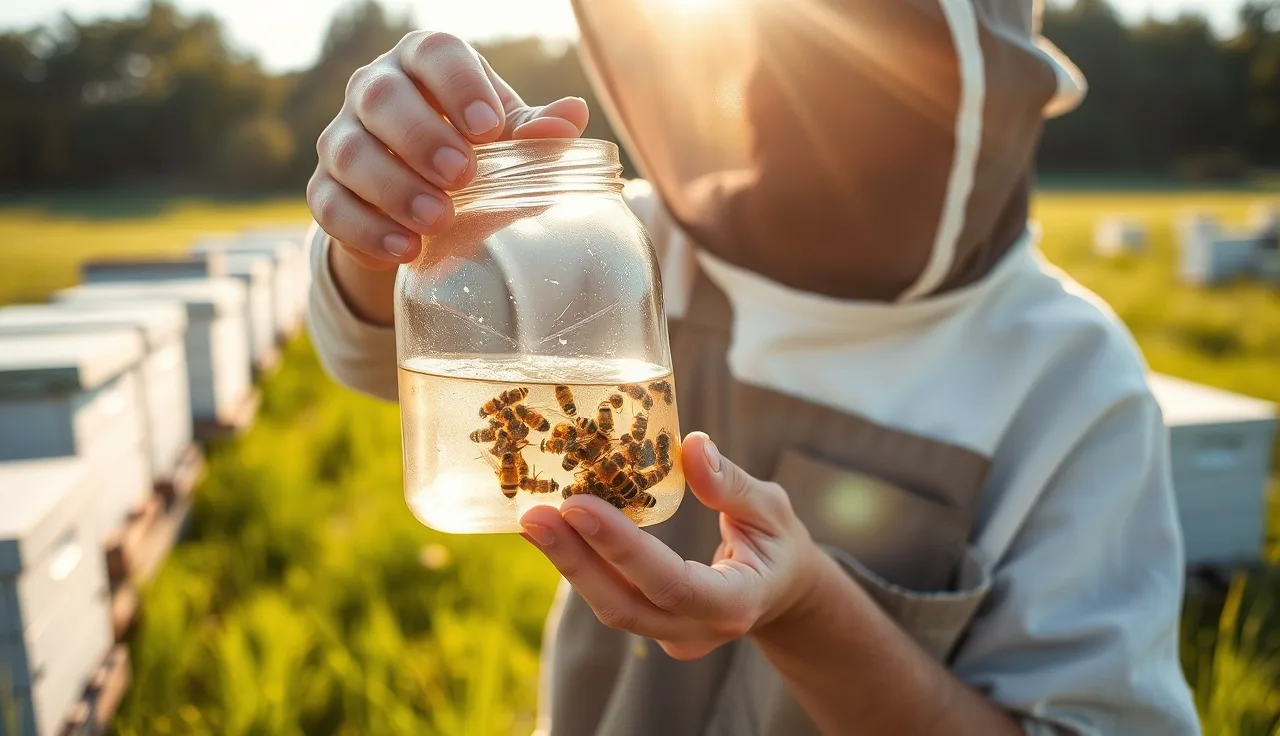
Alcohol wash is the method to use. It's accurate, fast, and the Honey Bee Health Coalition recommends it as the most reliable way to get a true percentage [2]. Collect roughly 300 bees (about half a cup) from a brood frame, keep the queen out of it, submerge them in isopropyl alcohol or windshield washer fluid, shake for 60 seconds, and count the mites that wash off. Divide mites by bees and multiply by 100 for your percentage.
A mite load below 2% during peak brood season (roughly June through August across most of North America) is the treatment threshold the Honey Bee Health Coalition recommends [2]. For resistance selection you want daughters that stay well under that line with no treatment, ideally under 1% through late summer.
Powdered sugar rolls aren't accurate enough for selection. Studies published in the Journal of Apicultural Research show sugar rolls recover only 60 to 80% of the mites an alcohol wash finds on the same sample [5]. Fine for a rough field check. Useless when you're trying to tell a 1.2% colony from a 1.8% colony, because that error swamps the signal you care about.
Natural mite drop on sticky boards gives you a trend rather than a snapshot. Counts reported as mites per day (usually averaged over 3 days) track infestation reasonably well, though the exact conversion shifts with season and brood area. A daily drop above 8 to 10 mites per day warrants a follow-up wash count. For selection, a daughter colony that stays under about 3 mites per day in peak season is a meaningful positive signal.
You can also pair adult bee counts with a brood check. Open 100 capped brood cells in the natural brood nest and count how many hold mites or mite offspring. A lone foundress isn't a problem; reproductive females with offspring mean the mite population is growing. Cells where you find dead or absent mite offspring point to SMR or VSH activity.
When during the season should you test daughter colonies?
Timing changes your answer. The mite-to-bee ratio runs lowest in spring, when the colony expands fast and brood is everywhere. It peaks in late summer and fall, when brood rears down and mites that hid in capped cells suddenly ride on adult bees. Test in April and you get falsely low numbers. Test in August and you see the truth.
For a selection program you want at least two counts: one in mid-summer (July across most of the US) and one in late summer (late August or early September). Genuinely resistant queens tend to produce daughters that accumulate mites slowly across that window. Susceptible queens often look fine in July, then spike in August.
The University of Minnesota Bee Lab recommends timing your first count about 6 to 8 weeks after the colony has a laying queen established, so at least one full brood cycle has passed [3]. For spring-raised daughters introduced in May, that puts your first meaningful count in late June or early July.
Run any freeze-killed brood test independently of mite counts. The freeze test is a one-time event per colony, not a repeated measure. Do it once the colony has at least 5 frames of brood, ideally in early to mid-summer.
Don't test colonies fresh off a brood break from swarming or supersedure. Mite loads drop artificially during a break because there are no capped cells to hide in, then spike once new brood is capped. Mark those events and weight the data accordingly, or just flag the colony as compromised.
How do you perform the freeze-killed brood test for hygienic behavior?
The freeze-killed brood test is the most practical way a hobbyist gets a direct read on hygienic behavior, one of the mechanisms behind VSH.
Cut a section of capped brood, about 100 cells worth, from a frame. You want capped worker brood that's been sealed at least 8 days so the pupae are well developed. Seal that section in a plastic bag and freeze it at 0°F (-18°C) for at least 24 hours. Thaw to room temperature, then return it to the colony, pinning it back in the frame or setting it in a small wire frame insert.
Come back 24 hours later and count how many cells the bees have uncapped and cleaned out. Removed means emptied, not merely uncapped. Divide cleaned cells by total cells and multiply by 100. A score of 95% or higher in 24 hours is the commonly cited threshold for hygienic colonies, from University of Minnesota research [3].
Scores between 70 and 94% at 24 hours mean partial hygiene; check again at 48 hours. Some colonies that hit 80% at 24 hours reach 95% by 48 hours and still qualify. Below 70% at 48 hours means a non-hygienic colony.
One caveat. The freeze test measures hygienic behavior generally, not VSH specifically. A hygienic colony removes freeze-killed brood but won't necessarily target mite-infested cells with the precision a true VSH colony brings. Confirming VSH takes a more specialized assay, checking whether the colony uncaps cells with reproducing mites, which needs time and a dissecting scope to verify mite reproduction. At the hobbyist level, the freeze test plus mite wash counts is a solid substitute.
What mite level tells you a daughter colony is genuinely resistant?
No single number separates resistant from susceptible with certainty, and anyone who claims otherwise is oversimplifying.
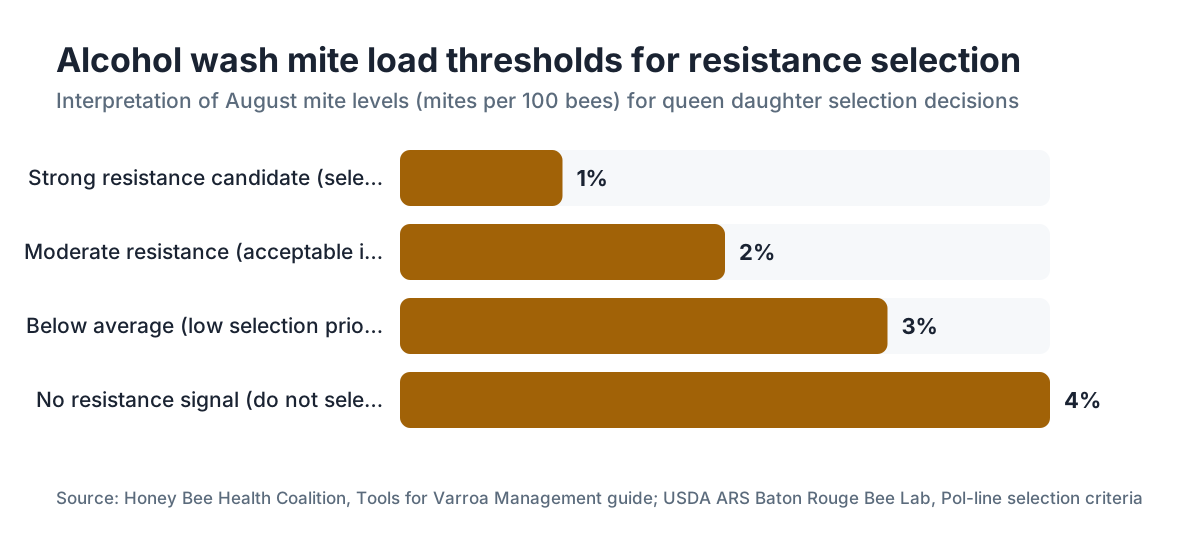
The working benchmarks used by most selection programs are consistent, though. A daughter colony that holds an alcohol wash mite load below 1% through August with no treatment, while neighboring control colonies of the same age and starting load hit 3 to 4%, is showing a real resistance signal. The Honey Bee Health Coalition's 2% threshold is for deciding when to treat; your resistance bar should sit lower, because you want colonies that stay well clear of the treatment zone on their own [2].
The USDA Pol-line program, one of the most rigorously documented resistant lines in North America, selects colonies that stay below 2 mites per hundred bees through late summer [1]. That's the number they use to decide which colonies produce the next round of breeders.
For natural drop equivalents: colonies averaging under 3 mites per day on a sticky board through July and August, in a high-pressure environment, are likely in the resistant range. Verify with a wash count before you conclude anything.
One season of data is suggestive. Two seasons from daughters of the same queen, or from granddaughter colonies, is far more convincing. Genetic resistance passes consistently to offspring. A lucky season does not.
| Mite level (alcohol wash, Aug) | Interpretation for selection |
|---|---|
| Below 1% | Strong resistance candidate, high selection priority |
| 1% to 2% | Moderate resistance, acceptable if hygienic score is high |
| 2% to 3% | Below average, treatment threshold territory, low priority |
| Above 3% | No resistance signal, do not select for breeding |
How do you record and compare results across multiple queen lines?
Paper records get lost. A simple spreadsheet, one row per colony, gives you something you can sort and analyze. Columns for queen ID, queen origin, introduction date, mite count dates and results, counting method, hygienic behavior score, disease observations, and honey production if you track it.
When comparing queen lines, average the mite percentage across all daughters for each queen, then rank the queens. The queens whose daughters consistently land in the bottom third of mite loads, and score above 90% on hygienic behavior, are your breeding candidates.
Be wary of single standouts. One daughter with a 0.4% mite load in August is exciting, but she could be an outlier. If her four sisters average 2.8%, the queen's genetics probably didn't produce that result. You want the whole cohort trending low.
Track supersedure rate among daughters too. Highly hygienic lines sometimes supersede more readily, which is worth knowing. It doesn't disqualify a queen line, but it's information you need if you're raising queens for sale or scaling your own operation.
VarroaVault's free protocol tracker (varroavault.com) lets you log wash counts by colony and queen line and flag colonies for re-test or selection, which earns its keep once you're running more than a handful of test colonies.
Should you use a mating apiary to control genetics during testing?
Open mating brings in drone genetics you can't control, and that's a genuine problem for serious selection. A virgin queen mates with 10 to 20 drones [7], so the workers in a daughter colony aren't genetically uniform, and the traits you measure come partly from unknown drones.
For a hobbyist running a small program, open mating is usually unavoidable. The work-around is to flood your local area with drones from your best resistant colonies: put drone-rearing frames in your top performers 2 to 3 weeks before your queen cells are ready. This shifts the drone pool toward your selected genetics, at least locally. It's imperfect, but it's what most small-scale breeders do.
Want a tighter program? Instrumental insemination removes the drone variable entirely, but it needs specialized equipment, training, and a steady hand. That's beyond most hobbyists.
Isolated mating yards on islands or in remote valleys are a middle-ground option some sideliner breeders use. Place your virgin queens and drone mother colonies several miles from the nearest other bees and you get near-controlled mating without the cost of instrumental insemination.
Even with open mating, daughter-colony testing still gives valid conclusions as long as you test enough daughters per queen and compare them against contemporary controls mated under the same conditions. The drone noise averages out somewhat once you have enough replicates.
What should you do with colonies that show low resistance scores?
Treat them. Don't let a test colony die to prove a point.
The goal of resistance testing is finding queens worth breeding, not running heroic no-treatment experiments at the expense of your bees or your neighbors'. A colony at 4% mites in August is heading for collapse by October, and a collapsing colony is a mite bomb that drifts into healthy hives nearby. Bad for your program, bad for your bees, bad for every beekeeper within a few miles.
If a test colony crosses 2% on an alcohol wash, treat with an approved miticide and mark it as a non-selected line. Oxalic acid dribble or vaporization works well and leaves no residue at label doses, so it won't confound your future mite counts the way a synthetic acaricide might [4]. Api-Bioxal is the primary EPA-registered oxalic acid product, with label directions for use during broodless periods or repeated vapor treatments during the brood season [4].
Queen lines that keep producing daughters needing treatment by mid-summer are telling you something real. Phase them out.
The colonies with low mite loads and good hygienic scores are the ones to raise queen cells from for your next round. Over several generations of consistent selection, this genuinely moves your local population toward better mite tolerance. It's slow, typically 3 to 5 seasons before you see a population-level shift, but the Arnot Forest work and the USDA Pol-line program both confirm it moves in the right direction [1][6].
What resources and tools support a queen resistance testing program?
The Honey Bee Health Coalition's varroa management guide is free online and the single most useful reference for standardized counting methods and thresholds [2]. It updates periodically and includes decision charts that translate mite counts into action. Use it as your baseline protocol.
The USDA Baton Rouge Bee Lab publishes information on the Pol-line and other bred-for-resistance stock, including how to obtain Pol-line queens or grafting material [1]. If you want a known-resistant starting point rather than selecting up from scratch, that's a practical option.
University extension programs with strong apiculture tracks, including the University of Minnesota and North Carolina State, have published guidance on hygienic behavior testing and mite monitoring that goes well beyond any single article [3][8]. Several include step-by-step alcohol wash instructions with photographs.
For supplies, a basic testing kit needs a mesh-bottom container or commercial mite-washing device, isopropyl alcohol (at least 70%) or windshield washer fluid, a fine strainer, and sticky boards for natural drop counts. Add a small freezer-safe container for freeze-killed brood tests. Most of this comes from standard beekeeping supply companies and costs under $30 total.
VarroaVault's free tracking tools at varroavault.com log counts across multiple colonies and queen lines so you don't have to build your own spreadsheet, handy once you're managing more than 5 to 10 test colonies.
One more thing worth knowing: the varroa mite background section on this site covers the mite's biology and reproductive cycle in detail, useful context for why VSH and SMR traits work the way they do.
How many seasons of testing does it take to confirm a resistant queen line?
Honestly? One season's data is a hypothesis. Two seasons is evidence. Three seasons with daughters and granddaughters is close to confirmation.
The complication is that resistance traits, especially VSH and hygienic behavior, are quantitative traits controlled by many genes and modified by the drone population the queen mated with. Even a genuinely resistant queen will throw some daughters with mediocre scores if they mated heavily with susceptible drones. The signal-to-noise ratio improves as you test more daughters and progressively select the drone pool by flooding your area with drones from your best colonies.
A reasonable minimum program looks like this. In year one, test 3 to 5 daughter colonies from each candidate queen through a full summer. In year two, raise daughters from the top performers and repeat with their daughters (your original queen's granddaughters). By year two you have two generations of selection data and can make a fairly confident call about whether that line is moving your colonies toward resistance.
Some commercial operations doing serious selection report it takes 5 to 7 generations of consistent work before a line breeds true for VSH in open-mated populations. At one to two generations a year for a hobbyist, that's 3 to 7 years. Thomas Seeley's research at the Arnot Forest suggests feral populations under natural selection can shift toward mite tolerance over roughly 5 to 10 years [9]. Managed selection with deliberate queen testing can move faster, but not dramatically so.
Frequently asked questions
How many daughter colonies do I need to test per queen to get reliable results?
Test at least 3 daughter colonies per queen, and 5 is better. A single colony's mite count can be skewed by mite immigration, a supersedure event, or plain random variation. With 5 daughters you can drop the high and low outliers and still keep a meaningful central tendency. Fewer than 3 gives you almost no power to separate genetics from luck.
What alcohol concentration works for an alcohol wash mite count?
Isopropyl alcohol at 70% or higher works reliably, as does standard blue windshield washer fluid, which is cheaper and easier to handle. The exact concentration matters less than thorough agitation. Shake the sample a full 60 seconds, then strain the bees and count the mites in the liquid. The Honey Bee Health Coalition recommends either option in its varroa management guide.
Can I test for varroa resistance without sacrificing bees?
Alcohol wash kills the sample bees, roughly 300 per test. There's no perfectly equivalent non-lethal method. Powdered sugar rolls are non-lethal but recover only 60 to 80% of mites and aren't accurate enough for selection. Natural mite drop on sticky boards is non-lethal and useful for trend monitoring, but less precise. For serious selection decisions, accept the small bee sacrifice of an alcohol wash.
What is VSH and how is it different from general hygienic behavior?
VSH (Varroa Sensitive Hygiene) is a specific form of hygienic behavior where bees preferentially detect and remove capped cells holding reproducing mites, beyond dead or diseased brood in general. General hygienic behavior is measured by how fast bees remove freeze-killed brood. VSH is a targeted subset of that. Colonies can score high on freeze-brood tests and still show only moderate VSH expression.
Does mite immigration from neighboring colonies ruin my resistance test results?
Mite immigration is a real problem, especially if a nearby colony collapses in late summer. Drifting foragers carry mites in from collapsing hives. The best mitigation is keeping test colonies well away from high-density beekeeping areas and running contemporary controls in the same location. If all your test colonies spike at once, suspect immigration rather than genetic failure.
How do I do a freeze-killed brood test at home?
Cut a section of capped worker brood, about 100 cells, from a frame of well-developed pupae (capped at least 8 days). Seal in a plastic bag and freeze at 0°F for 24 hours. Thaw to room temperature, then reinsert into the colony. Return in 24 hours and count cleaned-out cells. A score above 95% indicates strong hygienic behavior. Below 70% at 48 hours indicates a non-hygienic colony.
When is the best time of year to test daughter colonies for mite resistance?
Late summer, specifically late July through early September across most of North America, is when mite loads peak and genetic differences show most clearly. A resistant colony that looks fine in spring may still look fine in July but collapse in August; a truly resistant one stays low through the whole window. Count in mid-July and again in late August for the most informative picture.
Can I use drone brood uncapping as a sign of VSH behavior?
Not reliably. Bees preferentially uncap and remove drone brood for reasons unrelated to mite detection, including nutritional stress and space management. Seeing drone brood removal doesn't mean your colony practices VSH. For a meaningful VSH signal you need to examine uncapped worker brood cells and confirm the targeted cells actually held reproducing mites, which requires dissecting mite contents under magnification.
Should I treat daughter test colonies at all during the testing period?
Treat if a colony crosses the 2% alcohol wash threshold. Don't let a test colony die to preserve data integrity. A collapsing high-mite colony contaminates the whole apiary through drift and robbing. Use oxalic acid if you treat, since it leaves no residue that would affect future counts. Mark treated colonies clearly and reduce the weight you give their post-treatment mite data.
Where can I get queens from known varroa-resistant lines to start a breeding program?
The USDA Baton Rouge Bee Lab's Pol-line is one of the most documented resistant lines in North America, and queen material is sometimes available through their program. Several commercial breeders also sell VSH-derived or hygienic-tested queens. Look for breeders who show you actual mite count data from their source colonies, beyond marketing claims. State apiculture extension programs often keep lists of certified queen breeders in your region.
How does mite grooming behavior differ from hygienic behavior, and can I test for it?
Hygienic behavior targets mites in capped brood. Grooming behavior targets mites on adult bees: workers bite and remove mites that land on them, sometimes damaging or killing the mite. For a rough field read, examine your sticky board mites under magnification and count what fraction have missing, bent, or damaged legs. A high proportion of damaged mites suggests active grooming. It's not a validated standardized test, but it's a useful supporting observation.
What's the difference between mite tolerance and mite resistance in bees?
Technically, resistance means the bees actively suppress mite reproduction or populations through behaviors like VSH or grooming. Tolerance means the colony sustains higher mite loads without collapsing, possibly because the bees are less stressed by individual mites. In practice, most breeders and researchers use resistance loosely to cover both. For a practical program you care about both: low mite buildup rate and colony health under mite pressure.
How do I start a queen resistance testing program if I only have two or three hives?
Start by identifying your lowest-mite colony after a full summer season. Raise a handful of queens from it using any grafting or cell-punch method you're comfortable with. Introduce them into small nucleus colonies, run them through one summer, and compare mite counts at the end of August. Even with 3 or 4 test nucs you'll get directional information. Expand as your confidence and colony numbers grow.
Sources
- USDA Agricultural Research Service, Honey Bee Breeding, Genetics and Physiology Research (Baton Rouge Bee Lab), Pol-line varroa-resistant honey bees: USDA Pol-line breeding program uses colonies staying below 2 mites per hundred bees through late summer as a selection criterion; documented stable varroa-resistant lines with suppressed mite reproduction
- Honey Bee Health Coalition, Tools for Varroa Management guide: Alcohol wash is the most accurate method for mite percentage counts; treatment threshold of 2% mites per hundred bees during brood season; VSH bees can suppress mite populations without chemical treatment
- University of Minnesota Bee Lab, hygienic behavior in honey bees: 95% or more of freeze-killed brood removed within 24 hours is the threshold for classifying a colony as hygienic; first meaningful mite count recommended 6-8 weeks after laying queen is established
- EPA, Pesticide Registration, Api-Bioxal (oxalic acid) registration and label: Api-Bioxal is an EPA-registered oxalic acid product for varroa control; label directions include use during broodless periods and repeated vapor treatments during the brood season; leaves no residue at label doses
- Journal of Apicultural Research, studies comparing powdered sugar roll and alcohol wash accuracy: Powdered sugar rolls recover only 60-80% of the mites that an alcohol wash finds on the same sample, making them insufficiently accurate for resistance selection comparisons
- USDA Agricultural Research Service, Baton Rouge Bee Lab, Pol-line and mite-resistant stock selection research: Consistent selection using late-summer mite thresholds moves colony genetics toward mite tolerance over several seasons
- Penn State Extension, honey bee mating biology: A virgin queen mates with 10-20 drones during mating flights, meaning worker offspring in a daughter colony are not genetically uniform
- Thomas Seeley, Cornell University, Arnot Forest feral colony research and Darwinian Beekeeping: Feral populations under natural selection pressure at the Arnot Forest shifted toward mite tolerance over approximately 5-10 years without managed intervention
- USDA Agricultural Marketing Service, apiary and honey bee programs: National honey bee programs including genetics and health surveys supporting resistant stock development
Last updated 2026-07-09