Ceracell varroa mite test bottle: how it works and whether it's worth it
TL;DR
- The Ceracell Varroa Mite Test Bottle is an alcohol wash device built to count varroa in a 300-bee sample.
- You fill it with isopropyl alcohol, scoop bees from a brood frame, shake for 60 seconds, then read the mites through a clear mesh base.
- Accuracy matches standard alcohol wash protocols.
- You get an infestation percentage you can act on that same minute.
What is the Ceracell varroa mite test bottle?
The Ceracell Varroa Mite Test Bottle is a rigid plastic jar made in New Zealand by Ceracell Beekeeping Supplies. It runs alcohol wash mite counts in the field with no separate collection cup, strainer, or mason jar. It has two chambers: an upper bee-collection chamber with a mesh floor, and a lower clear chamber where the alcohol drains after you shake. You read the mite count through the transparent lower chamber without pouring anything out.
That's the whole idea. One tool instead of a rig built from hardware-store parts. Scoop, shake, flip, count. The test runs in under five minutes once you're at the hive.
Ceracell is based in Auckland and sells mostly to New Zealand and Australian beekeepers, though the bottle ships internationally and has become common in North America and the UK. It isn't the only purpose-built wash device out there (the BEECHECK and various DIY builds compete with it), but it's one of the most recognized by name.
The science is plain alcohol wash, which the Honey Bee Health Coalition lists as the most accurate method for detecting varroa in adult bees [1]. The bottle doesn't touch the chemistry. It changes the workflow, and that's it.
How do you use the Ceracell varroa test bottle step by step?
Here's the actual procedure, consistent with the Honey Bee Health Coalition's Varroa Management Guide and standard university extension alcohol wash protocols [1][2]. Start to finish, it's about five minutes per hive.
What you need: the Ceracell bottle, 70% isopropyl alcohol (rubbing alcohol from any pharmacy works fine), a marking pen, and a watch.
Step 1: Fill the lower chamber. Pour isopropyl alcohol into the lower clear chamber to the marked fill line, roughly 125-150 ml depending on the bottle version. Some beekeepers use windshield washer fluid (with methanol) instead. It works, but isopropyl is safer to handle without gloves if you're testing a lot of hives.
Step 2: Find a frame near the brood nest. You want nurse bees, not foragers. Nurse bees carry higher mite loads because they work the capped brood where mites reproduce. A frame with open brood and young larvae is ideal [2].
Step 3: Scoop about 300 bees. The upper chamber has a scoop lid. Shake bees off the frame into the open lid, then clip it onto the jar. The target is half a cup of bees, roughly 300 individuals. Avoid the queen. If you see her on the frame, shake her off before scooping.
Step 4: Combine and shake for 60 seconds. Invert the bottle so the alcohol moves up into the bee chamber. Shake hard for a full 60 seconds. The alcohol strips mites off the bees.
Step 5: Drain back and count. Flip the bottle upright. Alcohol and mites drain through the mesh into the clear lower chamber. Count the mites through the clear walls. The bees stay up top.
Step 6: Calculate the infestation rate. Divide mites by bees, then multiply by 100. Nine mites from 300 bees: 9 / 300 x 100 = 3%. That's your rate.
One shake usually does it. You can run a second 60-second shake on the same sample to catch stragglers. Studies comparing single and double washes show the second shake adds maybe 10-15% more mites from an already-shaken sample [3]. For a treatment decision, one shake is enough.
What mite count percentage means your colony needs treatment?
This is the question that decides everything, and the number is settled. The Honey Bee Health Coalition's Varroa Management Guide recommends treating when infestation in adult bees hits 2% or higher during brood-rearing season, and 1-2% in late summer or fall when colonies are raising the long-lived winter bees [1].
A 2% rate is 6 mites in a 300-bee sample. Six mites. That colony needs help now.
Here are the thresholds in plain terms:
| Mites per 300 bees | Infestation % | Action |
|---|---|---|
| 0-3 | 0-1% | Monitor monthly, no treatment needed |
| 4-6 | 1.3-2% | Treat immediately in late summer/fall; watch closely in spring |
| 7-9 | 2.3-3% | Treat now, regardless of season |
| 10+ | 3.3%+ | High risk. Treat immediately and check brood for deformed wing virus |
These come from Honey Bee Health Coalition guidance [1] and match Penn State Extension resources on varroa management [2]. Most state apiarists and university programs use 2% as the action point during the main season.
The threshold matters more than the device. A Ceracell bottle, a mason jar rig, or a professional bee lab all land on the same number when the technique is right. The bottle doesn't change when you treat. It makes counting faster, so you're more likely to actually do it.
How accurate is the alcohol wash method compared to other varroa testing options?
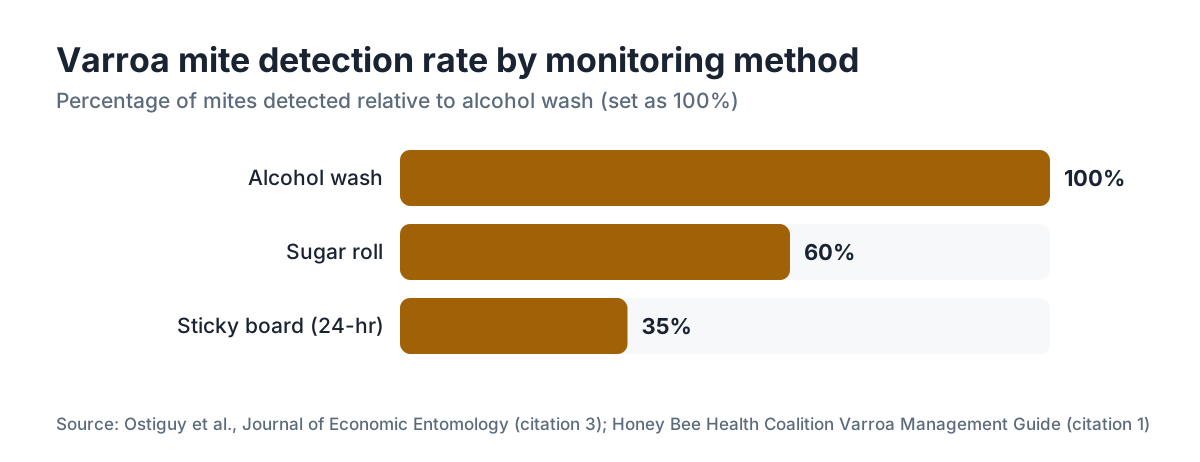
Alcohol wash is the most accurate field-practical method a beekeeper has. A widely cited comparison in the Journal of Economic Entomology found alcohol wash detected significantly more mites than sticky boards or sugar rolls from the same colonies [3]. The Honey Bee Health Coalition states that alcohol wash "provides the most accurate assessment of the mite infestation level" of the sampling methods it reviews [1].
Sugar roll only knocks loose mites that aren't gripping hard. Detection runs 20-60% lower than alcohol wash on matched samples [3]. Sugar roll earns its place in classes and for people who won't kill bees, but if you're making a treatment call, alcohol wash gives you a number you can trust.
Sticky boards count mite fall over 24 to 72 hours. Results swing with colony size, season, and whether a treatment is running. Good for watching a trend, weak for a single decision.
DNA and lab sampling exist. Neither is practical for a hobbyist or sideliner.
For the Ceracell bottle itself: the device doesn't change the chemistry or the physics of the wash. Its accuracy is the accuracy of a proper wash. The variable is your technique, mainly whether you grabbed real nurse bees and actually counted 300 instead of eyeballing it. Both problems fix themselves with practice.
What does the Ceracell test bottle cost and where can you buy it?
The Ceracell Varroa Mite Test Bottle usually sells for NZD $25-35 in New Zealand (roughly USD $15-22 at mid-2024 exchange rates, though currency moves this around). In North America it shows up from beekeeping suppliers in the USD $18-30 range, depending on the seller and whether shipping is included. Prices from online beekeeping supply companies vary more than you'd expect for one product.
Ceracell sells direct through its website (ceracell.co.nz) and through distributors. If you're in North America, check whether a domestic reseller stocks it before ordering overseas. Shipping from New Zealand adds cost and transit time.
For comparison, a DIY kit (a wide-mouth mason jar, a fine mesh strainer, and a second jar) costs about USD $5-8 in hardware and kitchen supplies. The Ceracell bottle costs more but folds those parts into one tool with measurement marks already on it. Test multiple hives regularly and the convenience pays off. Run a single hive and test twice a year, and the mason jar rig does the job fine.
Some beekeeping supplies retailers bundle the bottle with other monitoring tools. Worth a look before buying it alone.
How does the Ceracell bottle compare to other varroa wash devices?
Several purpose-built wash devices fight for this small market. Here's an honest comparison of the main ones:
| Device | Approx. price (USD) | Bees killed? | Readability | Notes |
|---|---|---|---|---|
| Ceracell Varroa Test Bottle | $18-30 | Yes (300 bees) | Clear lower chamber, easy count | New Zealand-made, widely distributed |
| BEECHECK Mite Washer | $20-35 | Yes (300 bees) | Similar clear-drain design | U.S. market, similar workflow |
| DIY mason jar + strainer | $5-8 | Yes (300 bees) | Requires pouring into a white tray | Works fine, less convenient |
| Sugar roll cup | $5-15 or DIY | No | Shake onto white paper, count | Lower detection rate than wash [3] |
| OABees Wash Kit | $15-25 | Yes | Similar to Ceracell design | Various brands use similar designs |
Be honest with yourself: the functional gap between the Ceracell bottle and a mason jar with a mesh strainer is small. Both run the same alcohol wash. The Ceracell wins on field convenience. No extra containers, pre-marked fill lines, and the clear lower chamber counts easier in bright sun than squinting into a white tray.
Already comfortable with a mason jar and testing regularly? You probably don't need to switch. Buying your first monitoring kit, or equipping a small outfit with several matching tools? The Ceracell bottle is a fair buy.
Can you use the Ceracell bottle without killing bees?
No. The alcohol kills the bees in the sample. That's the tradeoff, and it's real.
A 300-bee sample is about 0.3% of the adult population in a typical mid-season hive of 50,000-80,000 bees. Most beekeepers and researchers accept that, and the Honey Bee Health Coalition endorses the method because accuracy matters more than the sample loss for a management call [1].
If you genuinely can't sacrifice 300 bees, sugar roll is the alternative. Seal the bees in a container, add powdered sugar, roll for 60 seconds, dump the bees onto a white surface, count mites in the sugar. Accuracy drops, but it isn't zero. University of Minnesota Extension and others note sugar roll can underestimate mite loads by 30-60% against alcohol wash [8], which means you can miss a colony that needs treatment. That's the true cost of sugar roll. Not the sugar, the under-count.
Some beekeepers sugar roll for mid-season spot checks and save the alcohol wash for the fall pre-winter assessment. That's a fair compromise if bee preservation matters to you.
How often should you test for varroa mites with any wash device?
The Honey Bee Health Coalition recommends testing at least every 30 days through the active season, and before and after any treatment to confirm it worked [1]. Skip the post-treatment test and you don't actually know whether your mite load dropped. You're guessing.
Here's the practical rhythm for most hobbyist and sideliner beekeepers in temperate climates:
- Early spring, as brood rearing ramps up: test for a baseline.
- Late May or June: test during the main buildup.
- Late July or August: the most important test of the year. Mite populations peak and colonies are raising winter bees. A high load now means parasitized winter bees and a colony that may not see spring.
- Post-treatment, 7-10 days after oxalic acid or another treatment: retest to confirm it worked.
- Late fall, if any colony looks suspect.
That's four to six tests per hive per year at minimum. At 300 bees each, you take roughly 1,200-1,800 bees a year per colony for monitoring. Manageable.
The Ceracell bottle lowers the friction. When the tool is easy, you test instead of telling yourself you'll get to it next week. And next week, in August, can be the week that costs you a colony.
What treatments are appropriate once you've confirmed a high mite count?
Getting a number from your Ceracell bottle is step one. Knowing what to do with it is step two.
The registered varroa treatments in the United States fall into two camps: organic acids and synthetic miticides. Every product requires following its EPA-registered label exactly. Dosing, temperature ranges, and application methods are label requirements, not suggestions [4].
Oxalic acid (OA): Sold as Api-Bioxal, the only EPA-registered oxalic acid product for U.S. beekeepers, under EPA Reg. No. 87243-1 [4]. Highly effective during broodless periods (trickle application) or with extended-contact vaporization. A single broodless trickle at 3.2% OA by weight reaches 90-95% efficacy in published trials [5].
Amitraz (Apivar strips): A synthetic acaricide that works during brood-rearing because it has some contact activity on mites in cells. Resistance has been documented in some populations [6].
Formic acid (Mite Away Quick Strips, FormicPro): Works during brood-rearing because formic acid vapor gets through cappings. Temperature-sensitive, so follow the label range closely [4].
Thymol (Apiguard, ApiLife Var): Works by vapor, temperature-dependent, and weak below 60 degrees F.
You can find registration details through the Honey Bee Health Coalition's tools and through the EPA pesticide registration pages [4][7]. Some treatments registered federally carry state-specific restrictions.
For the biology behind the pest before you pick a treatment, the varroa mite reference article is a good place to start.
What do beekeepers get wrong when using the alcohol wash method?
A handful of mistakes show up again and again in extension materials and apiarist field reports [2][8].
Wrong bees. The biggest error is scooping the wrong frame. Foragers on the outside of the cluster carry far fewer mites than nurse bees near the brood. Sample the wrong frame and your count reads artificially low, so you under-estimate the infestation and skip a treatment you needed. Always sample from a frame with open brood.
Wrong bee count. Half a cup is about 300 bees, but cups vary and so do bee sizes. Sample 150 bees and your percentage is halved. Some beekeepers measure bees by volume against marked lines. The Ceracell bottle has measurement lines that help. Penn State Extension notes that an accurate 300-bee sample is the single most important procedural variable [2].
Not enough alcohol. The alcohol has to fully submerge and churn the bees to strip phoretic mites. Underfilling and under-shaking both cut recovery.
Counting before the mites settle. Mites are small (about 1.1 mm wide) and float in the fluid at first. Give the alcohol 30-60 seconds to settle after draining before you count.
Testing too rarely. One test in spring tells you nothing about July and August, when mite populations can double every 3-4 weeks under good conditions [9]. The tool only helps if you use it on a schedule.
Is there a free protocol or tracking system to pair with varroa test results?
Numbers don't help if they live in your head. Tracking mite counts across test dates per hive is how you catch a colony sliding toward collapse before it's gone.
VarroaVault offers a free varroa management toolkit (sample tracking sheets and treatment protocol guides) at varroavault.com/tools, built for hobbyist and sideliner beekeepers who want to move from random testing to a repeatable seasonal protocol.
Beyond that, the Honey Bee Health Coalition's Varroa Management Guide is free to download and includes record-keeping templates [1]. Several state departments of agriculture provide apiary inspection record forms too. The exact form doesn't matter. What matters is writing down the date, colony ID, mite count, bees sampled, and action taken every single time.
Looking for testing supplies or want to compare retailers? The resource on beekeeping supplies covers equipment sourcing broadly.
Does the Ceracell bottle work for hobbyists with just a few hives?
Yes, though the cost-benefit math shifts as your hive count drops.
With one or two hives, a mason jar setup costs almost nothing and gives identical results. The Ceracell bottle runs $18-30. That's real money for a one-hive beekeeper who already bought a suit, hive bodies, frames, and a smoker. Not a waste, but not a necessity either.
With five or more hives, or if you're running counts at several apiaries in a day, the purpose-built bottle earns its price fast. Less to forget, less to assemble in the field, and the clear lower chamber counts genuinely faster on your sixth hive of the afternoon when your eyes are tired.
For new beekeepers building a monitoring habit, some extension programs and local bee clubs lend alcohol wash gear. The free shipping honey bee supply companies article can also help you find cheaper sourcing if you're price-sensitive.
Frequently asked questions
How many bees does the Ceracell varroa test bottle hold?
The Ceracell bottle is built for a standard 300-bee sample, roughly half a cup of bees by volume. The upper collection chamber holds this sample comfortably. 300 bees is the sample size the Honey Bee Health Coalition recommends because it gives a statistically reliable infestation percentage for management decisions without pulling a damaging number of bees from the colony.
Can you use water instead of alcohol in the Ceracell test bottle?
No, water doesn't work. Isopropyl alcohol at 70% is standard because it breaks the grip between the mite's sticky pads and the bee's body. Water alone won't reliably dislodge phoretic mites. Some beekeepers use windshield washer fluid with methanol as a cheaper option, but 70% isopropyl rubbing alcohol from any pharmacy is the most practical and available choice.
What percentage of mites is too many? When do I treat?
The Honey Bee Health Coalition recommends treating when infestation hits 2% or higher during brood-rearing season. In late summer or early fall, when winter bees are being raised, the threshold drops to 1-2%. In a 300-bee sample, 2% is 6 mites. Finding 6 or more mites in a summer or fall wash means treat now, before those winter bees take more damage.
How long does an alcohol wash test take with the Ceracell bottle?
From opening the hive to a mite count, a Ceracell alcohol wash runs about 3-5 minutes per colony, assuming you find a brood frame fast. The shake is 60 seconds, plus 30-60 seconds for mites to settle in the clear chamber before you count. Experienced beekeepers running several hives in a day often finish each test in under four minutes.
Is the Ceracell varroa test bottle reusable?
Yes. Rinse it with clean water after each use and let it dry. The plastic build is made for repeated field use. The mesh separator between chambers can clog with wax or propolis over time, so inspect it after each season. Some beekeepers keep a dedicated bottle per apiary to avoid moving disease or chemicals between sites.
Does alcohol wash harm the queen if she's accidentally included?
Yes, it kills her, along with all 300 bees in the sample. That's why you scan the frame before scooping and shake the queen off if you spot her. In practice, sampling from a frame with open brood rather than the main cluster makes her less likely to be present. But always look. Losing a queen to a mite test is an avoidable mistake.
How does the Ceracell bottle compare to a sticky board for varroa monitoring?
Sticky boards count mites that fall naturally over 24-72 hours, and results swing with colony size and season. Alcohol wash, including with the Ceracell bottle, gives a direct infestation rate in adult bees. Research in the Journal of Economic Entomology found alcohol wash detects significantly more mites than sticky boards from the same colonies. Sticky boards are useful for trends, not for threshold-based treatment decisions.
Where is the Ceracell varroa test bottle made and who sells it?
Ceracell Beekeeping Supplies makes the bottle in New Zealand. It sells direct through ceracell.co.nz and through international distributors. In North America and the UK, several beekeeping suppliers stock it. U.S. pricing runs roughly $18-30 depending on the retailer. Checking domestic resellers before ordering overseas saves on shipping and transit time.
Can I use the Ceracell test bottle in winter when bees are clustered?
You can, but winter testing is fiddly and often unnecessary if you tested and treated properly in late summer and fall. If you test a winter cluster, sample gently from the outer edge, not the center where the queen sits. The math is the same: mites per 300 bees. Note that broodless winter colonies carry all phoretic mites on adult bees, so even a 1% count in January warrants attention.
What's the best time of year to use the varroa test bottle?
The most important window is late July through August in most temperate climates. Mite populations peak then, and colonies are raising the long-lived winter bees. A high count in August means parasitized winter bees and a likely collapse before spring. Test at least four times a year: early spring baseline, early summer, late summer (the big one), and post-treatment verification.
Do I need protective gear to use the Ceracell bottle?
You're at an open hive, so your normal gear applies: veil at minimum, gloves if you use them. For the wash itself, 70% isopropyl is low risk at this volume, but keep it out of your eyes and wash your hands after. If you use methanol-based windshield washer fluid instead of isopropyl, wear nitrile gloves. Methanol absorbs through skin.
Is the alcohol wash method approved by government or extension services?
Yes. The Honey Bee Health Coalition, Penn State Extension, and most U.S. state department of agriculture apiary programs recommend alcohol wash as the preferred monitoring method. It's the standard referenced in most state varroa management guidelines across the United States, and USDA research programs describe it as accepted monitoring practice.
Can I share one Ceracell bottle across multiple apiaries?
Technically yes, but it's poor practice. Moving equipment between apiaries risks spreading American foulbrood spores, small hive beetle eggs, or other pathogens. If you run multiple sites, keeping a dedicated testing bottle at each (or disinfecting between sites with a 0.5% bleach rinse followed by a clean water rinse) is better hygiene. The bottle's low cost makes per-apiary ownership practical.
What do I do if my mite count comes back at zero?
A zero is good news, but hold some skepticism. Confirm you sampled nurse bees near the brood (not foragers), used enough alcohol, and shook hard for the full 60 seconds. True zeros happen in well-managed colonies, in mite-resistant genetics, or early in the season before populations build. Keep monitoring monthly. A zero in April can turn into a 4% infestation by August.
Sources
- Honey Bee Health Coalition, Varroa Management Guide: Alcohol wash is the most accurate field method for varroa infestation assessment; treatment threshold is 2% during brood-rearing season and 1-2% in late summer/fall; monthly monitoring recommended with pre- and post-treatment testing.
- Penn State Extension, Varroa Mite Monitoring and Management: Accurate 300-bee sample is the most important procedural variable in alcohol wash; nurse bees near brood should be sampled; sugar roll underestimates mite loads compared to alcohol wash.
- Ostiguy, N. et al., Journal of Economic Entomology, Comparative Methods for Varroa Detection: Alcohol wash detects significantly more mites than sticky boards or sugar rolls from matched colony samples; sugar roll detection rates 20-60% lower than alcohol wash.
- U.S. EPA, Pesticide Registration (Api-Bioxal, EPA Reg. No. 87243-1): Api-Bioxal is the only EPA-registered oxalic acid product for varroa control in U.S. honey bee colonies; label compliance is a legal requirement.
- Rademacher, E. & Harz, M., Apidologie, Oxalic Acid for the Control of Varroosis: Single broodless trickle oxalic acid treatment at 3.2% concentration achieves 90-95% efficacy in published trials.
- González-Cabrera, J. et al., PLOS ONE, Resistance to Amitraz in Varroa destructor: Amitraz (Apivar) resistance has been documented in varroa populations in multiple countries.
- U.S. EPA, Pollinator Protection: EPA maintains registration and use requirements for all miticides used in U.S. honey bee colonies.
- University of Minnesota Extension, Varroa Mite Management: Common errors in alcohol wash include sampling forager bees rather than nurse bees and inaccurate bee counts; sugar roll can underestimate mite loads by 30-60% versus alcohol wash.
- USDA Agricultural Research Service, Honey Bee Research: Varroa mite populations can double every 3-4 weeks under favorable conditions during peak brood-rearing season.
- North Carolina State University Apiculture, Varroa Sampling Methods: Alcohol wash and sugar roll comparison; alcohol wash recommended for management threshold decisions.
Last updated 2026-07-09