Varroa mite test kit: every method ranked and explained
TL;DR
- A varroa mite test kit lets you count mites per 100 bees (your infestation rate) before deciding to treat.
- Alcohol wash is the gold standard, giving roughly 97% accuracy.
- A rate above 2% (2 mites per 100 bees) in the brood season is the standard treatment threshold.
- Basic kits cost $10-$30; commercial options like the Bee Squad kit run higher but add convenience.
Why does testing for varroa mites actually matter?
Most colony losses blamed on "mysterious die-off" trace back to varroa. The mite, Varroa destructor, reproduces inside capped brood cells and feeds on developing bees, shortening adult lifespans and transmitting viruses like Deformed Wing Virus. The problem is invisible until it's nearly too late. By the time you see deformed wings or a collapsing population, your mite load has almost certainly been crushing the colony for months.
Testing changes that. A simple varroa mite test, done every 30 days during the active season, gives you an actual number: mites per 100 bees. That number tells you whether to treat immediately, monitor more closely, or hold off and preserve your bees' exposure to chemicals. Guessing without data means you'll either under-treat (colony dies) or over-treat (resistance builds, chemical residue accumulates in wax).
The Honey Bee Health Coalition's Varroa Management Guide puts it plainly: regular monitoring is "the most important thing a beekeeper can do" to keep colonies alive [1]. That's not marketing language. Untreated colonies in most temperate climates collapse within one to two years of becoming infested, and mites spread to neighboring apiaries through drifting and robbing. Your testing decision reaches past your own fence line.
What are the main types of varroa mite test kits?
There are three practical testing methods, plus one passive monitoring tool. Each involves a different trade-off between accuracy, bee mortality, and ease of use.
| Method | Accuracy | Bee mortality | Approximate cost | Skill level |
|---|---|---|---|---|
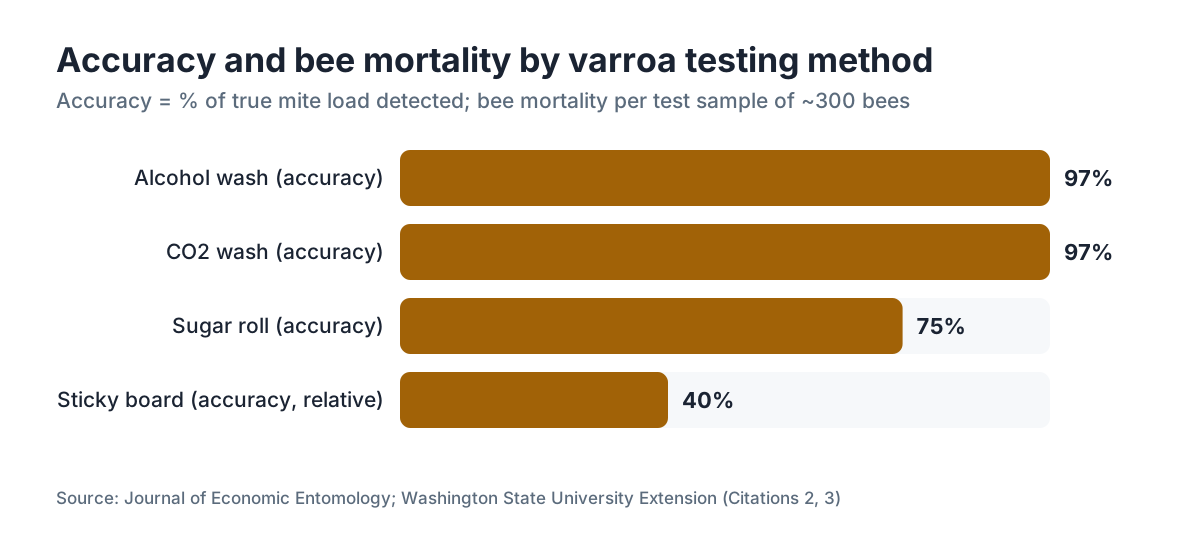
| Alcohol wash | ~97% [2] | ~300 bees per test | $10-$25 DIY, $20-$35 kit | Beginner |
| Sugar roll | ~70-80% [2] | None | $5-$15 DIY, $15-$25 kit | Beginner |
| CO2 wash | ~97% | None | $50-$150+ | Intermediate |
| Sticky board (passive) | Variable, not a count | None | $2-$10 | Beginner |
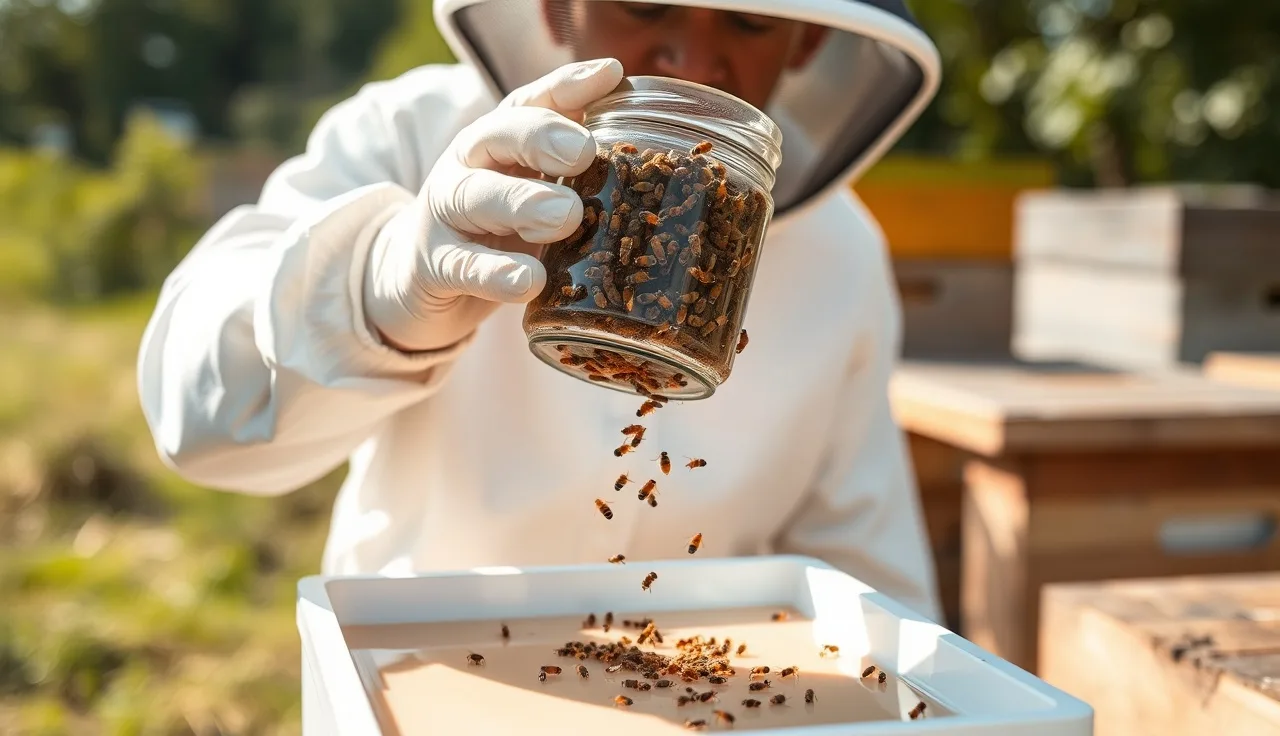
Alcohol wash is what most extension programs and the Honey Bee Health Coalition recommend as the primary method [1]. You collect roughly 300 bees (about half a cup) in a jar, add isopropyl alcohol, shake, and count the mites that fall off. The bees die, but 300 bees out of a healthy colony of 40,000-60,000 is a trivial sacrifice for an accurate number.
Sugar roll uses powdered sugar instead of alcohol. The theory is that mites slide off sugar-coated bees. It's gentler, but studies consistently show it undercounts mites, sometimes badly [2]. If you use it, know you're probably seeing 70-80% of the true load at best. I wouldn't make a no-treat decision based on a sugar roll alone.
CO2 kits immobilize bees with carbon dioxide so mites drop off without killing the bees. Accuracy is similar to alcohol wash. The hardware costs more and the CO2 cartridges are a recurring expense, but some beekeepers who can't stomach killing 300 bees prefer it.
Sticky boards slide under a screened bottom board and catch mites that fall naturally. They give you a "natural mite fall" count over 24-72 hours. The problem is this number doesn't translate cleanly to mites-per-100-bees without a conversion formula, and those formulas carry real uncertainty depending on colony size, season, and brood percentage. Use sticky boards as a flag, not a treatment decision.
How accurate is each varroa mite testing method?
Accuracy matters enormously here because the treatment threshold is just 2 mites per 100 bees during most of the brood season. At that margin, an undercount can kill your colony.
The most direct comparison comes from a study published in the Journal of Economic Entomology that tested alcohol wash against sugar roll and found alcohol wash detected significantly more mites under real apiary conditions [2]. The sugar roll's lower accuracy comes from the physics: mites grip bee bodies with modified front legs, and powdered sugar doesn't reliably dislodge all of them. Mites hidden under abdominal plates are especially likely to stay attached.
Alcohol wash wins on accuracy, full stop. The bees are dead so the mites release completely, and you can inspect the entire sample under bright light with no time pressure.
CO2 kits reach similar accuracy to alcohol wash by chemically relaxing the bees' limb-gripping muscles. A 2022 evaluation by Washington State University Extension found CO2 wash results were statistically comparable to alcohol wash [3]. The tradeoff is cost: a decent CO2 kit runs $50-$150, and you'll pay for cartridges each season.
For hobbyists watching every dollar, a homemade alcohol wash kit using two mason jars and a piece of hardware cloth costs maybe $5 once you have isopropyl alcohol on hand. That's not a knock on commercial kits, some of which add genuinely helpful features like graduated measurement containers. But the science doesn't require fancy gear.
What is the varroa mite treatment threshold, and how do you calculate your rate?
The treatment threshold is the mite load at which the research says your colony needs treatment to survive. The widely accepted threshold used by the Honey Bee Health Coalition and most state extension programs is 2 mites per 100 bees during the brood season (roughly spring through early fall) [1]. Some programs use 2% as shorthand for the same thing.
In late fall, when a colony is preparing or has entered its winter cluster, that threshold drops to 1 mite per 100 bees (1%) in many northern-state protocols, because winter bees live 6 months and mite-vectored viruses are more damaging to them [4].
Calculating your rate is simple arithmetic. You collect approximately 300 bees, wash them, and count the mites in the wash solution. Then:
Mite rate (%) = (mites counted / bees counted) x 100
So if you count 7 mites from a sample of 300 bees: 7/300 x 100 = 2.3%. That's above the 2% threshold. Treat.
One thing people get wrong: they sample from the wrong place. You must sample from a frame of open brood where nurse bees are clustered. Nurse bees carry the highest mite loads because they spend time in cells tending brood, which is where mites reproduce. Sampling bees from the entrance or from honey frames understates your true load badly [1].
Sample size matters too. Fewer than 200 bees gives you unreliable statistics. The standard 300 bees (roughly half a cup by volume, measured with a standard liquid measuring cup) gives you a sample large enough to mean something.
How do you do an alcohol wash step by step?
You need: a wide-mouth jar with a mesh lid (or two nested jars with hardware cloth between them), 70% isopropyl alcohol, a measuring cup or marked container, and a white plate or light-colored container to count mites.
Step 1. Find a frame with open brood and nurse bees clustered on it. This frame carries the highest mite concentration.
Step 2. Shake or brush bees from this frame directly into a plastic tub or directly into your collection jar. You want roughly 300 bees. Half a cup by volume is the standard approximation (about 1/2 cup of bees = roughly 300 bees) [1].
Step 3. Check the jar quickly. If you see a large, obvious queen, return her to the hive. You don't need to see every single bee; a quick look at the top of the sample is enough in most cases.
Step 4. Add enough 70% isopropyl alcohol to cover the bees, seal the mesh lid, and shake hard for 30-60 seconds.
Step 5. Pour the wash through the mesh into a white container. The bees stay on top of the mesh; the alcohol and mites flow through.
Step 6. Count the brown or reddish-brown oval specks in the white pan. Those are mites. Swirl the liquid or use a white plate under bright light to see them clearly.
Step 7. Count the bees in the jar to get your exact denominator. Divide mites by bees, multiply by 100 for your percentage.
The whole process takes about 10 minutes once you're practiced. Wash your hands before going back into the hive; alcohol on your hands makes bees aggressive.
What should a good varroa mite testing kit include?
Commercial varroa mite testing kits vary a lot. Some are excellent; some are basically a jar with a label. Here's what actually matters.
A collection vessel with measurement markings is the most useful feature. Half a cup of bees is your target, and a jar with a fill line removes guesswork. Without it, you're eyeballing 300 bees, which introduces real error.
A mesh or screen insert with openings fine enough to hold bees but pass mites is essential. Mites are about 1.1 mm long, so the mesh needs to be smaller than that. Most kits use around 8-mesh hardware cloth, which works fine [5].
A wash container that's white or light-colored (or has a white base) makes counting much easier. Varroa mites are dark reddish-brown, roughly 1 mm oval shapes. On a dark surface they vanish.
Instructions that reference the 2% threshold and explain nurse bee sampling are a sign of a quality kit. If the kit's instructions don't mention sampling from brood frames, that's a red flag.
The Bee Squad varroa mite testing kit, developed through the University of Minnesota Bee Squad program, is one well-regarded option that packages these components together with clear protocol cards. It's built for beekeepers learning the alcohol wash method for the first time and includes threshold guidance referenced to HBHC protocols [6].
For sourcing equipment, beekeeping supply companies often carry multiple kit options and can be a good way to compare what's currently in stock.
Expect to pay $15-$35 for a complete commercial kit. A DIY setup using hardware store materials costs closer to $5-$10 if you already have isopropyl alcohol. Honestly, the DIY version works just as well scientifically. The commercial kit earns its price if you're a new beekeeper who wants a protocol card and doesn't want to source mesh and jars separately.
How often should you test for varroa mites throughout the year?
The Honey Bee Health Coalition recommends testing every 30 days during the active brood season, which in most of the continental US runs from approximately March through October [1]. That sounds like a lot, but each test takes 10 minutes, and you only need to pull one or two samples per apiary.
For hobbyists with 1-5 hives, a practical schedule looks like this:
Early spring (March-April): Test as soon as you have brood. This tells you whether the colony survived winter with a manageable load or whether you need an emergency treatment before the spring buildup pushes mite reproduction into high gear.
Pre-honey flow (May-June): Test again before you add supers. You don't want to treat with most acaricides while supers are on, so knowing your load now lets you treat or clear, not scramble.
Midsummer (July): This is the most dangerous period. Queens are at peak laying, brood is abundant, and mites are reproducing at their fastest rate. Mite loads can double every three to four weeks in July and August. Missing this test is one of the most common causes of fall colony collapse [4].
Pre-winter (August-September): The most important test of the year for northern beekeepers. The bees raised in August and September are the winter bees that must survive until the following spring. High mite loads on these bees mean high virus loads, which means dead colonies in February [4]. Treat in August if you're above 1-2% so treatments have time to work before populations drop.
Winter check (optional): In regions where colonies are broodless in December-January, an oxalic acid treatment applied during a broodless period is highly effective, but only if you've already confirmed elevated loads. A sticky board check can flag whether mites are still present.
What do you do after you get your varroa mite count?
You have a number. Now what?
Below 1%: You're in good shape. Keep monitoring every 30 days. No treatment needed now, but stay alert, especially approaching midsummer.
1-2% during brood season: This is the gray zone. Some protocols say treat at 2%; others say treat at 1% if you're in July or August because the mite load will double again before your next check. I'd lean toward treating if you're in midsummer and trending up. A second test two weeks later is reasonable if you want more data.
Above 2% during brood season: Treat. The Honey Bee Health Coalition's treatment decision guide is clear on this [1]. The question becomes which treatment, which depends on temperature, whether supers are on, and local resistance patterns. That's a separate decision tree.
Above 1% in late August or September: Treat before winter. This is where most hobbyist colonies die. The beekeeper sees 1.5% and thinks "barely over threshold, I'll watch it." The colony dies in February with high Deformed Wing Virus titers.
For tracking counts over time and knowing when your next treatment window opens, VarroaVault's free protocol tools give you a seasonal schedule tied to your local climate. Worth bookmarking if you want a systematic approach rather than guessing at timing.
Once you decide to treat, always re-test 3-4 weeks after treatment to confirm efficacy. A treatment that fails (due to resistance, poor application, or temperature) can look like success because the beekeeper never recounts.
What treatments are available once you confirm a high mite load?
This article focuses on testing, but you can't talk about thresholds without saying what comes next. There are four main categories of EPA-registered varroa treatments available in the US [7].
Organic acids: Oxalic acid (Api-Bioxal is the EPA-registered formulation) and formic acid (Mite-Away Quick Strips, FormicPro). Oxalic acid is most effective in broodless conditions; it kills mites on adult bees but doesn't penetrate capped cells. Formic acid volatilizes and penetrates capped cells, making it effective during the brood season. Temperature ranges matter significantly for both.
Essential oils: Thymol-based products like Apiguard and ApiLifeVar. Effective at temperatures between 60-105°F. Not approved for use when honey supers are present.
Synthetic miticides: Amitraz (Apivar strips) and tau-fluvalinate (Apistan). These work inside capped cells as well as on adults. Resistance to tau-fluvalinate is widespread in US mite populations, making Apistan unreliable in many regions [8]. Apivar remains more effective but resistance is emerging in some areas. Rotate chemicals to slow resistance development.
All of these require following EPA label directions exactly. The label is the law. You can find registered product information through the EPA's pesticide database [7].
For deeper reading on the varroa mite itself, including its lifecycle and how it reproduces in brood, that's a natural next stop after understanding the testing side of management.
Are there any alternatives to killing bees during varroa testing?
Yes, and the options are improving. If sacrificing 300 bees per test genuinely troubles you, or if you're working with a very small or struggling colony where 300 bees feels significant, you have real alternatives.
CO2 wash kits, as mentioned above, immobilize bees temporarily. The mites fall off into a counting tray and the bees recover within a minute or two and can be returned to the hive. Accuracy is comparable to alcohol wash [3]. The downside is cost and the need to stock CO2 cartridges.
Powered options are emerging. The Varroa Count app (developed by the National Bee Unit in the UK) uses smartphone camera AI to count mites in wash samples, though it still requires the wash itself. This reduces counting error rather than bee mortality, but it's a useful tool for beginners who find mite counting tedious.
DNA-based detection: Research groups have been working on eDNA and PCR methods to detect varroa from wax or hive debris without disturbing the colony at all. These are not yet commercially available at a practical price point for hobbyists as of 2025, but the direction is promising.
For most beekeepers, the honest answer is that 300 bees from a 40,000-bee colony is roughly 0.75% of the population. The colony won't notice. But if you're committed to no-kill testing, CO2 wash is the practical, accurate choice right now.
Where can you buy a varroa mite testing kit and what should you expect to pay?
Commercial kits are sold by most major beekeeping supply companies, as well as directly from some state beekeeping associations and university extension programs.
Price ranges in 2024-2025:
DIY setup (two mason jars, hardware cloth, isopropyl alcohol): $5-$15 depending on what you have at home.
Basic commercial alcohol wash kit: $15-$25. These typically include a sample jar, mesh lid, and instruction card.
Premium kits with CO2 components or extra containers: $50-$150+.
Bee Squad varroa mite testing kit (University of Minnesota program): Available through their extension-linked supplier network, typically $20-$35, includes protocol cards aligned to HBHC guidance [6].
Isopropyl alcohol at 70% concentration is available at any pharmacy or big-box store for $2-$5 per bottle. That's your primary consumable.
For sourcing, beekeeping supplies retailers often carry multiple brands side by side, and some offer free shipping honey bee supply companies deals that make ordering kits online cost-competitive with local stores.
One thing to watch: some kits marketed as "mite testing kits" are just sticky boards in a bag. A sticky board is not a substitute for an alcohol wash or sugar roll. If the kit doesn't include a sample jar and mesh, it's a monitoring tool, not a counting method.
What does the research say about how many colonies are above the treatment threshold?
The numbers are sobering. A 2022-2023 survey conducted by the Bee Informed Partnership found that across participating US operations, winter colony losses averaged around 48% for hobbyist beekeepers, with varroa identified as the single largest contributing factor [9]. That figure has stayed stubbornly high for over a decade.
Nobody has perfectly clean data on what percentage of untested colonies sit above the 2% threshold at any given time, because untested colonies are, by definition, not in the data. The closest proxy comes from survey work where researchers visited random apiaries and tested: a 2016 study in North Carolina found that roughly 50% of surveyed colonies exceeded the 2% threshold during the summer months, most of them belonging to beekeepers who reported not testing regularly [10].
That number tracks with what experienced apiary inspectors report anecdotally: a lot of colonies, especially hobbyist hives, are carrying mite loads well above treatment thresholds without the beekeeper knowing.
The takeaway is not that beekeepers are careless. Most hobbyists simply weren't taught to monitor. Older beekeeping education emphasized swarm management and honey production; varroa protocols have only become standard curriculum relatively recently. If you started keeping bees before 2010, there's a reasonable chance you were never formally taught the alcohol wash.
Frequently asked questions
How do I test bees for varroa mites at home without a kit?
You can build a functional alcohol wash setup with two mason jars, a square of 8-mesh hardware cloth, and 70% isopropyl alcohol from a pharmacy. Collect about 300 nurse bees from a brood frame into the jar, add alcohol to cover, seal with the mesh, shake 30-60 seconds, pour through the mesh into a white pan, and count the mites. Total material cost is under $10 if you source the hardware cloth from a home improvement store.
What is the varroa mite treatment threshold I should use?
During the brood season (spring through late summer), the standard threshold is 2 mites per 100 bees (2%). In late summer heading into winter, most extension programs lower that to 1% because the long-lived winter bees are especially vulnerable to mite-vectored viruses. The Honey Bee Health Coalition's Varroa Management Guide is the primary reference document most US beekeepers use for these thresholds.
Is the Bee Squad varroa mite testing kit worth buying?
It's a solid kit for beginners. The University of Minnesota Bee Squad program developed it with clear protocol cards aligned to Honey Bee Health Coalition guidance. For an experienced beekeeper comfortable with the alcohol wash method, a DIY setup works equally well. The kit's main value is the built-in guidance and consistent container sizing, which reduces sampling error for people learning the method for the first time.
How accurate is a sugar roll compared to an alcohol wash?
Studies put sugar roll accuracy at roughly 70-80% of the true mite load compared to about 97% for alcohol wash. The gap exists because mites grip bees mechanically and powdered sugar doesn't reliably dislodge all of them, especially mites sheltering under abdominal plates. If a sugar roll shows 1.5%, your real load may be closer to 2-2.5%. Avoid making a no-treat decision based on a sugar roll result near the threshold.
Can I use a sticky board to count varroa mites accurately?
A sticky board gives you a natural mite fall count, not a mites-per-100-bees percentage. Converting that fall rate to an infestation level requires conversion formulas that vary by season, colony size, and brood percentage, introducing substantial uncertainty. Use sticky boards as a flag that mites are present and rising, then confirm with an alcohol wash before making treatment decisions.
How many bees do I need for a varroa mite alcohol wash sample?
The standard is approximately 300 bees, which equates to roughly half a cup by volume. Fewer than 200 bees gives you a statistically unreliable result; the margin of error gets wide enough that you could misclassify a colony. Most commercial kit jars and DIY setups include a half-cup fill line or mark to hit this target without counting bees individually.
Does varroa testing vary by season or time of year?
Yes, significantly. The most critical test window is late summer (August-September) before your winter bees are raised, because high mite loads at that point translate directly into virus-damaged winter bees and spring deadout. Midsummer (July) is also high-risk because mite populations can double every three to four weeks when brood is abundant. Test monthly during the active season; the threshold drops to 1% approaching winter.
Will doing an alcohol wash hurt my colony?
Losing 300 bees from a healthy colony of 40,000-60,000 bees is roughly 0.5-0.75% of the population. The colony replaces that number in less than a day of normal laying. The risk from not testing, and missing a mite load above the treatment threshold, is orders of magnitude larger than the loss of 300 nurse bees in a single test.
How do I sample nurse bees and not the queen?
Find a frame with open brood and a cluster of nurse bees attending larvae. Shake or brush those bees into your collection container quickly. Then glance at the top of the sample before adding alcohol. Queens are noticeably larger and will often be visible on the surface. If you spot her, tip her back into the hive. You don't need a frame-by-frame queen search; a quick visual before sealing the jar is sufficient.
What's the difference between varroa mite testing and varroa mite monitoring?
Testing means actively collecting a bee sample and getting a mites-per-100-bees percentage, which is what you use for treatment decisions. Monitoring is broader and includes passive tools like sticky boards, visual inspection for deformed wings, and brood pattern assessment. Monitoring can flag that a problem exists; testing quantifies it. You need testing to act on a threshold; monitoring alone is not sufficient for treatment decisions.
How long does it take to do a varroa mite test?
An alcohol wash from opening the hive to counting mites takes about 10-15 minutes once you're practiced. The first few times take longer because finding a good nurse bee frame and collecting the sample feels uncertain. After a season of regular testing, most beekeepers get the full process including notes done in under 10 minutes per hive.
Are there varroa mite tests that don't kill bees?
Yes. CO2 wash kits immobilize bees temporarily with carbon dioxide; mites fall off and the bees recover and can be returned to the hive. Accuracy is comparable to alcohol wash. Expect to pay $50-$150 for a CO2 kit plus ongoing cartridge costs. Sugar roll is another no-kill option but significantly underestimates mite loads. For most hobbyists, the CO2 wash is the best no-kill alternative.
What should I do if my varroa test shows a 3% or higher mite load?
Treat immediately. A 3% load is above the standard treatment threshold of 2% and will keep rising if untreated. Select a treatment appropriate for your current conditions: temperature range, presence or absence of honey supers, and your region's known resistance patterns. After treatment, re-test 3-4 weeks later to confirm the treatment worked. A failed treatment at 3% with no follow-up recount is how colonies die.
Sources
- Honey Bee Health Coalition, Varroa Management Guide: Alcohol wash is the recommended primary testing method; treatment threshold is 2 mites per 100 bees during brood season; nurse bee sampling from brood frames is required for accurate results
- Journal of Economic Entomology, comparison of varroa sampling methods: Alcohol wash achieves approximately 97% accuracy; sugar roll captures approximately 70-80% of the true mite load
- Washington State University Extension, Varroa Mite Monitoring Methods: CO2 wash results were statistically comparable to alcohol wash in accuracy
- University of Minnesota Extension, Varroa Mite Management: Mite loads can double every three to four weeks in summer; pre-winter threshold drops to 1 mite per 100 bees in many northern-state protocols; August-September treatment window is critical for winter bee health
- Penn State Extension, Varroa Mite Sampling Procedures: Mesh size for alcohol wash jars should be smaller than 1.1 mm to retain bees while passing mites; approximately 8-mesh hardware cloth is standard
- University of Minnesota Bee Squad, Varroa Testing Resources: Bee Squad varroa mite testing kit developed with protocol cards aligned to HBHC guidance for beginner beekeepers
- EPA, Pesticide Registration for Varroa Miticides: EPA-registered varroa treatments include oxalic acid (Api-Bioxal), formic acid (Mite-Away Quick Strips, FormicPro), amitraz (Apivar), tau-fluvalinate (Apistan), thymol (Apiguard, ApiLifeVar); label directions are legally required
- USDA ARS, Varroa Mite Resistance to Tau-Fluvalinate: Resistance to tau-fluvalinate (Apistan) is widespread in US Varroa destructor populations, reducing its effectiveness in many regions
- Bee Informed Partnership, 2022-2023 Colony Loss Survey: Winter colony losses for hobbyist beekeepers averaged approximately 48% in 2022-2023; varroa identified as the single largest contributing factor
- Apidologie, Varroa infestation rates in hobbyist apiaries, North Carolina survey 2016: Approximately 50% of surveyed colonies in North Carolina exceeded the 2% threshold during summer months, predominantly in apiaries where owners reported not testing regularly
Last updated 2026-07-09